


Quokka
| Quokka | |
|---|---|
.jpg)
| |
Scientific classification 
| |
| Domain: | Eukaryota |
| Kingdom: | Animalia |
| Phylum: | Chordata |
| Class: | Mammalia |
| Infraclass: | Marsupialia |
| Order: | Diprotodontia |
| Family: | Macropodidae |
| Subfamily: | Macropodinae |
| Genus: | Setonix Lesson, 1842[3] |
| Species: | S. brachyurus
|
| Binomial name | |
| Setonix brachyurus | |

| |
| Geographic range | |
The quokka (/ˈkwɒkə/) (Setonix brachyurus)[4] is a small macropod about the size of a domestic cat. It is the only member of the genus Setonix. Like other marsupials in the macropod family (such as kangaroos and wallabies), the quokka is herbivorous and mainly nocturnal.[5]
The quokka's range is a small area of southwestern Australia. They inhabit some smaller islands off the coast of Western Australia, particularly Rottnest Island just off Perth and Bald Island near Albany. Isolated, scattered populations also exist in forest and coastal heath between Perth and Albany. A small colony inhabits a protected area of Two Peoples Bay Nature Reserve, where they co-exist with the critically endangered Gilbert's potoroo.[6]
Description
[edit]A quokka weighs 2.5 to 5.0 kg (5.5 to 11 lb) and is 40 to 54 cm (16 to 21 in) long with a 25-to-30 cm-long (9.8-to-12 in) tail, which is quite short for a macropod. It has a stocky build, well developed hind legs, rounded ears, and a short, broad head. Its musculoskeletal system was originally adapted for terrestrial bipedal saltation, but over its evolution, its system has been built for arboreal locomotion.[7] Although looking rather like a very small kangaroo, it can climb small trees and shrubs up to 1.5 metres (4 ft 11 in).[8] Its coarse fur is a grizzled brown colour, fading to buff underneath. The quokka is known to live for an average of 10 years.[9] Quokkas are nocturnal animals; they sleep during the day in Acanthocarpus preissii, using the plants' spikes for protection and hiding.[10]
Quokkas have a promiscuous mating system.[11] After a month of gestation, females give birth to a single baby called a joey. Females can give birth twice a year and produce about 17 joeys during their lifespan.[9] The joey lives in its mother's pouch for six months. Once it leaves the pouch, the joey relies on its mother for milk for two more months and is fully weaned around eight months after birth.[9] Females sexually mature after roughly 18 months.[12] When a female quokka with a joey in her pouch is pursued by a predator, she may drop her baby onto the ground; the joey produces noises which may serve to attract the predator's attention, while the mother escapes.[13]
Discovery and name
[edit]
The word "quokka" is originally derived from a Noongar word, which was probably gwaga.[14] Today, the Noongar people refer to them as ban-gup, bungeup and quak –a.[15][16]
In 1658, Dutch mariner Samuel Volckertszoon wrote of sighting "a wild cat" on the island.[17] In 1696, Dutch explorer Willem de Vlamingh mistook them for giant rats, and renamed the Wadjemup island 't Eylandt 't Rottenest, which means "the rat nest island" in Dutch.[18][19] Vlamingh had originally described them "as a kind of rat as big as a common cat".[20]
Ecology
[edit]During the Pleistocene period, quokkas were more abundant and living on open landscapes. When the Europeans arrived in Australia, they introduced new species, some of which became predators to the quokkas. This caused the habitats of quokkas to eventually shift to islands and forests, where there were minimal predators and more vegetation.[21] In the wild, the quokka's roaming is restricted to a very small range in the South West of Western Australia, with a number of small scattered populations. One large population exists on Rottnest Island and a smaller population is on Bald Island near Albany. The islands are free of certain predators such as red foxes and feral cats. On Rottnest, quokkas are common and occupy a variety of habitats, ranging from semiarid scrub to cultivated gardens.[22] Prickly Acanthocarpus plants, which are unaccommodating for humans and other relatively large animals to walk through, provide their favourite daytime shelter for sleeping.[23] Additionally, they are known for their ability to climb trees.[9]
Diet
[edit]Like most macropods, quokkas eat many types of vegetation, including grasses, sedges and leaves. A study found that Guichenotia ledifolia, a small shrub species of the family Malvaceae, is one of the quokka's favoured foods.[23] Rottnest Island visitors are urged to never feed quokkas, in part because eating "human food" such as chips can cause dehydration and malnourishment, both of which are detrimental to the quokka's health.[24] Despite the relative lack of fresh water on Rottnest Island, quokkas do have high water requirements, which they satisfy mostly through eating vegetation. On the mainland, quokkas only live in areas that have 600 mm (24 in) or more of rain per year.[25] The quokkas chew their cud, similar to cows.[10]
Population
[edit]At the time of colonial settlement, the quokka was widespread and abundant, with its distribution encompassing an area of about 41,200 km2 (15,900 sq mi) of the South West of Western Australia, including the two offshore islands, Bald and Rottnest. By 1992, following extensive population declines in the 20th century, the quokka's distribution on the mainland had been reduced by more than 50% to an area of about 17,800 km2 (6,900 sq mi).[26]
Despite being numerous on the small, offshore islands, the quokka is classified as vulnerable. On the mainland, where it is threatened by introduced predatory species such as red foxes, cats, and dogs, it requires dense ground cover for refuge. Clearfell logging, agricultural development, and housing expansion have reduced their habitat, contributing to the decline of the species, as has the clearing and burning of the remaining swamplands. Moreover, quokkas usually have a litter size of one and successfully rear one young each year. Although they are constantly mating, usually one day after the young are born, the small litter size, along with the restricted space and threatening predators, contributes to the scarcity of the species on the mainland.[27]
An estimated 4,000 quokkas live on the mainland, with nearly all mainland populations being groups of fewer than 50, although one declining group of over 700 occurs in the southern forest between Nannup and Denmark.[26][28] In 2015, an extensive bushfire near Northcliffe nearly eradicated one of the local mainland populations, with an estimated 90% of the 500 quokkas dying.[29]
In 2007, the quokka population on Rottnest Island was estimated at between 8,000 and 12,000. Snakes are the quokka's only predator on the island. The population on smaller Bald Island, where the quokka has no predators, is 600–1,000. At the end of summer and into autumn, a seasonal decline of quokkas occurs on Rottnest Island, where loss of vegetation and reduction of available surface water can lead to starvation.
This species saw the most significant decline from 1930 to the 1990s, when their distribution was reduced by over half.[30] The quokka markedly declined in its abundance and distribution in the early 1930s, and this tendency has continued till today. Their presence on the mainland has declined to such an extent that they are only found in small groups in bushland surrounding Perth.
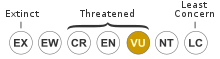
The quokka is now listed as vulnerable in accordance with the IUCN criteria.[26][31]
Conservation
[edit]The quokka, while not in complete danger of going extinct, are considered threatened. As the climate continues to change so does the Australian landscape; being herbivores, the quokka rely on many native plants for their diet as well as protection. The quokka were found to prefer malvaceae species as a main source of food, using shrubs as shelter during the hottest points of the day.[32] Due to factors such as wildfires and anthropogenic influence, the location of the natural flora has been changing making it harder for them to access. With no main predators, the quokkas primary threat appears to be climate change. A study found that the mainland populations prefer to live in areas with an average rainfall that exceeded 700 mm but fell below 1000 mm, which becomes increasingly complicated as aridity continues to increase in South west Australia.[33] Increasing temperatures have also been found to play an important role in the distribution of the quokka as the mean annual temperatures have increased exponentially since the 1970s in South West of Western Australia.[33] With climate change limiting the optimal living conditions of the quokka and changing the abundance of their diet, the quokka are listed as vulnerable on the IUCN Red List of threatened species.[34]
Human interaction
[edit]

Quokkas have little fear of humans and commonly approach people closely, particularly on Rottnest Island, where they are abundant. Though quokkas are approachable, there are a few dozen cases annually of quokkas biting people, especially children.[35] There are restrictions regarding feeding. It is illegal for members of the public to handle the animals in any way, and feeding, particularly of "human food", is especially discouraged, as they can easily get sick. An infringement notice carrying a $300 fine can be issued by the Rottnest Island Authority for such an offence.[36] The maximum penalty for animal cruelty is a $50,000 fine and a five-year prison sentence.[37][38][39] In addition to restrictions on human interactions with quokkas, they have been tested to be potentially harmful to humans with their high salmonella infection rates, especially in the summer heat. This has been proven and experimented by scientists who have taken blood tests on wild quokkas on Rottnest Island.[40][41][42]
Quokkas can also be observed at several zoos and wildlife parks around Australia, including Perth Zoo,[43] Taronga Zoo,[44] Wild Life Sydney,[45] Adelaide Zoo,[46][47] and Caversham Wildlife Park.[48] Physical interaction is generally not permitted without explicit permission from supervising staff.
Quokka behaviour in response to human interaction has been examined in zoo environments. One brief study indicated fewer animals remained visible from the visitor paths when the enclosure was an open or walk-through environment. This may have been due to the quokkas acquiring avoidance behaviour of visitors, which the authors propose has implications for stress management in their exhibition to the public.[49]
Quokka selfies
[edit]In the mid-2010s, quokkas earned a reputation on the internet as "the world's happiest animals" and symbols of positivity, as frontal photos of their faces make them appear to be smiling (they do not, in fact "smile" in the human sense; this can be attributed to their natural facial structures).[50] Many photos of smiling quokkas have since gone viral,[51] and the "quokka selfie" has become a popular social media trend, with celebrities such as Chris Hemsworth, Shawn Mendes, Margot Robbie, Roger Federer and Kim Donghyuk of iKON taking part in the activity.[52] Tourist numbers to Rottnest Island have subsequently increased.[51]
See also
[edit]References
[edit]- ^ Burbidge, A.A. & Woinarski, J. (2020) [amended version of 2019 assessment]. "Setonix brachyurus". IUCN Red List of Threatened Species. 2020: e.T20165A166611530. doi:10.2305/IUCN.UK.2020-1.RLTS.T20165A166611530.en. Retrieved 7 April 2021.
- ^ Quoy, [Jean René Constant]; Gaimard, [Joseph Paul] (1830). "Kangurus brachyurus". Voyage de découvertes de l'Astrolabe: Zoologie. Vol. 1. Paris: J. Tastu. pp. 114–116.
- ^ Lesson, R.-P. (1842). "Groupe: Setonix". Nouveau Tableau du Règne Animal: Mammifères. Paris: Arthus Bertrand. p. 194.
- ^ Groves, C. P. (2005). Wilson, D. E.; Reeder, D. M. (eds.). Mammal Species of the World: A Taxonomic and Geographic Reference (3rd ed.). Baltimore: Johns Hopkins University Press. p. 69. ISBN 0-801-88221-4. OCLC 62265494.
- ^ "the happiest animals on earth Quokkas". Rottnest Island Wildlife. Retrieved 7 February 2021.
- ^ Sinclair, Elizabeth. "Australian endangered species: Gilbert's Potoroo". The Conversation. Retrieved 20 October 2017.
- ^ Warburton, Natalie M.; Yakovleff, Maud; Malric, Auréline (2012). "Anatomical adaptations of the hind limb musculature of tree-kangaroos for arboreal locomotion (Marsupialia : Macropodinae)". Australian Journal of Zoology. 60 (4): 246–158. doi:10.1071/ZO12059. S2CID 86843529.
- ^ "Quokka videos, photos and facts - Setonix brachyurus". Arkive.org. Archived from the original on 20 March 2018. Retrieved 19 March 2018.
- ^ a b c d Burrell, Sue (30 October 2015). "Animal Species: Quokka". australian.museum. Retrieved 18 March 2018.
- ^ a b Giaimo, Cara (23 October 2020). "5 Strange Facts About Quokkas". The New York Times. ISSN 0362-4331. Retrieved 28 October 2020.
- ^ McLean, Ian G.; Schmitt, Natalie T. (1999). "Copulation and associated behavior in the quokka, Setonix brachyurus". Australian Mammalogy. 21: 139–142. doi:10.1071/AM99139.
- ^ "Quokka Facts | Quokkas | Australian Marsupials". animalfactguide.com. Retrieved 25 August 2016.
- ^ Hayward, Matt W.; de Tores, Paul J.; Augee, Michael L.; et al. (2005). "Mortality and survivorship of the quokka (Setonix brachyurus)(Macropodidae: Marsupialia) in the northern jarrah forest of Western Australia" (PDF). Wildlife Research. 32 (8): 715–722. doi:10.1071/WR04111. Archived (PDF) from the original on 7 March 2019.
- ^ Dixon, R. M. W.; Moore, Bruce; Ramson, W. S.; Thomas, Mandy (2006). Australian Aboriginal Words in English: Their Origin and Meaning (2nd ed.). Oxford: Oxford University Press. ISBN 0-19-554073-5.
- ^ "Quokka - WWF-Australia". www.wwf.org.au. Retrieved 2 November 2022.
- ^ "Meet the Quokka | The Nature Conservancy Australia". The Nature Conservancy Australia. Retrieved 2 November 2022.
- ^ Flannery, Tim (2008). Chasing Kangaroos: A Continent, a Scientist, and a Search for the World's Most Extraordinary Creature. Open Road + Grove/Atlantic. p. 30. ISBN 9781555848217.
- ^ Van Keulen, Joannes (1753). "Het Westelykste Gedeelte van 't Land vande Eendragt of Nova Hollandia Strekkende van het Eyland Rottenest lot voorby de Willems Rivier". National Library of Australia. Amsterdam. Retrieved 17 March 2021.
- ^ "Quokka". Australian Museum. Retrieved 25 August 2016.
- ^ Burrell, Sue. "Quokka". The Australian Museum. The Australian Museum. Retrieved 16 September 2024.
- ^ Scholtz, E. J.; DeSantis, L. R. G. (21 February 2020). "Invasive species, not environmental changes, restrict the population and geographical range of the quokka (Setonix brachyurus)". Journal of Zoology. 311 (2): 106–115. doi:10.1111/jzo.12765. ISSN 0952-8369. S2CID 212807911.
- ^ "A close encounter of the furry kind". Australian Geographic. 2010. Archived from the original on 21 September 2013. Retrieved 22 April 2010.
- ^ a b Poole, H. L.; Mukaromah, L.; Kobryn, H. T.; Fleming, P. A. (2015). "Spatial analysis of limiting resources on an island: diet and shelter use reveal sites of conservation importance for the Rottnest Island quokka". Wildlife Research. 41 (6): 510–521. doi:10.1071/WR14083. S2CID 84805749.
- ^ "Quokkas and Wildlife". Rottnest Island. Archived from the original on 14 August 2016. Retrieved 25 August 2016.
- ^ Jones, Ann (17 October 2016). "Quokka smiles mask pain on Rottnest Island". Off Track. Radio National. Australian Broadcasting Corporation. Retrieved 14 December 2016.
- ^ a b c de Tores, Paul; Williams, Richard; Podesta, Mia; Pryde, Jill (January 2013). "Quokka (Setonix brachyurus) Recovery Plan" (PDF). Bentley, WA: Department of Environment and Conservation, Government of Western Australia. Retrieved 3 May 2017.
- ^ Nocon, Wojtek. "Sentonix Brachyurus". Quokka. University of Michigan. Retrieved 30 September 2013.
- ^ Bain, Karlene (June 2015). "The ecology of the quokka (Setonix brachyurus)in the southern forests of Western Australia" (PDF). University of Western Australia. Crawley, WA: School of Animal Biology. Retrieved 3 May 2017.
- ^ Mainland quokka population decimated after 2015 bushfire near Northcliffe - ABC News (Australian Broadcasting Corporation). Abc.net.au. Retrieved on 24 December 2016.
- ^ de Tores, Paul; Matt W., Hayward; Dillon, Michael J.; Brazell, Robert I. (2007). "Review of the distribution, causes for the decline and recommendations for management of the quokka, Setonix brachyurus (Macropodidae: Marsupialia), an endemic macropodid marsupial from south-west Western Australia". Conservation Science Western Australia. 6 (1): 13–73. ISSN 1447-3682 – via ResearchGate.
- ^ "Setonix brachyurus — Quokka Glossary". Species Profile and Threats Database. Canberra: Department of the Environment. Retrieved 12 February 2017.
- ^ Poole, Holly L.; Mukaromah, Laily; Kobryn, Halina T.; Fleming, Patricia A. (4 March 2015). "Spatial analysis of limiting resources on an island: diet and shelter use reveal sites of conservation importance for the Rottnest Island quokka". Wildlife Research. 41 (6): 510–521. doi:10.1071/WR14083. ISSN 1448-5494. S2CID 84805749.
- ^ a b Gibson, Lesley; McNeill, Asha; Tores, Paul de; Wayne, Adrian; Yates, Colin (1 November 2010). "Will future climate change threaten a range restricted endemic species, the quokka (Setonix brachyurus), in south west Australia?". Biological Conservation. 143 (11): 2453–2461. Bibcode:2010BCons.143.2453G. doi:10.1016/j.biocon.2010.06.011. ISSN 0006-3207.
- ^ "Quokka | San Diego Zoo Animals & Plants". animals.sandiegozoo.org. Retrieved 23 March 2023.
- ^ "Quokka". rove.me. Retrieved 6 March 2019.
- ^ Rottnest Island Regulations 1988 (WA), rr 40 & 73; sched. 4
- ^ "Quokka cruelty: French tourists fined after pleading guilty to burning animal on Rottnest Island - ABC News (Australian Broadcasting Corporation)". Abc.net.au. 17 April 2015. Retrieved 25 August 2016.
- ^ Rottnest Island Regulations 2007 (WA), r 40
- ^ Squires, Nick (12 January 2003). "Rare marsupials kicked to death in 'quokka soccer'". The Daily Telegraph (London).
- ^ Martínez-Pérez, Pedro A.; Hyndman, Timothy H.; Fleming, Patricia A. (17 September 2020). "Haematology and blood chemistry in free-ranging quokkas (Setonix brachyurus): Reference intervals and assessing the effects of site, sampling time, and infectious agents". PLOS ONE. 15 (9): e0239060. Bibcode:2020PLoSO..1539060M. doi:10.1371/journal.pone.0239060. ISSN 1932-6203. PMC 7498088. PMID 32941511.
- ^ Hart, R P; Bradshaw, S D; Iveson, J B (May 1985). "Salmonella infections in a marsupial, the quokka (Setonix brachyurus), in relation to seasonal changes in condition and environmental stress". Applied and Environmental Microbiology. 49 (5): 1276–1281. Bibcode:1985ApEnM..49.1276H. doi:10.1128/aem.49.5.1276-1281.1985. ISSN 0099-2240. PMC 238542. PMID 4004242.
- ^ Martínez-Pérez, Pedro; Hyndman, Timothy H.; Fleming, Patricia A. (April 2020). "Salmonella in Free-Ranging Quokkas (Setonix brachyurus) from Rottnest Island and the Mainland of Western Australia". Animals. 10 (4): 585. doi:10.3390/ani10040585. ISSN 2076-2615. PMC 7222713. PMID 32244325.
- ^ "Quokka - Perth Zoo". perthzoo.wa.gov.au.
- ^ "Quokka". taronga.org.au. 10 July 2010. Archived from the original on 26 April 2018. Retrieved 24 April 2017.
- ^ "Our Quokkas Have Arrived (1)". www.wildlifesydney.com.au.
- ^ "Quokka Fact Sheet - Adelaide Zoo". adelaidezoo.com.au.
- ^ "Baby Quokka Makes Debut at Adelaide Zoo". Northern Territory News. 15 March 2022. Retrieved 10 September 2022.[permanent dead link]
- ^ "Caversham Wildlife Park". Whiteman Park.
- ^ Learmonth, Mark James; Sherwen, Sally; Hemsworth, Paul H. (1 July 2018). "The effects of zoo visitors on Quokka (Setonix brachyurus) avoidance behavior in a walk-through exhibit". Zoo Biology. 37 (4): 223–228. doi:10.1002/zoo.21433. hdl:11343/284165. ISSN 1098-2361. PMID 29992613.
- ^ "Wildlife photographer Suzana Paravac's photo of a quokka nibbling leaf into heart captivates Instagrammers". The West Australian. 2 November 2019. Retrieved 3 July 2019.
- ^ a b Jones, Ann (17 October 2016). "Quokka smiles mask pain on Rottnest Island". ABC. Retrieved 3 July 2020.
- ^ Rintoul, Caitlyn (20 October 2019). "Shawn Mendes becomes latest celeb to rack up Instagram likes with quokka selfie at Rottnest". The West Australian. Retrieved 3 July 2020.
Further reading
[edit]- Nowak, Ronald M. (1999). Walker's Mammals of the World (6th ed.). Baltimore, Md.: Johns Hopkins University Press. ISBN 0-8018-5789-9. LCCN 98023686.
External links
[edit]- "Setonix Lesson, 1842". Atlas of Living Australia.
 Media related to Quokka at Wikimedia Commons
 Data related to Setonix brachyurus at Wikispecies


| Authority control databases: National |
|---|
