


Catholic Church in Albania

 |
| Part of a series on the |
| Catholic Church by country |
|---|
.svg) |
 Catholicism portal Catholicism portal |

| Part of a series on |
| Albanians |
|---|
 |
|
|

.jpg)
The Catholic Church in Albania (Albanian: Kisha katolike në Shqipëri) is part of the worldwide Catholic Church, under the spiritual leadership of the Pope in Rome.
At the 2023 census, the percentage of Catholics was 8.38%[1]
Catholicism is strongest in the northwestern part of the country, which historically had the most readily available contact with, and support from, Rome and the Republic of Venice. Mirditë has the highest concentration of Catholics while, Shkodër is the center of Catholicism in Albania. More than 20,000 Albanian Catholics are located in Montenegro, mostly in Ulcinj, Bar, Podgorica, Tuzi, Gusinje and Plav. The region is considered part of the Malsia Highlander region of the seven Albanian Catholic tribes. The region was split from Ottoman Albania after the First Balkan War. There are also scattered Albanian Catholics in Kosovo and North Macedonia, with the greatest concentration being in the vicinity of Gjakova.
There are five dioceses in the country, including two archdioceses plus an Apostolic Administration covering southern Albania. Caritas Albania is the official social arm of the Church.
History
[edit]For four centuries, the Albanian Catholics have retained their faith with the aid of:
- The Franciscan missionaries, especially since the middle of the 17th century, when persecutions by Muslim lords set in motion the apostasy of many Albanian villages.
- The College of Propaganda at Rome, especially prominent in religious and moral support of Albanian Catholics. During the 17th and 18th centuries, particularly, it educated young clerics for service on the Albanian missions, contributing then as now to their support and to that of the churches.
- The Austrian Government, which gave about five thousand dollars yearly to the Albanian missions, in its role of Protector of the Christian community under Turkish rule. Apropos of the Austrian interest in Albania, it may be stated that it is the Austrian ambassador who obtains from the Sultan the Berat, or civil document of institution, for the Catholic bishops of Albania.[2]
The Church legislation of the Albanians was reformed by Pope Clement XI, effecting a general ecclesiastical visitation (1703) by the Archbishop of Antivari, at the close of which a national synod was held. Its decrees were printed by Propaganda (1705), and renewed in 1803.[3] In 1872, Pius IX caused a second national synod to be held at Scutari, for the renovation of the popular and ecclesiastical life.
Organization
[edit]
Ecclesiastical province of Tiranë-Durrës:
The country is currently split into two Ecclesiastical provinces each headed by Archbishops – Shkodër-Pult in the north and Tiranë-Durrës in the centre and south. Shkodrë-Pult has two suffragan Diocese for Lezhë and Sapë. Tiranë-Durrës has one suffragan Diocese for Rrëshen as well as metropolitan authority over the Byzantine Rite Apostolic Administration of Southern Albania, also known as the Albanian Greek-Catholic Church.[4]
| Name | Territory | Catholic Population | % |
|---|---|---|---|
| Archdiocese of Shkodër–Pult | Shkodër | 166,700 | 70% |
| Diocese of Lezhë | Lezhë | 86,300 | 71% |
| Diocese of Sapë | Zadrima, Vau-Dejes | 70,701 | 35% |
| Archdiocese of Tiranë-Durrës | Tirana | 135,400 | 11% |
| Diocese of Rrëshen | Rrëshen | 55,300 | 23% |
| Apostolic Administration of Southern Albania | Southern Albania | 3,000 | 0.2% |
The first known Bishop of present-day Albania was Bassus [citation needed], who was made Bishop of Scutari (Shkodër) in 387, suffragan to the Bishop of Thessaloniki, Primate of all Illyricum.[citation needed] In the 6th century, Shkodër became a suffrage of Ohrid, in the present-day North Macedonia[citation needed], which was made the Primate of all Illyricum[citation needed], and by the early Middle Ages, Shkodër was suffrage of the Bishop of Duklja, in present-day Montenegro.[citation needed] In 1867 Shkodër was united with the Archdiocese of Antivari (Bar, Montenegro)[citation needed], but split in 1886, to become a separate Archdiocese once again with suffragan bishops in Lezhë, Sapë and Pult. The Diocese of Pult (Pulati) – a region north of Shkodër between the present day villages of Drisht and Prekal – dates back to 899, when a Bishop of Pult was appointed as a suffragan to the Bishop of Duklja.[citation needed] The Diocese was once divided into Greater Pult and Lesser Pult but eventually merged with Shkodër in 2005. Drisht, a village north of Shkodër, also used to be a separate Bishopric. The Diocese of Sapë (Sappa) – covering the region of Zadrima between Shkodër and Lezhë – dates back to 1062, and that of Lezhë (Alessio) to the 14th century.[4] The Archdiocese of Durrës was created in the 13th century, as the Bishopric of Albanopolis[citation needed]. It united with Tirana in 1992. The Diocese of Rrëshen was split off in 1996.
The Apostolic Administration of Southern Albania was created in 1939.
Other former ancient Diocese in Albania were Dinnastrum and Balazum.[5][6]
Modern period
[edit]The Albanian Catholic Church experienced a short-lived period of freedom after the fall of the Ottoman Empire. It ended when the Communists came into power, government, after World War II, and in 1967 constitutionally declared Albania an atheistic state. "The Church was systematically persecuted and neither the structures nor the faithful were spared. All religion symbols in churches were forcefully removed and the buildings resemblance to churches were destroyed, and used for non-religious, degrading and humiliating purposes. The cathedral in Shkoder, for example, was turned into a sports hall, and the cathedral in Durres was used as a puppet theatre. As the Pope said during his visit to Albania in 2014, these were 'decades of atrocious suffering and terrible persecution'."[7]
On 26 November 2019, an earthquake struck Albania. The Catholic Church in Albania held Mass in its churches on 27 and 28 November for earthquake victims and coordinated its relief efforts through local branches of the Catholic charity Caritas Shqiptar.[8]
According to Marco Mencaglia, project director for the Catholic charity Aid to the Church in Need, the Church in Albania faces many challenges: " The Church in Tirana, the capital, in the middle of the country, is particularly in need. There are very few diocesan priests. Pastoral work is carried out by religious communities, with very little means of support. To this one must add the internal migration of people who come from the north of the country in search of a better future in the capital. The south, which has a very small number of Catholics, can be considered first-mission territory, and a starting point for a new mission. Many brave missionaries have arrived in this region to begin new communities where the church was completely unknown."[9]
Demographics
[edit]
According to the 2011 Albanian census, 10.03% of the population affiliated with Catholicism, while 56.7% were Muslims, 13.79% undeclared, 6.75% Orthodox believers, 5.49% other, 2.5% Atheists, 2.09% Bektashis and 0.14% other Christians.[10]
No clear statistics of any province of the former Ottoman empire have been compiled. The CIA World Factbook uses the figures from the 1939 Census of 70% Muslim, 20% Eastern Orthodox Christian, and 10% Catholic.[11]
The 2023 census note that 8% of the population are Catholic Christians.
Geographical distribution
[edit]Catholics form a majority in Lezhë County (72.38%) and the largest religious group in Shkodër County (47.19%).
| Share of Catholics in Albania per place (2011 census)[12] | ||
|---|---|---|
| Place | Population (2011) | Catholics (%) |
| Shllak | 671 | 99.1 |
| Vig-Mnelë | 1,509 | 98.1 |
| Orosh | 1,899 | 97.7 |
| Shalë | 1,804 | 97.7 |
| Hajmel | 4,430 | 96.9 |
| Kaçinar | 1,016 | 96.8 |
| Fierzë | 1,302 | 96.5 |
| Blinisht | 3,361 | 96.0 |
| Pult | 1,529 | 95.7 |
| Rubik | 4,454 | 95.1 |
| Ungrej | 1,587 | 93.8 |
| Kelmend | 3,056 | 93.5 |
| Kallmet | 4,118 | 93.4 |
| Fan | 2,977 | 93.4 |
| Gjegjan | 2,846 | 92.6 |
| Ulëz | 1,229 | 92.6 |
| Kolç | 4,228 | 92.4 |
| Dajç | 3,834 | 92.0 |
| Rrëshen | 8,803 | 91.8 |
| Kthjellë | 2,209 | 91.5 |
| Zejmen | 5,660 | 91.0 |
| Shosh | 304 | 90.9 |
| Shënkoll | 13,102 | 87.4 |
| Temal | 1,562 | 86.1 |
| Balldre | 6,142 | 85.4 |
| Velipojë | 5,031 | 84.5 |
| Lekbibaj | 1,207 | 84.1 |
| Selitë | 745 | 82.5 |
| Kastrat | 6,883 | 82.4 |
| Qelëz | 1,761 | 82.0 |
| Qafë-Mali | 1,548 | 81.5 |
| Qerret | 1,498 | 81.0 |
| Iballë | 1,129 | 78.2 |
| Vau i Dejës | 8,117 | 77.0 |
| Fushë-Arrëz | 2,513 | 73.3 |
| Shëngjin | 8,091 | 72.4 |
| Fushë-Kuqe | 5,460 | 71.3 |
| Dajç | 3,885 | 71.1 |
| Rrapë | 1,357 | 69.9 |
| Guri i Zi | 8,085 | 66.4 |
| Lezhë | 15,510 | 65.3 |
| Shkrel | 3,520 | 62.5 |
| Laç | 17,086 | 60.7 |
| Bushat | 14,149 | 57.4 |
| Rrethinat | 21,199 | 47.4 |
| Blerim | 913 | 46.6 |
| Mamurras | 15,284 | 36.9 |
| Bërdicë | 5,773 | 36.4 |
| Baz | 2,228 | 32.9 |
| Milot | 8,461 | 32.7 |
| Kodër-Thumanë | 12,335 | 31.0 |
| Shkodër | 77,075 | 29.9 |
| Bubq | 5,951 | 29.2 |
| Fierzë | 1,607 | 28.3 |
| Gruemirë | 8,890 | 26.1 |
| Llugaj | 1,787 | 24.0 |
| Pukë | 3,607 | 22.5 |
| Ana e Malit | 3,858 | 21.6 |
| Qendër | 4,740 | 21.2 |
Gallery
[edit]-
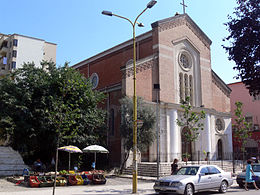 One of Tirana's Catholic churches.
 -
 Old Catholic church in Vlora.
 -
 Pope Francis Bust in Tirana
 -
 Mother Teresa Cathedral, Vau i Dejës
 -
 St Lucia Cathedral, Durrës


.jpg)


See also
[edit]- Religion in Albania
- Christianity in Albania
- Protestantism in Albania
- Episcopal Conference of Albania
- Jesuits in Albania
- Albanian Greek Catholic Church
- Catholic Church by country
Sources
[edit]- William Martin Leake, Travels in Northern Greece (London, 1835)
- Élisée Reclus, The Earth and its Inhabitants (New York, 1895, Eng. tr.): Europe, I, 115-126
- Gustave Léon Niox, Péninsule des Balkans
- Edith Durham, Travels
- John Gardner Wilkinson, almatia and Montenegro (1848)
- Herder, Konvers. Lex., s. v.
- Ami Boué, la Turquie d'Europe (Paris, 1889)
- Alexandre Degrand, Souvenirs de la Haute-Albanie (Paris, 1901)
- Emanuele Portal, Note Albanesi (Palermo, 1903)
 This article incorporates text from a publication now in the public domain: Christitch, Elizabeth (1907). "Albania". In Herbermann, Charles (ed.). Catholic Encyclopedia. Vol. 1. New York: Robert Appleton Company.

The documents of the medieval religious history of Albania are best found in the eight volumes of Daniele Farlati, Illyricum Sacrum (Venice, 1751-1819). See also Augustin Theiner, Vetera Monumenta Slavorum meridionalium historiam illustrantia (Rome, 1863 sqq.). Ecclesiastical statistics may be seen in O. Werner, Orbis Terrarum Catholicus (Freiburg, 1890), 122-124, and 120; also in the Missiones Catholicæ (Rome, Propaganda Press, triennially).
References
[edit]- ^ https://www.instat.gov.al/media/13626/cens-2023-census-botim.pdf.
{{cite web}}: Missing or empty|title=(help) - ^ Neber, in K. L., XI, 18, 19
- ^ Coll. Lucensis Conc. Recent., I, 283 sq
- ^ a b Catholic Church in Albania, Catholic Hierarchy, accessed 2008-06-14
- ^ Archdiocese of Scutari Archived 17 May 2008 at the Wayback Machine, Catholic Encyclopedia via Shkoder.net, accessed 2008-06-15
- ^ Initiative for Making the Passage, Albanian History.net, accessed 2008-06-15 Archived 1 May 2008 at the Wayback Machine
- ^ ACN (18 March 2022). "Albania: mission and challenges of the Church in the XXI century". ACN International. Retrieved 9 November 2022.
- ^ "Kisha Katolike dhe Karitasi Shqiptar pranë të dëmtuarve nga tërmeti" (in Albanian). Vatican News. 27 November 2019. Retrieved 29 November 2019.
- ^ ACN (18 March 2022). "Albania: mission and challenges of the Church in the XXI century". ACN International. Retrieved 9 November 2022.
- ^ "Albanian census 2011" (PDF). Archived from the original (PDF) on 14 November 2014. Retrieved 20 February 2013.
- ^ "Europe: Albania - The World Factbook - Central Intelligence Agency". www.cia.gov. Retrieved 26 February 2019.
- ^ "Religious composition of Albania 2011".
| Province of Shkodër–Pult |  | |
|---|---|---|
| Province of Tiranë–Durrës | ||
| Churches | ||
| Albanian Byzantine | ||
| Saints | ||
| Blessed | ||
| Orders | ||
| Former dioceses | ||
| See also | ||
| Sovereign states |
|
|---|---|
| States with limited recognition | |
| Dependencies and other entities | |
