


Salvia sclarea
| Salvia sclarea | |
|---|---|

| |
Scientific classification 
| |
| Kingdom: | Plantae |
| Clade: | Tracheophytes |
| Clade: | Angiosperms |
| Clade: | Eudicots |
| Clade: | Asterids |
| Order: | Lamiales |
| Family: | Lamiaceae |
| Genus: | Salvia |
| Species: | S. sclarea
|
| Binomial name | |
| Salvia sclarea | |
Salvia sclarea, the clary or clary sage (clary deriving from Middle English clarie, from Anglo-Norman sclaree, from Late or Medieval Latin sclarēia meaning clear), is a biennial or short-lived herbaceous perennial in the genus Salvia.[1] It is native to the northern Mediterranean Basin, along with some areas in north Africa and Central Asia.[citation needed] The plant has a lengthy history as an herb and is currently grown for its essential oil.[2]
Description[edit]
Salvia sclarea reaches 3 to 4 ft (0.91 to 1.22 m) in height, with thick square stems that are covered in hairs. The leaves are approximately 1 ft (0.30 m) long at the base, .5 ft (0.15 m) long higher on the plant. The upper leaf surface is rugose, and covered with glandular hairs. The flowers are in verticils, with 2-6 flowers in each verticil, and are held in large colorful bracts that range in color from pale mauve to lilac or white to pink with a pink mark on the edge. The lilac or pale blue corolla is approximately 1 in (2.5 cm), with the lips held wide open.[2] The cultivar S. sclarea 'Turkestanica' bears pink stems, petiolate leaves, and white, pink-flecked blossoms on spikes to 30 inches (76 cm) tall.[3]
History[edit]
Descriptions of medicinal use of the plant goes back to the writings of Theophrastus (4th century BCE), Dioscorides (1st century CE), and Pliny the Elder (1st century CE).[4]
Clary seeds have a mucilaginous coat, which is why some old herbals recommended placing a seed into the eye of someone with a foreign object in it so that it could adhere to the object and make it easy to remove. This practice is noted by Nicholas Culpeper in his Complete Herbal (1653), who referred to the plant as "clear-eye".[5]
It was used as an ingredient in wine and beer production. In 16th-century Germany elderflower infused clary was added to Rhine wines to make a more potent varietal known as Muscatel.[6]
Uses[edit]

The distilled essential oil is used widely in perfumes and as a muscatel flavoring for vermouths, wines, and liqueurs.[2] It is also used in aromatherapy.[7]
In the United States, large scale production is concentrated in northeastern North Carolina in the counties surrounding Bertie County.[8]
The chemical sclareol contained in clary sage oil has a low molecular weight and is absorbed transdermally.[9] In an experiment in which sclareol was dissolved in jojoba oil and applied to mice, (1) it was detected in the blood 30 minutes after application and (2) higher concentrations of sclareol were detected in the liver but did not cause liver dysfunction.[citation needed]
Gallery[edit]
-
 Salvia sclarea essential oil
 -
 Plants of Salvia sclarea
 -
 Plant of Salvia sclarea
 -
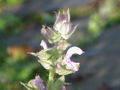 Clusters of clary flowers
 -
 Close-up
 -
 Close-up
 -

-
 Leaves


References[edit]
- ^ "Salvia sclarea (Clary Sage, Clear Eye, Europe Sage, Eyebright) | North Carolina Extension Gardener Plant Toolbox". plants.ces.ncsu.edu. Retrieved 2022-05-20.
- ^ a b c Clebsch, Betsy; Barner, Carol D. (2003). The New Book of Salvias. Timber Press. p. 261. ISBN 978-0-88192-560-9.
- ^ Mark Griffiths (1995). Index of Garden Plants (2nd American ed.). Portland, Oregon: Timber Press. ISBN 0-88192-246-3..
- ^ Wagner, Charles; De Gezelle, Jillian; Komarnytsky, Slavko (2020-02-28). "Celtic Provenance in Traditional Herbal Medicine of Medieval Wales and Classical Antiquity". Frontiers in Pharmacology. 11: 105. doi:10.3389/fphar.2020.00105. ISSN 1663-9812. PMC 7058801. PMID 32184721.
- ^ "The Complete Herbal: Clary, or More Properly Clear-Eye". bibliomania.com.
- ^ Kowalchik, Claire; Hylton, William H. (15 January 1998). Rodale's Illustrated Encyclopedia of Herbs. Rodale. ISBN 978-0-87596-964-0.
- ^ Kintzios, Spiridon E. (2000). Sage: The Genus Salvia. CRC Press. p. 20. ISBN 978-90-5823-005-8.
- ^ Leffingwell, John C.; Stallings, John W.; Sellers, Franklin O.; Lloyd, Robert A. & Kane Jr., Franklin C. (1974). "Clary Sage Production in the Southeastern United States". 6th International Congress of Essential Oils.
- ^ Matsumoto, Yutaka; Horikawa, Kazumasa (2022). "Transdermal Absorption of Sclareol, an Active Ingredient in Clary Sage Oil: A Complementary and Alternative Medicine for Menopausal Symptoms". Women. 2 (3): 304–312. doi:10.3390/women2030028.