


Unitary matrix
In linear algebra, an invertible complex square matrix U is unitary if its matrix inverse U−1 equals its conjugate transpose U*, that is, if

where I is the identity matrix.
In physics, especially in quantum mechanics, the conjugate transpose is referred to as the Hermitian adjoint of a matrix and is denoted by a dagger (†), so the equation above is written

A complex matrix U is special unitary if it is unitary and its matrix determinant equals 1.
For real numbers, the analogue of a unitary matrix is an orthogonal matrix. Unitary matrices have significant importance in quantum mechanics because they preserve norms, and thus, probability amplitudes.
Properties[edit]
For any unitary matrix U of finite size, the following hold:
- Given two complex vectors x and y, multiplication by U preserves their inner product; that is, ⟨Ux, Uy⟩ = ⟨x, y⟩.
- U is normal ().
- U is diagonalizable; that is, U is unitarily similar to a diagonal matrix, as a consequence of the spectral theorem. Thus, U has a decomposition of the form where V is unitary, and D is diagonal and unitary.
- . That is, will be on the unit circle of the complex plane.
- Its eigenspaces are orthogonal.
- U can be written as U = eiH, where e indicates the matrix exponential, i is the imaginary unit, and H is a Hermitian matrix.



For any nonnegative integer n, the set of all n × n unitary matrices with matrix multiplication forms a group, called the unitary group U(n).
Any square matrix with unit Euclidean norm is the average of two unitary matrices.[1]
Equivalent conditions[edit]
If U is a square, complex matrix, then the following conditions are equivalent:[2]
- is unitary.
- is unitary.
- is invertible with .
- The columns of form an orthonormal basis of with respect to the usual inner product. In other words, .
- The rows of form an orthonormal basis of with respect to the usual inner product. In other words, .
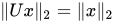
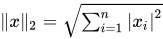
- is an isometry with respect to the usual norm. That is, for all , where .
- is a normal matrix (equivalently, there is an orthonormal basis formed by eigenvectors of ) with eigenvalues lying on the unit circle.



Elementary constructions[edit]
2 × 2 unitary matrix[edit]
One general expression of a 2 × 2 unitary matrix is

which depends on 4 real parameters (the phase of a, the phase of b, the relative magnitude between a and b, and the angle φ). The form is configured so the determinant of such a matrix is
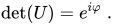
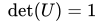
The sub-group of those elements with is called the special unitary group SU(2).

Among several alternative forms, the matrix U can be written in this form:

where and above, and the angles can take any values.

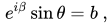

By introducing and has the following factorization:


This expression highlights the relation between 2 × 2 unitary matrices and 2 × 2 orthogonal matrices of angle θ.
Another factorization is[3]

Many other factorizations of a unitary matrix in basic matrices are possible.[4][5][6][7][8][9]
See also[edit]
- Hermitian matrix and
References[edit]
- ^ Li, Chi-Kwong; Poon, Edward (2002). "Additive decomposition of real matrices". Linear and Multilinear Algebra. 50 (4): 321–326. doi:10.1080/03081080290025507. S2CID 120125694.
- ^ Horn, Roger A.; Johnson, Charles R. (2013). Matrix Analysis. Cambridge University Press. doi:10.1017/CBO9781139020411. ISBN 9781139020411.
- ^ Führ, Hartmut; Rzeszotnik, Ziemowit (2018). "A note on factoring unitary matrices". Linear Algebra and Its Applications. 547: 32–44. doi:10.1016/j.laa.2018.02.017. ISSN 0024-3795. S2CID 125455174.
- ^ Williams, Colin P. (2011). "Quantum gates". In Williams, Colin P. (ed.). Explorations in Quantum Computing. Texts in Computer Science. London, UK: Springer. p. 82. doi:10.1007/978-1-84628-887-6_2. ISBN 978-1-84628-887-6.
- ^ Nielsen, M.A.; Chuang, Isaac (2010). Quantum Computation and Quantum Information. Cambridge, UK: Cambridge University Press. p. 20. ISBN 978-1-10700-217-3. OCLC 43641333.
- ^ Barenco, Adriano; Bennett, Charles H.; Cleve, Richard; DiVincenzo, David P.; Margolus, Norman; Shor, Peter; et al. (1 November 1995). "Elementary gates for quantum computation". Physical Review A. 52 (5). American Physical Society (APS): 3457–3467, esp.p. 3465. arXiv:quant-ph/9503016. doi:10.1103/physreva.52.3457. ISSN 1050-2947. PMID 9912645. S2CID 8764584.
- ^ Marvian, Iman (10 January 2022). "Restrictions on realizable unitary operations imposed by symmetry and locality". Nature Physics. 18 (3): 283–289. arXiv:2003.05524. doi:10.1038/s41567-021-01464-0. ISSN 1745-2481. S2CID 245840243.
- ^ Jarlskog, Cecilia (2006). "Recursive parameterisation and invariant phases of unitary matrices". arXiv:math-ph/0510034.
- ^ Alhambra, Álvaro M. (10 January 2022). "Forbidden by symmetry". News & Views. Nature Physics. 18 (3): 235–236. doi:10.1038/s41567-021-01483-x. ISSN 1745-2481. S2CID 256745894.
The physics of large systems is often understood as the outcome of the local operations among its components. Now, it is shown that this picture may be incomplete in quantum systems whose interactions are constrained by symmetries.
External links[edit]
- Weisstein, Eric W. "Unitary Matrix". MathWorld. Todd Rowland.
- Ivanova, O. A. (2001) [1994], "Unitary matrix", Encyclopedia of Mathematics, EMS Press
- "Show that the eigenvalues of a unitary matrix have modulus 1". Stack Exchange. March 28, 2016.
