


System of Rice Intensification
| Agriculture |
|---|
 |
 Agriculture portal Agriculture portal |
The System of Rice Intensification (SRI) is a farming methodology that aims to increase the yield of rice while using fewer resources and reducing environmental impacts. The method was developed by a French Jesuit Father Henri de Laulanié in Madagascar[1] and built upon decades of agricultural experimentation. SRI focuses on changing the management of plants, soil, water, and nutrients to create a more productive and sustainable system of rice cultivation.[2]

The methodology has been adopted by millions of smallholder farmers around the world, particularly in Asia and Africa. Despite its success, the adoption of SRI has been limited primarily due to a lack of awareness and available training.[3] SRI has been proposed as a prime example of how agroecological approaches to farming can address what The Economist newspaper describes as the impending global crisis in rice.[4][5]
History[edit]
The practices that culminated in SRI began in the 1960s based on Fr. de Laulanie's observations. Principles included applying a minimum quantity of water and the individual transplanting of very young seedlings in a square pattern.[1]

Father Laulanie began experimenting with a new approach that involved planting single seedlings and with wider spacing, using less water, and providing more nutrients to the plants through organic matter. These methods showed significant improvements in rice yields, and Father Laulanie's approach eventually became known as SRI.[6]
Over the 1990s, a political scientist named Norman Uphoff from Cornell University in the United States learned about SRI and began promoting its adoption in other parts of the world.[2] Uphoff and his colleagues worked with farmers in countries such as China, India, and Indonesia to refine and adapt the SRI approach to local conditions.[7]
Uphoff and his colleagues found that SRI methods could significantly increase rice yields, reduce water use by up to 50%, and decrease seed requirements by up to 90%.[6] SRI gained further recognition in the early 2000s when it was featured in the World Bank's World Development Report 2008: Agriculture for Development, which highlighted the potential of SRI to increase rice yields and reduce poverty in rural areas.[8]
Since then, SRI has been adopted by millions of farmers in more than 50 countries around the world with particularly high levels of adoption in Asia and Africa.[9] In India, for example, SRI has been widely adopted by smallholder farmers and has helped to improve rice productivity and increase farmers' incomes.[10]
Features[edit]
The components of the System of Rice Intensification (SRI) have been developed and refined through years of research and experimentation by farmers and scientists in different parts of the world.
As it is a methodology SRI has general principles for what it is, but they are fluid. Instead, these principles can be tailored to the situation-specific circumstances individuals find themselves. The four primarily agreed-upon principles of SRI are:[7]
- Planting younger seedlings: This is because young seedlings have more potential for growth and resilience than older ones. It has been found that planting 8-12 day-old seedlings leads to better establishment, higher yields, and reduced pest and disease incidence.[6]
- Careful planting of single seedlings in wider spaces: This is done to avoid transplant shock, which can be a major stress factor for rice plants. Studies have shown that careful handling of seedlings during transplanting can significantly improve yield and reduce seedling mortality. Furthermore wider spacing reduces competition amongst the plants letting each plant access sufficient nutrients, water, and sunlight. Studies have shown that grid planting can lead to higher yields and improved resource-use efficiency.[11]
- Organic fertilizers: The use of organic matter as a soil amendment is a key feature of SRI, as it helps to improve soil health and fertility over the long term. Studies have shown that SRI can achieve high yields with minimal or no use of synthetic chemical fertilizers, while reducing greenhouse gas emissions and further improving soil quality.[12]
- Reduced water consumption: This is because rice plants do not require continuously flooded conditions to grow,[13] and that water savings can be achieved without compromising yields. Studies have shown that SRI can reduce water use by 25-50% compared to conventional rice farming, while maintaining or increasing yields.[14][15]
All of these features are adjustable depending on the circumstances of farmers, but together they have a significant cumulative effect on rice production and environmental sustainability.
Impacts[edit]
SRI has demonstrated that it has a significant impact on the productivity of rice, its cost to farmers and the environmental footprint of rice farming. Due to environmental, economic and other factors, the exact impacts of SRI can vary from country to country.
For farmers most importantly SRI farming has consistently produced crop yields, often to an extremely significant degree. A study in India reported that SRI practices resulted in a yield increase of 41% compared to conventional practices.[16] The Food and Agriculture Organization of the United Nations (FAO) found similar effects on production. For example, in Cambodia they found that farms that introduced SRI practices were producing double the amount of rice per paddy.[17]
Furthermore, SRI practices reduced the amount of inputs farmers needed to use in order to achieve beneficial results. Groups like the FAO have found that the cost to farmers decreases due to fewer seeds, pesticides, fertilisers and water being used, a fact attested to in other studies.[18][16][14]
The environmental benefits of SRI are similarly significant.
Firstly SRI requires 25-50% less water than conventional rice farming methods, due to alternate wetting and drying (AWD) of the fields rather than flooding. This can lead to significant water savings in areas facing water scarcity or where water-intensive rice farming is a strain on resources.[19]
As a result of not flooding the fields SRI then reduces the amount of green house gasses emitted by rice farming. Conventional rice farming with flooded fields is an ideal environment for anaerobic soil organisms to flourish in the soil, these feed on detritus like rice straw residue and produce methane, while overuse of nitrous-based fertilizers lead to nitrous oxide being emitted from the soil.[20] Its thanks to these practises that rice farming produces 1.5% of the world's green house gas emissions according to the World Resources Institute.[21]
However, SRI's non-flooding practices, along with organic soil management, can reduce methane emissions by up to 50% compared to conventional methods, which significantly offsets the environmental impact of rice farming.[22]
In addition, SRI practices help to improve and restore soil health. This is because active soil aeration, organic fertilization, and mulching add additional soil organic matter, reduce soil erosion, and improve nutrient cycling, which help to better the soil structure and its fertility, reinforcing SRI's previous benefits of higher crop yields and lower fertilizer requirements.[23]
Furthermore, SRI practices protect the growth of a wider variety of rice strains and encourage the growth of a wider range of plants and insects in and around rice fields. This can provide habitat for beneficial insects, pollinators, and birds, which can help to improve ecosystem health and biodiversity, while hardening rice production against environmental changes that monoculture agriculture can be vulnerable to.[24]
Spread[edit]
The System of Rice Intensification (SRI) has spread rapidly in recent years, with millions of farmers adopting the approach in more than 50 countries around the world.[25] The spread of SRI has been driven by a range of factors, including its potential to increase yields, reduce input costs, and improve sustainability, which has motivated farmer uptake.
One of the key drivers of the spread of SRI has been the work of non-governmental organizations (NGOs) and international development agencies, who have played a significant role in promoting and disseminating the approach.[26] NGOs such as the Association Tefy Saina in Madagascar[27] and the Cornell International Institute for Food, Agriculture and Development (CIIFAD) have been instrumental in developing and promoting SRI,[28] while agencies such as the United Nations Development Programme (UNDP),[29] the United States Agency for International Development (USAID)[30] International Fund for Agricultural Development (IFAD)[31] the World Bank[32] and the Food and Agriculture Organization of the United Nations (FAO)[33] have supported its adoption in a range of countries.
Another important factor in the spread of SRI has been the success of early adopters, who have demonstrated the benefits of the approach to other farmers in their communities.[34] In many cases, farmers who have adopted SRI have been able to achieve significant increases in yields and reductions in input costs, which has led to widespread interest in the approach.[35]
The spread of SRI has also been facilitated by the development of networks and partnerships between farmers, researchers, NGOs, and other stakeholders. These networks have played a key role in disseminating information about SRI and supporting its implementation, as well as in facilitating the exchange of knowledge and best practices. For example, SRI's early spread in India can be partially attributed to the smart communication strategies by its proponents in which several newspapers in India disproportionately provided coverage on SRI and effective coalition building among several national and international organisations.[36]
Despite its rapid spread, SRI still faces significant challenges in terms of adoption and scalability, particularly in areas with limited access to resources, training, and support. However, ongoing research and innovation are helping to address some of these challenges and improve the effectiveness and sustainability of the approach and it is being used by an increasing number of people. Project Drawdown estimates that SRI is currently practiced on 6.7 million hectares which could to 40.21–52.00 million hectares by 2050.[37]
Countries[edit]
This is an incomplete list of countries that have implemented SRI and how they have done so.
- Madagascar: SRI for the longest period in Madagascar, as it was where the technique originated. The effort was started by the Association Tefy Saina (ATS) which was in 1990 by Fr Henri de Laulanié and his associates, to continue his mission of helping rural Madagascar. They were aided in this effort by the government of Madagascar, as the Ministry of Agriculture collaborated with various interested parties such as Cornell University to research and promote SRI and then integrate it into national agricultural strategies.[38] According to preliminary studies SRI was able to produce a staggering increase in rice production. For example, a study in 2002 found that during wet season, the Madagascar government’s previous recommended growing system SRA (système de riziculture améliorée), averaged a production of 2.45T/Ha, while example SRI plots averaged 4.38t/Ha.[39] Implementing SRI in Madagascar has been government policy since then with continual expansions ongoing with highly positive results in rice growing regions.[38]
- India: As one of the world’s largest rice producing nations SRI has been widely adopted in India. Much like in Madagascar, local NGOs like the Tata trust, worked with news papers, and academics to encourage SRI’s initial expansion into the nation.[40] Now SRI has been implemented in many of India’s states and is considered one of the governments best agricultural practises, with a section dedicated to it on Vikaspedia, the Indian Government’s online information guide.[41] Due to the scale of India how it has been implmented has varied across different states.
- Odisha, India: SRI has been successfully implemented in Odisha to improve rice production and alleviate poverty. Small-scale farmers in the Mayurbhanj district embraced SRI, witnessing a yield increase of 54% while reducing water usage by 34%.[42]
- Bihar, India: In Bihar, SRI adoption has been instrumental in achieving higher rice yields and reducing production costs. A study conducted in the Bhagalpur district reported a yield increase of 47% with SRI, accompanied by a 35% reduction in seed requirements.[43]
- Andhra Pradesh, India: SRI practices have been successfully implemented in Andhra Pradesh, contributing to sustainable agriculture and improved livelihoods. Farmers in the Nellore district embraced SRI, resulting in a 29% increase in rice yields along with water savings of up to 40%.[44]
- Mali: In Mali, SRI techniques have been adopted to enhance rice productivity and promote sustainable agriculture. The Africa Rice Center (AfricaRice) collaborated with local partners to introduce SRI practices in the Office du Niger irrigation scheme. Through the "More Rice for Africa" initiative, SRI was implemented, resulting in significant yield increases. Farmers in the region achieved average yields of 8 tons per hectare, compared to the conventional average of 4 tons per hectare.[45]
- Senegal: SRI has been introduced in Senegal to address challenges related to low rice productivity and water scarcity. The National Center of Agronomic Research (CNRA) and other stakeholders have collaborated to promote SRI practices. Farmers in the Senegal River Valley have adopted SRI, leading to increased rice yields, improved water management, and enhanced farmer livelihoods.[46]
Criticisms[edit]
While the System of Rice Intensification (SRI) has been lauded for its potential to improve rice yields while reducing input costs and environmental impacts, there have been criticisms of the approach as well.
Firstly that it is overly labour intensive. SRI often involves more frequent weeding, transplanting of younger seedlings, and other manual labor tasks, which can be challenging for farmers with limited resources and labor availability, at least when implementation begins.[47] However, an Anglo-Indian study of SRI in Andhra Pradesh, India found that overall there was a substantial reduction in labor requirement alongside significant benefits for farmers and the environment once farmers had time to optimise their implementation of SRI.[48]
Then there is the potential problem that it is too knowledge-intensive as SRI requires a higher level of technical knowledge and skill than traditional methods of rice cultivation, which can be a barrier for some farmers. For example, SRI involves precise plant spacing, water management, and nutrient application, which may require training and support for successful implementation.[49] This has created further criticism that it may not be able to operate on a large enough scale to compared to other methods of conventional rice production.
The risk of yield variability is cited as a critique as SRI methods can be more susceptible to yield variability than traditional methods of rice cultivation. This is because SRI involves more precise plant spacing and nutrient management, which can be affected by weather conditions and other factors that are difficult to control.[50]
And most commonly critics cited that there was limited evidence of SRI's impact with some citing that it was no better than any other method of rice production.[51] However, these early criticisms have mostly faded, as continual study has shown that SRI consistently increases rice production. Furthermore several of the studies that asserted SRI did not increase rice production either used secondary data or examined small data sets of SRI where it was deliberately implemented incorrectly to generate those results.[52]
While many of criticisms of SRI are valid to some degree, there is also evidence to suggest that many of these challenges can be addressed with appropriate training, support, and adaptation of the approach to local conditions, which numerous international and national agencies are engaged in.[53]
Gallery[edit]
SRI farming in Chhattisgarh, India:
-
 Planted field
 -
 Rice field
 -
 Nursery
 -
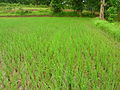 Fields left almost dry
 -
 SRI field
 -
 Farmer
 -
 Crop with weeds
 -
 Weeding
 -
 Weeding
 -
 Weeding
 -
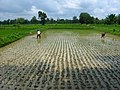 Weeding


.jpg)


See also[edit]


References[edit]
- ^ a b Intensive Rice Farming in Madagascar by H. De Laulanié, in Tropicultura, 2011, 29, 3, 183-187
- ^ a b Uphoff, Norman (2015). The System of Rice Intensification: Responses to Frequently Asked Questions (PDF) (1st ed.). Scotts Valley, California: CreateSpace Independent Publishing Platform. pp. 1–11. ISBN 978-1515022053. Retrieved 23 April 2023.
- ^ Dobermann, A. (2004). "A critical assessment of the system of rice intensification (SRI)". Agricultural Systems. 79 (2004/03/01): 261–281. doi:10.1016/S0308-521X(03)00087-8. Retrieved 23 April 2023.
- ^ Akbarpur, Bassi. "The global rice crisis". The Economist. Retrieved 24 April 2023.
- ^ Parr, Adam (April 22–28, 2023). "Rice and climate change". The economist. No. How to worry wisely about AI. The Economist Newspaper Ltd. Retrieved 24 April 2023.
- ^ a b c Stoop, Willam A.; Uphoff, Norman; Kassam, Amir (1 March 2002). "A review of agricultural research issues raised by the system of rice intensification (SRI) from Madagascar: opportunities for improving farming systems for resource-poor farmers". Agricultural Systems. 71 (3): 249–274. doi:10.1016/S0308-521X(01)00070-1. ISSN 0308-521X. Retrieved 24 April 2023.
- ^ a b Cornell University, System of Rice Intensification
- ^ World, Bank (2008). World Development Report, 2008 agriculture for development (1st ed.). The World Bank. pp. 72–93. doi:10.1596/978-0-8213-6807-7. ISBN 978-0-8213-6807-7. Retrieved 24 April 2023.
- ^ Pretty, Jules; Toulmin, Camilla; Williams, Stella (1 February 2011). "Sustainable intensification in African agriculture". International Journal of Agricultural Sustainability. 9 (1): 5–24. doi:10.3763/ijas.2010.0583. ISSN 1473-5903. S2CID 56167956.
- ^ Uphoff, Norman. "REPORT ON SRI FIELD VISITS IN TAMIL NADU AND ANDHRA PRADESH, INDIA January 22-29, 2004" (PDF). CIFFAD. Retrieved 24 April 2023.
- ^ Naidu, G. Jogi; Rao, K. Tejeswara; Rao, A. Upendra; Reddy, D. Srinivasulu (2013). "Age of Seedlings and Planting Pattern on Grain yield, Protein Content, NPK Uptake and Post-harvest Nutrient Status of Rice under SRI" (PDF). Journal of Academia and Industrial Research (JAIR). 2 (6): 334–337. Retrieved 9 June 2023.
- ^ Ali, Jahaur; Wani, Shabir H. (2021). Rice improvement : physiological, molecular breeding and genetic perspectives. Cham, Switzerland: Springer Nature Switzerland AG. p. 155. ISBN 978-3-030-66530-2. Retrieved 24 April 2023.
- ^ Rejesus, Roderick M.; Palis, Florencia G.; Rodriguez, Divina Gracia P.; Lampayan, Ruben M.; Bouman, Bas A. M. (1 April 2011). "Impact of the alternate wetting and drying (AWD) water-saving irrigation technique: Evidence from rice producers in the Philippines". Food Policy. 36 (2): 280–288. doi:10.1016/j.foodpol.2010.11.026. ISSN 0306-9192. Retrieved 9 May 2023.
- ^ a b Jagannath, P.; Pullabhotla, Hemant; Uphoff, Norman (December 2013). "Meta-analysis evaluating water use, water saving, and water productivity in irrigated production of rice with SRI vs. standard management methods". Taiwan Water Conservancy. 61 (4): 14–49. Retrieved 24 April 2023.
- ^ Singh, Sudhanshu; Mackill, David J.; Ismail, Abdelbagi M. (1 January 2014). "Physiological basis of tolerance to complete submergence in rice involves genetic factors in addition to the SUB1 gene". AoB Plants. 6. doi:10.1093/aobpla/plu060. PMC 4243076. PMID 25281725.
- ^ a b Varma, Poornima (26 September 2019). "Adoption and the impact of system of rice intensification on rice yields and household income: an analysis for India". Applied Economics. 51 (45): 4956–4972. doi:10.1080/00036846.2019.1606408. ISSN 0003-6846. S2CID 159258391. Retrieved 24 April 2023.
- ^ Sarim, Tea. "52 Profiles on Agroecology: Seeding the Way with Systems of Rice Intensification in Cambodia". Food and Agriculture Organisation of the United Nations. FAO. Retrieved 24 April 2023.
- ^ Barah, B.C. (2009). "Economic and Ecological Benefits of System of Rice Intensification (SRI) in Tamil Nadu". Agricultural Economics Research Review. 22 (2): 209–214. doi:10.22004/ag.econ.57397. Retrieved 24 April 2023.
- ^ McHugh, Oloro Vahid. "Growing More Rice with Less Water Adaptive Water Management Schemes Utilized in the System of Rice Intensification (SRI)" (PDF). Ciffad Cornel. Cornell University. Retrieved 24 April 2023.
- ^ Umali-Deininger, Diana (15 March 2022). "Greening the rice we eat". blogs.worldbank.org. World Bank Blogs. Retrieved 24 April 2023.
- ^ Searchinger, Tim; Waite, Richard (16 December 2014). "More Rice, Less Methane". WRI.org. World Resources Institute. Retrieved 24 April 2023.
- ^ Groenigen, Van; Jan, Cornelis; Arlene Adviento-Borbe, Marie; Pittelkow, Cameron; Kessel, Chris van (2012). "An agronomic assessment of greenhouse gas emissions from major cereal crops". Global Change Biology. 18 (1): 194–209. Bibcode:2012GCBio..18..194L. doi:10.1111/j.1365-2486.2011.02502.x. hdl:2262/62561. ISSN 1365-2486. S2CID 16466054. Retrieved 24 April 2023.
- ^ M. Al-Kaisi, Mahdi; Lowery, Birl (2017). Soil health and intensification of agroecosystems. Amsterdam: Elsevier Science. pp. 79–107. ISBN 978-0-12-805317-1. Retrieved 24 April 2023.
- ^ Thakur, Amod Kumar; Mandal, Krishna Gopal; Verma, Om Prakash; Mohanty, Rajeeb Kumar (April 2023). "Do System of Rice Intensification Practices Produce Rice Plants Phenotypically and Physiologically Superior to Conventional Practice?". Agronomy. 13 (4): 1098. doi:10.3390/agronomy13041098.
- ^ "System of Rice Intensification - Frequently Asked Questions (FAQs)". sri.ciifad.cornell.edu. Retrieved 9 May 2023.
- ^ Kassam, Amir; Uphoff, Norman. "The System of Rice Intensification: A Case Study" (PDF). europarl. EUROPEAN PARLIAMENT Science and Technology Options Assessment. Retrieved 24 April 2023.
- ^ Lalo, C.; Association Tefy Saina, Fianarantsoa. "Système de Riziculture Intensive (SRI), Madagascar". AGRIS. (Fianarantsoa) (Madagascar) Tefy Saina. Retrieved 24 April 2023.
- ^ "System of Rice Intensification - SRI websites and online communities". sri.ciifad.cornell.edu. Cornell University. Retrieved 24 April 2023.
- ^ "Upscaling AgroBiodiversity-based Rice Farming Systems Through The System of Rice Intensification (SRI) in Malaysia". www.sgp.undp.org. United Nations Development Programme. Retrieved 24 April 2023.
- ^ "Haitian Rice Farmers Double Their Yields | Archive - U.S. Agency for International Development". 2012-2017.usaid.gov. United States Agency for International Development. Retrieved 24 April 2023.
- ^ "Adoption of system of rice intensification (SRI)". IFAD. Retrieved 24 April 2023.
- ^ "India - India: A New Way of Cultivating Rice". web.worldbank.org. World Bank. Retrieved 24 April 2023.
- ^ "FAO in Lao People's Democratic Republic". www.fao.org. FAO. Retrieved 24 April 2023.
- ^ Aris, Nur Fatin Munirah; Fatah, Fazleen Abdul (2019). "Cost and Return Analysis of System of Rice Intensification (SRI): Evidence from Major Rice Producing Areas in Malaysia" (PDF). International Journal of Supply Chain Management. 8 (3): 541–546. Retrieved 9 May 2023.
- ^ Sridevi, V.; Chellamuthu1, V.; Jeyaraman2, S. (2011). "SYSTEM OF RICE INTENSIFICATION – A REVIEW". Agricultural Reviews. 32 (2): 120–126. ISSN 0253-1496. Retrieved 24 April 2023.
{{cite journal}}: CS1 maint: numeric names: authors list (link) - ^ Basu, Soutrik; Leeuwis, Cees (2012-09-01). "Understanding the rapid spread of System of Rice Intensification (SRI) in Andhra Pradesh: Exploring the building of support networks and media representation". Agricultural Systems. 111: 34–44. doi:10.1016/j.agsy.2012.04.005.
- ^ "System of Rice Intensification @ProjectDrawdown #ClimateSolutions". Project Drawdown. 6 February 2020. Retrieved 24 April 2023.
- ^ a b Serpantié, Georges; Rakotondramanana, Modeste (2014). "From Standards to Practices: The Intensive and Improved Rice Systems (SRI and SRA) in the Madagascar Highlands". Challenges and Opportunities for Agricultural Intensification of the Humid Highland Systems of Sub-Saharan Africa. Springer International Publishing. pp. 149–163. doi:10.1007/978-3-319-07662-1_13. ISBN 978-3-319-07662-1.
- ^ Rabenandrasana, Justin Leonard. "SRI Experience of the Association Tefy Sania in Madagascar" (PDF). Cornell University. Retrieved 11 May 2023.
- ^ Gujja, Biksham; Thiyagarajan, T.M. (2009). New Hope for Indian Food Security?: The System of Rice Intensification. International Institute for Environment and Development. pp. 1–24. Retrieved 11 May 2023.
- ^ "System of Rice Intensification (SRI)". Vikaspedia. Retrieved 11 May 2023.
- ^ Plabita, Ray; Raj, R. K. (2014). "Extent of adoption of practices under system of rice intensification in Odisha". Oryza. 51 (1): 81–85.
- ^ Pandey, Shikha; Kumar, Parmod (2019). Determinants of Farm-Level Adoption of System of Rice and Wheat Intensification in Gaya, Bihar (PDF). The Institute for Social and Economic Change, Bangalore. pp. 1–29. Retrieved 11 May 2023.
- ^ Adusumilli, Ravindra; Bhagya Laxmi, S. (1 March 2011). "Potential of the system of rice intensification for systemic improvement in rice production and water use: the case of Andhra Pradesh, India". Paddy and Water Environment. 9 (1): 89–97. doi:10.1007/s10333-010-0230-6. ISSN 1611-2504. S2CID 1477298.
- ^ Styger, Erika; Aboubacrine, Goumar; Attaher, Malick Ag; Uphoff, Norman (1 February 2011). "The system of rice intensification as a sustainable agricultural innovation: introducing, adapting and scaling up a system of rice intensification practices in the Timbuktu region of Mali". International Journal of Agricultural Sustainability. 9 (1): 67–75. doi:10.3763/ijas.2010.0549. ISSN 1473-5903. S2CID 153656729.
- ^ Krupnik, Timothy J.; Shennan, Carol; Settle, William H.; Demont, Matty; Ndiaye, Alassane B.; Rodenburg, Jonne (1 June 2012). "Improving irrigated rice production in the Senegal River Valley through experiential learning and innovation". Agricultural Systems. 109: 101–112. doi:10.1016/j.agsy.2012.01.008. ISSN 0308-521X.
- ^ Sinclair, T.R. "Agronomic UFOs waste valuable scientific resources". ricetoday.irri.org. Rice Today. Retrieved 24 April 2023.
- ^ Gathorne-Hardy, Alfred; Reddy, D. Narasimha; Venkatanarayana, M.; Harriss-White, Barbara (1 March 2016). "System of Rice Intensification provides environmental and economic gains but at the expense of social sustainability — A multidisciplinary analysis in India". Agricultural Systems. 143: 159–168. doi:10.1016/j.agsy.2015.12.012. Retrieved 24 April 2023.
- ^ Giller, Ken E.; Witter, Ernst; Corbeels, Marc; Tittonell, Pablo (October 2009). "Conservation agriculture and smallholder farming in Africa: The heretics' view". Field Crops Research. 114 (1): 23–34. doi:10.1016/j.fcr.2009.06.017. Retrieved 24 April 2023.
- ^ McDonald, A.J.; Hobbs, P.R.; Riha, S.J. (March 2006). "Does the system of rice intensification outperform conventional best management?". Field Crops Research. 96 (1): 31–36. doi:10.1016/j.fcr.2005.05.003. Retrieved 24 April 2023.
- ^ Sheehy, J.E; Peng, S; Dobermann, A; Mitchell, P.L; Ferrer, A; Yang, Jianchang; Zou, Yingbin; Zhong, Xuhua; Huang, Jianliang (June 2004). "Fantastic yields in the system of rice intensification: fact or fallacy?". Field Crops Research. 88 (1): 1–8. doi:10.1016/j.fcr.2003.12.006. Retrieved 24 April 2023.
- ^ Uphoff, Norman; Kassam, Amir; Stoop, Willem (July 2008). "A critical assessment of a desk study comparing crop production systems: The example of the 'system of rice intensification' versus 'best management practice'". Field Crops Research. 108 (1): 109–114. doi:10.1016/j.fcr.2007.12.016. Retrieved 24 April 2023.
- ^ Kassam, Amir; Uphoff, Norman. "The System of Rice Intensification: A Case Study" (PDF). europarl. EUROPEAN PARLIAMENT Science and Technology Options Assessment. Retrieved 24 April 2023.
External links[edit]
- SRI at Cornell University
- System of Rice Intensification from Project Regeneration
- SRI information from the International Rice Research Institute
- Rice Knowledge Bank: best management practices for rice production
- SRI - much more than more rice Farming Matters magazine, 29.1, March 2013
- Krishi Usha low-cost weeder developed by Krishi Gram Vikas Kendra and Usha Martin Limited, Jharkhand
- News article on SRI from the BBC
- SRI: Achieving More with Less - A new way of rice cultivation from the World Bank Institute