


Andhra Pradesh


Andhra Pradesh (English: /ˌɑːndrə prəˈdɛʃ/,[11] Telugu: [aːndʱrɐ prɐdeːʃ] ⓘ abbr. AP) is a state in the southern coastal region of India. It is the seventh-largest state with an area of 162,970 km2 (62,920 sq mi)[5] and the tenth-most populous state with 49,577,103 inhabitants.[4] It shares borders with Chhattisgarh, Odisha, Karnataka, Tamil Nadu, Telangana and the Bay of Bengal. It has the second-longest coastline in India at about 974 km (605 mi).[5] After existence as Andhra State and unified Andhra Pradesh, the state took its present form on 2 June 2014, when the new state of Telangana was formed through bifurcation.[12] Amaravati is the capital of the state, with the largest city being Visakhapatnam. Water sharing disputes and asset division with Telangana are not yet resolved. Telugu, one of the classical languages of India used by the majority of people, is the first official language.
As per the 8th century BCE Rigvedic text Aitareya Brahmana, the Andhras left North India off the banks of the Yamuna river and migrated to South India. In the third century BCE, Andhra was a vassal kingdom of Ashoka of the Mauryan Empire. After his death, it became powerful and extended its empire to the whole Maratha country and beyond under the rule of the Satavahana dynasty. After that, the major rulers included the Pallavas, Eastern Chalukyas, Kakatiyas, Vijayanagara Empire, Qutb Shahi dynasty, Nizam dynasty, East India Company, and British Raj.
The Eastern Ghats are a major dividing line separating coastal plains and peneplains. The coastal plains are part of Coastal Andhra. These are mostly delta regions formed by the Krishna, Godavari, and Penna rivers. Peneplains are part of Rayalaseema. 60% of the population is engaged in agriculture and related activities. Rice is the state's major food crop and staple food. The state contributes 10% of total fish production and over 70% of shrimp production in India. Industry sectors such as food products, non-metallic minerals, textiles, and pharmaceuticals are the top employment providers. The automotive sector accounts for 10% of India's auto exports. The state has about one-third of India's limestone reserves, large deposits of baryte and galaxy granite, and reserves of oil and natural gas.[13] Satish Dhawan Space Centre (SDSC), known as Sriharikota Range (SHAR), at the barrier island of Sriharikota in Tirupati district, is the satellite launching station of India.
Some of the unique products from the state are Banganapalle mangoes, Kondapalli toys, Tirupati laddu, Dharmavaram sarees and Pedana Kalamkari. Kuchipudi is the official dance form. Many composers of Carnatic music, like Annamacharya, Kshetrayya, and Tyagaraja, were from this region. The Tirumala Venkateswara temple near Tirupati is the most visited Hindu religious place in the world. The state is home to a variety of other pilgrimage centres and natural attractions.
Etymology[edit]
Epigraphist Iravatham Mahadevan interprets the Sanskrit word 'āndʰra' as a corruption of the masculine nominative suffix '-anṟu' of Early Telugu language (c.800 BCE).[14]
According to the Sanskrit text Aitareya Brahmana (800–500 BCE), a group of people named Andhras left North India off the banks of the Yamuna and settled in South India.[15][16][17] The Satavahanas were mentioned by the names Andhra, Andhrara-jateeya, and Andhrabhrtya in the Puranic literature.[18][19] They did not refer to themselves as Andhra in any of their coins or inscriptions; it is possible that they were termed as Andhras because of their ethnicity or because their territory included the Andhra region.[20]
History[edit]
Early and medieval history[edit]

The Assaka mahajanapada, one of the sixteen Vedic mahajanapadas, included Andhra Pradesh, Maharashtra, and Telangana.[21] Archaeological evidence from places such as Bhattiprolu, Amaravathi, and Dharanikota suggests that the Andhra region was part of the Mauryan empire. Amaravathi might have been a regional centre under Mauryan rule. After the death of Emperor Ashoka, Mauryan rule weakened around 200 BCE and was replaced by several smaller kingdoms in the Andhra region.[22] One of the earliest examples of the Brahmi script, the progenitor of several scripts, including Telugu, comes from Bhattiprolu, where the script was used on an urn containing the relics of Buddha.[23]
The Satavahana dynasty dominated the Deccan plateau from the 1st century BCE to the 3rd century CE.[24] It had trade relations with the Roman Empire.[25] The later Satavahanas made Dharanikota, near Amaravathi, their capital. According to the Buddhists, Nagarjuna, the philosopher of Mahayana, lived in this region.[26][27][28] The Andhra Ikshvakus, with their capital at Vijayapuri, succeeded the Satavahanas in the Krishna river valley in the latter half of the 2nd century.[29] The Salankayanas were an ancient dynasty that ruled the Andhra region between Godavari and Krishna rivers with their capital at Vengi (modern Pedavegi) from 300 to 440 CE.[30] Telugu Cholas ruled present-day Rayalaseema from the fifth to the eleventh centuries from Cuddapa and Jammalamadugu. The Telugu inscription of Erikal Mutturaju Dhananjaya Varma, known as Erragudipadu sasanam(law), was engraved in 575 CE in the present Kadapa district. It is the earliest written record in Telugu.[31]
The Vishnukundinas were the first dynasty in the fifth and sixth centuries to hold sway over most of Andhra Pradesh, Kalinga, and parts of Telangana.[32] The Eastern Chalukyas of Vengi, whose dynasty lasted for around five hundred years from the 7th century until 1130 CE, eventually merged with the Chola dynasty. They continued to rule under the protection of the Chola dynasty until 1189 CE.[33] At the request of King Rajaraja Narendra, Nannaya, considered the first Telugu poet, took up the translation of the Mahabharata into Telugu in 1025 CE.[34]
Kakatiyas ruled this region and Telangana for nearly two hundred years between the 12th and 14th centuries. They were defeated by the Delhi sultanate.[35] Musunuri Nayaks and Bahamani sultanate took over when Delhi sultanate became weak. The Reddi kingdom ruled parts of this region in the early 14th century. They constructed Kondaveedu fort and Kondapalli fort.[36][37] After their rule, Gajpathis and Bahmani sultans ruled in succession before this region, along with most of present-day Andhra Pradesh, became part of the Vijayanagara empire.[38]
The Vijayanagara empire originated on the Deccan plateau in the early 14th century. It was established in 1336 by Harihara Raya I and his brother Bukka Raya I of the Sangama dynasty, who served as treasury officers of the Kakatiyas of Warangal.[39] During their rule, the Pemmasani Nayaks controlled parts of Andhra Pradesh and had large mercenary armies that were the vanguard of the empire in the 16th century.[40] The empire's patronage enabled fine arts and literature to reach new heights in Kannada, Telugu, Tamil, and Sanskrit, while Carnatic music evolved into its current form.[41] The Lepakshi group of monuments built during this period have mural paintings of the Vijayanagara kings, Dravidian art, and inscriptions. These are put on the tentative list of the UNESCO World Heritage Committee.[42]
Modern history[edit]

Following the defeat of the Vijayanagara empire, the Qutb Shahi dynasty held sway over Andhra Pradesh.[43] This region passed under the rule of the Nizams under the Mughal Empire. Soon, Nizam established himself as the sovereign ruler.[44] In 1611, an English trading post by the name of British East India Company was established in Machilipatnam on India's east coast.[45] In the early nineteenth century, Northern Circars was ceded to the British East India Company and became part of its Madras Presidency.[46] Eventually, this region emerged as the Coastal Andhra region, the northern parts of which were later known as North Andhra. Later, the Nizam ceded five territories to the British, which eventually became the Rayalaseema region.[47] The local chieftains, known as Polygars, revolted in 1800 against the company's rule, which was suppressed by the company.[48] Raja Viziaram Raz (Vijayaram Raj) established a sovereign kingdom by claiming independence from the Kingdom of Jeypore in 1711. It formed alliances with the French and British East India companies to conquer the neighbouring principalities of Bobbili, Kurupam, Paralakhemundi, and the kingdom of Jeypore. It fell out with the British and, as a result, was attacked and defeated in the battle of Padmanabham. It was annexed as a tributary estate like other principalities and remained so until their accession to the Indian Union in 1949.[49] Following the Indian rebellion of 1857, the British crown ruled this region, until India became independent in 1947. The No Tax campaign in Chirala and Perala in 1919,[50] the Rampa revolt in 1921[51] are some of the protests against British rule.
Dowleswaram Barrage, built in 1850 by Arthur Cotton, brought unused lands in the Godavari river basin into cultivation and transformed the economy of the region.[52] Charles Philip Brown did pioneering work in transforming Telugu to the print era and introduced Vemana poems to English readers.[53] Kandukuri Veeresalingam is considered the father of the Telugu renaissance movement, as he encouraged the education of women and the remarriage of widows and fought against child marriage and the dowry system.[54] Gurajada Apparao, a pioneering playwright who used spoken dialect, wrote the play Kanyasulkam in 1892. It is considered the greatest play in the Telugu language.[55]
Post-independence[edit]

In an effort to gain an independent state based on linguistic identity and to protect the interests of the Telugu-speaking people of Madras state, Potti Sreeramulu fasted to death in 1952. The Telugu-speaking area of Andhra state was carved out of Madras state on 1 October 1953, with Kurnool as its capital city. Tanguturi Prakasam became the first chief minister.[56] On the basis of the Gentlemen's Agreement of 1956, the States Reorganisation Act created Andhra Pradesh by merging the neighbouring Telugu-speaking areas of the Hyderabad state with Hyderabad as the capital on 1 November 1956.[57]
In the unified state, Indian National Congress (INC) enjoyed a monopoly in ruling the state till 1983. After that Telugu Desam Party (TDP) and INC ruled the state alternately.[58] Implementing land reforms and land ceiling acts and securing reservation for lower castes in politics were launched during the rule of P. V. Narasimha Rao.[59] During TDP rule, led by N. T. Rama Rao sub-district administration was transformed by forming mandals in place of earlier taluks, removing hereditary village heads, and appointing non-hereditary village revenue assistants.[60] E-governance through e-Seva centres was started in 2001 for paperless and speedy delivery of government services.[61] Chandrababu Naidu helped Hyderabad grew into an Information Technology hub.[62]
During its 58 years as a unified state, the state weathered separatist movements from Telangana (1969) and Andhra (1972) successfully.[63] When the union cabinet made a decision to consider the formation of Telangana state in 2009 heeding to the demand of relaunched Telangana movement, Samaikyandhra movement opposing it took shape and the state went through a turmoil.[64] Finally, the Andhra Pradesh Reorganisation Act bill was passed by the parliament of India for the formation of the Telangana state, comprising ten districts, despite opposition by the state legislature.[65] The new state of Telangana came into existence on 2 June 2014 after approval from the president of India, with the residual state continuing as Andhra Pradesh.[66] TDP formed the first government of the residual state.[67] In 2017, the government of Andhra Pradesh began operating from its new greenfield capital, Amaravati, for which 33,000 acres were acquired from farmers through an innovative land pooling scheme.[68]
Geography[edit]

The state is bordered by Telangana to the north and west, Chhattisgarh and Orissa to the north, the Bay of Bengal to the east, Tamil Nadu to the south, and Karnataka to the west. Yanam district, an enclave of Puducherry, is in the state bordering Kakinada district.[69] It has a coastline of around 974 kilometres (605 mi), which makes it the second-longest coastline in the nation.[5]

The Eastern ghats are a major dividing line separating coastal plains and peneplains in the state's geography. These are discontinuous, and individual sections have local names. The ghats become more pronounced towards the south and extreme north of the coast. Some of these consist of the Horsley hills, the Seshachala hills,[70] the Nallamala hills, and the Papi hills.[71][72] Peneplains, part of Rayalaseema, slope towards the east.[73] The Eastern coastal plains comprise the area of coastal districts up to the Eastern ghats as their border along the Bay of Bengal, with variable width. These are, for the most part, delta regions formed by the Krishna, Godavari, and Penna rivers. Most of the coastal plains are put to intensive agricultural use.[74] The Kadapa basin, formed by two arching branches of the Eastern ghats, is a mineral-rich area.[75]
Flora and fauna[edit]
The total forest cover of the state is 29,784.3 square kilometres (11,499.8 sq mi), amounting to 18.28% of the total area.[76] The Eastern ghats region is home to dense tropical forests, while the vegetation becomes sparse as the ghats give way to the peneplains, where shrub vegetation is more common. The vegetation found in the state is largely of dry deciduous types, with a mixture of teak, Terminalia, Dalbergia, Pterocarpus, Anogeissus, etc. The state possesses some rare and endemic plants like Cycas beddomei, Pterocarpus santalinus, Terminalia pallida, Syzygium alternifolium, Shorea talura, Shorea tumburgia, Psilotum nudum, etc.[77] Coringa is an example of mangrove forests and salt-tolerant forest ecosystems near the sea. The area of these forests is 582 km2 (225 sq mi), accounting for about 9% of the local forest area of the state.[78]
The diversity of fauna includes tigers, leopards, dholes, black bucks, cheetals, sambars, sea turtles, and a number of birds and reptiles. The estuaries of the Godavari and Krishna rivers support rich mangrove forests with fishing cats and otters as keystone species.[77] The state has many sanctuaries and national parks, such as Coringa wildlife sanctuary, Nagarjunsagar-Srisailam tiger reserve, Kolleru bird sanctuary, and Nelapattu bird sanctuary.[79]
Mineral resources[edit]

The state, with its varied geological formations, contains a variety of industrial minerals and building stones. Major minerals found in significant quantities in the state include beach sand, bauxite, limestone, and diamonds. Minor minerals include barytes, calcite, and mica.[80] The largest reserves of uranium are in Tummalapalli village of YSR district. It has oil and natural gas to the extent of 698 million metric tonne of oil equivalent.[81] It is known for large exclusive deposits of galaxy granite.[82]
Climate[edit]
The climate varies considerably, depending on the geographical region. Summers last from March to June. In the coastal plain, the summer temperatures are generally higher than in the rest of the state, with temperatures ranging exceeding 40 °C (104 °F). July to September is the season for tropical rains from the southwest monsoon. During October to December, low-pressure systems and tropical cyclones form in the Bay of Bengal along with the northeast monsoon, bringing rains to the southern and coastal regions of the state. November to February are the winter months. Since the state has a long coastal belt, the winters are not very cold. The range of winter temperatures is generally 30 to 35 °C (86 to 95 °F) except in the north where it could fall below 15 °C (59 °F).[74] Lambasingi in Visakhapatnam district is nicknamed the "Kashmir of Andhra Pradesh" as its temperature ranges from 0 to 10 °C (32 to 50 °F).[83][84] The normal rainfall for the state is 966 mm (38.0 in), and the actual rainfall for June 2020–May 2021 was 1,191 mm (46.9 in).[85]
Demographics[edit]
Based on the 2011 Census of India, the population of Andhra Pradesh is 49,577,103, with a density of 304/km2 (790/sq mi). 70.53% of the population is rural, and 29.47% is urban.[5] The state has 17.08% Scheduled caste and 5.53% Scheduled tribe populations.[86] Children in the age group of 0–6 years number 5,222,384, constituting 10.6% of the total population. Among them, 2,686,453 are boys and 2,535,931 are girls. Adults in the age group of 18–23 account for 5,815,865 (2,921,284 males, 2,894,581 females).[87]
The state has a sex ratio of 997 females per 1000 males, higher than the national average of 926 per 1000. The literacy rate in the state stands at 67.35%. Erstwhile West Godavari district has the highest literacy rate of 74.32%, and erstwhile Vizianagaram district has the least with 58.89%.[5] The state ranks 27th of all Indian states in the Human Development Index (HDI) scores for the year 2018.[88] As of 1 January 2023[update], there are 39,984,868 voters (19,759,489 males, 20,221,455 females, and 3,924 third-gender voters). Kurnool district has the maximum number of voters at 1,942,233, while ASR district has the minimum at 729,085.[89]
Telugu is the first official language, and Urdu is the second official language of the state.[6] Telugu is the mother tongue of nearly 90% of the population.[90][91][92] Urdu, spoken by about 6% of the population, was a second official language in fifteen districts of united Andhra Pradesh[93] and was made the second official language on 17 June 2022.[7]
Tamil, Kannada, and Odia are spoken in the border areas. Lambadi, Koya, Savara, Konda, Gadaba, and a number of other languages are spoken by the Scheduled Tribes of the state.[94] 19% of the population aged 12+ years has the ability to read and understand English, as per the IRS Q4 2019 survey.[95]
According to the 2011 census, the major religious groups in the state are Hindus (90.89%), Muslims (7.30%), and Christians (1.38%).[b][96]
The National Family Health Survey (NFHS-5) 2019–21 data provides an insight into the economic and health status of households. 85% of households in the state have pucca houses. 76% of households (59% urban, 83% rural) own a house. Almost all houses have an electricity connection. 84% of households use clean fuel for cooking. 22% have piped water. 85% of all households (urban areas 97%, rural areas 80%) have access to a toilet facility. Almost all urban households (96%) and most rural households (89%) use a mobile phone. 96% of households use bank or post office savings accounts. 97% of childbirths during 2014–2019 happened in a health facility. The state health insurance scheme (Dr. YSR Arogya Sri), the employee health scheme, the Rashtriya Swasthya Bima Yojana (RSBY), the employees' state insurance scheme (ESIS), and the central government health scheme cover 70% of households with at least one member covered.[97]
Administrative divisions[edit]
Andhra Pradesh comprises two regions, namely Coastal Andhra and Rayalaseema. The northern part of Coastal Andhra is sometimes mentioned separately as North Andhra, particularly after the bifurcation to raise voice against underdevelopment.[98]
Districts[edit]

The state is further divided into 26 districts, with North Andhra comprising 6 districts, Coastal Andhra comprising 12 districts, and Rayalaseema comprising 8 districts.[99] These districts are made up of 76 revenue divisions,[100] 679 mandals[100] and 13,324 village panchayats as part of the administrative organisation.[101]
North Andhra:
Coastal Andhra:
Rayalaseema:
Cities and towns[edit]
There are 123 urban local bodies, comprising 17 municipal corporations, 79 municipalities, and 27 nagar panchyats, in the state. The urban population is 14.9 million (1.49 crores) as per the 2011 census.[102] There are two cities with more than one million inhabitants, namely Visakhapatnam and Vijayawada.[103]
| Ciy/Town | District(s) post 2022 reorg | Population (2011) |
|---|---|---|
| Visakhapatnam | Visakhapatnam, Anakapalli | 1,728,128 |
| Vijayawada | NTR | 1,476,931 |
| Guntur | Guntur | 743,354 |
| Nellore | Nellore | 558,548 |
| Kurnool | Kurnool | 484,327 |
| Rajahmundry | East Godavari | 560,756 |
| Tirupati | Tirupati | 461,900 |
| Kakinada | Kakinada | 443,028 |
| Kadapa | YSR | 344,893 |
| Anantapur | Anantapur | 340,613 |
Economy[edit]
GSDP at current prices for the year 2022–23 is estimated at ₹1,317,728 crore (US$170 billion) (advanced estimates) against ₹1,133,837 crore (equivalent to ₹12 trillion or US$150 billion in 2023) (first revised estimates) for the year 2021–22. The share of agriculture's contribution to the GSDP is at 36.19%, while industry is at 23.36%, and services are at 40.45%. The state posted a record growth of 7.02% at constant prices (2011–12) against the country's growth of 7%. GDP per capita is estimated at ₹219,518 (US$2,700).[5][104] AP achieved an overall 4th rank in the Sustainable Development Goals (SDG) India Report for the year 2020–21, with a first rank in SDG-7 (affordable energy) and a second rank in SDG-14 (life below water).[9]
In 2014–15, the first year after bifurcation, the state ranked eighth in GSDP at current prices, which stood at ₹520,030 crore (equivalent to ₹7.8 trillion or US$98 billion in 2023). It recorded 12.03% growth compared to the previous fiscal, which was ₹464,184 crore (equivalent to ₹7.4 trillion or US$93 billion in 2023).[105][106]
Agriculture[edit]

The agricultural economy comprises agriculture, livestock, poultry farming, and fisheries.[85] Four important rivers in India, the Godavari, Krishna, Penna, and Tungabhadra, flow through the state and provide irrigation. 60% of the population is engaged in agriculture and related activities. Rice is the state's major food crop and staple food. The state has three agricultural export zones: the undivided Chittoor district for mango pulp and vegetables, the undivided Krishna district for mangoes, and the undivided Guntur district for chillies.[107] Besides rice, farmers grow jowar, bajra, maize, minor millet, many varieties of pulses, oil seeds, sugarcane, cotton, chilli pepper, mango, and tobacco. Crops used for vegetable oil production, such as sunflower and peanuts, are popular.[108]
The state contributes 10% of total fish production and over 70% of shrimp production in India.[109] The geographical location of the state allows marine fishing as well as inland fish production. The most exported marine products include Vannamei shrimp.[110]
Rythu Bharosa Kendras (RBK) or farmer facilitation centres were initiated by the government in 2020 to serve as a hassle-free, one-stop solution for the requirements of farmers from seed-to-sale.[111] The services provide include sale of seeds and fertiliser, hiring of farm equipment, quality testing and procurement of produce and support for farmer welfare schemes. Banking services through banking correspondent are also integrated. 10,778 RBKs are functioning as of 2023.[112] AP land titling act 2023 was brought in to change from presumptive land ownership system based on possession, registration or inheritance documents to conclusive land ownership system, with government standing as surety for the ownership. Lands in 6000 villages were surveyed with drones and land title certificates were issued to owners, by georeferencing of their land parcels. The benefits of the act include reduction in land disputes and easier acquisition of lands for public requirements.[113][114]
Industries[edit]
-
 Aerial view of Hindustan Shipyard Limited (HSL), Visakhapatnam
 -
 Isuzu Motors India manufacturing plant aerial view, Sri City


As per the annual survey of industries 2019–20, the number of factories was 12,582 with 681,224 employees. The top 4 employment providers are food products (25.48%), non-metallic minerals (11.26%), textiles (9.35%), and pharmaceuticals (8.68%). Gross value added (GVA) contributed by the industrial sector is ₹55,035 crore (US$6.9 billion), of which food products (18.95%), pharmaceuticals (17.01%), and non-metallic minerals (16.25%) are the top 3 contributors. From a district perspective, the top three districts were undivided Visakhapatnam, Chittoor, and Krishna.[115]
The defence administered Hindustan Shipyard Limited built the first ship in India in 1948.[116] Sri City, located in Tirupati district, is an integrated business city that is home to several multinational companies.[117] The state has 36 big auto players, such as Ashok Leyland, Hero Motors, Isuzu Motors India, and Kia Motors, with investments of over US$2.8 billion. It accounts for 10% of India's auto exports.[118]
The mining sector contributed ₹3,390 crore (US$420 million) in revenue to the state during 2021–22.[119] As of April 2023,[update] Ravva Block, in the shallow offshore area of the Krishna Godavari Basin, had produced nearly 311 million barrels of crude oil and 385 billion cubic feet of natural gas since its initial production in March 1994.[120] The state accounts for 2.7% of crude oil production in India, with 827.8 thousand metric tonnes from its Krishna Godavari basin.[121] 809 million metric standard cubic metres of natural gas are produced from onshore sites, which accounts for 2.4% of India's production.[122]
Services[edit]

The value of information technology exports from the state in 2021–22 was ₹926 crore (US$120 million), which is 0.14% of the IT exports from India. Exports have remained below 0.2% in the past five years.[123]
The state is ranked third in domestic tourist footfalls for the year 2021, with 93.2 million domestic tourists, which amounts to 13.8% of all domestic tourists in India. A major share of the tourists visit temples in Tirupati, Vijayawada, and Srisailam.[124]
Government and politics[edit]

There are a total of 175 assembly constituencies in the state.[125] The legislative council is the upper house with 58 members.[126] In the Parliament of India, the state has 11 seats in the Rajya Sabha and 25 seats in the Lok Sabha.[125]
In the 2019 elections, Y. S. Jagan Mohan Reddy, leader of the YSR Congress Party, became the chief minister with a resounding mandate by winning 151 out of 175 seats.[127] He introduced the village and ward volunteers’ system in 2019 in Andhra Pradesh to bridge the gap between the government and citizens. Each volunteer is responsible for ensuring the government's welfare programs such as social security pensions and other social benefit schemes reach the needy. There are 2,62,483 volunteers and each volunteer is paid a monthly honorarium of ₹5,000. The volunteer services such as conducting household health survey, distributing masks and facilitating transportation of patients to hospitals during Covid outbreak earned praise from all sections of society[128]
Government revenue and expenditure[edit]
For 2021–22, total receipts of the Andhra Pradesh government were ₹2.05 lakh crore (US$26 billion), inclusive of ₹53,284 crore (US$6.7 billion) of loans. States' own tax revenue was ₹70,979 crore (US$8.9 billion). The top three sources of non-tax revenue are state goods and services tax (GST) (₹23,809 crore (US$3.0 billion)), sales tax/value added tax (VAT) (₹20,808 crore (US$2.6 billion)), and state excise (₹14,703 crore (US$1.8 billion)).[104] The government earned a revenue of ₹7,345 crore (US$920 million) from 2.574 million transactions for registration services. Visakhapatnam, Vijayawada, Guntur, and Tirupati are the top contributors to the revenue.[129] The government's total expenditure was ₹1,91,594 crore, which includes debt repayment of ₹13,920 crore. The fiscal deficit was ₹25,013 crore, which was 2.1% of the GSDP. Revenue expenditure was ₹1,59,163 crore and capital expenditure was ₹16,373 crore. Welfare expenditures got the maximum share. Education accounted for ₹25,796 crore, energy ₹10,852 crore, and irrigation ₹7,027 crore.[104] Outstanding debt was ₹3.89 lakh crore, an increase of almost ₹40,000 crore compared to the previous year. This accounts for 32.4 per cent of the GSDP.[130] The outstanding guarantee estimate was ₹1,38,875 crore, of which ₹38,473 are for the power sector, which equals 12% of GSDP.[104]
Amaravati protests[edit]
In August 2020, the Andhra Pradesh legislative assembly passed the Andhra Pradesh decentralisation and inclusive development of all regions act. It provided for limiting Amaravati as legislative capital while naming Vizag as executive capital and Kurnool as judicial capital.[131] The events leading to this decision resulted in widespread and continuing protests by the farmers of Amaravati.[132] When the act was challenged in the Andhra Pradesh High Court, the court ordered to maintain status quo until the court completes its hearing. The government, led by Y. S. Jagan Mohan Reddy, withdrew the act when the High court hearing reached the final stage. The chief minister said that his government would bring a better and more complete bill.[133] The protesters under the banner of Amaravati Parirakshana Samithi and the Joint Action Committee of Amaravati received support from all the political parties barring the ruling YCP when they held their long marches across the state seeking support for their agitation.[134]
On 3 March 2022, the High Court ruled that the government could not abandon the development of Amaravati as the capital city after farmers parted with 33,000 acres of land against the agreement with Andhra Pradesh capital region development authority to develop it as the capital city and ₹15,000 crore was sunk in it over development expenditure. It asked the government to develop Amaravati within six months.[135] When the government appealed to the Supreme court, it got a stay on the judgement regarding developing the city within six months. The Supreme court is set to hear it in April 2024, following its decision on 3 January 2024 about the government's request for expedited hearing.[136][137]
Interstate disputes[edit]
Assets division with Telangana[edit]
There are 91 institutions under schedule IX with assets of ₹1.42 lakh crore, 142 institutions under schedule X with assets of ₹24,018.53 crore, and another 12 institutions not mentioned in the act with assets of ₹1,759 crore, which are to be split between Andhra Pradesh and Telangana following the bifurcation. An expert committee headed by Sheela Bhide gave a recommendation for bifurcation of 89 out of the 91 schedule IX institutions. Telangana selectively accepted the recommendations, while Andhra Pradesh asked for their acceptance in total. The division of the RTC headquarters and the Deccan Infrastructure and Landholdings Limited (DIL) with huge land parcels has become contentious. Despite several meetings of the trilateral dispute resolution committees, no progress was made. The Andhra Pradesh government filed a suit in the Supreme Court.[138]
Krishna river water sharing dispute[edit]
Andhra Pradesh and Telangana continue to dispute the water share of the Krishna River. In 1969, the Bachawat tribunal for the allocation of water shares among the riparian states allocated 811 tmcft of water to Andhra Pradesh. The Andhra Pradesh government of that time split it in a 512:299 tmcft ratio between Andhra Pradesh (including the basin area of Rayalaseema) and Telangana, respectively. It was based on the utilisation facilities established at that time. Though the tribunal recommended the use of the Tungabhadra Dam (a part of the Krishna Basin) to provide water to the drought-prone Mahabubnagar area of Telangana, this was not implemented. The bifurcation act advised the formation of the Krishna River Management Board (KRMB) and the Godavari River Management Board (GRMB) for resolving disputes between the new states. In 2015, the two states agreed to share water in the 66:34 (AP:Telangana) ratio as an interim arrangement in a meeting with the central water ministry, which is to be reviewed every year. This practice continued without further review. Telangana filed a suit in the Supreme Court for a 70% share. Following the assurance of the formation of a tribunal to resolve the issue, Telangana withdrew its suit. The centre formulated the terms of reference for KWDT-2 in Oct 2023.[139][140]
Godavari water sharing dispute[edit]
Andhra Pradesh got 1172.78 tmcft of Godavari water. Telangana is utilising 433 tmcft for its completed projects, while Andhra Pradesh's share is 739 tmcft. The Andhra Pradesh government has opposed Telangana submitting a detailed project report for additional utilisation through new or upgraded projects such as Kaleswaram, Tupakulagudem, Sitarama, Mukteswaram, and Modikunta lift irrigation projects.[141]
Five villages near Bhadrachalam[edit]
The 1.50-metre increase in the height of the Polavaram coffer dam to 44 metres raised the suspicion that it led to flooding of Bhadrachalam and nearby villages in Telangana along the Godavari river in 2022. Three mandals that were originally part of Andhra state were transferred back to Andhra Pradesh, excluding Bhadrachalam town, to support the Polavaram project, as those areas are likely to be submerged. Telangana would like to take back five villages on the river banks for ease of movement of its government machinery to provide rehabilitation support to its other villages beyond them, to which the Andhra Pradesh government is objecting.[142]
2024 Elections[edit]
Polling is scheduled for 13 May, while counting will be done on 4 June.[143] According to an analysis in one English newspaper, special category status for state, capital issue, Y.S. Vivekananda Reddy’s murder, attack on Jagan Mohan Reddy,[144] and cases against N. Chandrababu Naidu are the key issues.[145]
Infrastructure[edit]
Transport[edit]
Roads[edit]

The state has a total major road network of 47,244.83 km (29,356.58 mi). This comprises 8,163.72 km (5,072.70 mi) of national highways, 12,595.60 km (7,826.54 mi) of state highways, and 26,485.51 km (16,457.33 mi) of major district roads.[146] NH 16, with a highway network of around 1,000 km (620 mi) in the state, is a part of the Golden Quadrilateral project undertaken by the National Highways Development Project. The proposed Anantapuram–Amaravati Expressway is changed to Anantapur–Guntur national highway 544D, with implementation expected to begin in January 2023.[147] The state government-owned Andhra Pradesh State Road Transport Corporation (APSRTC) is the public bus transport provider. It is split into 129 depots across four zones. It has a fleet strength of 11,098 buses and a staff count of 49,544. It operates 1.11 billion kilometres and serves 3.68 million passengers daily.[148]
1.828 million transport vehicles and 13.7 million non-transport vehicles are registered in the state. In the transport category, 0.98 million are goods carriages, constituting 53.61%; 0.66 million are auto rickshaws, constituting 36.21%; and 0.109 million are cabs, constituting 5.96%. In the non-transport category, 12.2 million are motorcycles, constituting 89.5%, and 1.067 million are four-wheelers, constituting 7.29%.[149] The integrated road accident database project, an initiative of the Ministry Of Road Transport and Highways (MORTH) is under implementation in the state. Construction of institutes of driver training and research Facilities at Darsi, Praksam district, and Dhone, Nandyal district, in partnership with Maruti Suzuki and Ashok Leyland, respectively, is in progress.[150] Automation of driving test tracks in nine district capitals is expected to be completed by 31 March 2023.[151]
Railways[edit]

Andhra Pradesh has a total broad-gauge railway route of 3,969 km (2,466 mi) with rail density at 24.36 km per 1000 square kilometres.[152][153] The railway network in Andhra Pradesh is under the South Central Railway,[154] East Coast Railway,[155] and South Western Railway zones.[156] During 2014–2022, 350 km of new lines were constructed at a rate of 44 km per year in Andhra Pradesh under the South Central Railway division. The rate of construction was only 2 km per year in the preceding five years.[157] The Nadikudi–Srikalahasti line of 308.70 km sanctioned at a budget of ₹22.89 billion (US$290 million) in 2011–12 as a joint project of the centre and state is progressing slowly, with only phase 1 of 46 km between New Piduguralla station and Savalyapuram completed in 2021–22.[158] There are three A1 and 23 A-category railway stations in the state, as per the assessment in 2017.[159] Visakhapatnam has been declared the cleanest railway station in the country, as per the assessment in 2018.[160] The railway station in Shimiliguda was the first broad gauge railway station at high altitude in the country.[161] A new railway zone South Coast Railway Zone (SCoR), with headquarters in Visakhapatnam, was announced as the newest railway zone of the Indian Railways in 2019, but is yet to be implemented.[162][163]
Airports[edit]

Visakhapatnam, Vijayawada, and Tirupati airports are international airports in the state. The state has three domestic airports, namely Rajahmundry, Kadapa, and Kurnool.[164] A privately owned airport for emergency flights and chartered flights is at Puttaparthi.[165] Bhogapuram international airport is being constructed with a budget of ₹4,750 crore on an area of 2,300 acres near Anakapalli. It is expected to be completed by 2025.[166]
Sea ports[edit]


The state has one major port at Visakhapatnam under the administrative control of the central government and 15 notified ports, including three captive ports, under the control of the state government.[167][168] The other famous ports are Krishnapatnam , Gangavaram, and Kakinada. Gangavaram port is a deep seaport that can accommodate ocean liners up to 200,000–250,000 DWT.[169] New sea ports are under construction at Ramayapatnam, Machilipatnam, Mulapeta, and Kakinada.[170]
Communication[edit]
As of January 2023,[update] the AP statewide area network (APSWAN) connects 2,164 offices of state administration at 668 locations down to the level of mandal headquarters. The network supports both data and video communications. Bharat Sanchar Nigam Limited (BSNL) and the National Knowledge Network (NKN) link district headquarters with state headquarters with a bandwidth of 34 Mbit/s. Mandal headquarters are connected with a bandwidth of 8 Mbit/s.[171][172] Andhra Pradesh state fiber net limited (APSFNL) operates an optical fibre network. This provides internet connectivity, telephony, and Internet protocol television (IPTV) with fibre to private and corporate users in Andhra Pradesh.[173]
Water[edit]
The state has 40 major and medium rivers and 40,000 minor irrigation sources. Godavari, Krishna, and Penna are major rivers. The total cultivable area is 19.904 million acres. Major, medium, and minor irrigation projects irrigate 10.311 million acres.[174] The Polavaram project under construction suffered setbacks with damage to its diaphragm wall during the 2022 floods.[175] The Veligonda project is delayed despite plan to commission by September 2023, as only the tunnels are completed in January 2024.[176][177] The Annamayya project, washed away in the 2021 floods, is set to be redesigned at a cost of 787 crore.[178][179]
Power[edit]


Thermal, hydel and renewable power plants supply power to the state. The installed capacity share of the state in the public sector generating stations was 7,245 MW. Private sector installed capacity was 9,370 MW, which includes independent power producer capacity of 1,961 MW. The total installed capacity was 16,615 MW. Peak power demand for the state in 2021–22 was 12,032 MW and per capita consumption was 1,285 kilowatt hours. The energy consumed is 68972 million units.[180]
Healthcare[edit]
The government is spending 7.3% of the state budget on healthcare, compared to an average of 4 to 4.5 per cent overall in the country.[181] The 108 service provides fast emergency management services by shifting patients to a nearby healthcare facility. The 104 service provides health care services at the doorstep of villages through mobile medical units that visit at least once a month.[182] All the poor families are covered by the free state health insurance scheme called Arogyasri up to a limit of ₹2,500,000 (US$31,000). The scheme serves 42.5 million people.[183] The services are provided in government and private hospitals under the network. During 2014–2018, though the nominal mean claim amount of Arogyasri beneficiaries went up significantly, it decreased after accounting for inflation. Mortality rates have significantly decreased, which indicates better outcomes are being achieved at a lower cost.[184]
Education[edit]

Primary and secondary school education is imparted by government and private schools, regulated by the school education department of the state.[185][186] The government decided to stop financial aid to aided schools, forcing them to handover the schools with the aided staff to government or become private in 2021.[187] The government runs several residential schools including separate schools for BC and SC/ST categories.[188] As per the child info and school information report (2018–19), there were a total of 7,041,568 students[189] enrolled in 62,063 schools.[190] 616,615 students have appeared for the March 2024 secondary school certificate (SSC) exam in the regular stream. Parvathipuram-Manyam district achieved the highest pass percentage of 96.37 among districts. The overall pass percentage was 86.69%, an increase of 14.43% over the previous year, with 100% in 2,803 schools.[191] [192] 393,757 students appeared for intermediate second-year examinations held in March 2024. 78%, which is an increase of 7% over the previous year, were declared passed.[193][194]
The state initiated education reforms in 2020 by creating six types of schools: satellite foundation schools (pre-primary), foundational schools (pre-primary – class II), foundational school plus (pre-primary – class V), pre-high school (class III – class VII/VIII), high school (class III – class X), and high school plus (class III – class XII).[195] The transition to English-medium education in all government schools was started in the academic year 2020–2021. It is expected to reach completion by 2024–25. 1000 government schools are affiliated to the CBSE in the years 2022–23 as an initial step, and the bilingual text book scheme was adopted to ease the transition.[196] The state government is going ahead with the English medium based on the parents survey despite protests and court cases.[197] The state initiative is being funded in part by a loan from the World Bank to the tune of $250 million over 2021–2026 through the "Supporting Andhra's Learning Transformation" (SALT) project to improve the learning outcomes of children up to class II level.[198]
There are 169 government-aided degree colleges and 55 private-aided degree colleges in the state. 66 government colleges and 48 private-aided colleges have valid NAAC grades. There are 85 government-aided and 175 private polytechnic colleges with a sanctioned strength of 75,906 students.[199] The AP State council of higher education organises various entrance tests for different streams and conducts counselling for admissions.[200] The AP state skill development corporation is set up to support skill development and placement for the educated.[201]
There are a total of 36 universities, which comprise 3 central universities, 23 state public universities, 6 state private universities, and 4 deemed universities.[202] Andhra University is the oldest of the universities in the state, established in 1926.[203][204] The government established Rajiv Gandhi University of knowledge technologies (RGUKT) in 2008 to cater to the education needs of the rural youth of the state.[205] Dr. Y.S.R University of Health Sciences oversees medical education in 348 affiliated colleges spanning the entire range from traditional medicine to modern medicine.[206] The public universities, including the legacy universities such as Andhra, Sri Venkateswara, and Nagarjuna, are suffering from a severe fund crunch and staff shortage, managing with only 20% of sanctioned full-time staff.[207] Koneru Lakshmaiah Education Foundation University (KL College of Engineering) bagged the 50th rank, while Andhra university in Visakhapatnam bagged the 76th rank in the overall category of India rankings for 2023 as per the national institute ranking framework (NIRF) of the Union Ministry of Education. 2,478 institutions, including 242 institutions from the state, participated in the ranking.[208] The gross enrolment ratio (GER) in higher education for the age group 18–23 for the state is at 35.2% for the year 2019–20, which compares favourably with the GER for all of India at 27.1%. With a female GER of 35.3 and a male GER of 38.2, the Gender Parity Index is 0.84. The corresponding ratio for India is 1.01.[209]
There were 510 industrial training institutes (ITI) in the year 2020–21 in Andhra Pradesh, with 82 under government management and 417 under private management. The total available seats in 2021 were 93,280, out of which 48.90% were filled. 10,053 students completed ITI education in the year 2020.[210]
The state has 2,510 public libraries, including 4 regional libraries and 13 district central libraries under government management.[211] Saraswata Niketanam at Vetapalem in Bapatla district, one of the oldest libraries established under private management in 1918, is losing its attraction as the Internet spreads.[212] The government is planning to develop digital libraries at the village panchayat level.[213]
Science and technology[edit]

As of 20 June 2023,[update] there are 190 science and technology organisations in Andhra Pradesh, including 12 central labs and research institutions.[214] Satish Dhawan Space Centre (SDSC), known as Sriharikota Range (SHAR), on the barrier island of Sriharikota in Tirupati district, is a satellite launching station operated by the Indian Space Research Organisation.[215] It is India's primary orbital launch site. India's lunar orbiter Chandrayaan-1 was launched from the centre on 22 October 2008.[216]
Some notable scientists[edit]
Yellapragada Subba Rao, a pioneering biochemist hailing from the state, discovered the function of adenosine triphosphate (ATP) as an energy source in the cell and developed drugs for cancer and filariasis.[217][218] Yelavarthy Nayudamma, a chemical engineer, worked extensively for the Central Leather Research Institute in Chennai and rose to become the director general of the Center for Scientific and Industrial Research (CSIR), India.[219] C. R. Rao was an Indian-American mathematician and statistician and an alumnus of Andhra University. His work on statistics influenced various sciences.[220]
Media[edit]
The total number of registered newspapers and periodicals in the state for the years 2020–21 was 5,798. There were 1,645 dailies, 817 weeklies, 2,431 monthlies, and 623 fortnightlies. 787 Telugu dailies had a circulation of 9,911,005. 103 English dailies had a circulation of 1,646,453.[221][222] Eenadu, Sakshi, and Andhra Jyothi are the top 3 Telugu daily newspapers in terms of circulation in India and are also the top 3 Telugu news sites.[223][224] BBC Telugu news was launched on 2 October 2017.[225][226] Several privately owned news media outlets are considered biased towards specific political parties in the state.[227][228]
There were 10 general entertainment channels, 23 news channels, 2 health channels, 6 religious channels, 2 other channels, and 2 cable distribution channels, for a total of 45 channels empanelled by the Andhra Pradesh information and public relations department.[229] As of 2019,[update] Akashvani previously known as All India Radio, operates 3 MW, 17 FM transmitters from 14 locations in the state. It reaches 99% of the area and 99.5% of population. Akashvani's FM coverage alone reaches 36% of the area and 45% of population.[230] 5 private operators run 13 FM stations, with Red FM operating from 5 locations.[231]
Culture[edit]
Geographically notable items[edit]

Andhra Pradesh has 17 geographical indications (GI) in the categories of agriculture, handicrafts, foodstuffs, and textiles as per the Geographical Indications of Goods (Registration and Protection) Act, 1999.[232] Some of the GI products are Banaganapalle mangoes,[233] Bandar laddu,[234] Kondapalli toys, Tirupati laddu, Dharmavaram textiles, Machilipatnam Kalamkari, and Srikalahasti Kalamkari handicrafts.[235][236] The soft limestone idol carvings of Durgi,[237] and Etikoppaka lacquered wooden toys are also notable handicrafts.[238][239]
Literature[edit]
Nannayya, Tikkana, and Yerrapragada form the trinity who translated the Sanskrit epic Mahabharata into Telugu during 11-14 centuries.[240] Nannayya wrote the first treatise on Telugu grammar, called Andhra Shabda Chintamani in Sanskrit.[241] Pothana translated Bhagavatam into Telugu.[242] Vemana was an Indian philosopher who wrote Telugu poems using simple language and native idioms on a variety of subjects, including yoga, wisdom, and morality.[243] Potuluri Veerabrahmendhra swami, a clairvoyant and social reformer of 17th century, wrote Kalagnanam, a book of predictions.[244][245][246]
Telugu literature after Kandukuri Veeresalingam is termed Adhunika Telugu Sahityam (modern Telugu literature).[247] He was the author of the first Telugu social novel Rajasekhara Charitram, published in 1880.[248] The use of colloquial idiom rather than grandhik (classical) in literature championed by Gurajada Apparao and Gidugu Ramamurthy Panthulu led to increased literacy.[249] The modern Telugu poetry, which began around 1900 developed into three forms — bhava kavitvam (lyrical poetry), abhyudaya kavitvam (progressive poetry), and new experimental poetry, including viplava kavitvam (revolutionary poetry). Gurajada Apparao, Rayaprolu Subbarao, Gurram Jashuva, Viswanatha Satyanarayana, Devulapalli Krishnasastri, and Sri Sri were some of the modern Telugu poets. [249] Viswanatha Satyanarayana was conferred the first Jnanpith Award for Telugu literature in 1970.[250] Telugu film song as literature took shape in the 1930s. Some of the famous lyric writers include Samudrala Senior, Arudra, Athreya, Daasarathi, and C. Narayana Reddy.[251]
Festivals[edit]
Sankranti is the major harvest festival celebrated across the state.[252] It is celebrated for four days in the second week of January. The first day of Telugu new year Ugadi which occurs during March/April is also a special festival with preparation and sharing of pickle (pachhadi) made from raw mangoes, neem flowers, pepper powder, jaggery and tamarind. Tasting this pickle which is mix of different tastes teaches the importance of taking positive/negative life experiences in one's stride. Celebrations end with the recitation of the coming year's astrological predictions called Panchanga sravanam. Vijaya Dasami known commonly as Dussera and Deepavali, the festival of lights are other major Hindu festivals.[253] Shivaratri is celebrated at Kotappakonda, with people from nearby villages preparing 80-100 ft height frames called prabhalu and taking it in a procession to the shine. Eid is celebrated with special prayers. [254] Rottela Panduga is celebrated at Bara Shaheed Dargah in Nellore with participation across religious lines.[255] Christians celebrate their religious festivals Good Friday, Easter and Christmas with processions and prayers.[256][257][258]
Dance, music, and cinema[edit]

Kuchipudi, the cultural dance recognised as the official dance form of the state of Andhra Pradesh, originated in the village of Kuchipudi in Krishna district.[259] Many composers of Carnatic music like Annamacharya, Kshetrayya, Tyagaraja, and Bhadrachala Ramadas were of Telugu descent.[260] The Telugu film industry hosted many music composers and playback singers, such as Ghantasala, S. P. Balasubrahmanyam, P. Susheela, S. Janaki, and P. B. Sreenivas.[261] Harikathaa Kalakshepam (or Harikatha) involves the narration of a story, intermingled with various songs relating to the story.[262] Burra katha is an oral storytelling technique in which the topic is either a Hindu mythological story or a contemporary social issue. It lost its sheen due to poor patronage[263] Drama is an Indian theatre art form is still popular.[264] Gurajada Apparao wrote the play Kanyasulkam in 1892, which is often considered the greatest play in the Telugu language.[265] C. Pullaiah is cited as the father of the Telugu cinema.[266][267]
Andhra Pradesh State Film, Television & Theatre Development Corporation offers incentives to promote the industry.[268] The government is asking the film industry to make Vizag its hub.[269] The Telugu film industry (known as "Tollywood"), which produces 300 films annually, is primarily based in Hyderabad, though several films are shot in Vizag.[270] Film producer D. Ramanaidu holds a Guinness record for the most films produced by a person.[271] In the years 2005, 2006, and 2008, the Telugu film industry produced the largest number of films in India, exceeding the number of films produced in Bollywood.[272][273] "Naatu Naatu" from the film RRR became the first song from an Indian film to win the Academy Award for Best Original Song and the Golden Globe Award for Best Original Song, as well as the first song from an Asian film to win the former.[274][275]
Cuisine[edit]

Andhra meals are combinations of spicy, tangy, and sweet flavours. Chillies, which are abundantly produced in Andhra Pradesh, and curry leaves are used copiously in most preparations of curries and chutneys. Various types of Pappu are made using lentils in combination with tomatoes, spinach, gongura, ridge gourd, etc. Apart from curries, pulusu, a stew made using tamarind juice in combination with vegetables, sea food, chicken, mutton, etc., is popular. Pachchadi, a paste usually made with a combination of groundnuts, fried vegetables, and chillies, is a must in a meal. Pickles made using mangoes, gooseberries, lemons, etc. are enjoyed in combination with Pappu. Buttermilk and yoghurt mixed with rice and eaten towards the end of the meal soothe the body, especially after eating spicy food items earlier. Ariselu, Burelu, Laddu, and Pootharekulu are some of the sweets made for special festivals and occasions.[276][277]
Tourism[edit]
-

-
 Kanaka Durga temple gopuram, Vijayawada
 -

-

-
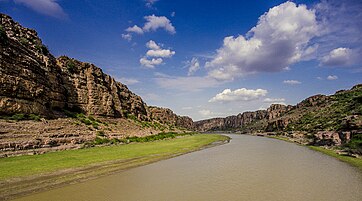 Gandikota canyon in Kadapa district


Some of the popular religious pilgrim destinations include Tirumala Venkateswara temple at Tirupati, Srikalahasti temple, Varaha Lakshmi Narasimha temple, Simhachalam, Shahi Jamia Masjid in Adoni, Gunadala Church in Vijayawada, and Buddhist centres at Amaravati and Nagarjuna Konda. Tirumala Venkateswara temple is the world's most visited Hindu temple, with footfalls of 30,000–40,000 daily and about 75,000 on New Year's Eve.[278] The region is home to a variety of other pilgrimage centres, such as the Pancharama Kshetras, Mallikarjuna Jyotirlinga, Kanaka Durga Temple and Kodanda Rama Temple. [279]
The state has several beaches in its coastal districts, such as Rushikonda, Mypadu, Suryalanka, etc.;[280] caves such as Borra Caves;[281] Indian rock-cut architecture depicting Undavalli Caves;[282] and the country's second-longest cave system, the Belum Caves.[283] The valleys and hills include Araku Valley, Horsley Hills, Papi Hills, and Gandikota Gorge.[284][285] Arma Konda, located in Visakhapatnam district, is the highest peak in the Eastern Ghats.[286]
Museums[edit]

The state has 32 museums,[287][c] which feature a varied collection of ancient sculptures, paintings, idols, weapons, cutlery, inscriptions, and religious artefacts. The Amaravati Archaeological Museum has several archaeological artefacts.[288] Visakha Museum and Telugu Samskruthika Niketanam in Visakhapatnam display historical artefacts of the pre-independence era. Bapu Museum in Vijayawada displays a large collection of artefacts. Advanced projection mapping with graphic, animation, and laser displays is used to tell the history of Kondapalli Fort, utilising the irregular landscapes, ruins, and buildings present in the fort as a screen. It was launched in 2019.[289]
The Archaeological Survey of India identified 135 centrally protected monuments in the state of Andhra Pradesh. These include the reconstructed monuments at Anupu and Nagarjunakonda.[290]
Sports[edit]

The Sports Authority of Andhra Pradesh is the governing body that looks after the infrastructure development, coaching, and administration of sports promotion schemes.[291] Dr. YSR Sports School, with classes for grades 4–10 and a focus on tapping rural sports talent, was established in Putlampalli, YSR district, in December 2006.[292]
The ACA-VDCA stadium in Visakhapatnam hosted ODI, T20I, and IPL matches.[293] Andhra Pradesh secured 16 medals at the 36th National Games held in 2022. It was ranked twenty-first in the competition. It won the most medals in athletics. Two silvers and one bronze were won in weightlifting.[294]
Karnam Malleswari is the first female Indian to win an Olympic medal.[295] Pullela Gopichand is a former Indian badminton player. He won the All England Open Badminton Championships in 2001, becoming the second Indian to win after Prakash Padukone.[296][297] Srikanth Kidambi, a badminton player, is the first Indian to reach the world championships final in 2021 in the men's singles and win a silver medal.[298]
See also[edit]
Notes[edit]
References[edit]
- ^ "Andhra celebrates Formation Day, CM hoists tricolour". Times of India. 1 November 2020. Archived from the original on 23 June 2023. Retrieved 23 June 2023.
- ^ "Former Supreme Court judge Justice S Abdul Nazeer appointed as Governor of Andhra Pradesh". Bar and Bench. 12 February 2023. Retrieved 8 August 2023.
- ^ Raghavendra, V. (30 November 2022). "Jawahar Reddy takes over as Chief Secretary of Andhra Pradesh". The Hindu. Archived from the original on 10 August 2023. Retrieved 8 August 2023.
- ^ a b DOP 2023, p. 430.
- ^ a b c d e f g DOP 2023, p. 3.
- ^ a b "AP Official Languages Act Amended to Recognise Urdu as Second Language". Sakshi Post. 7 March 2022. Archived from the original on 26 March 2022. Retrieved 31 October 2023.
- ^ a b Pavan (17 June 2022). "AP govt. issues orders recognising Urdu as the official language". The Hans India. Archived from the original on 27 July 2023. Retrieved 27 July 2023.
- ^ Vipra, Tanvi (16 March 2023). "Andhra Pradesh Budget Analysis 2023-24" (PDF). PRS Legislative Research. Retrieved 3 April 2024.
- ^ a b M, Sambasiva Rao (16 March 2023). "Andhra Pradesh posts a growth of 16.22% over the previous year". The Hindu. Archived from the original on 25 March 2023. Retrieved 25 March 2023.
- ^ a b "Andhra Pradesh gets new state bird, state flower". Deccan Chronicle. 31 May 2018. Archived from the original on 1 June 2018. Retrieved 1 June 2018.
- ^ "Andhra Pradesh". Lexico UK English Dictionary. Oxford University Press. Archived from the original on 26 September 2023. Retrieved 26 September 2023.
- ^ ICLD 2014, p. 2.
- ^ MOPNG 2023.
- ^ "Harappan heritage of Andhra, I.Mahadevan" (PDF). Archived from the original (PDF) on 10 June 2021. Retrieved 10 June 2021.
- ^ Ragini Devi 1990, p. 66.
- ^ "History of Andhra Pradesh". Government of Andhra Pradesh. Archived from the original on 16 July 2012. Retrieved 22 July 2012.
- ^ P. Raghunadha Rao (1993). Ancient and medieval history of Andhra Pradesh. Sterling Publishers, 1993. p. iv. ISBN 978-81-207-1495-3. Retrieved 9 June 2014.
- ^ Sailendra Nath Sen (1999). Ancient Indian history and civilization. New Age International. pp. 172–176. ISBN 978-81-224-1198-0. Archived from the original on 23 March 2017. Retrieved 29 January 2017.
- ^ Sudhakar Chattopadhyaya (1974). Some early dynasties of South India. Motilal Banarsidass. pp. 17–56. ISBN 978-81-208-2941-1. Retrieved 29 April 2024.
- ^ Carla M. Sinopoli (2001). "On the edge of empire: Form and substance in the Satavahana dynasty". In Susan E. Alcock (ed.). Empires: Perspectives from archaeology and history. Cambridge University Press. pp. 166–168. ISBN 978-0-521-77020-0. Retrieved 29 April 2024.
- ^ Tiwari, Anshuman; Sengupta, Anindya (10 August 2018). Laxminama: Monks, merchants, money and mantra. Bloomsbury Publishing. p. 307. ISBN 978-93-87-14680-8. Retrieved 29 April 2024.
- ^ Akira Shimada (2012). Early Buddhist architecture in context: The great stupa at Amaravati (ca. 300 BCE – 300 CE). BRILL. pp. 33–40. ISBN 978-90-04-23283-9. Archived from the original on 23 December 2016. Retrieved 14 October 2016.
- ^ "Ananda Buddha Vihara". Archived from the original on 14 October 2007. Retrieved 29 April 2024.
- ^ Charles Higham (2009). Encyclopedia of ancient Asian civilizations. Infobase Publishing. p. 299. ISBN 978-1-4381-0996-1. Archived from the original on 9 June 2016. Retrieved 6 March 2016.
- ^ Dutt, Sukumar (1988). Buddhist monks and monasteries of India: Their history and their contribution to Indian culture. Motilal Banarsidass. p. 132. ISBN 978-81-20-80498-2. Retrieved 29 April 2024.
- ^ David M. Knipe (2015). Vedic voices: Intimate narratives of a living Andhra tradition. Oxford University Press. pp. 8–9. ISBN 978-0-19-026673-8. Archived from the original on 9 April 2017. Retrieved 14 October 2016.
- ^ Padma, Sree; Barber, Anthony W. (2008). Buddhism in the Krishna river valley of Andhra. SUNY Press. p. 2.
- ^ Davidson, Ronald (2005). Tibetan renaissance. Columbia. p. 29.
- ^ Subramanian, K. R. (1989). Buddhist remains in Andhra and the history of Andhra between 225 and 610 A.D. Asian Educational Services. ISBN 978-81-20-60444-5. Retrieved 29 April 2024.
- ^ Sen, Sailendra Nath (1 January 1999). Ancient Indian history and civilization. New Age International. ISBN 978-81-22-41198-0. Retrieved 29 April 2024.
- ^ R. Parthasarathy. Andhra culture: A petal in Indian lotus. Government of Andhra Pradesh, 1984. p. 40.
- ^ Sarma, A. Rajeswara (2009). "Indrapura: The capital city of Vishnukundi dynasty". Proceedings of the Indian History Congress. 70: 138–141. ISSN 2249-1937. JSTOR 44147663. Retrieved 29 April 2024.
- ^ "About Eastern Chalukyas – Official AP state government portal – AP state portal". Archived from the original on 17 June 2016. Retrieved 27 May 2016.
- ^ Pollock, Sheldon, ed. (19 May 2003). Literary cultures in history: Reconstructions from South Asia. University of California Press. pp. 393, 397. ISBN 978-0-520-22821-4. Archived from the original on 5 April 2023. Retrieved 1 June 2023.
- ^ Dr. Mamidi, Harikrishna (19 October 2023). "Rise and fall of Kakatiyas, turning point in Indian history". Telangana Today. Archived from the original on 19 October 2023. Retrieved 30 October 2023.
- ^ "Imperial gazetteer of India, v. 15 1931". Kondaveedu. Digital South Asia Library. p. 393. Archived from the original on 13 June 2010. Retrieved 20 October 2009.
- ^ "Kondavid-durg near Guntur. 19 February 1804. Signed 'W.R.'". British on line Gallery. Archived from the original on 18 October 2012. Retrieved 20 October 2009.
- ^ Sewell, Robert (1884). Lists of inscriptions, and sketch of the dynasties of Southern India, Archaeological Survey of India. E. Keys at the Government Press. pp. 187–188. Retrieved 21 October 2009.
- ^ Sewell, Robert; Nunes, Fernão; Paes, Domingos (1900). "Origin of the empire (A.D. 1336)". A forgotten empire (Vijayanagar): A contribution to the history of India. S. Sonnenschein & co ., ltd. Retrieved 29 April 2024.
- ^ Stein, Burton (1989). The New Cambridge History of India: Vijayanagara. Cambridge University Press. p. 88. ISBN 978-0-521-26693-2. Retrieved 29 April 2024.
Controlling numerous villages and many large towns, these powerful chiefs commanded large mercenary armies that were the vanguard of Vijayanagara forces during the sixteenth century.
- ^ B. A. Saletore (1930). Social and Political Life in the Vijayanagara Empire Vol II. Retrieved 29 April 2024.
- ^ "Lepakshi Nandi, Veerabhadra temple on UNESCO world heritage tentative list". The Hindu. 29 March 2022. Archived from the original on 1 December 2022. Retrieved 30 May 2023.
- ^ Richards, J. F. (1975). "The Hyderabad Karnatik, 1687–1707". Modern Asian Studies. 9 (2): 241–260. doi:10.1017/S0026749X00004996. S2CID 142989123.
- ^ Faruqui, At Empire's End 2013, pp. 9–13.
- ^ Wheeler 1996, p. 26.
- ^ Regani, Sarojini (1988). Nizam-British relations, 1724–1857. Concept Publishing. pp. 130–150. ISBN 978-81-7022-195-1.
- ^ వెంకట శివరావు, దిగవల్లి (1944). కథలు-గాథలు (కందనూరు నవాబు రాజరికం) (in Telugu) (1 ed.). విజయవాడ: దిగవల్లి వెంకట శివరావు. pp. 127–140. Retrieved 1 December 2014.
- ^ Reddy, K. Venugopal (2010). "Dominance and Resistance: A Study of Narasimha Reddy's Revolt in Andhra against the injustice and towards India's freedom movement (1846–47)". Social Scientist. 38: 27. JSTOR 25621954.
- ^ "Imperial gazetteer of India v. 24, p. 339". Archived from the original on 4 June 2023. Retrieved 31 May 2023.
- ^ P 1978, p. 73-74.
- ^ P 1978, p. 78-79.
- ^ Hope, Elizabeth (1900). General Sir Arthur Cotton, R. E., K. C. S. I.: His life and work. London: Hodder and Stoughton. p. 120. ISBN 978-1444629965. Retrieved 26 December 2018.
dowleswaram.
- ^ Peter L. Schmitthenner (2001). Telugu resurgence: C.P. Brown and cultural consolidation in nineteenth-century South India. Manohar. p. 94. ISBN 978-81-7304-291-1.
- ^ "Kandukuri, A great reformer, remembered on his death centenary| Countercurrents". 27 May 2019. Archived from the original on 18 January 2022. Retrieved 16 January 2022.
- ^ Gudipoodi, Srihari (27 September 2012). "Remembering the immortal satirist". The Hindu. Archived from the original on 17 August 2021. Retrieved 16 June 2022.
- ^ "Struggle for Andhra state – AP state portal". Archived from the original on 15 June 2020. Retrieved 20 July 2020.
- ^ "Post-independence era, then and now". aponline.gov.in. Archived from the original on 20 December 2013. Retrieved 3 August 2013.
- ^ "N.T. Rama Rao: A timeline". The Hindu. 28 May 2017. Archived from the original on 1 June 2023. Retrieved 1 June 2023.
- ^ "P.V. Narasimha Rao". Encyclopedia Britannica. 17 May 2023. Archived from the original on 2 June 2023. Retrieved 1 June 2023.
- ^ Vaddiraju, Anil kumar (21 March 2020). "The mandal System in Telangana and Andhra Pradesh" (PDF). Economic & Political Weekly. LV (12). Archived (PDF) from the original on 1 June 2023. Retrieved 1 June 2023.
- ^ "eSeva: Andhra shows the way : P.M. Kuriakose, Commissioner, eSeva". Elets Techno media Pvt. Ltd. 8 August 2005. Retrieved 29 April 2024.
- ^ "KTR's admission: Chandrababu Naidu helped IT grow in Hyderabad". Economic Times. 15 December 2017. Archived from the original on 1 June 2023. Retrieved 1 June 2023.
- ^ "Bitter memories". Hinduonnet.com. Archived from the original on 22 January 2010. Retrieved 14 September 2010.
{{cite news}}: CS1 maint: unfit URL (link) - ^ "Civil war like situation in AP: TDP". Times of India. PTI. 12 August 2013. Retrieved 27 April 2024.
- ^ Jayaprakash Narayan (28 October 2013). "A challenge to Indian federalism". The Hindu. Archived from the original on 20 June 2023. Retrieved 20 June 2023.
- ^ "Telangana state formation gazette". The New Indian Express. Archived from the original on 6 July 2014. Retrieved 14 May 2014.
- ^ "CBN to be sworn as CM of Andhra on June 8th". Deccan-Journal. Archived from the original on 14 July 2014. Retrieved 2 June 2014.
- ^ P, Ashish (2 March 2017). "Chief Minister Chandrababu Naidu inaugurates new Andhra Pradesh assembly". India Today. Archived from the original on 14 April 2021. Retrieved 9 March 2021.
- ^ "Political map of India 1:4000000 (10th edition)". Survey of India. 1 January 2020. Archived from the original on 10 April 2023. Retrieved 16 June 2023.
- ^ Seshachalam Hills. Encyclopedia Britannica. 8 December 2023. Retrieved 29 April 2024.
- ^ M.S. Kohli (August 2010). Mountains of India: Tourism, Adventure and Pilgrimage. Indus Publishing, 2014. pp. 36–. ISBN 978-81-7387-135-1. Retrieved 4 July 2013.
- ^ "7 offbeat hill stations in Andhra Pradesh that are worth exploring this season". Goindigo. 3 January 2023. Retrieved 29 April 2024.
- ^ DES 2021, p. 107.
- ^ a b Britannica (23 April 2024). Andhra Pradesh. Encyclopedia Britannica. Retrieved 29 April 2024.
- ^ "Kadapa or Cuddapah basin". Directorate General of Hydrocarbons. Archived from the original on 26 April 2023. Retrieved 2 June 2023.
- ^ Chapter 13: Forests and tree resources in states and union territories (PDF). 2021. pp. 257–264. Archived (PDF) from the original on 2 June 2023. Retrieved 2 June 2023.
- ^ a b "Natural vegetation and wildlife". AP Forest Department. Archived from the original on 4 July 2014. Retrieved 6 June 2014.
- ^ "Coringa sanctuary". East godavari district, Government of AP. Archived from the original on 2 June 2023. Retrieved 2 June 2023.
- ^ "The list of wetlands of international importance" (PDF). The Ramsar convention on wetlands. The Secretariat of the Convention on Wetlands (Ramsar, Iran, 1971). p. 20. Archived (PDF) from the original on 30 May 2012. Retrieved 5 June 2014.
- ^ "Mineral reserves". Mines, Government of Andhra Pradesh. Retrieved 29 April 2024.
- ^ "Petroleum and Petrochemicals". Ysrapone, Government of Andhra Pradesh. Retrieved 4 May 2024.
- ^ "India: 'Massive' uranium find in Andhra Pradesh". New Delhi: BBC World News. 19 July 2011. Archived from the original on 19 July 2011. Retrieved 19 July 2011.
- ^ Ganguly, Nivedita (17 September 2014). "Lambasingi set to become tourist hotspot". The Hindu. Visakhapatnam. Archived from the original on 3 September 2015. Retrieved 26 November 2014.
- ^ "Lambasingi records 2º c". Deccan Chronicle. Visakhapatnam. 16 December 2013. Archived from the original on 13 July 2015. Retrieved 26 November 2014.
- ^ a b DES 2021, p. 31.
- ^ DOP 2023, p. 16.
- ^ Population in different age group - Census 2011 (PDF). MHRD. p. 3. Archived (PDF) from the original on 10 October 2022. Retrieved 28 May 2023.
- ^ "Sub-national HDI – area database". Global Data Lab. Institute for Management Research, Radboud University. Archived from the original on 23 September 2018. Retrieved 14 July 2021.
- ^ "A.P. has 3,99,84,868 voters, women outnumber men". The Hindu. 5 January 2023. Archived from the original on 28 May 2023. Retrieved 28 May 2023.
- ^ a b "Table C-16 Population by mother tongue: Andhra Pradesh". Census of India. Registrar General and Census Commissioner of India. Archived from the original on 12 November 2022. Retrieved 4 January 2023.
- ^ "Telugu language". AP State Portal. Government of India. Archived from the original on 19 June 2015. Retrieved 19 June 2015.
- ^ "Report of the commissioner for linguistic minorities: 47th report (July 2008 to June 2010)" (PDF). Commissioner for Linguistic Minorities, Ministry of Minority Affairs, Government of India. pp. 122–126. Archived from the original (PDF) on 13 May 2012. Retrieved 16 February 2012.
- ^ "AP recognises Urdu as second official language". Deccan Chronicle. 17 June 2022. Archived from the original on 27 July 2023. Retrieved 27 July 2023.
- ^ "Andhra Pradesh | History, capital, population, map, & points of interest". Encyclopedia Britannica. Archived from the original on 13 April 2020. Retrieved 7 April 2020.
- ^ Indian readership survey 2019 Q4 (PDF). IRS. 2020. p. 20. Archived (PDF) from the original on 25 September 2020. Retrieved 27 May 2023.
- ^ a b "Population by religion - Andhra Pradesh". censusindia.gov.in. Registrar General and Census Commissioner of India. 2011. Archived from the original on 28 May 2022. Retrieved 4 January 2023.
- ^ International Institute for Population Sciences (IIPS) and ICF (2021). National family health survey (NFHS-5), India, 2019-21: Andhra Pradesh (PDF). Mumbai: IIPS. Archived (PDF) from the original on 2 June 2023. Retrieved 2 June 2023.
- ^ "Andhra Pradesh: development eludes North Andhra region despite rich in natural resources, say leaders of various political parties". The Hindu. 7 January 2023. Archived from the original on 13 January 2023. Retrieved 16 June 2023.
- ^ "Population of AP districts (2011)". ap.gov.in. p. 14. Archived from the original on 17 March 2015. Retrieved 25 May 2014.
- ^ a b DOP 2023, p. 431.
- ^ Monthly bulletin (PDF). Ministry of Panchayat raj, Government of India. 2022. p. 3. Archived (PDF) from the original on 3 June 2023. Retrieved 3 June 2023.
- ^ DOP 2023, p. 18.
- ^ a b "Andhra Pradesh (India): State, major agglomerations & cities – Population statistics, maps, charts, weather and web information". Citypopulation.de. Archived from the original on 21 October 2018. Retrieved 7 September 2020.
- ^ a b c d "Andhra Pradesh budget analysis 2023-24". PRSINDIA. Archived from the original on 28 May 2023. Retrieved 28 May 2023.
- ^ "Indian states by GDP". Statistics Times. Archived from the original on 16 February 2016. Retrieved 21 February 2016.
{{cite web}}: CS1 maint: unfit URL (link) - ^ DOP 2015, p. 17.
- ^ "United AP stood second in agri exports". The Hindu. Vijayawada. 17 January 2016. Archived from the original on 17 January 2016. Retrieved 17 January 2016.
- ^ DES 2021, p. 127.
- ^ "AP top producer of shrimp: MPEDA". The Hindu. 16 January 2013. Archived from the original on 28 February 2013. Retrieved 9 June 2014.
- ^ "Vannamei hatcheries". Coastal Aquaculture Authority. Archived from the original on 3 June 2014. Retrieved 16 July 2014.
- ^ "195 Rythu Bharosa Kendras getting ready in the first phase". The Hindu. 19 February 2020. Retrieved 6 May 2024.
- ^ "Rythu Bharosa Kendras a big success, says A.P. Agriculture Minister". The Hindu. 26 February 2023. Retrieved 6 May 2024.
- ^ "12 states keen to emulate Land Titling Act: Kallam". Times of India. 6 March 2024. Retrieved 6 May 2024.
- ^ Jebaraj, Priscilla (21 February 2021). "The Hindu Explains | Why does India need conclusive land titling?". The Hindu. Retrieved 6 May 2024.
- ^ Annual survey of industries (PDF). DES, GOAP. 2020. Retrieved 26 May 2023.
- ^ "Ship building division". Hindustan Shipyard Limited. Archived from the original on 6 July 2014. Retrieved 6 August 2014.
- ^ "Firms in Sricity". Sricity.in. Archived from the original on 9 May 2015. Retrieved 14 May 2015.
- ^ "Auto, automobiles & EV". APEDB. Archived from the original on 26 May 2023. Retrieved 26 May 2023.
- ^ DOP 2023, p. 9.
- ^ "Cairn India operations - Andhra Pradesh". Cairn India. Archived from the original on 26 May 2023. Retrieved 26 May 2023.
- ^ MOPNG 2023, p. 31.
- ^ MOPNG 2023, p. 33.
- ^ "Andhra Pradesh's share in IT exports is below 0.2%, says union minister". The Hindu. 5 April 2023. Archived from the original on 24 May 2023. Retrieved 24 May 2023.
- ^ "AP ranked 3rd, Telangana 6th in domestic tourist footfalls". Deccan Chronicle. 5 December 2022. Archived from the original on 26 May 2023. Retrieved 26 May 2023.
- ^ a b "Delimitation of parliamentary and assembly constituencies order, 2008" (PDF). Election Commission of India. pp. 16–28. Archived (PDF) from the original on 5 October 2010. Retrieved 11 October 2014.
- ^ "Overview". AP Legislature. Government of Andhra Pradesh. Archived from the original on 19 May 2015. Retrieved 23 May 2015.
- ^ "Andhra Pradesh Assembly Election 2019 Detailed Results". Archived from the original on 20 March 2020. Retrieved 20 March 2020.
- ^ M., Sambasiva Rao (1 May 2024). "Impartial volunteers no longer | YSRCP uses village and ward volunteers for campaign". The Hindu. Retrieved 6 May 2024.
- ^ "Andhra Pradesh witnesses an upswing in revenue earned through registration and stamps department". The Hindu. 2 December 2022. Archived from the original on 26 May 2023. Retrieved 26 May 2023.
- ^ "AP Govt's debt mounts to ₹3.89 lakh crore in FY22". Businessline. 13 March 2022. Archived from the original on 28 May 2023. Retrieved 28 May 2023.
- ^ "YS Jaganmohan Reddy's three-capital plan on track as Andhra Pradesh governor gives nod to two bills". Archived from the original on 1 August 2020. Retrieved 1 August 2020.
- ^ Sudhir, Uma (13 January 2020). "Won't celebrate harvest festival, say Amaravati farmers amid protests". NDTV. Archived from the original on 14 April 2021. Retrieved 28 February 2021.
- ^ "Andhra Pradesh withdraws controversial 3-capital bill". NDTV.com. Archived from the original on 22 November 2021. Retrieved 22 November 2021.
- ^ "Andhra Pradesh: Support pours in for padyatra by Amaravati farmers". Siasat. 14 September 2022. Archived from the original on 25 April 2023. Retrieved 25 April 2023.
- ^ "Capital verdict: On A.P. high court judgment on Amaravati". The Hindu. 5 March 2022. Archived from the original on 26 April 2023. Retrieved 25 April 2023.
- ^ "Jagan's 3-capital plan hits SC hurdle". Hindustan Times. 9 January 2024. Archived from the original on 2 March 2024. Retrieved 2 March 2024.
- ^ Raghavendra, V. (12 July 2023). "Three capitals case: Supreme Court adjourns hearing of SLP filed by A.P. govt. to December". The Hindu. Archived from the original on 14 August 2023. Retrieved 14 August 2023.
- ^ "Explained : The stalemate between Telangana and AP". The Hindu. 10 January 2023. Archived from the original on 29 May 2023. Retrieved 29 May 2023.
- ^ "Cabinet approves terms of reference of Krishna water tribunal for Andhra, Telangana". Economic Times. 4 October 2023. Archived from the original on 2 March 2024. Retrieved 2 March 2024.
- ^ "Explained : The Telangana- Andhra Pradesh water dispute". The Hindu. 23 May 2023. Archived from the original on 29 May 2023. Retrieved 29 May 2023.
- ^ "Andhra Pradesh objects to Telangana's project on Godavari river". TOI. 30 January 2023. Archived from the original on 29 May 2023. Retrieved 29 May 2023.
- ^ "Explained : Dispute between Telangana and Andhra Pradesh over flooding of Bhadrachalam". The Hindu. 20 June 2022. Archived from the original on 29 May 2023. Retrieved 29 May 2023.
- ^ "Lok Sabha election 2024 date updates | Voting to be held from 19 April in 7 phases, results to be announced on 4 June". The Hindu. 16 March 2024. Retrieved 26 March 2024.
- ^ Apparasu, Srinivasa Rao (14 July 2022). "4 yrs after arrest, man accused of attacking Jagan awaits trial". Hindustan Times. Archived from the original on 27 March 2024. Retrieved 27 March 2024.
- ^ V, Raghavendra (25 March 2024). "Analysis | Five issues likely to cast a major impact on fortunes of YSRCP and NDA partners in Lok Sabha elections in A.P." The Hindu. Archived from the original on 26 March 2024. Retrieved 26 March 2024.
- ^ DOP 2023, p. 168.
- ^ "Anantapur-Guntur national highway gets govt's nod". TOI. 14 December 2022. Archived from the original on 21 May 2023. Retrieved 21 May 2023.
- ^ DOP 2023, p. 176.
- ^ DOP 2023, p. 173.
- ^ DOP 2023, p. 174-175.
- ^ DOP 2023, p. 175.
- ^ Indian railways year book 2021-22 (PDF). Indian Railways. 2022. p. 62. Archived (PDF) from the original on 18 April 2023. Retrieved 19 May 2023.
- ^ "Indian Railway map (searchable)". Indian Railway. Retrieved 30 April 2024.
- ^ "State-wise route kilometerage". South Central Railway. Archived from the original on 6 February 2011. Retrieved 23 April 2017.
- ^ "East coast railway divisions". East coast railway. Archived from the original on 28 March 2024. Retrieved 24 April 2023.
- ^ "South Western Railway - divisions". South Western railway. Archived from the original on 24 April 2023. Retrieved 24 April 2023.
- ^ IR 2022, p. 5.
- ^ IR 2022, p. 29.
- ^ "Statement showing category-wise no. of stations" (PDF). South Central Railway. Archived (PDF) from the original on 28 January 2016. Retrieved 23 April 2017.
- ^ "Vizag billed the cleanest rail station". The Hindu. 18 May 2017. ISSN 0971-751X. Archived from the original on 4 January 2018. Retrieved 4 January 2018.
- ^ Bhattacharjee, Sumit. "Hidden 100 – 58 tunnels. 84 bridges. Welcome to Araku Valley". The Hindu. Archived from the original on 9 June 2017. Retrieved 23 April 2017.
- ^ "Cabinet approves South Coast railway zone". Press Information Bureau. Archived from the original on 2 April 2019. Retrieved 12 February 2022.
- ^ B, Madhu Gopal (28 December 2021). "Delays dog new railway zone". Retrieved 30 April 2024.
- ^ DOP 2023, p. 180-183.
- ^ "Puttaparthi airport to facilitate emergency landings; security to be beefed up". Deccan Chronicle. 25 July 2021. Archived from the original on 10 August 2021. Retrieved 10 August 2021.
- ^ "Bhogapuram international airport will be ready by 2025, says Andhra Pradesh Industries Minister Gudivada Amarnath". The Hindu. 16 December 2023. Retrieved 6 May 2024.
- ^ DOP 2023, p. 183.
- ^ "Vizag port info". vizagport. Archived from the original on 11 November 2012. Retrieved 9 June 2014.
- ^ "Capacity of port". gangavaram port. Archived from the original on 21 February 2014. Retrieved 9 June 2014.
- ^ V., Raghavendra (17 August 2023). "Works apace at seaports and fishing harbours being constructed in Andhra Pradesh". Retrieved 6 May 2024.
- ^ DOP 2023, p. 195.
- ^ DOP 2023, p. 204.
- ^ "AP Fiber Grid Vision". apsfl.in. Archived from the original on 31 October 2018. Retrieved 31 October 2018.
- ^ "Water resources department - History". Water resources department. Archived from the original on 30 May 2023. Retrieved 30 May 2023.
- ^ "Dam design review panel approves repairs to Polavaram diaphragm wall damaged in Godavari floods". The Hindu. 5 March 2023. Archived from the original on 30 May 2023. Retrieved 30 May 2023.
- ^ "Excavation works of Poola Subbaiah Veligonda Project's tunnel two completed in Andhra Pradesh, says official". The Hindu. 24 January 2024. Archived from the original on 26 March 2024. Retrieved 26 March 2024.
- ^ "Veligonda project may be inaugurated in September". The Times of India. 10 January 2023. Archived from the original on 30 May 2023. Retrieved 30 May 2023.
- ^ "Rs 787 crore sanctioned by Andhra for makeover of Annamayya". Times of India. 4 November 2022. Archived from the original on 30 May 2023. Retrieved 30 May 2023.
- ^ "Andhra Pradesh Budget: Rs 11,908 crore to develop irrigation with focus on pending projects". The New Indian Express. 17 March 2023. Archived from the original on 30 May 2023. Retrieved 30 May 2023.
- ^ Power development in Andhra Pradesh (Statistics) 2021-22 (PDF). 2022. pp. 1–2. Retrieved 29 April 2024.
- ^ "AP govt spending 7.3 pc of state budget on healthcare, says top official". Siasat. 11 May 2023. Archived from the original on 2 June 2023. Retrieved 2 June 2023.
- ^ Vanam, Jwala Narasimha Rao (4 July 2022). "108 & 104 totally dissimilar services". The hansindia. Archived from the original on 2 June 2023. Retrieved 2 June 2023.
- ^ Sridhar, G. Naga (18 December 2023). "AP increases YSR Aarogyasri free treatment limit to ₹25 lakh". Business Line. Retrieved 30 April 2024.
- ^ Singh, P.; Powell, A. C. (2022). "Utilization trends of a government-sponsored health insurance program in South India: 2014 to 2018". Value in Health Regional Issues. 27: 82–89. doi:10.1016/j.vhri.2021.02.007. PMID 34844063. S2CID 244706313.
- ^ "School education department" (PDF). Rashtriya Madhyamik Shiksha Abhiyan. Hyderabad: School Education Department, Government of Andhra Pradesh. 26 March 2015. Archived from the original (PDF) on 19 March 2016. Retrieved 6 June 2019.
- ^ "The department of school education – Official AP state government portal". ap.gov.in. Archived from the original on 13 April 2017. Retrieved 7 November 2016.
- ^ Nandam, Naresh (28 September 2021). "Ongole : Future of poor students hangs in balance as govt absorbs aided staff". The Hans India. Archived from the original on 9 March 2024. Retrieved 22 March 2024.
- ^ "APREIS, about us". APSWREIS. Archived from the original on 24 March 2024. Retrieved 24 March 2024.
- ^ "Student information day wise status report". Commissionerate of School Education. Archived from the original on 6 June 2019. Retrieved 6 June 2019.
- ^ "School information". Commissionerate of School Education. Archived from the original on 6 June 2019. Retrieved 6 June 2019.
- ^ Rajulapudi, Sreenivas (22 April 2024). "86.69% students pass SSC examinations in Andhra Pradesh, 2,803 schools record 100% results". The Hindu. Retrieved 3 May 2024.
- ^ "Girls outperform boys by over 6% in SSC exams in Andhra Pradesh". 6 May 2023. Archived from the original on 19 May 2023. Retrieved 17 June 2023.
- ^ P., Sujatha Verma (12 April 2024). "Girls outperform boys in Intermediate Public Examination in Andhra Pradesh". The Hindu. Retrieved 3 May 2024.
- ^ "Girls dominate boys in AP Intermediate 1 & 2 results". Deccan chronicle. 27 April 2023. Archived from the original on 9 May 2023. Retrieved 17 June 2023.
- ^ DOP 2023, p. 12.
- ^ "Andhra Pradesh first state to adopt CBSE system for government run schools". Times of India. 7 November 2022. Archived from the original on 25 April 2023. Retrieved 25 April 2023.
- ^ "Andhra schools' transition from Telugu to English medium has roots in the far past". The federal. 19 May 2022. Archived from the original on 25 April 2023. Retrieved 25 April 2023.
- ^ Program appriasal document -SALT (PDF). World Bank. 20 May 2021. Archived (PDF) from the original on 25 April 2023. Retrieved 25 April 2023.
- ^ DOP 2023, p. 13-14.
- ^ "AP State Council for Higher Education home page". APSCHE. Archived from the original on 25 April 2023. Retrieved 25 April 2023.
- ^ "AP State Skill Development Corporation - Home". APSSDC. Archived from the original on 28 January 2023. Retrieved 22 May 2023.
- ^ UGC 2021, p. 100.
- ^ Correspondent, Special. "Old-timers recollect glorious days of AU". The Hindu. Archived from the original on 14 February 2021. Retrieved 2 May 2017.
- ^ "Statistical profile of universities in Andhra Pradesh" (PDF). Andhra Pradesh State Council of Higher Education. Archived from the original (PDF) on 22 December 2017. Retrieved 13 May 2017.
- ^ "Rajiv Gandhi University of Knowledge Technologies". Rgukt.in. Archived from the original on 7 October 2011. Retrieved 8 October 2011.
- ^ "Dr. Y.S.R University of Health Sciences (NUHS)". Department of health, medical and family welfare, Government of Andhra Pradesh. Archived from the original on 27 February 2020. Retrieved 2 June 2023.
- ^ Bhattacharjee, Sumit (2 June 2023). "A.P. Spotlight | The slow descent of state-run varsities into oblivion in Andhra Pradesh". The Hindu. Archived from the original on 2 June 2023. Retrieved 2 June 2023.
- ^ "NIRF Rankings: only two institutions from Andhra Pradesh figure in top 100 educational institutions". The Hindu. 5 June 2023. Archived from the original on 12 June 2023. Retrieved 17 June 2023.
- ^ UGC 2021, p. 93.
- ^ Transforming industrial training institutes (PDF). Niti Ayog. 2023. p. 30. Archived (PDF) from the original on 20 April 2023. Retrieved 17 June 2023.
- ^ B, Deenadhayalu (5 June 2021). "Public library system in Andhra Pradesh: An overview". Library Philosophy and Practice. University of Nebraska - Lincoln. Archived from the original on 5 August 2023. Retrieved 19 June 2023.
- ^ "This 100-year-old library loses its patrons as Internet spreads reach". The New Indian Express. 31 December 2018. Archived from the original on 19 June 2023. Retrieved 19 June 2023.
- ^ "Digital libraries yet to materialise despite funding". The Hans India. 19 November 2022. Archived from the original on 19 June 2023. Retrieved 19 June 2023.
- ^ "List of S&T organisations". India science, technology and innovation. Vigyan Prasar, Department of science and technology, Government of India. Archived from the original on 20 June 2023. Retrieved 20 June 2023.
- ^ "SHAR". Archived from the original on 27 September 2013. Retrieved 15 May 2014.
- ^ "Chandrayaan 1". Archived from the original on 8 February 2014. Retrieved 15 May 2014.
- ^ Maruyama, Koscak (1 March 1991). "The discovery of adenosine triphosphate and the establishment of its structure". Journal of the History of Biology. 24 (1): 145–154. doi:10.1007/BF00130477. S2CID 87425890. Archived from the original on 15 April 2023. Retrieved 3 June 2023.
- ^ Mukherjee, Siddhartha (2010). The emperor of all maladies: A biography of cancer. Simon and Schuster. p. 31. ISBN 978-1-4391-0795-9. Archived from the original on 28 March 2024. Retrieved 6 September 2011.
- ^ Joseph H Hulse (1 October 1985). "Professor Yelavarthy Nayudamma : A grateful appreciation of a dear friend" (PDF). IDRC. Archived from the original (PDF) on 8 October 2007. Retrieved 14 June 2007.
- ^ Prakasa Rao, B. L. S. (10 September 2014). "C. R. Rao: A life in statistics" (PDF). Current Science. Archived (PDF) from the original on 31 October 2017. Retrieved 17 February 2020.
- ^ Press in India 2020-21 Chapter 9: Press in states and union territories (PDF). RNI. 2021. p. 524. Archived (PDF) from the original on 28 May 2023. Retrieved 27 May 2023.
- ^ Dudekula, Dastagiri; KVN, Rajeswara Rao; Kopparthi, Adisesu (2018). "Telugu newspapers and periodicals in Andhra Pradesh and Telangana states: A study" (PDF). International Journal of Library and Information Studies. 8 (4). ISSN 2231-4911. Archived (PDF) from the original on 19 June 2023. Retrieved 19 June 2023.
- ^ "Highest circulated dailies, weeklies & magazines amongst member publications (across languages)" (PDF). Auditbureau. Archived (PDF) from the original on 8 April 2023. Retrieved 8 March 2023.
- ^ KT, Naheem; M, Saraswati Rao (2017). "Webometric analysis of Telugu news paper websites: An evaluative study using Alexa Internet". International Journal of Digital Library Services. 7 (2). ISSN 2250-1142.
- ^ "BBC to launch Telugu news website". The Hindu. 10 December 2016. Archived from the original on 19 June 2023. Retrieved 19 June 2023.
- ^ "BBC News తెలుగు: ఒక ఏడాది.. కొన్ని అనుభవాలు" (in Telugu). BBC. 2 October 2018. Archived from the original on 19 June 2023. Retrieved 19 June 2023.
- ^ "Andhra Pradesh: Tussle between media houses takes political colour". Hindustan Times. 27 April 2023. Archived from the original on 27 May 2023. Retrieved 27 May 2023.
- ^ "Warning to media by Andhra Pradesh government: Is it a caste rivalry?". The Telegraph. 21 October 2019. Archived from the original on 27 May 2023. Retrieved 27 May 2023.
- ^ "I & PR approved rates towards telecast of TV spots and Scrolls". IPR, AP Government. Archived from the original on 26 March 2023. Retrieved 27 May 2023.
- ^ "Existing AIR stations" (PDF). All India Radio. 1 April 2019. Retrieved 4 May 2024.
- ^ "Details of operational private FM radio stations as on 15.08.2022" (PDF). Ministry of Information and Broadcasting, Government of India. 15 August 2022. Retrieved 4 May 2024.
- ^ Annual report 2021-22 Intellectual property India (PDF). The Office of the controller general of patents, designs and geographical indications, Government of India. 2022. p. 76. Archived (PDF) from the original on 30 May 2023. Retrieved 30 May 2023.
- ^ "Banaganapalle mangoes finally get GI tag". deccanchronicle.com/. 4 May 2017. Archived from the original on 5 May 2017. Retrieved 13 May 2017.
- ^ Naidu, T. Appala. "Bandar laddu gets GI tag". The Hindu. Archived from the original on 12 November 2020. Retrieved 13 May 2017.
- ^ "Kalamkari: Craft of the matter". mid-day. 24 August 2015. Archived from the original on 31 January 2016. Retrieved 26 January 2016.
- ^ "State wise registration details of G.I applications (15th September, 2003 – till date)" (PDF). Geographical Indication Registry. p. 1. Archived (PDF) from the original on 18 September 2017. Retrieved 5 May 2017.
- ^ "Durgi stone craft". Cesdeva. Archived from the original on 4 December 2013. Retrieved 20 December 2013.
- ^ "Lacquer ware toys". Lepakshi handicrafts. Archived from the original on 30 May 2023. Retrieved 30 May 2023.
- ^ Sarma, Rani (20 December 2015). "The lac industry of Etikoppaka – An art form to cherish". The Times of India. Archived from the original on 25 December 2015. Retrieved 11 March 2016.
- ^ Pandippedi & Mantripragada 1928, pp. 42–49.
- ^ Gopavaram, Padmapriya; Subrahmanyam, Korada (2011). "1". A comparative study of Andhrasabdachintamani and Balavyakaranam. Hyderabad: University of Hyderabad.
- ^ Pandippedi & Mantripragada 1928, p. 64.
- ^ Pandippedi & Mantripragada 1928, p. 99.
- ^ Shaw, Padmaja (5 November 2019). "Celebrated Professor Harassed For Identifying 17th Century Social Reformer as 'Sudra'". The Wire. Retrieved 29 April 2024.
- ^ Proceedings of the Andhra Pradesh oriental conference, first session, Andhra Saraswatha Parishat, Hyderabad, May 1977. The Conference. 1979. p. 131. Archived from the original on 9 May 2023. Retrieved 2 June 2023.
Kalagnana is a special type of discipline very popular in Andhra Desa because of the famous Kalagnanam of Sri Potuluri Veerabrahmendhra swami written in Telugu. It forecasts many incidents which are proved to be correct by the posterity.
- ^ Yogendra K. Malik (1981). South Asian intellectuals and social change: A study of the role of vernacular-speaking intelligentsia. Heritage. p. 314. ISBN 978-08-364-0825-6. Retrieved 29 April 2024.
A later poet similar to Vemana was Potuluri Veerabrahmendhra swami , popularly known as Brahmamgaru
- ^ D. 1976, p. 80.
- ^ D. 1976, p. 88.
- ^ a b GK, Subbarayudu; C, Vijayasree (1996). "Twentieth-century Telugu literature". In Nalini Natarajan (ed.). Handbook of twentieth-century literatures of India. Greenwoord press. Archived from the original on 14 January 2021. Retrieved 30 May 2023.
- ^ "Jnanpith Laureates Official listings". Jnanpith Website. Archived from the original on 13 October 2007. Retrieved 7 November 2008.
- ^ A.D., Rangarajan (10 January 2020). "C Narayana Reddi: Changing contours of Telugu film lyrics". The Hindu. Retrieved 7 May 2024.
- ^ Ganguli, Nivedita (12 January 2023). "Festive flavours of Sankranti in Andhra Pradesh". The Hindu. Archived from the original on 2 June 2023. Retrieved 2 June 2023.
- ^ "Festivals and Fairs of Andhra Pradesh". AP Tourism. Archived from the original on 7 July 2022. Retrieved 5 October 2023.
- ^ "Special prayers mark Ramzan". The Hindu. 8 July 2016. Archived from the original on 2 June 2023. Retrieved 2 June 2023.
- ^ "Stage set for Rottela panduga". www.deccanchronicle.com. Archived from the original on 6 December 2011. Retrieved 6 December 2011.
- ^ "Good Friday observed across the State". The Hindu. 26 March 2016. Retrieved 7 May 2024.
- ^ "Easter celebrated with fervour and gaiety". Deccan Chronicle. 10 April 2023. Retrieved 7 May 2024.
- ^ "Grandeur marks Christmas celebrations". The Hindu. 26 December 2014. Retrieved 7 May 2024.
- ^ Ragini Devi 1990, p. 67.
- ^ Kuppuswami, Gowri; Hariharan, M. (1982). Bhajana tradition in South India. New Delhi: Sangeet Natak Academy.
- ^ Seepana, Dhanunjaya Rao (1 November 2021). "The importance of music in Telugu film industry with special reference to prominent music directors and playback singers" (PDF). International Journal of Academic Research. 8 (11): 34. ISSN 2348-7666.
- ^ Thoomati Donappa. Telugu harikatha sarvasvam. OCLC 13505520.
- ^ "Burrakatha loses sheen sans patronage". The Times of India. 14 January 2013. Archived from the original on 2 April 2015. Retrieved 2 September 2013.
- ^ "'Nandi Natakotsavam' begins with exciting plays in Andhra Pradesh". The New Indian Express. 24 December 2023. Retrieved 8 May 2024.
- ^ 20th century Telugu luminaries, Potti Sriramulu Telugu University, Hyderabad, 2005
- ^ M. L., Narasimham (7 November 2010). "Sati Savithri (1933)". The Hindu. Archived from the original on 13 November 2010. Retrieved 8 July 2011.
- ^ Bhagwan Das Garg (1996). So many cinemas: the motion picture in India. Eminence Designs. p. 86. ISBN 978-81-900602-1-9. Archived from the original on 21 May 2016. Retrieved 17 February 2017.
- ^ "AP state film television and theatre development corporation". APSFTVTDC. Archived from the original on 4 April 2023. Retrieved 30 May 2023.
- ^ "Film hub: Focus on Vizag again". Thehansindia. 17 February 2022. Archived from the original on 30 May 2023. Retrieved 30 May 2023.
- ^ Reddem, Appaji (5 March 2022). "Is Telugu cinema set for a change of scene?". The Hindu. Archived from the original on 23 June 2023. Retrieved 23 June 2023.
- ^ Ramakrishnan, Sathyalaya (11 September 2010). "Prestigious 'Phalke" award conferred to veteran film producer D Rama Naidu". Asian Tribune. Archived from the original on 23 May 2012. Retrieved 8 October 2011.
- ^ "Tollywood loses to Bollywood on numbers". The Times of India. 2 October 2010. Archived from the original on 13 July 2015. Retrieved 31 January 2014.
- ^ "Telugu film industry enters new era". Business Line. 6 November 2007. Archived from the original on 3 February 2014. Retrieved 31 January 2014.
- ^ "Oscars 2023: RRR's 'Naatu Naatu' wins best original song at the 95th Academy Awards, MM Keeravani sings ode to India on stage". Indian Express. 13 March 2023. Archived from the original on 13 March 2023. Retrieved 13 March 2023.
- ^ "Oscars 2023: RRR's Naatu Naatu wins best original song". BBC News. 13 March 2023. Archived from the original on 13 March 2023. Retrieved 13 March 2023.
- ^ APTDC 2019, p. 54–63.
- ^ "Andhra cuisine: A symphony of spices". Indianculture.gov.in. Archived from the original on 29 May 2023. Retrieved 29 May 2023.
- ^ "Most visited Hindu temple". Guinness world records. Archived from the original on 18 March 2020. Retrieved 19 June 2023.
- ^ APTDC 2019, p. 18–25.
- ^ "Andhra Pradesh to develop beach front locations". The Times of India. Archived from the original on 13 December 2016. Retrieved 13 May 2017.
- ^ Bhattacharjee, Sumit. "Natural world heritage status for Borra Caves sought". The Hindu. Archived from the original on 16 January 2017. Retrieved 13 May 2017.
- ^ "Welcome to Guntur district official website". Archived from the original on 27 June 2016. Retrieved 31 May 2016.
- ^ "Film tourism to boost Kurnool economy". deccanchronicle.com/. 3 February 2017. Archived from the original on 13 March 2017. Retrieved 13 May 2017.
- ^ "Tourist destinations in AP". Andhra Pradesh Tourism Department. Archived from the original on 6 August 2010. Retrieved 5 June 2014.
- ^ APTDC 2019, p. 67-75.
- ^ "Arma Konda, India". peakbagger. Archived from the original on 5 January 2023. Retrieved 17 June 2023.
- ^ Directory of museums in India. Ministry of culture, Government of India. 2023. pp. 1–29. Archived from the original on 1 June 2023. Retrieved 18 June 2023.
- ^ "Archaeological museum, Amaravati – Archaeological Survey of India". Asi.nic.in. Archived from the original on 29 September 2011. Retrieved 19 August 2010.
- ^ "Visitor footfall picks up at Kondapalli Fort post-renovation". The Hindu. 20 February 2019. Archived from the original on 16 July 2021. Retrieved 17 June 2023.
- ^ "Alphabetical list of monuments – Andhra Pradesh". Archaeological Survey of India. Archived from the original on 30 November 2022. Retrieved 24 May 2023.
- ^ "Sports authority of Andhra Pradesh". SAAP. Retrieved 28 May 2022.
- ^ "Home page of Dr YSR Sports school". Dr YSR sports school, Sports authority of Andhra Pradesh. Archived from the original on 20 June 2023. Retrieved 20 June 2023.
- ^ "ACA-VDCA Stadium". Board of Control for Cricket in India. Archived from the original on 24 April 2023. Retrieved 24 April 2023.
- ^ "National games: AP settles with 16 medals, 21st rank". The Hindu. 12 October 2022. Archived from the original on 28 May 2023. Retrieved 28 May 2023.
- ^ Ganguly, Meenakshi (27 December 2000). "Conversations: 'I did what I could for my country'". Time. Archived from the original on 5 January 2013. Retrieved 5 January 2013.
- ^ "Pulella Gopichand". mapsofindia.com. Archived from the original on 13 February 2009. Retrieved 7 February 2010.
- ^ "P Gopichand". The Times of India. 11 December 2002. Archived from the original on 21 August 2009. Retrieved 7 February 2010.
- ^ "Srikanth Srikanth Kidambi". Olympics. Archived from the original on 28 October 2022. Retrieved 28 October 2022.
Bibliography[edit]
- APTDC (2019). Andhra Pradesh main book. Andhra Pradesh Tourism. Archived from the original on 31 March 2023. Retrieved 17 June 2023.
- DES (2021). Agricultural statistics at a glance 2020-21 Andhra Pradesh (PDF). DES, Government of Andhra Pradesh. Retrieved 29 April 2024.
- DOP (2015). AP Socio economic survey 2014-15; Chapter 2: Macro economic aggregates (PDF). Archived from the original (PDF) on 1 July 2015. Retrieved 1 July 2015.
- DOP (2023). Socio economic survey 2022-23 (PDF). Government of AP. Archived (PDF) from the original on 28 March 2024. Retrieved 24 April 2023.
- ICLD (2014). The Andhra Pradesh reorganisation act, 2014 (PDF). Ministry of Law and Justice. Archived from the original (PDF) on 24 September 2015. Retrieved 14 July 2015.
- IR (2022). New railways New Andhra Pradesh 2014-2022 (PDF). Archived (PDF) from the original on 13 August 2022. Retrieved 19 May 2023.
- MOPNG (2023). Indian PNG statistics (PDF). Ministry of petroleum and natural gas, India. Archived (PDF) from the original on 26 May 2023. Retrieved 26 May 2023.
- UGC (2021). Annual report 2020-21 (PDF). UGC. Archived (PDF) from the original on 22 May 2023. Retrieved 22 May 2023.
- Wheeler, James Talboys (1996). Madras in the Olden Time: Being a History of the Presidency from the First Foundation of Fort St. George to the Occupation of Madras by the French (1639–1748). Asian Educational Services. ISBN 8-12-060553-5.
- P, Raghunadha Rao (1978). History of Modern Andhra (PDF). New Delhi: Sterling Publishers Pvt. Ltd. Retrieved 29 April 2024.
- Faruqui, Munis D. (2013). "At Empire's End: The Nizam, Hyderabad and Eighteenth-century India". In Richard M. Eaton; Munis D. Faruqui; David Gilmartin; Sunil Kumar (eds.). Expanding Frontiers in South Asian and World History: Essays in Honour of John F. Richards. Cambridge University Press. pp. 1–38. ISBN 978-1-107-03428-0.
- Pandippedi, Chenchiah; Mantripragada, Bhujanga Rao (1928). "VI Purana yuga, or the age of translation". A history of Telugu literature. Calcutta: The association press. pp. 42–49.
- D., Anjaneyulu (1976). Kandukuri Veeresalingam. New Delhi: Publications Division. p. 90.
- Ragini Devi (1990). Dance dialects of India. Motilal Bansarsi Dass. ISBN 978-81-208-0674-0. Retrieved 9 June 2014.
External links[edit]
 Definitions from Wiktionary
 Media from Commons
 News from Wikinews
 Quotations from Wikiquote
 Texts from Wikisource
 Textbooks from Wikibooks
 Resources from Wikiversity


Government[edit]

General information[edit]
- Andhra Pradesh at Curlie
 Geographic data related to Andhra Pradesh at OpenStreetMap


.svg)


| International | |
|---|---|
| National | |
| Geographic | |