Talk:Gini coefficient
| This article is of interest to the following WikiProjects: | |||||||||||||||||||||||||||||||||||||||||||||||||||||||||||||||||||||||||||||||||||||||
|---|---|---|---|---|---|---|---|---|---|---|---|---|---|---|---|---|---|---|---|---|---|---|---|---|---|---|---|---|---|---|---|---|---|---|---|---|---|---|---|---|---|---|---|---|---|---|---|---|---|---|---|---|---|---|---|---|---|---|---|---|---|---|---|---|---|---|---|---|---|---|---|---|---|---|---|---|---|---|---|---|---|---|---|---|---|---|---|
|
|||||||||||||||||||||||||||||||||||||||||||||||||||||||||||||||||||||||||||||||||||||||
Archives |
|---|
[edit] External link
I have been disappointing to notice a user have been permanently deleting all the external links I have posted on Wikipedia (roughly a little bit more than half a dozen). For example, I had posted one on that page but it is now gone. I have an economics blog that aims at spreading technical economics knowledge, especially targeting students. I am not giving any point of view whatsoever on my articles, I am not trying to bias the materials. I have several degrees and professional experiences in economics, i.e. I know what I'm writing. I am not infringing any copyrights since I have been writing an overwhelming majority of the materials available through my blog. Though, my handouts are sourced and documented if necessary.
All the links I have provided on Wikipedia were making computational programs related to the pages' topics available for free. I therefore consider the links and the materials as added-values since you can't download anything directly from the website.
In a nutshell, my links had nothing to do with email-spamming, advertising or spreading corrupted knowledge. They were perfectly respecting all the Wikipedia criteria for posting external links. Though I admit they refer to my personal web page at the very beginning of the articles, no one is forced to click on the reference to visit my website. The reader is absolutely free to stay on the google docs page where my links are hosted.
Here is a sample [[1]]
Thank you, I appreciate your time. --Julienbarlan (talk) 21:15, 14 October 2010 (UTC)
[edit] On a quick glance...
Just a suggestion for better presentation/visibility - a quick glance of the article by a lay person doesnt really reveal whether a higher gini co-efficent represents higher equality or higher inequality. May be a statement in the opening paragraph can be of help. Chocolate Horlicks (talk) 13:39, 11 March 2010 (UTC)
-
- Agree!, I still do not understand if is better for a country to be near 0 or near 1. --Jor70 (talk) 18:12, 6 May 2010 (UTC)
- Agree!, I think Gini is a complete wrong way to measure equality (or fair).If we believe that the ability of people follow the bell shape ,their income should follow bell shape ! — Preceding unsigned comment added by 80.191.130.200 (talk) 09:17, 21 August 2011 (UTC)
-
-
- From everybody according to ability, to everybody according to need! :-)
-
-
-
- Not everybody thinks fairness is about people left with what they are able to earn themselves, and equality is certainly not. Equality of opportunity might be nearer that, but read e.g. Amartya Sen and Capability approach for many complications.
-
-
-
- One may also want to see to what degree a society is equal (as measured by the income distribution), regardless of what is thought to be a good distribution.. E.g. market mechanisms work best in somewhat equal societies, as prices then reflect real choice, not choices of the wealthy. The Gini coefficient may be good for that.
-
[edit] Gini coefficient need not be bounded above by 1
The Gini coefficient has cumulative share of X on the vertical axis. If X is for instance, wealth, then some households can have negative wealth, that is a negative percentage of the total wealth in the economy. This means the Lorenz curve can dip below zero (in fact, this does happen even in US data). Whether the Lorenz curve dips far enough below to cause the Gini to be above 1 is another question, but perhaps some note should be made of this. —Preceding unsigned comment added by 76.124.108.179 (talk) 13:46, 17 February 2010 (UTC)
[edit] Motivate the math for non-quants please
This topic is of interest to anyone who wishes to think precisely about equality, and most such people are not deeply versed in statistics. Yet the concepts in play are not terribly complex. In other words, non-quants should be able to follow the presentation, and could if the author explained as he went along how each number or equation related to the guiding project of quantifying equality. (Yes, I know this is partly subjective.) Personally, I became impatient with the math and decided not to invest time trying to understand it, since the author had not earned my trust. That is, I didn't sense that by the end of the article I would understand Gini coefficient and its the strengths and weaknesses as a quantitative measure of equality of income or whatever else it can be applied to. 24.125.43.171 (talk) 21:30, 3 August 2008 (UTC) Peter Henderson
There is no shortcut to understanding quantitative relationships. You must learn some mathematics. --Kjb (talk) 15:57, 10 May 2009 (UTC)
I think you're overstating the case, Kjb. We could add some text to the article that explains how the mathematical formulae represent inequality in a way that would be very accessible to someone who did not want to deal with the details of the integral. (Right now the article has some very nice and clear explanations of how the computation works that are accessible to non-math types, but no explanation of *why* those computations are the right ones.) If there are no objections, I'll take a shot at adding such text. —Preceding unsigned comment added by Riedl (talk • contribs) 14:29, 12 June 2009 (UTC)
[edit] Japan not colored right in Picture
In the image titled "Gini coefficient, income distribution by country." Japan is colored yellow turkey, which would mean it has the lowest Gini coefficient of all nations (<0.25). However, Japan's Gini value is 0.38 which would make it light green. —Preceding unsigned comment added by 76.230.234.52 (talk) 07:15, 10 June 2008 (UTC)
- I'm going to change Japan's Gini coefficient in the intro paragraph to what the Japan article says - .38. There's a citation in the japan article and no citation in here, so I'll default to that. Meviin (talk) 03:44, 24 August 2008 (UTC)
[edit] abused concept
The gini is a much abused concept that this article doesnt reflect.
Firstly socialists use it to imply that unequal income distribution is bad, whereas this is absolutely not the case. In itself the use of the word "perfect" distribution implies that a perfect straight line is some of form of goal. A straight-line distribution is neither desierable nor necessarily acheivable.
Inequality is the natural product of individual choices expressed as preferences for differentiated options. See Albert-László Barabási: Linked, the new science of networks. These preferential attachments, as Barabási calls them are mathematically shown to result in power law distributions. Which are distributions of vast inequality.
The underlying principle can simple be explained as small difference in a set options yield vast differences in outcome.
The implication is very clear that inequality in society can be the natural result of fair and free trade, so the factors that alter inequality in either positive or negative are not comparable with gini.
The gini coefficient tells you nothing about any particular society other then as a fairly meaningless comparative number.
- I think that the article does quite a good job in describing Gini coefficient limitations. Have in mind that this is just a measure (and it is important to understand a measure of what, exactly). Whether particular value is 'good or 'bad' is a matter of interpretation. Of course, those who moan about Gini coefficient (or other similar indices) abuse prefer to sweep data about startling inequalities in some highly developed countries under the rug. --bonzi (talk) 09:50, 10 February 2008 (UTC)
- What about large gini coefficients, in comparison to other countries or the world average, says more than 0.5? does that tell us anything about the country? It sounds rather unhealthy. --Vsion 02:06, 26 August 2005 (UTC)
-
- no because you can't tell what is the normal degree of inequality and what factors changed it. you also have to consider the dynamic nature of a society. what is the rate of change over time? You cant compare two societies with vastly different tax system because they create inequality at different speeds, but eventually the higher taxing system will arrive at the same place as the lower taxing system. I think you can only meaningfully compare one set of data against itself over time if you know what are the causes of the differences.
-
- some distributions are extremely unequal, for example distributions of market share of search engines, but this is a good thing because it means more people are using the better search engines.
-
- A single number doesnt really tell you where in its evolution a country is or why its inequality deviates from expectation or even what its expectation is.
-
- the UK has a gini index of 36. Uzbekistan has a gini index of 26 and papua new guinea 51. yet the later are both very poor countries. You cant infer much from these numbers without looking at what is happening in each country. vietnam has an index of 36.1 which is nearly indentical to the UK. yet you would expect the UK to have a vastly different inequality to vietnam.
-
-
- If a country has a high gini index say more than .50, then i would say the country has an income distribution problem, leading to social instability and crimes. Unless it is caused by natural disaster, the problem probably indicates an unfair distribution of the country's resources (fertile land, mineral resources, govt. revenue, restriction on internal migration, ethnic discrimination, etc). Of course, we can't summarize a whole society into a single number, we alway need to examine further to better understand. --Vsion 03:35, 26 August 2005 (UTC)
-
-
-
-
- Perhaps you can point to evidence of any study that shows a corelation between a gini number and crime or social instability. Denmark has more property crime then the US and as much as the UK but has one of the lowest gini coeficients in the world. gini doesn't measure opportunity and restriction on opportunity is a better indicator of a society with a problem. Uzbekistan has a very low gini yet has a lot of social instability same with most of the former yugoslav republic. Rwanda is another example of a very low gini with catastrophic social instability.
- A counter example is Hong Kong, above .5 for a long time but the only social unrest is against china not inequality.
-
-
-
-
-
- Inequality in itself is fairly benign if opportunity is present. In fact an excess of equality can be a sign of a society with serious problems. Deus777
-
-
Anyway today is generally accepted as better a low one. Think too about envy in a not equal society.
-
-
-
-
- Granite26
- I think the issue is that according to this, a 'perfect' distribution has a doctor (8+ years of schooling) making the same income as a janitor(High School, maybe), and somebody working 50 hours a week making the same as somebody working 30.
- It could be argued that there is nothing wrong with a doctor and janitor making the same amount. Just because you perform more skilled work, which law, moral, or god's book says you deserve a bigger cut of the natural resources and energy spending of a country? "Wealth" tied to what you do is a concept that's at the core of capitalism, and not one that holds in general. For example, what if there was an economy where manufacturing of everything had been completely automated (no human intervention), but most services (medical, teaching, cleaning, even hair dressing) were still provided by people. Does it make sense that all of a sudden the doctor has more right to more of the machines' output, for example 10 BMWs and the hair dresser has right to only bicycles? Who makes that call? If you say the "market", then that means that you are only considering capitalism. We must think further ahead people! Post-capitalism may one day be a reality ... —The preceding unsigned comment was added by 129.162.1.31 (talk) 23:38, 9 January 2007 (UTC).
-
-
-
As a 'concept', the Gini coefficient (better use the Theil index) just is about measurement, not about socialists or communists or rightists or marsians or whatsoever. As for judgements and interpretation of data, the following excellent book could help: Yoram Amiel: Thinking about Inequality: Personal Judgment and Income Distributions, 2000. The book adds meaning to maths.
DL5MDA (talk) 23:49, 10 February 2008 (UTC)
- I agree with the above two responses. I study political science, and if the Gini coefficient was just about edifying a socialist worldview, I would be against it on grounds of childish oversimplification. However, the Gini coefficient has and can be used for theories predicting social conflict. Such theories are commonly variants of relative deprivation theory, a theory that is attributed to Ted Gurr (who wrote "Why Men Rebel") or Davies (see "J-curve theory") but can be traced back as far as Aristotle's "The Politics":
- "The universal and chief cause of...revolutionary feeling... [is] the desire of equality, when men think that they are equal to others who have more than themselves; or again the desire of inequality and superiority, when conceiving themselves to be superior they think that they have not more but the same or less than their inferiors....(1236-1237)
- I think the Gini coefficient can be helpful, though it is unclear of how useful it is when predicting conflict in low-income societies where conflicts can be over land (the "minifundia" or by comparison the "landlessness" theories of social conflict), drugs (which may possibly be tied to land, such as in Columbia or Afghanistan), or other resources like oil or diamonds. —Preceding unsigned comment added by 68.197.126.201 (talk) 07:38, 24 April 2008 (UTC)
- Granite 26: For more on this concept you might want to check out Johan Galtung's "intellectual proletariat" theory of social revolution, if you are not already familiar with it. By the way, I appreciate your enthusiasm, but you have to realize socialism is a very old concept. Again, it goes back to Aristotle (see Book Two: Part 5). The problem with socialism is not a lack of imagination on the part of "the masses," but that it is predicated on false assumptions of human nature - that is, that reward and punishment are not operative on human motivation, and that moral dilemmas can be eradicated through Draconian laws against inequality. I think socialists need to be more imaginative at this point, not capitalists. —Preceding unsigned comment added by 68.197.126.201 (talk) 07:55, 24 April 2008 (UTC)
-
- Strange discussion. None of the inequality measures has any normative implication on what is right or wrong, on wether inequality is good or bad etc. Those measures just describe inequality. Forget about socialism and capitalism and just do honest science. That starts with unbiased observation and measurement. The abuse of inequality measures is labeling them socialist or capitalist or whatsoever. The difference between the inequality measures is the distribution model behind the inequality measures. Gini's coefficient basically has no model, but it is "intuitive" to people who like the Lorenz curve. And there is lots of empirical experience with that measure. Hoover's "Robin-Hood-Index" is proportional to the effort required to get from inequality to equality with maximum information and minimum effort. Theil's index assumes a model, in which stochastical changes eventually lead to equality in a closed system. Now pleaseplease hold your horses: This does NOT mean, that equality is a teleological goal of redistribution. Equality of everything just is the most probable final state of a closed system. In open living systems you always need a difference between maximum entropy of a category (perfectly equal distribution within that category) and the actual entropy of a category, which is given by inequal distribution within that category. In information theory such a security gap is called "redundancy" (ISO/IEC DIS 2382-16:1996). That is what also keeps societies alive. (They do that since the stoneage by defining system borders by means of "us" and "them" and exporting entropy to "them". "Them" is, where the litter is.) However, too much inequality results in turbulent adjustment processes, which may destroy structures required to stay alive. Different inequalities in different categories have different implications, which can be shown by the non-proportional relation between Hoover's and Theil's index. All those aggregating measures have in common, that socialists, communists, Austrian school disciples, anarcho capitalists etc. can abuse them in fighting against each other. But that isn't science anymore. The Gini-Coefficiont just is a statistical measure. What you make out of it should be discussed under distributive justice etc. And with the Theil index you even can do research on where inequality can have optima under certain conditions. If one can not deal with measuring before judging, one should stay away from economics as a science and turn to learn the rules belief systems and ideology, which deal with any analytic measurement as a threat to their stability. And reading Yoram Amiel's Thinking about Inequality: Personal Judgment and Income Distributions and Sen's & Foster's On Economic Inequality could save you lots of time which otherwise is wasted in normative and biased discussions. Regards from Munich -- DL5MDA (talk) 16:47, 26 April 2008 (UTC)
[edit] The case of India and China
How come that the coefficient is so low in India and China? I mean disparities between rich and poor are tremendous down there and forms of child labour are commonplace. I'm also astonished by the case of Russia.Mitch1981 (talk) 19:26, 7 January 2008 (UTC)
- Is it Income or savings or ...? If income, then what kind of income? How has the coefficient be computed? How reliable are statistics in India, China, Russia etc.? The sources of confusion are endless ;-)
- Try: http://www.wider.unu.edu/research/Database/en_GB/database/
- DL5MDA (talk) 01:24, 8 January 2008 (UTC)
There are 1.3 billion and 1 billion people in China and India respectively. There may be a huge gap between the rich and poor, but the vast, vast majority of their citizens make the same money and live the same poor life. As for Russia, according to the CIA factbook/wiki, their middle-class has grown from 5 million to 55 million over the past 7 years, with the average weekly salary increasing 10 fold. Your idea of income inequality in Russia may be outdated. —Preceding unsigned comment added by Sbw01f (talk • contribs) 06:20, 19 January 2008 (UTC)
China had Gini figure about the same as US, which is high. However, there are lot people in China that don't have the access to good quality of education and thus have less chance of climbing up the ladders, this cannot be reflected by the Gini coefficient. its a kind of inequality of opportunity and are common among the third world. The US should do better as its the most democratic and the richest country in the world, and its education system are also considered the best. Russian experienced very high speed of economic growth since 2000, and the salary was increasing even faster, however a drawback was caused by the financial crisis of 2008, and the economic gap between different regions and cities are still big. but generally speaking, Russian are much more equal than a decade before. —Preceding unsigned comment added by 61.49.9.186 (talk) 09:48, 24 January 2011 (UTC)
[edit] Disadvantages of Gini coefficient as a measure of inequality
"As an extreme example, an economy where half the households have no income, and the other half share income equally has a Gini coefficient of ½; but an economy with complete income equality, except for one wealthy household that has half the total income, also has a Gini coefficient of ½"
According to these calculator, a society where 2 individual have an income of 0 and other two have an income of 15 has a gini index of 0.5.
A society where 3 individual earn 5 and one earn 15 has a gini index of 0.25.
How is right (wrong) - the article or the calculator?--83.132.102.216 (talk) 17:32, 10 April 2008 (UTC)
Someone {{fact}}tagged the assertion in this article that, "As an extreme example, an economy where half the households have no income, and the other half share income equally has a Gini coefficient of ½; but an economy with complete income equality, except for one wealthy household that has half the total income, also has a Gini coefficient of ½". I did a quick check with the Gini calculator here,with results that data of "1000, 1000, 1000, 1000, 1000, 0, 0, 0, 0, 0" produces a Gini coefficient of 0.5, but data of "2500, 500, 500, 500, 500, 500" produces a Gini coefficient of 0.333333. I tried again with data of "2500, 250, 250, 250, 250, 250", and that produces a Gini coefficient of 0.5, so I reworded the assertion to say "As an extreme example an economy where half the households have no income, and the other half share income equally has a Gini coefficient of 0.5; and an economy with one wealthy household that has half the total income and the rest of the households share the other half equally also has a Gini coefficient of 0.5". -- Boracay Bill (talk) 23:22, 10 April 2008 (UTC)
- But the second situation is not "an economy with one wealthy household that has half the total income and the rest of the households share the other half equally" - it is "an economy with one wealthy household that has two thirds of the total income and the rest of the households share the remaining third equally" (the total income is 3750 = 2500 + 5*250; 2500 is 2/3 of 3750)--83.132.77.218 (talk) 23:35, 11 April 2008 (UTC)
-
- I don't what I was thinking. I trashed the link above to the Gini calculator (now corrected) and garbled the info. The earlier example had problems and so did my ham-handed attempt to fix it. I've removed the "As an extreme example ..." bit -- Boracay Bill (talk) 01:39, 12 April 2008 (UTC)
- Is there a measure of the gini coefficient excluding indigenous people? (ie, are not a part of the normal flow of economy.) Obviously such a measure also has it problems... do you want to discount the rural population of china since china is actively trying to incorporate them in the society, and soon they will be counted? but it also has advantages (how much of brasil's inequality is structural versus how much is really just their extreme preservation of hundreds of local indigenous cultures) — robbiemuffin page talk 22:49, 18 June 2008 (UTC)
[edit] Split proposal
In many places in the article, remarks pertaining only to the Gini index of wealth in a country or region interfere with general discussion of the Gini coefficient, which can be used in any context, but which even in economics has other applications. I propose we move treatment of the Gini index for wealth to a separate article (where we can also discuss use of the coefficient rather than the index for wealth). Classical geographer (talk) 09:15, 15 May 2008 (UTC)
-
- What? Do you mean that splitting the article up so that there is a clear distinction between the economic use of the term, plus the other applications of gini coefficients such as in biology and the other things? I'm not so sure about that. Economics uses it quite alot, whereas other disciplines dont afaik. Still, it can be discussed. 58.7.206.131 (talk) 15:04, 25 May 2008 (UTC)
I agree!! As a measure of dispersion it can be used accross disciplines, there should be a regular statistics entry for it! —Preceding unsigned comment added by 138.253.73.55 (talk) 01:46, 17 June 2008 (UTC)
- I agree that the article should be split. The present title could be kept for the maths stuff, with something more directly meaningful for the "measure of inequality" stuff.Melcombe (talk) 09:12, 20 June 2008 (UTC)
- I don't think the article should be split. Yes, GINI can be used to talk about any inequalities, but its application to economics significantly outweighs other applications. Odds are that anyone who came here searching came for economics. The article is still short enough that any disambiguation can/should happen within the article itself. Cretog8 (talk) 15:19, 20 June 2008 (UTC)
- Agree with Cretog8 against a split. Dbfirs 21:57, 20 June 2008 (UTC)
- Also agree with Cretog8 against a split. You can still create a disambig if needed (leaving this article in place with a small tag at the top) or create a section in this article for alternative meanings. Morphh (talk) 19:01, 29 June 2008 (UTC)
- Also against a split for the reasons stated by Cretog8. I'm not sure we have enough information for a separate mathematics article. The article focuses on the economic uses of the Gini coefficient. The first sentence says it well: "most prominently used as a measure of inequality of income distribution". That is, it is most notable as a measurement in economics. It should not come as a surprise that the article focuses on the economic uses of the coefficient. Besides, there's a link to Statistical dispersion#Measures of statistical dispersion in the first line, if users are actually looking for the mathematical application, even though that seems unlikely because there are so many other (less ambiguous) ways of expressing statistical dispersion. I think Morphh's idea of putting the little tag at the top is good, something like "This article is about the use of the Gini coefficient in economics. For its use in mathematics and statistics, see Statistical dispersion". Ultimately, the economics article should be kept here (without a disambiguation page) since economics is the most common application of the term Gini coefficient: look at "What links here". Nearly all of those links refer to the Gini coefficient as a measure in economics. Phlyght (talk) 17:44, 26 October 2008 (UTC)
- Also agree with Cretog8 against a split. You can still create a disambig if needed (leaving this article in place with a small tag at the top) or create a section in this article for alternative meanings. Morphh (talk) 19:01, 29 June 2008 (UTC)
- Agree with Cretog8 against a split. Dbfirs 21:57, 20 June 2008 (UTC)
- I don't think the article should be split. Yes, GINI can be used to talk about any inequalities, but its application to economics significantly outweighs other applications. Odds are that anyone who came here searching came for economics. The article is still short enough that any disambiguation can/should happen within the article itself. Cretog8 (talk) 15:19, 20 June 2008 (UTC)
- I think a split makes sense. The article entitled "Gini coefficient" would most appropriately be about the coefficient itself. Using wealth distribution as an example makes sense, but the Gini coefficient is used for many other purposes nowadays. The detailed material about its use for wealth distribution is important, but should be in an article about "Gini coefficient in wealth distribution". One observation about this debate: many of the people arguing against the split seem to be fighting to keep the article "an economic article". That seems an inappropriate sort of disciplinary ownership. Economists should be proud to have invented the coefficient that is now being used for all sorts of statistical dispersion measurements. riedl —Preceding undated comment added 15:11, 12 June 2009 (UTC).
- A split could perhaps make sense as explained by ser:riedl, The Gini has been developed for econometrics. There it is used habitually. Geometrically it is easy to explain, but that does not show, how much sense it makes in economics or any other application. Its just popular in economics, so one should deal with it associated to economics. For scientifiv research, Theil's index or even Hoover's index is more suitable. --DL5MDA (talk) 20:49, 12 June 2009 (UTC)
[edit] Talk page archival
I've taken the liberty of archiving some of the older topics on this page. Let me know if there are issues with the archive. Thanks. -FrankTobia (talk) 01:49, 26 May 2008 (UTC)
[edit] Brazil´s 2008 GINI
Recent Brazilian steady growth has reduced its GINI to a 2008 value of 50.5 (http://en.wikipedia.org/wiki/Brazil). Brazil is after all being able to reflect its economic boom into social improvement results, it was recently announced that 20% of the total population has left de poverty zone. —Preceding unsigned comment added by 77.54.45.160 (talk) 13:22, 26 June 2008 (UTC)
I agree this page is way badly written, it should contain a listing of countries by GINI instead of the not updated chart. —Preceding unsigned comment added by 213.22.33.64 (talk) 10:53, 20 September 2008 (UTC)
[edit] "Disadvantages"
"However, Gini coefficient can also be calculated for any kind of distribution, e.g. for wealth." has been added to "It measures current income rather than lifetime income. A society in which everyone earned the same over a lifetime would appear unequal because of people at different stages in their life; a society in which students study rather than save can never have a coefficient of 0." The addition is right. The original sentence simply describes one out of many uses of inequality measures. That is not a "disadvantage". --DL5MDA (talk) 22:26, 8 August 2008 (UTC)
- There is a lot of information that the coefficient does not give. I think this is not a series of "disadvantages" but "limitations". 77.20.185.243 (talk) 09:25, 11 May 2009 (UTC)
The biggest disadvantage is that there is no agreed upon purpose for measuring inequality. A room occupied by a millionaire, a billionaire and a multi-billionaire would have a very misleading Gini coefficient. The Gini coefficient is inherently a political tool. —Preceding unsigned comment added by 67.241.83.46 (talk) 20:31, 29 January 2011 (UTC)
[edit] A simple Gini model
While the cases G=0 and G=1 are intuitively clear, the meaning of intermediate values is not very obvious. A simple "two social classes" model can help in this direction.
If we assume the total income equal to 1 and consider two population groups, the poorer X earning total income A and the rest 1-X earning total income 1-A , the Gini coefficient has a very simple form:
G = X - A
It can be further shown, that within the legal values G < X < 1 , the minimum of the rich-to-poor per capita income occures when X = 0.5 ( 1 + G ) and equals ((1+G)/(1-G))^2
Some values of the minimum ratios of rich-to-poor per capita incomes for different Gini values:
G = 0.25 (Sweden) : R/P (min) = 2.8 , for 63% of people earning 38% of the total income
G = 0.41 (USA) .... : R/P (min) = 5.7 , for 71% of people earning 30% of the total income
G = 0.55 (Clile) ..... : R/P (min) = 11.9 , for 78% of people earning 23% of the total income
G = 0.74 (Namibia) : R/P (min) = 45 , for 87% of people earning 13% of the total income
More details (in bulgarian) here: http://rigas.forumotion.com/iauanoai-f4/iaaaoiaoiaie-iiaeie-t147-750.htm#27809
- More generally, with two income groups, poor and rich, Gini = (share of poor in population) - (share of poor's income in total income). I don't have a ref for it but it's just a simple calculation. Perhaps it should be added.radek (talk) 19:18, 11 May 2009 (UTC)
[edit] credit risk model
I propose to include a section on the use of the Gini Coefficient as part of credit risk model build. There are several different intrepretations of the formulae and also its application. I would like to clear it up and publish for other users. MaryGowenBOI (talk) 10:17, 8 October 2008 (UTC)
- I'm not familiar with this, but if it's used that way it might be a good addition. Just make sure your new info is sourced. CRETOG8(t/c) 13:35, 8 October 2008 (UTC)
- I moved your addition plus the credit risk stuff from the lead to a new section. CRETOG8(t/c) 13:45, 8 October 2008 (UTC)
- Can you provide (maybe here on the talk page) a more complete reference for "Analytics of risk model validation"--author, pages, and such? Also, does the whole idea come from that book? Which parts of your addition should get referenced by it? If you put that stuff here, I'll update the reference in the article. CRETOG8(t/c) 17:00, 8 October 2008 (UTC)
-
- His source is The Analytics of Risk Model Valuation by George Christodoulakis and Stephen Satchell, Academic Press, 2007. If, like me, you don't have that book, you can get an idea of how the gini coefficient can be used for credit scoring measurement from this journal article: Assessing the Discriminatory Power of Credit Scores (very technical, from page 13 onwards). - Marcika (talk) 15:16, 14 October 2008 (UTC)
-
-
- I'm also a bit unfamiliar with this but I looked at the above paper and it makes sense. You basically use the Gini to construct a statistical estimator. That part's fine. The part that bothers me is "In this case, negative Gini Coefficient values are possible." Maybe it's just not explained well, but the Gini, by definition (and by formula G1) cannot be negative, otherwise it's not a Gini. Note that this is also true in the paper provided above. It cannot be negative because you cannot have a negative area and the Gini's a ratio of two areas.radek (talk) 15:45, 14 October 2008 (UTC)
-
-
-
-
- This may help: Deutsche Bundesbank, Do banks diversify loan portfolios?, 2005 (Usage of e.g. the Gini coefficient for risc evaluation of loan portefolios) --DL5MDA (talk) 21:55, 29 October 2008 (UTC)
-
-
As someone who works in Credit Risk, I may be able to shed some light on this (no time to clear up that paragraph in the article at the minute though). Basically, the Gini coeff. (usually along with something like the Kolmogorov-Smirnov measure) is used to measure the predictive power of binary-outcome models, like ones for predicting the likelihood of default on a loan over some time period. Assuming we're talking about a scorecard model, you basically compute the cumulative proportion of 'good' and 'bad' records as you move upwards through the range of scores being assigned by the model and use them to plot the Lorenz curve. If the model discriminates well, it will tend to assign low scores to bad records (those which went on to default) and high scores to good records (those which did not); in this case, you'll get a Lorenz curve and Gini coeff. close to the ideal (there's a definite value to discrimination in this instance!) of 1 (i.e. all your bads get the lowest possible score and all your goods get the highest). A negative Gini would appear if (most or all of) the Lorenz curve was above the diagonal, i.e. the model was assigning low scores to good records and high scores to bad ones. I've seen it referred to as Somers D(R|C) stat in this context - by the SAS software's procedures, for instance. Oddtwang (talk) 15:57, 10 July 2009 (UTC)
[edit] free market nations
In the first paragraph the article mentions "free market" nations. As far as I'm aware there are no nations that adhere to the free market. There are some that are more liberalised then others (countries such as Singapore and Hong Kong being the most liberalised). This should be changed.
[edit] Gini coeff over time.
In regard to the fact tag on the statement: "It is possible for a given economy to have a higher Gini coefficient at any one point in time than another economy, while the Gini coefficient calculated over individuals' lifetime income is actually lower (or even more higher) than the "more equal" (at a given point in time) economy's.". I think this possibility is just intuitive. Consider two economies. In both economies individuals live for two periods, young, then old and the proportion of young to old in both is 1/2, 1/2. In the first economy 1/2 of people (young and old) always have income of 1 regardless of whether they're old or young, while the other 1/2 have income of 2/3. In the second economy all the young (also 1/2 of total pop) have income of 1/5 but all the old have (1/2) have income of 4/5. Then the first economy will have a lower Gini at any point in time, while the second Gini will have a Gini of zero based on lifetime income (since everybody's lifetime income is 1).radek (talk) 19:38, 13 April 2009 (UTC)
[edit] EU Gini
I removed speculation about the EU gini being "surprisingly low" because it's not clear how Eurostat calculated the EU-wide gini. It's possible that it was calculated by weighting the country specific Ginis by population shares (this, unfortunately, is how it's often done) but this method is invalid as the section on disadvantages of the Gini points out.radek (talk) 03:01, 23 April 2009 (UTC)
Until an actual Gini coefficient is calculated for the EU (averaging Gini coefficients does NOT provide anywhere near the correct value for the entity as a whole), maybe this value (31) for "European Gini coefficient" should be removed entirely? It's very misleading to even compare this to other Gini coefficients.Ed Sanville (talk) 20:02, 21 September 2010 (UTC)
I have removed the EU entry. There was a comment that claimed that it was not an average, but that's not substantiated by the source/reference. Furthermore, it is numerically close to the average, which is implausible given the wide disparities in incomes between EU countries. The EU Gini coefficient needs to be substantially higher than the average of the Gini coefficients of the member states, and this is not.
[edit] Figure caption is wrong
The caption on the figure illustrating the curve says "Graphical representation of the Gini coefficient; (The area of the whole triangle is defined as 1, not 0.5)"
The area of the triangle, i.e.: the area under the 45deg line, IS 0.5. The Gini coefficient is the area between the 45deg line and the Lorenz curve AS A PERCENTAGE OF the area under the 45deg line, 0.5.
The section in the body describes it correctly. A/(A+B), where A is the area between the curves and B is the area below the Lorenz curve. A+B = 0.5, since that's the area of the triangle (b*h*1/2 = 1*1*1/2 = 0.5), so the coefficient is A/0.5 = 2A, where A = 1/2 (area of triangle) - B (area below Lorenz curve). —Preceding unsigned comment added by 204.178.86.60 (talk) 15:37, 19 May 2009 (UTC)
[edit] Link from country pages to this article
The Gini coefficient is linked to from many country pages (France, Honduras, ...). The values on those pages are between 0 and 100, while this page defines the Gini coefficient to be a ratio between 0 and 1. The use is not even consistent within this article: "Gini coefficients range from approximately 0.230 in Sweden to 0.707 in Namibia" and then "While most developed European nations and Canada tend to have Gini indices between 24 and 36". MarcelM (talk) 12:27, 15 June 2009 (UTC)
[edit] Removed portion
Uncited "facts" (Original Research?) which Advance a Controvertial Position, so placed here so anyone can Verify This section of the article (copied as a blockquote after this paragraph):
1. In any case it should be RELIABLY SOURCED (has been over a year since someone other than me requested it to be...), otherwise shouldn't be re-added to this or any WP article as it doesn't meet standards such as WP:OR, WP:RS. But additionally:
2. It seems to be "cherry picking" data instead of considering all countries of the entire world; its assertion that there is a "correlation" is uncited. But what's more, the following list of nations --given that it's a long list, though I don't claim this to be any more verifiable than what the author put in the article, it's JUST a very rough qualitative, not quantitative, form of evidence (unlike the author who added the unverified claims, I won't overstate my case or claim this is encyclopedic/verifiable/etc)-- it only _seems_ to contradict that author's assertion (that equality-of-income i.e. low Gini correlates to high income), but the onus really isn't on me to prove him wrong, the onus is on him/her to verify a claim like this BEFORE someone needed to ask him for a citation then I needed to remove it, but I have here a list of "low Gini, low GDP" nations which contradict the pattern that he/she claimed to exist; these nations have --like most of Europe-- Gini indices of less than 40, but every nation on this list --unlike Europe's wealth, and much like Latin America, southern Africa, and other "high Gini low income" nations-- all have per-capita GDP (PPP) ranging from under $2,000 to under $15,000 income annually; I've omitted some very small nations from this list: Albania, Algeria, Armenia, Azerbaijan, Bangladesh, Belarus, Benin, Bulgaria, Egypt, Ethiopia, India (1/6th of world-population), Indonesia, Kazakhstan, Kosovo, Kyrgyzstan, Laos, Libya, Macedonia, Mauritania, Moldova, Mongolia, Montenegro, Myanmar, Pakistan, Tajikstan, Tanzania, Ukraine, Uzbekstan, Vietnam, Yemen. THE POINT IS: Take the nations that support or contradict the author's assertion of one pattern, take the total land-mass of the nations I listed which contradict the author's assertion of one pattern (and includes India, 1/6th of the world's pop), and they add up to ROUGHLY equal the land-mass as the nations that DO support with high Gini & low GDP (mostly LatAm, Southern Africa). I'm sceptical that 50/50 would result in a "clear" pattern as he/she claims, but I don't even need to disprove his statement, the onus probandi (burden of proof) is on someone to get a verifiable source before re-adding this assertion to the article.
3. It should carry with it a caution that correlation is not causation (Cum Hoc logical fallacy) -- even if sources can confirm correlation is present, despite my scepticism based on the above list.
Poor countries (those with low per-capita GDP) generally have higher Gini indices, spread between 40 and 65, with extremes at 25 and 71, while rich countries generally have lower Gini indices (under 40). The lowest Gini coefficients (under 30) can be found in continental Europe. Overall, there is a clear negative correlation between Gini coefficient and GDP per capita; although the U.S.A, Hong Kong and Singapore are all rich and have high Gini coefficients.
The paragraph after that is:
In many of the former socialist countries and in-development capitalist countries (e.g., Brazil), the sizeable underground economy may hide income for many. In such a case, earning/wealth statistics over-represent certain income ranges (i.e., in lower-income regions), and may alter the Gini coefficient either up or down.[citation needed]
...and someone was giving us mere speculation in that paragraph, but more importantly:
Western Europeans (cited as his/her opposite example of Gini vs income) may ALSO "hide income for many," e.g. if the wealthy use money-laundering and offshore tax-shelters, both of which have been in the news lately, that is also an "underground economy" and many wealthy people reside in those wealthy Western European nationss, not just "socialist...and in-development capitalist," nations, and that would mean Western Europe's Gini could be skewed into the lower numbers than is reality, even more than (or perhaps less than, such is the nature of unencyclopedic speculation) "socialist...and in-development capitalist countries". My point here is that, again, someone has cherry picked only the info that advances a certain political position, and omitted the rest (half-truths vs the full truth).
Returning to "only IMHO" again (what I'm about to say doesn't belong in the article any more than what I took out of the article and placed above, since the following is just as WP:OR, the only diff is I don't have the audacity to put MHO (unverifiable opinions) into a WP article, I say this only in case anyone wants to research it): Looking at the map in section 4.0 of the article, there _seems to be_ correlation of (Gini & per-capita GDP, where either may be high or low) relative to (a certain culture and/or regional trading-partners e.g. wealth condensation: Look at South & SE Asia=low Gini+low GDP, Central Asia=low Gini+low GDP, Eastern Europe=low Gini+low GDP, BUT INSTEAD Latin America=high Gini+low GDP (They share a Spanish culture of course: laws, religion, how Spain left its colonies, etc.), southern Africa=high Gini+low GDP, AND INSTEAD Western Europe=low Gini+high GDP... these examples of "other factors, without Gini having a consistent relation to GDP once you move outside EACH REGION OF THE WORLD" suggest a spurious correlation, if any correlation at all, of Gini to GDP (the latter typically being associated with income, wealth, and/or productivity). Some nations that I listed (as subsection "2.", in italics) in my first paragraph are approx as war-torn as LatAm's Banana Republics (e.g. some --and only some-- of Eastern Europe is war-torn, yet unlike LatAm, has low Gini...but shared LatAm's low income), or have had dictators throughout history like much of LatAm+southern Africa, which have stunted growth...most of these regions have had those same factors (although maybe to greater or lesser degrees, which can cause them to have differences to each other). 24.155.205.244 (talk) 19:19, 3 August 2009 (UTC)
- Let me summarize your point, for the benefit of those who have some trouble in getting through what you wrote here:
-
- (And please be a bit careful with capitalization and the use of bold and italics - it might give the impression that your fist is on the table...) (I took the liberty to put double == around the title of your comment; and while I was at it, I also replaced the title with a shorter one, as is customary here, and moved your title just below. Apologies in advance for that.)
- You doubt the statement that GDP and Gini are correlated, and have therefore removed that statement;
- and you doubt the statement that a sizeable underground economy may bias the result, and have therefore removed that statement as well.
-
- My position is that you're right in removing these unsourced statements; however, I feel the bias created by underground economies can be put back in. The statement about a correlation between GDP and Gini can be reverted to say the opposite is true, quoting some of your examples - or citing a trustworthy publication; I stumbled upon an article by R. Ram in a 1992 issue of Economic Development and Cultural Change, entitled "Income, distribution, and welfare: an intercountry comparison", which might be an easy starting point. Classical geographer (talk) 20:02, 3 August 2009 (UTC)
[edit] Ùpdate this article please
There is a picture in this article showing brazil with 60,0 gini. You should update that... New gini for brazil in 2009 is 49,3... there is a big difference.. Please update that... —Preceding unsigned comment added by 189.77.139.137 (talk) 02:15, 6 August 2009 (UTC)
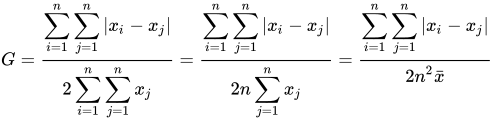
The article is unclear about the actual upper bound of the Gini coefficient. It says only that the range of the Gini coefficient is from zero to one. Actually, the second formula (the first non-integral formula) provided for the Gini ratio in the calculation section DOES NOT have an upper bound of one. It has an upper bound of (n-1)/n. For n=4, the upper bound would be 0.75. For n=5, it would be n=0.80 and so on. The upper bound would have an assymptotic limit of one as n approached infinity. At the end of the calculation, Angus Deaton's version of the formula is given, which is essentially the preceding version with a scaling factor correction so the upper bound is equal to one. For n=4, for example, the Gini ratio would be calculated as in the preceding formula only multiplied by 4/3. So which is better? The logic of an upper bound of 0.75 and not 1.0 for N=4 is straightforward. If one person out of four had all the income, three quarters of his income would have to be redistributed for absolute income equality. (If all of it were redistributed, as implied by a coefficient of one, then he would have no income left, and would be income deprived.) For N=100, the upper bound would be 0.99 because then if the same person had all of the income, he would have to give up 99% of it to achieve an equal distribution of income. What is the logic of giving the same Gini ratio (one) to a situation where one person out of four has all the income and to a situation where one person out of 100 has all the income, when the second situation is clearly more unequal than the first?
t the bottom of page 2 —Preceding unsigned comment added by BA0017 (talk • contribs) 20:07, 9 August 2009 (UTC)
[edit] Bad color map in diagram
The color map goes from yellow to green, back to yellow, back to green. This makes it needlessly difficult to differentiate the low index nations. http://upload.wikimedia.org/wikipedia/commons/3/34/Gini_Coefficient_World_CIA_Report_2009.png —Preceding unsigned comment added by 87.198.170.2 (talk) 13:53, 19 October 2009 (UTC)
[edit] US Gini coefficient
Is there really a need for this section? United States is already featured on the timeline graph and I doubt we should do this for every large country in the world. PokitJaxx (talk) 20:51, 25 October 2009 (UTC)
The Gini Coefficient cited for the US for 2008 is incorrect. On pg 38 of the Census report cited, the number is 46.6, not 46.69. [1] Hmakav (talk) 16:32, 1 July 2010 (UTC)
If the US GINI is listed (and I personally was looking for exactly these data), then could some-one check to see if an additional note should be made based on the following: "First, a significant part of the rise in inequality is an illusion. Changes to the tax code since the 1980s have created strong icentives for owners . . . [i.e., some wealthy parties] to report their business earnings as personal income. . . . [I]t just menat that money is recorded in a different column of Uncle Sam's ledger" with respect to the highest 1/2% (David von Drehle, "Don't Bet Against [sic] the United States," <ital>Time</ital> March 14, 2011, pp. 22~23, quoted material on p. 23. The author does not specifically mention GINI, so I don't know if it is applicable. Also, is this what the Wik note ("(Recalculations made in 1992 added a significant upward shift for later values) ") is referring to? Kdammers (talk) 03:47, 9 March 2011 (UTC)
- Apparently significant changes in the mode of calculation were made by the Census Bureau - making direct comparison year-to-year at that time impossible. This is not about tax law changes AFAICT. Collect (talk) 15:44, 9 March 2011 (UTC)
[edit] Anti-Immigrant Bias?
I use this article as a quick link rather often yet lately I have found someone has sneaked in some anti-immigrant language in the "disadvantages" section. I've marked the bullet point with a request for citations --Lizasabater (talk) 14:05, 13 May 2010 (UTC)
- The phrases marked are a purely hypothetical observation that is obviously correct. It does not imply any moral judgement. It just says (expressed simply): if a lot of low wage people are added to the population, the Gini coefficient will go up (unequality will rise). −Woodstone (talk) 10:33, 14 May 2010 (UTC)
This page looks as if somebody had just added random "disadvantages" off the top of their head. {{essay-entry}}. The statement under discussion appears to be
- "Care should be taken in using the Gini coefficient as a measure of egalitarianism, as it is properly a measure of income dispersion. For example, if two equally egalitarian countries pursue different immigration policies, the country accepting higher proportion of low-income or impoverished migrants will be assessed as less equal (gain a higher Gini coefficient)."
The problem with it is not "anti-immigrant bias". The problem is that it is simply pulled out of thin air. What are "two equally egalitarian countries"? How do you even define that? What does it mean to "accept low-income migrants"? Before you can "accept low-income migrants" you need to have lots of low-income jobs available, which already says something about your level of egalitarianism. Also, what's with the caveat "don't use it as a measure of egalitarianism"? Has anyone suggested it should be used as a measure of egalitarianism? It is obviously one possible measure of social equality, but without pairing it with the Gini coefficient of wealth distribution, income distribution says nothing. Why, most of the richest people declare an income of zero.
In short, please don't just make up stuff. If there are applications, advantages and disadvantages cited in literature, refer to such literature. It is obvious that the Gini coefficient of income distribution says something about a society (very stable societies (Scandinavia) have the lowest value, societies with considerable social tension (China, USA, Latin America) have intermediate values, and societies on the brink of race war or tribal fragmentation (South Africa, Angola) have the highest values; it would probably be instructive to ask how India can have a lower value than the USA). The important thing is to point out what the coefficient is supposed to do, and what it isn't supposed to do, and in conjunction with what other indicators it should be studied. For all this, we need to rely on expert literature. --dab (𒁳) 12:08, 10 July 2010 (UTC)
[edit] US Gini Analysis
I felt that this section wasn't neutral enough because although it shows the changes in the GINI over time for the US, it does not compare their changes to other countries in the world. —Preceding unsigned comment added by 64.81.35.138 (talk) 18:14, 11 December 2010 (UTC)
- In fact, since small changes in what is included and not included in income makes a huge difference (One source ascribes a very large change just by including or not including Social Security and Medicare as income or not) the US figures are specifically not comparable to other countries. As for indicating in any way desirablitly of "total equality" one might note than a community of ten who have absolutely nothing has an Gini of .000, while a community of ten where one person is a billionaire and the other 9 only have a million each has a Gini of nearly 1.000. Collect (talk) 14:57, 27 February 2011 (UTC)
[edit] Can anyone take a peek at ...
List of U.S. states by Gini coefficient of income inequality, it is up for deletion and can use opinions for either keep or delete. --Richard Arthur Norton (1958- ) (talk) 19:06, 1 February 2011 (UTC)
[edit] Scale of coefficient/index above or below 1
I just dropped to learn what this thing (seen in some Web article) is, and I noticed something confusing as I read about it.
In the intro and first sections of the article, we learn that the "Gini coefficient" is a value between 0 and 1, e.g., 0.23. Down in the section "Gini coefficient of income distributions", the text talks about the "Gini index" being some considerably larger number, e.g., 24, 36, 40, 56, 66. The graphic in that section also uses "Gini index" in the title and (although the axes of the graph are, regrettably, unlabelled) the y-axis runs from 0 to 70. Is this difference based on an actual, formal differentiation between coefficient and index, or are we just being a little sloppy with the numbers? — JohnFromPinckney (talk) 10:19, 18 August 2011 (UTC)
- The Gini coefficient (or index) is a dimensionless number between 0 and 1. It can be expressed as a percentage between 0 and 100. Publications, including this article, are often sloppy by omitting the percent sign. Confusion is not really possible, since values under 1% (0.01) never occur in practice. Any value over 1 should be read a a percentage. −Woodstone (talk) 10:34, 18 August 2011 (UTC)
- Thanks. But that just means we need to fix the article and accompanying graphic (not that I know how). Yes? — JohnFromPinckney (talk) 10:39, 18 August 2011 (UTC)
- Cool, Woodstone; I see you've addressed this. Good work! — JohnFromPinckney (talk) 09:21, 19 August 2011 (UTC)
- Thanks. But that just means we need to fix the article and accompanying graphic (not that I know how). Yes? — JohnFromPinckney (talk) 10:39, 18 August 2011 (UTC)
[edit] Weakness?
This is from the article as it stands right now: "The weaknesses of Gini largely lie in its relative nature: It loses information about absolute national and personal incomes". The GINI coefficient is not a measure of absolute national or personal incomes. This is not a weakness, it is inherent from the design criteria. No one goes around complaining about how F1 cars are no good as vitamin sources. F1 cars are designed to go really fast, not to be eaten for vitamins. 46.162.89.103 (talk) 21:38, 30 August 2011 (UTC)
- I have taken a stab at this with a few small edits. There is more to be done, however. Jmacwiki (talk) 16:42, 24 September 2011 (UTC)
[edit] Negative Gini
In this article is a section on the use of the Gini coefficient in credit scoring. It's also well known that G1 = 1 − 2AUC[2]. So when the AUC is less than .5, the Gini is negative. So actually the Gini coefficient is locked in the interval between -1 and 1, isn't it? --217.14.52.2 (talk) 13:53, 6 September 2011 (UTC)
- If 0 < AUC < 1/2, then 1 < 1-2*AUC < 0. (For instance AUC = 1/4 => 1-2*AUC = 1/2. This is approximately the case that the figure in the article shows. AUC is labeled "B" in that figure.) What's the problem?
- What is also "well known" is that the cumulative distribution is usually defined to accumulative from whichever direction (+Infinity or -Infinity) results in a concave curve (Lorenz curve). In this case, 0 < AUC < 1/2, and G1 = 1-2*AUC. If the distribution happens to be defined in the opposite direction, then AUC can be > 1/2.
- But that just means that the formula in its "well known" form is wrong. If you happen to choose to accumulate in the unconventional direction, so that the Lorenz curve is convex, then AUC > 1/2, and G1 is defined as twice the area above the Line of Equality, but under the Lorenz curve (instead of below the line, but above the curve). In that case, AUC = 1/2 + G1/2, i.e., the area under the Line of Equality (1/2) plus the area above the Line but below the Lorenz curve. So G1 = 2*AUC - 1 in this case.
- Don't get stuck on the formula. G1 is defined as twice the area of a certain region of this figure (whether above the Line or below). It's defined to be positive (area), and the region is defined to lie between the Line and the edges (wherever the curve happens to lie). So that region cannot have an area > 1/2, and G1 cannot be > 1. If a formula gives a different result, you are using the wrong formula. — Preceding unsigned comment added by Jmacwiki (talk • contribs) 16:20, 24 September 2011 (UTC)
Thank you for explanation, seems I got it a bit wrong. — Preceding unsigned comment added by 212.40.209.98 (talk) 11:24, 16 November 2011 (UTC)
[edit] 2010 Gini coefficient worldwide ?
Is there some data out ? Yug (talk) 20:13, 5 October 2011 (UTC)
[edit] income vs. wealth
All the data in the article relates to the Gini coefficient of income. As the first item in the disadvantage section points out, the Gini coefficient of wealth may be more useful. Does data exist on the Gini coefficient of wealth for various countries/times? Mostly I ask because India is famous for its unequal distribution of wealth but has a low Gini coefficient of income.Wikimedes (talk) 18:18, 13 October 2011 (UTC)
[edit] Cuba
I'm not sure why but it seems like Cuba isn't included on quite a few of these maps and lists. I think it's because some data sets ignore them. Maybe it's an ongoing effect of the economic embargo but ... that aside, after a brief google search I found one that has data on them; PDF
Cite error: There are <ref> tags on this page, but the references will not show without a {{Reflist}} template or a <references /> tag; see the help page.
- Mathematics articles related to probability and statistics
- Frequently viewed mathematics articles
- Mathematics articles with comments
- B-Class mathematics articles
- Mid-Priority mathematics articles
- B-Class Economics articles
- Mid-importance Economics articles
- WikiProject Economics articles
- B-Class sociology articles
- High-importance sociology articles
- B-Class Statistics articles
- Low-importance Statistics articles
- WikiProject Statistics articles