


Rock monitor
| Rock monitor | |
|---|---|
_(5984080381).jpg)
| |
| White-throated monitor at Kruger National Park, South Africa | |
Scientific classification 
| |
| Domain: | Eukaryota |
| Kingdom: | Animalia |
| Phylum: | Chordata |
| Class: | Reptilia |
| Order: | Squamata |
| Family: | Varanidae |
| Genus: | Varanus |
| Subgenus: | Polydaedalus |
| Species: | V. albigularis
|
| Binomial name | |
| Varanus albigularis | |
| Synonyms[4] | |
| |
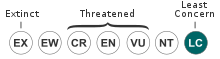
The rock monitor (Varanus albigularis) is a species of monitor lizard in the family Varanidae. The species is endemic to sub-Saharan Africa, where, on average it is the largest lizard found on the continent. It is called leguaan or likkewaan in some areas.
Taxonomy
[edit]First described by François Marie Daudin in 1802,[2] V. albigularis had been classified as a subspecies of V. exanthematicus,[5] but has since been declared a distinct species, based on differences in hemipenal morphology.[6] The generic name Varanus is derived from the Arabic word waral ورل (English: "monitor"). The specific name albigularis comes from a compound of two Latin words, albus (meaning "white") and gula ("throat").
Subspecies of V. albigularis are:
- White-throated monitor, V. a. albigularis
- Angolan white-throated monitor, V. a. angolensis
- Eastern white-throated monitor, V. a. microstictus
- Black-throated monitor, V. a. ionidesi [4] (but may be synonymous with V. a. microstictus)
Description
[edit]Varanus albigularis is on average the most massive lizard in Africa, as adult males average about 6 to 8 kg (13 to 18 lb) and females weigh from 3.2 to 5 kg (7.1 to 11.0 lb).[7][8][9] Large mature males can attain weights of 15 to 17 kg (33 to 37 lb), which would make it slightly smaller than the Nile monitor by maximum size.[10] It is the second longest African lizard after the Nile monitor. Mature specimens typically measure 0.85 to 1.5 meters (2 ft 9 in to 4 ft 11 in).[8][10] The head and neck are the same length, and are distinct from each other.[11] The bulbous, convex snout gives an angular, box-like appearance. The forked tongue is pink or bluish,[11] and the body scales are usually a mottled gray-brown with yellowish or white markings.[11] Exceptionally large specimens reach 2 meters (6 ft 7 in) in total length (including tail), with its tail and body being of equal size.[12]
Geographic range and habitat
[edit]V. albigularis is found in Central Africa (Democratic Republic of the Congo/Zaire), Southern Africa (Namibia, Botswana, Republic of South Africa, Eswatini, Zimbabwe, Mozambique, Zambia, Angola), East Africa and the African Great Lakes region (Burundi, Kenya, Uganda, Tanzania), and the Horn of Africa (Ethiopia, Somalia).[11] V. albigularis is found in a variety of arid habitats, including steppes, grasslands and savanna, and may frequent rock kopje (inselbergs) formations that dot the landscape. They are generally absent from desert interiors, rainforests and thick scrub forests.[11]
Diet
[edit]V. albigularis are generalists, feeding opportunistically on a broad variety of prey in the wild, such as other lizards, amphibians, birds, snakes, tortoises, eggs and small mammals.[13][14] Tortoises make up a significant part of their diet, and are swallowed whole due to the hard shell. Otherwise, this species consumes very little vertebrate prey, eating primarily invertebrates, especially millipedes, beetles, molluscs, orthopterans and scorpions.[15] Millipedes for example form nearly a quarter of their diet; the monitors are apparently resistant to its poisonous secretions. They are not averse to occasionally scavenging the corpses of vertebrate prey, even those as large as vervet monkeys, which are sometimes torn to pieces by "death rolling" like a crocodilian prior to consumption.[16] Live vertebrate prey other than tortoises are usually too fast to catch for these monitors, and therefore form very little of their diet.[17] This contrasts with what is often a diet of mostly vertebrates in captivity, such as rodents, poultry or fish.[18]
Predator
[edit]Natural predators of adult rock monitors include martial eagles and leopard.[19][20]
Intelligence
[edit]An intelligent lizard, several specimens of V. albigularis have demonstrated the ability to count as high as six in an experiment conducted by Dr. John Philips at the San Diego Zoo in 1999.[21] Philips offered varying numbers of snails, and the monitors were able to distinguish numbers whenever one was missing.[22][23]
Folklore
[edit]People living with the HIV/AIDS virus in Yumbe District of Uganda have been reported injecting themselves with the blood of rock monitors, which they believe to be a cure for the virus.[24] Many are reportedly discontinuing anti-retroviral therapy to pursue this anecdotal treatment.[24]
As a result, V. albigularis is reported to have become an expensive item in the Ugandan black market, selling for more than 175 US$ each.[24]
References
[edit]

- ^ Beraduccii, J.; Msuya, C.A.; Howell, K.; Ngalason, W. (2021). "Varanus albigularis". IUCN Red List of Threatened Species. 2021: e.T22473612A22473630. doi:10.2305/IUCN.UK.2021-2.RLTS.T22473612A22473630.en. Retrieved 19 November 2021.
- ^ a b Daudin, FM (1802). "Histoire Naturelle, Génerale et Particulière des Reptiles; Ouvrage faisant suite à l'Histoire Naturelle, générale et particulière, composée par LECLERC DE BUFFON, et redigée par C. S. SONNINI, membre de plusieurs Sociétés savantes". F. Dufart (in French). Tome Troisième. Paris: 72-75 + Plate XXXII.
- ^ "Varanus albigularis ". Integrated Taxonomic Information System. Retrieved 22 August 2008.
- ^ a b "Varanus albigularis ". The Reptile Database. www.reptile-database.org. [1]
- ^ Laurent, RF (1964). "A new subspecies of Varanus exanthematicus (Sauria, Varanidae)". Breviora. 199: 1–5..
- ^ Böhme, W. [in German] (1991). "New finding on the hemipenal morphology of monitor lizards and their systematic implications". Mertensiella. 2: 42–49.
- ^ "White Throated Monitor – Varanus albigularis ". Reptiliana: Ultimate Reptile Resource. March 2008. Retrieved 2013-06-06.
- ^ a b "African Savannah Monitor – Varanus exanthematicus albigularis ". WAZA : World Association of Zoos and Aquariums. Retrieved 2013-06-06.
- ^ Gardner BR, Barrows MG (2010). "Yolk coelomitis in a white-throated monitor lizard (Varanus albigularis)". Journal of the South African Veterinary Association 81 (2): 121-122.
- ^ a b "Varanus albigularis ". Monitor-Lizards.net. Archived from the original on 2012-07-31. Retrieved 2013-06-06.
- ^ a b c d e Alexander, Graham; Marais, Johan (2008). A Guide to the Reptiles of Southern Africa. South Africa: Struik Publishers. 408 pp. ISBN 978-1-77007-386-9.
- ^ Carruthers, Vincent (June 5, 2008). The Wildlife of Southern Africa: The Larger Illustrated Guide to the Animals and Plants of the Region. South Africa: Struik Publishers. 320 pp. ISBN 978-1-77007-199-5.
- ^ Werner Conradie (December 2012). "VARANIDAE Varanus albigularis (Daudin, 1802) Rock Monitor DIET". African Herp News : Newsletter of the Herpetological Association of Africa – via ResearchGate.
- ^ "Varanus Albigularis".
- ^ "Varanus albigularis".
- ^ Krebs, Uwe (January 2019). "Observations and Experiments on "Spinning Behavior" in Varanus albigularis". Biawak. 13 (1): 54–61.
- ^ Dalhuijsen, Kim (10 December 2013). "A comparative analysis of the diets of Varanus albigularis and Varanus niloticus in South Africa". African Zoology. 49 (1): 84–93.
- ^ "Black-Throated Monitor 101: Care, Size, Diet & More!". 26 July 2022.
- ^ "Eagle Rips Lizard's Eyes Apart As it Tries to Escape". Kruger sighting. September 15, 2020.
- ^ Radloff, Frans GT and Johan T. Du Toit (2004). "Large predators and their prey in a southern African savanna: a predator's size determines its prey size range". Journal of Animal Ecology. 73 (3): 410–423.
- ^ Pianka, Eric R.; Vitt, Laurie J. (2003). Lizards: Windows to the Evolution of Diversity. Berkeley, Los Angeles, London: University of California Press. 346 pp. ISBN 978-0-520-23401-7.
- ^ King, Dennis; Green, Brian (1999). Goannas: The Biology of Varanid Lizards. University of New South Wales Press. p. 43. ISBN 0-86840-456-X.
- ^ The Weekend Australian. July 24–25, 1999, p. 12.
- ^ a b c "Ugandans turn to varanid lizard blood for AIDS cure" (PDF). BIAWAK. 2 (1). INTERNATIONAL VARANID INTEREST GROUP. February 2008. Retrieved 2008-08-27.
External links
[edit]Further reading
[edit]- Bayless, Mark K. (1992). "The Necropsy and internal Anatomy of a white-throated monitor lizard (Varanus albigularis Daudin, 1802)". VaraNews 2 (1): 5-6.