


Georges-Louis Leclerc, Comte de Buffon
Georges-Louis Leclerc, Comte de Buffon | |
|---|---|
 Painting by François-Hubert Drouais | |
| Born | Georges-Louis Leclerc 7 September 1707 |
| Died | 16 April 1788 (aged 80) Paris, France |
| Known for | Histoire Naturelle (1749–1804) Buffon's needle problem Rejection sampling |
| Scientific career | |
| Fields | Natural history |
| Institutions | Académie Française |
| Signature | |
 | |
Georges-Louis Leclerc, Comte de Buffon (French: [ʒɔʁʒ lwi ləklɛʁ kɔ̃t də byfɔ̃]; 7 September 1707 – 16 April 1788) was a French naturalist, mathematician, and cosmologist. He held the position of intendant (director) at the Jardin du Roi, now called the Jardin des plantes.
Buffon's works influenced the next two generations of naturalists, including two prominent French scientists Jean-Baptiste Lamarck and Georges Cuvier. Buffon published thirty-six quarto volumes of his Histoire Naturelle during his lifetime, with additional volumes based on his notes and further research being published in the two decades following his death.[1]
Ernst Mayr wrote that "Truly, Buffon was the father of all thought in natural history in the second half of the 18th century".[2] Credited with being one of the first naturalists to recognize ecological succession, he was later forced by the theology committee at the University of Paris to recant his theories about geological history and animal evolution because they contradicted the biblical narrative of Creation.[3][4]
Early life
[edit]Georges Louis Leclerc (later Comte de Buffon) was born at Montbard, in the province of Burgundy to Benjamin François Leclerc, a minor local official in charge of the salt tax and Anne-Christine Marlin, also from a family of civil servants. Georges was named after his mother's uncle (his godfather) Georges Blaisot, the tax-farmer of the Duke of Savoy for all of Sicily. In 1714 Blaisot died childless, leaving a considerable fortune to his seven-year-old godson. Benjamin Leclerc then purchased an estate containing the nearby village of Buffon and moved the family to Dijon acquiring various offices there as well as a seat in the Dijon Parlement.
Georges attended the Jesuit College of Godrans in Dijon from the age of ten onwards. From 1723 to 1726 he then studied law in Dijon, the prerequisite for continuing the family tradition in civil service. In 1728 Georges left Dijon to study mathematics and medicine at the University of Angers in France. At Angers in 1730 he made the acquaintance of the young English Duke of Kingston, who was on his grand tour of Europe, and traveled with him on a large and expensive entourage for a year and a half through southern France and parts of Italy.[5]
There are persistent but completely undocumented rumors from this period about duels, abductions and secret trips to England. In 1732 after the death of his mother and before the impending remarriage of his father, Georges left Kingston and returned to Dijon to secure his inheritance. Having added 'de Buffon' to his name while traveling with the Duke, he repurchased the village of Buffon, which his father had meanwhile sold off. With a fortune of about 80,000 livres (at the time, worth nearly 27 kilograms of gold), Buffon set himself up in Paris to pursue science, at first primarily mathematics and mechanics, and the increase of his fortune.[6]
Career
[edit]
In 1732 he moved to Paris, where he made the acquaintance of Voltaire and other intellectuals. He lived in the Faubourg Saint-Germain, with Gilles-François Boulduc, first apothecary of the King, professor of chemistry at the Royal Garden of Plants, member of the Academy of Sciences.[7] He first made his mark in the field of mathematics and, in his Sur le jeu de franc-carreau (On the game of fair-square), introduced differential and integral calculus into probability theory; the problem of Buffon's needle in probability theory is named after him. In 1734 he was admitted to the French Academy of Sciences. During this period he corresponded with the Swiss mathematician Gabriel Cramer.
His protector Maurepas had asked the Academy of Sciences to do research on wood for the construction of ships in 1733. Soon afterward, Buffon began a long-term study, performing some of the most comprehensive tests to date on the mechanical properties of wood. Included were a series of tests to compare the properties of small specimens with those of large members. After carefully testing more than a thousand small specimens without knots or other defects, Buffon concluded that it was not possible to extrapolate to the properties of full-size timbers, and he began a series of tests on full-size structural members.
In 1739 he was appointed head of the Parisian Jardin du Roi with the help of Maurepas; he held this position to the end of his life. Buffon was instrumental in transforming the Jardin du Roi into a major research center and museum. He also enlarged it, arranging the purchase of adjoining plots of land and acquiring new botanical and zoological specimens from all over the world.
Thanks to his talent as a writer, he was invited to join Paris's second great academy, the Académie Française in 1753 and then in 1768 he was elected to the American Philosophical Society.[8] In his Discours sur le style ("Discourse on Style"), pronounced before the Académie française, he said, "Writing well consists of thinking, feeling and expressing well, of clarity of mind, soul and taste ... The style is the man himself" ("Le style c'est l'homme même").[9] Unfortunately for him, Buffon's reputation as a literary stylist also gave ammunition to his detractors: the mathematician Jean le Rond d'Alembert, for example, called him "the great phrase-monger".
In 1752 Buffon married Marie-Françoise de Saint-Belin-Malain, the daughter of an impoverished noble family from Burgundy, who had been enrolled in the convent school run by his sister. Madame de Buffon's second child, a son born in 1764, survived childhood; she herself died in 1769. When in 1772 Buffon became seriously ill and the promise that his son (then only 8) should succeed him as director of the Jardin became clearly impracticable and was withdrawn, the King raised Buffon's estates in Burgundy to the status of a county – and thus Buffon (and his son) became a count. He was elected a Foreign Honorary Member of the American Academy of Arts and Sciences in 1782.[10] Buffon died in Paris in 1788.
He was buried in a chapel adjacent to the church of Sainte-Urse Montbard; during the French Revolution, his tomb was broken into and the lead that covered the coffin was ransacked to produce bullets. His son, George-Louie-Marie Buffon (often called Buffonet) was guillotined on July 10, 1794.[11] Buffon's heart was initially saved, as it was guarded by Suzanne Necker (wife of Jacques Necker), but was later lost. Today, only Buffon's cerebellum remains, as it is kept in the base of the statue by Pajou that Louis XVI had commissioned in his honor in 1776, located at the Museum of Natural History in Paris.
His Histoire naturelle was also a source of inspiration for the painters of the Sèvres factory, giving rise to porcelain services called Buffon. The name of the different species, faithfully reproduced, is inscribed on the back of each piece. Several "Buffon services" were produced during the reign of Louis XVI; the first was intended for the Count of Artois, in 1782.
Histoire Naturelle
[edit]

Buffon's Histoire naturelle, générale et particulière (1749–1788: in 36 volumes; an additional volume based on his notes appeared in 1789) was originally intended to cover all three "kingdoms" of nature but the Histoire naturelle ended up being limited to the animal and mineral kingdoms, and the animals covered were only the birds and quadrupeds. "Written in a brilliant style, this work was read ... by every educated person in Europe".[2] Those who assisted him in the production of this great work included Louis Jean-Marie Daubenton, Philibert Guéneau de Montbeillard, and Gabriel-Léopold Bexon, along with numerous artists. Buffon's Histoire naturelle was translated into many different languages, making him one of the most widely read authors of the day, a rival to Montesquieu, Rousseau, and Voltaire.[12]
In the opening volumes of the Histoire naturelle Buffon questioned the usefulness of mathematics, criticized Carl Linnaeus's taxonomical approach to natural history, outlined a history of the Earth with little relation to the Biblical account, and proposed a theory of reproduction that ran counter to the prevailing theory of pre-existence. The early volumes were condemned by the Faculty of Theology at the Sorbonne. Buffon published a retraction, but he continued publishing the offending volumes without any change.
In the course of his examination of the animal world, Buffon noted that different regions have distinct plants and animals despite similar environments, a concept later known as Buffon's Law. This is considered to be the first principle of biogeography. He made the suggestion that species may have both "improved" and "degenerated" after dispersing from a center of creation. In volume 14 he argued that all the world's quadrupeds had developed from an original set of just thirty-eight quadrupeds.[13] On this basis, he is sometimes considered a "transformist" and a precursor of Darwin. He also asserted that climate change may have facilitated the worldwide spread of species from their centers of origin. Still, interpreting his ideas on the subject is not simple, for he returned to topics many times in the course of his work.

Buffon originally held that “the animals common both to the old and new world are smaller in the latter,”[14] ascribing this to environmental conditions. Upon meeting Buffon, Thomas Jefferson attempted “to convince him of his error,” noting that “the reindeer could walk under the belly of our moose.” Buffon, who was “absolutely unacquainted” with the moose, asked for a specimen.[15] Jefferson dispatched twenty soldiers to the New Hampshire woods to find a bull moose for Buffon as proof of the "stature and majesty of American quadrupeds".[16] According to Jefferson, the specimen “convinced Mr. Buffon. He promised in his next volume to set these things right."[17]
In Les époques de la nature (1778) Buffon discussed the origins of the Solar System, speculating that the planets had been created by a comet's collision with the Sun.[18] He also suggested that the Earth originated much earlier than 4004 BC, the date determined by Archbishop James Ussher. Basing his figures on the cooling rate of iron tested at his Laboratory the Petit Fontenet at Montbard, he calculated that the Earth was at least 75,000 years old. Once again, his ideas were condemned by the Sorbonne, and once again he issued a retraction to avoid further problems.[19]
Buffon knew of the existence of extinct species as mammoths or European rhinos. And some of his assumptions have inspired current models, such as continental drift.
Publications
[edit]
Histoire naturelle, générale et particuliére, 1749–1767. Paris: Imprimerie Royale. Volumes 3, 4, 5, 6, 7, 10, 11, 13, 14, 15.
Anthropological studies
[edit]Buffon believed in monogenism, the concept that all humanity has a single origin, and that physical differences arose from adaptation to environmental factors, including climate and diet. He speculated on the possibility that the first humans were dark-skinned Africans,[20] but did not pinpoint the area of human origin beyond delineating it as “the most temperate climate [that] lies between the 40th and 50th degree of latitude.” [21] This geophysical band encompasses portions of Europe, North America, North Africa, Mongolia, and China.
Controversially for a European of his era, Buffon did not believe that Europe was the cradle of human civilization. Instead he stated that Japanese and Chinese culture were “of a very ancient date,” and that Europe “only much later received the light from the East…it is thus in the northern countries of Asia that the stem of human knowledge grew."[22]
Buffon thought that skin color could change in a single lifetime, depending on the conditions of climate and diet.[23] Clarence Glacken suggests that "The environmental changes through human agency described by Buffon were those which were familiar and traditional in the history of Western civilization".[24] However, Buffon also challenged Carl Linnaeus' conceptualization of the fixed division of race. In this sense, Buffon expands his perspective on monogenism that associating these dissimilar traits and features into one larger category rather than in a fixed division. This brought to his conceptualization on distinguishing race in a broad and narrow sense; in a broad sense, race means larger groups of people who inhabit a huge region known as a continent; while in a narrow sense, it denotes equivalently with "nation".[25] With this, he implies his ambivalence in defining race by looking at specific traits to differenciate them but at the same time he rejects the idea of categorizing race in a specific fixed division. Therefore, because Buffon seems to favor in working on gerealization and marking the similarities rather than the difference in the race categorization.
Relevance to modern biology
[edit]Charles Darwin wrote in his preliminary historical sketch added to the third edition of On the Origin of Species: "Passing over ... Buffon, with whose writings I am not familiar". Then, from the fourth edition onwards, he amended this to say that "the first author who in modern times has treated it [evolution] in a scientific spirit was Buffon. But as his opinions fluctuated greatly at different periods, and as he does not enter on the causes or means of the transformation of species, I need not here enter on details".[26] Buffon's work on degeneration, however, was immensely influential on later scholars but was overshadowed by strong moral overtones.[27]
The paradox of Buffon is that, according to Ernst Mayr:
He was not an evolutionary biologist, yet he was the father of evolutionism. He was the first person to discuss a large number of evolutionary problems, problems that before Buffon had not been raised by anybody ... he brought them to the attention of the scientific world.
Except for Aristotle and Darwin, no other student of organisms [whole animals and plants] has had as far-reaching an influence.
He brought the idea of evolution into the realm of science. He developed a concept of the "unity of type", a precursor of comparative anatomy. More than anyone else, he was responsible for the acceptance of a long-time scale for the history of the earth. He was one of the first to imply that you get inheritance from your parents, in a description based on similarities between elephants and mammoths. And yet, he hindered evolution by his frequent endorsement of the immutability of species. He provided a criterion of species, fertility among members of a species, that was thought impregnable.[2]
Buffon wrote about the concept of struggle for existence.[28] He developed a system of heredity which was similar to Darwin's hypothesis of pangenesis.[29] Commenting on Buffon's views, Darwin stated, "If Buffon had assumed that his organic molecules had been formed by each separate unit throughout the body, his view and mine would have been very closely similar."[30]
“Buffon asked most all of the questions that science has since been striving to answer,” the historian Otis Fellows wrote in 1970.
His glory lies in what he prepared for his successors: bold and seminal views on the common characters of life’s origin, laws of geographical distribution, a geological record of the earth’s evolution, extinction of old species, the successive appearance of new species, the unity of the human race.[31]
Eponyms of Buffon
[edit]- Buffon (crater), a lunar impact crater located on the southern hemisphere of the far side of the Moon.
- Lycée Buffon, a secondary school in the 15th arrondissement of Paris.
- Rue Buffon (Paris), a street bordering the Jardin des Plantes in the 5th arrondissement of Paris.
- Rue Buffon (Dijon)[32] Rue Buffon], a street in Dijon, France.
- An asteroid was named (7420) Buffon.
Works
[edit]Buffon, Œuvres, ed. S. Schmitt and C. Crémière, Paris: Gallimard, 2007.
Complete works
- Vol 1. Histoire naturelle, générale et particulière, avec la description du Cabinet du Roy. Tome I (1749). Texte établi, introduit et annoté par Stéphane Schmitt avec la collaboration de Cédric Crémière, Paris: Honoré Champion, 2007, 1376 p. (ISBN 978-2-7453-1601-1)
- Vol 2. Histoire naturelle, générale et particulière avec la participation du Cabinet du Roy. Tome II. Texte établi, introduit et annoté par Stéphane Schmitt, avec la collaboration de Cédric Crémière, Paris: Honoré Champion, 2008, 808 p. (ISBN 978-2-7453-1729-2)
- Vol 3. Histoire naturelle, générale et particulière, avec la description du Cabinet du Roy. Texte établi, introduit et annoté par Stéphane Schmitt avec la collaboration de Cédric Crémière. Tome III (1749), Paris: Honoré Champion, 2009, 776 p. (ISBN 978-2-7453-1730-8)
- Vol 4. Histoire naturelle, générale et particulière, avec la description du Cabinet du Roi. Texte établi, introduit et annoté par Stéphane Schmitt avec la collaboration de Cédric Crémière. Tome IV (1753), Paris: Honoré Champion, 2010. 1 vol., 864 p. (ISBN 978-2-7453-1928-9)
- Vol 5. Histoire naturelle, générale et particulière, avec la description du Cabinet du Roi. Texte établi, introduit et annoté par Stéphane Schmitt avec la collaboration de Cédric Crémière. Tome V (1755), Paris: Honoré Champion, 2010. 1 vol., 536 p. (ISBN 978-2-7453-2057-5)
- Vol 6. Histoire naturelle, générale et particulière, avec la description du Cabinet du Roi. Texte établi, introduit et annoté par Stéphane Schmitt avec la collaboration de Cédric Crémière. Tome VI (1756), Paris: Honoré Champion, 2011. 1 vol., 504 p. (ISBN 978-2-7453-2150-3)
- Vol. 7. Histoire naturelle, générale et particulière, avec la description du Cabinet du Roi. Texte établi, introduit et annoté par Stéphane Schmitt avec la collaboration de Cédric Crémière. Tome VII (1758), Paris: Honoré Champion, 2011. 1 vol., 544 p. (ISBN 978-2-7453-2239-5)
- Vol. 8. Histoire naturelle, générale et particulière, avec la description du Cabinet du Roi. Texte établi, introduit et annoté par Stéphane Schmitt avec la collaboration de Cédric Crémière. Tome VIII (1760), Paris: Honoré Champion, 2014, 640 p. (ISBN 978-2-7453-2615-7)
- Vol. 9. Histoire naturelle, générale et particulière, avec la description du Cabinet du Roi. Texte établi, introduit et annoté par Stéphane Schmitt avec la collaboration de Cédric Crémière. Tome IX (1761), Paris: Honoré Champion, 2016, 720 p. (ISBN 978-2-7453-2994-3)
- Vol. 10. Histoire naturelle, générale et particulière, avec la description du Cabinet du Roi. Texte établi, introduit et annoté par Stéphane Schmitt avec la collaboration de Cédric Crémière. Tome X (1763), Paris: Honoré Champion, 2017, 814 p. (ISBN 978-2-7453-3456-5)
- Vol. 11. Histoire naturelle, générale et particulière, avec la description du Cabinet du Roi. Texte établi, introduit et annoté par Stéphane Schmitt avec la collaboration de Cédric Crémière. Tome XI (1764), Paris: Honoré Champion, 2018, 724 p. (ISBN 978-2-7453-4730-5)
- Vol. 12. Histoire naturelle, générale et particulière, avec la description du Cabinet du Roi. Texte établi, introduit et annoté par Stéphane Schmitt avec la collaboration de Cédric Crémière. Tome XII (1764), Paris: Honoré Champion, 2018, 810 p. (ISBN 978-2-7453-4732-9)
- Vol. 13. Histoire naturelle, générale et particulière, avec la description du Cabinet du Roi. Texte établi, introduit et annoté par Stéphane Schmitt avec la collaboration de Cédric Crémière. Tome XIII (1765), Paris: Honoré Champion, 2019, 887 p.
- Vol. 14. Histoire naturelle, générale et particulière, avec la description du Cabinet du Roi. Texte établi, introduit et annoté par Stéphane Schmitt avec la collaboration de Cédric Crémière. Tome XIV (1768), Paris: Honoré Champion, 2020, 605 p.
- Vol. 15. Histoire naturelle, générale et particulière, avec la description du Cabinet du Roi. Texte établi, introduit et annoté par Stéphane Schmitt avec la collaboration de Cédric Crémière. Tome XV (1767), Paris: Honoré Champion, 2021, 764 p.
-
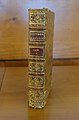 1774 edition of Histoire Naturelle, Générale et Particulière
 -
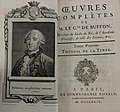 Frontispiece of a 1774 edition of Histoire Naturelle, Générale et Particulière
 -
 Table of contents of a 1774 edition of Histoire Naturelle, Générale et Particulière
 -
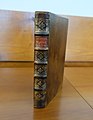 1792 English translation of Buffon's Natural History
 -
 Title page of a 1792 English translation of Buffon's Natural History
 -
 Table of contents page of a 1792 English translation of Buffon's Natural History
 -
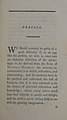 Preface for a 1792 English translation of Buffon's Natural History


See also
[edit]References
[edit]- ^ Farber, Paul (2000). Finding Order in Nature. Baltimore: Johns Hopkins University Press. p. 14.
- ^ a b c Mayr, Ernst 1981. The Growth of Biological Thought. Cambridge: Harvard. p 330
- ^ Brody, David Eliot (6 August 2013). The Science Class You Wish You Had. Penguin. ISBN 9780399160325.
- ^ Larsen, James A. (22 October 2013). Ecology of the Northern Lowland Bogs and Conifer Forests. Elsevier. ISBN 9781483269863.
- ^ Otis E. Fellows and Stephen F. Milliken, Buffon, Twayne's World Authors Series; TWAS 243 (New York: Twayne Publishers, 1972), 41-43.
- ^ Otis E. Fellows and Stephen F. Milliken, Buffon, Twayne's World Authors Series; TWAS 243 (New York: Twayne Publishers, 1972), 40-50.
- ^ Roger, Jacques (1997). Buffon: A Life in Natural History. Cornell University Press. p. 15. ISBN 978-0-8014-2918-7.
- ^ Bell, Whitfield J., and Charles Greifenstein, Jr. Patriot-Improvers: Biographical Sketches of Members of the American Philosophical Society. 3 vols. Philadelphia: American Philosophical Society, 1997, 3:569–572.
- ^ Fellows, Otis E. and Stephen F. Milliken 1972. Buffon. New York: Twayne. pp 149–54
- ^ "Book of Members, 1780–2010: Chapter B" (PDF). American Academy of Arts and Sciences. Retrieved 28 July 2014.
- ^ Roberts, Jason, Every Living Thing (New York, Random House, 2024), p. 263
- ^ Buffon, Georges Louis Leclerc, Comte de", Encyclopedia of Life Sciences. Biographies Plus Illustrated, H.W. Wilson Company, 2001. vnweb.hwwilsonweb.com (Accessed December 26, 2005)
- ^ Roger, Jacques 1989. Buffon: un philosophe au Jardin du Roi Paris: Fayard. pp 434–5
- ^ Jefferson, Thomas, Notes on the State of Virginia (Boston, Wells and Lilly, 1829), p. 47
- ^ Jefferson, Thomas, The Writings of Thomas Jefferson: 1816–1826 (G.P. Putnam’s Sons, 1899), p. 331
- ^ Bryson, Bill 2004. A Short History of Nearly Everything. New York: Broadway Books. p 81
- ^ Dugatkin, Lee Alan, Mr. Jefferson and the Giant Moose: Natural History in Early America (University of Chicago Press, 2019), p. 99
- ^ L'Histoire Naturelle, générale et particulière, avec la description du Cabinet du Roi
- ^ Jean Stengers 1974. "Buffon et la Sorbonne" in Études sur le XVIIIe siecle, ed. Roland Mortier and Hervé Hasquin. Brussels: Université de Bruxelles. pp 113–24
- ^ Buffon, George-Louis de, Supplemément a l’Histoire Naturelle (Paris, L’Imprimerie Royale, 1775), p 564
- ^ Gould, Stephen J, The Mismeasure of Man (New York, W.W. Norton, 1996), p. 71
- ^ Buffon, Georges-Louis Leclerc de, Buffon’s Natural History (Barr’s Buffon), (London, J.S. Barr, 1792), p. 213
- ^ Harris, Rise of Anthropological Theory, 2001, p. 86
- ^ GLACKEN, CLARENCE J. (March 1960). "Count Buffon on Cultural Changes of the Physical Environment". Annals of the Association of American Geographers. 50 (1): 1–22. doi:10.1111/j.1467-8306.1960.tb00325.x. ISSN 0004-5608.
- ^ Hudson, Nicholas (March 1996). "From "Nation"to "Race": The Origin of Racial Classification in Eighteenth- Century Thought". Eighteenth-Century Studies. 29 (3): 247–264. doi:10.1353/ecs.1996.0027. ISSN 1086-315X.
- ^ Darwin, Charles 1861. On the Origin of Species, An historical sketch: 3rd edition. xiii. 4th edition of 1866 xiii.
- ^ Mason, P.H. (2010) Degeneracy at multiple levels of complexity, Biological Theory: Integrating Development, Evolution and Cognition, 5(3), 277-288.
- ^ Zirkle, Conway (25 April 1941), "Natural Selection before the Origin of Species", Proceedings of the American Philosophical Society, 84 (1), Philadelphia: American Philosophical Society: 71–123, JSTOR 984852
- ^ Hull, David L. (1988). Science as a Process: An Evolutionary Account of the Social and Conceptual Development of Science. University of Chicago Press. p. 86. ISBN 0-226-36051-2 "As Darwin was to discover many years later, Buffon had devised a system of heredity not all that different from his own theory of pangenesis."
- ^ Zirkle, Conway (1935). "The Inheritance of Acquired Characters and the Provisional Hypothesis of Pangenesis". The American Naturalist. 69 (724): 417–445. doi:10.1086/280617. S2CID 84729069.
- ^ Fellows, Otis, From Voltaire to la Nouvelle Critique: Problems and Personalities (Geneva, Libraire Droz, 1970), p. 25
- ^ https://www.monnuage.fr/point-d-interet/la-rue-buffon-a104424%20rue%20Buffon,%20Dijon [bare URL]
External links
[edit]
 Media related to Georges-Louis Leclerc, comte de Buffon at Wikimedia Commons
 Quotations related to Georges-Louis Leclerc, Comte de Buffon at Wikiquote
- Works by Georges-Louis Leclerc, Comte de Buffon at Project Gutenberg
- Works by Georges-Louis Leclerc, Comte de Buffon at LibriVox (public domain audiobooks)

- Works by or about Georges-Louis Leclerc, Comte de Buffon at the Internet Archive
- (in French) The Buffon project : L'histoire naturelle


- The same, in English: L'histoire naturelle
- Buffon's Hypothesis about the Origin of the Earth
- Buffon's View of Domestic Cats
- Digital text Kyoto University Archived 1 October 2011 at the Wayback Machine
- O'Connor, John J.; Robertson, Edmund F., "Georges-Louis Leclerc, Comte de Buffon", MacTutor History of Mathematics Archive, University of St Andrews
- Buffon's American Degeneracy, from The Academy of Natural Sciences
- William Smellie's English Translation of Buffon's Natural History, General and Particular, 3rd Edition
- (in French) Discours sur le Style – at athena.unige.ch[permanent dead link]
- Gaedike, R.; Groll, E. K. & Taeger, A. 2012: Bibliography of the entomological literature from the beginning until 1863 : online database - version 1.0 - Senckenberg Deutsches Entomologisches Institut.
- A collection of high-resolution scans of animal illustrations from several books by Buffon Archived 6 October 2020 at the Wayback Machine, from the Linda Hall Library
- Buffon's Histoire naturelle des époches de la nature Archived 21 August 2020 at the Wayback Machine, (this ed. published as Histoire naturelle, générale et particulière, avec la description du cabinet du roy, suppl. vol. 5. in 1778) - digital facsimile from the Linda Hall Library
- "Dissertation sur les couleurs accidentelles" (PDF). Mémoire de l'Académie Royale des Sciences —- Année 1743: 147–158. 1746. Archived from the original (PDF) on 14 June 2015.

| Pioneering naturalists |
|  | ||||||||||
|---|---|---|---|---|---|---|---|---|---|---|---|---|
| Topics | ||||||||||||
| International | |
|---|---|
| National | |
| Academics | |
| Artists | |
| People | |
| Other | |


- 1707 births
- 1788 deaths
- People from Montbard
- French naturalists
- French ornithologists
- 18th-century French zoologists
- French Roman Catholics
- University of Angers (pre-1793) alumni
- Proto-evolutionary biologists
- Members of the Académie Française
- Members of the French Academy of Sciences
- Contributors to the Encyclopédie (1751–1772)
- Counts of Buffon
- French science writers
- Fellows of the American Academy of Arts and Sciences
- Fellows of the Royal Society
- 18th-century French male writers
- 18th-century French mathematicians
- Founder fellows of the Royal Society of Edinburgh
- French male non-fiction writers
- National Museum of Natural History (France) people