


Bohemian crown jewels
 | You can help expand this article with text translated from the corresponding article in Czech. (February 2024) Click [show] for important translation instructions.
|

The Bohemian crown jewels, also called the Czech crown jewels (Czech: české korunovační klenoty), include the Crown of Saint Wenceslas (Svatováclavská koruna), the royal orb and sceptre, the coronation vestments of the Kings of Bohemia, the gold reliquary cross, and St. Wenceslas' sword. They were originally held in Prague and Karlštejn Castle, designed in the 14th century by Matthias of Arras. Since 1791 they have been stored in St. Vitus Cathedral at Prague Castle. Reproductions of the jewels are permanently exhibited in the historical exposition at the former royal palace in the castle. The crown was made for the coronation of Charles IV in 1347, making it the fourth oldest in Europe.[1][2]
Description[edit]

The crown has an unusual design, with vertical fleurs-de-lis standing at the front, back and sides. Made from 22-carat gold and a set of precious 19 sapphires, 30 emeralds, 44 spinels, 20 pearls, 1 ruby, 1 rubellite and 1 aquamarine, it weighs 2,475 g. At the top of the crown is the cross, which reportedly stores a thorn from Christ's crown of thorns. Unlike in most later crowns, the cross does not stand on a monde.[citation needed]
The Royal sceptre is made from 18-carat gold, 4 sapphires, 5 spinels and 62 pearls with an extra large spinel mounted on top of the sceptre; it weighs 1,013 g. The Royal orb is also made from 18-carat gold, 8 sapphires, 6 spinels and 31 pearls. It weighs 780 g and is decorated with wrought relief scenes from the Old Testament and the Book of Genesis. The Coronation robe was used from 1653 until 1836. It is made from precious silky red material called "zlatohlav" and is lined with ermine (fur of the stoat). The robe is stored separately from jewelry in a specially air conditioned repository.[citation needed]
For the coronation ceremonies, St. Wenceslas' sword, a typical Gothic weapon, was used. The first mention of the sword reported in historical records is in 1333, but the blade dates back to the 10th century, while the hilt is from the 13th century and textiles are probably from the time of Charles IV. The iron blade length is 76 cm, at the widest point is 45 mm and has a ripped hole in a cross shape (45 × 20 mm). The wooden handle is covered with yellow-brown fabric and velvet embroidered with the ornament of laurel twigs with thick silver thread. After coronation ceremonies, the sword was used for the purpose of granting knighthoods.[citation needed]
The oldest leather case for the crown was made for Charles IV in 1347. On top are inscribed four symbols: the Imperial eagle, Bohemian lion, the coat of arms of Arnošt of Pardubice and emblem of the Archbishopric of Prague.[citation needed]
The door to crown jewels chamber, and likewise the iron safe, is hardly accessible and has seven locks. There are seven holders of the keys: the President of the Czech Republic, the Speaker of the Chamber of Deputies, the President of the Senate, the Prime Minister, the Mayor of Prague, the Archbishop of Prague, and the Dean of the Metropolitan Chapter of St. Vitus Cathedral in Prague, who must all convene to facilitate opening the impenetrable door and coffer.[citation needed]
History[edit]

The crown is named and dedicated after the Duke St. Wenceslaus of the Přemyslids dynasty of Bohemia. The jewels should be permanently stored in the chapel of St. Wenceslaus in St. Vitus. They were only lent to Kings, and only on the day of the coronation, and should be returned in the evening that day. After 1918 and the establishment of the Czechoslovak Republic the Coronation Jewels ceased to serve their original function, but remained important as symbols of national independence and statehood.
In the past, the Jewels were kept in different places, but have been always brought to royal coronations in Prague. Wenceslaus IV (1378–1419) probably moved them to Karlštejn Castle. They were then repeatedly moved for safety reasons: in the 17th century, they were returned to Prague Castle, during the Thirty Years' War (1631) they were sent to a parish church in České Budějovice, and then they were secretly taken to the Imperial Treasury, Vienna (1637). While the Jewels were stored in Vienna, the original gold orb and sceptre from the 14th century were replaced with current ones. The new orb and sceptre probably originated with an order by Ferdinand I in 1533. Possible reasons for this replacement might be that the originals were simply too austere, and lacked any precious stones. Deemed unrepresentative of the prestige of the Kingdom of Bohemia, it made sense to replace them with an orb and sceptre in an ornate, jeweled style that resembled the crown.[3]
.JPG)
The Jewels were brought back to Prague on the occasion of the coronation of Bohemian king Leopold II in 1791. At that time, the current tradition of seven keys was established, though the holders of the keys in the course of time were changed according to political and administrative structures. The jewels were kept in Vienna due to the threat from the Prussian Army,[4] but were later returned to Prague, arriving in the city on 28 August 1867.[5]
According to the ancient tradition and regulations laid down by Charles IV in the 14th century, the Jewels are exhibited only to mark special occasions. Exhibitions can take place only at the Prague Castle. In the 20th century there were nine such moments in history. The President of the Republic has the exclusive right to decide on the display of the crown jewels.
An ancient Czech legend says that any usurper who places the crown on his head is doomed to die within a year. This legend is supported by a rumor that Reinhard Heydrich, the Nazi governor of the puppet state Protectorate of Bohemia and Moravia secretly wore them, and was assassinated less than a year later by the Czech resistance.
Gallery[edit]
-
 St. Wenceslas's Sword and one of the keys to jewel chamber
 -
 The door in the St. Vitus Cathedral
 -
 Reproductions of the Bohemian crown jewels
 -
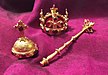 Little reproductions of the Bohemian crown jewels
 -
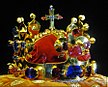 Crown of St. Wenceslas
 -
 Royal sceptre of Bohemia
 -
 Royal orb of Bohemia


Exhibitions[edit]

| Date | Place | Occasion |
|---|---|---|
| 22 September – 6 October 1929 | St. Vitus Cathedral | 1,000 years since the death of St. Wenceslas |
| 25–30 October 1945 | St. Vitus Cathedral | Liberation of Czechoslovakia |
| 1–6 July 1955 | St. Vitus Cathedral | 1st nationwide spartakiad |
| 23 May – 30 August 1958 | Old Royal Palace (Vladislav Hall) | 1st national exhibition of archival documents |
| 26 October – 3 November 1968 | Plečnikova hall | 50th anniversary of Czechoslovakia |
| 2–25 May 1975 | Basilica of St. George | 30th anniversary of the liberation |
| 26 June – 4 December 1978 | Old Royal Palace (Charles Hall) | 600 years since the death of Charles IV. exhibition Time of Charles IV. in the history of Czech nation |
| 29 January – 7 February 1993 | Old Royal Palace (Charles Hall) | formation of the Czech Republic |
| 24 October – 1 November 1998 | Old Royal Palace (Charles Hall) | 80th anniversary of Czechoslovakia and election of president Václav Havel |
| 3–13 August 2003 | Old Royal Palace (Charles Hall) | 85th anniversary of Czechoslovakia, 10th anniversary of the Czech Republic, election of president Václav Klaus |
| 19–29 April 2008 | Old Royal Palace (Vladislav Hall) | 90th anniversary of Czechoslovakia, election of president Václav Klaus |
| 10–19 May 2013 | Old Royal Palace (Vladislav Hall) | direct election of president Miloš Zeman |
| 15–29 May 2016 | Old Royal Palace (Vladislav Hall) | 700th anniversary of Charles IV's birth |
List of crowned Bohemian kings and queens[edit]
If not mentioned coronation was held in Prague.
| King | Coronation date |
|---|---|
| Vratislaus II. (1061–1092, king from 1085) | 20 April 1085, Mainz; 15 June 1086 15 June 1086 |
| Vladislaus II. (1140–1172, king from 1158) | 11 January 1158, Regensburg; 8 September 1158, Milan 1158 (?) |
| Ottokar I. (1192–1193, 1197–1230, king from 1198) | 8 September 1198, Boppard; 24 August 1203, Merseburg |
| Wenceslaus I. (1230–1253) | 6 February 1228 6 February 1228 |
| Ottokar II. (1253–1278) | 25 December 1261 25 December 1261 |
| Wenceslaus II. (1283–1305) | 2 June 1297 2 June 1297 |
| John the Blind (1310–1346) | 7 February 1311 7 February 1311 |
Kings and queens crowned with the Crown of Saint Wenceslas (and other crown jewels):
| King | Coronation date |
|---|---|
| Charles IV. (1346–1378) | 2 September 1347 2 September 1347 |
| Wenceslaus IV. (1378–1419) | 15 June 1363 17 November 1370 |
| Sigismund (1419–1421, 1436–1437) | 28 July 1420 11 February 1437 |
| Albert (1438–1439) | 29 June 1438 |
| Ladislaus the Posthumous (1453–1457) | 28 October 1453 |
| George of Poděbrady (1458–1471) | 2 April 1458 |
| Vladislaus II. (1471–1516) | 22 August 1471 |
| Louis II. (1516–1526) | 11 March 1509 1 June 1522 |
| Ferdinand I. (1526–1564) | 24 February 1526 24 February 1526 |
| Maximilian II. (1564–1576) | 20 November 1562 20 November 1562 |
| Rudolf II. (1576–1611) | 25 September 1575 |
| Matthias II. (1576–1619) | 11 May 1611 10 January 1616 |
| Frederick (1619–1620) | 4 November 1619 4 November 1619 |
| Ferdinand II. (1619–1637) | 29 June 1617 21 November 1627 |
| Ferdinand III. (1637–1657) | 24 November 1627 11 November 1656 |
| Ferdinand IV. | 5 August 1646 |
| Leopold I. (1657–1705) | 14 November 1656 |
| Charles VI. (1711–1740) | 5 September 1723 8 September 1723 |
| Maria Theresa (1740–1780) | 12 May 1743 |
| Leopold II. (1790–1792) | 6 September 1791 12 September 1791 |
| Francis I. (1792–1835) | 9 August 1792 11 August 1792 |
| Ferdinand V. (1835–1848) | 12 September 1836 12 September 1836 |
See also[edit]
References[edit]
- ^ Andrew Lawrence Roberts, From Good King Wenceslas to the Good Soldier Švejk: a dictionary of Czech Popular Culture, pg. 83, Central European University Press (2005), ISBN 963-7326-26-X
- ^ Brett Atkinson Lonely Planet Prague Encounter 2010 Page 50 "CURSE OF THE CZECH CROWN JEWELS In St Vitus Cathedral, on the southern side of .."
- ^ "The royal orb and sceptre". Archived from the original on 2016-03-04. Retrieved 2013-04-22.
- ^ Sayer, Derek (1998). The Coasts of Bohemia: A Czech History. p. 179. ISBN 0-691-05052-X.
- ^ "28. 8. 1867: Převoz českých korunovačních klenotů" [28.8.1867: The transport of the Czech Crown Jewels] (in Czech). Czech Radio. 28 August 2007. Retrieved 5 February 2014.
External links[edit]
 Media related to Crown jewels of Bohemia at Wikimedia Commons
- The Bohemian Crown Jewels – Prague Castle website
| Authority control databases: National |
|---|
