


Breadcrumbs
 | This article needs additional citations for verification. (September 2009) |
 Commercially produced breadcrumbs | |
| Main ingredients | Dried bread |
|---|---|
| Variations | Panko |

Breadcrumbs (also known as breading) consist of crumbled bread of various dryness, sometimes with seasonings added, used for breading or crumbing foods, topping casseroles, stuffing poultry, thickening stews, adding inexpensive bulk to soups, meatloaves and similar foods, and making a crisp and crunchy covering for fried foods, especially breaded cutlets like tonkatsu and schnitzel. The Japanese variety of breadcrumbs is called "panko".
Types[edit]
Dry[edit]
Dry breadcrumbs are made from dry breads which have been baked or toasted to remove most remaining moisture, and may have a sandy or even powdery texture. Breadcrumbs are most easily produced by pulverizing slices of bread in a food processor, using a steel blade to make coarse crumbs, or a grating blade to make fine crumbs. A grater or similar tool will also do.
Fresh[edit]
The breads used to make soft or fresh breadcrumbs are not quite as dry, so the crumbs are larger and produce a softer coating, crust, or stuffing. The crumb of breadcrumb also refers to the texture of the soft, inner part of a bread loaf, as distinguished from the crust, or "skin".
Panko[edit]

Panko (パン粉) is a type of flaky breadcrumbs used in Japanese cuisine as a crunchy coating for fried foods, such as tonkatsu. Panko is made from bread baked by passing electrical current through the dough, which yields a bread without a crust, and then grinding the bread to create fine slivers of crumb.[1][2] It has a crisper, airier texture than most types of breading found in Western cuisine and maintains its texture baked or deep fried, resulting in a lighter coating.[3] Outside Japan, its use has become more common in both Asian and non-Asian dishes. It is often used on seafood and is typically available in Asian markets, speciality stores, and many large supermarkets.
Panko is produced worldwide, particularly in Asian countries, including Japan, Korea, Malaysia, Thailand, China, and Vietnam.
Etymology[edit]
The Japanese first learned to make bread from Europeans. The word パン粉 (panko) is derived from pan, giving us the word for bread in Japanese (derived from the Portuguese word "pão" for bread), and -粉 (-ko), a Japanese Kanji indicating "flour", "coating", "crumb", or "powder" on occasion, when used as a suffix; (as in komeko, "rice powder", sobako, "buckwheat flour", and komugiko, "wheat flour").[4]
Breading[edit]

Breading (also known as crumbing) is a dry grain-derived food coating for a piece of food made from breadcrumbs or a breading mixture with seasonings. Breading is well suited for frying as it lends itself to creating a crisp coating around the food. Breading mixtures can be made of breadcrumb, flour, cornmeal, and seasoning that the item to be breaded is dredged in before cooking. If the item to be breaded is too dry for the coating to stick, the item may first be moistened with buttermilk, raw egg, egg wash or other liquid.
Breading contrasts with batter, which is a grain-based liquid coating for food that produces a smoother and finer texture, but which can be softer overall.
In popular culture[edit]
In the fairy tale "Hansel and Gretel", breadcrumbs are used by Hansel and Gretel to track their footpath. However, the breadcrumbs were eventually eaten by birds, subsequently leading them to become lost in the woods. The popularity of breadcrumbs in the fairy tale led to the use of the word "breadcrumb" as a navigation element that allows users to keep track of their locations within programs or documents.[5]
Gallery[edit]
-
 Bread fried in breadcrumbs and stuffed with chicken and corn
 -
 Panko breadcrumbs with paprika flavour
 -
 Panko white breadcrumbs
 -
 IANS simple breadcrumbs
 -
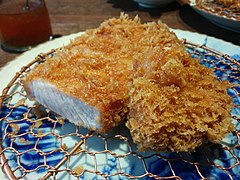 Panko on Tonkatsu
 -
 Fried shrimp with panko breadcrumbs
 -
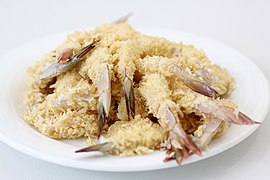 Shrimp coated by panko breadcrumbs
 -
 Panko breadcrumbs – white
 -
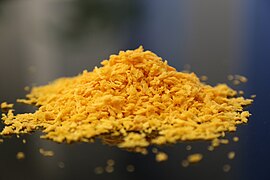 Panko breadcrumbs – paprika
 -
 Panko breadcrumbs – spicy
 -
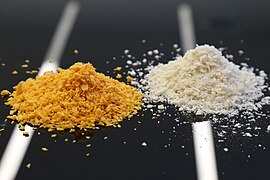 Panko breadcrumbs – paprika and white
 -
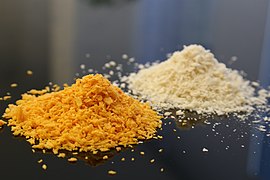 Panko breadcrumbs – paprika and white
 -
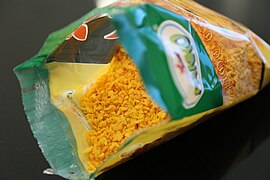 Panko breadcrumbs – paprika


References[edit]
- ^ Shabir Ahmad Mir, Manzoor Ahmad Shah & Afshan Mumtaz Hamdani (2021). Gluten-free Bread Technology. Springer Nature. p. 81. ISBN 9783030738983. Retrieved 19 February 2024.
- ^ "Panko Bread Crumbs: The Secrets Revealed". YouTube. 2018-10-07. Archived from the original on 2012-06-16. Retrieved 2021-08-07.
- ^ "You'll Never Believe How Panko Bread Crumbs Are Made". HuffPost. 2 May 2012. Retrieved 7 August 2021.
- ^ Marshall, Jo (2010-10-05). "COOKCABULARY: Panko is a crumby ingredient - Fall River, MA". The Herald News. Archived from the original on 2011-11-22. Retrieved 2012-11-17.
- ^ Mark Levene (18 October 2010). An Introduction to Search Engines and Web Navigation (2nd ed.). Wiley. p. 221. ISBN 978-0470526842. Retrieved June 24, 2016.
| Types |  | |
|---|---|---|
| Ingredients | ||
| Equipment | ||
| Processes and techniques | ||
| Uses | ||
| Other | ||
| List articles | ||

| Authority control databases: National |
|---|
