


Great Falls (Passaic River)
Paterson Great
Falls National Historical Park | |
 The Great Falls of the Passaic River. | |
  Location of the Great Falls of the Passaic River in Passaic County. Inset: Location of Passaic County in New Jersey.  Great Falls (Passaic River) (New Jersey)  Great Falls (Passaic River) (the United States) | |
| Location | Paterson, New Jersey |
|---|---|
| Coordinates | 40°54′58″N 74°10′54″W / 40.91611°N 74.18167°W |
| Website | Paterson Great Falls National Historical Park |
| NRHP reference No. | 70000391[1] (original) 86001507[2] (increase) |
| NJRHP No. | 2383[3] |
| Significant dates | |
| Added to NRHP | April 14, 1970 |
| Boundary increase | August 14, 1986 |
| Designated NHLD | May 11, 1976[4] |
| Designated NHP | November 7, 2011 |
| Designated NJRHP | May 27, 1971 |

The Great Falls of the Passaic River is a prominent waterfall, 77 feet (23 m) high, on the Passaic River in the city of Paterson in Passaic County, New Jersey. The falls and surrounding area are protected as part of the Paterson Great Falls National Historical Park, administered by the National Park Service. Congress authorized its establishment in 2009.[5]
One of the United States' largest waterfalls, it played a significant role in the early industrial development of New Jersey starting in the earliest days of the nation. It is part of the Great Falls of Paterson–Garret Mountain National Natural Landmark.[6] It has also been designated as a National Historic Landmark District since 1976.[7][8] The Great Falls' raceway and power systems were designated a National Historic Civil Engineering Landmark and a National Historic Mechanical Engineering Landmark in 1977.[9]
History
[edit]Formation and early history
[edit]Geologically, the falls were formed at the end of the last ice age approximately 13,000 years ago. Formerly the Passaic had followed a shorter course through the Watchung Mountains near present-day Summit. As the glacier receded, the river's previous course was blocked by a newly formed moraine. A large lake, called Glacial Lake Passaic, formed behind the Watchungs. As the ice receded, the river found a new circuitous route around the north end of the Watchungs, carving the spectacular falls through the underlying basalt, which was formed approximately 200 million years ago.
The falls later became the site of a habitation of the historic Lenape Native Americans, who followed earlier indigenous cultures in the region. Later, in the colonial era, Dutch settlers developed a community here beginning in the 1690s.
Industrial development
[edit]
In 1778, Alexander Hamilton visited the falls and was impressed by its potential for industry. Later when Hamilton was the nation's Secretary of Treasury, he selected the site of the nation's first planned industrial city, which he called a "national manufactory." In 1791, Hamilton helped found the Society for the Establishment of Useful Manufactures (S.U.M.), a state-chartered private corporation to fulfill this vision. The town of Paterson was founded by the society and named after New Jersey Governor William Paterson, in appreciation of his efforts to promote the society.
Hamilton commissioned civil engineer Pierre Charles L'Enfant, responsible for the layout of the new capital at Washington, D.C., to design the system of canals known as raceways to supply the power for the watermills in the new town.[10] As a result, Paterson became the nucleus for a burgeoning mill industry. In 1792, David Godwin was commissioned to build the first water-powered cotton spinning mill in New Jersey. He subsequently built the first dam on the falls; it was a structure made of wood.[11]
In 1812, this was the site of the state's first continuous roll paper mill. Other 19th-century industries that produced goods using the falls as a power source include the Rogers Locomotive Works (1832), Colt's Manufacturing Company, for the Colt revolver (1837), and the construction of the USS Holland (SS-1) (1898). The oldest extant structure in the historic district is the Phoenix Mill, built in 1813.[12]
Workers were exploited, especially new immigrants from Europe, who often did not speak English. They began to seek better working conditions. The industrial area became the site of labor unrest, and it was a center for the 1913 Paterson silk strike. Facing harsh conditions in factories, immigrant workers staged numerous strikes during and after the Great War, adding to social tensions of the time. They organized the first labor movements in the United States.

The SUM society continued operation until 1945, when its charter and property were sold to the city of Paterson. The area fell into disuse during a period of restructuring that resulted in a steep decline of industry in the region during the mid to late 20th century. In 1971, concerned residents established the Great Falls Preservation and Development Corporation to restore and redevelop the historic mill buildings and raceways as artifacts of industrial history.
Great Falls State Park
[edit]The State of New Jersey announced plans for a new urban state park in Paterson surrounding the Great Falls, called Great Falls State Park, in 2007.[13] The master plan for the park called for utilizing surrounding industrial areas for parklands that include a trail network and recreation areas, and creating new areas to view the falls. These plans were superseded by the establishment of Great Falls National Historical Park.
National Historical Park
[edit]On March 30, 2009, President Obama signed the Omnibus Public Land Management Act[5] authorizing the falls as a national historical park, which would provide additional federal protections for the 77-foot waterfall.[5][14][15] By 2011, Great Falls State Park and other land along the Passaic River were transferred to the federal government for the creation of the Paterson Great Falls National Historical Park. Formal establishment as a unit of the National Park System required action by the Secretary of the Interior,[5] which took place November 7, 2011, when Secretary Salazar formally accepted lands on behalf of the United States, and dedicated the park as the nation's 397th park system unit.[16]
Viewing the falls
[edit]
The Falls are viewable from Haines Overlook Park on the south and Mary Ellen Kramer Park on the north. Drive-by viewing is available from McBride Avenue where it crosses the river just above the Falls. A footbridge over the Falls gorge (historically, the eighth such bridge to span this chasm) also serves as an outlook point. A visitor's center at the corner of Spruce and McBride avenues, in the Great Falls Historic District, provides a historical overview of the falls and the industrial and cultural history of Paterson.[citation needed] A record 177,000 visitors went to the Great Falls in 2016.[17]
National Natural Landmark
[edit]

The Great Falls of Paterson – Garret Mountain is a National Natural Landmark designated in January 1967 and were expanded in April 1967 to include nearby Garret Mountain. Together they help demonstrate how jointed basaltic lava flow shaped the geology of the area during the Early Mesozoic period through both extrusion and intrusion.[18] The designation protects the site from federal development, but not from local and state development. Redevelopment of the decayed adjacent industrial areas has been an ongoing controversial topic. An attempt in the 1990s to redevelop the adjacent Allied Textile Printing Co. (ATP) facility, destroyed by fire in the 1980s, into prefabricated townhouses was initially approved by the city but later repelled by a coalition of local citizens seeking to preserve the historic character of the district.
Hydroelectric facility
[edit]The hydroelectric plant at the falls is operated by Eagle Creek Renewable Energy, which is considering commissioning another facility downstream at the Dundee Dam.[19][20]

The Great Falls hydroelectric plant has three Kaplan type turbines with a total capacity of 10.95 Mwe. Flow through each turbine is 710 cfs, with a total flow of 2,130 cfs, 1,377 MGD. Three 8.5' diameter penstocks feed the turbines, with a velocity 12.5 ft/sec and 8.5 mph.
In popular culture
[edit]The unique history of the Great Falls and the city were described in the five-volume philosophical poem Paterson by William Carlos Williams. Among the episodes described in Williams' poem is the 1827 leap over the falls by Sam Patch, who later became the first known person to perform a stunt at Niagara Falls. The 2016 film Paterson, directed by Jim Jarmusch, is partly inspired by the works of Williams and features the falls as a primary location.
The Great Falls were also featured in the pilot of the HBO crime drama The Sopranos, as well as in the series' sixth episode, in which Mikey Palmice and another associate throw a drug dealer off the bridge and into the falls to his death.
See also
[edit]


- List of waterfalls
- List of National Natural Landmarks in New Jersey
- Garret Mountain Reservation
- National Register of Historic Places listings in Passaic County, New Jersey
- Paterson Museum and Rogers Locomotive and Machine Works
- Old Great Falls Historic District
- Lambert Castle
References
[edit]- ^ "National Register Information System – Great Falls of Paterson/S.U.M. Historic District (#70000391)". National Register of Historic Places. National Park Service. November 2, 2013.
- ^ "National Register Information System – Great Falls of the Passaic and Society for Useful Manufactures Historic District (Boundary Increase) (#86001507)". National Register of Historic Places. National Park Service. November 2, 2013.
- ^ "New Jersey and National Registers of Historic Places - Passaic County" (PDF). New Jersey Department of Environmental Protection - Historic Preservation Office. July 15, 2022. p. 7.
- ^ "Great Falls of the Passaic Society for Useful Manufacturing HD". National Historic Landmark summary listing. National Park Service. June 23, 2008. Archived from the original on March 8, 2008. Retrieved June 24, 2008.
- ^ a b c d 111th U.S. Congress. "Public Law 111-11 § 7001(b)(1)(B)" (PDF). Retrieved August 20, 2009.
{{cite web}}: CS1 maint: numeric names: authors list (link) - ^ "NPS NNL Summary for Great Falls and Garret Mountain". Archived from the original on January 16, 2009. Retrieved January 1, 2009.
- ^ "Great Falls State Park". Archived from the original on March 30, 2009. Retrieved January 14, 2017.
- ^ Herb Jackson. "Paterson prepares for President Obama's visit today". NorthJersey.com. Retrieved January 25, 2017.
- ^ "Great Falls Raceway & Power System". American Society of Civil Engineers. Retrieved January 29, 2022.
- ^ Goldberger, Paul (August 3, 2009), "Facelift The Falls", The New Yorker, p. 23, retrieved January 1, 2022
- ^ Nelson, William. History of Paterson and its environs. Рипол Классик. ISBN 9785877307438.
- ^ "A history of Paterson NJ". Patersonhistory.com. Retrieved January 25, 2017.
- ^ "NJDEP-Parks and Forests". Nj.gov. Retrieved January 25, 2017.
- ^ Ed Murray/The Star-Ledger (March 31, 2009). "Great Falls in Paterson becomes national park with Obama's signature". NJ.com. Retrieved January 25, 2017.
- ^ Mroz, Jacqueline (March 27, 2009). "The Great Falls: Power for Another Revolution?". New York Times. Retrieved April 1, 2009.
- ^ Adam Fetcher (November 7, 2011). "Salazar, City Officials Sign Agreement to Establish Paterson Great Falls National Historical Park". Retrieved November 7, 2011.
- ^ Rahman, Jayed (March 30, 2017). "Paterson's Great Falls sees record number of visitors". The Paterson Times. Retrieved April 27, 2017.
- ^ "Great Falls of Paterson-Garret Mountain". National Park Service. Archived from the original on January 16, 2009. Retrieved January 1, 2009.
- ^ O'Neill, James M. (September 5, 2014). "UnitedWater att Dundee Dam". The Record. Retrieved September 14, 2014.
- ^ O'Neill, James M. (September 5, 2014). "Hydro operator at Paterson's Great Falls weighs putting new hydro project at Dundee Dam". The Record. Retrieved September 5, 2014.
External links
[edit]
- Paterson Great Falls National Historical Park
- National Park Service: On Designation of the Area as part of the National Park System
- Paterson Friends of the Great Falls
- Passaic County, NJ Archived February 5, 2021, at the Wayback Machine Passaic County Board of Chosen Freeholders
- Hamilton Partnership for Paterson
- From Local Landmark to National Site
| Topics | 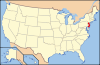 | |
|---|---|---|
| Lists by county | ||
| Other lists | ||


National Historical Parks of the United States | ||
|---|---|---|
|  | |

| Authority control databases: Geographic |
|---|

- Landforms of Passaic County, New Jersey
- Historic Civil Engineering Landmarks
- Historic districts on the National Register of Historic Places in New Jersey
- National Historic Landmarks in New Jersey
- National Historical Parks in New Jersey
- Passaic River
- National Natural Landmarks in New Jersey
- Protected areas of Passaic County, New Jersey
- Watchung Mountains
- Waterfalls of New Jersey
- Parks in Passaic County, New Jersey
- National Register of Historic Places in Passaic County, New Jersey
- Block waterfalls
- Protected areas established in 2009
- 2009 establishments in New Jersey
- United Water
- Paterson, New Jersey
- Hydroelectric power plants in New Jersey
- Energy infrastructure on the National Register of Historic Places
- Geography of Passaic County, New Jersey
- National Historical Parks of the United States