


Moonlight

Moonlight consists of mostly sunlight (with little earthlight) reflected from the parts of the Moon's surface where the Sun's light strikes.[1]
History[edit]
The ancient Greek philosopher Anaxagoras was aware that "the sun provides the moon with its brightness".[2]
Illumination[edit]
The intensity of moonlight varies greatly depending on the lunar phase, but even the full moon typically provides only about 0.05–0.1 lux illumination.[3] When a full Moon around perigee (a "supermoon") is viewed around upper culmination from the tropics, the illuminance can reach up to 0.32 lux.[3] From Earth, the apparent magnitude of the full Moon is only about 1⁄380,000 that of the Sun.[citation needed]
The color of moonlight, particularly around full moon, appears bluish to the human eye compared to other, brighter light sources due to the Purkinje effect. The blue or silver appearance of the light is an illusion.
The Moon's bond albedo averages 0.136,[4] meaning only 13.6% of incident sunlight is reflected from the lunar surface. Moonlight takes approximately 1.26 seconds to reach Earth's surface. Scattered in Earth's atmosphere, moonlight generally increases the brightness of the night sky, reducing contrast between dimmer stars and the background. For this reason, many astronomers usually avoid observing sessions around a full moon.
Gallery[edit]
-
 Moonlight onto Earth's cloud cover from space
 -
 Moonlight shines on the Very Large Telescope.
 -
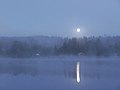 Moonlight illuminates a lake and surroundings.
 -
 During a lunar eclipse, the Moon is colored red by indirect sunlight, which Earth's atmosphere has scattered and refracted.
 -
 Earthlight (indirect sunlight reflected from Earth) illuminates the dim side of the Moon, while direct sunlight the bright side.
 -


.jpg)


Folklore[edit]
In folklore, moonlight sometimes has a harmful influence. For example, sleeping in the light of a full Moon on certain nights was said to transform a person into a werewolf. The light of the Moon was thought to worsen the symptoms of lunatics, and to sleep in moonlight could make one blind, or mad.[5] Nyctalopia (night blindness caused by a lack of vitamin A) was thought to be caused by sleeping in moonlight in the tropics.
"Moon blindness" is a name for equine recurrent uveitis. Moonlight is no longer thought of as the cause.
In the 16th century, moonmilk, a soft white limestone precipitate found in caves, was thought to be caused by the rays of the Moon.[6]
Art[edit]
-
 Seaport by Moonlight (1771) by Claude Joseph Vernet
 -
 Dovedale by Moonlight (1784) by Joseph Wright of Derby
 -
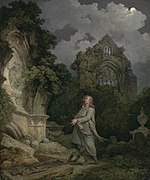 A Philosopher in a Moonlit Churchyard (1790) by Philip James de Loutherbourg
 -

-
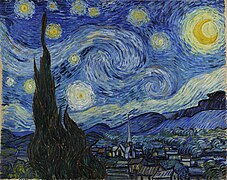 The Starry Night (1889) by Vincent van Gogh
 -
 Halny (1895) by Stanisław Witkiewicz


In 2008 Katie Paterson produced an artwork titled Light bulb to Simulate Moonlight.[7] It consists of 289 lightbulbs coated to produce a similar spectrum to the light of the full Moon.[7]
See also[edit]

- Airglow
- Daylight
- Diffuse reflection
- Earthlight (astronomy)
- Lunar effect
- Scotobiology
- Starlight
- Night in paintings (Western art)
- Night in paintings (Eastern art)
References[edit]
- ^ Toomer, G. J. (December 1964). "Review: Ibn al-Haythams Weg ur Physik by Matthias Schramm". Isis. 55 (4): 463–465 [463–4]. doi:10.1086/349914.
- ^ Fragment in Plutarch De facie in orbe lunae, 929b, as quoted in "The Riverside Dictionary of Biography" (2005), p. 23
- ^ a b Kyba, Christopher C M; Mohar, Andrej; Posch, Thomas (1 February 2017). "How bright is moonlight?". Astronomy & Geophysics. 58 (1): 1.31–32. doi:10.1093/astrogeo/atx025. Retrieved 14 February 2017.
- ^ Matthews, Grant (2008). "Celestial body irradiance determination from an underfilled satellite radiometer: application to albedo and thermal emission measurements of the Moon using CERES". Applied Optics. 47 (27): 4981–93. Bibcode:2008ApOpt..47.4981M. doi:10.1364/AO.47.004981. PMID 18806861.
- ^ A Dictionary of English Folklore, Oxford University Press, 2000
- ^ Gessner, Conrad (1555). Descriptio Montis Fracti sive Montis Pilati [Description of Mount Fractus, or Mount Pilatus] (in Latin). p. 54. Retrieved March 12, 2016.
- ^ a b "Katie Paterson Light bulb to Simulate Moonlight". guggenheim.org. Solomon R. Guggenheim Foundation. Retrieved 29 January 2019.
External links[edit]


- Phases of the Moon Archived 2011-07-09 at the Wayback Machine at USNO
- Strange Moonlight at Science@NASA
- Moonlight Brightness at LunarLight Photography
| Physical properties |  | |
|---|---|---|
| Orbit | ||
| Surface and features | ||
| Science | ||
| Exploration | ||
| Time-telling and navigation | ||
| Phases and names | ||
| Daily phenomena | ||
| Related |
| |


