


Notation for differentiation
 |
| Part of a series of articles about |
| Calculus |
|---|
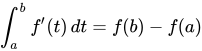
In differential calculus, there is no single uniform notation for differentiation. Instead, various notations for the derivative of a function or variable have been proposed by various mathematicians. The usefulness of each notation varies with the context, and it is sometimes advantageous to use more than one notation in a given context. The most common notations for differentiation (and its opposite operation, the antidifferentiation or indefinite integration) are listed below.
Leibniz's notation
[edit]The original notation employed by Gottfried Leibniz is used throughout mathematics. It is particularly common when the equation y = f(x) is regarded as a functional relationship between dependent and independent variables y and x. Leibniz's notation makes this relationship explicit by writing the derivative as

Furthermore, the derivative of f at x is therefore written
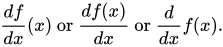
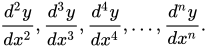
Higher derivatives are written as
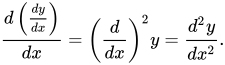
This is a suggestive notational device that comes from formal manipulations of symbols, as in,
The value of the derivative of y at a point x = a may be expressed in two ways using Leibniz's notation:
- .
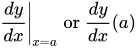
Leibniz's notation allows one to specify the variable for differentiation (in the denominator). This is especially helpful when considering partial derivatives. It also makes the chain rule easy to remember and recognize:
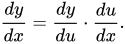
Leibniz's notation for differentiation does not require assigning a meaning to symbols such as dx or dy (known as differentials) on their own, and some authors do not attempt to assign these symbols meaning. Leibniz treated these symbols as infinitesimals. Later authors have assigned them other meanings, such as infinitesimals in non-standard analysis, or exterior derivatives. Commonly, dx is left undefined or equated with , while dy is assigned a meaning in terms of dx, via the equation

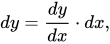
which may also be written, e.g.
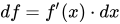
(see below). Such equations give rise to the terminology found in some texts wherein the derivative is referred to as the "differential coefficient" (i.e., the coefficient of dx).
Some authors and journals set the differential symbol d in roman type instead of italic: dx. The ISO/IEC 80000 scientific style guide recommends this style.
Lagrange's notation
[edit]One of the most common modern notations for differentiation is named after Joseph Louis Lagrange, even though it was actually invented by Euler and just popularized by the former. In Lagrange's notation, a prime mark denotes a derivative. If f is a function, then its derivative evaluated at x is written
- .

It first appeared in print in 1749.[1]
Higher derivatives are indicated using additional prime marks, as in for the second derivative and for the third derivative. The use of repeated prime marks eventually becomes unwieldy. Some authors continue by employing Roman numerals, usually in lower case,[2][3] as in



to denote fourth, fifth, sixth, and higher order derivatives. Other authors use Arabic numerals in parentheses, as in

This notation also makes it possible to describe the nth derivative, where n is a variable. This is written

Unicode characters related to Lagrange's notation include
- U+2032 ◌′ PRIME (derivative)
- U+2033 ◌″ DOUBLE PRIME (double derivative)
- U+2034 ◌‴ TRIPLE PRIME (third derivative)
- U+2057 ◌⁗ QUADRUPLE PRIME (fourth derivative)
When there are two independent variables for a function f(x, y), the following convention may be followed:[4]
![{\displaystyle {\begin{aligned}f^{\prime }&={\frac {\partial f}{\partial x}}=f_{x}\\[5pt]f_{\prime }&={\frac {\partial f}{\partial y}}=f_{y}\\[5pt]f^{\prime \prime }&={\frac {\partial ^{2}f}{\partial x^{2}}}=f_{xx}\\[5pt]f_{\prime }^{\prime }&={\frac {\partial ^{2}f}{\partial y\partial x}}\ =f_{xy}\\[5pt]f_{\prime \prime }&={\frac {\partial ^{2}f}{\partial y^{2}}}=f_{yy}\end{aligned}}}](https://wikimedia.org/api/rest_v1/media/math/render/svg/8242cb974856d243f0e51e3fe1e018ffeadbeb75)
Lagrange's notation for antidifferentiation
[edit]f(−2)(x)
When taking the antiderivative, Lagrange followed Leibniz's notation:[5]

However, because integration is the inverse operation of differentiation, Lagrange's notation for higher order derivatives extends to integrals as well. Repeated integrals of f may be written as
- for the first integral (this is easily confused with the inverse function ),
- for the second integral,
- for the third integral, and
- for the nth integral.


D-notation
[edit]D2f
This notation is sometimes called Euler's notation although it was introduced by Louis François Antoine Arbogast, and it seems that Leonhard Euler did not use it. [citation needed]
This notation uses a differential operator denoted as D (D operator)[6][failed verification] or D̃ (Newton–Leibniz operator).[7] When applied to a function f(x), it is defined by
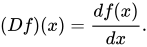
Higher derivatives are notated as "powers" of D (where the superscripts denote iterated composition of D), as in[4]
- for the second derivative,
- for the third derivative, and
- for the nth derivative.


D-notation leaves implicit the variable with respect to which differentiation is being done. However, this variable can also be made explicit by putting its name as a subscript: if f is a function of a variable x, this is done by writing[4]
- for the first derivative,
- for the second derivative,
- for the third derivative, and
- for the nth derivative.


When f is a function of several variables, it is common to use "∂", a stylized cursive lower-case d, rather than "D". As above, the subscripts denote the derivatives that are being taken. For example, the second partial derivatives of a function f(x, y) are:[4]
![{\displaystyle {\begin{aligned}&\partial _{xx}f={\frac {\partial ^{2}f}{\partial x^{2}}},\\[5pt]&\partial _{xy}f={\frac {\partial ^{2}f}{\partial y\,\partial x}},\\[5pt]&\partial _{yx}f={\frac {\partial ^{2}f}{\partial x\,\partial y}},\\[5pt]&\partial _{yy}f={\frac {\partial ^{2}f}{\partial y^{2}}}.\end{aligned}}}](https://wikimedia.org/api/rest_v1/media/math/render/svg/6975c0cbc69a3074c409b338d0c390a987857ffc)
D-notation is useful in the study of differential equations and in differential algebra.
D-notation for antiderivatives
[edit]xy
D−2f
D-notation can be used for antiderivatives in the same way that Lagrange's notation is[8] as follows[7]
- for a first antiderivative,
- for a second antiderivative, and
- for an nth antiderivative.


Newton's notation
[edit]Isaac Newton's notation for differentiation (also called the dot notation, fluxions, or sometimes, crudely, the flyspeck notation[9] for differentiation) places a dot over the dependent variable. That is, if y is a function of t, then the derivative of y with respect to t is

Higher derivatives are represented using multiple dots, as in

Newton extended this idea quite far:[10]
![{\displaystyle {\begin{aligned}{\ddot {y}}&\equiv {\frac {d^{2}y}{dt^{2}}}={\frac {d}{dt}}\left({\frac {dy}{dt}}\right)={\frac {d}{dt}}{\Bigl (}{\dot {y}}{\Bigr )}={\frac {d}{dt}}{\Bigl (}f'(t){\Bigr )}=D_{t}^{2}y=f''(t)=y''_{t}\\[5pt]{\overset {...}{y}}&={\dot {\ddot {y}}}\equiv {\frac {d^{3}y}{dt^{3}}}=D_{t}^{3}y=f'''(t)=y'''_{t}\\[5pt]{\overset {\,4}{\dot {y}}}&={\overset {....}{y}}={\ddot {\ddot {y}}}\equiv {\frac {d^{4}y}{dt^{4}}}=D_{t}^{4}y=f^{\rm {IV}}(t)=y_{t}^{(4)}\\[5pt]{\overset {\,5}{\dot {y}}}&={\ddot {\overset {...}{y}}}={\dot {\ddot {\ddot {y}}}}={\ddot {\dot {\ddot {y}}}}\equiv {\frac {d^{5}y}{dt^{5}}}=D_{t}^{5}y=f^{\rm {V}}(t)=y_{t}^{(5)}\\[5pt]{\overset {\,6}{\dot {y}}}&={\overset {...}{\overset {...}{y}}}\equiv {\frac {d^{6}y}{dt^{6}}}=D_{t}^{6}y=f^{\rm {VI}}(t)=y_{t}^{(6)}\\[5pt]{\overset {\,7}{\dot {y}}}&={\dot {\overset {...}{\overset {...}{y}}}}\equiv {\frac {d^{7}y}{dt^{7}}}=D_{t}^{7}y=f^{\rm {VII}}(t)=y_{t}^{(7)}\\[5pt]{\overset {\,10}{\dot {y}}}&={\ddot {\ddot {\ddot {\ddot {\ddot {y}}}}}}\equiv {\frac {d^{10}y}{dt^{10}}}=D_{t}^{10}y=f^{\rm {X}}(t)=y_{t}^{(10)}\\[5pt]{\overset {\,n}{\dot {y}}}&\equiv {\frac {d^{n}y}{dt^{n}}}=D_{t}^{n}y=f^{(n)}(t)=y_{t}^{(n)}\end{aligned}}}](https://wikimedia.org/api/rest_v1/media/math/render/svg/31289a31e5d7cb530177761e89a230aa3840c8fe)
Unicode characters related to Newton's notation include:
- U+0307 ◌̇ COMBINING DOT ABOVE (derivative)
- U+0308 ◌̈ COMBINING DIAERESIS (double derivative)
- U+20DB ◌⃛ COMBINING THREE DOTS ABOVE (third derivative) ← replaced by "combining diaeresis" + "combining dot above".
- U+20DC ◌⃜ COMBINING FOUR DOTS ABOVE (fourth derivative) ← replaced by "combining diaeresis" twice.
- U+030D ◌̍ COMBINING VERTICAL LINE ABOVE (integral)
- U+030E ◌̎ COMBINING DOUBLE VERTICAL LINE ABOVE (second integral)
- U+25AD ▭ WHITE RECTANGLE (integral)
- U+20DE ◌⃞ COMBINING ENCLOSING SQUARE (integral)
- U+1DE0 ◌ᷠ COMBINING LATIN SMALL LETTER N (nth derivative)
Newton's notation is generally used when the independent variable denotes time. If location y is a function of t, then denotes velocity[11] and denotes acceleration.[12] This notation is popular in physics and mathematical physics. It also appears in areas of mathematics connected with physics such as differential equations.

When taking the derivative of a dependent variable y = f(x), an alternative notation exists:[13]

Newton developed the following partial differential operators using side-dots on a curved X ( ⵋ ). Definitions given by Whiteside are below:[14][15]
![{\displaystyle {\begin{aligned}{\mathcal {X}}\ &=\ f(x,y)\,,\\[5pt]\cdot {\mathcal {X}}\ &=\ x{\frac {\partial f}{\partial x}}=xf_{x}\,,\\[5pt]{\mathcal {X}}\!\cdot \ &=\ y{\frac {\partial f}{\partial y}}=yf_{y}\,,\\[5pt]\colon \!{\mathcal {X}}\,{\text{ or }}\,\cdot \!\left(\cdot {\mathcal {X}}\right)\ &=\ x^{2}{\frac {\partial ^{2}f}{\partial x^{2}}}=x^{2}f_{xx}\,,\\[5pt]{\mathcal {X}}\colon \,{\text{ or }}\,\left({\mathcal {X}}\cdot \right)\!\cdot \ &=\ y^{2}{\frac {\partial ^{2}f}{\partial y^{2}}}=y^{2}f_{yy}\,,\\[5pt]\cdot {\mathcal {X}}\!\cdot \ \ &=\ xy{\frac {\partial ^{2}f}{\partial x\,\partial y}}=xyf_{xy}\,,\end{aligned}}}](https://wikimedia.org/api/rest_v1/media/math/render/svg/b721c8f5527432575a415cd20c9790be27c2ce0c)
Newton's notation for integration
[edit]Newton developed many different notations for integration in his Quadratura curvarum (1704) and later works: he wrote a small vertical bar or prime above the dependent variable (y̍ ), a prefixing rectangle (▭y), or the inclosure of the term in a rectangle (y) to denote the fluent or time integral (absement).

To denote multiple integrals, Newton used two small vertical bars or primes (y̎), or a combination of previous symbols ▭y̍ y̍, to denote the second time integral (absity).

Higher order time integrals were as follows:[16]
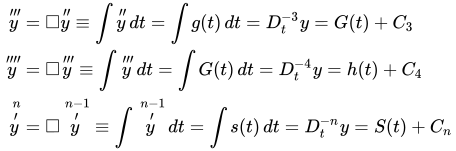
This mathematical notation did not become widespread because of printing difficulties and the Leibniz–Newton calculus controversy.
Partial derivatives
[edit]When more specific types of differentiation are necessary, such as in multivariate calculus or tensor analysis, other notations are common.
For a function f of a single independent variable x, we can express the derivative using subscripts of the independent variable:
![{\displaystyle {\begin{aligned}f_{x}&={\frac {df}{dx}}\\[5pt]f_{xx}&={\frac {d^{2}f}{dx^{2}}}.\end{aligned}}}](https://wikimedia.org/api/rest_v1/media/math/render/svg/905c52cd925d398bd1e987c01e5b52271b0a8a2e)
This type of notation is especially useful for taking partial derivatives of a function of several variables.
Partial derivatives are generally distinguished from ordinary derivatives by replacing the differential operator d with a "∂" symbol. For example, we can indicate the partial derivative of f(x, y, z) with respect to x, but not to y or z in several ways:
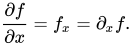
What makes this distinction important is that a non-partial derivative such as may, depending on the context, be interpreted as a rate of change in relative to when all variables are allowed to vary simultaneously, whereas with a partial derivative such as it is explicit that only one variable should vary.


Other notations can be found in various subfields of mathematics, physics, and engineering; see for example the Maxwell relations of thermodynamics. The symbol is the derivative of the temperature T with respect to the volume V while keeping constant the entropy (subscript) S, while is the derivative of the temperature with respect to the volume while keeping constant the pressure P. This becomes necessary in situations where the number of variables exceeds the degrees of freedom, so that one has to choose which other variables are to be kept fixed.


Higher-order partial derivatives with respect to one variable are expressed as
![{\displaystyle {\begin{aligned}&{\frac {\partial ^{2}f}{\partial x^{2}}}=f_{xx},\\[5pt]&{\frac {\partial ^{3}f}{\partial x^{3}}}=f_{xxx},\end{aligned}}}](https://wikimedia.org/api/rest_v1/media/math/render/svg/06dc729f4aa870fcb14aa80d9b4dee7137cdb374)
and so on. Mixed partial derivatives can be expressed as
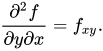
In this last case the variables are written in inverse order between the two notations, explained as follows:
![{\displaystyle {\begin{aligned}&(f_{x})_{y}=f_{xy},\\[5pt]&{\frac {\partial }{\partial y}}\!\left({\frac {\partial f}{\partial x}}\right)={\frac {\partial ^{2}f}{\partial y\,\partial x}}.\end{aligned}}}](https://wikimedia.org/api/rest_v1/media/math/render/svg/d06478b3937d08d2b18787a7210103a69585cb8b)
So-called multi-index notation is used in situations when the above notation becomes cumbersome or insufficiently expressive. When considering functions on , we define a multi-index to be an ordered list of non-negative integers: . We then define, for , the notation




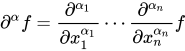
In this way some results (such as the Leibniz rule) that are tedious to write in other ways can be expressed succinctly -- some examples can be found in the article on multi-indices.[17]
Notation in vector calculus
[edit]Vector calculus concerns differentiation and integration of vector or scalar fields. Several notations specific to the case of three-dimensional Euclidean space are common.
Assume that (x, y, z) is a given Cartesian coordinate system, that A is a vector field with components , and that is a scalar field.

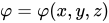
The differential operator introduced by William Rowan Hamilton, written ∇ and called del or nabla, is symbolically defined in the form of a vector,
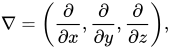
where the terminology symbolically reflects that the operator ∇ will also be treated as an ordinary vector.
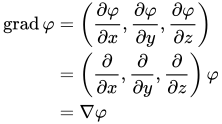
- Gradient: The gradient of the scalar field is a vector, which is symbolically expressed by the multiplication of ∇ and scalar field ,


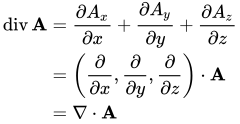
- Divergence: The divergence of the vector field A is a scalar, which is symbolically expressed by the dot product of ∇ and the vector A,

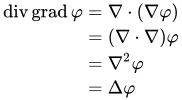
- Laplacian: The Laplacian of the scalar field is a scalar, which is symbolically expressed by the scalar multiplication of ∇2 and the scalar field φ,

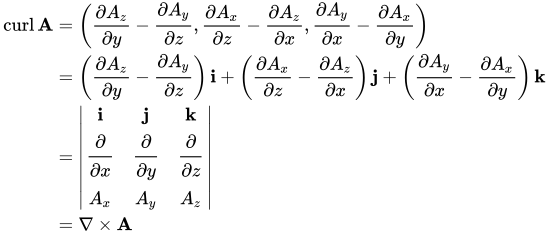
- Rotation: The rotation , or , of the vector field A is a vector, which is symbolically expressed by the cross product of ∇ and the vector A,


Many symbolic operations of derivatives can be generalized in a straightforward manner by the gradient operator in Cartesian coordinates. For example, the single-variable product rule has a direct analogue in the multiplication of scalar fields by applying the gradient operator, as in

Many other rules from single variable calculus have vector calculus analogues for the gradient, divergence, curl, and Laplacian.
Further notations have been developed for more exotic types of spaces. For calculations in Minkowski space, the d'Alembert operator, also called the d'Alembertian, wave operator, or box operator is represented as , or as when not in conflict with the symbol for the Laplacian.


See also
[edit]- Analytical Society – 19th-century British group who promoted the use of Leibnizian or analytical calculus, as opposed to Newtonian calculus
- Derivative – Instantaneous rate of change (mathematics)
- Fluxion – Historical mathematical concept; form of derivative
- Hessian matrix – (Mathematical) matrix of second derivatives
- Jacobian matrix – Matrix of all first-order partial derivatives of a vector-valued function
- List of mathematical symbols by subject – Meanings of symbols used in mathematics
- Operational calculus
References
[edit]- ^ Grosse, Johann; Breitkopf, Bernhard Christoph; Martin, Johann Christian; Gleditsch, Johann Friedrich (September 1749). "Notation for differentiation". Nova Acta Eruditorum: 512.
- ^ Morris, Carla C. (2015-07-28). Fundamentals of calculus. Stark, Robert M., 1930-2017. Hoboken, New Jersey. ISBN 9781119015314. OCLC 893974565.
{{cite book}}: CS1 maint: location missing publisher (link) - ^ Osborne, George A. (1908). Differential and Integral Calculus. Boston: D. C. Heath and co. pp. 63-65.
- ^ a b c d The Differential and Integral Calculus (Augustus De Morgan, 1842). pp. 267-268
- ^ Lagrange, Nouvelle méthode pour résoudre les équations littérales par le moyen des séries (1770), p. 25-26. http://gdz.sub.uni-goettingen.de/dms/load/img/?PID=PPN308900308%7CLOG_0017&physid=PHYS_0031
- ^ "The D operator - Differential - Calculus - Maths Reference with Worked Examples". www.codecogs.com. Archived from the original on 2016-01-19.
- ^ a b Weisstein, Eric W. "Differential Operator." From MathWorld--A Wolfram Web Resource. "Differential Operator". Archived from the original on 2016-01-21. Retrieved 2016-02-07.
- ^ Weisstein, Eric W. "Repeated Integral." From MathWorld--A Wolfram Web Resource. "Repeated Integral". Archived from the original on 2016-02-01. Retrieved 2016-02-07.
- ^ Zill, Dennis G. (2009). "1.1". A First Course in Differential Equations (9th ed.). Belmont, CA: Brooks/Cole. p. 3. ISBN 978-0-495-10824-5.
- ^ Newton's notation reproduced from:
- 1st to 5th derivatives: Quadratura curvarum (Newton, 1704), p. 7 (p. 5r in original MS: "Newton Papers : On the Quadrature of Curves". Archived from the original on 2016-02-28. Retrieved 2016-02-05.).
- 1st to 7th, nth and (n+1)th derivatives: Method of Fluxions (Newton, 1736), pp. 313-318 and p. 265 (p. 163 in original MS: "Newton Papers : Fluxions". Archived from the original on 2017-04-06. Retrieved 2016-02-05.)
- 1st to 5th derivatives : A Treatise of Fluxions (Colin MacLaurin, 1742), p. 613
- 1st to 4th and nth derivatives: Articles "Differential" and "Fluxion", Dictionary of Pure and Mixed Mathematics (Peter Barlow, 1814)
- 1st to 4th, 10th and nth derivatives: Articles 622, 580 and 579 in A History of Mathematical Notations (F .Cajori, 1929)
- 1st to 6th and nth derivatives: The Mathematical Papers of Isaac Newton Vol. 7 1691-1695 (D. T. Whiteside, 1976), pp.88 and 17
- 1st to 3rd and nth derivatives: A History of Analysis (Hans Niels Jahnke, 2000), pp. 84-85
- ^ Weisstein, Eric W. "Overdot." From MathWorld--A Wolfram Web Resource. "Overdot". Archived from the original on 2015-09-05. Retrieved 2016-02-05.
- ^ Weisstein, Eric W. "Double Dot." From MathWorld--A Wolfram Web Resource. "Double Dot". Archived from the original on 2016-03-03. Retrieved 2016-02-05.
- ^ Article 580 in Florian Cajori, A History of Mathematical Notations (1929), Dover Publications, Inc. New York. ISBN 0-486-67766-4
- ^ "Patterns of Mathematical Thought in the Later Seventeenth Century", Archive for History of Exact Sciences Vol. 1, No. 3 (D. T. Whiteside, 1961), pp. 361-362,378
- ^ S.B. Engelsman has given more strict definitions in Families of Curves and the Origins of Partial Differentiation (2000), pp. 223-226
- ^ Newton's notation for integration reproduced from:
- 1st to 3rd integrals: Quadratura curvarum (Newton, 1704), p. 7 (p. 5r in original MS: "Newton Papers : On the Quadrature of Curves". Archived from the original on 2016-02-28. Retrieved 2016-02-05.)
- 1st to 3rd integrals: Method of Fluxions (Newton, 1736), pp. 265-266 (p. 163 in original MS: "Newton Papers : Fluxions". Archived from the original on 2017-04-06. Retrieved 2016-02-05.)
- 4th integrals: The Doctrine of Fluxions (James Hodgson, 1736), pp. 54 and 72
- 1st to 2nd integrals: Articles 622 and 365 in A History of Mathematical Notations (F .Cajori, 1929)
- ^ Tu, Loring W. (2011). An introduction to manifolds (2 ed.). New York: Springer. ISBN 978-1-4419-7400-6. OCLC 682907530.

External links
[edit]- Earliest Uses of Symbols of Calculus, maintained by Jeff Miller (Archived 2020-07-26 at the Wayback Machine).