


Port Jervis, New York
Port Jervis | |
|---|---|
 View of Port Jervis, taken from Elks-Brox Park | |
 Seal | |
| Motto: Gateway to the Upper Delaware River | |
 | |
 Interactive map of Port Jervis | |
| Coordinates: 41°22′N 74°41′W / 41.367°N 74.683°W | |
| Country |  United States United States |
| State | New York |
| County | Orange |
| Settled | 1690 |
| Incorporated (village) | 1853 |
| Incorporated (city) | 1907 |
| Named for | John B. Jervis |
| Government | |
| • Type | Mayor–council |
| • Mayor | Dominic Cicalese (R) |
| • Councilman at Large | Michael Hockenberry (R) |
| Area | |
| • Total | 2.70 sq mi (7.00 km2) |
| • Land | 2.53 sq mi (6.55 km2) |
| • Water | 0.17 sq mi (0.44 km2) 6.64% |
| Elevation | 400 ft (122 m) |
| Population (2020) | |
| • Total | 8,775 |
| • Density | 3,468.38/sq mi (1,339.24/km2) |
| Time zone | UTC−5 (EST) |
| • Summer (DST) | UTC−4 (EDT) |
| ZIP Code | 12771 |
| Area code | 845 |
| FIPS code | 36-59388 |
| GNIS feature ID | 0960971 |
| Website | www |
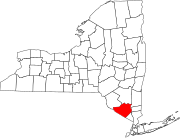
Port Jervis is a city located at the confluence of the Neversink and Delaware rivers in western Orange County, New York, United States, north of the Delaware Water Gap. Its population was 8,775 at the 2020 census. The communities of Deerpark, Huguenot, Sparrowbush, and Greenville are adjacent to Port Jervis. Matamoras, Pennsylvania, is across the river and connected by the Mid-Delaware Bridge. Montague Township, New Jersey, also borders the city. The Tri-States Monument, marking the tripoint between New York, New Jersey, and Pennsylvania, lies at the southwestern corner of the city.
Port Jervis was part of early industrial history, a point for shipping coal to major markets to the southeast by canal and later by railroads. Its residents had long-distance passenger service by railroad until 1970. The restructuring of railroads resulted in a decline in the city's business and economy.[2]
In the 21st century, from late spring to early fall, many thousands of travelers and tourists pass through Port Jervis on their way to enjoying rafting, kayaking, canoeing and other activities in the Delaware Water Gap National Recreation Area and the Upper Delaware Scenic and Recreational River and the surrounding area.
Port Jervis is part of the Poughkeepsie–Newburgh–Middletown metropolitan area as well as the larger New York metropolitan area. In August 2008, Port Jervis was named one of "Ten Coolest Small Towns" by Budget Travel magazine.[3]
History[edit]
The first fully developed European settlement in the area was established by Dutch and English colonists c.1690, and a land grant of 1,200 acres (490 ha) was formalized on October 14, 1697. The settlement was originally known as Mahackamack, after a Lenape word. It was raided and burned in 1779 during the American Revolutionary War, by British and Mohawk forces under the command of Mohawk leader Joseph Brant before the Battle of Minisink. Over the next two decades, residents rebuilt the settlement. They developed more roadways to better connect Mahackamack with the eastern parts of Orange County.
After the Delaware and Hudson Canal was opened in 1828, providing transportation of coal from northeastern Pennsylvania to New York and New England via the Hudson River, trade attracted money and further development to the area.[4] A village was incorporated on May 11, 1853.[2] It was renamed as Port Jervis in the mid-19th century, after John Bloomfield Jervis, chief engineer of the D&H Canal. Port Jervis grew steadily into the 1900s, and on July 26, 1907, it became a city.

Coming of the railroad[edit]
The first rail line to run through Port Jervis was the New York & Erie Railroad, which in 1832 was chartered to run from Piermont, New York, on the Hudson River in Rockland County, to Lake Erie. Ground was broken in 1835, but construction was delayed by a nationwide financial panic, and did not start again until 1838. The line was completed in 1851, and the first passenger train – with President Millard Fillmore and former United States Senator Daniel Webster on board – came through the city on May 14. The railroad went through a number of name changes, becoming the Erie Railroad in 1897.[5]
A second railroad, the Port Jervis and Monticello Railroad, later leased to the New York, Ontario and Western Railway (O&W), opened in 1868, running northeast out of the city, and eventually connecting to Kingston, New York, Weehawken, New Jersey and eastern connections.[5]
Like the D&H Canal, the railroads brought new prosperity to Port Jervis in the form of increased trade and investment in the community from the outside. However, the competition by the railroad, which could deliver products faster, hastened the decline of the canal, which ceased operation in 1898. The railroads were the basis of the city's economy for the coming decades. Port Jervis became Erie's division center between Jersey City, New Jersey and Susquehanna, Pennsylvania, and by 1922, 20 passenger trains went through the city every day. More than 2,500 Erie RR employees made their homes there.[6]
The railroads began to decline after the Great Depression.[6] A shift in transportation accelerated after World War II with the federal subsidy of the Interstate Highway System and increased competition from trucking companies. One of the first Class I railroads to shut down was the O&W, on March 29, 1957, leaving Port Jervis totally reliant on the Erie. A few years later, in 1960, the Erie, also on a shaky financial footing, merged with Delaware, Lackawanna and Western Railroad to become the Erie Lackawanna. Railroad restructuring continued and in 1976, the Erie Lackawana became part of Conrail, along with a number of other struggling railroads, such as the Penn Central.[5] Since the breakup of Conrail, the trackage around Port Jervis has been controlled by Norfolk Southern. The decline of the railroads was an economic blow to Port Jervis. The city has struggled to find a new economic basis.
Lynching and Racist incidents[edit]
On June 2, 1892, Robert Lewis, an African American, was lynched, hanged on Main Street in Port Jervis by a mob after being accused of participation in an assault on a white woman.[7][8] A grand jury indicted nine people for assault and rioting rather than Lewis's lynching.[9] Some literary critics argue that this event influenced Stephen Crane's 1898 novella The Monster. Crane lived in Port Jervis from 1878 until 1883 and frequently visited the area from 1891 to 1897.[10]
In the mid-1920s some residents in the area formed a Ku Klux Klan chapter, in the period of the KKK's early 20th-century revival. They burned crosses on Point Peter, the mountain peak that overlooks the city.[11]


Geological history[edit]
The city's location at the confluence of the Delaware and Neversink rivers has made it subject to occasional flooding. There was flooding during the 1955 Hurricane Diane, and a flood-related rumor started a panic in the population. This incident was studied and a 1958 report issued by the National Research Council: "The Effects of a Threatening Rumor on a Disaster-Stricken Community".[12]
In addition to the rivers having flooded during periods of heavy rainfall, at times ice jams have effectively dammed the Delaware, also causing flooding. In 1875 ice floes destroyed the bridge to Matamoras, Pennsylvania.[6] In 1981 a large ice floe resulted in the highest water crest measured to date at the National Weather Service's Matamoras river gauge 26.6 feet (8.1 m).[13]

Geography[edit]
Port Jervis is located on the north bank of the Delaware River at the confluence where the Neversink River – the Delaware's largest tributary – empties into the larger river. Port Jervis is connected by the Mid-Delaware Bridge across the Delaware to Matamoras, Pennsylvania.
From here the Delaware flows to the southwest, running parallel to Kittatinny Ridge until reaching the Delaware Water Gap. It heads southeastward, continuing past New Hope, Pennsylvania and Lambertville, New Jersey; and the New Jersey capital, Trenton; to Philadelphia, and the Delaware Bay.
Port Jervis is also home to the tri-point between New York, Pennsylvania and New Jersey.
According to the United States Census Bureau, the city has a total area of 2.7 square miles (7.0 km2), of which 2.5 square miles (6.5 km2) is land and 0.2 square miles (0.52 km2) (6.64%) is water.
Climate[edit]
Port Jervis has a Humid Continental Climate (Köppen Dfb) with relatively hot summers and cold winters. It receives approximately 47.18 inches (1,198 mm) of precipitation per year, most of which occurs in the late spring in early summer. Extremes range from −26 °F (−32 °C) on January 14, 1912, to 105 °F (40.5 °C) on July 9, 1936.
| Climate data for Port Jervis, New York 1991–2022 normals, extremes 1893–present | |||||||||||||
|---|---|---|---|---|---|---|---|---|---|---|---|---|---|
| Month | Jan | Feb | Mar | Apr | May | Jun | Jul | Aug | Sep | Oct | Nov | Dec | Year |
| Record high °F (°C) | 71 (22) |
75 (24) |
88 (31) |
96 (36) |
98 (37) |
102 (39) |
105 (41) |
103 (39) |
103 (39) |
93 (34) |
85 (29) |
73 (23) |
105 (41) |
| Mean daily maximum °F (°C) | 33.9 (1.1) |
37.3 (2.9) |
46.2 (7.9) |
60.1 (15.6) |
71.3 (21.8) |
78.8 (26.0) |
83.6 (28.7) |
81.4 (27.4) |
73.8 (23.2) |
61.8 (16.6) |
49.4 (9.7) |
38.5 (3.6) |
59.7 (15.4) |
| Daily mean °F (°C) | 24.9 (−3.9) |
27.1 (−2.7) |
35.4 (1.9) |
47.4 (8.6) |
58.4 (14.7) |
66.9 (19.4) |
71.8 (22.1) |
69.8 (21.0) |
62.4 (16.9) |
50.7 (10.4) |
39.7 (4.3) |
30.4 (−0.9) |
48.7 (9.3) |
| Mean daily minimum °F (°C) | 16.0 (−8.9) |
17.0 (−8.3) |
24.5 (−4.2) |
34.7 (1.5) |
45.6 (7.6) |
55.0 (12.8) |
60.0 (15.6) |
58.3 (14.6) |
51.0 (10.6) |
39.6 (4.2) |
30.1 (−1.1) |
22.8 (−5.1) |
37.8 (3.2) |
| Record low °F (°C) | −26 (−32) |
−20 (−29) |
−9 (−23) |
8 (−13) |
21 (−6) |
34 (1) |
39 (4) |
33 (1) |
21 (−6) |
15 (−9) |
1 (−17) |
−20 (−29) |
−26 (−32) |
| Average precipitation inches (mm) | 3.07 (78) |
2.63 (67) |
3.66 (93) |
3.78 (96) |
3.58 (91) |
4.72 (120) |
4.72 (120) |
4.64 (118) |
4.54 (115) |
4.67 (119) |
3.27 (83) |
3.90 (99) |
47.18 (1,198) |
| Average precipitation days (≥ 0.01 in) | 8.6 | 8.6 | 11.9 | 16.1 | 16.7 | 15.1 | 15.7 | 13.7 | 11.5 | 11.7 | 9.4 | 11.5 | 150.5 |
| Source: NOAA[14]
Weather Atlas[15] | |||||||||||||
Demographics[edit]
| Census | Pop. | Note | %± |
|---|---|---|---|
| 1870 | 6,377 | — | |
| 1880 | 8,678 | 36.1% | |
| 1890 | 9,327 | 7.5% | |
| 1900 | 9,385 | 0.6% | |
| 1910 | 9,564 | 1.9% | |
| 1920 | 10,171 | 6.3% | |
| 1930 | 10,243 | 0.7% | |
| 1940 | 9,749 | −4.8% | |
| 1950 | 9,372 | −3.9% | |
| 1960 | 9,268 | −1.1% | |
| 1970 | 8,852 | −4.5% | |
| 1980 | 8,699 | −1.7% | |
| 1990 | 9,060 | 4.1% | |
| 2000 | 8,860 | −2.2% | |
| 2010 | 8,828 | −0.4% | |
| 2020 | 8,775 | −0.6% | |
| U.S. Decennial Census[16] | |||
As of the census[17] of 2000, there were 8,860 people, 3,533 households, and 2,158 families residing in the city. The population density was 3,500/sq mi (1,300/km2). There were 3,851 housing units at an average density of 1,500/sq mi (590/km2). The racial makeup of the city was 82.4% White, 8.2% African American, 0.59% Native American, 0.64% Asian, 0.02% Pacific Islander, 2.19% from other races, and 2.26% from two or more races. Hispanic or Latino of any race were 7.5% of the population.
There were 3,533 households, out of which 32.4% had children under the age of 18 living with them, 39.9% were married couples living together, 15.6% had a female householder with no husband present, and 38.9% were non-families. 32.6% of all households were made up of individuals, and 15.1% had someone living alone who was 65 years of age or older. The average household size was 2.48 and the average family size was 3.15.

In the city, the age distribution of the population shows 27.8% under the age of 18, 8.4% from 18 to 24, 28.3% from 25 to 44, 20.3% from 45 to 64, and 15.2% who were 65 years of age or older. The median age was 36 years. For every 100 females, there were 91.4 males. For every 100 females age 18 and over, there were 86.0 males.
The median income for a household in the city was $30,241, and the median income for a family was $35,481. Males had a median income of $31,851 versus $22,274 for females. The per capita income for the city was $16,525. About 14.2% of families and 15.7% of the population were below the poverty line, including 25.5% of those under age 18 and 10.3% of those age 65 or over.
Points of interest[edit]
State line monuments[edit]

Port Jervis lies near the points where the states of New York, New Jersey and Pennsylvania come together. South of the Laurel Grove Cemetery, under the viaduct for Interstate 84, are two monuments marking the boundaries between the three states.[19]
The larger monument is a granite pillar inscribed "Witness Monument". It is not on any boundary itself, but instead is a witness for two boundary points. On the north side (New York), it references the corner boundary point between New York and Pennsylvania that is located in the center of the Delaware River 475 feet (145 m) due west of the Tri-State Rock. On the south side (New Jersey), it references the Tri-State Rock 72.25 feet (22.02 m) to the south.
The smaller monument, the Tri-States Monument, also known as the Tri-State Rock, marks both the northwest end of the New Jersey and New York boundary and the north end of the New Jersey and Pennsylvania boundary.[20] It is a small granite block with inscribed lines marking the boundaries of the three states and a bronze United States Coast and Geodetic Survey marker.[21] Both monuments were erected in 1882.[19]
Transportation[edit]

US 6, U.S. Route 209, New York State Route 42, and New York State Route 97 (the "Upper Delaware Scenic Byway"[22]) pass through Port Jervis. Interstate 84 passes to the south.
Port Jervis is the last stop on the 95-mile-long (153 km) Port Jervis Line, which is a commuter railroad service from Hoboken, New Jersey and New York City (via a Secaucus Transfer) that is contracted to NJ Transit by the Metro-North Railroad of the Metropolitan Transportation Authority. The track itself continues on to Binghamton and Buffalo, but passenger service west of Port Jervis was discontinued in November 1966.
Short Line provides bus service between Honesdale, Pennsylvania, Port Jervis, and the Port Authority Bus Terminal.[23]
Government[edit]

Port Jervis is governed by a mayor and a city council under a mayor–council government system. The city council has nine members: a councilman-at-large and eight members elected from wards. The city comprises four wards, residents of which elect two council members each for two year terms.[24] The mayor and councilman-at-large are elected at large for two year terms. Elections are held in odd number years. Terms of office begin on January 1.
Representation in the state legislature is split between Democrats and Republicans. The city is located in the 98th Assembly district, currently represented by Republican Karl Brabenec. Democrat James Skoufis represents the city in the state senate as part of the 42nd district.
Port Jervis is a part of New York's 18th congressional district, represented by Democrat Pat Ryan. Senators Charles Schumer and Kirsten Gillibrand represent all of New York in the U.S. Senate, including the city.
| Seat | Member | Party | Took office |
|---|---|---|---|
| Councilman-at-large | Michael Hockenberry | Republican | January 1, 2024 |
| Councilman (ward 1) | Jason Vicchiariello | Republican | January 1, 2024 |
| Councilman (ward 1) | Colin O'Connell | Republican | January 1, 2024 |
| Councilman (ward 2) | Misty Fuller | Republican | January 1, 2022 |
| Councilman (ward 2) | Maria Mann | Republican | January 1, 2018 |
| Councilman (ward 3) | Jeffrey Rhoades | Republican | January 1, 2024 |
| Councilman (ward 3) | Vacant | ||
| Councilman (ward 4) | Jacqueline Dennison | Democratic | January 1, 2024 |
| Councilman (ward 4) | Stanley Siegel | Democratic | January 1, 2024 |

Education[edit]
Port Jervis City School District operates public schools serving Port Jervis.[25] The area elementary school, Anna S. Kuhl Elementary School, is in Deerpark but with a Port Jervis postal address.[26] Port Jervis Middle School is in Port Jervis.[27] Port Jervis High School is also in Deerpark but with a Port Jervis postal address.[28] Kuhl and Port Jervis High are on the same property.[29]
Recreation[edit]
The Port Jervis Recreation department maintains thirteen parks and squares. The city's largers Parks are Elks-Brox Park and Riverside Park. Elks-Brox Park, which includes Skyline Drive, the Elks-Brox Campground and the overlook at Point Peter, backs up to the much larger Port Jervis Watershed Park and Recreation Area, which together include more than sixty miles of hiking and biking trails. Riverside Park is home to the Riverside Disc Golf Course, the Port Jervis Pump Track, trails, playground equipment, basketball courts, and other facilities. Riverside Park is also home to a summer concert series, as well as movies in the park. The smaller Farnum Park at the end of Ulster Place is also home to a summer concert series and a playground and a basketball court. Basketball Courts can also be found at Church Street Park and West End Beach. West End Beach is a park along the Delaware River that has a bathing beach in the summer, a boat launch, volleyball and basketball and also serves as the city's sledding hill in the winter. Playground equipment is also located at Barkley Street Park (Tri-States) and John Glenn Park on Cahoonzie Street. Other parks and squares in the city are Skinners Park, Orange Square/Veterans Memorial Park, Mothers Park, West End Memorial Park, Chris Marion Park, and Farmer's Market Square.
The Youth Community Center on Pike Street provides after-school activities throughout the year, as well as summer programming.
The Dog Yard, located near the Erie Turntable, is a free dog park open to residents by application.
The Lynx at River Bend Golf Club is located just past city limits on the other side of the Neversink River.
Media[edit]
On July 4, 1953, WDLC at 1490 on the AM dial signed-on. Co-owned.[clarification needed] The station also can receive WSPK-FM K104.7 and WRRV on 92.7.
Notable people[edit]
Notable current and former residents of Port Jervis include:
- Frank Abbott, Mayor of Port Jervis from 1874 to 1876
- Ed and Lou Banach, University of Iowa wrestlers, NCAA All-Americans and NCAA Champions, 1984 Summer Olympics gold medalists in freestyle wrestling, lived in Port Jervis and graduated from Port Jervis Senior High School.[30]
- William Stiles Bennet (1870–1962), U.S. representative for New York's 17th congressional district from 1905 to 1911 and New York's 23rd congressional district from 1915 to 1917.
- Daniel Cohen, children's book author[31]
- Stephen Crane, author of The Red Badge of Courage, lived in Port Jervis between the ages 6–11 and frequently visited and wrote there from 1891 to early 1897.[32]
- William Howe Crane (1854–1926), older brother of Stephen Crane, lived and practiced law in Port Jervis for many years.
- Stefanie Dolson, basketball player for the New York Liberty and formerly of the Connecticut Huskies Women's Basketball team, was born in Port Jervis. She was a high school standout at nearby Minisink Valley High School, where she was a McDonald's All-American and won multiple National Championships with Connecticut.
- Samuel Fowler (1851–1919) represented New Jersey's 4th congressional district in the U.S. House of Representatives from 1893 to 1895.[33]
- E. Arthur Gray (1925–2006) was the longest-serving mayor of Port Jervis and was later a New York State Senator. The Port Jervis United States Post Office building is dedicated in his name.[34]
- Benjamin Hafner (March 24, 1821–spring 1899), known as "The Flying Dutchman" and "Uncle Ben", was an American locomotive engineer who worked for the Erie Railway.
- Albert Hammond Jr., (1980–), musician and music producer best known as a guitarist of The Strokes. His One Way Studio in the area is where much of the albums Angles and Comedown Machine were recorded, among others.[35][36]
- Bucky Harris, Baseball player/manager and Hall of Famer; born in Port Jervis.
- The Kalin Twins, Hal (1934–2005) and Herbie (1934–2006), were one hit wonders whose record "When" made the top 5 in the U.S. and was number one for five weeks in the U.K. in 1958.
- Francis Marvin (1828–1905), U.S. representative for New York's 17th congressional district from 1893 to 1895.
- William C. Norris (1926-), a major general who served in the United States Air Force from 1945 to 1980.
- Amar'e Stoudemire (1982–), former professional basketball player for the New York Knicks. Lived in Port Jervis for a duration of grade school and middle school. It is said that this is where he played basketball at local parks and first fell in love with the sport of basketball.
- Hudson Van Etten, Medal of Honor recipient, was born in Port Jervis.
Sister City[edit]

Gallery[edit]
-
 The E. Arthur Gray Post Office, on the NRHP
 -
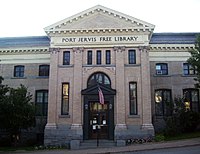 The Free Library, a Carnegie library built in 1903
 -
 The largest working rail turntable in the U.S. is in Port Jervis
 -
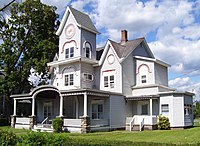 One of the many Victorian style houses in the city
 -
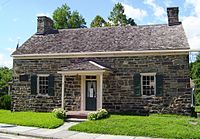 Fort Decker (1793), the oldest building in the city
 -
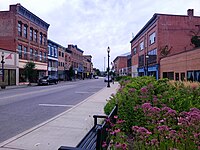 A view of many small businesses on Front St


References[edit]
- ^ "ArcGIS REST Services Directory". United States Census Bureau. Retrieved September 20, 2022.
- ^ a b "Minisink Valley Historical Society - Port Jervis and the Gilded Age". minisink.org. Retrieved October 21, 2019.
- ^ Harrison, Karen Tina. "10 Coolest Small Towns: Port Jervis" Archived 2010-09-22 at the Wayback Machine. Budget Travel. (September 2008). Retrieved January 13, 2011.
- ^ "D&H Canal & Gravity Railroad", Minisink Valley Historical Society
- ^ a b c "Railroads of Port Jervis". Minisink Valley Historical Society website
- ^ a b c "Port Jervis and the Gilded Age", Minisink Valley Historical Society
- ^ "Lynching at Port Jervis. – Robert Jackson, a colored man, hanged by a mob" (PDF). New York Times. June 3, 1892.
- ^ https://academicworks.cuny.edu/cgi/viewcontent.cgi?article=1025&context=ho_pubs [bare URL]
- ^ "Port Jervis Lynching indictments" (PDF). New York Times. June 30, 1892.
- ^ Wertheim, Stanley. A Stephen Crane Encyclopedia. Westport, Connecticut: Greenwood Press, 1997. ISBN 0-313-29692-8. p. 195
- ^ "Boys get 'K.K.K.' Warning – Port Jervis Youths are Ordered to restore crosses to Point Peter" (PDF). New York Times. August 13, 1922.
- ^ "The Effects of a Threatening Rumor on a Disaster-Stricken Community ". National Research Council (NRC). (1958) Retrieved January 13, 2011.
- ^ Weyandt, Kimberly. "Flooding is old news". The River Reporter (September 30 – October 6, 2004). Retrieved March 5, 2011.
However, the NWS' list of "Historical Crests" for the river at Matamoras/Port Jervis shows a peak of 25.5 feet (7.8 m) in 1904, and no record peak in 1981 at all. - ^ "NowData - NOAA Online Weather Dat". National Oceanic and Atmospheric Administration. Retrieved June 14, 2022.
- ^ "Port Jervis, New York - Monthly weather forecast and Climate data". Weather Atlas. Retrieved June 14, 2022.
- ^ "Census of Population and Housing". Census.gov. Retrieved June 4, 2015.
- ^ "U.S. Census website". United States Census Bureau. Retrieved January 31, 2008.
- ^ City of Port Jervis historical marker at the church site
- ^ a b Graff, Bill (Summer 2006). "Sentinels at the Northern Border" (PDF). Unearthing New Jersey Vol. 2, No. 2. New Jersey Geological Survey.
- ^ Vermeule, C. Clarkson (1888). "Physical Description of New Jersey: Northern Boundary Between New Jersey and New York". In Cook, George H. (ed.). Final Report of the State Geologist. Vol. 1. Trenton, New Jersey: Geological Survey of New Jersey. pp. 66–67.
- ^ "LY2604: TRI STATES". U.S. National Geodetic Survey.
- ^ "Upper Delaware Scenic Byway website". Archived from the original on October 9, 2011.
- ^ "ShortLine Scheduled Bus Service | Coach USA". www.coachusa.com.
- ^ "City Council". Port Jervis Website. Retrieved September 9, 2022.
- ^ "2020 CENSUS - SCHOOL DISTRICT REFERENCE MAP: Orange County, NY" (PDF). U.S. Census Bureau. Retrieved May 5, 2021.
- ^ "Home". Anna S. Kuhl Elementary School. Retrieved January 18, 2022.
10 Route 209 Port Jervis, New York 12771
- Despite the "Port Jervis" postal address, the school is physically in Deerpark.- Compare full address to the zoning map of Deerpark: "Zoning Map" (PDF). Town of Deerpark. Retrieved January 18, 2022.
- Compare to the map of Port Jervis: "2010 CENSUS - CENSUS BLOCK MAP: Port Jervis city, NY" (PDF). U.S. Census Bureau. Retrieved January 18, 2022.
- ^ "Home". Port Jervis Middle School. Retrieved January 18, 2022.
118 E Main Street Port Jervis, New York 12771
- ^ "Home". Port Jervis High School. Retrieved January 18, 2022.
10 Route 209 Port Jervis, New York 12771
- Despite the "Port Jervis" postal address, the school is physically in Deerpark.- Compare full address to the zoning map of Deerpark: "Zoning Map" (PDF). Town of Deerpark. Retrieved January 18, 2022.
- Compare to the map of Port Jervis: "2010 CENSUS - CENSUS BLOCK MAP: Port Jervis city, NY" (PDF). U.S. Census Bureau. Retrieved January 18, 2022.
- ^ "Port Jervis High School Profile" (PDF). Port Jervis School District. Retrieved January 18, 2022.
- ^ Rimer, Sara. "Port Jervis Celebrates Its Conquering Heroes", New York Times, September 3, 1984. Accessed October 10, 2007. "The Banach boys, as everyone knows them here, came back home this weekend, and as the townspeople celebrated their own Olympic gold medalists with a day of marching bands, waving flags and heartfelt speeches, all the hard times and disasters Port Jervis had endured seemed at last forgotten."
- ^ "Lockerbie victim's mom happy to see 'monster' Gadhafi gone". Times Herald-Record. October 21, 2011. Retrieved April 3, 2021.
Theo's parents, Susan and Dan Cohen, moved from Port Jervis to Cape May Courthouse, N.J.,[...]
- ^ Wertheim, Stanley and Paul Sorrentino. 1994. The Crane Log: A Documentary Life of Stephen Crane, 1871–1900. pp. 13–30, 54, 65, 71, 108, et al to 240, New York: G. K. Hall & Co. ISBN 0-8161-7292-7.
- ^ Samuel Fowler, Biographical Directory of the United States Congress. Accessed September 4, 2007.
- ^ "E. Arthur Gray Post Office Building" Archived 2014-08-28 at the Wayback Machine in the Congressional Record (March 10, 2008)
- ^ "Gus Oberg: Recording The Strokes' Angles". Sound on Sound. Retrieved November 11, 2020.
[In 2007-2008]... Albert and I needed a place to work, so we started to build what's now his One Way Studios, which is located one and a half hours' drive from Manhattan, in the Catskill Mountains. Albert and I designed the studio together. We had a building constructed from scratch...
- ^ Frisicano, Andrew (September 15, 2015). "See photos from our interview with Albert Hammond Jr". Time Out New York. Retrieved November 7, 2020.
He might live upstate these days (Eldred, NY, to be exact)...
- ^ "Regular Meeting Minutes September 12, 2023" (PDF). portjervisny.gov. Retrieved April 7, 2024.
External links[edit]


Places adjacent to Port Jervis, New York | ||||||||||||||||
|---|---|---|---|---|---|---|---|---|---|---|---|---|---|---|---|---|
| ||||||||||||||||


| International | |
|---|---|
| National | |
| Geographic | |

- Port Jervis, New York
- Cities in New York (state)
- Neversink River
- Populated places established in 1690
- Kiryas Joel–Poughkeepsie–Newburgh metropolitan area
- Cities in Orange County, New York
- Cities in the New York metropolitan area
- 1690 establishments in the Province of New York
- New York (state) populated places on the Delaware River