


Portal:Myths

The Myths Portal

Myth is a genre of folklore or theology consisting primarily of narratives that play a fundamental role in a society, such as foundational tales or origin myths. For folklorists, historians, philosophers or theologians this is very different from the use of "myth" simply indicating that something is not true. Instead, the truth value of a myth is not a defining criterion.
Myths are often endorsed by secular and religious authorities and are closely linked to religion or spirituality. Many societies group their myths, legends, and history together, considering myths and legends to be true accounts of their remote past. In particular, creation myths take place in a primordial age when the world had not achieved its later form. Other myths explain how a society's customs, institutions, and taboos were established and sanctified. There is a complex relationship between recital of myths and the enactment of rituals. (Full article...)
Selected article -

In Hinduism, Ahalya (Sanskrit: अहल्या, IAST: Ahalyā) also spelt as Ahilya, is the wife of the sage Gautama Maharishi. Many Hindu scriptures describe her legend of seduction by the king of the gods Indra, her husband's curse for her infidelity, and her liberation from the curse by the god Rama.
Created by the god Brahma as the most beautiful woman, Ahalya was married to the much older Gautama. In the earliest full narrative, when Indra comes disguised as her husband, Ahalya sees through his disguise but nevertheless accepts his advances. Later sources often absolve her of all guilt, describing how she falls prey to Indra's trickery. In all narratives, Ahalya and Indra are cursed by Gautama. The curse varies from text to text, but almost all versions describe Rama as the eventual agent of her liberation and redemption. Although early texts describe how Ahalya must atone by undergoing severe penance while remaining invisible to the world and how she is purified by offering Rama hospitality, in the popular retelling developed over time, Ahalya is cursed to become a stone and regains her human form after she is brushed by Rama's foot. (Full article...)Did you know? -
- ... that the demon Maha Sohona, whose head has been replaced with that of a bear, haunts graveyards and feasts on human flesh?

- ...that Ugaritic culture hero Danel may have been a model for the Biblical Daniel of Ezekiel?
- ... that the pre-Columbian Zapotec storm god Cocijo was said to have created the world from his breath?
- ...that the Ancient Greeks credited Broteas, the ugly son of Tantalus, with an ancient rock-cut cliff-face carving of the Great Mother of the Gods in modern Turkey?
Recognised content
Featured Articles:
 Ahalya, Ancient Egyptian literature, King Arthur, Ganesha, Iravan, Orion (mythology), Vampire, Vithoba
Featured Lists:
List of valkyrie names in Norse mythology
Good Articles:
 2012 phenomenon,
Æsir–Vanir War,
Ala (demon),
Anu,
Aphrodite,
Athena,
Ardhanarishvara,
Battle of Barry,
Bhikshatana,
Catalogue of Women,
Chamunda,
Chhinnamasta,
Consorts of Ganesha,
Cú Chulainn,
Dhumavati,
Dumuzid,
Einherjar,
Eir,
Enlil,
Fairy Flag,
Fenrir,
Gerðr,
Hel (being),
Huginn and Muninn,
Iðunn,
Ila (Hinduism),
Inanna,
Kabandha,
Kali,
Kamadhenu,
Kangiten,
Keshi (demon),
Khandoba,
Kratos (mythology)
Krishna,
Kubera,
LGBT themes in Hindu mythology,
Manasa,
Mandodari,
Matangi,
Matrikas,
Maya Sita,
Mohini,
Myrrha,
Mythology of Carnivàle,
Naraka (Hinduism),
Ninurta,
Prester John,
Prithu,
Putana,
Rati,
Ratatoskr,
Revanta,
Satyavati,
Satyr,
Sharabha,
Shashthi,
Shiva,
Sif,
Tara (Ramayana),
Troilus,
Tuisto,
Valhalla,
Valkyrie,
Vampire folklore by region,
Varaha,
Varahi,
Veðrfölnir and eagle
Zduhać
2012 phenomenon,
Æsir–Vanir War,
Ala (demon),
Anu,
Aphrodite,
Athena,
Ardhanarishvara,
Battle of Barry,
Bhikshatana,
Catalogue of Women,
Chamunda,
Chhinnamasta,
Consorts of Ganesha,
Cú Chulainn,
Dhumavati,
Dumuzid,
Einherjar,
Eir,
Enlil,
Fairy Flag,
Fenrir,
Gerðr,
Hel (being),
Huginn and Muninn,
Iðunn,
Ila (Hinduism),
Inanna,
Kabandha,
Kali,
Kamadhenu,
Kangiten,
Keshi (demon),
Khandoba,
Kratos (mythology)
Krishna,
Kubera,
LGBT themes in Hindu mythology,
Manasa,
Mandodari,
Matangi,
Matrikas,
Maya Sita,
Mohini,
Myrrha,
Mythology of Carnivàle,
Naraka (Hinduism),
Ninurta,
Prester John,
Prithu,
Putana,
Rati,
Ratatoskr,
Revanta,
Satyavati,
Satyr,
Sharabha,
Shashthi,
Shiva,
Sif,
Tara (Ramayana),
Troilus,
Tuisto,
Valhalla,
Valkyrie,
Vampire folklore by region,
Varaha,
Varahi,
Veðrfölnir and eagle
Zduhać
Wikiversity
Selected creature -

General images
-
 Jason returns with Golden fleece (from List of mythological objects)
 -
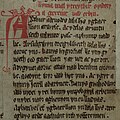 Opening lines of one of the Mabinogi myths from the Red Book of Hergest (written pre-13c, incorporating pre-Roman myths of Celtic gods):
Gereint vab Erbin. Arthur a deuodes dala llys yg Caerllion ar Wysc...
(Geraint the son of Erbin. Arthur was accustomed to hold his Court at Caerlleon upon Usk...) (from Myth) -

-
 Several mythical creatures from Bilderbuch für Kinder (lit. 'picture book for children') between 1790 and 1822, by Friedrich Justin Bertuch (from Legendary creature)
 -
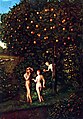 "The Fall of Man" by Lucas Cranach the Elder and the Tree of Knowledge is on the right (from List of mythological objects)
 -
 Azoth, a universal medicine or universal solvent sought in alchemy. (Medieval legend) (from List of mythological objects)
 -
 Voodoo doll with pins in it, Museum of Witchcraft (from List of mythological objects)
 -
 Claíomh Solais on an Ireland stamp printed in 1922 (from List of mythological objects)
 -
 The Honest Woodcutter, also known as Mercury and the Woodman and his famous Golden Axe (from List of mythological objects)
 -
 Perillos being forced into the brazen bull that he built for Phalaris (from List of mythological objects)
 -
 Sampo, a magical artifact of indeterminate type constructed by Ilmarinen that brought riches and good fortune to its holder, in the Finnish epic poetry Kalevala (The Forging of the Sampo, Joseph Alanen, 1911) (from List of mythological objects)
 -
 Tissot Moses and Joshua in the Tabernacle (from List of mythological objects)
 -
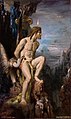 Prometheus (1868) by Gustave Moreau. In the mythos of Hesiodus and possibly Aeschylus (the Greek trilogy Prometheus Bound, Prometheus Unbound and Prometheus Pyrphoros), Prometheus is bound and tortured for giving fire to humanity. (from Myth)
 -
 Heracles would use arrows dipped in the Hydra's poisonous blood to kill other foes during his Labours, such as Stymphalian birds and the giant (from List of mythological objects)
 -
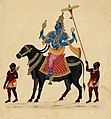 Yama with his famous Yama Pasha (from List of mythological objects)
 -
 Lord Vishnu took the form of Beauty Mohini and distributed the Amrita (Ambrosia, Elixir) to Devas. When Rahu (snake dragon) tried to steal the Amrita, his head was cut off (from List of mythological objects)
 -

-
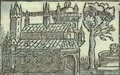 Image showing the sacred tree to the right of the temple, from Olaus Magnus' Historia de Gentibus Septentrionalibus (1555). To the right of the tree is a depiction of a man being sacrificed in the spring (from List of mythological objects)
 -

-
 The fall of Icarus (from List of mythological objects)
 -
 Fountain of Youth (from List of mythological objects)
 -
 The Giving of the Seven Bowls of Wrath / The First Six Plagues, Revelation 16:1–16. Matthias Gerung, c. 1531 (from List of mythological objects)
 -
 Dietrich von Bern and Hildebrand fight against dragons (from List of mythological objects)
 -
 Odysseus Overcome by Demodocus' Song, by Francesco Hayez, 1813–1815 (from Myth)
 -
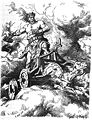 Thor wearing the magic belt Megingjörð (from List of mythological objects)
 -
 "Tizona", the sword attributed to El Cid, on exhibit in the Army Museum of Madrid (from List of mythological objects)
 -
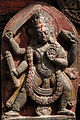 Vishnu holding his legendary sword Nandaka (from List of mythological objects)
 -
 King Svafrlame Secures the Sword Tyrfing (from List of mythological objects)
 -
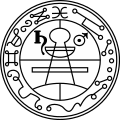 Goetia seal of solomon (from List of mythological objects)
 -
 The Shrine of the Three Kings in Cologne Cathedral (from List of mythological objects)
 -
 Giza pyramids (from List of mythological objects)
 -
-
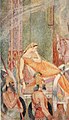
 Ancient Sumerian cylinder seal impression showing the god Dumuzid being tortured in the Underworld by galla demons (from Comparative mythology)
 -
 The Stone of Destiny (Lia Fáil) at the Hill of Tara, once used as a coronation stone for the High Kings of Ireland (from List of mythological objects)
 -
 A 19th-century drawing of Sun Wukong featuring his staff (from List of mythological objects)
 -
 Adam's Bridge also called as Rama Setu (from List of mythological objects)
 -
 Achilles wearing his armor (from List of mythological objects)
 -
 Aura, a field of luminous radiation surrounding a person or object (from List of mythological objects)
 -
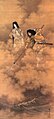 Amenonuhoko (天沼矛 or 天之瓊矛 or 天瓊戈, "heavenly jeweled spear") is the name given to the spear in Shinto used to raise the primordial land-mass, Onogoro-shima, from the sea (from List of mythological objects)
 -
 The Flying Dutchman (from List of mythological objects)
 -
 Fortune Wheel (from List of mythological objects)
 -
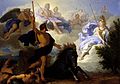 The Dispute of Minerva and Neptune (c. 1689 or 1706) by René-Antoine Houasse, depicting the founding myth of Athens (from National myth)
 -
 Ballads of bravery (1877) part of Arthurian mythology (from Myth)
 -
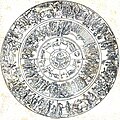 Shield of Achilles (illustration) (from List of mythological objects)
 -
 seven angels with seven trumpets (from List of mythological objects)
 -
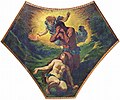 An angel (Camael) expelling Adam and Eve with a flaming sword (from List of mythological objects)
 -
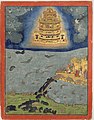 The Celestial Chariot, Pushpaka Vimana from Ramayana (from List of mythological objects)
 -
 Artist's impressions of the (unseen) Imperial Regalia of Japan (from List of mythological objects)
 -
 Golem and Loew (from List of mythological objects)
 -
 Longinus with his famous Spear (from List of mythological objects)
 -
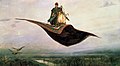 Riding a Flying Carpet, an 1880 painting by Viktor Vasnetsov (from List of mythological objects)
 -
 Veronica holding her veil, Hans Memling, c. 1470 (from List of mythological objects)
 -
 Ancient Roman relief from the Cathedral of Maria Saal showing the infant twins Romulus and Remus being suckled by a she-wolf (from Comparative mythology)
 -
 Greek God Kronos/Saturnus with sickle (from List of mythological objects)
 -

-
 Jug from Lydian Treasure Usak (from List of mythological objects)
 -
 Vishnu with his Panchajanya (from List of mythological objects)
 -
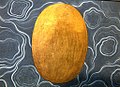 Golden cosmic egg Hiranyagarbha by Manaku (from List of mythological objects)
 -
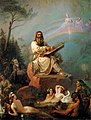 Väinämöinen, the wise demigod and one of the significant characters of Finnish mythological 19th-century epic poetry, The Kalevala (Väinämöinen's Play, Robert Wilhelm Ekman, 1866) (from Myth)
 -
 Joan of Arc with her famous sword (from List of mythological objects)
 -
 Erlang Shen (二郎神), or Erlang is a Chinese God with his spear (from List of mythological objects)
 -
 As is usual in bestiaries, the lynx in this late 13th-century English manuscript is shown urinating, the urine turning to the mythical stone Lyngurium (from List of mythological objects)
 -
 The third gift — an enormous hammer (1902) by Elmer Boyd Smith and the ring Draupnir is visible among other creations by the Sons of Ivaldi (from List of mythological objects)
 -
 This panel by Bartolomeo di Giovanni relates the second half of the Metamorphoses. In the upper left, Jupiter emerges from clouds to order Mercury to rescue Io. (from Myth)
 -
 Pied piper (from List of mythological objects)
 -
 The Crown of Immortality, held by the allegorical figure Eterna (Eternity) (from List of mythological objects)
 -
 The Deluge, frontispiece to Gustave Doré's illustrated edition of the Bible. Based on the story of Noah's Ark, this engraving shows humans and a tiger doomed by the flood futilely attempting to save their children and cubs. (from Comparative mythology)
 -
 Snake and world egg of the inhabitants of Tyre (from List of mythological objects)
 -
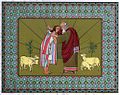 Jacob blesses Joseph and gives him the coat of many colors (from List of mythological objects)
 -
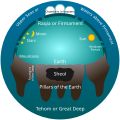 Early Hebrew Conception of the Universe (from List of mythological objects)
 -
 Hanuman fetches the herb-bearing mountain, in a print from the Ravi Varma Press, 1910's (from List of mythological objects)
 -
 Shiva with his Trishula (from List of mythological objects)
 -
 The Argo (c. 1500 – 1530), painting by Lorenzo Costa (from List of mythological objects)
 -
 Surya on His Celestial Chariot (from List of mythological objects)
 -
 Holy Robe in Trier (from List of mythological objects)
 -
 Rectangular tablets passed down by the Hand of God in the 10th century Byzantine Leo Bible (from List of mythological objects)
 -
 The Ash Yggdrasil by Friedrich Wilhelm Heine (from List of mythological objects)
 -
 Fig trees often represent talismans with the udumbara (from List of mythological objects)
 -
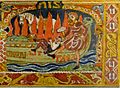 Thor kicks Litr onto Baldr's Hringhorni, illustration by Emil Doepler (ca. 1905) (from List of mythological objects)
 -
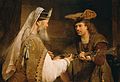 Ahimelech giving the sword of Goliath to David, by Aert de Gelder. (from List of mythological objects)
 -
 Killing of Ravana Painting by Brahmstra of Arrow of Brahma (from List of mythological objects)
 -
 The famous sword of Excalibur painted by Howard Pyle (from List of mythological objects)
 -
 Hop-o'-My-Thumb stealing the Seven-league boots from the Ogre, by Gustave Doré (from List of mythological objects)
 -
 Edith Hamilton's Mythology has been a major channel for English speakers to learn classical Greek and Roman mythology (from Myth)
 -
 Lichas bringing the garment of Nessus to Hercules (from List of mythological objects)
 -
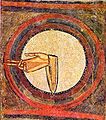 Hand of God (from List of mythological objects)
 -
 Houyi, the God of Archery (from List of mythological objects)

_Geraint.jpg)


_-_Adam_and_Eve-Paradise_-_Kunsthistorisches_Museum_-_Detail_Tree_of_Knowledge.jpg)


_to_Devas._When_Rahu_(snake_dragon)_tried_to_steal_the_Amrita,_his_head_was_cut_off.jpg)


-late.14c.jpg)

.jpg)


_(14801987593).jpg)


.jpg)


.jpg)

.jpg)
.jpg)


.jpg)


_(15949358169).jpg)


Subcategories

WikiProjects

Things you can do
- Help with the myth and folklore missing articles project.
- Help create requested articles.
- Help assessment at Wikipedia:WikiProject Mythology/Assessment.
- Place the project banner {{WikiProject Mythology}} on the talk pages of all relevant articles.
- Check the recent changes for recent improvements, vandalism, and other changes.
- Answer requests for mythology articles needing attention: Category:Mythology articles needing attention
- Answer requests for mythology articles needing expert attention: Category:Mythology articles needing expert attention
- Expand articles tagged as mythology stubs: Category:Mythology stubs
- Assist mythology subprojects.
- Add requested photographs of mythology subjects: Category:Wikipedia requested photographs of mythology subjects
Associated Wikimedia
The following Wikimedia Foundation sister projects provide more on this subject:
-
 Commons
Free media repository -
 Wikibooks
Free textbooks and manuals -
 Wikidata
Free knowledge base -
 Wikinews
Free-content news -
 Wikiquote
Collection of quotations -
 Wikisource
Free-content library -
 Wikiversity
Free learning tools -
 Wiktionary
Dictionary and thesaurus


