


Pratt & Whitney R-4360 Wasp Major
| R-4360 Wasp Major | |
|---|---|

| |
| Pratt & Whitney R-4360 Wasp Major | |
| Type | Four-row Radial engine |
| National origin | United States |
| Manufacturer | Pratt & Whitney |
| First run | 1944 |
| Major applications | Boeing 377 Boeing B-50 Superfortress Boeing C-97 Stratofreighter Convair B-36 Fairchild C-119 Flying Boxcar |
| Number built | 18,697 |
| Developed from | Pratt & Whitney R-2180-A Twin Hornet |
| Developed into | Pratt & Whitney R-2180-E Twin Wasp E |
The Pratt & Whitney R-4360 Wasp Major is an American 28-cylinder four-row radial piston aircraft engine designed and built during World War II. At 4,362.5 cu in (71.5 L), it is the largest-displacement aviation piston engine to be mass-produced in the United States, and at 4,300 hp (3,200 kW) the most powerful. First run in 1944, it was the last of the Pratt & Whitney Wasp family, and the culmination of its maker's piston engine technology.
The war was over before it could power airplanes into combat. It powered many of the last generation of large piston-engined aircraft before turbojets, but was supplanted by equivalent (and superior) powered turboprops (such as the Allison T56).
Its main rival was the twin-row, 18-cylinder, nearly 3,350 cu in (54.9 L) displacement, up to 3,700 hp (2,800 kW) Wright R-3350 Duplex-Cyclone, first run some seven years earlier (May 1937).
Design and development
[edit]The R-4360 was a 28-cylinder four-row air-cooled radial engine. Each row of seven air-cooled cylinders possessed a slight angular offset from the previous, forming a semi-helical arrangement to facilitate effective airflow cooling of the cylinder rows behind them, inspiring the engine's "corncob" nickname.[1] A mechanical supercharger geared at 6.374:1 ratio to engine speed provided forced induction, while the propeller was geared at 0.375:1 so that the tips did not reach inefficient supersonic speeds.
The engine was a technological challenge and the first product from Pratt and Whitney's new plant near Kansas City, Missouri.[2] The four-row configuration had severe thermal problems that decreased reliability, with an intensive maintenance regime involving frequent replacement of cylinders required.[citation needed] Large cooling flaps were required, which decreased aerodynamic efficiency, putting extra demands on engine power when cooling needs were greatest. Owing in large part to the maintenance requirements of the R-4360, all airplanes equipped with it were costly to operate and suffered decreased availability. Its commercial application in the Boeing Stratocruiser was unprofitable without government subsidy.[3] Abandonment of the Stratocruiser was almost immediate when jet aircraft became available, while aircraft with smaller powerplants such as the Lockheed Constellation and Douglas DC-6 remained in service well into the jet era.
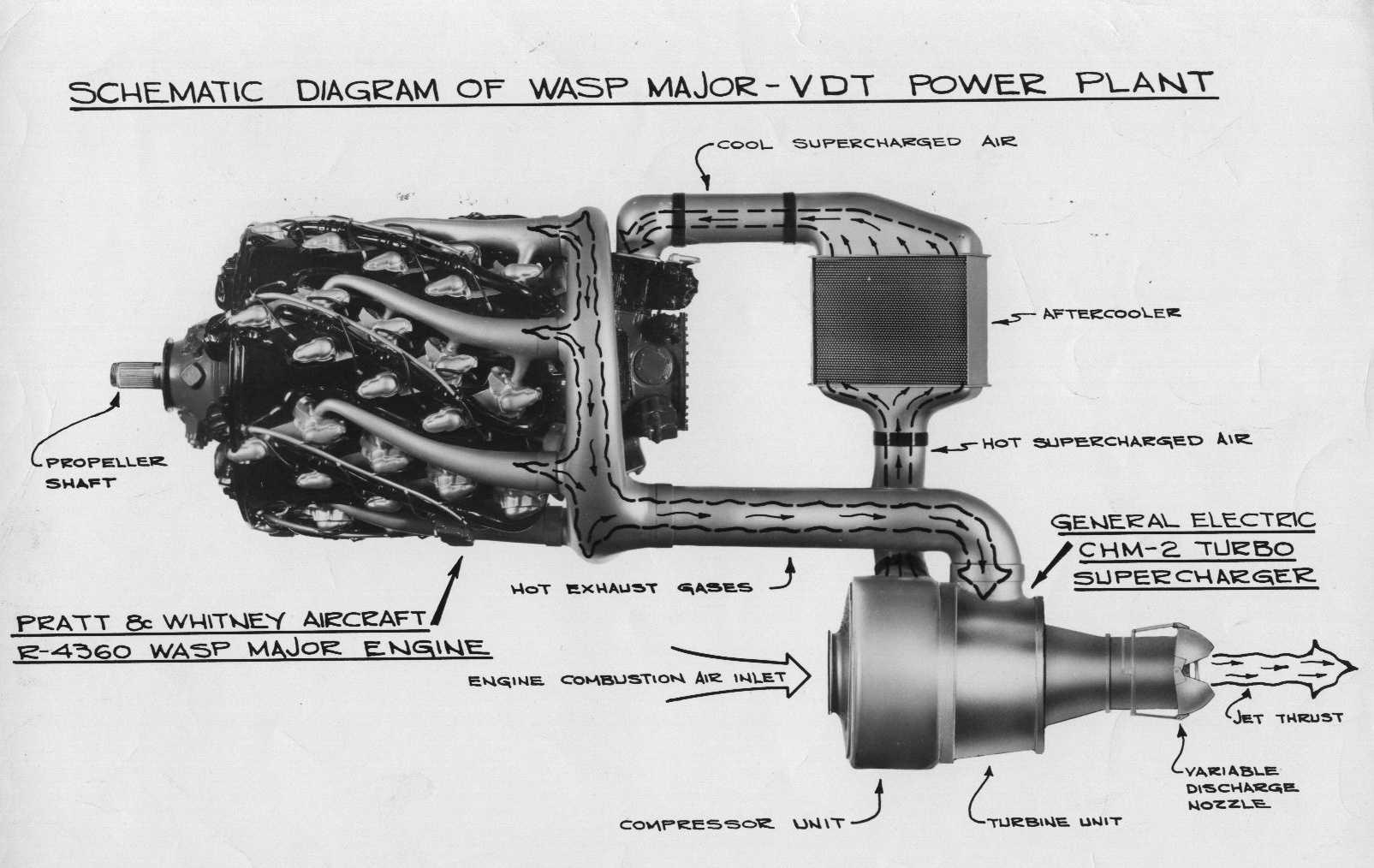
Engine displacement was 4,362.5 cu in (71.5 L), hence the model designation. Initial models developed 3,000 hp (2,200 kW), and later models 3,500 hp (2,600 kW). One model that used two large turbochargers in addition to the supercharger delivered 4,300 horsepower (3,200 kW). Engines weighed 3,482–3,870 lb (1,579–1,755 kg), giving a power-to-weight ratio of 1.11 hp/lb (1.82 kW/kg).
Wasp Majors were produced between 1944 and 1955; 18,697 were built.
A derivative engine, the Pratt & Whitney R-2180-E Twin Wasp E, was essentially the R-4360 "cut in half". It had two rows of seven cylinders each, and was used on the postwar Saab 90 Scandia airliner.[4]
Variants
[edit]
- R-4360-4 - 2,650 hp (1,980 kW)
- R-4360-17 - 3,500 hp (2,600 kW) XB-35 and YB-35 outboard engines with 8-bladed contra-rotating propellers[5]
- R-4360-20 - 3,500 hp (2,600 kW)
- R-4360-21 - 3,500 hp (2,600 kW) XB-35 and YB-35 inboard engines with 8-bladed contra-rotating propellers[5]
- R-4360-25 - 3,000 hp (2,200 kW)
- R-4360-41 - 3,500 hp (2,600 kW)
- R-4360-45 - 3,500 hp (2,600 kW) YB-35 outboard engines with 4-bladed propellers[5]
- R-4360-47 - 3,500 hp (2,600 kW) YB-35 inboard engines with 4-bladed propellers[5]
- R-4360-51 VDT - "Variable Discharge Turbine" 4,300 hp (3,210 kW). Intended for B-36C. Used on Boeing YB-50C Superfortress. [6]
- R-4360-53 - 3,800 hp (2,800 kW)
- R-4360-B3 - 3,500 hp (2,600 kW)
- R-4360-B6 - 3,500 hp (2,600 kW)
Applications
[edit]- Aero Spacelines Mini Guppy
- Aero Spacelines Pregnant Guppy
- Boeing 377 Stratocruiser
- Boeing B-50 Superfortress
- Boeing C-97 Stratofreighter
- Boeing KC-97 Stratofreighter
- Boeing XF8B
- Boeing XB-44 Superfortress
- Convair B-36 Peacemaker
- Convair XC-99
- Curtiss XBTC
- Curtiss XP-71 (not built)
- Douglas C-74 Globemaster
- Douglas C-124 Globemaster II
- Douglas XTB2D Skypirate
- Fairchild C-119 Flying Boxcar
- Fairchild XC-120 Packplane
- Goodyear F2G "Super" Corsair
- Hughes H-4 Hercules ("Spruce Goose")
- Hughes XF-11
- Lockheed R6V Constitution
- Martin AM Mauler
- Martin JRM Mars
- Martin P4M Mercator
- Northrop YB-35
- Republic XP-72
- Republic XF-12 Rainbow
- SNCASE SE-2010 Armagnac
- Vultee XA-41
Engines on display
[edit]
.jpg)

- An R-4360 is on display at the Texas Air Museum, Stinson Municipal Airport, San Antonio, Texas
- An R-4360 is on display at the Owls Head Transportation Museum, Owls Head, Maine
- An R-4360 is on display at the Mid America Museum of Aviation and Transportation in Sioux City, Iowa.[7]
- An R-4360 is on display at the Museum of Flight in Seattle, Washington.[8][9]
- An R-4360 is on display at the Heritage Flight Museum in Burlington, Washington.[10]
- An R-4360 is on display at the New England Air Museum, in Windsor Locks, Connecticut.[9]
- An R-4360 is on display at the Museum of Alaska Transportation and Industry in Wasilla, Alaska.[9]
- An R-4360 is on display at the Pioneer Air Museum in Fairbanks, Alaska.
- An R-4360 is on display at the CAF Airpower Museum in Dallas, Texas.[9]
- An R-4360 is on display at the Air Zoo in Kalamazoo, Michigan.[9]
- An R-4360-4W is on display at the Yankee Air Museum in Belleville, Michigan[11]
- An R-4360-20WA is on display at the Teaneck Ignition Service in Teaneck, New Jersey.[9]
- An R-4360-20WD is on display at the Combat Air Museum in Topeka, Kansas.[12]
- An R-4360-59B is on display at the Combat Air Museum in Topeka, Kansas.[12]
- An R-4360-69 is on display at the Castle Air Museum in Atwater, California.[9]
- An R-4360 cutaway is on display at the Hill Aerospace Museum at Hill Air Force Base in Roy, Utah.[13]
- An R-4360 cutaway is on display at the Air Victory Museum in Lumberton, New Jersey.[14]
- An R-4360 cutaway is on display at the Air Zoo in Kalamazoo, Michigan.[9]
- An R-4360 cutaway is on display at the Museum of Aviation in Warner Robins, Georgia.[9]
- An R-4360 cutaway is on display at the Evergreen Aviation and Space Museum in McMinnville, Oregon.[9]
- An R-4360 cutaway is on display at the CAF Airpower Museum in Dallas, Texas.[9]
- An R-4360 cutaway is on display at the Pima Air and Space Museum in Tucson, Arizona.[9]
- An R-4360 cutaway is on display at the Air Force Armament Museum at Eglin Air Force Base in Valparaiso, Florida.[9]
- An R-4360 cutaway is on display at the Strategic Air Command & Aerospace Museum in Ashland, Nebraska.[9]
- An R-4360-4 cutaway is on display at the National Museum of Naval Aviation in Pensacola, Florida.[9]
- An R-4360-59B cutaway is on display at the Steven F. Udvar-Hazy Center of the National Air and Space Museum in Chantilly, Virginia.[15]
- An R-4360-59B cutaway is on display at the Florida Air Museum in Lakeland, Florida.[16][9]
- An R-4360 cutaway is on display at the Mid-Atlantic Air Museum, Reading, Pennsylvania[17]
- Wreckage of an R-4360 is on display as a memorial in the Ben Shemen Forest in Israel.
- An R-4360 is on display at the presidential gallery at the National Museum of the United States Air Force in Dayton, Ohio.[18]
- An operational R-4360 is on display at the Penngrove Power and Implement Museum in Penngrove, California.[19]
- Two R-4360s are on public display at the Aerospace Museum of California. One is complete, the other is a cutaway.
- An operational R-4360 is on display at Nieman's Harley Rentals in St Helena, California[20]
Specifications (R-4360-51VDT)
[edit]
Data from White, 1995[21]
General characteristics
- Type: 28-cylinder supercharged air-cooled four-row radial engine
- Bore: 5.75 in (146 mm)
- Stroke: 6.00 in (152 mm).
- Displacement: 4,362.5 cu in (71.489 L)
- Length: 103 in (2,600 mm)
- Diameter: 61 in (1,500 mm)
- Dry weight: 3,720 lb (1,690 kg)
Components
- Valvetrain: Poppet, two valves per cylinder
- Supercharger: Gear-driven single stage variable speed centrifugal type supercharger
- Turbocharger: General Electric CHM-2 (optional)
- Fuel system: Bendix-Stromberg PR-100E2 pressure carburetor
- Fuel type: 115/145 Aviation gasoline
- Oil system: Dry sump
- Cooling system: Air-cooled
Performance
- Power output: 4,300 hp (3,200 kW) at 2800 rpm
- Specific power: 0.99 hp/cu in (45 kW/L)
- Compression ratio: 7:1
- Power-to-weight ratio: 1.11 hp/lb (1.82 kW/kg)
See also
[edit]Related development
- Pratt & Whitney Wasp series
- Pratt & Whitney R-1830 Twin Wasp
- R-1535 Twin Wasp Junior
- Pratt & Whitney R-2180-A Twin Hornet
- Pratt & Whitney R-2180-E Twin Wasp E
- Pratt & Whitney R-2800 Double Wasp
Comparable engines
- BMW 803
- Shvetsov ASh-2
- Bristol Centaurus
- Lycoming XR-7755
- Wright R-3350 Duplex-Cyclone
- Wright R-4090 Cyclone 22
Related lists
References
[edit]Notes
[edit]- ^ White 1995, p. 212.
- ^ Gunston 2006, p. 132.
- ^ "Ernest K. Gann's Flying Circus: Lady with a past". Ovi.ch. Retrieved 2012-06-18.
- ^ Gunston 2006, p. 164.
- ^ a b c d Pape, Garry R.; Campbell, John M. (1995). Northrop Flying Wings : a history of Jack Northrop's visionary aircraft (1st ed.). Atglen: Schiffer Pub. pp. 116–193, 253. ISBN 0887406890.
- ^ "Schematic Diagram of Wasp Major VDT Power Plant". Retrieved 8 November 2023.
- ^ "About the Museum". Mid America Museum of Aviation and Transportation. Retrieved 18 February 2018.
- ^ "Goodyear F2G-1 Super Corsair". The Museum of Flight. The Museum of Flight. Retrieved 18 February 2018.
- ^ a b c d e f g h i j k l m n o p Huff, Randy. "Engines in North American Museums". Aircraft Engine Historical Society. Aircraft Engine Historical Society. Retrieved 18 February 2018.
- ^ "Pratt & Whitney R-4360 Wasp Major". Heritage Flight Museum. Avada. Retrieved 18 February 2018.
- ^ Yankee Air Museum archive records and display
- ^ a b "ENGINES ON DISPLAY". Combat Air Museum. Combat Air Museum. Retrieved 18 February 2018.
- ^ ""Wasp Major" Engine". Hill Air Force Base. United States Air Force. 20 January 2007. Retrieved 18 February 2018.
- ^ "R-4360 Wasp Major". Air Victory Museum. Air Victory Museum. Retrieved 18 February 2018.
- ^ "Pratt & Whitney Wasp Major R-4360-59B, Cutaway, Radial Engine". Smithsonian National Air and Space Museum. Smithsonian Institution. 2016-04-05. Retrieved 18 February 2018.
- ^ "Exhibits". SUN 'n FUN. SUN 'n FUN. Retrieved 18 February 2018.
- ^ "WELCOME TO THE MID-ATLANTIC AIR MUSEUM". www.maam.org. Retrieved 2018-09-07.
- ^ "Pratt & Whitney R-4360 "Wasp Major"". National Museum of the US Air Force™. Retrieved 2018-09-07.
- ^ "main exhibits". penngrovepower.org. Retrieved 2019-07-11.
- ^ Stoneberg, David (September 16, 2020). "A piece of military aircraft history sits in St. Helena, just waiting to put on a show". Napa Valley Register. St Helena, CA: Lee Enterprises, Inc. Retrieved September 17, 2020.
- ^ White 1995, p. 222.
Bibliography
[edit]- Bridgman, Leonard, ed. Jane's All The World's Aircraft 1951–1952. London: Samson Low, Marston & Company, Ltd 1951.
- Gunston, Bill (2006). World Encyclopedia of Aero Engines: From the Pioneers to the Present Day (5 ed.). Stroud, UK: Sutton. ISBN 0-7509-4479-X.
- White, Graham (1995). Allied Aircraft Piston Engines of World War II: History and Development of Frontline Aircraft Piston Engines Produced by Great Britain and the United States During World War II. Warrendale, Pennsylvania: SAE International. ISBN 1-56091-655-9.
- White, Graham (2006). R-4360: Pratt & Whitney's Major Miracle. North Branch, Minn.: Specialty Press. ISBN 1-58007-097-3.
External links
[edit]
- Pratt & Whitney R-4360 page
- Pratt Whitney
- National Museum of the USAF – R-4360 fact sheet
- "3,500 h.p. Radial" a 1947 Flight article on the Wasp Major