


Primark
  | |
 The original shop on Mary Street, Dublin | |
| Penneys (in Ireland) | |
| Company type | Subsidiary |
| Industry | Retail |
| Founded | 13 June 1969 in Dublin, Ireland |
| Founder | Arthur Ryan |
| Headquarters | Arthur Ryan House, 22–24 Parnell Street, Dublin , Ireland |
Number of locations | 450[1] (2024) |
Area served |
|
Key people | Paul Marchant (CEO and COO) |
| Products | |
| Revenue |  £9,008 million[2] (2023) £9,008 million[2] (2023) |
Number of employees | 76,000 (2023) |
| Parent | Associated British Foods |
| Website | primark |
| Footnotes / references [3][4][2][5] | |
Primark Stores Limited (/ˈpraɪmɑːrk/; trading as Penneys in Ireland)[6][7] is an Irish multinational fashion retailer with headquarters in Dublin, Ireland,[8] with outlets across Europe and in the United States. The original Penneys brand is not used outside of Ireland because it is owned elsewhere by American retailer JCPenney.
History
[edit]The company's first shop, named Penneys and still in operation today, was established by Arthur Ryan in June 1969 on behalf of the Weston family (who in 1935 founded Allied Bakeries Limited, later renamed Associated British Foods) at 47 Mary Street in Dublin.[4][9] The first major shops outside of Dublin were opened in the cities of Cork and Belfast in 1971, both under the name of Penneys.[10][11][12]
The company subsequently expanded outside of Ireland and into Great Britain, opening a shop in Derby in 1973.[10] By 1974, the business had 24 shops, including three in Scotland and two in England, all operating under the Penneys brand.[11][13]
The American company, JC Penney, opposed the use of Penneys as a business name. JC Penney registered the various business names of Penneys's parent company in countries throughout Europe in order to put pressure on it to relinquish its registration of the Penneys brand, and issued proceedings disputing the use of the brand. Following an injunction granted by the High Court of England in June 1974, the two shops in England were rebranded as Primark. However, the Penneys brand continued to be used in Ireland and Scotland, and in 1975–1976, four more Penneys-branded shops were opened in Scotland and Northern Ireland.[11]
Eventually, the two companies settled their dispute. Penneys/Primark agreed that from 27 August 1976 onward, it would only use the Penneys brand in the Republic of Ireland, with its shops elsewhere, including in Northern Ireland, to be rebranded as Primark. In exchange, JC Penney agreed to relinquish its registration of the various business names of Primark's parent companies throughout Europe, and agreed not to trade under the Penneys brand in the Republic of Ireland.[11] Since that date, the business has been known as Penneys in the Republic of Ireland and as Primark elsewhere.[4][14]
In 2005, Primark bought UK retailer Littlewoods's retail stores for £409 million, retaining 40 of the 119 shops and selling the rest.[15]
In May 2006, the first Primark shop in mainland Europe opened in Madrid, Spain. In December 2008, Primark opened in the Netherlands, followed by Portugal, Germany and Belgium in 2009, Austria in 2012, France in 2013, and Italy in 2014.[16][17]
Primark opened its current headquarters in 2015 in a redeveloped Dublin building, Arthur Ryan House, formerly Chapel House.[5][18][19][3]
In 2015, Primark opened its first United States shop in Boston, later expanding into New York City, Philadelphia, Danbury and Chicago.[20][21][22][23] Having built a chain of around 40 shops in Spain, Primark opened a second outlet in Madrid in October 2015, its second-biggest in the world.[24] The largest Primark shop opened in Birmingham on 11 April 2019, occupying the former Pavilions Shopping Centre of 161,000 sq ft (15,000 m2), with five floors including a beauty salon, Disney-themed café and a barbershop, and adding the largest Greggs fast-food outlet in the world in February 2022.[25][26] On 13 June 2019, Primark expanded to Slovenia with a shop in Ljubljana.[27]
On 23 March 2020, Primark temporarily closed its 189 UK shops, as a result of government restrictions during the COVID-19 outbreak.[28] Its 153 shops in England re-opened on 15 June 2020.[29] As a result of the lockdown, the company reported a sales loss of £430 million.[30]
On 10 August 2020, Primark opened the first shop in Poland in the Galeria Młociny shopping center in Warsaw, later expanding into Poznań, Kraków, Katowice, Wrocław and Łódź. In June 2021, Primark opened the first shop in the Czech Republic in Prague, occupying the area of 50,590 sq ft (4,700 m2) and serving as a flagship for the region of Central and Eastern Europe.[31]
In 2021, Primark unveiled a sustainability strategy that sets targets to reduce textile waste, halving CO2 emissions and improving the life of Primark workers.[32]
On 15 December 2022, Primark opened its first shop in Romania, in Bucharest.[33][34] On 20 June 2023, Primark opened its second store in Bucharest.
In November 2022, Primark announced it was going online with a new click-and-collect service. This announcement came after the company lost more than £1 billion in sales during the Covid-19 pandemic, when its shops had to be closed, while the competitors with online shops had smaller or no financial losses.[35] The click-and-collect service was launched as a trial in 25 stores in north-west England, Yorkshire and north Wales for children's products only. However, on the day of launch of the new service, the company's website crashed, causing the issues for people trying to access it.[36]
In 8 February 2024, as part of expansion plans, Primark announced a major scheme in which five shops would open and 15 (including its shop on Oxford Street) would be renovated. Primark also opened a distribution centre in Jacksonville, Florida.[37][38]
In 21 May 2024, Primark unveiled a new brand identity, revealing a more curved and bold logo based on its 2005 logo, along with changing the colour slightly.[39]
On 28 May 2024, Primark opened its first Hungarian shop in the Arena Mall in Budapest. On 20 June 2024, it was announced that the business intended to invest more than €40 million on its Portuguese business, including opening four further shops in Portugal, as part of its plan to have 530 shops internationally by 2026.[40]
Corporate affairs
[edit]The key trends for Primark are (as of the financial year ending 17 September):[41]
| Revenue (£m) |
Adjusted operating profit (£m) |
Number of employees |
Number of stores |
Number of served countries |
Sq ft of selling space (m) |
References | |
|---|---|---|---|---|---|---|---|
| 2014 | 4,950 | 662 | 54 | 278 | 9 | 10.2 | |
| 2015 | 5,347 | 673 | 61 | 293 | 10 | 11.1 | |
| 2016 | 5,949 | 689 | 68 | 315 | 11 | 12.3 | |
| 2017 | 7,053 | 735 | 73 | 345 | 11 | 13.8 | |
| 2018 | 7,477 | 843 | 75 | 360 | 11 | 14.8 | |
| 2019 | 7,792 | 913 | 78 | 373 | 12 | 15.6 | |
| 2020 | 5,895 | 362 | 70 | 384 | 13 | 16.2 | |
| 2021 | 5,593 | 321 | 71 | 398 | 14 | 16.8 | |
| 2022 | 7,697 | 756 | 72 | 408 | 14 | 17.3 | |
| 2023 | 9,008 | 735 | 76 | 432 | 16 | 18.1 |
| Country | Number of stores |
|---|---|
| England | 154 |
| Spain | 60 |
| Republic of Ireland | 37 |
| Germany | 32 |
| France | 27 |
| US | 24 |
| Netherlands | 20 |
| Scotland | 20 |
| Italy | 15 |
| Portugal | 10 |
| Northern Ireland | 9 |
| Belgium | 8 |
| Wales | 8 |
| Austria | 5 |
| Poland | 4 |
| Romania | 2 |
| Czech Republic | 2 |
| Slovenia | 1 |
| Hungary | 1 |
| Slovakia | 1 |
| Total | 439 |
Products
[edit]Primark offers a diverse range of products, including: baby, children's, women's and men's clothing, accessories and footwear; beauty products; housewares and confectionery. The chain sells clothing at prices below those typically charged by other retailers.
From 2014, Primark began selling makeup products.[42] Primark started selling vegan snacks from January 2018. Laura O' Sullivan, co-founder of Primark, expressed her support of the new snacks.[43]
Along with retailers such as Zara and H&M, Primark contributes to the contemporary fast fashion trend. According to an article about Primark in The Economist, "For many shoppers, Primark has an irresistible offer: trendy clothes at astonishingly low prices. The result is a new and even faster kind of fast fashion, which encourages consumers to buy heaps of items, discard them after a few wears and then come back for another batch of new outfits."[44]
In 2020, Primark launched their Wellness collection which includes 80 eco-conscious products.[45] All of the products are made of organic, sustainable or recycled materials. This is part of the retailer's commitment to be more responsible for its footprint.[46]
Media
[edit]In early 2024, RTÉ broadcast a six-part documentary, entitled Inside Penneys, exploring the workings of the business.[47][48]
Working practices
[edit]In 2006, Primark joined the Ethical Trading Initiative (ETI), a collaborative organisation bringing together businesses, trades unions and NGOs to work on labour rights issues in their supply chains.[49] ETI members commit to working towards the implementation of a code of conduct based on the International Labour Organization's core conventions.
In December 2008, the UK charity War on Want launched a new report, Fashion Victims II, that showed conditions had not improved in Bangladeshi factories supplying Primark, two years after the charity first visited them.[50]
On 9 January 2009, a supplier was forced by ETI to remove its branding from Primark stores and websites following a BBC/The Observer investigation into the employment practices. The investigation alleged the use of illegal immigrant labour and argued that the workers were paid less than the UK legal minimum wage.[51]
On 16 June 2011, the BBC Trust's Editorial Standards Committee (ESC) published its findings into a Panorama programme[52] "Primark: On the Rack", broadcast in June 2008. The programme was an undercover investigative documentary examining poor working conditions in Indian factories supplying Primark. Although Primark subsequently stopped doing business with the Indian supplier, the ESC concluded that footage in the programme was 'more likely than not' to have been fabricated.[53] The ESC directed the BBC to make an on-air apology and to ensure that the programme was not repeated or sold to other broadcasters. Primark created a specific website to deal with the issues around the programme.[54]
In 2011 and 2012, Primark achieved 'Leader' status in the Ethical Trading Initiative.[55]
In June 2013, two labels both stitched with alleged SOS messages were separately found in garments purchased from a store in Swansea, Wales. Primark argued the supply chain showed these label messages were a hoax.[56]
Also in June 2014, a customer from Ireland allegedly found an SOS note wrapped in a prison ID card in the pocket of trousers purchased from a Primark store several years earlier.[57] The letter was written in Chinese and said to report that prisoners were forced to work "like oxen" making fashion clothes for export for 15 hours per day and that the food they were given would not be fit for animals.[58]
A year and a half later an alleged SOS note from a Chinese torture victim was found in socks purchased from Primark.[59]
In December 2018, a bone was found by a customer in a sock purchased in the shop's Colchester branch.[60]
Gallery
[edit]-
-
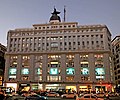
 Interior of the Primark store at Gran Vía.
 -
-

-

-
 Primark store in The Hague, Netherlands
_08.jpg)


_004.jpg)
_02.jpg)
References
[edit]- ^ "Primark opens its 450th store in Florida". The Irish Times. Retrieved 5 September 2024.
- ^ a b "Annual Report and Accounts 2023". Associated British Foods. 2023. Retrieved 16 December 2023.
- ^ a b "About Us". Primark. Retrieved 15 February 2016.
- ^ a b c "A household Irish name built from humble beginnings: The Penneys story". TheJournal.ie. 1 March 2015. Retrieved 14 April 2016.
- ^ a b "Snapshot: Primark Stores Limited". Bloomberg. Retrieved 11 February 2016.
- ^ Horton, Helena (15 August 2017). "Primark reveals how to pronounce its name". The Daily Telegraph. London. Retrieved 16 August 2017.
- ^ "Penneys owner eyes significant growth in full-year profit". 23 April 2024. Retrieved 5 June 2024 – via www.rte.ie.
{{cite journal}}: Cite journal requires|journal=(help) - ^ "Primark Holdings". SoloCheck.ie.
- ^ Jones, David (11 July 2008). "Fashion swing is felt by Penneys' owners". Irish Independent. Dublin. Reuters.
- ^ a b O'Neill, Louise (19 January 2014). "Why Penneys is no longer our little secret". Irish Examiner. Dublin. Retrieved 9 December 2016.
- ^ a b c d "78/193/EEC: Commission Decision of 23 December 1977 relating to a proceeding under Article 85 of the EEC Treaty (IV/29.246 – Penneys)". Commission of the European Communities. 23 December 1977. Retrieved 9 December 2016.
- ^ "Women First". The Irish Times. No. 34779, p 22. 8 May 1974.
- ^ Pritchard, Charles (19 June 1974). "£4.2m. Profits Rise for Associated British Foods". The Irish Times. No. 36805, p 14.
- ^ "Fashion, Home & Beauty". Penneys.
- ^ Finch, Julia (8 August 2005). "M&S to cash in as Littlewoods disappears". The Guardian. London.
- ^ Ruddick, Graham (16 December 2013). "Primark targets chic French shoppers as it opens in Marseille". The Daily Telegraph. London. Retrieved 9 December 2016.
- ^ Redazione (31 August 2014). "Primark, la catena di shopping low cost arriva in Italia" [Primark, the low cost shopping chain arrives in Italy]. Velvet Style Italia (in Italian).
- ^ "Primark officially opens redeveloped Dublin HQ". RTÉ News. 17 September 2015.
- ^ McCabe, Sarah (29 November 2013). "Expansion plans on course for Penneys international HQ in Dublin". Irish Independent. Dublin. Retrieved 20 October 2014.
- ^ Ruddick, Graham (23 April 2014). "Primark to open in the United States". The Daily Telegraph.
- ^ "Primark stores United States". Primark. 10 May 2021.
- ^ Rozario, Kevin (16 March 2021). "After Chicago State Street Opening, Primark Says It Is 'Just Getting Going'". Forbes.
- ^ Zumbach, Lauren. "Fast-fashion brand Primark to open Chicago store on State Street". Chicago Tribune. Retrieved 25 May 2020.
- ^ O' Leary, Elizabeth (15 October 2015). "Penney's opens its second biggest store in the world in Spain". Irish Independent. Dublin. Retrieved 27 November 2016.
- ^ Young, Graham (19 July 2019). "100 days of the world's biggest Primark – and Mickey Mouse pancakes". Birmingham Mail. Retrieved 16 February 2022.
- ^ Young, Graham (11 February 2022). "First look inside the world's biggest Greggs in Primark – with a doughnut swing". Birmingham Mail. Retrieved 16 February 2022.
- ^ "Primark opens its first store in Slovakia". RTÉ News. 25 May 2023. Retrieved 24 August 2023.
- ^ "Primark UK stores closing 'until further notice'". BBC News. 23 March 2020. Retrieved 26 March 2020.
- ^ "Primania returns: why is the UK so obsessed with shopping at Primark?". The Daily Telegraph. London. 15 June 2020. Retrieved 5 July 2020.
- ^ Nilsson, Patricia (4 December 2020). "Lockdowns wipe £430m off Primark sales". Financial Times. London. Archived from the original on 11 December 2022. Retrieved 6 December 2020.
- ^ "Nine new brands have entered the Czech market in H1 2021". Cushman & Wakefield. 19 June 2021. Retrieved 14 July 2021.
- ^ Preuss, Simone (6 December 2022). "Primark presents results in latest sustainability report". Fashion United.
- ^ "Primark to open first store in Romania before Christmas". Romania-Insider.com. 18 November 2022. Retrieved 25 November 2022.
- ^ "Primark opens its first store in Romania". RTÉ News. 15 December 2022. Retrieved 24 August 2023.
- ^ "Primark finally goes online with click-and-collect". BBC News. 14 November 2022. Retrieved 14 November 2022.
- ^ "Primark website crashes as click-and-collect launched". BBC News. 14 November 2022. Retrieved 15 November 2022.
- ^ Beevers, Angela (8 February 2024). "Primark continues US expansion with new Florida distribution centre | Retail Bulletin". Retail Bulletin | Daily UK Retail News. Retrieved 8 February 2024.
- ^ Morgan, Aoife (8 February 2024). "Primark to invest £100m in UK stores in 2024 – Retail Gazette". www.retailgazette.co.uk. Retrieved 8 February 2024.
- ^ Wright, Georgia (21 May 2024). "Primark unveils 'refreshed' brand identity and new summer campaign – Retail Gazette". Retrieved 21 May 2024.
- ^ "Primark plans €40m expansion in Portugal". The Irish Times. Retrieved 21 June 2024.
- ^ "Annual Reports – ABF". ABF. Retrieved 25 November 2023.
- ^ Partington, Lucy (5 March 2014). "Primark has got a brand new makeup range". Cosmopolitan. Retrieved 24 August 2023.
- ^ Chiorando, Maria (29 January 2018). "Budget Chain Primark Starts Selling Vegan Snack Range". Plant Based News. Retrieved 19 February 2018.
- ^ "Faster, cheaper fashion". The Economist. 5 September 2015.
- ^ "Primark's new Wellness collection has landed and prices start from just £2". You. 5 March 2020. Retrieved 24 August 2023.
- ^ Roberts, Lauretta (14 February 2020). "Primark to launch Wellness collection with Boxpark pop-up". The Industry.Fashion.
- ^ Fetherston, Sinann (8 January 2024). "Trend forecaster on bringing "an evolution of styles" to Penneys". RTÉ. Retrieved 1 October 2024.
- ^ Power, Ed (9 January 2024). "Inside Penneys: A starry-eyed love letter to one of Ireland's great success stories". The Irish Times. Retrieved 1 October 2024.
- ^ "Primark joins Ethical Trading Initiative ETI" (Press release). Ethical Trading Initiative. 26 May 2006. Archived from the original on 8 October 2007.
- ^ "Fashion Victims II". War on Want. Archived from the original on 2 March 2009. Retrieved 18 February 2009.
- ^ McDougall, Dan (11 January 2009). "Primark in storm over conditions at UK supplier". The Guardian. London. Retrieved 22 May 2010.
- ^ "BBC Trust". Archived from the original on 19 June 2011. Retrieved 17 June 2011.
- ^ Burrell, Ian; Hickman, Martin (16 June 2011). "BBC crisis over 'fake' sweatshop scene in Primark documentary". The Independent. London.
- ^ "Primark welcomes the BBC Panorama verdict" (Press release). Primark. Archived from the original on 18 June 2011.
- ^ "Responsibility – Responsibility in action – Primark Ethical Trade Team". Associated British Foods. Archived from the original on 2 May 2015. Retrieved 8 September 2015.
- ^ "Primark claims 'cry for help labels' are a hoax carried out in the UK following investigation". The Independent. London. 28 June 2014.
- ^ "Primark investigates claim of 'cry for help' note in trousers". BBC News. 25 June 2014.
- ^ "'Cry for help' from prisoner in Chinese forced labour jail alleged to have been found inside Primark trousers" (Press release). Amnesty International UK. 24 June 2014. Archived from the original on 9 July 2016.
- ^ Cherrington, Rosy (21 December 2015). "Man Finds Letter Claiming To Be From Chinese Torture Victim In Primark Socks". HuffPost. Retrieved 20 November 2020.
- ^ "Primark customer finds 'human bone' in sock". BBC News. 25 January 2019.
External links
[edit]
| Current operations |
|
|---|---|
| Former operations |
|
| People | |
| Other | |

| International | |
|---|---|
| National | |
