


Repton
| Repton | |
|---|---|
  Repton Location within Derbyshire | |
| Population | 2,707 (2001 census)[1] |
| OS grid reference | SK3026 |
| District | |
| Shire county | |
| Region | |
| Country | England |
| Sovereign state | United Kingdom |
| Post town | Derby |
| Postcode district | DE65 |
| Dialling code | 01283 |
| Police | Derbyshire |
| Fire | Derbyshire |
| Ambulance | East Midlands |
| UK Parliament | |
| Website | Repton Village Website |
Repton is a village and civil parish in the South Derbyshire district of Derbyshire, England, located on the edge of the River Trent floodplain, about 5 miles (8 km) north of Swadlincote. The population taken at the 2001 census was 2,707, increasing to 2,867 at the 2011 census.[2] Repton is close to the county boundary with neighbouring Staffordshire and about 5 miles (8 km) northeast of Burton upon Trent.
The village is noted for St Wystan's Church, Repton School and the Anglo-Saxon Repton Abbey and medieval Repton Priory.
History[edit]
.jpg)
Christianity was reintroduced to the Midlands at Repton, where some of the Mercian royal family under Peada were baptised in AD 653.[citation needed] Soon a double abbey under an abbess was built.
In 669 the Bishop of Mercia translated his see from Repton to Lichfield. Offa, King of Mercia, seemed to resent his own bishops paying allegiance to the Archbishop of Canterbury in Kent who, while under Offa's control, was not of his own kingdom of Mercia.[citation needed] Offa therefore created his own Archdiocese of Lichfield, which presided over all the bishops from the Humber to the Thames. Repton was thus the forebear of the archdiocese of Lichfield, a third archdiocese of the English church: Lichfield, the other two being Canterbury and York. This lasted for only 16 years, however, before Mercia returned to being under the Archbishopric of Canterbury.
At the centre of the village is the Church of England parish church dedicated to Saint Wigstan of Mercia.[3]
The Anglo-Saxon Chronicle also reports that 873–74 the Great Heathen Army overwintered at Repton. The first indications of Viking presence at Repton were discovered by accident in the late 17th century by Thomas Walker who found a pit of bones in the vicarage garden. A hogback tombstone was discovered sometime during 1801-1802 in the western part of the churchyard. An extensive programme of archaeological excavations, led by Martin Biddle and his wife, Birthe, that took place between 1974 and 1988 led the Biddles to identify the Viking camp with a D-shaped earthwork that they identified on a bluff, overlooking an arm of the River Trent. In more recent times the view that the entire Viking army spent the winter in this small (0.4 ha.) D-shaped enclosure has been challenged.[4] A new set of excavations led by Cat Jarman and Mark Horton began in 2015 with a geophysical survey of the vicarage conducted which revealed new structures.[5] During the 2016–2017 excavations, ground penetrating radar surveys revealed more possible structures that were subsequently excavated and proved to be grave deposits. These contained a number of pits and stone features such as broken quern stones and a fragment of a carved sandstone cross shaft.[6]
The Biddles also re-opened and a mound containing a mass grave containing the remains of at least 264 individuals which they also believed to be associated with the Viking army. The bones were disarticulated and mostly jumbled together. Forensic study revealed that the individuals ranged in age from their late teens to about forty, 80% were male where sex could be determined. Five associated pennies fit well with the overwintering date of 873–74 and this date was later confirmed by a reassessment of the radiocarbon dates.[7][8]
An early 18th century account describes how, in the last quarter of the 17th century, Thomas Walker, a workman looking for stone, opened the mound and found the skeleton of a "nine foot tall" man in a stone coffin in the remains of a building. According to the account, human bones had been neatly stacked around the coffin.[9]
Parish church[edit]

The church is notable for its Anglo-Saxon crypt, which was built in the 8th century AD[10] as a mausoleum for the Mercian royal family. Wystan, or Wigstan, was a prince of Mercia who was murdered by his guardian in 849,[3] in the reign of Wiglaf. His remains were buried in the crypt at Repton and miracles were ascribed to them. Repton proceeded to become a place of pilgrimage; Wigstan was later canonised and became the patron saint of the church. At the north edge of the village is St Wystan's Church, an Anglo-Saxon church dedicated to the Anglo-Saxon Saint Wystan (or Wigstan) and designated by English Heritage as a Grade I listed building.[11] The 8th-century crypt beneath the church was the original burial place of Saint Wigstan, as well as his grandfather, King Wiglaf of Mercia. Also buried there is King Æthelbald of Mercia, under whose reign the building was first constructed, and for whom it was first converted to a mausoleum. Upon the burial of St Wigstan, the crypt became a shrine and place of pilgrimage.[12]
It has been suggested that the crypt at Repton later influenced the design of both the spiral-columned shrine of Edward the Confessor and the Cosmati Coronation Pavement in Westminster Abbey, both commissioned by Henry III, based on close correspondence of their dimensions and design.[13][14]
The cruciform Anglo-Saxon church itself has had several additions and restorations throughout its history. These include Medieval Gothic north and south aisles in the nave that were rebuilt in the 13th century and widened early in the 14th century, and the addition in 1340 of the west tower and recessed spire.[15] The church was also restored between 1885 and 1886 by Arthur Blomfield.[16]
Notable people[edit]
- King Æthelbald of Mercia was buried here in 757.[17]
- Beornred of Mercia was buried here[18]
- Russell Osman, Ipswich Town & international footballer, was born here in 1959.[19]
- King Wiglaf of Mercia was buried here
- Basil Rathbone lived in his childhood here
- Saint Wigstan of Mercia was buried here, although his remains were later removed to Evesham Abbey[20]
- Walter Somers, engineer and industrialist, was born in Repton in 1839.
- Elsie Steele (1899–2010), the oldest documented person in Britain at the time of her death, lived at the Dales Residential Home during the final few years of her life.[21]
See also[edit]
Gallery[edit]
-
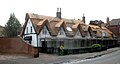 Thatching in progress, May 2007
 -
 Mount Pleasant
 -
 Bull's Head
 -
 Crypt at St Wystan's Church


References[edit]
- ^ "Area selected: South Derbyshire (Non-Metropolitan District)". Neighbourhood Statistics: Full Dataset View. Office for National Statistics. Retrieved 29 September 2011.
- ^ "Civil parish population 2011". Neighbourhood Statistics. Office for National Statistics. Retrieved 30 March 2016.
- ^ a b Pevsner & Williamson, 1978, page 303
- ^ Hadley, D.; Richards, J. (2021). The Viking Great Army and the Making of England. London: Thames & Hudson. pp. 82–85.
- ^ Jarman, Catrine (2018). "Resolving Repton: Has Archaeology Found the Great Viking Camp". British Archaeology: 28–35.
- ^ Jarman, Catrine (2018). "The 'Great Army' at Repton and The New Archaeology Of Viking Campaigns". The SAA Archaeological Record: 19–22.
- ^ Hall, Richard (2010). Viking Age Archaeology. Shire archaeology. Princes Risborough: Shire Publications. pp. 14ff. ISBN 978-0-7478-0063-7.
- ^ Jarman, Catrine L.; Biddle, Martin; Higham, Tom; Ramsey, Christopher Bronk (February 2018). "The Viking Great Army in England: new dates from the Repton charnel". Antiquity. 92 (361): 183–199. doi:10.15184/aqy.2017.196. ISSN 0003-598X. S2CID 29165821.
- ^ Biddle, M. and Kjølbye-Biddle, B., 1992, 'Repton and the Vikings.', Antiquity, 66, (1992), 36–51.
- ^ Pevsner & Williamson, 1978, pages 304–305
- ^ Historic England. "Church of St Wystan, Repton (1334560)". National Heritage List for England. Retrieved 16 August 2012.
- ^ "The Crypt". St Wystan's Church, Repton. Archived from the original on 26 January 2012. Retrieved 22 March 2013.
- ^ Austin, Sue (21 April 2023). "Revealed: Links between Shropshire country hall and the King's Coronation". Shropshire Star. Telford. Retrieved 24 April 2023.
- ^ Wenn, James. "Revealed: Secrets in the Stones: Decoding Anglo-Saxon Art. Part 4: The Garnet Code". www.thegns.org. Retrieved 24 April 2023.
- ^ Pevsner & Williamson, 1978, page 305
- ^ Derby Mercury. 28 July 1886.
- ^ Kirby, D.P. (1992). The Earliest English Kings. Routledge. p. 134. ISBN 0-415-09086-5.
- ^ Swanton, 1996, pages 755, 757
- ^ "Russell Osman". EnglandStats.com. Retrieved 8 October 2016.
- ^ Swanton, 1996, pages 48–49
- ^ Smyth, Rob (10 September 2010). "Girl who delivered Mail is now UK's oldest person". Burton Mail.
Further reading[edit]
- Page, W.H., ed. (1907). "Houses of Austin canons: The priory of Repton, with the cell of Calke". A History of the County of Derby, Volume 2. Victoria County History. pp. 58–63.
- Pevsner, Nikolaus; Williamson, Elizabeth (1978) [1953]. Derbyshire. The Buildings of England. Harmondsworth: Penguin Books. pp. 303–308. ISBN 0-14-071008-6.
- Swanton, Michael (1996). The Anglo-Saxon Chronicle. Routledge. ISBN 0-415-92129-5.
External links[edit]

- Repton in the Domesday Book
- Repton: historical and genealogical information at GENUKI.
- . Encyclopædia Britannica (11th ed.). 1911.
| International | |
|---|---|
| National | |
| Geographic | |
