


Robert Shaw (actor)
Robert Shaw | |
|---|---|
 Shaw in a 1958 advertisement for The Buccaneers | |
| Born | Robert Archibald Shaw 9 August 1927 Westhoughton, Lancashire, England |
| Died | 28 August 1978 (aged 51) Toormakeady, County Mayo, Ireland |
| Occupations |
|
| Years active | 1947–1978 |
| Spouses | Jennifer Bourke
(m. 1952; div. 1963)Virginia Jansen (m. 1976) |
| Children | 10; including Ian Shaw |
| Relatives | Tanya Landman (niece) Rob Kolar (grandson) |
Robert Archibald Shaw (9 August 1927 – 28 August 1978) was an English actor, novelist, playwright and screenwriter. Beginning his career in theatre, Shaw joined the Shakespeare Memorial Theatre after the Second World War and appeared in productions of Macbeth, Henry VIII, Cymbeline, and other Shakespeare plays. With the Old Vic company (1951–52), he continued primarily in Shakespearean roles. In 1959 he starred in a West End production of The Long and the Short and the Tall.
Shaw was nominated for an Academy Award and a Golden Globe for his role as Henry VIII in the drama film A Man for All Seasons (1966). His other film roles included the mobster Doyle Lonnegan in The Sting (1973) and the shark hunter Quint in Jaws (1975). He also played roles in From Russia with Love (1963), Battle of Britain (1969), Young Winston (1972), The Taking of Pelham One Two Three (1974), Robin and Marian (1976), and Black Sunday and The Deep, both of which were released in 1977.
Early life[edit]
Robert Archibald Shaw was born on 9 August 1927 at 51 King Street in Westhoughton, Lancashire,[1] the son of Thomas Archibald Shaw and Doreen Nora, née Avery. His father, a doctor and former Royal Field Artillery Lieutenant, was of Scottish descent; his mother, a former nurse, was born at Piggs Peak, Swaziland.[2][3] He had three sisters named Elisabeth, Joanna, and Wendy, and one brother named Alexander. When he was seven years old, the family moved to Scotland, settling in Stromness, Orkney. His father killed himself when Shaw was 12, and the family then relocated to Cornwall, where Shaw attended the independent Truro School.[4] For a brief period, he was a teacher at Glenhow Preparatory School in Saltburn-by-the-Sea in the North Riding of Yorkshire, before attending the Royal Academy of Dramatic Art in London, graduating in 1948.[5]
Acting career[edit]
Early career[edit]

Shaw began his acting career in theatre, appearing in regional theatre throughout England. He played Angus in a production of Macbeth at Stratford in 1946.[6] He played at Stratford for two seasons.
In 1947, he appeared in The Cherry Orchard on British TV; also for that medium, he performed scenes from Twelfth Night and Macbeth.
He had a small part in The Lavender Hill Mob (1951), playing a police laboratory technician towards the end of the film; the following year he made his London debut, in the West End, at the Embassy Theatre in Caro William. That year he appeared on TV in A Time to Be Born (1952). He returned to Stratford in 1953.[6]
Shaw had small roles in The Dam Busters (1955), a TV version of The Scarlet Pimpernel (1956), the films Doublecross (1956) and A Hill in Korea (1956) (alongside other young actors like Michael Caine), and a TV version of Hindle Wakes (1957).
The Buccaneers[edit]
Shaw became a TV star in the UK when he starred as Captain Dan Tempest in The Buccaneers (1956–57) which ran for 39 episodes.[7]
He was by this time a TV leading man, having lead roles in TV films such as Success (1957) and a TV version of Rupert of Hentzau (1957). He had a big stage success with The Long and the Short and the Tall on the West End in 1959, directed by Lindsay Anderson, a performance that was filmed for television (though Shaw did not appear in the feature film version).[8]
Shaw had small roles in Sea Fury (1958) and Libel (1959) and guest-starred on William Tell, ITV Television Playhouse, The Four Just Men, and Danger Man. He also appeared in TV plays including The Dark Man, Misfire and The Train Set.
In 1961, he appeared in a Broadway production of Harold Pinter's The Caretaker alongside Donald Pleasence and Alan Bates. Shaw replaced Peter Woodthorpe, who had performed with the others on stage in London. It ran for 165 performances.[9] He had good roles in The Valiant, a war film, and Tomorrow at Ten (both 1962), a thriller. Shaw played the leads in TV versions of The Winter's Tale and The Father (both 1962). He, Pleasence, and Bates reprised their performances in a film version of The Caretaker (1963); Shaw was part of the consortium who helped finance the latter.[10]
Writing[edit]
Shaw's first novel, The Hiding Place, published in 1960, received positive reviews.[11] His second novel The Sun Doctor (1961), was awarded the Hawthornden Prize in 1962.[12]
Film fame[edit]
Shaw became well known as a film actor when cast as assassin Donald "Red" Grant in the second James Bond film, From Russia with Love (1963). For TV he adapted and appeared in a production of A Florentine Tragedy (1963), and was Claudius in Hamlet at Elsinore (1964) with Christopher Plummer. He played the title role in The Luck of Ginger Coffey (1964), shot in Canada alongside Mary Ure, who became his second wife. He had a role in A Carol for Another Christmas (1964). Shaw later said of his early career, "I could have been a straight leading man but that struck me as a boring life."[6]
In 1964, Shaw returned to Broadway in a production of The Physicists directed by Peter Brook but it ran for only 55 performances. "I want very much to avoid doing bad commercial pictures for lots of money", he said. "It's difficult to avoid with six kids and two wives."[13] Shaw then embarked on a trilogy of novels – The Flag (1965), The Man in the Glass Booth (1967) and A Card from Morocco (1969). He also adapted The Hiding Place into a screenplay for the film Situation Hopeless ... But Not Serious starring Sir Alec Guinness.
Shaw was the relentless Wehrmacht panzer commander Colonel Hessler in Battle of the Bulge (1965), produced by Philip Yordan; a young Henry VIII in A Man for All Seasons (1966), which earned him a nomination for the Golden Globe Award and the Academy Award for Best Supporting Actor; General George Armstrong Custer in Custer of the West (1967), again for Yordan;[14] Martin Luther in Luther (a 1968 film made for television); he was top billed in another film version of Pinter's The Birthday Party (1968), directed by William Friedkin.[15]
The Man in the Glass Booth[edit]
His play The Man in the Glass Booth was a success in London in 1967. It transferred to Broadway the following year and was a hit, running for 264 performances.[16] His adaptation for the stage of The Man in the Glass Booth gained him the most attention for his writing. The book and play present a complex and morally ambiguous tale of a man who, at various times in the story, is either a Jewish businessman pretending to be a Nazi war criminal, or a Nazi war criminal pretending to be a Jewish businessman. The play was quite controversial when performed in the UK and the US, some critics praising Shaw's "sly, deft and complex examination of the moral issues of nationality and identity", others sharply critical of Shaw's treatment of such a sensitive subject.[17] The play, but not the movie, presents the question: "Given the chance, would Jews behave like Nazis?" [18]
Shaw was one of many stars in Battle of Britain (1969), with the role of Sailor Malan written specifically for him.[19] He had the lead in The Royal Hunt of the Sun (1969) where he played Spanish conquistador Francisco Pizarro, alongside Christopher Plummer who played Incan Emperor Atahualpa, and Figures in a Landscape (1970); his fee for the latter was reportedly $500,000.[20] In 1970, Shaw returned to Broadway playing the title role in Gantry, a musical adaptation of Elmer Gantry, which ran for just one performance, despite co-starring Rita Moreno.[13] His play Cato Street, about the 1820 Cato Street Conspiracy, was produced for the first time in 1971 in London. He appeared in Old Times on Broadway in 1971.[21]
As an actor he appeared in A Town Called Bastard (1971), a spaghetti Western; Young Winston (1972), as Lord Randolph Churchill; A Reflection of Fear (1972); The Hireling (1973); he had a cameo in The Golden Voyage of Sinbad (1973); played mobster Doyle Lonnegan in The Sting (1973), a huge hit; was the subway-hijacker and hostage-taker "Mr. Blue" in The Taking of Pelham One Two Three (1974).
He made his final appearance on Broadway, in a production of Dance of Death, in 1974.
The Man in the Glass Booth was further developed for the screen, but Shaw disapproved of the resulting screenplay and had his name removed from the credits. However, he viewed the completed film before its release and asked to have his name reinstated. In 2002, director Arthur Hiller related Shaw's initial objection to the screenplay and his subsequent change of heart:
When we decided that we needed more emotions in the film and leaned it towards that, we tried, obviously, to be honest to Robert Shaw, to keep that intellectual game-playing, but to create more of an emotional environment. And Robert Shaw became very disturbed. He did not like the idea and indeed, if you will watch the film, you will see that his name does not appear in the credits, nor does it even say, "based on the play, The Man in the Glass Booth" because he wouldn't let us do it. He just didn't like the idea until he saw the film. Then he phoned Eddie Anhalt, the screenwriter, and congratulated him because he thought it was—just kept the tone he wanted and did it so well. And he phoned Mort Abrahams the Executive Producer to see if he could get his name put on the final credits. But it was too late to restore his name, all the prints were all made.[22]
Arthur Hiller's account is uncorroborated.[17]
Film stardom[edit]
Shaw achieved his greatest film stardom after playing the shark-obsessed fisherman Quint in Jaws (1975), although he was at first reluctant to take the role since he did not like the book, but decided to accept at the urging of both his wife, actress Mary Ure, and his secretary—"The last time they were that enthusiastic was From Russia with Love. And they were right."[23]
Shaw then appeared in End of the Game (1975); Diamonds (1975), because "I wanted to play a wonderfully elegant Englishman";[6] Robin and Marian (1976) as the Sheriff of Nottingham opposite Audrey Hepburn (Maid Marian) and Sean Connery (Robin Hood); Swashbuckler (1976); playing the lighthouse keeper and treasure-hunter Romer Treece in The Deep (1977), for which his fee was $650,000;[24] and as Israeli Mossad agent David Kabakov in Black Sunday (1977).
During filming Force 10 from Navarone (1978) Shaw said "I'm seriously thinking that this might be my last film ... I no longer have anything real to say. I'm appalled at some of the lines ... I'm not at ease in film. I can't remember the last film I enjoyed making."[25] He made one more film, Avalanche Express (1979).[26][27] Shaw and director/producer Mark Robson both died of heart attacks during post-production within months of each other; Robson in June 1978 and Shaw in August 1978. Shaw said he would use the proceeds from the film to pay off his taxes, then focus on writing and making the "occasional small film".[28]
Personal life[edit]
Shaw was married three times and had 10 children, two of whom were adopted. His first wife was Jennifer Bourke from 1952 to 1963, with whom he had four daughters. His second wife was actress Mary Ure from 1963 to 1975, with whom he had four children, including daughters Elizabeth (born 1963) and Hannah (born 1965). He adopted son Colin (born 1961) from his wife's previous marriage to playwright John Osborne; according to an interview with Colin, he was Shaw's son born during an affair while Ure was still married to Osborne. Shaw's son Ian (born 1969) also became an actor. This marriage ended with Ure's death from an overdose. His third and final wife was Virginia Jansen from 1976 until his death in 1978, with whom he had one son, Thomas; he also adopted her son, Charles, from a previous relationship. Shaw's grandson (via his daughter Deborah and film producer Evzen Kolar) [29] is American musician and composer Rob Kolar.[30][31] Another grandson of his, Ferdia Shaw, made his debut in the film Artemis Fowl.
For the last seven years of his life, Shaw lived at Drimbawn House in Tourmakeady, County Mayo, Ireland.[32] Like his father, Shaw was an alcoholic for most of his life.[33]
Death[edit]
Shaw died in Ireland at the age of 51 from a heart attack on 28 August 1978, while driving from Castlebar, County Mayo, to his home in Tourmakeady.[34] He was accompanied by his wife Virginia and his son Thomas.[35]
He suddenly became ill, stopped the car, stepped out, then collapsed and lost consciousness on the roadside. He was taken to Castlebar General Hospital, where he was pronounced dead.[36][37] He had just completed acting in the film Avalanche Express.[38] His body was cremated and his ashes scattered near his home in Tourmakeady. A stone memorial to him was unveiled there in his honour in August 2008, nearly 30 years after his death.[32]
-
 Robert Shaw memorial in Tourmakeady, County Mayo, Ireland, near the location where he died
 -
 Closeup of the text
 -
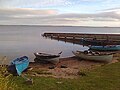 View of the pier at the site


Tributes[edit]
Shaw has a Wetherspoons pub named after him in his birthplace of Westhoughton.[39]
Villain Sebastian Shaw from the X-Men comics is named and modelled after Shaw.[40]
Film director Ridley Scott, in the DVD commentary for Gladiator (2000) when discussing the casting of Próximo and Marcus Aurelius, said "We have very few Robert Shaws now",[41] implying he had wanted to cast a certain type of rugged actor that Shaw typified, in this case Oliver Reed and Richard Harris.
Work[edit]
Stage[edit]
- The Caretaker (1962)
- The Physicists (1964)
- The Man in the Glass Booth (1968)
- Gantry (1970)
- Old Times (1971)
- The Dance of Death (1974)
Filmography[edit]
- The Cherry Orchard (1947)
- The Lavender Hill Mob (1951) – Chemist at Police Exhibition (uncredited)
- The Dam Busters (1954) – Flight Sgt. J. Pulford
- Double Cross (1956) – Ernest
- A Hill in Korea (1956) – Lance Corporal Hodge
- Sea Fury (1958) – Gorman
- Libel (1959) – First Photographer
- The Dark Man (TV, 1960) – Alan Regan
- The Valiant (1962) – Lieutenant Field
- The Father (1962) – The Captain
- Tomorrow at Ten (1962) – Marlowe
- The Caretaker (1963) – Aston
- From Russia with Love (1963) – Donald 'Red' Grant
- The Luck of Ginger Coffey (1964) – Ginger Coffey
- Battle of the Bulge (1965) – Col. Martin Hessler
- A Man for All Seasons (1966) – King Henry VIII
- Custer of the West (1967) – Gen. George Armstrong Custer
- Luther (TV, 1968) – Martin Luther
- The Birthday Party (1968) – Stanley Webber
- Battle of Britain (1969) – Squadron Leader "Skipper"
- The Royal Hunt of the Sun (1969) – Francisco Pizarro
- Figures in a Landscape (1970) – MacConnachie (also adapted for the screen)
- A Town Called Bastard (a.k.a. A Town Called Hell) (1971) – The Priest
- A Reflection of Fear (a.k.a. Labyrinth) (1972) – Michael
- Young Winston (1972) – Lord Randolph Churchill
- The Hireling (1973) – Steven Ledbetter
- The Golden Voyage of Sinbad (1973) – The Oracle of All Knowledge (uncredited)
- The Sting (1973) – Doyle Lonnegan
- The Taking of Pelham One Two Three (1974) – Mr. Blue – Bernard Ryder
- Jaws (1975) – Quint
- The Man in the Glass Booth (1975) – Writer only
- End of the Game (a.k.a. Der Richter und sein Henker, Murder on the Bridge, Deception, and Getting Away with Murder) (1975) – Richard Gastmann
- Diamonds (a.k.a. Diamond Shaft) (1975) – Charles / Earl Hodgson
- Robin and Marian (1976) – Sheriff of Nottingham
- Swashbuckler (a.k.a. Scarlet Buccaneer) (1976) – Ned Lynch
- Black Sunday (1977) – Major David Kabokov
- The Deep (1977) – Romer Treece
- Force 10 from Navarone (1978) – Major Keith Mallory
- Avalanche Express (1979) – General Marenkov (shot in 1978; final film role)
Television[edit]
| Year | Series | Role | Notes |
|---|---|---|---|
| 1956–1957 | The Buccaneers | Captain Dan Tempest | |
| 1957 | Rupert of Hentzau | Rupert of Hentzau | Television film |
| 1958 | Dial 999 | Willy | Episode: "Extradition" |
| 1960 | Armchair Theatre | Marl Renfrew | Episode: "Misfire" |
| The Four Just Men | Stuart | Episode: "Crack-Up" | |
| ITV Television Playhouse | Ken Rudge | Episode: "Place Of My Own" | |
| Charlie Williams | Episode: "Night Run to the West" | ||
| Play of the Week | Wilson | Episode: "The Pets"
| |
| 1961 | Danger Man | Tony Costello | Episode: "Bury the Dead" |
| 1962 | The Winter's Tale | Leontes | Television film |
| 1964 | Hamlet at Elsinore | King Claudius | |
| A Carol for Another Christmas | Ghost of Christmas Future | ||
| 1974 | The Wide World of Mystery | Giles | Episode: "The Break" |
Writing[edit]
- The Hiding Place (1960)
- The Sun Doctor (1961) Awarded the Hawthornden Prize in 1962
- The Flag (1965)
- Situation Hopeless ... But Not Serious (screenplay adaptation of The Hiding Place, 1965)
- The Man in the Glass Booth (1967)
- The Man in the Glass Booth (play adaptation, 1968)
- A Card from Morocco (1969)
- Figures in a Landscape (1970) (screenplay adaptation of novel)
- Cato Street (play, 1971)
- Jaws (1975) (uncredited rewrite of Indianapolis monologue)
Awards[edit]
At the 39th Academy Awards in 1967, Shaw became the second actor – after Charles Laughton – to receive an Oscar nomination for portraying Henry VIII of England, in the film A Man for All Seasons (1966).[42] He was also nominated to the 24th Golden Globe Awards for the same role.[43]
References[edit]
- ^ "Mayor to unveil plaque in honour of Jaws star". The Bolton News. Newsquest. 19 July 1996. Retrieved 18 June 2018.
- ^ Wakeman, John; Kunitz, Stanley (1975). World Authors, 1950–1970: A Companion Volume to Twentieth Century Authors. Wilson. p. 1292. ISBN 978-0-8242-0419-8.
- ^ Ross, Lillian; Ross, Helen (1961). The Player A Profile of an Art. Simon and Schuster. p. 472.
- ^ "The "Spirit of Truro" – When Truro School Built an Aeroplane". Truro School. 11 June 2015. Retrieved 25 April 2019.
- ^ "Robert Shaw". RADA. Retrieved 8 May 2020.
- ^ a b c d Taylor, Clarke (3 February 1976). "Robert Shaw: Actor, Author, Egotist". The Washington Post. p. D2.
- ^ "The Buccaneers". BFI Screenonline.
- ^ "Actor-author Robert Shaw dies". The Guardian. 29 August 1978. p. 1.
- ^ "The Caretaker". BFI Screenonline.
- ^ McIlvanney, Hugh (21 April 1968). "Mr Shaw likes to play the winner". The Observer. p. 22.
- ^ "Heart attack kills Robert Shaw in Mayo". The Irish Times. 29 August 1978. p. 1.
- ^ Díez Medrano, Juan (24 January 2010). Framing Europe: Attitudes to European Integration in Germany, Spain, and the United Kingdom. Princeton University Press. p. 273. ISBN 9780691146508.
- ^ a b Gussow, Mel (5 January 1970). "Robert Shaw: Actor, Novelist, Playwright Singer?". The New York Times. p. 48.
- ^ Sinclair, Clive (4 May 2015). "Writers at the Movies: 'Custer of the West'". Contrapasso.
- ^ "ABC's 5 Years of Film Production Profits & Losses". Variety. 31 May 1973. p. 3.
- ^ "Robert Shaw Play Staged in London: Actor's First Effort, 'Glass Booth,' Grips Audience". The New York Times. 29 July 1967. p. 12.
- ^ a b The Forgotten Novels of Robert Shaw. Withnail Books. Retrieved 14 July 2023.
- ^ "Off the Wall can't shatter clunky finale of 'Man in the Glass Booth'". www.jsonline.com. Retrieved 14 July 2023.
- ^ Mackenzie, S. P. (2016). The Battle of Britain on Screen: 'The Few' in British Film and Television Drama. Bloomsbury. p. 139. ISBN 9781474228466.
- ^ Dangaard, Colin (29 January 1978). "Shaw: Cash crunch adds up to misery". Chicago Tribune. p. e20.
- ^ "Robert Shaw, 51, Hunter of 'Jaws,' Dies". Los Angeles Times. 29 August 1978. p. 5.
- ^ The Man In The Glass Booth; Interview with Arthur Hiller; 2003 DVD release; KINO VIDEO.
- ^ "Summer of the Shark". Time. 23 June 1975. Archived from the original on 30 November 2009. Retrieved 9 November 2011.
- ^ Watters, Jim (12 September 1976). "The Fathomable Film Life in 'The Deep': Film Intrigue of Underwater Life Films Follow Lure of the Deep Fathoming 'The Deep' Film". Los Angeles Times. p. v1.
- ^ Shaw: Cash crunch adds up to misery Dangaard, Colin. Chicago Tribune 29 January 1978: e20.
- ^ Lee, Grant (2 September 1978). "Film Clips: Memories of Robert Shaw: 'A Gallant Man'". Los Angeles Times. p. b5.
- ^ "Avalanche Express (1979) – A Review". 23 February 2021. Retrieved 25 July 2022.
- ^ Mann, Roderick (4 April 1978). "Robert Shaw: Into Other Waters". Los Angeles Times. p. b20.
- ^ Busch, Anita (17 July 2017). "Evzen Kolar Dies: Film Producer Of 'Surf Ninjas' & 'City of Industry' Was 67". Deadline Hollywood. Penske Business Media, LLC. Retrieved 25 August 2018.
- ^ Ciafardini, Marc (6 June 2016). "Composer Rob Kolar Takes the Sonic Wheel for 'The Detour' on TBS". goseetalk.com. Retrieved 27 January 2018.
- ^ Holdsworth, Nick (17 July 2010). "Brother, sister act is film fest friendly". Variety. Penske Business Media, LLC. Retrieved 25 August 2018.
- ^ a b O'Toole, Connie (11 August 2008). "Robert Shaw memorial unveiled in Mayo village". Irish Times.
- ^ McIver, Brian (14 June 2012). "Revealed: The Scottish roots behind hellraiser Robert Shaw as Jaws hits cinemas again". Daily Record.
- ^ "Robert Shaw". tourmakeady.weebly.com.
- ^ Arnold, Gary (29 August 1978). "Actor Robert Shaw, Known for Menacing Roles, Dies in Ireland". The Washington Post. Retrieved 8 November 2019.
- ^ "Robert Shaw, British Actor, Dies in Ireland". The Post and Courier. 29 August 1978. Archived from the original on 18 July 2012. Retrieved 6 December 2011.
- ^ Parkinson, David. "Shaw, Robert Archibald (1927–1978)". Oxford Dictionary of National Biography (online ed.). Oxford University Press. doi:10.1093/ref:odnb/57319. (Subscription or UK public library membership required.)
- ^ Lentz, Robert J. (16 January 2016). Lee Marvin: His Films and Career. McFarland Publishing. p. 159. ISBN 9780786426065.
- ^ "The Robert Shaw". JD Weatherspoon. Retrieved 9 June 2011.
- ^ Cronin, Brian (30 March 2006). "Comic Book Urban Legends Revealed #44!". CBR. Retrieved 9 June 2011.
- ^ Scott, Ridley (2022). Gladiator. Universal studios. OCLC 1353211685. Retrieved 15 January 2023.
- ^ "From The Favourite to The Crown: British royals in TV and film". Telegraph. Telegraph Media Group Limited. 4 October 2018. Archived from the original on 26 October 2018. Retrieved 25 April 2019.
- ^ Walters, Ivan (12 November 2015). A Year of Movies: 365 Films to Watch on the Date They Happened. Rowman & Littlefield. p. 203. ISBN 9781442245600.
External links[edit]
- Robert Shaw at the Internet Broadway Database
- Robert Shaw at the British Film Institute
- Robert Shaw at IMDb
- Robert Shaw – For All Seasons
- Robert Shaw at AllMovie
- Robert Shaw at the TCM Movie Database
| International | |
|---|---|
| National | |
| People | |
| Other | |

- 1927 births
- 1978 deaths
- 20th-century English dramatists and playwrights
- 20th-century English male actors
- 20th-century English male writers
- 20th-century English novelists
- Male actors from Bolton
- Alumni of RADA
- English expatriate male actors in the United States
- British people of English descent
- English expatriates in Ireland
- English male dramatists and playwrights
- English male film actors
- English male novelists
- English male Shakespearean actors
- English male television actors
- English people of Scottish descent
- English people of Swazi descent
- Male actors from Lancashire
- People educated at Truro School
- People from Orkney
- People from Westhoughton