


Jack Russell Terrier


| Jack Russell Terrier | |||||||||||||||||||||
|---|---|---|---|---|---|---|---|---|---|---|---|---|---|---|---|---|---|---|---|---|---|
 | |||||||||||||||||||||
| Origin | United Kingdom | ||||||||||||||||||||
| |||||||||||||||||||||
| |||||||||||||||||||||
| Dog (domestic dog) | |||||||||||||||||||||
The Jack Russell Terrier is a British breed of small terrier. It is principally white-bodied and smooth-, rough- or broken-coated, and can be any colour.
It derives from dogs bred and used for fox-hunting in North Devon in the early nineteenth century by a country parson, Jack Russell – for whom the breed is named – and has similar origins to the modern Fox Terrier. Though closely similar, it is a distinct and different breed from the Parson Russell Terrier.[3]
Jack Russells are an energetic breed that rely on a high level of exercise and stimulation. It has gone through several changes over the years, corresponding to different use and breed standards set by kennel clubs. Recognition by kennel clubs for the Jack Russell breed has been opposed by the breed's parent societies – which resulted in the breeding and recognition of the Parson Russell terrier. Jack Russells have appeared many times in film, television, and print – with several historical dogs of note.
History[edit]
Sporting parson[edit]

The small white fox-working terriers we know today were first bred by the Reverend John "Jack" Russell, a parson and hunting enthusiast born in 1795,[4] and they can trace their origin to the now extinct English white terrier.[5] Difficulty in differentiating the dog from the creature it was pursuing brought about the need for a mostly white dog,[6] and so in 1819 during his last year of university at Exeter College, Oxford,[7] he purchased a small white and tan terrier female named Trump from a local milkman[8] in the nearby small hamlet of Elsfield[9] or Marston.[10] Trump epitomised his ideal Fox Terrier,[11] which, at the time, was a term used for any terrier which was used to bolt foxes out of their burrows.[5] Her colouring was described as "...white, with just a patch of dark tan over each eye and ear; whilst a similar dot, not larger than a penny piece, marks the root of the tail."[12] Davies, a friend of Russell's, wrote: "Trump was such an animal as Russell had only seen in his dreams".[7] She was the basis for a breeding program to develop a terrier with high stamina for the hunt as well as the courage and formation to chase out foxes that had gone to ground.[13] By the 1850s, these dogs were recognised as a distinct breed.[14]
An important attribute in this dog was a tempered aggressiveness that would provide the necessary drive to pursue and bolt the fox, without resulting in physical harm to the quarry and effectively ending the chase, which was considered unsporting.[15] Russell was said to have prided himself that his terriers never tasted blood.[14] This line of terriers developed by John Russell was well respected for those qualities, and his dogs were often taken on by hunt enthusiasts. It is unlikely, however, that any dogs alive today can be proved to be descendants from Trump, as Russell was forced to sell all his dogs on more than one occasion because of financial difficulty, and had only four aged (and non-breeding) terriers left when he died in 1883.[16]
The Fox terrier and Jack Russell terrier type dogs of today are all descended from dogs of that period. However, documented pedigrees earlier than 1862 have not been found. Several records remain of documented breeding by John Russell between the 1860s and 1880s. The Fox Terrier Club was formed in 1875 with Russell as one of the founder members; its breed standard was aspiration, and not a description of how the breed appeared then. By the start of the 20th century, the Fox Terrier had altered more towards the modern breed, but in some parts of the country the old style of John Russell's terriers remained, and it is from those dogs that the modern Jack Russell type has descended.[7]
Many breeds can claim heritage to the early Fox Terrier of this period, including the Brazilian Terrier, Japanese Terrier, Miniature Fox Terrier, Ratonero Bodeguero Andaluz, Rat Terrier, and Tenterfield Terrier.[17]
After John Russell[edit]

Following Russell's death, the only people who made serious efforts to continue those strains were two men, one in Chislehurst with the surname of East, and another in Cornwall named Archer. East, at one point, had several couples, all of which were descended from one of Russell's dogs. The type aimed for were not as big as the show Fox Terrier and were usually less than 7 kg (15 lb).[6]
Arthur Blake Heinemann created the first breed standard and, in 1894, he founded the Devon and Somerset Badger Club, the aims of which were to promote badger digging rather than fox hunting, and the breeding of terriers suitable for this purpose. Terriers were acquired from Nicholas Snow of Oare, and they were likely descended from Russell's original dogs, as Russell would probably have hunted at some point with Snow's hunting club and is likely to have provided at least some of their original terriers.[7] By the turn of the 20th century, Russell's name had become associated with this breed of dog.[19]
The club was later renamed the Parson Jack Russell Terrier Club.[7] Badger digging required a different type of dog than fox hunting, and it is likely that Bull Terrier stock was introduced to strengthen the breed, which may have caused the creation of a shorter legged variety of Jack Russell terrier that started to appear around this period. At the same time that a split was appearing between show and working Fox terriers, a further split was occurring between two different types of white terrier, both carrying Jack Russell's name.[6] Heinemann was invited to judge classes for working terriers at Crufts with an aim to bring working terriers back into the show ring and influence those that disregard working qualities in dogs. These classes were continued for several years by various judges, but Charles Cruft dropped the attempt as the classes were never heavily competed. Following Heinemann's death in 1930, the kennel and leadership of the club passed to Annie Harris, but the club itself folded shortly before World War II.[6][7]
Post-World War II[edit]
Following World War II, the requirement for hunting dogs drastically declined, and with it the numbers of Jack Russell terriers. The dogs were increasingly used as family and companion dogs.[citation needed]
The Jack Russell Terrier Club of America (JRTCA) was formed in 1976 by Ailsa Crawford, one of the first Jack Russell terrier breeders in the United States. Size ranges for dogs were kept broad, with the ability of working dogs awarded higher than those in conformation shows. An open registry was maintained, with restricted line breeding. Registration for the club is made at adulthood for Jack Russells, rather than at birth, to ensure the breed's qualities remain, given the open registry.[20]
Several breed clubs appeared in the United Kingdom during the 1970s to promote the breed, including the Jack Russell Club of Great Britain (JRTCGB) and the South East Jack Russell Terrier Club (SEJRTC). The JRTCGB promoted the range of sizes that remain in its standards today, whereas the SEJRTC set a minimum height for dogs at 33 cm (13 in). While the JRTCGB sought to ensure that the breed's working ability remained through non-recognition with other breed registries, the SEJRTC activity sought recognition with the UK Kennel club.[21] In 1983, the Parson Jack Russell Club of Great Britain (PJRTCGB) was resurrected to seek Kennel Club recognition for the breed. Although the application was initially rejected, a new standard was created for the PJRTCGB based on the standard of the SEJRTC, and under that standard the breed was recognised by the Kennel Club in 1990 as the Parson Jack Russell terrier.[22] Jack was dropped from the official name in 1999, and the recognised name of the breed became the Parson Russell Terrier.[23]
In the late 1990s, the American Kennel Club explored the possibility of recognising the Jack Russell Terrier.[24] This move was opposed by the Jack Russell Terrier Club of America as they did not want the breed to lose its essential working characteristics.[25] The Jack Russell Terrier Breeders Association formed and petitioned the AKC; the breed's admission was granted in 2001. Under the AKC-recognised standard, the size of the breed was narrowed from the previous club's standard, and the name of the AKC-recognised Jack Russell Terrier was changed to Parson Russell Terrier,[26] with the Jack Russell Terrier Breeders Association renamed to the Parson Russell Terrier Association of America.[24]
The Australian National Kennel Council (ANKC) and the New Zealand Kennel Club (NZCK) are some of national kennel associations that register both the Jack Russell terrier and the Parson Russell terrier;[27] however, the size requirements for the Jack Russell terrier under both those standards would classify a dog as a Russell terrier in the United States.[28] In 2009, there were 1073 Jack Russells registered with the ANKC, compared to 18 for the Parson Russell terrier.[29] Other modern breeds are often mistaken for modern Jack Russell terriers, including their cousin the Parson Russell terrier,[30] the Tenterfield terrier,[31] and the Rat Terrier.[32] Several other modern breeds exist that descended from the early Fox Terrier breed, including the Brazilian Terrier, Japanese Terrier, Miniature Fox Terrier, Ratonero Bodeguero Andaluz, Rat Terrier, and Tenterfield Terrier.[33]
-
 A Jack Russell terrier wearing a dog harness
 -
 A working Jack Russell terrier exits a den pipe
 -
 Jack Russell Terriers playing with a ball
 -
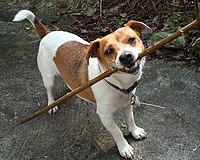 A Jack Russell Terrier brings a stick


.jpg)
Description[edit]


Due to their working nature, Jack Russell terriers remain much as they were some 200 years ago.[34] They are sturdy, tough, and tenacious, measuring between 25–38 cm (10–15 in) at the withers,[35] and weigh 6–8 kg (14–18 lb).[citation needed] The body length must be in proportion to the height, and the dog should present a compact, balanced image. Predominantly white in colouration (more than 51%) with black and/or brown and/or tan markings,[35] they exhibit either a smooth, rough or a combination of both which is known as a broken coat. A broken-coated dog may have longer hair on the tail or face than that which is seen on a smooth-coated dog.[36]

The head should be of moderate width at the ears, narrowing to the eyes, and slightly flat between the ears. There should be a defined but not overpronounced stop at the end of the muzzle where it meets the head, and a black nose. The jaw should be powerful and well boned with a scissor bite and straight teeth. The eyes are almond shaped and dark coloured and should be full of life and intelligence. Small V-shaped ears of moderate thickness are carried forward on the head.[citation needed] When the dog is alert, the tip of the V should not extend past the outer corner of the eyes. The tail is set high and in the past was docked to approximately 10 cm (5 in) in order to provide a sufficient hand-hold for gripping the terrier.[citation needed]
The Jack Russell should always appear balanced and alert.[35] The red fox is the traditional quarry of the Jack Russell terrier, so the working Jack Russell must be small enough to pursue it. Red foxes vary in size, but across the world, they average from 6–8 kg (13–17 lb) in weight and have an average chest size of 30–36 cm (12–14 in) at the widest part.[37]
[edit]

The Jack Russell terrier and Parson Russell Terrier breeds are similar, sharing a common origin, but have several marked differences – the most notable being the range of acceptable heights.[38] Other differences in the Parson Russell can include a longer head and larger chest as well as overall a larger body size.[39] The height of a Parson Russell at the withers according to the breed standard is 30–36 cm (12–14 in) which places it within the range of the Jack Russell Terrier Club of America's standard size for a Jack Russell of 25–38 cm (10–15 in). However, the Parson Russell is a conformation show standard whereas the Jack Russell standard is a more general working standard.[40]
The Russell Terrier, which is also sometimes called the English Jack Russell terrier or the Short Jack Russell terrier is a generally smaller related breed.[41] Both the breed standards of the American Russell Terrier Club and the English Jack Russell Terrier Club Alliance states that at the withers it should be an ideal height of 20–30 cm (8–12 in).[42][43] Although sometimes called the English or Irish Jack Russell terrier,[44] this is not the recognised height of Jack Russells in the United Kingdom. According to the Jack Russell Club of Great Britain's breed standard, it is the same size as the standard for Jack Russells in the United States, 25–38 cm (10–15 in).[45] Compared to the Parson Russell Terrier, the Russell Terrier should always be longer than tall at the withers, whereas the Parson Russell's points should be of equal distance.[46] The Fédération Cynologique Internationale standard for the Jack Russell terrier has this smaller size listed as a requirement.[47] Terrierman Eddie Chapman, who has hunted in Devon for more than 30 years, the same area that John Russell himself hunted, notes that, "I can state categorically that if given the choice, ninety-nine percent of hunt terrier men would buy an under 12 in (30 cm) worker, if it was available, over a 14 in (36 cm) one."[48]
Temperament[edit]

Jack Russells are first and foremost a working terrier.[49] Originally bred to bolt foxes from their dens during hunts, they are used on numerous ground-dwelling quarry such as groundhog, badger, otter, and red and grey fox.[50] The working Jack Russell terrier is required to locate quarry in the earth, and then either bolt it or hold it in place until they are dug to.[51] To accomplish this, the dog will not bark but will expect attention to the quarry continuously. Because the preservation of this working ability is of highest importance to most registered JRTCA/JRTCGB breeders, Jack Russells tend to be extremely intelligent, athletic, fearless, and vocal dogs.[13] It is not uncommon for these dogs to become moody or destructive if not properly stimulated and exercised, as they have a tendency to bore easily and will often create their own fun when left alone to entertain themselves, leading to the semi-affectionate nickname among suburban pet dogs of "Jack Russell Terrorist".[52]
Their high energy and drive make these dogs ideally suited to a number of different dog sports such as flyball or agility.[53] Obedience classes are also recommended to potential owners,[50] as Jack Russells can be stubborn at times and aggressive towards other animals and humans if not properly socialized.[13] Despite their small size, these dogs are not recommended for the condominium or apartment dweller unless the owner is ready to take on the daunting task of providing the dog with the necessary amount of exercise and stimulation. They have a tremendous amount of energy for their size.[52]
Health[edit]


Breeders have protected the gene pool, and direct in-line breeding has been prevented.[44] However, certain lines have been noted for having specific health concerns and, therefore, could occur in any line or generation because of recessive genes. These issues can include hereditary cataracts, ectopia lentis, congenital deafness, patellar luxation, ataxia, myasthenia gravis, Legg–Calvé–Perthes syndrome, and von Willebrand disease.[44]
Being a hunt-driven dog, the Jack Russell will usually pursue most creatures that it encounters. This includes the skunk, and the breed is prone to skunk toxic shock syndrome.[54] The chemical in the skunk spray is absorbed by the dog and causes the red blood cells to undergo haemolysis, which can occasionally lead to fatal anaemia and kidney failure. If sprayed underground, it can also cause chemical burning of the cornea. Treatments are available to flush the toxin out of the dog's system.[55]
A study of life expectancy of dogs in the UK using veterinary data found the Jack Russel Terrier to have an average life expectancy of 12 years and 9 months, this was higher than any other breed in the study including crossbreeds.[56]
Eye disorders[edit]
Lens luxation, also known as ectopia lentis is the most common hereditary disorder in Jack Russell terriers. Even so, this condition is not a common occurrence in the breed. Most frequently appearing in dogs between the ages of 3 and 8 years old, it is where the lens in one or both eyes becomes displaced. There are two types, posterior luxation (where the lens slips to the back of the eye) and anterior luxation (where the lens slips forward). Posterior luxation is the less severe of the two types, as the eye can appear normal although the dog's eyesight will be affected. In anterior luxation, the lens can slip forward and rub against the cornea, damaging it. Anterior luxation also has a high probability of causing glaucoma which can lead to partial or complete blindness. Treatment is available and may include both medical and surgical options. Secondary lens luxation is caused by trauma to the eye and is not hereditary.[citation needed]
Musculoskeletal conditions[edit]
Patellar luxation, also known as luxating patella, is a hereditary disorder affecting the knees. It is where the kneecap slips off the groove on which it normally sits. The effects can be temporary with the dog running while holding its hind leg in the air before running on it again once the kneecap slipped back into place as if nothing has happened. Dogs can have a problem with both rear knees, and complications can include arthritis or torn knee ligaments. Severe cases can require surgery. Some are prone to dislocation of the kneecaps, inherited eye diseases, deafness and Legg Perthes—a disease of the hip joints of small dog breeds. Prone to mast cell tumors. Legg–Calvé–Perthes syndrome, also called Avascular Necrosis of the Femoral Head, is where the ball section of the femur in the hip joint deteriorates following interruption of the blood flow and is the same condition as in humans.[57] In dogs, this causes lameness of the hind-legs, the thigh muscles to atrophy and pain in the joint.[58] It usually occurs between 6–12 months of age and has been documented in a variety of other terrier breeds including the Border terrier, Lakeland terrier, and Wheaten terrier.[57]
Well-known Jack Russell terriers[edit]

Nipper was a dog born in 1884 who was thought to be a dog of the Jack Russell terrier type.[59] He was the inspiration for the painting Dog looking at and listening to a Phonograph, later renamed His Master's Voice. The painting was used by a variety of music related companies including The Gramophone Company, EMI, the Victor Talking Machine Company, and RCA. Today it remains in use incorporated into the logo for HMV in the UK and Europe.[60]
A Jack Russell named Bothie made history in 1982 as part of the Transglobe Expedition. Owned by explorers Ranulph and Ginny Fiennes, he became the first dog to travel to both the North and South Poles.[61][62] This feat is unlikely to be repeated, as all dogs have been banned from Antarctica by the Antarctic Treaty nations since 1994, due to fears that they could transmit diseases to the native seal population.[63] Ranulph Fiennes and Charles Burton actually made the trip to the north pole by powered sledges before signalling to the base camp that they had arrived. To celebrate their achievement, a plane was sent out to take the two men champagne, along with Bothie.[64]
On 29 April 2007, a Jack Russell named George saved five children at a carnival in New Zealand from an attack by two pit bulls. He was reported to have charged at them and held them at bay long enough for the children to get away, but he was killed by the pit bulls. He was posthumously awarded the PDSA Gold Medal in 2009, the animal equivalent of the George Cross. A statue has been erected in Manaia, New Zealand, in his memory.[65] A former US Marine also donated to George's owner a Purple Heart award he had received for service in Vietnam.[66]
In 2019, Boris Johnson and his partner Carrie Symonds took a Jack Russell cross from an animal rescue charity in Wales.[67] The dog's name is Dilyn and he became a famous dog at a polling station in the general election.[68][69]
During the ongoing 2022 Russian invasion of Ukraine, a 2-year old Jack Russell named Patron has been working with the State Emergency Service of Ukraine to sniff out Russian explosives. As of April 20, 2022, the Ukrainian Government announced that he had located nearly 90 explosives.[70]
On screen and in literature[edit]
In the UK, one of the more recognisable canine stars was restaurateur and chef Rick Stein's irrepressible terrier Chalky,[71] who frequently upstaged his owner on his various cookery series.[72] Chalky had his own line of merchandise, including plushes, tea towels, art prints, art paw prints and two real ales – Chalky's Bite and Chalky's Bark,[73] which won gold in the Quality Drink Awards 2009.[74] Chalky was given a BBC obituary when he died in 2007.[75]
Moose and his son Enzo played the role of Eddie on the long-running American TV sitcom Frasier.[71] Eddie belonged to lead character Frasier's father Martin Crane, and constantly "stole the show" with his deadpan antics, receiving more fan mail than any other Frasier character.[76] Moose and Enzo also starred as Skip in the 2000 film My Dog Skip.
Soccer was a Jack Russell who became the star of the American TV series Wishbone, which aired from 1995 to 2001.[21] In the 2009 movie Hotel for Dogs, Friday, one of the main characters is a Jack Russell, played by the dog actor Cosmo.[77] Cosmo went on to appear in the films Paul Blart: Mall Cop and Beginners.[78]
Uggie (2002–2015) was an animal actor, appearing in commercials starting in 2005 and in the films Water for Elephants and The Artist, both in 2011.[79] In the same year, based on interest following The Artist, the "Consider Uggie" campaign was launched, which attempted to gain the dog a nomination for an Academy Award.[80] In 2012, Uggie was named Nintendo's first-ever spokesdog.[81]
Sykes (est. 2001 - 2019) was a dog actor from Clifton, Oxfordshire, England. He was best known in the UK for his appearance as "Harvey" in Thinkbox's three television commercials, and, under his real name in five seasons of Midsomer Murders. He also appeared in several Hollywood blockbusters, as well as in a UK TV movie, several series and miniseries. He retired in 2016 after a long career on the big and small screen. Sykes was also a champion agility competitor.
A clever Jack Russel Terrier, named Jack, played a central role in the 1980s TV adventure series Tales of the Gold Monkey.
K.K. Slider is a Jack Russell who is a main character in the Animal Crossing video game series developed by Nintendo. K.K. is a musician who performs to the townsfolk. He has appeared in every Animal Crossing game to date since the original Animal Crossing game in 2001 to Animal Crossing: New Horizons in 2020.
-
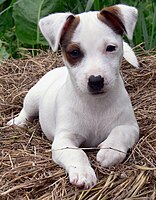 A smooth-coated Jack Russell terrier puppy
 -
 A rough-coated Jack Russell terrier puppy


Footnotes[edit]
- ^ a b FCI-Standard N° 345: Jack Russell Terrier Archived 8 May 2016 at the Wayback Machine. Thuin, Belgium: Fédération Cynologique Internationale. Accessed June 2023.
- ^ Jack Russell Terrier Archived 5 June 2023 at the Wayback Machine. London: The Kennel Club. Accessed June 2023.
- ^ "Jack Russell terrier and a Parson Russell - can you tell the difference?". Shooting UK. 26 January 2021. Archived from the original on 2 December 2022. Retrieved 2 December 2022.
- ^ Nicholas, Anna Katherine (1995). Jack Russell Terriers. Neptune City, NJ: TFH Publications. p. 4. ISBN 0-7938-2379-X.
Parson Jack was born in 1795. His father was a noted sportsman... also a clergyman. ...patterned his own life after the senior Russell's footsteps
- ^ a b "Fox Terriers and Jack Russells". Jane Dogs. Archived from the original on 3 June 2011. Retrieved 7 October 2010.
- ^ a b c d "Breed History & Club History". Jack Russell Terrier Club of Great Britain. Archived from the original on 12 August 2010. Retrieved 17 March 2010.
- ^ a b c d e f "An introduction to the Parson Russell Terrier". Parson Russell Terrier Club UK. Archived from the original on 5 May 2011. Retrieved 15 March 2010.
- ^ "A Field Guide to the English Clergy' Butler-Gallie, F p90: London, Oneworld Publications, 2018 ISBN 9781786074416
- ^ Davies, Norman (1 January 1996). Europe: A History. Oxford University Press. p. 343. ISBN 978-0-19-820171-7. Retrieved 24 March 2010.
jack russell.
- ^ "From the civil war to Jack Russell breed by Chris Koenig, Oxford Times 25 January 2007". Archived from the original on 16 November 2018. Retrieved 3 April 2016.
- ^ Coile (2000): p. 6
- ^ Coile (2000): p. 3
- ^ a b c Smith, Steve (September 2002). The Encyclopedia of North American Sporting Dogs: Written by Sportsmen for Sportsmen. Willow Creek Press. p. 229. ISBN 978-1-57223-501-4. Archived from the original on 12 February 2024. Retrieved 14 March 2010.
- ^ a b McKinney, Liz. "History of the Jack Russell Terrier". Parson Russell Terrier / Jack Russell Terrier.com. Archived from the original on 15 July 2011. Retrieved 18 March 2010.
- ^ Burns (2006): p. 12
- ^ Burns (2006): p. 237
- ^ "Different Types of Terrier: Smooth Fox Terrier". JackRussell.co.uk. Archived from the original on 1 April 2010. Retrieved 2 April 2010.
- ^ "Origin & History". Cumbreck Jack Russells. Archived from the original on 21 December 2009. Retrieved 2 April 2010.
- ^ Lee, Rawdon B. (1902). A History and Description, with Reminiscences, of the Fox Terrier. Horace Cox, London. p. 153. ISBN 9781103296620. Archived from the original on 12 February 2024. Retrieved 29 March 2010.
- ^ Burns (2006): p. 58
- ^ a b Coile(2000): p. 9
- ^ Coile(2000): p. 10
- ^ "FCI-Standard N°339 / 28. 11. 2003 / GB Parson Russell Terrier". Montefiore. Archived from the original on 14 September 2009. Retrieved 27 March 2010.
- ^ a b Burns (2006): p. 60
- ^ Burns (2006): p. 59
- ^ Burns (2006): p. 61
- ^ "Jack Russell Terrier". New Zealand Kennel Club. Archived from the original on 10 January 2010. Retrieved 5 April 2010.
"Parson Russell Terrier". New Zealand Kennel Club. Archived from the original on 27 March 2009. Retrieved 5 April 2010.
"Breeds – Group 2 (Terriers) Page 1". Australian National Kennel Council. Archived from the original on 15 April 2010. Retrieved 5 April 2010.
"Parson Russell Terrier". Australian National Kennel Council. 2 July 2009. Archived from the original on 6 July 2011. Retrieved 5 April 2010. - ^ "The differences between Parson Jack Russell Terriers and Jack Russell Terriers". Jack-Russell-Terrier.co.uk. Archived from the original on 1 April 2010. Retrieved 5 April 2010.
- ^ "ANKC: National Animal Registration Analysis". Australian National Kennel Club. Retrieved 5 April 2010.[permanent dead link]
- ^ "About Us". Kannye Parson Russell Terrier. Archived from the original on 30 March 2010. Retrieved 5 April 2010.
- ^ "Tenterfield Terrier". Burkes Backyard. Archived from the original on 13 January 2010. Retrieved 5 April 2010.
- ^ "Roosevelt's Rat Terrier". TerrierLover.com. 2 September 2007. Archived from the original on 23 February 2010. Retrieved 5 April 2010.
- ^ "Different Types of Terrier". Jack-Russell-Terrier.co.uk. Archived from the original on 1 April 2010. Retrieved 5 April 2010.
- ^ Coile (2000): p. 11
- ^ a b c "JRTCA Breed Standard". therealjackrussell.com. Jack Russell Terrier Club of America. Archived from the original on 19 May 2009. Retrieved 2 June 2009.
- ^ Romaine Brown, Catherine (27 March 2006). Jack Russell Terrier: Your Happy Healthy Pet. Howell Book House. p. 18. ISBN 978-0-471-74837-3. Archived from the original on 12 February 2024. Retrieved 15 March 2010.
- ^ "WORKING DOG". therealjackrussell.com. Jack Russell Terrier Club of America. Archived from the original on 22 May 2009. Retrieved 2 June 2009.
- ^ Rice, Dan (17 November 2005). Small Dog Breeds. Barron's Educational Series. p. 140. ISBN 978-0-7641-2095-4. Archived from the original on 12 February 2024. Retrieved 15 March 2010.
- ^ Rainwater (2008): p. 9
- ^ "Breed Comparison". Jack Russell Terrier Club of America. Archived from the original on 1 March 2010. Retrieved 17 March 2010.
- ^ "A Brief History of the American Russell Terrier Club". American Russell Terrier Club. Archived from the original on 20 February 2010. Retrieved 17 March 2010.
- ^ "EJRTCA Breed Standard". English Jack Russell Terrier Club Alliance, Inc. Archived from the original on 30 April 2009. Retrieved 17 March 2010.
- ^ "AKC Russell Terrier Breed Standard". American Russell Terrier Club. Archived from the original on 27 March 2010. Retrieved 17 March 2010.
- ^ a b c Rainwater (2008): p. 65
- ^ "Breed Standard". Jack Russell Terrier Club of Great Britain. Archived from the original on 19 August 2011. Retrieved 17 March 2010.
- ^ "The Body & Tail". American Russell Terrier Club. Archived from the original on 29 March 2010. Retrieved 17 March 2010.
- ^ "Jack Russell Terrier" (PDF). Fédération Cynologique Internationale. 9 August 2004. Archived (PDF) from the original on 8 May 2016. Retrieved 26 March 2010.
- ^ Chapman, Eddie (1994). The Working Jack Russell Terrier. Dorset Press.
- ^ "The Jack Russell Terrier: A Working Dog". therealjackrussell.com. Jack Russell Terrier Club of America. Archived from the original on 30 August 2009. Retrieved 11 September 2009.
- ^ a b "So You're Thinking About Getting a Jack Russell Terrier". Working-Dog.com. Archived from the original on 6 February 2010. Retrieved 27 March 2010.
- ^ Rainwater (2008): p. 80
- ^ a b Rainwater (2008): p. 73
- ^ Pavia, Audrey (21 November 2003). What About Jack Russell Terriers: The Joys and Realities of Living with a JRT. What About?. Howell Book House. p. 7. ISBN 978-0-7645-4089-9. Archived from the original on 12 February 2024. Retrieved 24 March 2010.
- ^ Smith, Steve (September 2002). "Jack Russell Terrier". The Encyclopedia of North American Sporting Dogs: Written by Sportsmen for Sportsmen. Willow Creek Press. pp. 229 & 229. ISBN 978-1-57223-501-4. Archived from the original on 12 February 2024. Retrieved 24 March 2010.
- ^ Burns (2006): p. 227
- ^ Teng, Kendy Tzu-yun; Brodbelt, Dave C.; Pegram, Camilla; Church, David B.; O’Neill, Dan G. (28 April 2022). "Life tables of annual life expectancy and mortality for companion dogs in the United Kingdom". Scientific Reports. 12 (1). Springer Science and Business Media LLC. doi:10.1038/s41598-022-10341-6. ISSN 2045-2322. PMC 9050668.
- ^ a b Dangerfield, Peter H. "Perthes' Disease of the Hip". The University of Liverpool. Archived from the original on 31 May 2009. Retrieved 2 April 2010.
- ^ "Jack Russell Terrier – Specific Wellness Program". Hillside Animal Hospital. Archived from the original on 11 July 2011. Retrieved 2 April 2010.
- ^ "HMV seeks budding Nipper". BBC News. 8 September 1999. Archived from the original on 4 June 2023. Retrieved 18 March 2010.
- ^ "The History of Nipper and His Master's Voice". erikoest.dk. Archived from the original on 12 October 2010. Retrieved 18 March 2010.
- ^ "Part 3: The Arctic: May 1981 – August 1982". Transglobe Expedition.org. Archived from the original on 3 February 2010. Retrieved 18 March 2010.
- ^ "Part 2: The Antarctic: January 1980 – April 1981". Transglobe Expedition.org. Archived from the original on 2 January 2010. Retrieved 18 March 2010.
- ^ Macklin, Debbie (22 June 1991). "Redundant huskies sent packing from Antarctica". New Scientist. Archived from the original on 12 January 2010. Retrieved 18 March 2010.
- ^ Hadzima, Eva (12 September 2016). "Famous Dogs". dewintonvet.com. Archived from the original on 12 August 2020. Retrieved 25 September 2016.
- ^ "Hero Dog Dies Fighting Pit Bulls". Sky News. 11 February 2009. Archived from the original on 14 February 2009. Retrieved 2 June 2009.
- ^ "Medals for brave jack russell terrier". tvnz.co.nz. Television New Zealand. 8 May 2007. Archived from the original on 28 October 2008. Retrieved 2 June 2009.
- ^ Boris Johnson's new rescue puppy moves into Downing Street, BBC, 2 September 2019, archived from the original on 16 December 2019, retrieved 16 December 2019
- ^ Jen Mills (12 December 2019), "Boris Johnson joins dogs at polling stations trend by taking Dilyn with him", Metro, archived from the original on 13 December 2019, retrieved 16 December 2019
- ^ Will Pavia; Charles Bremner (14 December 2019), "World wakes to one man and his dog", The Times, p. 11
- ^ Treisman, Rachel (20 April 2022). "Meet Patron, a bomb-sniffing Jack Russell terrier who has become a Ukrainian hero". NPR. Archived from the original on 21 April 2022. Retrieved 21 April 2022.
- ^ a b Rainwater (2008): p. 76
- ^ "Rick Stein's dog Chalky dies". Metro.co.uk. 16 January 2007. Archived from the original on 6 January 2011. Retrieved 18 March 2010.
- ^ "Chalky's Bite". Sharp's Brewery. Archived from the original on 23 February 2010. Retrieved 14 March 2010.
- ^ "Chalky's Bark wins Gold at Quality Drink Awards 2009". Sharp's Brewery. Archived from the original on 17 April 2010. Retrieved 14 March 2010.
- ^ "Celebrity chef Stein's dog dies". news.bbc.co.uk. BBC News. 16 January 2007. Archived from the original on 21 February 2009. Retrieved 2 June 2009.
- ^ "Moose (III) – Biography". IMDb. Archived from the original on 11 January 2004. Retrieved 2 June 2009.
- ^ Ebert, Roger (14 January 2009). "Hotel for Dogs". 14 January 2009. Suntimes.com. Archived from the original on 20 August 2010. Retrieved 26 September 2010.
- ^ "Cast and Crew: Cosmo". Beginners Official Site. Archived from the original on 18 May 2011. Retrieved 9 August 2011.
- ^ Clarke, Cath (22 December 2011). "First sight: Uggie". London: Guardian News and Media. Archived from the original on 15 July 2014. Retrieved 5 March 2011.
- ^ Eber, Hailey (4 December 2011). "Uggie, the canine co-star of 'The Artist,' is receiving praise from critics". New York Post. Archived from the original on 26 January 2012. Retrieved 5 March 2012.
- ^ "Canine Superstar Uggie Lands Epic Role as Nintendo's First-Ever "Spokesdog"". Business Wire. 8 February 2012. Archived from the original on 11 February 2012. Retrieved 5 March 2012.
References[edit]

- Burns, Patrick (16 February 2006). American Working Terriers. Lulu.com. ISBN 978-1-4116-6082-3. Archived from the original on 12 February 2024. Retrieved 18 October 2020.[self-published source?]
- Coile, D. Caroline (1 August 2000). Jack Russell Terrier Handbook, The. Barron's Pet Handbooks. Barron's Educational Series. ISBN 978-0-7641-1411-3.
- Rainwater, Don; Rainwater, Kellie (3 March 2008). The Jack Russell Terrier Canine Companion Or Demon Dog. CreateSpace. ISBN 978-1-4348-4890-1. Archived from the original on 12 February 2024. Retrieved 18 October 2020.
