


SPQR
 |
|---|
| Periods |
|
| Constitution |
| Political institutions |
| Assemblies |
| Ordinary magistrates |
| Extraordinary magistrates |
| Public law |
| Senatus consultum ultimum |
| Titles and honours |
SPQR, an acronym for Senatus PopulusQue Romanus (Classical Latin: [s̠ɛˈnäːt̪ʊs̠ pɔpʊˈɫ̪ʊs̠kʷɛ roːˈmäːnʊs̠]; transl. "The Senate and the Roman People"), is an emblematic phrase referring to the government of the Roman Republic. It appears on documents made public by an inscription in stone or metal, in dedications of monuments and public works, and on some Roman currency.
The full phrase appears in Roman political, legal, and historical literature, such as the speeches of Cicero and Ab Urbe Condita Libri (Books from the Founding of the City) of Livy.
Translation[edit]
 |
In Latin, Senātus is a nominative singular noun meaning "Senate". Populusque is compounded from the nominative noun Populus, "the People", and -que, an enclitic particle meaning "and" which connects the two nominative nouns. The last word, Rōmānus ("Roman"), is an adjective modifying the whole of Senātus Populusque: the "Roman Senate and People", taken as a whole. Thus, the phrase is translated literally as "The Roman Senate and People", or more freely as "The Senate and People of Rome".
Historical context[edit]
|

The title's date of establishment is unknown, but it first appears in inscriptions of the Late Republic, from around 80 BC onwards. Previously, the official name of the Roman state, as evidenced on coins, was simply ROMA. The abbreviation last appears on coins of Constantine the Great (ruled 312–337 AD), the first Roman emperor to support Christianity.[citation needed]
The two legal entities mentioned, Senātus and the Populus Rōmānus, are sovereign when combined. However, where populus is sovereign alone, Senātus is not. Under the Roman Kingdom, neither entity was sovereign. The phrase, therefore, can be dated to no earlier than the foundation of the Republic.[citation needed]
This signature continued in use under the Roman Empire. The emperors were considered the de jure representatives of the people even though the senātūs consulta, or decrees of the Senate, were made at the de facto pleasure of the emperor.[citation needed]
Populus Rōmānus in Roman literature is a phrase meaning the government of the People. When the Romans named governments of foreign states, they used populus in the singular or plural, such as populī Prīscōrum Latīnōrum, "the governments of the Old Latins". Rōmānus is the established adjective used to distinguish the Romans, as in cīvis Rōmānus, "Roman citizen".[citation needed]
The Roman people appear very often in law and history in such phrases as dignitās, maiestās, auctoritās, lībertās populī Rōmānī, the "dignity, majesty, authority, freedom of the Roman people". They were a populus līber, "a free people". There was an exercitus, imperium, iudicia, honorēs, consulēs, voluntās of this same populus: "the army, rule, judgments, offices, consuls and will of the Roman people". They appear in early Latin as Popolus and Poplus, so the habit of thinking of themselves as free and sovereign was quite ingrained.[citation needed]
The Romans believed that all authority came from the people. It could be said that similar language seen in more modern political and social revolutions directly comes from this usage. People in this sense meant the whole government. The latter, however, was essentially divided into the aristocratic Senate, whose will was executed by the consuls and praetors, and the comitia centuriāta, "committee of the centuries", whose will came to be safeguarded by the Tribunes.[citation needed]
One of the ways the emperor Commodus (180–192) paid for his donatives and mass entertainments was to tax the senatorial order, and on many inscriptions, the traditional order is provocatively reversed (Populus Senatusque...).[citation needed]
Medieval use[edit]
Beginning in 1184, the Commune of Rome struck coins in the name of the SENATVS P Q R. From 1414 until 1517, the Roman Senate struck coins with a shield inscribed SPQR.
Modern use[edit]
During the regime of Benito Mussolini, SPQR was emblazoned on a number of public buildings and manhole covers in an attempt to promote his dictatorship as a "New Roman Empire".[citation needed]

Even in contemporary usage, SPQR is still used in the municipal coat of arms of Rome and as abbreviation for the comune of Rome in official documents.[1][2] The Italians have long used a different and humorous expansion of this abbreviation, "Sono Pazzi Questi Romani" (literally: "They're crazy, these Romans").[3] SPQR is also part of the coat of arms of the Capital Military Command of the Italian army (Italian: Comando Militare Capitale).
In business, in English-speaking countries, SPQR is sometimes (humorously) used to mean "Small Profits, Quick Returns", often by people who have studied Latin at school.[citation needed]
Civic references[edit]


| This section needs additional citations for verification. (February 2018) |
SPQx is sometimes used as an assertion of municipal pride and civic rights. The Italian town of Reggio Emilia, for instance, has SPQR in its coat of arms, standing for Senatus Populusque Regiensis. There have been confirmed usages and reports of the deployment of the "SPQx" template in:
| City | Country | SPQx | Latin | Where has it been used |
|---|---|---|---|---|
| Alkmaar |  Netherlands Netherlands |
SPQA | On the façade of the Waag building. | |
| Amsterdam | Netherlands |
SPQA | Senatus Populusque Amstelodamensis[4] | At the Stadsschouwburg theater on Leidseplein[5] and some of the bridges.[4] |
| Antwerp |  Belgium Belgium |
SPQA | Senatus Populusque Antverpensis | On Antwerp City Hall and other public buildings and schools.[6] |
| Ascoli Piceno |  Italy Italy |
SPQA | Senatus Populusque Asculum | On the wall above the south loggia of the Piazza del Popolo, Ascoli Piceno. |
| Basel |  Switzerland Switzerland |
SPQB | Senatus Populusque Basilea | On the Webern-Brunnen in Steinenvorstadt.[7] |
| Benevento | Italy |
SPQB[8] | Senatus Populusque Beneventanus[8] | On manhole covers.[8] |
| Bologna | Italy |
SPQB | Senatus Populusque Bonononiensis | On the Fountain of Neptune, Bologna. |
| Bremen |  Germany Germany |
SPQB | In the Bremen City Hall.[9] | |
| Bruges | Belgium |
SPQB | On its coat of arms.[10] | |
| Brussels | Belgium |
SPQB | Senatus Populusque Bruxellensis (of the city) or Senatus Populusque Belgicus (of the country) | Found repeatedly on the Palais de Justice,[11] over the main stage of La Monnaie,[citation needed] and on the ceiling of the hemicycle of the Belgian Senate in the Palais de la Nation. |
| Capua | Italy |
SPQC | ||
| Catania | Italy |
SPQC | Can be found on manhole covers. | |
| Chicago |  United States United States |
SPQC | Senatus Populusque Chicago | Can be found on the George N. Leighton Cook County Criminal Courthouse.[12] |
| Dublin |  Ireland Ireland |
SPQH | Senatus Populusque Hibernicus | On the City Hall, built in 1769. |
| Florianópolis |  Brazil Brazil |
SPQF[8] | Senatus Populusque Florianopolitanus[8] | |
| Franeker | Netherlands |
SPQF | At the a gate on the Westerbolwerk and Academiestraat 16.[13] | |
| Freising | Germany |
SPQF | Above the door of the town hall. | |
| Ghent | Belgium |
SPQG | Senatus Populusque Gandavensis | On the Opera, Theater and some other major buildings. Inscribed on a shield on coins struck in Ghent in 1583, during the Dutch Revolt.[14] |
| Groningen | Netherlands |
SPQG | Above the entrance of the Der Aa-kerk. | |
| The Hague | Netherlands |
SPQH | Above the stage in Koninklijke Schouwburg. | |
| Hamburg | Germany |
SPQH | On a door in the Hamburg Rathaus.[15] | |
| Hanover | Germany |
|||
| Haarlem | Netherlands |
SPQH | On the face of the town hall at the "Grote Markt". | |
| Hasselt | Belgium |
SPQH | ||
| Kortrijk | Belgium |
SPQC | Senatus Populusque Cortoriacum | City hall. |
| Kraków |  Poland Poland
|
SPQC | Senatus Populusque Cracoviensis | Over the Waza Gate in Wawel Castle. |
| La Plata |  Argentina Argentina |
SPQR | On a monument outside of the city's "casco urbano". | |
| Leeuwarden | Netherlands |
SPQL | Senatus Populusque Leovardia | On the mayor's chain of office.[16] |
| Liverpool |  United Kingdom United Kingdom |
SPQL | Senatus Populusque Liverpudliensis | On various gold doors in St George's Hall.[17] |
| City of London | United Kingdom |
SPQL | Senatus Populusque Londiniensis | On historic variants of the City's coat of arms[18][19] |
| Lübeck | Germany |
SPQL | Senatus Populusque Lubecensis | On the Holstentor.[20] |
| Lucerne | Switzerland |
|||
| Madrid |  Spain Spain |
SPQM | Senatus Populusque Matritensis | On the Fuente de Apolo, built in 1780. |
| Milan | Italy |
SPQM | The Holy Roman Emperor Charles V struck coins at Milan with the inscription S P Q Mediol Optimo Principi.[21] | |
| Modica | Italy |
SPQM | On the coat of arms.[22] | |
| Molfetta | Italy |
SPQM | On the coat of arms.[23] | |
| Naples | Italy |
SPQN | Senatus Populusque Neāpolis | Inscribed on a shield on coins struck during Masaniello's 1647 revolt.[24] |
| Noto | Italy |
SPQN | Senatus Populusque Netum | On the coat of arms.[25] and the façade of Noto Cathedral |
| Nuremberg | Germany |
SPQN | Senatus Populusque Norimbergensis | On the Charles Bridge (one of the major bridges over river Pegnitz in the inner city).[26] |
| Oudenburg | Belgium |
SPQO | Senatus Populusque Odenburgensis | On its water pump next to the market square.[27] |
| Olomouc |  Czech Republic Czech Republic |
SPQO[8] | Senatus Populusque Olomucensis | On its coat of arms.[28] |
| Palermo | Italy |
SPQP | [29] | |
| Penne, Abruzzo | Italy |
SPQP | [29] | |
| Rieti | Italy |
SPQS | Senatus Populusque Sabinus | On the coat of arms. Present also in the modern composite Lazio coat-of-arms. |
| Rotterdam | Netherlands |
SPQR | On a wall painting in the Rotterdam City Hall. | |
| Severn Beach | United Kingdom |
SPQR | On the crest of Pilning & Severn Beach Parish Council. | |
| Seville | Spain |
SPQH | Senatus Populusque Hispalensis | On the historic banner of the city. |
| Siena | Italy |
SPQS | On the base of a statue of the Capitoline Wolf.[30] | |
| Solothurn | Switzerland |
SPQS | Senatus Populusque Solodori | On the Cathedral of St Ursus and Victor. |
| Terracina | Italy |
SPQT | [31] | |
| Tivoli, Lazio | Italy |
SPQT | [32] | |
| Toruń | Poland
|
SPQT | Senatus Populusque Thorunensis | City Hall.[33] |
| Valencia | Spain |
SPQV | Senatus Populusque Valentinus | In several places and buildings, including the Silk Exchange[34] and the University of Valencia Historic Building.[35] |
| Verviers | Belgium |
SPQV | On the Grand Theatre.[36] | |
| Vienna |  Austria Austria |
SPQV[8] | Senatus Populusque Viennensis[8] | Schönbrunn Palace |
Popular culture[edit]
SPQR is often used to represent the Roman Empire and Roman Republic, such as in video games and movies. In the 2000 movie Gladiator, the Roman general Maximus (portrayed by Russell Crowe) has "SPQR" tattooed on his shoulder, which he removes by scraping after he is sold into slavery.
Gallery[edit]
-
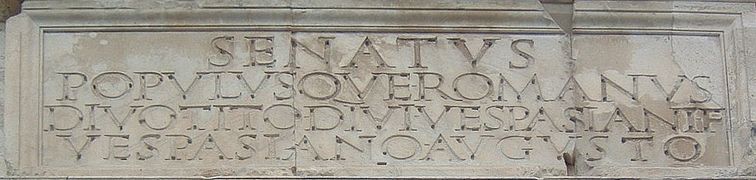 The inscription in the Arch of Titus
 -
 Manhole cover in Rome with SPQR inscription
 -
 SPQR in the coat of arms of Reggio Emilia
 -
 Detail from the mosaic floor in the Galleria Vittorio Emanuele II in Milan
 -
 "Superiority of the warrior class", by Wenceslaus Hollar
 -
 Arch of Septimius Severus top inscription
 -
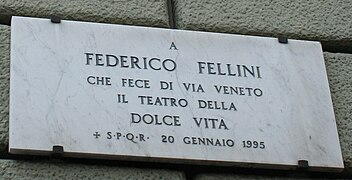 Dedicatory plaque to Federico Fellini on Via Veneto
 -
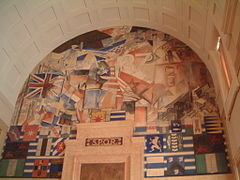 Mural in the Burgerzaal of Rotterdam City Hall


.jpg)


References[edit]
- ^ "Roma Capitale – Sito Istituzionale – Home" (in Italian). Archived from the original on 18 October 2019. Retrieved 29 October 2019.
- ^ "OGGETTO: Revoca deleghe Consigliera Nathalie Naim" (PDF) (in Italian). S.P.Q.R. – ROMA CAPITALE – MUNICIPIO ROMA CENTRO STORICO. 2 February 2011. Archived (PDF) from the original on 29 October 2019. Retrieved 29 October 2019.
- ^ See, e.g. von Hefner, Otto Titan [in German] (1861). Handbuch der theoretischen und praktischen Heraldik. Munich. p. 106.
{{cite book}}: CS1 maint: location missing publisher (link) - ^ a b "Heraldic symbols of Amsterdam". Livius. 2 December 2006. Archived from the original on 10 December 2006.
- ^ de Cleen, Marjolein (24 February 2023). "Stadsschouwburg Leidseplein" (in Dutch). Retrieved 6 May 2023.
- ^ Woesinger (5 January 2007). "SPQA". Flickr. Retrieved 17 February 2014.
- ^ "Webern-Brunnen" [Webern Fountain]. Basler Brunnenführer (in German). 1 January 2003. Archived from the original on 4 March 2016. Retrieved 30 October 2015.
- ^ a b c d e f g h "Rome – Historical Flags (Italy)". Flags of the World. 14 November 2003. Archived from the original on 8 February 2007. Retrieved 6 February 2007.
- ^ International Council on Monuments and Sites (2003). "Evaluations of Cultural Properties" (PDF). UNESCO. pp. 39–42. Archived (PDF) from the original on 23 June 2020. Retrieved 17 February 2014.
- ^ "Crest of Brugge". Heraldry of the World. Archived from the original on 26 July 2020. Retrieved 17 February 2014.
- ^ "SPQB sign on the court of Justice of Brussels". Eupedia. Archived from the original on 17 April 2010. Retrieved 17 February 2014.
- ^ Jeffery Baer. "Biking the Boulevards with Jeffery Baer". WTTV. Retrieved 19 March 2024.
- ^ "Franeker". gevelstenen.net. Archived from the original on 27 January 2018. Retrieved 26 January 2018.
- ^ Carew Hazlitt, W. Coinage of the European Continent. p. 216.
- ^ "Hamburg". Nefers Hapiland (in German). Archived from the original on 3 November 2008. Retrieved 6 January 2009.
- ^ "De Ambtsketen Van De Burgemeester" [The Mayor's Office]. gemeentearchief.nl (in Dutch). Archived from the original on 19 July 2011.
- ^ Coslett, Paul. "St George's Hall". BBC Liverpool. Archived from the original on 25 September 2015. Retrieved 17 February 2014.
- ^ Corporation of London Records Office. "The City Arms" (PDF). cityoflondon.gov.uk. The Corporation of the City of London. Archived from the original (PDF) on 27 September 2011.
The letters SPQL [Senatus Populusque Londinii – literally, The Senate and People of London] also occasionally appear in imitation of the SPQR of ancient Rome.
- ^ Brunet, Alex (2013) [1839]. Regal Armorie of Great Britain. London: Forgotten Books. pp. 156–7.
- ^ Roberto (1 March 2007). "Holstentor – SPQL: Senatus Populusque Lubecensis". Flickr. Archived from the original on 9 December 2019. Retrieved 17 February 2014.
- ^ Potter, W. J. The Coinage of Milan. p. 19. coin 4.
- ^ "Modica". Heraldry of the World. Archived from the original on 26 July 2020. Retrieved 26 July 2020.
- ^ "Molfetta". Heraldry of the World. Archived from the original on 26 July 2020. Retrieved 26 July 2020.
- ^ Italian Coinage Medieval to Modern, The Collection of Ercole Gnecchi, coin 3683
- ^ "Noto". Heraldry of the World. Archived from the original on 26 July 2020. Retrieved 26 July 2020.
- ^ "Forum Romanum: Modell-Ausstellung im Hirsvogelsaal". nordbayern.de (in German). 14 December 2017. Retrieved 26 September 2023.
- ^ "Stadspomp, Oudenburg". Flickr. 30 May 2009. Archived from the original on 26 January 2019. Retrieved 20 December 2017.
- ^ "Olomouc". Heraldry of the World. 20 August 2023.
- ^ a b mypixbox (5 December 2007). "SPQP". Flickr. Archived from the original on 4 November 2012. Retrieved 17 February 2014.
- ^ Moree (17 June 2008). "SPQS". Flickr. Retrieved 17 February 2014.
- ^ Dilke, O. A. W.; Dilke, Margaret S. (October 1961). "Terracina and the Pomptine Marshes". Greece & Rome. II:8 (2). Cambridge University Press: 172–178. doi:10.1017/S0017383500014406. ISSN 0017-3835. OCLC 51206579. S2CID 162727396.
- ^ "Walking in Pomata". Tibursuperbum. Con il patrocinio del Comune di Tivoli Assessorato al Turismo. Archived from the original on 25 December 2008. Retrieved 17 February 2014.
- ^ "Sala Rady (Senatu) w Ratuszu Staromiejskim – Atrakcje Torunia – Przewodnik po Toruniu | Toruń Tour Toruński Portal Turystyczny". Toruński Portal Turystyczny (in Polish). Retrieved 10 March 2021.
- ^ "Biblioteca Virtual Miguel de Cervantes". Cervantesvirtual.com. Archived from the original on 22 September 2013. Retrieved 17 February 2014.
- ^ Gallardo, Elena (27 September 2008). "SPQV". Flickr.
- ^ "Le Grand-Théâtre de Verviers". bestofverviers.be (in French). Archived from the original on 12 November 2014.
Further reading[edit]
- Beneš, Carrie E. (2009). "Whose SPQR? Sovereignty and semiotics in medieval Rome". Speculum. 84 (4): 874–904. doi:10.1017/s0038713400208130. S2CID 162598924.
- Moatti, Claudia (2017). "Res publica, forma rei publicae, and SPQR". Bulletin of the Institute of Classical Studies of the University of London. 60 (1): 34–48. doi:10.1111/2041-5370.12046.
External links[edit]


- Instances of "Roman Senate and People" on Perseus.edu
- Lewis & Short dictionary entry for populus on Perseus.edu
- Polybius on the Senate and People (6.16)