


Santiago, Ilocos Sur
Santiago | |
|---|---|
| Municipality of Santiago | |
 | |
 Flag  Seal | |
| Motto: Go Go Go Santa! | |
 Map of Ilocos Sur with Santiago highlighted | |
OpenStreetMap  | |
.svg)  Santiago Location within the Philippines | |
| Coordinates: 17°17′41″N 120°26′43″E / 17.2947°N 120.4453°E | |
| Country | Philippines |
| Region | Ilocos Region |
| Province | Ilocos Sur |
| District | 2nd district |
| Named for | St. James the Great |
| Barangays | 24 (see Barangays) |
| Government | |
| • Type | Sangguniang Bayan |
| • Mayor | Josefino E. Miranda |
| • Vice Mayor | Adrien Lawrence S. Miranda |
| • Representative | Kristine Singson-Meehan |
| • Municipal Council | Members |
| • Electorate | 13,139 voters (2022) |
| Area | |
| • Total | 46.36 km2 (17.90 sq mi) |
| Elevation | 54 m (177 ft) |
| Highest elevation | 257 m (843 ft) |
| Lowest elevation | 0 m (0 ft) |
| Population (2020 census)[3] | |
| • Total | 19,471 |
| • Density | 420/km2 (1,100/sq mi) |
| • Households | 4,821 |
| Economy | |
| • Income class | 4th municipal income class |
| • Poverty incidence | 15.77 |
| • Revenue | ₱ 86.83 million (2020) |
| • Assets | ₱ 1,232 million (2020) |
| • Expenditure | ₱ 101 million (2020) |
| • Liabilities | ₱ 44.04 million (2020) |
| Service provider | |
| • Electricity | Ilocos Sur Electric Cooperative (ISECO) |
| Time zone | UTC+8 (PST) |
| ZIP code | 2707 |
| PSGC | |
| IDD : area code | +63 (0)77 |
| Native languages | Ilocano Tagalog |
Santiago, officially the Municipality of Santiago (Ilocano: Ili ti Santiago; Filipino: Bayan ng Santiago), is a 4th class municipality in the province of Ilocos Sur, Philippines. According to the 2020 census, it has a population of 19,471 people.[3]
Santiago Cove is dubbed as the "Boracay of Ilocos Sur" because of its white sands.[5]
Etymology[edit]
The town was named in honor of Saint James (Spanish: Santiago).
History[edit]
 |
 | This section's tone or style may not reflect the encyclopedic tone used on Wikipedia. (August 2023) |
As soon as the Spaniards colonized the Philippines, Spain sent missionaries to spread Christianity, one of their purposes for colonization. Christianity was then spread throughout the Philippines. The Spaniards organized groups called pueblos and divided these into sitios for easier proselytization and evangelization. From then on, the pueblo built tribunals for the Spanish government and churches and convents for the missionaries to live. Because the Muslim were the champions of Islamic religion and because they considered war as an occupation and piracy as a hobby, they raided Christian pueblos along China Seacoast of the Philippines.
In June 1578, Spain started the Moro Wars in Jolo. This aggressive act marked the beginning of a long, bloody conflict between Spaniards and the Moros. In 1602, Spain sent punitive expeditions to Zamboanga, Cotabato and other places to curb the rising tide of Moro depredations. In were built along the seacoasts from Mindanao to Luzon. Armed galleys and frigates patrolled the sea-lanes. The Moros stopped the raids for a while.
The Moros renewed their piratical forays. In 1717, they swept the Visayan Islands and attacked Aparri and Northern Luzon. According to an old resident, Moro pirates entered the pueblo known today as Santiago in their return to Jolo. Guards in the watchtowers sounded their trumpets warning all the people of the pueblo of the arrival of the pirates. The church bells also rang alarming the people that pirates are fast approaching the shore. The people rushed and got their available arms like bolos, bows and arrows and fought the pirates boldly. Sporadic battles ensued. These lasted for few hours. As the battle went on, the missionaries stations=greater which they bought with them from Spain and held it high facing the seashore praying fervently the rosary with few people, for the safety and victory of his Christian followers, The Moros ran away and fled southward in their kumpits leaving behind their dead. After the battle, a solemn mass was held in the church. The missionary told the people that due the great intercession and miraculous protection of the image of St. James the Greater from the Moro Pirates, this pueblo was saved and in his honor, this town was named Santiago (Spanish for Saint James).
Geography[edit]
Santiago is 358 kilometres (222 mi) from Metro Manila and 49 kilometres (30 mi) from Vigan City, the provincial capital.
Barangays[edit]
Santiago is politically subdivided into 24 barangays. [6] Each barangay consists of puroks and some have sitios.
- Al-aludig
- Ambucao
- San Jose (Baraoas)
- Baybayabas
- Bigbiga
- Bulbulala
- Busel-busel
- Butol
- Caburao
- Dan-ar
- Gabao
- Guinabang
- Imus
- Lang-ayan
- Mambug
- Nalasin
- Olo-olo Norte
- Olo-olo Sur
- Poblacion Norte
- Poblacion Sur
- Sabangan
- Salincub
- San Roque
- Ubbog
Climate[edit]
| Climate data for Santiago, Ilocos Sur | |||||||||||||
|---|---|---|---|---|---|---|---|---|---|---|---|---|---|
| Month | Jan | Feb | Mar | Apr | May | Jun | Jul | Aug | Sep | Oct | Nov | Dec | Year |
| Mean daily maximum °C (°F) | 30 (86) |
31 (88) |
33 (91) |
34 (93) |
32 (90) |
31 (88) |
30 (86) |
30 (86) |
30 (86) |
31 (88) |
31 (88) |
30 (86) |
31 (88) |
| Mean daily minimum °C (°F) | 19 (66) |
20 (68) |
21 (70) |
23 (73) |
25 (77) |
25 (77) |
25 (77) |
24 (75) |
24 (75) |
22 (72) |
21 (70) |
19 (66) |
22 (72) |
| Average precipitation mm (inches) | 10 (0.4) |
10 (0.4) |
14 (0.6) |
23 (0.9) |
80 (3.1) |
103 (4.1) |
121 (4.8) |
111 (4.4) |
119 (4.7) |
144 (5.7) |
39 (1.5) |
15 (0.6) |
789 (31.2) |
| Average rainy days | 5.2 | 3.9 | 6.2 | 9.1 | 18.5 | 21.4 | 22.9 | 19.8 | 19.8 | 16.2 | 10.5 | 6.1 | 159.6 |
| Source: Meteoblue (modeled/calculated data, not measured locally)[7] | |||||||||||||
Demographics[edit]

|
|
| ||||||||||||||||||||||||||||||||||||||||||||||||||||||
| Source: Philippine Statistics Authority[8][9][10][11] | ||||||||||||||||||||||||||||||||||||||||||||||||||||||||
In the 2020 census, Santiago had a population of 19,471.[3] The population density was 420 inhabitants per square kilometre (1,100/sq mi).
Economy[edit]
Poverty Incidence of Santiago
5
10
15
20
25
30
2006
24.00 2009
20.88 2012
24.68 2015
13.02 2018
5.67 2021
15.77 Source: Philippine Statistics Authority[12][13][14][15][16][17][18][19] |
Santiago is the headquarters of the Ilocos Sur Electric Cooperative (ISECO), which distributes electricity to the entire province.
Government[edit]
Local government[edit]
Santiago, belonging to the second congressional district of the province of Ilocos Sur, is governed by a mayor designated as its local chief executive and by a municipal council as its legislative body in accordance with the Local Government Code. The mayor, vice mayor, and the councilors are elected directly by the people through an election which is being held every three years.
Elected officials[edit]
| Position | Name |
|---|---|
| Congressman | Kristine Singson-Meehan |
| Mayor | Josefino E. Miranda |
| Vice-Mayor | Adrien Lawrence S. Miranda |
| Councilors | Joselito S. Miranda Jr. |
| Lydia B. Locquiao | |
| Michael S. Miranda | |
| Warlito H. Gacoscos | |
| Virgilio C. Pasion | |
| Eddie G. Carranza | |
| Jonathan A. Trinidad | |
| Ernesto C. Galano |
Gallery[edit]
-
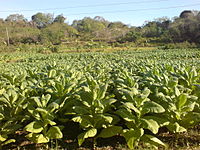 A field of tobacco growing in Baybayabas
 -
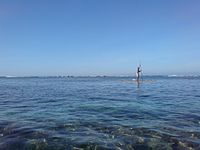 A man fishing just offshore near Gabao Beach.
 -
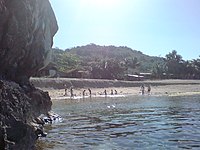 A beach in Ambucao


References[edit]
- ^ Municipality of Santiago | (DILG)
- ^ "2015 Census of Population, Report No. 3 – Population, Land Area, and Population Density" (PDF). Philippine Statistics Authority. Quezon City, Philippines. August 2016. ISSN 0117-1453. Archived (PDF) from the original on May 25, 2021. Retrieved July 16, 2021.
- ^ a b c Census of Population (2020). "Region I (Ilocos Region)". Total Population by Province, City, Municipality and Barangay. Philippine Statistics Authority. Retrieved 8 July 2021.
- ^ "PSA Releases the 2021 City and Municipal Level Poverty Estimates". Philippine Statistics Authority. 2 April 2024. Retrieved 28 April 2024.
- ^ "Sunrise at Santiago". Retrieved 14 January 2008.
- ^ "Province: Ilocos Sur". PSGC Interactive. Quezon City, Philippines: Philippine Statistics Authority. Retrieved 12 November 2016.
- ^ "Santiago: Average Temperatures and Rainfall". Meteoblue. Retrieved 14 May 2020.
- ^ Census of Population (2015). "Region I (Ilocos Region)". Total Population by Province, City, Municipality and Barangay. Philippine Statistics Authority. Retrieved 20 June 2016.
- ^ Census of Population and Housing (2010). "Region I (Ilocos Region)" (PDF). Total Population by Province, City, Municipality and Barangay. National Statistics Office. Retrieved 29 June 2016.
- ^ Censuses of Population (1903–2007). "Region I (Ilocos Region)". Table 1. Population Enumerated in Various Censuses by Province/Highly Urbanized City: 1903 to 2007. National Statistics Office.
{{cite encyclopedia}}: CS1 maint: numeric names: authors list (link) - ^ "Province of Ilocos Sur". Municipality Population Data. Local Water Utilities Administration Research Division. Retrieved 17 December 2016.
- ^ "Poverty incidence (PI):". Philippine Statistics Authority. Retrieved December 28, 2020.
- ^ "Estimation of Local Poverty in the Philippines" (PDF). Philippine Statistics Authority. 29 November 2005.
- ^ "2003 City and Municipal Level Poverty Estimates" (PDF). Philippine Statistics Authority. 23 March 2009.
- ^ "City and Municipal Level Poverty Estimates; 2006 and 2009" (PDF). Philippine Statistics Authority. 3 August 2012.
- ^ "2012 Municipal and City Level Poverty Estimates" (PDF). Philippine Statistics Authority. 31 May 2016.
- ^ "Municipal and City Level Small Area Poverty Estimates; 2009, 2012 and 2015". Philippine Statistics Authority. 10 July 2019.
- ^ "PSA Releases the 2018 Municipal and City Level Poverty Estimates". Philippine Statistics Authority. 15 December 2021. Retrieved 22 January 2022.
- ^ "PSA Releases the 2021 City and Municipal Level Poverty Estimates". Philippine Statistics Authority. 2 April 2024. Retrieved 28 April 2024.
- ^ "2019 National and Local Elections" (PDF). Commission on Elections. Retrieved March 11, 2022.
External links[edit]

- Pasyalang Ilocos Sur
- Philippine Standard Geographic Code
- Philippine Census Information
- Local Governance Performance Management System
Places adjacent to Santiago, Ilocos Sur | ||||||||||||||||
|---|---|---|---|---|---|---|---|---|---|---|---|---|---|---|---|---|
| ||||||||||||||||


