


Provinces of the Philippines
| Provinces of the Philippines | |
|---|---|
 | |
| Category | Province |
| Location | Philippines |
| Found in | Administrative and autonomous regions |
| Number | 82 (as of 2022) |
| Populations | 17,246–4,632,359 |
| Areas | 219.01–17,030.75 km2 (84.56–6,575.61 sq mi) |
| Government | |
| Subdivisions | |
 |
|---|
 Philippines portal Philippines portal |
In the Philippines, provinces (Filipino: lalawigan or probinsiya) are one of its primary political and administrative divisions. There are 82 provinces at present, which are further subdivided into component cities and municipalities. The local government units in the National Capital Region, as well as independent cities, are independent of any provincial government. Each province is governed by an elected legislature called the Sangguniang Panlalawigan and an elected governor.
The provinces are grouped into seventeen regions based on geographical, cultural, and ethnological characteristics. Thirteen of these regions are numerically designated from north to south, while the National Capital Region, the Cordillera Administrative Region, the Southwestern Tagalog Region (Mimaropa), and the Bangsamoro Autonomous Region in Muslim Mindanao are only designated by acronyms.
Each province is a member of the League of Provinces of the Philippines, an organization that aims to address issues affecting provincial and metropolitan government administrations.[1]
Government[edit]
A provincial government is autonomous of other provinces within the republic. Each province is governed by two main elected branches of the government: executive and legislative. Judicial affairs are separated from provincial governance and are administered by the Supreme Court of the Philippines. Each province has at least one branch of a Regional Trial Court.
Executive[edit]
The provincial governor is chief executive and head of each province. Elected to a term of three years and limited to three consecutive terms, he or she appoints the directors of each provincial department which include the office of administration, engineering office, information office, legal office, and treasury office.
Legislative[edit]
The vice governor acts as the president for each Sangguniang Panlalawigan (SP; "Provincial Board"), the province's legislative body. Every SP is composed of regularly elected members from provincial districts, as well as ex officio members. The number of regularly elected SP members allotted to each province is determined by its income class. First- and second-class provinces are provided ten regular SP members; third- and fourth-class provinces have eight, while fifth- and sixth-class provinces have six. Exceptions are provinces with more than five congressional districts, such as Cavite with 16 regularly elected SP members, and Cebu, Negros Occidental and Pangasinan which have twelve each.
Every SP has designated seats for ex officio members, given to the respective local presidents of the Association of Barangay Captains (ABC), Philippine Councilors' League (PCL), and Sangguniang Kabataan (SK; "Youth Council").
The vice governor and regular members of an SP are elected by the voters within the province. Ex officio members are elected by members of their respective organizations.
Relation to other levels of government[edit]
National government[edit]
National intrusion into the affairs of each provincial government is limited by the Philippine Constitution. The President of the Philippines however coordinates with provincial administrators through the Department of the Interior and Local Government. For purposes of national representation, each province is guaranteed its own congressional district. One congressional representative represents each district in the House of Representatives. Senatorial representation is elected at an at-large basis and not apportioned through territory-based districts.
Cities and municipalities[edit]
Those classified as either "highly urbanized" or "independent component" cities are independent from the province, as provided for in Section 29 of the Local Government Code of 1991.[2] Although such a city is a self-governing second-level entity, in many cases it is often presented as part of the province in which it is geographically located, or in the case of Zamboanga City, the province it last formed part the congressional representation of.
Local government units classified as "component" cities and municipalities are under the jurisdiction of the provincial government. In order to make sure that all component city or municipal governments act within the scope of their prescribed powers and functions, the Local Government Code mandates the provincial governor to review executive orders issued by mayors, and the Sangguniang Panlalawigan to review legislation by the Sangguniang Panlungsod (City Council) or Sangguniang Bayan (Municipal Council), of all component cities and municipalities under the province's jurisdiction.[2]
Barangays[edit]
The provincial government does not have direct relations with individual barangays. Supervision over a barangay government is the mandate of the mayor and the Sanggunian of the component city or municipality of which the barangay in question is a part.[2]
Classification [edit]

Provinces are classified according to average annual income based on the previous 4 calendar years. Effective July 29, 2008, the thresholds for the income classes for cities are:[3][needs update]
| Class | Average annual income |
|---|---|
| First | ₱450 million or more |
| Second | ₱360 million or more but less than ₱450 million |
| Third | ₱270 million or more but less than ₱360 million |
| Fourth | ₱180 million or more but less than ₱270 million |
| Fifth | ₱90 million or more but less than ₱180 million |
| Sixth | below ₱90 million |
A province's income class determines the size of the membership of its Sangguniang Panlalawigan, and also how much it can spend on certain items, or procure through certain means.[2]
List[edit]
| ISO[4] | Province | Capital | Population[5] | Area[6] | Density | Founded[A] | Island group | Region | Total LGUs | |||
|---|---|---|---|---|---|---|---|---|---|---|---|---|
| PH-ABR | Abra | Bangued | 0.23% | 250,985 | 4,165.25 km2 (1,608.21 sq mi) |
60/km2 (156/sq mi) | 1846 | Luzon | CAR | 27 | — | 303 |
| PH-AGN | Agusan del Norte[i] | Cabadbaran[ii][7] | 0.70% | 760,413 | 3,546.86 km2 (1,369.45 sq mi) |
214/km2 (555/sq mi) | 20 Sep 1907 | Mindanao | XIII | 10 | 2 | 253 |
| PH-AGS | Agusan del Sur | Prosperidad | 0.68% | 739,367 | 9,989.52 km2 (3,856.98 sq mi) |
74/km2 (192/sq mi) | 1 Jan 1970 [8] |
Mindanao | XIII | 13 | 1 | 314 |
| PH-AKL | Aklan | Kalibo | 0.56% | 615,475 | 1,821.42 km2 (703.25 sq mi) |
338/km2 (875/sq mi) | 8 Nov 1956 [9] |
Visayas | VI | 17 | — | 327 |
| PH-ALB | Albay | Legazpi | 1.26% | 1,374,768 | 2,575.77 km2 (994.51 sq mi) |
534/km2 (1,382/sq mi) | 3 Apr 1574 [10] |
Luzon | V | 15 | 3 | 720 |
| PH-ANT | Antique | San Jose de Buenavista | 0.56% | 612,974 | 2,729.17 km2 (1,053.74 sq mi) |
225/km2 (582/sq mi) | 10 Mar 1917 | Visayas | VI | 18 | — | 590 |
| PH-APA | Apayao | Kabugao[iii] | 0.11% | 124,366 | 4,413.35 km2 (1,704.00 sq mi) |
28/km2 (73/sq mi) | 14 Feb 1995 | Luzon | CAR | 7 | — | 133 |
| PH-AUR | Aurora | Baler | 0.22% | 235,750 | 3,147.32 km2 (1,215.19 sq mi) |
75/km2 (194/sq mi) | 13 Aug 1979 | Luzon | III | 8 | — | 151 |
| PH-BAS | Basilan[iv] | Lamitan[12] | 0.51% | 556,586 | 1,327.23 km2 (512.45 sq mi)[13] |
419/km2 (1,086/sq mi) | 27 Dec 1973 | Mindanao | BARMM[v] | 11 | 2 | 255 |
| PH-BAN | Bataan | Balanga | 0.78% | 853,373 | 1,373.98 km2 (530.50 sq mi) |
622/km2 (1,610/sq mi) | 11 Jan 1754 | Luzon | III | 11 | 1 | 237 |
| PH-BTN | Batanes | Basco | 0.02% | 18,831 | 219.01 km2 (84.56 sq mi) |
86/km2 (223/sq mi) | 26 Jun 1783 [14] |
Luzon | II | 6 | — | 29 |
| PH-BTG | Batangas | Batangas City | 2.67% | 2,908,494 | 3,119.72 km2 (1,204.53 sq mi) |
932/km2 (2,415/sq mi) | 8 Dec 1581 | Luzon | IV-A | 29 | 5 | 1,078 |
| PH-BEN | Benguet[vi] | La Trinidad | 0.76% | 827,041 | 2,826.59 km2 (1,091.35 sq mi) |
293/km2 (758/sq mi) | 16 Jun 1966 | Luzon | CAR | 13 | 1 | 269 |
| PH-BIL | Biliran | Naval | 0.16% | 179,312 | 536.01 km2 (206.95 sq mi) |
335/km2 (866/sq mi) | 11 May 1992 | Visayas | VIII | 8 | — | 132 |
| PH-BOH | Bohol | Tagbilaran | 1.28% | 1,394,329 | 4,820.95 km2 (1,861.38 sq mi) |
289/km2 (749/sq mi) | 22 Jul 1854 [15] |
Visayas | VII | 47 | 1 | 1,109 |
| PH-BUK | Bukidnon | Malaybalay | 1.41% | 1,541,308 | 10,498.59 km2 (4,053.53 sq mi) |
147/km2 (380/sq mi) | 10 Mar 1917 | Mindanao | X | 20 | 2 | 464 |
| PH-BUL | Bulacan | Malolos | 3.40% | 3,708,890 | 2,796.10 km2 (1,079.58 sq mi) |
1,326/km2 (3,435/sq mi) | 15 Aug 1578 | Luzon | III | 21 | 3 | 569 |
| PH-CAG | Cagayan | Tuguegarao | 1.16% | 1,268,603 | 9,295.75 km2 (3,589.11 sq mi) |
136/km2 (353/sq mi) | 29 Jun 1583 [16] |
Luzon | II | 28 | 1 | 820 |
| PH-CAN | Camarines Norte | Daet | 0.58% | 629,699 | 2,320.07 km2 (895.78 sq mi) |
271/km2 (703/sq mi) | 15 Apr 1920 [17] |
Luzon | V | 12 | — | 282 |
| PH-CAS | Camarines Sur[vii] | Pili | 1.90% | 2,068,244 | 5,497.03 km2 (2,122.42 sq mi) |
376/km2 (974/sq mi) | 27 May 1579 [18] |
Luzon | V | 35 | 2 | 1,063 |
| PH-CAM | Camiguin | Mambajao | 0.09% | 92,808 | 237.95 km2 (91.87 sq mi) |
390/km2 (1,010/sq mi) | 18 Jun 1966 | Mindanao | X | 5 | — | 58 |
| PH-CAP | Capiz | Roxas | 0.74% | 804,952 | 2,594.64 km2 (1,001.80 sq mi) |
310/km2 (804/sq mi) | 10 Mar 1917 | Visayas | VI | 16 | 1 | 473 |
| PH-CAT | Catanduanes | Virac | 0.25% | 271,879 | 1,492.16 km2 (576.13 sq mi) |
182/km2 (472/sq mi) | 26 Sep 1945 | Luzon | V | 11 | — | 315 |
| PH-CAV | Cavite | Imus[19] | 3.98% | 4,344,829 | 1,574.17 km2 (607.79 sq mi) |
2,760/km2 (7,149/sq mi) | 10 Mar 1614 [20] |
Luzon | IV-A | 15 | 8 | 803 |
| PH-CEB | Cebu[viii] | Cebu City[21] | 4.72% | 5,151,274 | 5,342.00 km2 (2,062.56 sq mi) |
964/km2 (2,498/sq mi) | 27 Apr 1565 | Visayas | VII | 44 | 9 | 1,203 |
| PH-NCO | Cotabato | Kidapawan | 1.17% | 1,275,185 | 9,008.90 km2 (3,478.36 sq mi) |
142/km2 (367/sq mi) | 1 Sep 1914 [22] |
Mindanao | XII | 17 | 1 | 543 |
| PH-COM | Davao de Oro | Nabunturan | 0.70% | 767,547 | 4,479.77 km2 (1,729.65 sq mi) |
171/km2 (444/sq mi) | 31 Jan 1998 | Mindanao | XI | 11 | — | 237 |
| PH-DAV | Davao del Norte | Tagum | 1.03% | 1,125,057 | 3,426.97 km2 (1,323.16 sq mi) |
328/km2 (850/sq mi) | 8 May 1967 | Mindanao | XI | 8 | 3 | 223 |
| PH-DAS | Davao del Sur[ix] | Digos | 2.25% | 2,457,430 | 4,607.59 km2 (1,779.00 sq mi) |
533/km2 (1,381/sq mi) | 1 Sep 1914 | Mindanao | XI | 9 | 2 | 414 |
| PH-DVO | Davao Occidental | Malita | 0.29% | 317,159 | 2,163.45 km2 (835.31 sq mi) |
147/km2 (380/sq mi) | 28 Oct 2013 | Mindanao | XI | 5 | — | 105 |
| PH-DAO | Davao Oriental | Mati | 0.53% | 576,343 | 5,679.64 km2 (2,192.92 sq mi) |
101/km2 (263/sq mi) | 8 May 1967 | Mindanao | XI | 10 | 1 | 183 |
| PH-DIN | Dinagat Islands | San Jose | 0.12% | 128,117 | 1,036.34 km2 (400.13 sq mi) |
124/km2 (320/sq mi) | 2 Dec 2006 | Mindanao | XIII | 7 | — | 100 |
| PH-EAS | Eastern Samar | Borongan | 0.44% | 477,168 | 4,660.47 km2 (1,799.42 sq mi) |
102/km2 (265/sq mi) | 19 Jun 1965 | Visayas | VIII | 22 | 1 | 597 |
| PH-GUI | Guimaras | Jordan | 0.17% | 187,842 | 604.57 km2 (233.43 sq mi) |
311/km2 (805/sq mi) | 22 May 1992 | Visayas | VI | 5 | — | 98 |
| PH-IFU | Ifugao | Lagawe | 0.19% | 207,498 | 2,628.21 km2 (1,014.76 sq mi) |
79/km2 (204/sq mi) | 18 Jun 1966 | Luzon | CAR | 11 | — | 176 |
| PH-ILN | Ilocos Norte | Laoag | 0.56% | 609,588 | 3,467.89 km2 (1,338.96 sq mi) |
176/km2 (455/sq mi) | 2 Feb 1818 | Luzon | I | 21 | 2 | 559 |
| PH-ILS | Ilocos Sur | Vigan | 0.65% | 706,009 | 2,596.00 km2 (1,002.32 sq mi) |
272/km2 (704/sq mi) | 1572 | Luzon | I | 32 | 2 | 768 |
| PH-ILI | Iloilo[x] | Iloilo City[21] | 2.30% | 2,509,525 | 5,079.17 km2 (1,961.08 sq mi) |
494/km2 (1,280/sq mi) | 1566 | Visayas | VI | 42 | 2 | 1,901 |
| PH-ISA | Isabela[xi] | Ilagan | 1.56% | 1,697,050 | 12,414.93 km2 (4,793.43 sq mi) |
137/km2 (354/sq mi) | 1 May 1856 | Luzon | II | 34 | 3 | 1,055 |
| PH-KAL | Kalinga | Tabuk | 0.21% | 229,570 | 3,231.25 km2 (1,247.59 sq mi) |
71/km2 (184/sq mi) | 18 Jun 1966 | Luzon | CAR | 7 | 1 | 153 |
| PH-LUN | La Union | San Fernando | 0.75% | 822,352 | 1,497.70 km2 (578.27 sq mi) |
549/km2 (1,422/sq mi) | 2 Mar 1850 | Luzon | I | 19 | 1 | 576 |
| PH-LAG | Laguna | Santa Cruz | 3.10% | 3,382,193 | 1,917.85 km2 (740.49 sq mi) |
1,764/km2 (4,568/sq mi) | 28 Jul 1571 | Luzon | IV-A | 24 | 6 | 674 |
| PH-LAN | Lanao del Norte[xii] | Tubod | 1.00% | 1,086,017 | 4,159.94 km2 (1,606.16 sq mi) |
261/km2 (676/sq mi) | 4 Jul 1959 | Mindanao | X | 22 | 1 | 506 |
| PH-LAS | Lanao del Sur | Marawi | 1.10% | 1,195,518 | 3,872.89 km2 (1,495.33 sq mi)[23] |
309/km2 (800/sq mi) | 1 Sep 1914 | Mindanao | BARMM | 39 | 1 | 1,159 |
| PH-LEY | Leyte[xiii] | Tacloban[21] | 1.86% | 2,028,728 | 6,515.05 km2 (2,515.47 sq mi) |
311/km2 (806/sq mi) | 1735 | Visayas | VIII | 40 | 3 | 1,641 |
| PH-MDN | Maguindanao del Norte[xiv] | Datu Odin Sinsuat | 0.85% | 926,037 | 4,752.47 km2 (1,834.94 sq mi) |
232/km2 (601/sq mi) | 17 Sep 2022 | Mindanao | BARMM | 12 | 1 | 189 |
| PH-MDS | Maguindanao del Sur | Buluan | 0.68% | 741,221 | 4,973.48 km2 (1,920.27 sq mi) |
149/km2 (386/sq mi) | 22 Nov 1973 | Mindanao | BARMM | 24 | — | 167 |
| PH-MAD | Marinduque | Boac | 0.22% | 239,207 | 952.58 km2 (367.79 sq mi) |
251/km2 (650/sq mi) | 21 Feb 1920 | Luzon | Mimaropa | 6 | — | 218 |
| PH-MAS | Masbate | Masbate City | 0.83% | 908,920 | 4,151.78 km2 (1,603.01 sq mi) |
219/km2 (567/sq mi) | 18 Mar 1901 [24] |
Luzon | V | 20 | 1 | 550 |
| PH-MSC | Misamis Occidental | Oroquieta | 0.57% | 617,333 | 2,055.22 km2 (793.52 sq mi) |
300/km2 (778/sq mi) | 8 Nov 1929 | Mindanao | X | 14 | 3 | 490 |
| PH-MSR | Misamis Oriental[xv] | Cagayan de Oro[21] | 1.55% | 1,685,302 | 3,544.32 km2 (1,368.47 sq mi) |
475/km2 (1,232/sq mi) | 15 May 1901 | Mindanao | X | 23 | 3 | 504 |
| PH-MOU | Mountain Province | Bontoc | 0.15% | 158,200 | 2,157.38 km2 (832.97 sq mi) |
73/km2 (190/sq mi) | 1846 | Luzon | CAR | 10 | — | 144 |
| PH-NEC | Negros Occidental[xvi] | Bacolod[21] | 2.96% | 3,223,955 | 7,965.21 km2 (3,075.38 sq mi) |
405/km2 (1,048/sq mi) | 1 Jan 1890 [25] |
Visayas | VI | 19 | 13 | 662 |
| PH-NER | Negros Oriental | Dumaguete | 1.31% | 1,432,990 | 5,385.53 km2 (2,079.36 sq mi) |
266/km2 (689/sq mi) | 1 Jan 1890 [26] |
Visayas | VII | 20 | 6 | 557 |
| PH-NSA | Northern Samar | Catarman | 0.59% | 639,186 | 3,692.93 km2 (1,425.85 sq mi) |
173/km2 (448/sq mi) | 19 Jun 1965 | Visayas | VIII | 24 | — | 569 |
| PH-NUE | Nueva Ecija | Palayan[xvii] | 2.12% | 2,310,134 | 5,751.33 km2 (2,220.60 sq mi) |
402/km2 (1,040/sq mi) | 25 Apr 1801 [27] |
Luzon | III | 27 | 5 | 849 |
| PH-NUV | Nueva Vizcaya | Bayombong | 0.46% | 497,432 | 3,975.67 km2 (1,535.01 sq mi) |
125/km2 (324/sq mi) | 24 May 1839 [28] |
Luzon | II | 15 | — | 275 |
| PH-MDC | Occidental Mindoro | Mamburao | 0.48% | 525,354 | 5,865.71 km2 (2,264.76 sq mi) |
90/km2 (232/sq mi) | 15 Nov 1950 [29] |
Luzon | Mimaropa | 11 | — | 162 |
| PH-MDR | Oriental Mindoro | Calapan | 0.83% | 908,339 | 4,238.38 km2 (1,636.45 sq mi) |
214/km2 (555/sq mi) | 1663 | Luzon | Mimaropa | 14 | 1 | 426 |
| PH-PLW | Palawan[xviii] | Puerto Princesa[21] | 1.14% | 1,246,673 | 17,030.75 km2 (6,575.61 sq mi) |
73/km2 (190/sq mi) | 23 Jan 1902 | Luzon | Mimaropa | 23 | 1 | 433 |
| PH-PAM | Pampanga[xix] | San Fernando | 2.66% | 2,900,637 | 2,062.47 km2 (796.32 sq mi) |
1,406/km2 (3,643/sq mi) | 11 Dec 1571 | Luzon | III | 19 | 3 | 538 |
| PH-PAN | Pangasinan[xx] | Lingayen | 2.90% | 3,163,190 | 5,451.01 km2 (2,104.65 sq mi) |
580/km2 (1,503/sq mi) | 5 Apr 1580 [30] |
Luzon | I | 44 | 4 | 1,364 |
| PH-QUE | Quezon[xxi] | Lucena[21] | 2.04% | 2,229,383 | 9,069.60 km2 (3,501.79 sq mi) |
246/km2 (637/sq mi) | 1591[31] | Luzon | IV-A | 39 | 2 | 1,242 |
| PH-QUI | Quirino | Cabarroguis | 0.19% | 203,828 | 2,323.47 km2 (897.10 sq mi) |
88/km2 (227/sq mi) | 18 Jun 1966 | Luzon | II | 6 | — | 132 |
| PH-RIZ | Rizal | Antipolo | 3.05% | 3,330,143 | 1,191.94 km2 (460.21 sq mi) |
2,794/km2 (7,236/sq mi) | 23 Feb 1853 | Luzon | IV-A | 13 | 1 | 189 |
| PH-ROM | Romblon | Romblon | 0.28% | 308,985 | 1,533.45 km2 (592.07 sq mi) |
201/km2 (522/sq mi) | 16 Mar 1901 [32] |
Luzon | Mimaropa | 17 | — | 219 |
| PH-WSA | Samar | Catbalogan | 0.73% | 793,183 | 6,048.03 km2 (2,335.16 sq mi) |
131/km2 (340/sq mi) | 1768 | Visayas | VIII | 24 | 2 | 951 |
| PH-SAR | Sarangani | Alabel | 0.51% | 558,946 | 3,601.25 km2 (1,390.45 sq mi) |
155/km2 (402/sq mi) | 16 Mar 1992 | Mindanao | XII | 7 | — | 141 |
| PH-SIG | Siquijor | Siquijor | 0.09% | 103,395 | 337.49 km2 (130.31 sq mi) |
306/km2 (793/sq mi) | 17 Sep 1971 | Visayas | VII | 6 | — | 134 |
| PH-SOR | Sorsogon | Sorsogon City | 0.76% | 828,655 | 2,119.01 km2 (818.15 sq mi) |
391/km2 (1,013/sq mi) | 17 Oct 1894 | Luzon | V | 14 | 1 | 541 |
| PH-SCO | South Cotabato[xxii] | Koronadal | 1.53% | 1,672,791 | 4,428.81 km2 (1,709.97 sq mi) |
378/km2 (978/sq mi) | 18 Jun 1966 | Mindanao | XII | 10 | 2 | 225 |
| PH-SLE | Southern Leyte | Maasin | 0.39% | 429,573 | 1,798.61 km2 (694.45 sq mi) |
239/km2 (619/sq mi) | 22 May 1959 | Visayas | VIII | 18 | 1 | 500 |
| PH-SUK | Sultan Kudarat | Isulan | 0.78% | 854,052 | 5,298.34 km2 (2,045.70 sq mi) |
161/km2 (417/sq mi) | 22 Nov 1973 | Mindanao | XII | 11 | 1 | 249 |
| PH-SLU | Sulu | Jolo | 0.92% | 1,000,108 | 1,600.40 km2 (617.92 sq mi)[33] |
625/km2 (1,619/sq mi) | 10 Mar 1917 | Mindanao | BARMM | 19 | — | 410 |
| PH-SUN | Surigao del Norte | Surigao City | 0.49% | 534,636 | 1,972.93 km2 (761.75 sq mi) |
271/km2 (702/sq mi) | 15 May 1901 | Mindanao | XIII | 20 | 1 | 335 |
| PH-SUR | Surigao del Sur | Tandag | 0.59% | 642,255 | 4,932.70 km2 (1,904.53 sq mi) |
130/km2 (337/sq mi) | 16 Jun 1960 | Mindanao | XIII | 17 | 2 | 309 |
| PH-TAR | Tarlac | Tarlac City | 1.38% | 1,503,456 | 3,053.60 km2 (1,179.00 sq mi) |
492/km2 (1,275/sq mi) | 28 Mar 1873 [34][35] |
Luzon | III | 17 | 1 | 511 |
| PH-TAW | Tawi-Tawi | Bongao[36] | 0.40% | 440,276 | 1,087.40 km2 (419.85 sq mi)[37] |
405/km2 (1,049/sq mi) | 11 Sep 1973 | Mindanao | BARMM | 11 | — | 203 |
| PH-ZMB | Zambales[xxiii] | Iba | 0.83% | 909,932 | 3,830.83 km2 (1,479.09 sq mi) |
238/km2 (615/sq mi) | 1578 | Luzon | III | 13 | 1 | 247 |
| PH-ZAN | Zamboanga del Norte | Dipolog | 0.96% | 1,047,455 | 7,301.00 km2 (2,818.93 sq mi) |
143/km2 (372/sq mi) | 6 Jun 1952 | Mindanao | IX | 25 | 2 | 691 |
| PH-ZAS | Zamboanga del Sur[xxiv] | Pagadian | 1.86% | 2,027,902 | 5,914.16 km2 (2,283.47 sq mi) |
343/km2 (888/sq mi) | 1 Sep 1914 | Mindanao | IX | 26 | 2 | 779 |
| PH-ZSI | Zamboanga Sibugay | Ipil | 0.61% | 669,840 | 3,607.75 km2 (1,392.96 sq mi) |
186/km2 (481/sq mi) | 22 Feb 2001 | Mindanao | IX | 16 | — | 389 |
| PH-00 | Metro Manila | Manila † | 12.37% | 13,484,462 | 638.55 km2 (246.55 sq mi) |
21,117/km2 (54,694/sq mi) | — | Luzon | NCR[B] | 1 | 16 | 1,706 |
| ||||||||||||
Table notes[edit]
| ||||||||||||
Former provinces[edit]
- Manila (until 1901) – Incorporated into Rizal; portions around Manila later consolidated to form present-day NCR.
- Lepanto-Bontoc (1902–1908) – Incorporated into Mountain Province.
- Moro Province (1903–1913) – Converted to the Department of Mindanao and Sulu, composed of seven provinces. Now part of several regions in Mindanao.
- Ambos Camarines (1901–1908) – Divided into Camarines Norte and Camarines Sur, although the wording of Act No. 2809 implies Camarines Norte was created from Ambos Camarines, the remainder of which was renamed Camarines Sur. Camarines Sur retained the provincial capital of Nueva Caceres.
- Misamis (1901–1939) – Partitioned into Misamis Occidental and Misamis Oriental. Misamis Oriental retained the provincial capital of Cagayan.
- Mindoro (1902–1950) – Divided into Occidental Mindoro and Oriental Mindoro. Oriental Mindoro retained the provincial capital of Calapan.
- Zamboanga (1914–1952) – Partitioned into Zamboanga del Norte and Zamboanga del Sur. The de jure provincial capital of Molave was placed under the jurisdiction of Zamboanga del Sur which had its capital in Pagadian. Zamboanga Sibugay later created from Zamboanga del Sur.
- Lanao (1914–1959) – Divided into Lanao del Norte and Lanao del Sur. Lanao del Sur retained the provincial capital of Dansalan (now Marawi).
- Surigao (1901–1967) – Partitioned into Surigao del Norte and Surigao del Sur. Surigao del Norte retained the provincial capital of Surigao City and the provincial seal. The province of Dinagat Islands was later created from Surigao del Norte.
- Davao (1914–1967; 1972–1998) – Divided into Davao del Norte, Davao del Sur and Davao Oriental. Davao del Norte was officially known as Davao from 1972 to 1998, when Compostela Valley (now Davao de Oro) was later created from Davao province. Davao Occidental later created from Davao del Sur.
- Agusan (1907–1967) – Partitioned into Agusan del Norte and Agusan del Sur. Agusan del Norte retained the former provincial capital of Butuan. The provincial capital was officially transferred to Cabadbaran in 2000 but the provincial government services and functions are yet to be completely transferred to the new capital.[38]
- Negros del Norte (1985–1986) – Batas Pambansa Blg. 885,[39] which created a new province out of the northern part of Negros Occidental, took effect on December 23, 1985, with a plebiscite to ratify the law held on January 3, 1986. The province comprised the present-day cities of Cadiz (which was to serve as the capital), Escalante, Sagay, San Carlos, Silay and Victorias, as well as the municipalities of Calatrava, Don Salvador Benedicto, Enrique B. Magalona, Manapla, and Toboso. Despite voters ratifying Batas Pambansa Blg. 885, on July 11, 1986, the Supreme Court declared the law and the proclamation of the province null and void. The ruling states the enabling law was unconstitutional for, among other things, not including the rest of Negros Occidental in the plebiscite, and the proposed province not meeting the 3,500 square kilometer land area requirement of the 1983 Local Government Code.[40]
- Kalinga-Apayao (1966–1995) – Divided into Apayao and Kalinga. Kalinga retained the provincial capital of Tabuk.
- Shariff Kabunsuan (2006–2008) – Republic Act No. 9054 conferred to the Autonomous Region in Muslim Mindanao expanded powers, especially the capacity to create provinces (Article VI, Section 19).[41] Based on this, the ARMM Regional Legislative Assembly enacted Muslim Mindanao Autonomy Act No. 201 on August 28, 2006. The Act created a new province, comprising all the municipalities in the first congressional district of Maguindanao (except Cotabato City), with its capital at Datu Odin Sinsuat. The province's creation was approved on October 28, 2006, by a majority vote in a plebiscite. Responding to requests for clarification as to which congressional districts form Shariff Kabunsuan for the 2007 elections (specifically whether Cotabato City was part of the representation of the new province), COMELEC issued Resolution No. 7845, which initially held Cotabato City to be the sole remaining LGU in the First District of Maguindanao. COMELEC later amended this with Resolution No. 7902, which maintained the status quo before the province's creation. The COMELEC resolutions became the subject of a case in which the Supreme Court opined that because "the power to create new a province or city inherently involves the power to create a legislative district"—a power that Congress did not explicitly delegate to the ARMM Regional Assembly—the creation of a province by a lower legislative body (the ARMM Regional Assembly) will necessarily entail the creation of a legislative district for a higher legislative body (Congress). Therefore, on July 16, 2008, the Supreme Court declared Section 19, Article VI of RA No. 9054 unconstitutional, MMA Act No. 201 void, and COMELEC Resolution No. 7902 valid.[42]
- Maguindanao (1973–2022) – Republic Act No. 11550[43] divided the province into Maguindanao del Norte and Maguindanao del Sur through a plebiscite. Maguindanao del Norte resembles the former province of Shariff Kabunsuan however adds the municipality of Sultan Sumagka into its territory. The capital of Maguindanao del Norte is Datu Odin Sinsuat while the capital of Maguindanao del Sur is Buluan.
Etymologies[edit]
History[edit]
 |
| This section provides insufficient context for those unfamiliar with the subject. (August 2013) |
Timeline[edit]
When the United States acquired the Philippines from Spain in 1898, the islands were divided into four gobiernos (governments), which were further subdivided into provinces and districts. The American administration initially inherited the Spanish divisions and placed them under military government. As insurgencies were pacified, civil government was gradually organized.
- 1900–1901
- November 23, 1900 – Civil government of the province of Benguet established through Act No. 49. Capital moved to Baguio.[44]
- February 6, 1901 – Act No. 83, or the Provincial Government Act, enacted by the Philippine Commission.[45]
- February 13 – Provisions of the Provincial Government Act extended to Pampanga through Act No. 85.[46]
- February 16 – Provisions of the Provincial Government Act extended to Pangasinan through Act No. 86. Towns of Balungao, Rosales, San Quintin and Umingan annexed from Nueva Ecija.[47]
- February 18 – Provisions of the Provincial Government Act extended to Tarlac through Act No. 87.[48]
- February 27 – Provisions of the Provincial Government Act extended to Bulacan through Act No. 88. Capital moved to Malolos.[49]
- March 2 – Provisions of the Provincial Government Act extended to Bataan through Act No. 92.[50]
- March 12 – Provisions of the Provincial Government Act extended to Tayabas through Act No. 103. Capital moved to Lucena.[51]
- March 16 – Provisions of the Provincial Government Act extended to Romblon, elevated from Spanish-era status of District, through Act No. 104.[52]
- March 18 – Provisions of the Provincial Government Act extended to Masbate, elevated from Spanish-era status of District, through Act No. 105.[53]
- April 11 – Provisions of the Provincial Government Act extended to Iloilo, formed through the merging of the Spanish-era Province of Iloilo with the Comandancia of Concepcion, through Act No. 113.[54]
- April 13 – Provisions of the Provincial Government Act extended to Antique through Act No. 114.[55]
- April 15 – Provisions of the Provincial Government Act extended to Capiz through Act No. 115.[56]
- April 18 – Provisions of the Provincial Government Act extended to Cebu through Act No. 116.[57]
- April 20 – Provisions of the Provincial Government Act extended to Bohol through Act No. 117.[58]
- April 22 – Provisions of the Provincial Government Act extended to Leyte through Act No. 121.[59]
- April 26 – Provisions of the Provincial Government Act extended to Albay through Act No. 122.[60]
- April 27 – Provisions of the Provincial Government Act extended to Ambos Camarines through Act No. 123.[61]
- April 30 – Provisions of the Provincial Government Act extended to Sorsogon through Act No. 124.[62]
- May 1:
- Provisions of the Provincial Government Act extended to Occidental Negros and Oriental Negros through Acts No. 119[63] and 120,[64] respectively, enacted on April 20, 1901.
- Provisions of the Provincial Government Act extended to newly created Marinduque through Act No. 125.[65]
- May 2 – Provisions of the Provincial Government Act extended to Batangas through Act No. 126.[66]
- May 15:
- June 11:
- Provisions of the Provincial Government Act extended to newly created Rizal, formed through the merging of the Politico-Military District of Morong with the entire province of Manila except the territory of the city of Manila, through Act No. 137.[69]
- Provisions of the Provincial Government Act extended to Cavite through Act No. 138. Annexed Lubang and adjacent islands to the province. Provincial government provided an option to move capital from the town of Cavite.[70]
- Provisions of the Provincial Government Act extended to Nueva Ecija through Act No. 139. Provincial government provided an option to move capital from the town of San Isidro.[71]
- July 16 – Catanduanes annexed to Albay through Act No. 169.[72]
- July 17 – Batangas, Bohol and Cebu placed under the control of military governors through Act No. 173.[73]
- August 15 – Provisions of the Provincial Government Act and its amendments extended to La Union through Act No. 203.[74]
- August 16 – Provisions of the Provincial Government Act and its amendments extended to Ilocos Sur through Act No. 205.[75]
- August 19 – Provisions of the Provincial Government Act and its amendments extended to Abra, excluding its territory east of the crest of the Cordillera Central, through Act No. 206.[76]
- August 20 – Provisions of the Provincial Government Act and its amendments extended to Ilocos Norte through Act No. 207.[77]
- August 22 – Provisions of the Provincial Government Act and its amendments extended to Cagayan through Act No. 209. The Babuyan Islands and the Spanish-era province of Batanes annexed to the province.[78]
- August 24 – Provisions of the Provincial Government Act and its amendments extended to Isabela through Act No. 210.[79]
- August 28 – Provisions of the Provincial Government Act and its amendments extended to Zambales through Act No. 211.[80]
- 1902
- January 1 – Civil government of the Province of Cebu restored through Act No. 322 enacted on December 20, 1901.[81]
- January 28 – Civil government of the Province of Nueva Vizcaya established through Act No. 337.[82]
- April 1 – Civil government of the Province of Bohol restored through Act No. 365 enacted on March 3, 1902.[83]
- May 28 – Spanish-era comandancias of Amburayan, Bontoc and Lepanto organized into sub-provinces under the new province of Lepanto-Bontoc through Act No. 410. Areas between Abra and Cagayan not yet placed under the jurisdiction of any province annexed as part of the sub-province of Bontoc.[84]
- June 12 – Spanish-era districts of El Principe and Infanta, including the Polillo Islands, annexed to Tayabas through Act No. 417.[85]
- June 17 – Provisions of the Provincial Government Act and its amendments extended to Samar through Act No. 419.[86]
- June 23:
- July 1 – Provisions of the Provincial Government Act and its amendments extended to La Laguna through Act No. 424.[89]
- November 10:
- Marinduque annexed to Tayabas through Act No. 499.[90]
- Provisions of the Provincial Government Act and its amendments extended to newly created Mindoro, separated from Marinduque through Act No. 500.[91]
- 1903
- May 14 – Cagayancillo, Balabac and the rest of Palawan Island (south of Tapul and Ulugan rivers) annexed to Paragua through Act No. 747. Provincial government provided the option to choose capital between Cuyo or Puerto Princesa.[92]
- May 26 – Spanish-era Comandancia of Kayapa annexed to Benguet through Act No. 768.[93]
- July 15 – Moro Province formed, composed of the districts of Cotabato, Davao, Lanao, Sulu, and Zamboanga through Act No. 787 enacted on June 1, 1903.[94]
- 1905
- April 1 – Abra annexed to Ilocos Sur as sub-province through Act No. 1306 enacted on February 27, 1905.[95]
- April 19 – Catanduanes established as sub-province of Albay through Act No. 1331.[96]
- June 28 – Name of Paragua changed to Palawan through Act No. 1363.[97]
- 1906–1907
- January 1, 1906 – Masbate annexed to Sorsogon as sub-province through Act No. 1413 enacted on November 23, 1905.[98]
- May 9, 1907 – Apayao and Kalinga established as sub-provinces of Cagayan and Lepanto-Bontoc, respectively, through Act No. 1642.[99]
- July 15 – Romblon (except the island of Maestro de Campo, annexed to Mindoro) annexed to Capiz as sub-province through Act No. 1665 enacted on July 2, 1907.[100]
- August 10 – Marinduque declared a sub-province of Tayabas through Act No. 1649 enacted on May 17, 1907.[101]
- August 20 – Act No. 1693 creates Agusan (composed of the sub-provinces of Butuan and Bukidnon), and establishes Batanes as a sub-province of Cagayan.[102]
- October 8 – Siquijor established as sub-province of Negros Oriental through Act No. 1753.[103]
- 1908–1919
- August 18, 1908 – Mountain Province, with seven sub-provinces, formed by merging territories of the entire province of Lepanto-Bontoc (with Amburayan, Bontoc, Kalinga and Lepanto sub-provinces); the district in the province of Nueva Vizcaya that formerly the comprised the Spanish-era Comandancia of Quiangan (annexed as Ifugao sub-province); the entire province of Benguet except Baguio (annexed as Benguet sub-province); and Apayao sub-province in Cagayan, through Act No. 1876.[104]
- May 20, 1909 – Batanes re-established as province, separated from Cagayan through Act No. 1952.[105]
- December 20, 1913 – Act No. 2309 renames Moro Province to Department of Mindanao and Sulu and annexes Agusan (with Bukidnon sub-province) to the Department. Department of Mindanao and Sulu formally organized on January 1, 1914.[106]
- September 1, 1914 – Department of Mindanao and Sulu provided with autonomous government through Act No. 2408 enacted on July 23, 1914. Bukidnon sub-province and the former Moro Province districts of Cotabato, Davao, Lanao, Sulu and Zamboanga converted to provinces.[107]
- March 9, 1917 – Abra re-established as regular province, separated from Ilocos Sur through Act No. 2683.[108]
- December 7, 1917 – Romblon re-established as regular province, separated from Capiz through Act No. 2724.[109]
- March 3, 1919 – Ambos Camarines divided into Camarines Norte and Camarines Sur through Act No. 2809.[110]
- 1920
- February 4
- Act No. 2877 abolishes Amburayan sub-province in Mountain Province by annexing its municipal entities to Ilocos Sur and La Union.[111]
- Lepanto sub-province reduced in size by annexing some of its municipal entities to Ilocos Sur and Benguet.[111]
- February 22 – Marinduque re-established as regular province, separated from Tayabas through Act No. 2880.[112]
- December 15 – Masbate re-established as regular province, separated from Sorsogon through Act No. 2934.[113]
- 1923–1939
- March 27, 1923 – Leyte divided into Occidental Leyte and Oriental Leyte through Act No. 3117, but never proclaimed by the governor-general.[114]
- November 28, 1930 – Division of Misamis into Misamis Occidental and Misamis Oriental implemented by virtue of Act No. 3777,[115] the law that amended Act No. 3537 (enacted on November 2, 1929), which first sought the division.[116]
- June 8, 1940 – Provincial government of Romblon abolished, municipal governments reorganized into four "special municipalities" through Commonwealth Act No. 581.[117]
- 1942
- January 1 – Executive Order No. 400 issued by Manuel L. Quezon creates the City of Greater Manila, composed of the chartered cities of Manila and Quezon City with the following municipalities from the province of Rizal: Caloocan, Makati, Mandaluyong, Parañaque, Pasay and San Juan.[118]
- May 18 – Executive Order No. 42 issued by Jorge Vargas of the Japanese-era Philippine Executive Commission abolishes sub-provinces, annexing their municipalities to their respective provinces.[a][120]
- August 31 – Executive Order No. 84 issued by Jorge Vargas abolishes the province of Batanes and annexes its municipalities to Cagayan; annexes the municipalities of Baler and Casiguran (corresponding to the entire present-day territory of Aurora) from Tayabas to Nueva Ecija; annexes the municipality of Infanta (including the present-day municipalities of General Nakar and Real) from Tayabas to Laguna; abolishes the province of Marinduque and annexes its municipalities to Tayabas; and abolishes the province of Romblon and annexes its special municipalities to Capiz.[a][121]
- November 1 – Executive Order No. 103 issued by Jorge Vargas annexes the Polillo Islands from Tayabas to Laguna.[a][122]
- 1945–1956
- August 1, 1945 – Executive Order No. 58 issued by Sergio Osmeña reduces the territory of the City of Greater Manila to only Manila and Quezon City, restoring Caloocan, Makati, Mandaluyong, Parañaque, Pasay and San Juan to Rizal. Republic Act No. 54 of October 10, 1946, later repealed Executive Order No. 400 (series 1942) and Executive Order No. 58 (series 1945), finally abolishing the City of Greater Manila and restoring the pre-war status of the chartered cities of Manila and Quezon City.[123]
- October 26, 1945 – Catanduanes established as regular province, separated from Albay through Commonwealth Act No. 687 enacted on September 26, 1945.[124]
- September 7, 1946 – Name of Tayabas changed to Quezon through Republic Act No. 14.[125]
- October 1, 1946 – CA 581 repealed and Romblon's provincial and municipal governments restored through Republic Act No. 38.[126]
- June 13, 1950 – Mindoro divided into Occidental Mindoro and Oriental Mindoro through Republic Act No. 505.[127]
- June 14, 1951 – Aurora established as sub-province of Quezon through Republic Act No. 648.[128]
- June 6, 1952 – Zamboanga divided into Zamboanga del Norte and Zamboanga del Sur through Republic Act No. 711.[129]
- April 25, 1956 – Aklan separated from Capiz through Republic Act No. 1414.[130]
- June 22, 1957 – Camiguin established as sub-province of Misamis Oriental through Republic Act No. 2021.[131]
- 1959
- April 8 – Biliran established as sub-province of Leyte through Republic Act No. 2141.[132]
- May 22 – Lanao province divided into Lanao del Norte and Lanao del Sur through Republic Act No. 2228.[133]
- July 1 – Southern Leyte separated from Leyte through Republic Act No. 2227 approved on May 22, 1959.[134]
- 1960–1969
- June 19, 1960 – Surigao divided into Surigao del Norte and Surigao del Sur through Republic Act No. 2786.[135]
- November 9, 1965 – Plebiscite approves the division of Samar into Eastern Samar, Northern Samar, and Western Samar by virtue of Republic Act No. 4221 enacted on June 19, 1965.[136][137]
- June 18, 1966
- Guimaras established as sub-province of Iloilo through Republic Act No. 4667.[138]
- Camiguin established as regular province, separated from Misamis Oriental through Republic Act No. 4669.[139]
- Benguet re-established, and Ifugao and Kalinga-Apayao created, from Mountain Province through Republic Act No. 4695.[140]
- Quirino established as sub-province of Nueva Vizcaya through Republic Act No. 4734.[141]
- South Cotabato separated from Cotabato through Republic Act No. 4849.[142]
- May 8, 1967 – Davao province divided into Davao del Norte, Davao del Sur, and Davao Oriental through Republic Act No. 4867.[143]
- November 14, 1967 – Plebiscite approves the division of Agusan into Agusan del Norte and Agusan del Sur by virtue of Republic Act No. 4979 enacted on June 17, 1967.[144]
- June 21, 1969 – Name of Western Samar province changed to Samar through Republic Act No. 5650.[145]
- August 4, 1969 – Samal sub-province created from Davao del Norte through Republic Act No. 5999, but never inaugurated.[146]
- 1971–1998
- October 4, 1971 – Maranaw province created from Lanao del Sur through Republic Act No. 6406, remained unorganized due to the disruption caused by the declaration of Martial Law in the Philippines.
- November 11, 1971 – Plebiscites approve the establishment of Quirino and Siquijor as regular provinces by virtue of Republic Act No. 6394 (approved on September 10, 1971) and Republic Act No. 6398 (approved on September 17, 1971), separating them from Nueva Vizcaya and Negros Oriental, respectively.
- June 17, 1972 – Name of Davao del Norte changed to Davao through Republic Act No. 6430.
- September 11, 1973 – Tawi-Tawi separated from Sulu through Presidential Decree No. 302.
- November 22, 1973 – Cotabato divided into Maguindanao, North Cotabato, and Sultan Kudarat through Presidential Decree No. 341.
- December 27, 1973 – Basilan province created through Presidential Decree No. 356 out of most of the territory of the City of Basilan, which itself was delimited to only the downtown area of what is now Isabela City, then finally abolished by Presidential Decree No. 840 in 1975.
- November 7, 1975 – Metro Manila established through Presidential Decree No. 824, composed of the four chartered cities of Manila, Caloocan, Pasay and Quezon City, and several municipalities of Rizal and Bulacan, all of which effectively became independent from provincial supervision.
- August 13, 1979 – Aurora proclaimed a regular province, separated from Quezon through Batas Pambansa Blg. 7 enacted on November 21, 1978. Plebiscite held on May 20, 1979, approves provincehood.
- March 7, 1984 – Name of North Cotabato province changed to Cotabato through Batas Pambansa Blg. 660.
- January 3, 1986 – Plebiscite approves the separation of Negros del Norte from Negros Occidental by virtue of Batas Pambansa Blg. 885 enacted on December 3, 1985.
- August 18, 1986 – BP No. 885 found unconstitutional by the Supreme Court, Negros del Norte reverts as part of Negros Occidental.
- May 11, 1992 – Plebiscites affirm the establishment of Biliran and Guimaras as regular provinces, separating them from Leyte and Iloilo, respectively, by virtue of Section 462 of Republic Act No. 7160 (Local Government Code of 1991) approved on October 10, 1991.
- November 28, 1992 – Plebiscite approves the separation of Sarangani from South Cotabato by virtue of Republic Act No. 7228 approved on March 16, 1992.
- May 8, 1995 – Plebiscite approves the division of Kalinga-Apayao into Apayao and Kalinga by virtue of Republic Act No. 7878 approved on February 14, 1995.
- March 7, 1998 – Plebiscite approves the separation of Compostela Valley from Davao by virtue of Republic Act No. 8470 approved on January 30, 1998. Name of Davao changed back to Davao del Norte.
- 2001–present
- February 22, 2001 – Plebiscite approves the separation of Zamboanga Sibugay from Zamboanga del Sur by virtue of Republic Act No. 8973 approved on November 7, 2000.
- October 28, 2006 – Plebiscite approves the separation of Shariff Kabunsuan from Maguindanao by virtue of Muslim Mindanao Autonomy Act No. 201 enacted on August 28, 2006.
- December 2, 2006 – Plebiscite approves the separation of Dinagat Islands from Surigao del Norte by virtue of Republic Act No. 9355 approved on October 2, 2006.
- November 18, 2008 – MMA Act No. 201 declared void by the Supreme Court, Shariff Kabunsuan reverts as part of Maguindanao.
- February 11, 2010 – RA No. 9355 found unconstitutional by the Supreme Court, Dinagat Islands reverts as part of Surigao del Norte.
- March 30, 2011 – Supreme Court reverses its decision on Dinagat Islands and became a province once again.
- October 28, 2013 – Plebiscite approves the separation of Davao Occidental from Davao del Sur by virtue of Republic Act No. 10360 approved on January 21, 2013.
- December 8, 2019 – Name of Compostela Valley changed to Davao de Oro through Republic Act 11297 approved on April 17, 2019.
- September 18, 2022 – Plebiscite approves the division of Maguindanao into Maguindanao del Norte and Maguindanao del Sur by virtue of Republic Act No. 11550 approved on May 27, 2021.[147]
Gallery[edit]
-
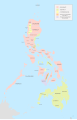 1880
1880 -
 1899
1899 -
 1907
1907 -
 1918
1918 -
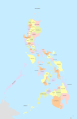 1935
1935 -
 1942–1945
 -
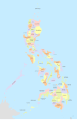 1986
1986 -
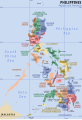 1992-
1992-
.svg)
.svg)
.svg)
.svg)
.svg)
.svg)
.svg)

Formally proposed/renamed provinces[edit]
Proposed provinces with enacted law[edit]

- Occidental Leyte and Oriental Leyte (1923) – Leyte was divided into two new provinces by Act No. 3117 on March 27, 1923.[148] The division never took place, however, as no proclamation was issued by the Governor-General.
- The province of Oriental Leyte would have covered the present-day territories of the entire province of Biliran, the municipalities of Abuyog, Alangalang, Babatngon, Barugo, Burauen, Calubian, Capoocan, Carigara, Dagami, Dulag, Jaro, Javier, Julita, La Paz, Leyte, MacArthur, Mahaplag, Mayorga, Palo, Pastrana, San Isidro, San Miguel, Santa Fe, Tabango, Tabontabon, Tanauan, Tolosa, Tunga and Tacloban (which was designated as the provincial capital).
- The province of Occidental Leyte would have covered the present-day territories of the entire province of Southern Leyte, the municipalities of Albuera, Bato, Hilongos, Hindang, Inopacan, Isabel, Kananga, Matag-ob, Matalom, Mérida, Palompon, Villaba and the cities of Baybay and Ormoc. The province capital of Occidental Leyte "SEC. 2. ... shall be designated by the Governor-General, until determined by a plurality vote of the electors of the new province at the next general election."
- Samal (1969) – The sub-province of Samal was created by Republic Act No. 5999[149] and covered the area of the present-day Island Garden City of Samal. However, the sub-province was never inaugurated.
- Maranaw (1971) – Republic Act No. 6406,[150] which sought to create a new province out of eastern Lanao del Sur (now corresponding to the province's first congressional district), was approved on October 4, 1971. The province was to consist of the municipalities of Bubong, Ditsaan-Ramain (including what is now Buadiposo-Buntong), Kapai, Lumba-Bayabao (including what is now Maguing), Marantao, Masiu, Mulondo, Saguiaran, Piagapo, Poona Bayabao, Tamparan, Taraka and Wao (including what is now Bumbaran), with the chartered city of Marawi serving as the new province's capital. Lanao del Sur was to retain the remaining municipalities, with Malabang serving as its new capital. Section 4 of RA 6406 provided that "The new provinces as provided in this Act shall come into existence upon the election and qualification of their first elective provincial officials, who shall be elected in a special election simultaneously with the general elections of November, nineteen hundred and seventy-three." The division never took place due to the declaration of martial law in the Philippines on September 21, 1972, which disrupted the scheduled general elections for 1973 and paved the way for the adoption of a new Constitution and the establishment of the Fourth Philippine Republic. A legacy of this unimplemented division is the existence of two ZIP code series for Lanao del Sur: the 93- series was retained by what were to be the remaining towns of the province (with Malabang, the new capital, being reassigned the code 9300), while a new series (97-) was assigned to what was supposed to be the province of Maranaw (with Marawi getting the new code 9700).
Rejected in a plebiscite[edit]
- Isabela del Norte and Isabela del Sur (1995) – On February 20, 1995, Republic Act No. 7891,[151] which sought to divide the province of Isabela, was approved. Isabela del Norte was to comprise municipalities belonging to the province's first and second congressional districts with Ilagan serving as capital. Isabela del Sur was to consist of the third and fourth congressional districts (excluding the independent component city of Santiago), with Cauayan as the capital. The proposed division was rejected in a plebiscite held on June 20, 1995.
- Quezon del Norte and Quezon del Sur (2007) – The act dividing the province of Quezon into two, Republic Act No. 9495,[152] lapsed into law without the President's signature on September 7, 2007. Quezon del Norte (which would be renamed from Quezon) was to be composed of the first and second congressional districts of the province, with Lucena as its capital. Quezon del Sur, with its capital at Gumaca, would have been composed of the third and fourth congressional districts. The COMELEC held the plebiscite on December 13, 2008, and the majority of the votes rejected the division. Notwithstanding the voters' rejection, all the representatives of Quezon's four legislative districts—Wilfrido Mark Enverga, Irvin Alcala, Danilo Suarez, and Lorenzo Tañada III—reintroduced the measure as House Bill No. 3839 on December 8, 2010. They explained that “the wisdom, logic and bare facts behind what is driving this bill to be filed again in this Congress remain,” citing the persistence of poverty in far-flung coastal municipalities and small islands. Yet, the bill did not make it out of the committee level this time.[153][154]
- Palawan del Norte, Palawan Oriental, and Palawan del Sur (2021) – On April 5, 2019, President Rodrigo Duterte signed Republic Act No. 11259 that proposed the division the province of Palawan, with the exception of the independent city of Puerto Princesa, into three separate provinces. A plebiscite was originally scheduled for the second Monday of May 2020[155] but was postponed to March 2021 due to the COVID-19 pandemic.[156] Palawan del Norte would have been composed of Taytay and municipalities north of it. Palawan del Sur would have been composed of the municipalities west and south of Puerto Princesa, including Kalayaan (which administers the country's claims in the Spratly Islands), while the rest were proposed to form Palawan Oriental. The proposed provincial capitals would be Taytay (Palawan del Norte), Brooke's Point (Palawan del Sur), and Roxas (Palawan Oriental).[157] The COMELEC held the plebiscite on March 13, 2021, and the majority of the votes rejected the division.
Currently proposed provinces in the 19th Congress[edit]
- Surigao Oriental (1992, 2015, 2022): House Bill No. 2336 seeks to carve a province out of the six southernmost local government units of Surigao del Sur province. The City of Bislig and the municipalities of Barobo, Hinatuan, Lingig, and Tagbina all comprise the district of the bill's author, Surigao del Sur 2nd District Representative Johnny T. Pimentel; the bill also seeks to transfer Lianga, currently part of the First District, to the proposed province. Bislig would be the designated capital. The bill is pending with the Committee on Local Government since August 2, 2022.[158] A previous attempt to create the province of Surigao del Oriente, which would have covered the 2nd District municipalities but would have excluded Lianga, died in the committee level during the 16th Congress.[159][160] The proposal to create a province called Surigao Oriental was raised as early as 1992 by then-2nd District Representative Ernesto T. Estrella.[161]
- Zamboanga Occidental (2002, 2007, 2010, 2017, 2023) – On September 25, 2023, Zamboanga del Norte 3rd District Representative Adrian Michael A. Amatong filed House Bill No. 9311 seeking to create a new province out of his constituency. The proposed province would consist of the 12 westernmost municipalities of Zamboanga del Norte—Liloy as the proposed capital, together with Baliguian, Godod, Gutalac, Kalawit, Leon B. Postigo, Salug, Sibuco, Siocon, Sirawai, and Tampilisan.[162] Previous attempts to turn the district into the province of Zamboanga Occidental, the province of Liloy, or the province of Zamboanga Hermosa—which began with the efforts of then-2nd District Representative Ernesto T. Estrella as early as 1992—failed to hurdle the 12th, the 14th, the 15th and the 17th Congress.[163][164][165][166][167][168]
Other proposed provinces[edit]
- Mindoro del Sur (1998): During the 11th Congress, Oriental Mindoro 1st District Rep. Renato Leviste filed House Bill No. 1476 proposing to turn the adjoining 2nd District into its own province called Mindoro del Sur. The proposed province would have consisted of the seven municipalities forming the southern half of Oriental Mindoro: Bansud, Bongabong, Bulalacao, Gloria, Mansalay, Pinamalayan, and Roxas. However, the measure did not take off.[169] The Sangguniang Panlalawigan in 2002 passed a resolution urging the province's two representatives, Charity Leviste and Alfonso Umali, Jr., to refile the bill in the 12th Congress, but to no avail.[170]
- Panguil Bay (1999): During the 11th Congress, Lanao del Norte 1st District Rep. Alipio Cirilo Badelles filed House Bill No. 8049 to carve the province of Panguil Bay out of Lanao del Norte. The bill died in the committee level.[171]
- Bukidnon del Sur (2004): In November 2004, during the 13th Congress, Bukidnon 3rd District Rep. Juan Miguel F. Zubiri filed a bill seeking to carve the new province of Bukidnon del Sur out of the province of Bukidnon. [172] The proposed province would have been composed of 10 southwestern and southern municipalities: Damulog, Dangcagan, Don Carlos, Kadingilan, Kalilangan, Kibawe, Kitaotao, Maramag, Pangantucan, and Quezon. The capital would have been determined by way of plebiscite had the bill passed into law.[173] House Bill No. 4834 was unanimously approved on third reading by the House of Representatives on November 21, 2005, but it never moved past the committee level at the Senate. [174]
- Cebu del Norte, Cebu del Sur, and Occidental Cebu (2005): During the 13th Congress, the province of Cebu grappled with the so-called Sugbuak controversy. Three bills were filed in January and February 2005 by 2nd District Rep. Simeon L. Kintanar, 3rd District Rep. Antonio P. Yapha, Jr., and 4th District Clavel A. Martinez, who sought to turn their respective constituencies into the new provinces of Cebu del Sur, Occidental Cebu, and Cebu del Norte, respectively. [175] [176] [177] The consolidated substitute bill, House Bill No. 5721, was approved by the Committee on Local Government but was not acted upon by the Committee on Rules by the end of the 13th Congress amid strong opposition. [178]
- Misamis North and Misamis South (2005): During the 13th Congress, Misamis Oriental 2nd District Rep. Augusto H. Baculio introduced two bills seeking to carve the provinces of Misamis North and Misamis South out of the province of Misamis Oriental. The bills died in the committee level.[179][180]
- Western Leyte (2005, 2010): During the 13th and the 15th Congress, Leyte 5th District Rep. Carmen L. Cari and her son and successor Rep. Jose Carlos L. Cari introduced bills seeking to carve the new province of Western Leyte out of the province of Leyte. The Caris' constituency consisted of the City of Baybay and the eight southernmost municipalities of the province. The bills died in the committee level.[181][182] Previously, during the 9th Congress, Leyte 4th District Rep. Carmelo J. Locsin filed House Bill No. 6388 also to create the province of Western Leyte; his district consists of the City of Ormoc and the surrounding western municipalities of Albuera, Isabel, Kananga, Matag-ob, Merida, and Palompon.[183]
- Northwestern Samar (2008, 2010, 2019) – Most recently during the 17th Congress, House Bill No. 8824 was introduced in the House of Representatives on January 22, 2019, by 1st District Representative Edgar Mary Sarmiento to turn his constituency into a new province called Northwestern Samar.[184] The proposed province would have consisted of the City of Calbayog as its capital, along with the nine municipalities of Almagro, Gandara, Matuginao, Pagsanghan, San Jorge, Santa Margarita, Santo Niño, Tagapul-an, and Tarangnan.[185] This proposal has repeatedly died in the committee level during the 14th, 15th and 17th Congress.[186][187][188]
- Nueva Camarines (2011) – On May 24, 2011, during the 15th Congress, Camarines Sur Fourth District Rep. Arnulfo Fuentebella introduced House Bill 4728, which sought to create a new province out of the City of Iriga and 16 municipalities comprising the eastern half and the southern portion of Camarines Sur.[189] This would have included all 10 municipalities of Fuentebella's Fourth District (Caramoan, Garchitorena, Goa, Lagonoy, Presentacion, Sagñay, San Jose, Siruma, Tigaon, and Tinambac) and all six municipalities of the adjacent Fifth District (Baao, Balatan, Bato, Buhi, Bula, and Nabua). Tigaon would have been the capital of the proposed province.[190] Just three months later, on August 3, 2011, the finalized measure numbered House Bill No. 4820 passed the House of Representatives of the Philippines with 229 votes in favor to one against.[191][192] However, it failed to gain the concurrence of the Senate, which did not take up the controversial bill by the end of 15th Congress, following the opposition of Senators Joker Arroyo, Antonio Trillanes IV, Bongbong Marcos and Manny Villar.[193] In 2015, Rappler reported: “It is widely believed here that the Fuentebellas want a new province they can rule because they had failed to win the governorship of Camarines Sur since former Governor Luis Villafuerte held the position.”[194]
Proposed renaming[edit]
- Southern Leyte to Leyte del Sur (2007) – Southern Leyte Lone District Rep. Roger Mercado introduced bills to rename the province of Southern Leyte to Leyte del Sur, citing a desire to “enhance the identity of [the province] as geographically a part of the Leyte Island with a distinct personality of its own” and to have the province alphabetically listed closer to the neighboring province of Leyte, from which it was separated in 1959.[195] Mercado first filed the bill in 2007,[196] and this attempt gained traction during the 14th Congress, as House Bill No. 6650 was passed by the House of Representatives on September 8, 2009, with 170 votes in its favor and none against it. The Senate, however, did not act on the measure.[197] Mercado's second attempt in 2017 did not prosper, as House Bill No. 1602 died in the committee level during the 17th Congress.[198]
See also[edit]
- List of Philippine provinces by population
- List of Philippine provincial etymologies
- List of Philippine provinces by Human Development Index
- List of Philippine provinces by poverty rate
- List of demonyms for Philippine provinces
- ISO 3166-2:PH
- Sub-provinces of the Philippines, a defunct group of administrative divisions in the Philippines
Notes[edit]
References[edit]
- ^ "About the League of Provinces". League of Provinces of the Philippines. Archived from the original on March 5, 2009. Retrieved January 12, 2008.
- ^ a b c d "R.A. 7160". lawphil.net. Archived from the original on May 3, 2016.
- ^ Teves, Margarito B. (July 29, 2008). "Department Order No. 23-08 Prescribing the New Income Brackets for the Re-classification of Provinces, Cities and Municipalities and Amending for the Purpose Department of Finance Order No. 20-05, dated July 29, 2005" (PDF). Archived from the original (PDF) on March 4, 2016. Retrieved September 29, 2014.
- ^ "ISO 3166-2 Newsletter: Changes in the list of subdivision names and code elements" (PDF). ISO (International Organization for Standardization). June 30, 2010. pp. 56–58. Retrieved January 19, 2015.
- ^ "2020 Census of Population and Housing (2020 CPH) Population Counts Declared Official by the President". 2020 Census of Population. Philippine Statistics Authority. May 19, 2016. Retrieved July 18, 2022.
- ^ "List of Provinces". PSGC Interactive. Makati, Philippines: National Statistical Coordination Board. Archived from the original on April 19, 2016. Retrieved May 14, 2014.
- ^ Republic Act 8811 (PDF). August 16, 2000. Archived from the original (PDF) on March 3, 2016.
- ^ "Agusan del Sur..." OoCities.org. Retrieved February 22, 2016.
- ^ "Proclamation No. 290, s. 1956". GOVPH. Retrieved February 22, 2016.
- ^ "Albay celebrates 439th Foundation Day". balita-dot-ph. Archived from the original on December 22, 2015. Retrieved October 14, 2015.
- ^ "Apayao gov't center established in Luna". Philippine Information Agency.[dead link]
- ^ "Basilan starts construction of new provincial gov't center". Archived from the original on August 11, 2017. Retrieved May 14, 2017.
- ^ Bangsamoro Development Plan: Environment and Natural Resources Archived March 4, 2016, at the Wayback Machine
- ^ "The Batanes Islands". National Commission on Culture and the Arts. Archived from the original on March 4, 2016. Retrieved October 14, 2015.
- ^ "No work on Monday, July 23, in observance of Bohol Day". The Bohol Standard. Archived from the original on December 22, 2015. Retrieved December 18, 2015.
- ^ "Festivals". Official Website of the Provincial Government of Cagayan. Archived from the original on January 31, 2016. Retrieved December 18, 2015.
- ^ "Camarines Norte holds Bantayog fest". Philippine Daily Inquirer (in Filipino). Retrieved December 31, 2015.
- ^ Abad, Danilo. "Kaogma 2015 isasagawa sa Camarines Sur". Philippine Information Agency. Retrieved December 31, 2015.[permanent dead link]
- ^ The provincial government of Cavite makes it clear that Imus is the provincial capital, while the seat of the provincial government is Trece Martires. Official Website of the Province of Cavite – Quick Facts Archived October 7, 2011, at the Wayback Machine Imus is capital of Cavite — Maliksi
- ^ Census of the Philippine Islands (1920). "Census of the Philippine Islands Vol. I, 1918", pg. 132. Bureau of Printing, Manila.
- ^ a b c d e f g Because the provincial government holds office within an independent city, in effect the province maintains the seat of its government outside its jurisdiction.
- ^ Unson, John. "North Cotabato set for Kalivungan fest, 101st anniversary". The Philippine Star. Retrieved October 14, 2015.
- ^ Autonomous Region in Muslim Mindanao, Department of Agriculture: Lanao del Sur Archived January 19, 2015, at the Wayback Machine (The value given at NSCB is unreasonable and must be assumed as erroneous, see Talk:Lanao del Sur#Area.)
- ^ "President Aquino declares March 18 as special non-working day in Masbate in commemoration of 112th Foundation Day". Presidential Communications Operations Office. Archived from the original on August 6, 2013. Retrieved January 1, 2016.
- ^ "History of Negros Occidental". Official Website of the Provincial Government of Negros Occidental. Archived from the original on October 20, 2018. Retrieved January 18, 2019.
- ^ "History of Negros Oriental". Official Website of the Provincial Government of Negros Oriental. Archived from the original on February 15, 2017.
- ^ "N. Ecija founding date April 25, not Sept. 2". Philippine Daily Inquirer. Retrieved June 17, 2016.
- ^ Babiera, Lester G. (July 14, 2014). "Nueva Vizcaya mounts Ammungan fest, celebrates diversity". Philippine Daily Inquirer. Retrieved October 7, 2015.
- ^ "Speech of President Aquino during his visit to Occidental Mindoro, November 15, 2012". GOVPH. Retrieved March 3, 2016.
- ^ Ramirez, Cesar (March 27, 2011). "April 5 a special non-working holiday in Pangasinan". The Philippine Star. Retrieved October 7, 2015.
- ^ "Census of the Philippine Islands : Taken under the direction of the Philippine Legislature in the year 1918". April 13, 2024.
- ^ "History of Romblon". United Romblon Ministerial Fellowship. February 20, 2014. Retrieved January 1, 2016.
- ^ Province of Sulu: Brief Profile Archived February 26, 2011, at the Wayback Machine (There seems to be major discrepancies among authoritative sources: 343,699 ha (NSCB 2007), 175,460 ha (NSCB 2000), 167,377 ha (NAMRIA))
- ^ "History of Tarlac". Province of Tarlac. Archived from the original on December 22, 2015. Retrieved October 7, 2015.
- ^ "Proclamation No. 109, s. 1998". Retrieved October 7, 2015.
{{cite journal}}: Cite journal requires|journal=(help) - ^ The National Statistical Coordination Board Archived November 18, 2008, at the Wayback Machine recognizes both Bongao and Panglima Sugala as capitals of the province. However, the provincial capitol is located in Bongao, the de facto seat of government.
- ^ Autonomous Region in Muslim Mindanao, Department of Agriculture: Tawi-Tawi Archived September 6, 2012, at the Wayback Machine (There seems to be major discrepancies among authoritative sources: 362,655 ha (NSCB 2007), 120,876 ha (NAMRIA), 1,197 km² (Department of Tourism), 999 km² (Mapcentral))
- ^ Republic Act No. 8811 Archived March 3, 2016, at the Wayback Machine, Republic Act No. 8811.
- ^ Firm, Ronald Echalas Diaz, Chan Robles & Associates Law. "PHILIPPINE LAWS, STATUTES AND CODES – CHAN ROBLES VIRTUAL LAW LIBRARY". www.chanrobles.com.
{{cite web}}: CS1 maint: multiple names: authors list (link) - ^ "G.R. No. 73155". lawphil.net.
- ^ Republic Act No. 9054 Archived July 8, 2011, at the Wayback Machine, Chan-Robles Law Library.
- ^ G.R. No. 177597 – Sema v. COMELEC and Dilangalen, Supreme Court of the Philippines.
- ^ "Republic Act No. 11550". lawphil.net. Retrieved September 18, 2022.
- ^ "Act No. 49 – An Act Providing for the Establishment of a Civil Government for the Province of Benguet". Supreme Court E-Library. Philippine Commission. November 23, 1900. Retrieved February 18, 2022.
- ^ "Act No. 83 – A General Act for the Organization of Provincial Governments in the Philippine Islands". Supreme Court E-Library. Philippine Commission. February 6, 1901. Retrieved February 18, 2022.
- ^ "Act No. 85 – An Act Providing for the Establishment of a Civil Government for the Province of Pampanga". Supreme Court E-Library. Philippine Commission. February 13, 1901. Retrieved February 18, 2022.
- ^ "Act No. 86 – An Act Providing for the Establishment of a Civil Government for the Province of Pangasinan". Supreme Court E-Library. Philippine Commission. February 16, 1901. Retrieved February 18, 2022.
- ^ "Act No. 87 – An Act Providing for the Establishment of a Civil Government for the Province of Tarlac". Supreme Court E-Library. Philippine Commission. February 18, 1901. Retrieved February 18, 2022.
- ^ "Act No. 88 – An Act Providing for the Establishment of a Civil Government for the Province of Bulacan". Supreme Court E-Library. Philippine Commission. February 27, 1901. Retrieved February 18, 2022.
- ^ "Act No. 92 – An Act Providing for the Establishment of a Civil Government for the Province of Bataan". Supreme Court E-Library. Philippine Commission. March 2, 1901. Retrieved February 18, 2022.
- ^ "Act No. 103 – An Act Providing for the Establishment of a Civil Government for the Province of Tayabas". Supreme Court E-Library. Philippine Commission. March 12, 1901. Retrieved February 18, 2022.
- ^ "Act No. 104 – An Act Providing for the Establishment of a Civil Government for the Province of Romblon, As Therein Defined". Supreme Court E-Library. Philippine Commission. March 16, 1901. Retrieved February 18, 2022.
- ^ "Act No. 105 – An Act Providing for the Establishment of a Civil Government for the Province of Masbate". Supreme Court E-Library. Philippine Commission. March 18, 1901. Retrieved February 18, 2022.
- ^ "Act No. 113 – An Act Providing for the Establishment of a Civil Government for the Province of Iloilo". Supreme Court E-Library. Philippine Commission. April 11, 1901. Retrieved February 18, 2022.
- ^ "Act No. 114 – An Act Providing for the Establishment of a Civil Government for the Province of Antique". Supreme Court E-Library. Philippine Commission. April 13, 1901. Retrieved February 18, 2022.
- ^ "Act No. 115 – An Act Providing for the Establishment of a Civil Government for the Province of Capiz". Supreme Court E-Library. Philippine Commission. April 15, 1901. Retrieved February 18, 2022.
- ^ "Act No. 116 – An Act Extending the Provisions of the Provincial Government Act to the Province of Cebu, and Incorporating the Pueblo of San Nicolas in the Municipality of Cebu". Supreme Court E-Library. Philippine Commission. April 18, 1901. Retrieved February 18, 2022.
- ^ "Act No. 117 – An Act Providing for the Establishment of a Civil Government for the Province of Bohol". Supreme Court E-Library. Philippine Commission. April 20, 1901. Retrieved February 18, 2022.
- ^ "Act No. 121 – An Act Providing for the Establishment of a Civil Government for the Province of Leyte". Supreme Court E-Library. Philippine Commission. April 22, 1901. Retrieved February 18, 2022.
- ^ "Act No. 122 – An Act Providing for the Establishment of a Civil Government for the Province of Albay". Supreme Court E-Library. Philippine Commission. April 26, 1901. Retrieved February 18, 2022.
- ^ "Act No. 123 – An Act Providing for the Establishment of a Civil Government for the Province of Ambos Camarines". Supreme Court E-Library. Philippine Commission. April 27, 1901. Retrieved February 18, 2022.
- ^ "Act No. 124 – An Act Providing for the Establishment of a Civil Government for the Province of Sorsogon". Supreme Court E-Library. Philippine Commission. April 27, 1901. Retrieved February 18, 2022.
- ^ "Act No. 119 – An Act Extending the Provisions of the Provincial Government Act and the Municipal Code to the Province of Occidental Negros". Supreme Court E-Library. Philippine Commission. April 20, 1901. Retrieved February 18, 2022.
- ^ "Act No. 120 – An Act Extending the Provisions of the Provincial Government Act and the Municipal Code to the Province of Oriental Negros". Supreme Court E-Library. Philippine Commission. April 20, 1901. Retrieved February 18, 2022.
- ^ "Act No. 125 – An Act Providing for the Establishment of a Civil Government for the Province of Marinduque". Supreme Court E-Library. Philippine Commission. May 1, 1901. Retrieved February 18, 2022.
- ^ "Act No. 126 – An Act Providing for the Establishment of a Civil Government for the Province of Batangas". Supreme Court E-Library. Philippine Commission. May 2, 1901. Retrieved February 18, 2022.
- ^ "Act No. 127 – An Act Providing for the Establishment of a Civil Government for the Province of Surigao". Supreme Court E-Library. Philippine Commission. May 15, 1901. Retrieved February 18, 2022.
- ^ "Act No. 128 – An Act Providing for the Establishment of a Civil Government for the Province of Misamis". Supreme Court E-Library. Philippine Commission. May 15, 1901. Retrieved February 18, 2022.
- ^ "Act No. 137 – An Act Providing for the Establishment of a Civil Government for the Province of Rizal". Supreme Court E-Library. Philippine Commission. June 11, 1901. Retrieved February 18, 2022.
- ^ "Act No. 138 – An Act Providing for the Establishment of a Civil Government for the Province of Cavite". Supreme Court E-Library. Philippine Commission. June 11, 1901. Retrieved February 18, 2022.
- ^ "Act No. 139 – An Act Providing for the Establishment of a Civil Government for the Province of Nueva Ecija". Supreme Court E-Library. Philippine Commission. June 11, 1901. Retrieved February 18, 2022.
- ^ "Act No. 169 – An Act Annexing the Island of Catanduanes to the Province of Albay". Supreme Court E-Library. Philippine Commission. July 16, 1901. Retrieved February 18, 2022.
- ^ "Act No. 173 – An Act Restoring the Provinces of Batangas, Cebu, and Bohol to the Executive Control of the Military Governor". Supreme Court E-Library. Philippine Commission. July 17, 1901. Retrieved February 18, 2022.
- ^ "Act No. 203 – An Act Extending the Provisions of the Provincial Government Act and Its Amendments to the Province of La Union". Supreme Court E-Library. Philippine Commission. August 15, 1901. Retrieved February 18, 2022.
- ^ "Act No. 205 – An Act Extending the Provisions of the Provincial Government Act and Its Amendments to the Province of Ilocos Sur". Supreme Court E-Library. Philippine Commission. August 16, 1901. Retrieved February 18, 2022.
- ^ "Act No. 206 – An Act Extending the Provisions of the Provincial Government Act and Its Amendments to the Province of Abra". Supreme Court E-Library. Philippine Commission. August 19, 1901. Retrieved February 18, 2022.
- ^ "Act No. 207 – An Act Extending the Provisions of the Provincial Government Act and Its Amendments to the Province of Ilocos Norte". Supreme Court E-Library. Philippine Commission. August 20, 1901. Retrieved February 18, 2022.
- ^ "Act No. 209 – An Act Extending the Provisions of the Provincial Government Act and Its Amendments to the Province of Cagayan". Supreme Court E-Library. Philippine Commission. August 22, 1901. Retrieved February 18, 2022.
- ^ "Act No. 210 – An Act Extending the Provisions of the Provincial Government Act and Its Amendments to the Province of Isabela". Supreme Court E-Library. Philippine Commission. August 24, 1901. Retrieved February 18, 2022.
- ^ "Act No. 211 – An Act Extending the Provisions of the Provincial Government Act and Its Amendments to the Province of Zambales". Supreme Court E-Library. Philippine Commission. August 28, 1901. Retrieved February 18, 2022.
- ^ "Act No. 322 – An Act Repealing So Much of Act Numbered One Hundred and Seventy-three as Applies to the Province of Cebu, and Restoring That Province to the Executive Control of the Civil Governor". Supreme Court E-Library. Philippine Commission. December 20, 1901. Retrieved February 18, 2022.
- ^ "Act No. 337 – An Act Providing for the Organization of a Provincial Government in the Province of Nueva Viscaya [sic]". Supreme Court E-Library. Philippine Commission. January 28, 1902. Retrieved February 18, 2022.
- ^ "Act No. 365 – An Act Repealing So Much of Act Numbered One Hundred and Seventy-three as Applies to the Province of Bohol, and Restoring That Province to the Executive Control of the Civil Governor". Supreme Court E-Library. Philippine Commission. March 3, 1902. Retrieved February 18, 2022.
- ^ "Act No. 410 – An Act Providing for the Organization of a Provincial Government in the Territory Comprised in the Comandancias of Lepanto, Bontoc, and Amburayan, and the Territory Lying Between Abra, Cagayan, and Bontoc Not Included Within the Limits of Any Province, and Providing for Justices of the Peace in This Territory and in the Province of Nueva Vizcaya". Supreme Court E-Library. Philippine Commission. May 28, 1902. Retrieved February 18, 2022.
- ^ "Act No. 417 – An Act Annexing the Districts of Infanta and Principe and the Island of Polillo to the Province of Tayabas". Supreme Court E-Library. Philippine Commission. June 12, 1902. Retrieved February 18, 2022.
- ^ "Act No. 419 – An Act Providing for the Organization of a Provincial Government in the Province of Samar". Supreme Court E-Library. Philippine Commission. June 17, 1902. Retrieved February 18, 2022.
- ^ "Act No. 422 – An Act Providing for the Organization of a Provincial Government in the Province of Paragua, and Defining the Limits of That Province". Supreme Court E-Library. Philippine Commission. June 23, 1902. Retrieved February 18, 2022.
- ^ "Act No. 423 – An Act Extending the Provisions of the Provincial Government Act and Its Amendments to the Island of Mindoro and Incorporating That Island with the Province of Marinduque". Supreme Court E-Library. Philippine Commission. June 23, 1902. Retrieved February 18, 2022.
- ^ "Act No. 424 – An Act Extending the Provisions of the Provincial Government Act and Its Amendments to the Province of La Laguna". Supreme Court E-Library. Philippine Commission. July 1, 1902. Retrieved February 18, 2022.
- ^ "Act No. 499 – An Act Annexing the Province of Marinduque to the Province of Tayabas, Amending Act Numbered One Hundred and Three, Entitled "An Act Extending the Provisions of the Provincial Government Act to the Province of Tayabas," and Repealing Act Numbered One Hundred and Twenty-five and All Amendments Thereto". Supreme Court E-Library. Philippine Commission. November 10, 1902. Retrieved February 18, 2022.
- ^ "Act No. 500 – An Act Providing for the Organization of a Provincial Government in the Island of Mindoro, Defining the Limits of That Province, and Repealing Act Numbered Four Hundred and Twenty-three, Entitled "An Act Extending the Provisions of the Provincial Government Act and Its Amendments to the Island of Mindoro and Incorporating That Island with the Province of Marinduque"". Supreme Court E-Library. Philippine Commission. November 10, 1902. Retrieved February 18, 2022.
- ^ "Act No. 747 – An Act to Amend Act Numbered Pour Hundred and Twenty-two, as Amended, by Defining New Limits for the Province of Paragua, and for Other Purposes". Supreme Court E-Library. Philippine Commission. May 14, 1903. Retrieved February 18, 2022.
- ^ "Act No. 768 – An Act Fixing the Boundary Line Between the Subprovinces of Amburayan and Lepanto and the Province of Benguet, and Adding the Territory Comprised in the Former Comandancia of Kayapa to the Latter Province". Supreme Court E-Library. Philippine Commission. May 26, 1903. Retrieved February 18, 2022.
- ^ "Act No. 787 – An Act Providing for the Organization and Government of the Moro Province". Supreme Court E-Library. Philippine Commission. June 1, 1903. Retrieved February 18, 2022.
- ^ "Act No. 1306 – An Act Annexing the Province of Abra to the Province of Ilocos Sur, Making Appropriation for the Payment of Certain Outstanding Liabilities of the Province of Abra and Providing for the Establishment of Civil Governments in the Settlements of Non-Christian Tribes in the Province of Ilocos Sur". Supreme Court E-Library. Philippine Commission. February 28, 1905. Retrieved February 18, 2022.
- ^ "Act No. 1331 – An Act to Amend Act Numbered One Hundred and Sixty-nine, Entitled "An Act Annexing the Island of Catanduanes to the Province of Albay," so as to Create the Subprovince of Catanduanes of the Province of Albay". Supreme Court E-Library. Philippine Commission. April 19, 1905. Retrieved February 18, 2022.
- ^ "Act No. 1363 – An Act Changing the Name of the Province and Island of Paragua to That of Palawan". Supreme Court E-Library. Philippine Commission. June 28, 1905. Retrieved February 18, 2022.
- ^ "Act No. 1413 – An Act Annexing the Province of Masbate to the Province of Sorsogon, and Amending Act Numbered Seventy-four, as Amended by Making the Provinces of Albay and Sorsogon Separate School Divisions, and for Other Purposes". Supreme Court E-Library. Philippine Commission. November 23, 1905. Retrieved February 18, 2022.
- ^ "Act No. 1642 – An Act Providing for the Establishment of Two Subprovinoes to Be Known as the Subprovince of Kalinga and the Subprovince of Apayao". Supreme Court E-Library. Philippine Commission. May 9, 1907. Retrieved February 18, 2022.
- ^ "Act No. 1665 – An Act to Annex the Province of Romblon to the Province of Capiz". Supreme Court E-Library. Philippine Commission. July 2, 1907. Retrieved February 18, 2022.
- ^ "Act No. 1649 – An Act Declaring All of the Territory Comprised in the Island of Marinduque a Subprovince of Tayabas, and for Other Purposes". Supreme Court E-Library. Philippine Commission. May 17, 1907. Retrieved February 18, 2022.
- ^ "Act No. 1693 – An Act Creating the Province of Agusan and the Sub-provinces of Butuan, Bukidnon and Batanes, Empowering the Provincial Board of Cagayan to Apply the Provisions of "the Township Government Act" to the Municipalities and Settlements of the Babuyanes Islands, and Providing That the Salaries of the Lieutenant-Governor of the Sub-province of Apayao and of Any Duly Authorized Employees of Said Sub-province Shall Be Payable From Insular Funds". Supreme Court E-Library. Philippine Commission. August 20, 1907. Retrieved February 18, 2022.
- ^ "Act No. 1753 – An Act Declaring All of the Territory Comprised in the Island of Siquijor a Subprovince of Oriental Negros, and for Other Purposes". Supreme Court E-Library. Philippine Commission. October 8, 1907. Retrieved February 18, 2022.
- ^ "Act No. 1876 – An Act Providing for the Establishment of a Province to Be Known as the Mountain Province, for the Establishment of a Prison at Bontoc for Non-Christian Criminals, Changing the Boundaries of the Province of Nueva Vizcaya, Amending Act Numbered Eight Hundred and Sixty-seven, as Amended, by Changing the Boundaries of the Mountain Judicial District and the Times and Places of Holding Courts of First Instance in the Said District, Providing for Participation by the Mountain Province in the Distribution of Internal-revenue Collections, and Repealing All Acts or Parts of Acts Inconsistent with This Act". Supreme Court E-Library. Philippine Commission. August 18, 1908. Retrieved February 18, 2022.
- ^ "Act No. 1952 – An Act to Provide for the Establishment of the Province of Batanes; to Amend Paragraph Seven of Section Sixty-eight of Act Numbered Eleven Hundred and Eighty-nine in Certain Particulars; to Authorize the Provincial Board of the Province of Batanes, with the Approval of the Governor-General, to Extend the Time for the Payment Without Penalty of Taxes and Licenses; to Amend Section Five of Act Numbered Fifteen Hundred and Eighty-two, Entitled "the Election Law," by Increasing the Number of Delegates to the Philippine Assembly to Eighty-one, and for Other Purposes". Supreme Court E-Library. Philippine Legislature. May 20, 1909. Retrieved February 18, 2022.
- ^ "Act No. 2309 – An Act Changing the Name of the Moro Province to the Department of Mindanao and Sulu, Placing the Province of Agusan Under the Jurisdiction and Control of the Governor of the Said Department, and for Other Purposes". Supreme Court E-Library. Philippine Commission. December 20, 1913. Retrieved February 18, 2022.
- ^ "Act No. 2408 – An Act Providing a Temporary Form of Government for the Territory Known as the Department of Mindanao and Sulu, Making Applicable Thereto, with Certain Exceptions, the Provisions of General Laws Now in Force in the Philippine Islands, and for Other Purposes". Supreme Court E-Library. Philippine Commission. July 23, 1914. Retrieved February 18, 2022.
- ^ "Act No. 2683 – An Act to Authorize the Segregation of the Subprovince of Abra From the Province of Ilocos Sur and the Reestablishment of the Former Province of Abra, and for Other Purposes". Supreme Court E-Library. Philippine Legislature. March 9, 1917. Retrieved February 18, 2022.
- ^ "Act No. 2724 – An Act Authorizing the Separation of the Subprovince of Romblon From the Province of Capiz and the Reestablishment of the Former Province of Romblon, and for Other Purposes". Supreme Court E-Library. Philippine Legislature. December 7, 1917. Retrieved February 18, 2022.
- ^ "Act No. 2809 – An Act to Authorize the Segregation of Camarines Norte From the Province of Ambos Camarines and Re-establishment of the Former Province of Camarines Norte, and for Other Purposes". Supreme Court E-Library. Philippine Legislature. March 3, 1919. Retrieved February 18, 2022.
- ^ a b "Act No. 2877 – An Act to Modify and Establish the Boundary Line Between the Mountain Province and the Provinces of Ilocos Sur and La Union". Supreme Court E-Library. Philippine Legislature. February 4, 1920. Retrieved February 21, 2022.
- ^ "Act No. 2880 – An Act Authorizing the Separation of the Subprovince of Marindnaque [sic] From the Province of Tayabas and the Reestablishment of the Former Province of Marinduque, and for Other Purposes". Supreme Court E-Library. Philippine Legislature. January 21, 1920. Retrieved February 21, 2022.
- ^ "Act No. 2934 – An Act Authorizing the Separation of the Subprovinee [sic] of Masbate From the Province of Sorsogon and the Reestablishment of the Former Province of Masbate, and for Other Purposes". Supreme Court E-Library. Philippine Legislature. December 15, 1920. Retrieved February 21, 2022.
- ^ "Act No. 3117 – An Act to Provide for the Division of the Province of Leyte into Two Provinces Independent From Each Other, Fix the Boundaries of Each, and for Other Purposes". Supreme Court E-Library. Philippine Legislature. March 27, 1923. Retrieved February 21, 2022.
- ^ "Act No. 3777 – An Act to Amend the Second Paragraph of Section One of Act Numbered Thirty-five Hundred and Thirty-seven, Entitled "An Act to Create the Provinces of Oriental Misamis and Occidental Misamis, etc."". Supreme Court E-Library. Philippine Legislature. November 28, 1930. Retrieved February 21, 2022.
- ^ "Act No. 3537 – An Act to Create the Provinces of Oriental Misamis and Occidental Misamis; Establish the Boundaries Thereof; Assign One Representative to Each Province; and Repeal Act Numbered Thirty-three Hundred and Fifty-four, and for Other Purposes". Supreme Court E-Library. Philippine Legislature. November 2, 1929. Retrieved February 21, 2022.
- ^ "Commonwealth Act No. 581 – An Act Abolishing the Existing Municipal Governments and the Provincial Government of Romblon, and Cheating Instead Four Special Municipalities". Supreme Court E-Library. National Assembly of the Philippines. June 8, 1940. Retrieved February 21, 2022.
- ^ "Executive Order No. 400 – Creating the City of Greater Manila". Supreme Court E-Library. President of the Philippines. January 1, 1942. Retrieved February 21, 2022.
- ^ a b c "Official Gazette". Official Gazette - Republic of the Philippines. 1. Manila, Philippines: Philippine Executive Commission: 428–430, 447–448, and 753. 1942. ISSN 0115-0421. Retrieved February 21, 2022.
- ^ SEC. 2. Subprovinces abolished.—The subprovinces and their governments are hereby abolished and their territories annexed to the provinces to which they belong."[119]
- ^ "Pursuant to the authority conferred upon me as Head of the Central Administrative Organization by Order No. 1 in connection with Order No. 3 of the Commander in Chief of the Imperial Japanese Forces in the Philippines and upon the recommendation of the Executive Commission it is hereby ordered that—
- The Province of Batanes is abolished and the comprising the same as well as the territory thereof shall be annexed to the Province Cagayan.
- The municipalities of Baler and Casiguran, Province of Tayabas, and the territories thereof are segregated from said province and shall be annexed to the Province of Nueva Ecija.
- The municipality of Infanta, Province of Tayabas, and the territory thereof are segregated from province and shall be annexed to the Province of Laguna.
- The Province of Marinduque is abolished and municipalities comprising the same as well as territory thereof shall be annexed to the Province of Tayabas.
- The Province of Romblon is abolished and the municipalities comprising the same as well the territory thereof shall be annexed to the of Capiz."[119]
- ^ "Pursuant to the authority conferred upon me by Order No. 1 in connection with Order No. 3 of the Commander in Chief of the Imperial Japanese Forces in the Philippines and upon the recommendation of the Executive Commission it is hereby ordered that—
- The Polillo islands are segregated from the Province of Tayabas and shall be annexed to the Province of Laguna."[119]
- ^ "Executive Order No. 58 – Reducing the Territory of the City of Greater Manila". Supreme Court E-Library. President of the Philippines. July 26, 1945. Retrieved February 21, 2022.
- ^ "Commonwealth Act No. 687 – An Act Authorizing the Separation of the Subprovince of Catanduanes From the Province of Albay and Its Establishment as an Independent Province". Supreme Court E-Library. Congress of the Philippines. September 26, 1945. Retrieved February 21, 2022.
- ^ "Republic Act No. 14 – An Act to Change the Name of the Province of Tayabas to Quezon". Supreme Court E-Library. Congress of the Philippines. September 7, 1946. Retrieved February 21, 2022.
- ^ "Republic Act No. 38 – An Act Repealing Commonwealth Act Numbered Five Hundred and Eighty-one, Entitled "An Act Abolishing the Existing Municipal Governments and the Provincial Government of Romblon, and Creating Instead Four Special Municipalities," Restoring the Regular Provincial Government and Municipalities of the Province of Romblon, and Creating the Municipality of Santa Fe". Supreme Court E-Library. Congress of the Philippines. October 1, 1946. Retrieved February 21, 2022.
- ^ "Republic Act No. 505 – An Act to Create the Provinces of Oriental Mindoro and Occidental Mindoro". Supreme Court E-Library. Congress of the Philippines. June 13, 1950. Retrieved March 22, 2022.
- ^ "Republic Act No. 648 – An Act Creating the Subprovince of Aurora, Which Shall Comprise the Municipalities of Baler, Casiguran, Dipaculao and Maria Aurora, Province of Quezon". Supreme Court E-Library. Congress of the Philippines. June 14, 1951. Retrieved March 22, 2022.
- ^ "Republic Act No. 711 – An Act to Create the Provinces of Zamboanga del Norte and Zamboanga del Sur". Supreme Court E-Library. Congress of the Philippines. June 6, 1952. Retrieved March 22, 2022.
- ^ "Republic Act No. 1414 – An Act to Create the Province of Aklan". Supreme Court E-Library. Congress of the Philippines. April 25, 1956. Retrieved March 22, 2022.
- ^ "Republic Act No. 2021 – An Act Creating the Subprovince of Camiguin in the Province of Misamis Oriental". Supreme Court E-Library. Congress of the Philippines. June 22, 1957. Retrieved March 22, 2022.
- ^ "Republic Act No. 2141 – An Act Creating the Sub-province of Biliran". Supreme Court E-Library. Congress of the Philippines. April 8, 1959. Retrieved March 22, 2022.
- ^ "Republic Act No. 2228 – An Act to Create the Provinces of Lanao del Norte and Lanao del Sur". Supreme Court E-Library. Congress of the Philippines. May 22, 1959. Retrieved March 22, 2022.
- ^ "Republic Act No. 2227 – An Act Creating the Province of Southern Leyte". Supreme Court E-Library. Congress of the Philippines. May 22, 1959. Retrieved March 22, 2022.
- ^ "Republic Act No. 2786 – An Act to Create the Provinces of Surigao del Norte and Surigao del Sur". Supreme Court E-Library. Congress of the Philippines. June 19, 1960. Retrieved March 22, 2022.
- ^ Vance, Lee W. (1980). Tracing Your Philippine Ancestors. Provo, Utah: Stevenson's Genealogical Center. p. 321.
- ^ "Republic Act No. 4221 – An Act Creating the Provinces of Northern Samar, Eastern Samar and Western Samar". Supreme Court E-Library. Congress of the Philippines. June 19, 1965. Retrieved March 22, 2022.
- ^ "Republic Act No. 4667 – An Act Creating the Subprovince of Guimaras in the Province of Iloilo". Supreme Court E-Library. Congress of the Philippines. June 18, 1966. Retrieved March 22, 2022.
- ^ "Republic Act No. 4669 – An Act Separating the Subprovince of Camiguin From the Province of Misamis Oriental and Establishing It as an Independent Province". Supreme Court E-Library. Congress of the Philippines. June 18, 1966. Retrieved March 22, 2022.
- ^ "Republic Act No. 4695 – An Act Creating the Provinces of Benguet, Mountain Province, Ifugao and Kalinga-Apayao". Supreme Court E-Library. Congress of the Philippines. June 18, 1966. Retrieved March 22, 2022.
- ^ "Republic Act No. 4734 – An Act Creating the Subprovince of Quirino in the Province of Nueva Vizcaya". Supreme Court E-Library. Congress of the Philippines. June 18, 1966. Retrieved March 22, 2022.
- ^ "Republic Act No. 4849 – An Act Creating the Province of South Cotabato". Supreme Court E-Library. Congress of the Philippines. July 18, 1966. Retrieved March 22, 2022.
- ^ "Republic Act No. 4867 – An Act Creating the Provinces of Davao del Norte, Davao del Sur and Davao Oriental". Supreme Court E-Library. Congress of the Philippines. May 8, 1967. Retrieved March 22, 2022.
- ^ "Republic Act No. 4979 – An Act Creating the Provinces of Agusan del Norte and Agusan del Sur". Supreme Court E-Library. Congress of the Philippines. June 17, 1967. Retrieved March 22, 2022.
- ^ "Republic Act No. 5650 – An Act Changing the Name of the Province of Western Samar to Samar". Supreme Court E-Library. Congress of the Philippines. June 21, 1969. Retrieved March 22, 2022.
- ^ "Republic Act No. 5999 – An Act Creating the Sub-province of Samal in the Province of Davao". Supreme Court E-Library. Congress of the Philippines. August 4, 1969. Retrieved March 22, 2022.
- ^ "'Yes' vote wins in Maguindanao plebiscite". Rappler. September 18, 2022. Retrieved September 18, 2022.
- ^ "Philippines-Archipelago, Region VIII (Eastern Visayas)". Specific information on the division of Leyte provided by David A. Short, webmaster of Philippines-Archipelago, which was updated accordingly after indirectly obtaining a copy of the text of Act No. 3117 from the Legislative Library, House of Representatives. Retrieved May 17, 2008.
{{cite journal}}: Cite journal requires|journal=(help) - ^ Republic Act No. 5999 Archived July 8, 2011, at the Wayback Machine, Chan-Robles Law Library.
- ^ Republic Act No. 6406. Chan-Robles Law Library.
- ^ "PHILIPPINE LAWS, STATUTES AND CODES - CHAN ROBLES VIRTUAL LAW LIBRARY". www.chanrobles.com.
- ^ "Republic Act No. 9495" (PDF). Archived from the original (PDF) on February 28, 2008.
- ^ "House Bill No. 3839 (15th Congress)" (PDF). Congress of the Philippines. Retrieved December 24, 2023.
- ^ "House Bill No. 3839 (15th Congress)". Senate of the Philippines Legislative Digital Resources. Retrieved December 24, 2023.
- ^ Leila B. Salaverria (April 14, 2019). "Plebiscite on splitting Palawan into 3 provinces set for 2020". Philippine Daily Inquirer. Retrieved May 25, 2020.
- ^ Sofia Tomacruz (April 7, 2020). "Comelec suspends Palawan plebiscite due to coronavirus outbreak". Rappler. Retrieved May 25, 2020.
- ^ "Palawan congressmen want province split into 3". Philippine Daily Inquirer. April 2, 2018. Retrieved July 9, 2018.
- ^ "House Bill No. 2336 (19th Congress)" (PDF). Congress of the Philippines. Retrieved September 18, 2022.
- ^ "House Bill No. 5881 (16th Congress)" (PDF). Congress of the Philippines. Retrieved December 24, 2023.
- ^ "House Bill No. 5881 (16th Congress)". Senate of the Philippines Legislative Digital Resources. Retrieved December 24, 2023.
- ^ "House Bill No. 594 (9th Congress)". Senate of the Philippines Legislative Digital Resources. Retrieved January 13, 2024.
- ^ "House Bill No. 9311 (19th Congress)" (PDF). Congress of the Philippines. Retrieved December 24, 2023.
- ^ Isagani S. Amatong (February 14, 2017). "House Bill No. 5040: An Act Creating the Province of Zamboanga Hermosa from the Province of Zamboanga Del Norte" (PDF). www.congress.gov.ph. Republic of the Philippines – House of Representatives. Archived from the original (PDF) on March 12, 2017. Retrieved March 10, 2017.
- ^ "Seventeenth Congress First Regular Session 2016 – 2017" (PDF). Journal of the House of Representatives. 73. Journal Service Plenary Affairs Bureau. February 21, 2017. Archived from the original (PDF) on March 12, 2017. Retrieved March 10, 2017.
- ^ "House Bill No. 4568 (9th Congress)". Senate of the Philippines Legislative Digital Resources. Retrieved January 13, 2024.
- ^ "House Bill No. 1334 (14th Congress)". Senate of the Philippines Legislative Digital Resources. Retrieved December 24, 2023.
- ^ "House Bill No. 3755 (15th Congress)". Senate of the Philippines Legislative Digital Resources. Retrieved December 24, 2023.
- ^ "House Bill No. 5040 (17th Congress)". Senate of the Philippines Legislative Digital Resources. Retrieved December 24, 2023.
- ^ "House Bill No. 1476 (11th Congress)". Senate of the Philippines Legislative Digital Resources. Retrieved January 13, 2024.
- ^ "Resolution No. 220-2002" (PDF). Electronic Legislative Tracking System. Retrieved January 13, 2024.
- ^ "House Bill No. 8049 (11th Congress)". Senate of the Philippines Legislative Digital Resources. Retrieved January 13, 2024.
- ^ "House Bill No. 3312 (13th Congress)". Senate of the Philippines Legislative Digital Resources. Retrieved December 24, 2023.
- ^ "House Bill No. 4834 (13th Congress)" (PDF). Senate of the Philippines Legislative Digital Resources. Retrieved January 18, 2024.
- ^ "House Bill No. 4834 (13th Congress)". Senate of the Philippines Legislative Digital Resources. Retrieved January 18, 2024.
- ^ "House Bill No. 3733 (13th Congress)". Senate of the Philippines Legislative Digital Resources. Retrieved December 24, 2023.
- ^ "House Bill No. 3632 (13th Congress)". Senate of the Philippines Legislative Digital Resources. Retrieved December 24, 2023.
- ^ "House Bill No. 3657 (13th Congress)". Senate of the Philippines Legislative Digital Resources. Retrieved December 24, 2023.
- ^ "House Bill No. 5721 (13th Congress)". Senate of the Philippines Legislative Digital Resources. Retrieved December 24, 2023.
- ^ "House Bill No. 4290 (13th Congress)". Senate of the Philippines Legislative Digital Resources. Retrieved December 24, 2023.
- ^ "House Bill No. 4302 (13th Congress)". Senate of the Philippines Legislative Digital Resources. Retrieved December 24, 2023.
- ^ "House Bill No. 3764 (13th Congress)". Senate of the Philippines Legislative Digital Resources. Retrieved December 24, 2023.
- ^ "House Bill No. 3648 (15th Congress)". Senate of the Philippines Legislative Digital Resources. Retrieved December 24, 2023.
- ^ "House Bill No. 6388 (9th Congress)". Senate of the Philippines Legislative Digital Resources. Retrieved January 13, 2024.
- ^ Charissa Luci-Atienza (January 22, 2019). "Creation of Northwestern Samar province pushed". Manila Bulletin. Retrieved May 25, 2020.
- ^ "House Bill No. 8824 (17th Congress)" (PDF). Congress of the Philippines. Retrieved January 18, 2024.
- ^ "House Bill No. 3553 (14th Congress)". Senate of the Philippines Legislative Digital Resources. Retrieved December 24, 2023.
- ^ "House Bill No. 1488 (15th Congress)". Senate of the Philippines Legislative Digital Resources. Retrieved December 24, 2023.
- ^ "House Bill No. 8824 (17th Congress)". Senate of the Philippines Legislative Digital Resources. Retrieved December 24, 2023.
- ^ "House Bill No. 4728 (15th Congress)". Senate of the Philippines Legislative Digital Resources. Retrieved December 24, 2023.
- ^ "House Bill No. 4820 (15th Congress)" (PDF). Congress of the Philippines. Retrieved December 24, 2023.
- ^ "House Bill No. 4820 (15th Congress)". Senate of the Philippines Legislative Digital Resources. Retrieved December 24, 2023.
- ^ Cynthia D. Balana (August 5, 2011). "House passes bill splitting CamSur". Philippine Daily Inquirer. Retrieved December 24, 2023.
- ^ Juan Escandor, Jr. (June 7, 2013). "Nueva Camarines bill 'buried'". Philippine Daily Inquirer. Retrieved December 24, 2023.
- ^ Rhadyz B. Barcia (October 6, 2015). "Political realignments start in Robredo's Camarines Sur". Rappler. Retrieved December 24, 2023.
- ^ "House Bill No. 6408 (17th Congress)" (PDF). Congress of the Philippines. Retrieved December 24, 2023.
- ^ "House Bill No. 1602 (14th Congress)". Senate of the Philippines Legislative Digital Resources. Retrieved December 24, 2023.
- ^ "House Bill No. 6650 (14th Congress)". Senate of the Philippines Legislative Digital Resources. Retrieved December 24, 2023.
- ^ "House Bill No. 6408(17th Congress)". Senate of the Philippines Legislative Digital Resources. Retrieved December 24, 2023.
External links[edit]

- Philippine Standard Geographic Code Interactive, National Statistical Coordination Board
- The 2010 Census of Population and Housing Reveals the Philippine Population at 92.34 Million, Philippine Statistics Authority, Republic of the Philippines
- Provinces of the Philippines, Gwillim Law, Statoids.com
- Flags of the World – Philippines Provincial Flags

Philippines articles | |||||||
|---|---|---|---|---|---|---|---|
| History |
| ||||||
| Geography | |||||||
| Politics |
| ||||||
| Economy | |||||||
| Society |
| ||||||

