


Symphony No. 6 (Tchaikovsky)
| Symphony No. 6 | |
|---|---|
| by Pyotr Ilyich Tchaikovsky | |
.jpg) Portrait of Tchaikovsky, 1893 | |
| Other name | Pathétique Symphony |
| Key | B minor |
| Opus | 74 |
| Period | Romantic music |
| Composed | August 1893 |
| Dedication | Tchaikovsky's nephew, Vladimir Davydov |
| Duration | about 45 minutes |
| Movements | Four |
| Scoring | Orchestra |
| Premiere | |
| Date | 28 October [O.S. 16 October] 1893 |
| Location | Saint Petersburg |
| Conductor | Pyotr Ilyich Tchaikovsky |
The Symphony No. 6 in B minor, Op. 74, also known as the Pathétique Symphony, is Pyotr Ilyich Tchaikovsky's final completed symphony, written between February and the end of August 1893. The composer entitled the work "The Passionate Symphony", employing a Russian word, Патетическая (Pateticheskaya), meaning "passionate" or "emotional", which was then translated into French as pathétique, meaning "solemn" or "emotive".
The composer led the first performance in Saint Petersburg on 28 October [O.S. 16 October] of that year, nine days before his death. The second performance, conducted by Eduard Nápravník, took place 21 days later, at a memorial concert on 18 November [O.S. 6 November].[1][2] It included some minor corrections that Tchaikovsky had made after the premiere, and was thus the first performance of the work in the exact form in which it is known today. The first performance in Moscow was on 16 December [O.S. 4 December], conducted by Vasily Safonov.[3] It was the last of Tchaikovsky's compositions premiered in his lifetime; his very last composition, the single-movement 3rd Piano Concerto, Op. 75, which was completed a short time before his death in October 1893, received a posthumous premiere.
Title[edit]
The Russian title of the symphony, Патетическая (Pateticheskaya), means "passionate" or "emotional", not "arousing pity," but it is a word reflective of a touch of concurrent suffering. Tchaikovsky considered calling it Программная (Programmnaya or "Program Symphony") but realized that would encourage curiosity about the program, which he did not want to reveal.
His brother Modest claims to have suggested the Патетическая title, which was used in early editions of the symphony; there are conflicting accounts about whether Tchaikovsky liked the title,[4] but in any event his publisher chose to keep it and the title remained. Its French translation Pathétique is generally used in French, Spanish, English, German and other languages,[5] Many English-speaking classical musicians had, by the early 20th century, adopted an English spelling and pronunciation for Tchaikovsky's symphony, dubbing it "The Pathetic", as shorthand to differentiate it from a popular 1798 Beethoven piano sonata also known as The Pathétique. Tchaikovsky's symphony was first published in piano reduction by Jurgenson of Moscow in 1893,[6] and by Robert Forberg of Leipzig in 1894.[7]
Background[edit]
After completing his 5th Symphony in 1888, Tchaikovsky did not start thinking about his next symphony until April 1891, on his way to the United States. The first drafts of a new symphony were started in the spring of 1891.[8] However, some or all of the symphony was not pleasing to Tchaikovsky, who tore up the manuscript "in one of his frequent moods of depression and doubt over his alleged inability to create".[8] In 1892, Tchaikovsky wrote the following to his nephew Vladimir "Bob" Davydov:
The symphony is only a work written by dint of sheer will on the part of the composer; it contains nothing that is interesting or sympathetic. It should be cast aside and forgotten. This determination on my part is admirable and irrevocable.[9]
This work was the Symphony in E♭, the first movement of which Tchaikovsky later converted into the one-movement 3rd Piano Concerto (his final composition), and the latter two movements of which Sergei Taneyev reworked after Tchaikovsky's death as the Andante and Finale.
In February 1893, Tchaikovsky mentions an entirely new symphonic work in a letter to his nephew "Bob" Davydov:
Now, on my journey, the idea of a new symphony came to me, this time one with a programme, but a programme that will be a riddle to everyone. Let them try and solve it ... The programme of this symphony is completely saturated with myself and quite often during my journey I cried profusely. Having returned, I have settled down to write the sketches and the work is going so intesely, so fast, that the first movement was ready in less than four days, and the others have taken shape in my head. Half of the third movement is also done. There will still be much that is new in the form of this work and the finale is not to be a loud allegro but the slowest adagio.[10]
And to his brother:
I am now wholly occupied with the new work ... and it is hard for me to tear myself away from it. I believe it comes into being as the best of my works. I must finish it as soon as possible, for I have to wind up a lot of affairs and I must soon go to London. I told you that I had completed a Symphony which suddenly displeased me, and I tore it up. Now I have composed a new symphony which I certainly shall not tear up.[9]
The symphony was written in a small house in Klin and completed by August 1893. Tchaikovsky left Klin on 19 October for the first performance in Saint Petersburg, arriving "in excellent spirits".[11] However, the composer began to feel apprehension over his symphony, when, at rehearsals, the orchestra players did not exhibit any great admiration for the new work.[11] Nevertheless, the premiere was met with great appreciation. Tchaikovsky's brother Modest wrote, "There was applause and the composer was recalled, but with more enthusiasm than on previous occasions. There was not the mighty, overpowering impression made by the work when it was conducted by Eduard Nápravník, on November 18, 1893, and later, wherever it was played."[12]
Instrumentation[edit]
The symphony is scored for an orchestra with the following instruments:
|
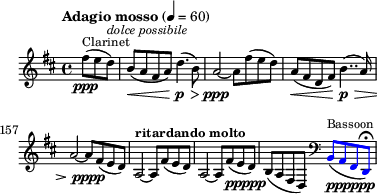
Although not called for in the score, a bass clarinet is commonly employed to replace the solo bassoon for the four notes immediately preceding the Allegro vivo section of the first movement,[14][15][16] which originates from Austro-Hungarian conductor Hans Richter.[15][16] This substitution is because it is nearly impossible in practice for a bassoonist to execute the passage at the indicated dynamic of pppppp.[14][15]
Music[edit]

The symphony is in four movements:
I. Adagio – Allegro non troppo[edit]

The first movement, in sonata form, frequently alternates speeds, moods, and keys, with the main key being B minor. The introduction is formed from repeated modules of its initial theme, presented by the bassoon, whose purpose seems to be to open a dominant chord, failing to do so. Violas appear with the first theme of the Allegro in B minor, a faster variant of the slow opening melody. This section introduces the motif of the full, octave-long downward scale, which recurs throughout the symphony; it eventually leads to a long medial caesura that gives way to the secondary theme in D major.

The energetic development section begins abruptly with an outburst from the full orchestra, with half-diminished harmony that leads uneasily to D minor. It runs seamlessly into the fortissimo recapitulation, a great contrast in atmosphere from its hesitant equivalent at the beginning of the Allegro. Tchaikovsky soon goes into something more nightmarish, which culminates in an explosion of despair and misery in B minor, accompanied by a strong and repetitive four-note figure in the brass, which recalls the motif from the introduction. This explosion concludes in a powerful note in the trombones marked quadruple forte, a rare, extreme dynamic marking. This section ends with diminishing strains on the basses and brass, letting through the pathos and upcoming despair of the symphony. The movement concludes shortly after the recapitulation of the second subject shown above, this time in the tonic major (B major) with a coda which is also in B major, finally ending very quietly.
The terms "development" and "recapitulation" are used loosely when describing the form of this movement. The structure of the first movement is a Type 2 sonata, which involves a typical expositional rotation, and a second rotation which includes a developmental section and a tonal closure. In the case of this movement, the essential closure is an imperfect authentic cadence (IAC), making it an example of sonata failure.[17]
II. Allegro con grazia[edit]
The second movement, a D major dance in ternary form, is in 5
4 time; it has been described as a "limping" waltz.[18] The opening whirling, first presented as a cello section solo, contrasts with a darker B section in B minor, the tonic minor of the symphony. There is an upward momentum to the major sections, a suggestion of reconciliatory inversion of the downward scale motif. A fragmented coda crosses the scales and becomes more wistful before leading to a calm, rippling close.
![\relative c {
\set Score.tempoHideNote = ##t \tempo 4 = 144
\set Staff.midiInstrument = #"cello"
\clef bass
\key d \major
\time 5/4
fis4\mf(^\markup { \translate #'(-3.5 . 0)
\column {
\line { First theme }
\line { \bold { Allegro con grazia } }
}
}
g) \tuplet 3/2 { a8(\< g a } b4 cis)\!
d( b) cis2.\>
a4(\mf b) \tuplet 3/2 { cis8(\< b cis } d4 e)\!
\clef tenor
fis(\f d) e2. \break
g4( fis) \tuplet 3/2 { e8( fis e } d4 cis)
fis8-. [ r16 g( ] fis8) [ r16 eis( ] fis2.)
fis4( e) \tuplet 3/2 { d8( e d } cis4) b\upbow(\<^\markup { \italic gliss. }
b'8)\ff\> [ a( g) fis-. ] e-. [ es-.( d-. cis-. b-. bes-.) ]
a4\mf
}](http://upload.wikimedia.org/score/2/4/24z4l5wb6mrgcnphio7d0ubaamkr549/24z4l5wb.png)
III. Allegro molto vivace[edit]
The third movement starts with a scherzo, a playful, march-like weaving of 12
8 and 4
4 in a sonatina form. The strings establish a fast, light compound meter which later lies underneath more brusque wind fanfares in 4
4. This leads to the jubilant E major secondary theme in full, first given quietly by unison clarinets with a continued string accompaniment. Between the exposition and the recapitulation, there is no development section – only 2 bars of fragmentary retransition. The opening theme reappears emboldened, and after flourishes of scales traded between the strings and woodwind, the secondary theme returns triumphantly in G major; this is the only appearance of the bass drum and cymbals. The movement ends with a deceptive finale, once again featuring downward scales. It is probably no coincidence that the movement, with its stormy character through restless strings, wind-like whistling woodwinds and thundering brass instruments, is reminiscent of the finale from Joachim Raff's Symphony No. 3 "In the forest":[19] the symphony was one of the most played of its time, and Tchaikovsky had already been inspired by Raff in his 5th Symphony with his famous horn solo.[20]

IV. Adagio lamentoso[edit]
Back in B minor, although opened with striking half-diminished harmony, the fourth movement takes a slow six-part sonata rondo form (A-B-A-C-A-B). The opening A theme in the first and second violins appears frequently through the movement, varying in intensity. The theme is a "composite melody": at first, neither the first nor second violins play in full the upper line that is heard.[21]

A calmer B theme in D major builds up to a full orchestral palette, with driving brass and descending scales pushing to a Neapolitan C major caesura. The B theme is transformed in a dramatic return to B minor before the A theme returns. Similarly to the first movement, there is a turbulent climax with prominent trombones in the development section (the C theme). This is followed by the most agitated restatement of the A theme (the start of the recapitulation), on an F♯ bass pedal. The music fades into a single, unique strike of a tam-tam; this quietly introduces a funereal chorale in the low brass which rounds off the dominant harmony. The return of the B section, originally a break in the clouds, is richly mournful, coinciding with the final resolution to B minor. The waves of descending muted string motifs carry on down into the lower strings and bassoons, finally dying away in total tragedy.
Among Tchaikovsky's symphonies, this is the only one to end in a minor key. His first, second, fourth and fifth symphonies, plus the Manfred Symphony, are all minor-key symphonies that end in the tonic major, while the home key of his third symphony is D major (even though it begins in D minor) and that of his unfinished Symphony in E♭ (unofficially "No. 7") is E♭ major.
It is also unusual for a slow movement to come at the end of a symphony. The despondent effect of the structural upheaval here has been the subject of much critical analysis. Had Tchaikovsky followed the standard four-movement structure, the movements would have been ordered like this:
- Adagio – Allegro non troppo
- Adagio lamentoso (actually IV)
- Allegro con grazia (actually II)
- Finale: Allegro molto vivace (actually III)
Interpretation[edit]
.jpg)
Tchaikovsky critic Richard Taruskin writes:
Suicide theories were much stimulated by the Sixth Symphony, which was first performed under the composer's baton only nine days before his demise, with its lugubrious finale (ending morendo, 'dying away'), its brief but conspicuous allusion to the Orthodox requiem liturgy in the first movement and above all its easily misread subtitle. ... When the symphony was done again a couple of weeks later, in memoriam and with subtitle in place, everyone listened hard for portents, and that is how the symphony became a transparent suicide note. Depression was the first diagnosis. 'Homosexual tragedy' came later.[22]
In the words of the critic Alexander Poznansky, "Since the arrival of the 'court of honour' theory in the West, performances of Tchaikovsky's last symphony are almost invariably accompanied by annotations treating it as a testimony of homosexual martyrdom."[23] Yet critic David Brown describes the idea of the Sixth Symphony as some sort of suicide note as "patent nonsense".[24] Other scholars, including Michael Paul Smith, believe that with or without the supposed 'court of honour' sentence, there is no way that Tchaikovsky could have known the time of his own death while composing his last masterpiece. There is also evidence that Tchaikovsky was unlikely to have been depressed while composing the symphony, with his brother noting of him after he had sent the manuscript for publishing, "I had not seen him so bright for a long time past."[21]
Dedication and suggested programs[edit]
Tchaikovsky dedicated the Pathétique to his nephew, Vladimir "Bob" Davydov, whom he greatly admired.[25]
The Pathétique has been the subject of a number of theories as to a hidden program. This goes back to the first performance of the work, when fellow composer Nikolai Rimsky-Korsakov asked Tchaikovsky whether there was a program to the new symphony, and Tchaikovsky asserted that there was, but would not divulge it.[26]

A suggested program has been what Taruskin disparagingly termed "symphony as suicide note".[28] This idea began to assert itself as early as the second performance of the symphony in Saint Petersburg, not long after the composer had died. People at that performance "listened hard for portents. As always, they found what they were looking for: a brief but conspicuous quotation from the Russian Orthodox requiem at the stormy climax of the first movement, and of course the unconventional Adagio finale with its tense harmonies at the onset and its touching depiction of the dying of the light in conclusion".[28] Countering this is Tchaikovsky's statement on 26 September/8 October 1893 that he was in no mood to write any sort of requiem. This was in reply to a suggestion from his close friend Grand Duke Konstantin that he write a requiem for their mutual friend the writer Aleksey Apukhtin, who had died in late August, just as Tchaikovsky was completing the Pathétique.[29][30]
Tchaikovsky specialist David Brown suggests that the symphony deals with the power of Fate in life and death.[31] This program would not only be similar to those suggested for the Fourth and Fifth Symphonies, but also parallels a program suggested by Tchaikovsky for his unfinished Symphony in E♭.[31] That program reads, "The ultimate essence ... of the symphony is Life. First part – all impulse, passion, confidence, thirst for activity. Must be short (the finale death – result of collapse). Second part love: third disappointments; fourth ends dying away (also short)."[32]
Simon Karlinsky, a composer[33] and professor of Slavic languages and literature at UC Berkeley and "an expert on homosexuality in pre-Soviet culture",[34] wrote in the gay literary magazine Christopher Street in 1988 that in 1941 a musician friend of his youth called Alex, who had spent several months associating with the painter Pavel Tchelitchew, told him an oral tradition that Tchelitchew had heard from the composer's brother Modest, told to him by Tchaikovsky himself. According to this, what Karlinsky himself calls "poorly remembered hearsay", the secret programme of the symphony is about love between men: the search for it, from the beginning of the first movement; finding it, in the romantic andante theme (measure 89); and the attacks of a hostile world on it, in the agitated allegro vivo passage that follows (measure 161); and escape from that, in the return to the love them (andante come prima, measure 305). The last movement, Karlinsky was told, is an elegy for a dead lover.[35]
In popular culture[edit]
The second theme of the first movement formed the basis of a popular song in the 1940s, "(This is) The Story of a Starry Night" (by Mann Curtis, Al Hoffman and Jerry Livingston), which was popularized by Glenn Miller. That theme also served as the melody of "Where" by Tony Williams and The Platters (a 1959 hit for them), "In Time" by Steve Lawrence (1961) and "John O'Dreams" by Bill Caddick (1976); however, all four songs have different lyrics. It was also used to great effect in one of the early Cinerama movies in the mid-50s.[citation needed]
Excerpts from the symphony can be heard in a number of films, including Victor Young's theme for Howard Hughes' 1943 American western The Outlaw, 1942's Now, Voyager, the 1997 version of Anna Karenina, as well as The Ruling Class, Minority Report, Sweet Bird of Youth, Soylent Green, Maurice, The Aviator, and The Death of Stalin. It has also been featured in The Ren & Stimpy Show episode "Son of Stimpy" in a scene where the eponymous cat walks out into a blizzard[citation needed].
The third movement was featured during the 2010 Winter Olympics closing ceremony during the Sochi 2014 handover segment.[citation needed]
The symphony plays a major role in E. M. Forster's novel Maurice (written in 1913 and later, but unpublished until 1971), where it serves as a veiled reference to homosexuality.[36]
Notes[edit]
- ^ Steinberg 1995, p. 635.
- ^ Poznansky, p. 603.
- ^ Tchaikovsky Research.net
- ^ Listen to "Discovering Music – Tchaikovsky's 6th Symphony". from 2:30
- ^ Steinberg 1995, p. 638.
- ^ see IMSLP
- ^ coproduction with Jurgenson of Moscow most likely; also, see "Hofmeisters Monatsberichte" (in German). March 1894. Retrieved November 22, 2012.
- ^ a b Bagar 1947, p. 754
- ^ a b quoted in Bagar 1947, p. 754
- ^ Tchaikovsky, Piotr Ilyich (1981). Letters to his Family. Translated by von Meck, Galina. London: Dennis Dobson. quoted in Norton, Rictor, ed. (1998). My Dear Boy: Gay Love Letters through the Centuries. San Francisco: Leyland.
- ^ a b Bagar 1947, p. 755
- ^ quoted in Bagar 1947, p. 755
- ^ P.I.Tchaikovsky. Symphony No.6. Breitkopf und Härtel. p. 19. (Published ca. 1945. Online version at IMSLP)
- ^ a b c Norman Del Mar (1983). Anatomy of the Orchestra. University of California Press. p. 180. ISBN 978-0520050624.
- ^ a b c d Steinberg 1995, n. 19 on p. 640
- ^ a b c Christopher Fifield (2016). Hans Richter. Boydell & Brewer. p. 300. ISBN 978-1783270217.
- ^ Wolfe, Daniel (May 2020). "Popular but Disparaged: Sonata Structures in Tchaikovsky's Symphonies Four, Five, and Six". MTI - Dissertation. Retrieved 22 October 2023.
- ^ "Tchaikovsky's Symphony # 6 (Pathetique), Classical Classics, Peter Gutmann". Classical Notes. Retrieved 2012-04-20.
- ^ Look at the scores or compare for example Stadlmair's recording of Raff's final (start from minute 11:00) with the last third of this movement.
- ^ "Tchaikovsky's view of Raff". Retrieved 2020-04-24.
- ^ a b Service, Tom (2014-08-26). "Symphony Guide: Tchaikovsky's Sixth ('Pathetique')". The Guardian. Retrieved 2018-04-29.
- ^ Taruskin, Richard (1 July 2000). "The Essential Tchaikovsky". Russian Life. Retrieved 8 January 2022.
- ^ Poznansky, Alexander (August 1998). "'Tchaikovsky's Last Days': I". Music & Letters. 79 (3). Oxford University Press: 463–467. doi:10.1093/ml/79.3.463-c. JSTOR 855392.
- ^ Brown, David (November 1997). "How Did Tchaikovsky Come to Die: And Does It Really Matter". Music & Letters. 78 (4). Oxford University Press: 581–588. doi:10.1093/ml/78.4.581. JSTOR 737640.
- ^ Poznansky, p. 558.
- ^ Rimsky-Korsakov 1942, pp. 339–340.
- ^ a b Jackson 1999, p. 51
- ^ a b Taruskin 2009, p. 133
- ^ Poznansky, p. 569.
- ^ Tchaikovsky Research: Aleksey Apukhtin. Retrieved 21 June 2015
- ^ a b Brown 1992, p. 445
- ^ Brown 1992, p. 388.
- ^ Hughes, Robert P.; McLean, Robert; Putney, Christopher; Taruskin, Richard (2010). "University of California Academic Senate: In Memoriam, Simon Karlinsky, Professor of Slavic Languages and Literatures, Emeritus, UC Berkeley, 1924–2009". Retrieved June 14, 2024.
- ^ Woo, Elaine (July 28, 2009). "Simon Karlinsky dies at 84; expert on Slavic languages and literature". Los Angeles Times. Retrieved September 25, 2023.
- ^ Karlinsky, Simon (1988). "Should We Retire Tchaikovsky". Christopher Street. Vol. 11, no. 3. New York. pp. 16–21.
- ^ Keeling, Bret L. (March 2003). " 'No Trace of Presence': Tchaikovsky and the Sixth in Forster's Maurice". Mosaic. 36 (1). University of Manitoba: 85–101. JSTOR 44030280.
Sources[edit]
- Bagar, Robert (1947). "Peter Ilyitch Tchaikowsky". The Concert Companion: A Comprehensive Guide to Symphonic Music. New York: McGraw-Hill.
- Brown, David (1992). Tchaikovsky: The Final Years. New York: W. W. Norton. ISBN 0-393-03099-7.
- Jackson, Timothy L. (1999). Tchaikovsky: Symphony No. 6 (Pathétique). Cambridge Music Handbooks. Cambridge University Press. ISBN 0-521-64676-6.
- Poznansky, Alexander. Tchaikovsky: The Quest for the Inner Man. [full citation needed]
- Rimsky-Korsakov, Nikolai (1942). My Musical Life (3rd ed.). New York: Knopf.
- Steinberg, Michael (1995). The Symphony. Oxford and New York: Oxford University Press. ISBN 0-19-512665-3.|
- Taruskin, Richard (2009). On Russian Music. Berkeley and Los Angeles: University of California Press. ISBN 9780520268067.
Further reading[edit]
- Cross, Milton and Ewen, David, "Peter Ilitch Tchaikovsky", in vol. II of Milton Cross' Encyclopedia of Great Composers and Their Music (Garden City, New York: Doubleday, 1962).
- Holden, Anthony, Tchaikovsky: A Biography (New York: Random House, 1995). ISBN 0-679-42006-1.
- Keller, Hans, "Peter Ilyich Tchaikovsky", in vol. I of The Symphony, ed. Robert Simpson (Harmondsworth, 1966).
- Ritzarev, Marina, Tchaikovsky's Pathétique and Russian Culture (Ashgate, 2014). ISBN 9781472424112.
External links[edit]
| Operas | |
|---|---|
| Ballets | |
| Symphonies |
|
| Concertante | |
| Orchestral works |
|
| Vocal music | |
| Chamber music | |
| Piano music | |
| Portrayals |
|
| People |
|
| Related | |


| International | |
|---|---|
| National | |
| Other | |
