


Greek Catholic Eparchy of Ruski Krstur
Eparchy of San Nicola di Ruski Krstur Крстурска гркокатоличка епархија | |
|---|---|
 | |
| Location | |
| Country | Serbia |
| Metropolitan | Exempt directly to the Holy See |
| Statistics | |
| Population - Catholics | 21,845 (2016) |
| Parishes | 21 (2016) |
| Information | |
| Denomination | Catholic Church |
| Sui iuris church | Greek Catholic Church of Croatia and Serbia |
| Rite | Byzantine Rite |
| Established | 2018 |
| Cathedral | Greek Catholic Cathedral of St. Nicholas in Ruski Krstur, Serbia |
| Patron saint | Saint Nicholas |
| Secular priests | 21 (2016) |
| Current leadership | |
| Pope | Francis |
| Bishop | Đura Džudžar |
The Eparchy of San Nicola di Ruski Krstur (Serbian: Крстурска гркокатоличка епархија) is a Greek Catholic Church of Croatia and Serbia ecclesiastical territory or eparchy of the Catholic Church in Serbia. It was founded in 2003 as apostolic exarchate with territory in Serbia and Montenegro, and was reduced to the territory of Serbia in 2013. In 2018, it was elevated to an eparchy by Pope Francis.[1] Since 2003, it is headed by bishop Đura Džudžar.[2]
The Eparchy of Ruski Krstur is one of two eparchies for the Greek Catholic Church of Croatia and Serbia, together with the Eparchy of Križevci in Croatia. The Eparchy of Ruski Krstur is exempt directly to the Holy See.[1] The Eparchy of Križevci is a suffragan of the Latin Church Archdiocese of Zagreb.[3]
The Eparchy of Ruski Krstur mostly serves a group of Rusyn Greek Catholics in the region of Vojvodina.[4]
Apostolic Exarchate of Serbia and Montenegro (2003–2013)[edit]
Until 2001, the Greek Catholic Eparchy of Križevci had full jurisdiction over all Eastern Catholics of the Byzantine Rite throughout the entire territory of the former Yugoslavia, including all of its successor states: Croatia, Slovenia, Bosnia-Herzegovina, Serbia, Montenegro and North Macedonia.
After the formation of independent successor states from what had been Yugoslavia, the process of administrative reorganization was initiated. In 2001, the separate Byzantine Catholic Apostolic Exarchate of Macedonia was formed for Eastern Catholics of the Byzantine Rite in neighboring North Macedonia. It was fully separated from the Eparchy of Križevci and directly subjected to the Holy See.[5]
In 2003, a new apostolic exarchate was created for Byzantine Catholics in Serbia and Montenegro, the Apostolic Exarchate of Serbia and Montenegro. Its first and only exarch was Eparch Đura Džudžar, who was appointed on August 28 (2003), with residence in Ruski Krstur.[2] This exarchate remained in association with the Eparchy of Križevci.
In 2004, the Apostolic Exarchate for Serbia and Montenegro had 26 parishes with 22,934 faithful and 18 priests, and in 2009 it had 21 parishes with 22,369 faithful and 18 priests.[6]
Apostolic Exarchate of Serbia (2013–2018)[edit]
On 19 January 2013, all Greek Catholics in Montenegro were entrusted to the local Latin bishops, so the jurisdiction of the Apostolic Exarchate of Serbia and Montenegro was reduced to just Serbia.[7] Bishop Đura Džudžar remained in his post as exarch. The Apostolic Exarchate of Serbia is still associated with the Greek Catholic Eparchy of Križevci as part of the Greek Catholic Church of Croatia and Serbia.
The Apostolic Exarchate of Serbia practices liturgy in the Slavonic form of Byzantine Rite and uses the Old Church Slavonic language and the Cyrillic alphabet. Adherents of the Eastern Catholic Byzantine Rite in Serbia are mainly Rusyns,[4] Ukrainians, and Rumanians[citation needed]. In 2016, the Apostolic Exarchate for Serbia had 21 parishes with 21,845 faithful and 21 priests.[1]
Greek Catholic Eparchy of Ruski Krstur (since 2018)[edit]
On December 6, 2018, the Apostolic Exarchate of Serbia was elevated by Pope Francis to the rank of Eparchy and Đura Džudžar was appointed the first eparchial bishop.[8]
Gallery[edit]
-

-

-

-
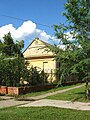 Greek Catholic Church in Jankov Most, Serbia


See also[edit]
- Catholic Church in Serbia
- Religion in Vojvodina
- Catholic Church in Kosovo
- Byzantine Catholic Church in Montenegro
References[edit]
- ^ a b c "Eparchy of San Nicola di Ruski Krstur (Križevci)". catholic-hierarchy.org. Retrieved July 2, 2019.
- ^ a b "Bishop Đura Džudžar". catholic-hierarchy.org. Retrieved July 2, 2019.
- ^ "Diocese of Križevci (Kreutz) (Križevci)". catholic-hierarchy.org. Retrieved July 2, 2019.
- ^ a b Ronald G. Roberson. "Greek Catholic Churches in Former Yugoslavia". CNEWA. Retrieved July 2, 2019.
- ^ Acta Apostolicae Sedis, 93 (2001), p. 339.
- ^ "Apostolic Exarchate of Serbia e Montenegro (Križevci)". catholic-hierarchy.org. Retrieved July 2, 2019.
- ^ Acta Apostolicae Sedis, 105 (2013), p. 187.
- ^ Elevation of the apostolic exarchate for Catholic faithful of Byzantine rite resident in Serbia to eparchy, and appointment of the first eparchial bishop
External links[edit]

- Eparchy of Križevci (in Croatian)
- Apostolic Exarchate of Macedonia (2001-2018) on Catholic Hierarchy
- Apostolic Exarchate of Serbia (2013-2018) on Catholic Hierarchy
- Rusyns in Serbia
- Catholic Information
| Eparchies |  | |
|---|---|---|
| Churches | ||
| Bishops | ||
| Former dioceses | ||
| See also | ||

| International | |
|---|---|
| National | |

- Greek Catholic Church of Croatia and Serbia
- Eastern Catholicism in Serbia
- Eastern Catholicism in Montenegro
- Eastern Catholic dioceses in Europe
- Christian organizations established in 2018
- Dioceses established in the 21st century
- 2018 establishments in Serbia
- Apostolic exarchates
- Ruski Krstur
- Pannonian Rusyns