


Just intonation
 | This article has multiple issues. Please help improve it or discuss these issues on the talk page. (Learn how and when to remove these template messages)
|


In music, just intonation or pure intonation is the tuning of musical intervals as whole number ratios (such as 3:2 or 4:3) of frequencies. An interval tuned in this way is said to be pure, and is called a just interval. Just intervals (and chords created by combining them) consist of tones from a single harmonic series of an implied fundamental. For example, in the diagram, if the notes G3 and C4 (labelled 3 and 4) are tuned as members of the harmonic series of the lowest C, their frequencies will be 3 and 4 times the fundamental frequency. The interval ratio between C4 and G3 is therefore 4:3, a just fourth.
In Western musical practice, bowed instruments such as violins, violas, cellos, and double basses are tuned using pure fifths or fourths. In contrast, keyboard instruments are rarely tuned using only pure intervals—the desire for different keys to have identical intervals in Western music makes this impractical. Some instruments of fixed pitch, such as electric pianos, are commonly tuned using equal temperament, in which all intervals other than octaves consist of irrational-number frequency ratios. Acoustic pianos are usually tuned with the octaves slightly widened, and thus with no pure intervals at all.
The phrase "just intonation" is used both to refer to one specific version of a 5-limit diatonic intonation, that is, Ptolemy's intense diatonic, as well to a whole class of tunings which use whole number intervals derived from the harmonic series. In this sense, "just intonation" is differentiated from equal temperaments and the "tempered" tunings of the early renaissance and baroque, such as Well temperament, or Meantone temperament. Since 5-limit has been the most prevalent just intonation used in western music, western musicians have subsequently tended to consider this scale to be the only version of just intonation. In principle, there are an infinite number of possible "just intonations," since the harmonic series is infinite.
Terminology[edit]
Just intonations are categorized by the notion of limits. The limit refers to the highest prime number fraction included in the intervals of a scale. All the intervals of any 3 limit just intonation will be multiples of 3. So 6 / 5 is included in 5 limit, because it has 5 in the denominator. If a scale uses an interval of 21:20, it is a 7 limit just intonation, since 21 is a multiple of 7. The interval 9 / 8 is a 3 limit interval because both numerator and denominator are multiples of 3 and 2. It is possible to have a scale that uses 5 limit intervals but not 2 limit intervals, i.e. no octaves, such as Wendy Carlos's alpha and beta scales. It is also possible to make diatonic scales that do not use fourths or fifths (3 limit), but use 5 and 7 limit intervals only. Thus, the notion of limit is a helpful distinction, but certainly does not tell us everything there is to know about a particular scale.
Pythagorean tuning, or 3 limit tuning, allows ratios including the numbers 2 and 3 and their powers, such as 3:2, a perfect fifth, and 9:4, a major ninth. Although the interval from C to G is called a perfect fifth for purposes of music analysis regardless of its tuning method, for purposes of discussing tuning systems musicologists may distinguish between a perfect fifth created using the 3:2 ratio and a tempered fifth using some other system, such as meantone or equal temperament.
5-limit tuning encompasses ratios additionally using the number 5 and its powers, such as 5:4, a major third, and 15:8, a major seventh. The specialized term perfect third is occasionally used to distinguish the 5:4 ratio from major thirds created using other tuning methods. 7 limit and higher systems use higher prime number partials in the overtone series (e.g. 11, 13, 17, etc.)
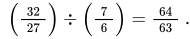
Commas are very small intervals that result from minute differences between pairs of just intervals. For example, the (5 limit) 5:4 ratio is different from the Pythagorean (3 limit) major third (81:64) by a difference of 81:80, called the syntonic comma. The septimal comma, the ratio of 64:63, is a 7 limit interval which is the distance between the Pythagorean semi-ditone, 32 / 27 , and the septimal minor third, 7:6 , since
A cent is a measure of interval size. It is logarithmic in the musical frequency ratios. The octave is divided into 1200 steps, 100 cents for each semitone. Cents are often used to describe how much a just interval deviates from 12 TET. For example, the major third is 400 cents in 12 TET, but the 5th harmonic, 5:4 is 386.314 cents. Thus, the just major third deviates by −13.686 cents.
History[edit]

Pythagorean tuning has been attributed to both Pythagoras and Eratosthenes by later writers, but may have been analyzed by other early Greeks or other early cultures as well. The oldest known description of the Pythagorean tuning system appears in Babylonian artifacts.[1]
During the second century AD, Claudius Ptolemy described a 5-limit diatonic scale in his influential text on music theory Harmonics, which he called "intense diatonic".[2] Given ratios of string lengths 120, 112+1/2, 100, 90, 80, 75, 66+2/3, and 60,[2] Ptolemy quantified the tuning of what would later be called the Phrygian scale (equivalent to the major scale beginning and ending on the third note) – 16:15, 9:8, 10:9, 9:8, 16:15, 9:8, and 10:9.
Ptolemy describes a variety of other just intonations derived from history (Pythagoras, Philolaus, Archytas, Aristoxenus, Eratosthenes, and Didymus) and several of his own discovery / invention, including many interval patterns in 3-limit, 5-limit, 7-limit, and even an 11-limit diatonic.
Non-Western music, particularly that built on pentatonic scales, is largely tuned using just intonation. In China, the guqin has a musical scale based on harmonic overtone positions. The dots on its soundboard indicate the harmonic positions: 1/8, 1/6, 1/5, 1/4, 1/3, 2/5, 1/2, 3/5, 2/3, 3/4, 4/5, 5/6, 7/8.[3] Indian music has an extensive theoretical framework for tuning in just intonation.[citation needed]
Diatonic scale[edit]


The prominent notes of a given scale may be tuned so that their frequencies form (relatively) small whole number ratios.
The 5-limit diatonic major scale is tuned in such a way that major triads on the tonic, subdominant, and dominant are tuned in the proportion 4:5:6, and minor triads on the mediant and submediant are tuned in the proportion 10:12:15. Because of the two sizes of wholetone – 9:8 (major wholetone) and 10:9 (minor wholetone) – the supertonic must be microtonally lowered by a syntonic comma to form a pure minor triad.
The 5-limit diatonic major scale (Ptolemy's intense diatonic scale) on C is shown in the table below:[4][5][6]: 78 [7]
| Note | Name | C | D | E | F | G | A | B | C | ||||||||
|---|---|---|---|---|---|---|---|---|---|---|---|---|---|---|---|---|---|
| Ratio from C | 1:1 | 9:8 | 5:4 | 4:3 | 3:2 | 5:3 | 15:8 | 2:1 | |||||||||
| Harmonic of Fundamental F | 24 | 27 | 30 | 32 | 36 | 40 | 45 | 48 | |||||||||
| Cents | 0 | 204 | 386 | 498 | 702 | 884 | 1088 | 1200 | |||||||||
| Step | Name | T | t | s | T | t | T | s | |||||||||
| Ratio | 9:8 | 10:9 | 16:15 | 9:8 | 10:9 | 9:8 | 16:15 | ||||||||||
| Cents | 204 | 182 | 112 | 204 | 182 | 204 | 112 | ||||||||||

In this example the interval from D up to A would be a wolf fifth with the ratio 40⁄27, about 680 cents, noticeably smaller than the 702 cents of the pure 3⁄2 ratio. This is mentioned by Schenker in reference to the teaching of Bruckner.[8]
For a justly tuned diatonic minor scale, the mediant is tuned 6:5 and the submediant is tuned 8:5. It would include a tuning of 9:5 for the subtonic. For example, on A:
| Note | Name | A | B | C | D | E | F | G | A | ||||||||
|---|---|---|---|---|---|---|---|---|---|---|---|---|---|---|---|---|---|
| Ratio from A | 1:1 | 9:8 | 6:5 | 4:3 | 3:2 | 8:5 | 9:5 | 2:1 | |||||||||
| Harmonic of Fundamental B♭ | 120 | 135 | 144 | 160 | 180 | 192 | 216 | 240 | |||||||||
| Cents | 0 | 204 | 316 | 498 | 702 | 814 | 1018 | 1200 | |||||||||
| Step | Name | T | s | t | T | s | T | t | |||||||||
| Ratio | 9:8 | 16:15 | 10:9 | 9:8 | 16:15 | 9:8 | 10:9 | ||||||||||
| Cents | 204 | 112 | 182 | 204 | 112 | 204 | 182 | ||||||||||
Twelve-tone scale[edit]
There are several ways to create a just tuning of the twelve-tone scale.
Pythagorean tuning[edit]
Pythagorean tuning can produce a twelve-tone scale, but it does so by involving ratios of very large numbers, corresponding to natural harmonics very high in the harmonic series that do not occur widely in physical phenomena. This tuning uses ratios involving only powers of 3 and 2, creating a sequence of just fifths or fourths, as follows:
| Note | G♭ | D♭ | A♭ | E♭ | B♭ | F | C | G | D | A | E | B | F♯ |
|---|---|---|---|---|---|---|---|---|---|---|---|---|---|
| Ratio | 1024:729 | 256:243 | 128:81 | 32:27 | 16:9 | 4:3 | 1:1 | 3:2 | 9:8 | 27:16 | 81:64 | 243:128 | 729:512 |
| Cents | 588 | 90 | 792 | 294 | 996 | 498 | 0 | 702 | 204 | 906 | 408 | 1110 | 612 |
The ratios are computed with respect to C (the base note). Starting from C, they are obtained by moving six steps (around the circle of fifths) to the left and six to the right. Each step consists of a multiplication of the previous pitch by 2⁄3 (descending fifth), 3⁄2 (ascending fifth), or their inversions (3⁄4 or 4⁄3).
Between the enharmonic notes at both ends of this sequence is a pitch ratio of 312/219 = 531441/524288, or about 23 cents, known as the Pythagorean comma. To produce a twelve-tone scale, one of them is arbitrarily discarded. The twelve remaining notes are repeated by increasing or decreasing their frequencies by a power of 2 (the size of one or more octaves) to build scales with multiple octaves (such as the keyboard of a piano). A drawback of Pythagorean tuning is that one of the twelve fifths in this scale is badly tuned and hence unusable (the wolf fifth, either F♯–D♭ if G♭ is discarded, or B–G♭ if F♯ is discarded). This twelve-tone scale is fairly close to equal temperament, but it does not offer much advantage for tonal harmony because only the perfect intervals (fourth, fifth, and octave) are simple enough to sound pure. Major thirds, for instance, receive the rather unstable interval of 81:64, sharp of the preferred 5:4 by an 81:80 ratio.[9] The primary reason for its use is that it is extremely easy to tune, as its building block, the perfect fifth, is the simplest and consequently the most consonant interval after the octave and unison.
Pythagorean tuning may be regarded as a "three-limit" tuning system, because the ratios can be expressed as a product of integer powers of only whole numbers less than or equal to 3.
Five-limit tuning[edit]
A twelve-tone scale can also be created by compounding harmonics up to the fifth: namely, by multiplying the frequency of a given reference note (the base note) by powers of 2, 3, or 5, or a combination of them. This method is called five-limit tuning.
To build such a twelve-tone scale (using C as the base note), we may start by constructing a table containing fifteen pitches:
Factor 1 / 9 1 / 3 1 3 9 5 D A E B F♯ note 10:9 5:3 5:4 15:8 45:32 ratio 182 ¢ 884 ¢ 386 ¢ 1088 ¢ 590 ¢ cents 1 B♭ F C G D note 16:9 4:3 1:1 3:2 9:8 ratio 996 ¢ 498 ¢ 0 ¢ 702 ¢ 204 ¢ cents 1 / 5 G♭ D♭ A♭ E♭ B♭ note 64:45 16:15 8:5 6:5 9:5 ratio 610 ¢ 112 ¢ 814 ¢ 316 ¢ 1018 ¢ cents
The factors listed in the first row and column are powers of 3 and 5, respectively (e.g., 1 / 9 = 3−2 ). Colors indicate couples of enharmonic notes with almost identical pitch. The ratios are all expressed relative to C in the centre of this diagram (the base note for this scale). They are computed in two steps:
- For each cell of the table, a base ratio is obtained by multiplying the corresponding factors. For instance, the base ratio for the lower-left cell is 1 / 9 × 1 / 5 = 1/ 45 .
- The base ratio is then multiplied by a negative or positive power of 2, as large as needed to bring it within the range of the octave starting from C (from 1:1 to 2:1). For instance, the base ratio for the lower left cell (1/ 45 ) is multiplied by 26, and the resulting ratio is 64:45, which is a number between 1:1 and 2:1.
Note that the powers of 2 used in the second step may be interpreted as ascending or descending octaves. For instance, multiplying the frequency of a note by 26 means increasing it by 6 octaves. Moreover, each row of the table may be considered to be a sequence of fifths (ascending to the right), and each column a sequence of major thirds (ascending upward). For instance, in the first row of the table, there is an ascending fifth from D and A, and another one (followed by a descending octave) from A to E. This suggests an alternative but equivalent method for computing the same ratios. For instance, one can obtain A, starting from C, by moving one cell to the left and one upward in the table, which means descending by a fifth and ascending by a major third:
- 2/3 × 5/4 = 10/12 = 5/6 .
Since this is below C, one needs to move up by an octave to end up within the desired range of ratios (from 1:1 to 2:1):
- 5/6 × 2/1 = 10/6 = 5/3 .
A 12 tone scale is obtained by removing one note for each couple of enharmonic notes. This can be done in four ways that have in common the removal of G♭, according to a convention which was valid even for C-based Pythagorean and quarter-comma meantone scales. Note that it is a diminished fifth, close to half an octave, above the tonic C, which is a discordant interval; also its ratio has the largest values in its numerator and denominator of all tones in the scale, which make it least harmonious: All are reasons to avoid it.
The following chart shows one way to obtain a 12 tone scale by removing one note for each pair of enharmonic notes. In this method one discards the first column of the table (labeled " 1 / 9 ").
Asymmetric scale Factor 1 / 3 1 3 9 5 A E B F♯ 5:3 5:4 15:8 45:32 1 F C G D 4:3 1:1 3:2 9:8 1 / 5 D♭ A♭ E♭ B♭ 16:15 8:5 6:5 9:5
This scale is "asymmetric" in the sense that going up from the tonic two semitones we multiply the frequency by 9 / 8 , while going down from the tonic two semitones we do not divide the frequency by 9 / 8 . For two methods that give "symmetric" scales, see Five-limit tuning: twelve-tone scale.
Extension of the twelve-tone scale[edit]
The table above uses only low powers of 3 and 5 to build the base ratios. However, it can be easily extended by using higher positive and negative powers of the same numbers, such as 52 = 25, 5−2 = 1⁄25, 33 = 27, or 3−3 = 1⁄27. A scale with 25, 35 or even more pitches can be obtained by combining these base ratios.
Indian scales[edit]
In Indian music, the just diatonic scale described above is used, though there are different possibilities, for instance for the sixth pitch (dha), and further modifications may be made to all pitches excepting sa and pa.[10]
Note sa re ga ma pa dha ni sa Ratio 1:1 9:8 5:4 4:3 3:2 5:3 or 27:16 15:8 2:1 Cents 0 204 386 498 702 884 or 906 1088 1200
Some accounts of Indian intonation system cite a given 12 swaras being divided into 22 shrutis.[11][12] According to some musicians, one has a scale of a given 12 pitches and ten in addition (the tonic, shadja (sa), and the pure fifth, pancham (pa), are inviolate (known as achala[13] in Indian music theory):
| Note | C | D♭↓ | D♭ | D↓ | D | E♭↓ | E♭ | E | E↑ | F | F↑ | F♯ | F♯↑ | G | A♭↓ | A♭ | A | A↑ | B♭↓ | B♭ | B | B↑ | C |
|---|---|---|---|---|---|---|---|---|---|---|---|---|---|---|---|---|---|---|---|---|---|---|---|
| Ratio | 1:1 | 256:243 | 16:15 | 10:9 | 9:8 | 32:27 | 6:5 | 5:4 | 81:64 | 4:3 | 27:20 | 45:32 | 729:512 | 3:2 | 128:81 | 8:5 | 5:3 | 27:16 | 16:9 | 9:5 | 15:8 | 243:128 | 2:1 |
| Cents | 0 | 90 | 112 | 182 | 204 | 294 | 316 | 386 | 408 | 498 | 520 | 590 | 612 | 702 | 792 | 814 | 884 | 906 | 996 | 1018 | 1088 | 1110 | 1200 |
Where we have two ratios for a given letter name or swara, we have a difference of 81:80 (22 cents), which is the syntonic comma[9] or the praman[13] in Indian music theory. These notes are known as chala.[13] The distance between two letter names comes in to sizes, poorna (256:243) and nyuna (25:24).[13] One can see the symmetry, looking at it from the tonic, then the octave.
(This is just one example of explaining a 22 Śhruti scale of tones. There are many different explanations.)
Practical difficulties[edit]
 |
Some fixed just intonation scales and systems, such as the diatonic scale above, produce wolf intervals when the approximately equivalent flat note is substituted for a sharp note not available in the scale, or vice versa. The above scale allows a minor tone to occur next to a semitone which produces the awkward ratio 32:27 for D→F, and still worse, a minor tone next to a fourth giving 40:27 for D→A. Flattening D by a comma to 10:9 alleviates these difficulties but creates new ones: D→G becomes 27:20, and D→B becomes 27:16. This fundamental problem arises in any system of tuning using a limited number of notes.
One can have more frets on a guitar (or keys on a piano) to handle both As, 9:8 with respect to G and 10:9 with respect to G so that A→C can be played as 6:5 while A→D can still be played as 3:2. 9:8 and 10:9 are less than 1/53 of an octave apart, so mechanical and performance considerations have made this approach extremely rare. And the problem of how to tune complex chords such as C6 add 9 (C→E→G→A→D), in typical 5 limit just intonation, is left unresolved (for instance, A could be 4:3 below D (making it 9:8, if G is 1) or 4:3 above E (making it 10:9, if G is 1) but not both at the same time, so one of the fourths in the chord will have to be an out-of-tune wolf interval). Most complex (added-tone and extended) chords usually require intervals beyond common 5 limit ratios in order to sound harmonious (for instance, the previous chord could be tuned to 8:10:12:13:18, using the A note from the 13th harmonic), which implies even more keys or frets. However the frets may be removed entirely—this, unfortunately, makes in-tune fingering of many chords exceedingly difficult, due to the construction and mechanics of the human hand—and the tuning of most complex chords in just intonation is generally ambiguous.
Some composers deliberately use these wolf intervals and other dissonant intervals as a way to expand the tone color palette of a piece of music. For example, the extended piano pieces The Well-Tuned Piano by La Monte Young and The Harp of New Albion by Terry Riley use a combination of very consonant and dissonant intervals for musical effect. In "Revelation", Michael Harrison goes even further, and uses the tempo of beat patterns produced by some dissonant intervals as an integral part of several movements.
When tuned in just intonation, many fixed-pitch instruments cannot be played in a new key without retuning the instrument. For instance, if a piano is tuned in just intonation intervals and a minimum of wolf intervals for the key of G, then only one other key (typically E♭) can have the same intervals, and many of the keys have a very dissonant and unpleasant sound. This makes modulation within a piece, or playing a repertoire of pieces in different keys, impractical to impossible.
Synthesizers have proven a valuable tool for composers wanting to experiment with just intonation. They can be easily retuned with a microtuner. Many commercial synthesizers provide the ability to use built-in just intonation scales or to create them manually. Wendy Carlos used a system on her 1986 album Beauty in the Beast, where one electronic keyboard was used to play the notes, and another used to instantly set the root note to which all intervals were tuned, which allowed for modulation. On her 1987 lecture album Secrets of Synthesis there are audible examples of the difference in sound between equal temperament and just intonation.
Many singers (especially barbershop quartets) and fretless instrument players naturally aim for a more just intonation when playing:
“Don’t be scared if your intonation differs from that of the piano. It is the piano that is out of tune. The piano with its tempered scale is a compromise in intonation." -Pablo Casals
In trying to get a more just system for instruments that is more adaptable like the human voice and fretless instruments, the tuning trade-offs between more consonant harmony versus easy transposability (between different keys) have traditionally been too complicated to solve mechanically, though there have been attempts throughout history with various drawbacks, including the archicembalo.
Since the advent of personal computing, there have been more attempts to solve the perceived problem by trying to algorithmically solve what many professional musicians have learned through practice and intuition. Four of the main problems are that consonance cannot be perfect for some complex chords, chords can have internal consistency but clash with the overall direction of the piece, and naively adjusting the tuning only taking into account chords in isolation can lead to a drift where the end of the piece is noticeably higher or lower in overall pitch rather than centered.
Software solutions like Hermode Tuning often analyze solutions chord by chord instead of taking in the global context of the whole piece like it's theorized human players do. Since 2017, there has been research to address these problems algorithmically through dynamically adapted just intonation and machine learning.[14]
Singing and scale-free instruments[edit]
|
The human voice is among the most pitch-flexible instruments in common use. Pitch can be varied with no restraints and adjusted in the midst of performance, without needing to retune. Although the explicit use of just intonation fell out of favour concurrently with the increasing use of instrumental accompaniment (with its attendant constraints on pitch), most a cappella ensembles naturally tend toward just intonation because of the comfort of its stability. Barbershop quartets are a good example of this.
The unfretted stringed instruments such as those from the violin family (the violin, the viola, and the cello), and the double bass are quite flexible in the way pitches can be adjusted. Stringed instruments that are not playing with fixed pitch instruments tend to adjust the pitch of key notes such as thirds and leading tones so that the pitches differ from equal temperament.
Trombones have a slide that allows arbitrary tuning during performance. French horns can be tuned by shortening or lengthening the main tuning slide on the back of the instrument, with each individual rotary or piston slide for each rotary or piston valve, and by using the right hand inside the bell to adjust the pitch by pushing the hand in deeper to flatten the note, or pulling it out to sharpen the note while playing. Some natural horns also may adjust the tuning with the hand in the bell, and valved cornets, trumpets, Flugelhorns, Saxhorns, Wagner tubas, and tubas have overall and valve-by-valve tuning slides, like valved horns.
Wind instruments with valves are biased towards natural tuning and must be micro-tuned if equal temperament is required.
Other wind instruments, although built to a certain scale, can be micro-tuned to a certain extent by using the embouchure or adjustments to fingering.
Western composers[edit]
Composers often impose a limit on how complex the ratios may become.[15][page needed] For example, a composer who chooses to write in 7-limit just intonation will not employ ratios that use powers of prime numbers larger than 7. Under this scheme, ratios like 11:7 and 13:6 would not be permitted, because 11 and 13 cannot be expressed as powers of those prime numbers ≤ 7 (i.e. 2, 3, 5, and 7).
Staff notation[edit]

Originally a system of notation to describe scales was devised by Hauptmann and modified by Helmholtz (1877); the starting note is presumed Pythagorean; a “+” is placed between if the next note is a just major third up, a “−” if it is a just minor third, among others; finally, subscript numbers are placed on the second note to indicate how many syntonic commas (81:80) to lower by.[16] For example, the Pythagorean major third on C is C+E () while the just major third is C+E1 (). A similar system was devised by Carl Eitz and used in Barbour (1951) in which Pythagorean notes are started with and positive or negative superscript numbers are added indicating how many commas (81:80, syntonic comma) to adjust by.[17] For example, the Pythagorean major third on C is C−E0 while the just major third is C−E−1. An extension of this Pythagorean-based notation to higher primes is the Helmholtz / Ellis / Wolf / Monzo system[18] of ASCII symbols and prime-factor-power vectors described in Monzo's Tonalsoft Encyclopaedia.[18]
While these systems allow precise indication of intervals and pitches in print, more recently some composers have been developing notation methods for Just Intonation using the conventional five-line staff. James Tenney, amongst others, preferred to combine JI ratios with cents deviations from the equal tempered pitches, indicated in a legend or directly in the score, allowing performers to readily use electronic tuning devices if desired.[19][20]
Beginning in the 1960s, Ben Johnston had proposed an alternative approach, redefining the understanding of conventional symbols (the seven "white" notes, the sharps and flats) and adding further accidentals, each designed to extend the notation into higher prime limits. His notation "begins with the 16th-century Italian definitions of intervals and continues from there."[21] Johnston notation is based on a diatonic C Major scale tuned in JI (Fig. 4), in which the interval between D (9:8 above C) and A (5:3 above C) is one syntonic comma less than a Pythagorean perfect fifth 3:2. To write a perfect fifth, Johnston introduces a pair of symbols, + and − again, to represent this comma. Thus, a series of perfect fifths beginning with F would proceed C G D A+ E+ B+. The three conventional white notes A E B are tuned as Ptolemaic major thirds (5:4) above F C G respectively. Johnston introduces new symbols for the septimal ( &
&  ), undecimal (↑ & ↓), tridecimal (
 &
&  ), and further prime-number extensions to create an accidental based exact JI notation for what he has named "Extended Just Intonation" (Fig. 2 & Fig. 3).[6]: 77–88 For example, the Pythagorean major third on C is C-E+ while the just major third is C-E♮ (Fig. 4).


In 2000–2004, Marc Sabat and Wolfgang von Schweinitz worked in Berlin to develop a different accidental-based method, the Extended Helmholtz-Ellis JI Pitch Notation.[23] Following the method of notation suggested by Helmholtz in his classic On the Sensations of Tone as a Physiological Basis for the Theory of Music, incorporating Ellis' invention of cents, and continuing Johnston's step into "Extended JI", Sabat and Schweinitz propose unique symbols (accidentals) for each prime dimension of harmonic space. In particular, the conventional flats, naturals and sharps define a Pythagorean series of perfect fifths. The Pythagorean pitches are then paired with new symbols that commatically alter them to represent various other partials of the harmonic series (Fig. 1). To facilitate quick estimation of pitches, cents indications may be added (e.g. downward deviations below and upward deviations above the respective accidental). A typically used convention is that cent deviations refer to the tempered pitch implied by the flat, natural, or sharp. A complete legend and fonts for the notation (see samples) are open source and available from the Plainsound Music Edition website.[24] For example, the Pythagorean major third on C is C-E♮ while the just major third is C-E♮↓ (see Fig. 4 for "combined" symbol)


Sagittal notation (from Latin sagitta, "arrow") is a system of arrow-like accidentals that indicate prime-number comma alterations to tones in a Pythagorean series. It is used to notate both just intonation and equal temperaments. The size of the symbol indicates the size of the alteration.[25]
The great advantage of such notation systems is that they allow the natural harmonic series to be precisely notated. At the same time, they provide some degree of practicality through their extension of staff notation, as traditionally trained performers may draw on their intuition for roughly estimating pitch height. This may be contrasted with the more abstract use of ratios for representing pitches in which the amount by which two pitches differ and the "direction" of change may not be immediately obvious to most musicians. One caveat is the requirement for performers to learn and internalize a (large) number of new graphical symbols. However, the use of unique symbols reduces harmonic ambiguity and the potential confusion arising from indicating only cent deviations.
Audio examples[edit]
- An A-major scale, followed by three major triads, and then a progression of fifths in just intonation.
- An A-major scale, followed by three major triads, and then a progression of fifths in equal temperament. The beating in this file may be more noticeable after listening to the above file.
- A pair of major thirds, followed by a pair of full major chords. The first in each pair is in equal temperament; the second is in just intonation. Piano sound.
- A pair of major chords. The first is in equal temperament; the second is in just intonation. The pair of chords is repeated with a transition from equal temperament to just intonation between the two chords. In the equal temperament chords a roughness or beating can be heard at about 4 Hz and about 0.8 Hz. In the just intonation triad, this roughness is absent. The square waveform makes the difference between equal temperament and just intonation more obvious.
See also[edit]
- Lists
- Article topics
References[edit]
- ^ West, M. L. (May 1994). "The Babylonian musical notation and the Hurrian melodic texts". Music & Letters. 75 (2): 161–179. doi:10.1093/ml/75.2.161. JSTOR 737674.
- ^ a b Barker, Andrew (1989). Greek musical writings. Cambridge: Cambridge University Press. p. 350. ISBN 0-521-23593-6. OCLC 10022960.
- ^ "Qin tunings, some theoretical concepts". silkqin.com. Table 2: Relative positions of studs on the qin.
- ^ a b Campbell, Murray & Greated, Clive (2001) [1987]. The Musician's Guide to Acoustics (Reprint of 1st ed.). London, UK & New York: Oxford University Press. pp. 172–173. ISBN 978-0-19-816505-7.
- ^ Wright, David (2009). Mathematics and Music. Mathematical World. Vol. 28. Providence, Rhode Island: American Mathematical Society. pp. 140–141. ISBN 978-0-8218-4873-9.
- ^ a b Johnston, Ben (2006) [2003]. "A notation system for extended Just Intonation". In Gilmore, Bob (ed.). 'Maximum Clarity' and Other Writings on Music. Urbana and Chicago, Illinois: University of Illinois Press. pp. 77–88. ISBN 978-0-252-03098-7.
- ^ Partch, Harry (1979). Genesis of a Music. pp. 165, 73. ISBN 978-0-306-80106-8.
- ^ Heinrich Schenker, Free Composition, p. 8, note 14: "Bruckner used to teach that even the sixth tone of the diatonic scale was dissonant and therefore had to be resolved downward."
- ^ a b Daniélou, Alain (1968). The Ragas of Northern Indian Music. London: Barrie & Rockliff. ISBN 0-214-15689-3.
- ^ Bagchee, Sandeep (1998). Nad: Understanding Raga music. India: BPI PVT Ltd. p. 23. ISBN 81-86982-07-8.
- ^ Daniélou, Alain (1995). Music and the Power of Sound: The influence of tuning and interval on consciousness (Rep Sub ed.). Inner Traditions. ISBN 0-89281-336-9.
- ^ Daniélou, Alain (1999). Introduction to the Study of Musical Scales. Oriental Book Reprint Corporation. ISBN 81-7069-098-6.
- ^ a b c d "22 shruti". 22shruti.com (main page). Retrieved 2023-06-28.
- ^ https://www.researchgate.net/publication/317591114_Playing_Music_in_Just_Intonation_-_A_Dynamically_Adapting_Tuning_Scheme&ved=2ahUKEwjU7p3_tL6EAxXJbPUHHXrRCTcQFnoECEoQAQ&usg=AOvVaw2j0eIzdqpVVVysw57bGaIe
- ^ Partch, Harry (1974). Genesis of a music : an account of a creative work, its roots and its fulfillments (second, enlarged ed.). New York. ISBN 0-306-71597-X. OCLC 624666.
{{cite book}}: CS1 maint: location missing publisher (link) - ^ Helmholtz, Hermann von (1885). On the Sensations of Tone as a Physiological Basis for the Theory of Music. Longmans, Green. p. 276. Note the use of the “+” between just major thirds, “−” between just minor thirds, “|” between Pythagorean minor thirds, and “±” between perfect fifths.
- ^ Benson, David J. (2007). Music: A Mathematical Offering. Cambridge University Press. p. 172. ISBN 978-0-521-85387-3.
who cites Eitz, Carl A. (1891). Das mathematisch-reine Tonsystem. Leipzig.{{cite book}}: CS1 maint: location missing publisher (link) - ^ a b Monzo. "Helmholtz / Ellis / Wolf / Monzo system". Tonalsoft Encyclopaedia. tonalsoft.com.
- ^ Garland, Peter, ed. (1984). The Music of James Tenney. Soundings. Vol. 13. Santa Fe, New Mexico: Soundings Press. OCLC 11371167.
- ^ Wannamaker, Robert, The Music of James Tenney, Volume 1: Contexts and Paradigms (University of Illinois Press, 2021), 288-89.
- ^ Kyle Gann. "Just Intonation Explained". KyleGann.com. Retrieved 28 February 2016.
- ^ Fonville, John (Summer 1991). "Ben Johnston's Extended Just Intonation: A guide for interpreters". Perspectives of New Music. 29 (2): 121, 106–137. doi:10.2307/833435. JSTOR 833435.
- ^ Stahnke, Manfred, ed. (2005). "The Extended Helmholtz-Ellis JI Pitch Notation: eine Notationsmethode für die natürlichen Intervalle". Mikrotöne und Mehr – Auf György Ligetis Hamburger Pfaden. Hamburg: von Bockel Verlag. ISBN 3-932696-62-X.
- ^ Sabat, Marc. "The Extended Helmholtz Ellis JI Pitch Notation" (PDF). Plainsound Music Edition. Retrieved 11 March 2014.
- ^ Secor, George D.; Keenan, David C. (2006). "Sagittal: A Microtonal Notation System" (PDF). Xenharmonikôn: An Informal Journal of Experimental Music. Vol. 18. pp. 1–2 – via Sagittal.org.
External links[edit]

- Art of the States: microtonal/just intonation works using just intonation by American composers
- The Chrysalis Foundation – Just Intonation: Two Definitions
- Dante Rosati's 21 Tone Just Intonation guitar
- Just Intonation by Mark Nowitzky
- Just intonation compared with meantone and 12-equal temperaments; a video featuring Pachelbel's canon.
- Just Intonation Explained by Kyle Gann
- A selection of Just Intonation works edited by the Just Intonation Network web published on the Tellus Audio Cassette Magazine project archive at UbuWeb
- Medieval Music and Arts Foundation
- Music Novatory – Just Intonation
- Why does Just Intonation sound so good?
- The Wilson Archives
- Barbieri, Patrizio. Enharmonic instruments and music, 1470–1900. (2008) Latina, Il Levante
- 22 Note Just Intonation Keyboard Software with 12 Indian Instrument Sounds Libreria Editrice
- Plainsound Music Edition – JI music and research, information about the Helmholtz-Ellis JI Pitch Notation
 | Division and ratio |  | |
|---|---|---|---|
| Fraction |
| ||
| Authority control databases: National |
|---|
