


1933 Long Beach earthquake
 Damage to the John Muir School, Pacific Avenue, Long Beach | |
   Los Angeles | |
| UTC time | 1933-03-11 01:54:00 |
|---|---|
| ISC event | 905457 |
| USGS-ANSS | ComCat |
| Local date | March 10, 1933 |
| Local time | 5:54 P.M. PST[1] |
| Magnitude | 6.4 Mw [2] |
| Depth | 10 km (6.2 mi) [2] |
| Epicenter | 33°37′52″N 118°00′00″W / 33.631°N 118.000°W [3] |
| Fault | Newport-Inglewood Fault[4] |
| Type | Strike-slip[5] |
| Areas affected | South Coast (California) United States |
| Total damage | $40 million [1] |
| Max. intensity | MMI VIII (Severe) [1] |
| Peak acceleration | 0.22 g [6] |
| Peak velocity | 20 cm/s (est) [7] |
| Tsunami | No |
| Aftershocks | M5.4 on Oct 2 1933 [8] |
| Casualties | 115–120 killed [1][9] |

The 1933 Long Beach earthquake took place on March 10 at 5:54 P.M. PST south of downtown Los Angeles. The epicenter was offshore, southeast of Long Beach, California, on the Newport–Inglewood Fault.[10] The earthquake had a magnitude estimated at 6.4 Mw, and a maximum Mercalli intensity of VIII (Severe). Damage to buildings was widespread throughout Southern California. It resulted in 115 to 120 fatalities and an estimated $40 million worth of property damage, equivalent to $941 million in 2023. The majority of the fatalities resulted from people running out of buildings exposing themselves to the falling debris.
Damage[edit]
_(14578209967).jpg)


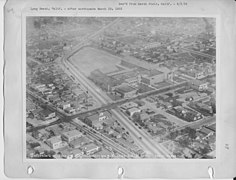
Major damage occurred in the densely populated city of Long Beach on the south-facing coast of Los Angeles County. However, the damage was also found in the industrial area south of downtown Los Angeles. An estimated 75,000 mi3 area was impacted, being felt as far as San Joaquin Valley, Owens Valley, and Northern Baja California. The magnitude of the earthquake is considered medium, but a significant amount of damage occurred due to unfavorable geological conditions (landfill, water-soaked alluvium) combined with poorly constructed buildings. At Long Beach, buildings collapsed, water tanks fell through roofs, and houses were tossed off their foundations. School buildings were among the structures that incurred the most severe damage.[11] Within seconds, 120 schools within the Long Beach area were damaged, 70 of which were destroyed. It was recognized that unreinforced masonry bearing walls were the reason that school buildings suffered so much damage.[12] On March 20, 2008, a Los Angeles Times article stated that "the 1933 quake changed the landscape, leading to improved school construction standards and a heightened awareness of earthquake risks."[13] Among other buildings, the La Grande Station, the main Los Angeles terminal of the Atchison, Topeka, and Santa Fe Railroad, was heavily damaged.[14]
Aftermath[edit]
The earthquake highlighted the need for earthquake-resistant design for structures in California. More than 230 school buildings either were destroyed, suffered major damage, or were judged unsafe to occupy. Casualties would have been much higher had the earthquake occurred a few hours earlier while school was in session. Many schools were permanently closed for a long time due to the building being unsafe for inhabitation or not meeting earthquake safety regulations at the time. Since these schools were deemed unsafe, students would report to classes held in tents. Large sums of money were needed to upgrade these damaged school buildings.[15]
Only 30 days after the earthquake, Governor James Rolph Jr. signed the Field Act to govern the planning, design and construction of public school buildings.[16] The Field Act mandated that building designs be based on high-level building standards adopted by the state and enforced by independent plan review and inspection. The plans and specifications must be prepared by competent designers qualified through state registration.[17]
A group of local scientists, architects, and builders formed a Joint Technical Committee on Earthquake Protection to propose ways to minimize loss of life and property in future earthquakes. The committee was chaired by CalTech physicist Robert Millikan, and included architects John C. Austin and Sumner Hunt. In June 1933 they released their report, which advocated for stronger building codes.
The Bureau of Public Roads also took action to rebuild roads, highways, and bridges.[18] The economy of Long Beach was able to return to normal swiftly because of the rise of the aircraft industry. To support the World War II efforts, Long Beach created naval yards and increased the number of aircraft produced. This directly helped Long Beach repair and stabilize the economy after the disaster.[19]
This earthquake prompted the federal government to play an active role in disaster relief. The government created the Reconstruction Finance Corporation, providing loans for reconstructing buildings that were affected during the natural disaster.
The damage to the La Grande Station indirectly led to the construction of Los Angeles Union Station, which was built on top of what was at that time the Chinatown, Los Angeles.[20]
Cause[edit]

A 2016 press release by the United States Geological Survey indicates that research shows the 1933 Long Beach earthquake may have been man-made, caused by oil and gas extraction underneath the city.[21] Further studies indicate that several, if not most earthquakes during the peak years of Los Angeles's oil boom were likely caused by tectonic stress induced by methods used at the time which did not replace the millions of barrels of removed oil with other liquids.[22][23] A study done by the USGS suggests that drilling in a Huntington Beach area caused the 1933 earthquake. Other studies done by the USGS have also indicated that oil drilling may have been responsible for earthquakes in the surrounding areas in the 1920s. This study was done by two scientists that studied early state oil drilling records. They found that the epicenters of these earthquakes were located near areas where significant changes[clarification needed] occurred in oil production areas.[24] Man-made earthquakes are still an issue, especially in Oklahoma and Texas. Recent studies have shown that the injection of wastewater into the ground increases the occurrence of earthquakes.[25]
Within the Los Angeles depositional basin, northwest-trending groups of faulted anticlines were viewed to be caused by oil and gas extraction underneath the city. The extraction of oil and gas produces salty water,[clarification needed] adding stress to faults, causing earthquakes. Often wastewater and natural gas production will increase the magnitude of the earthquake making them even more dangerous.[further explanation needed][26]
The Newport–Inglewood Fault, the source of the 1933 earthquake, is a right-lateral strike-slip fault trending northwest–southeast, and parallel to other major right-lateral faults in California. The fault spans about 46 miles onshore from Culver City to Newport Beach, where it enters the Pacific Ocean. This fault is expected to produce an earthquake of magnitude 7.4.[27] The 1933 Long Beach earthquake was only a magnitude of about 6.4, approximately ten times less vibration amplitude and 1,000 times less energy release than that of a magnitude of 7.4 earthquake.[citation needed]
Appearances in documentaries and popular culture[edit]
- Headline Shooter – newsreel footage
- Quake! Its Effect on Long Beach and Compton California by Guy D. Haselton[28][29][30]
- When The Earth Trembled – Pathé News[31]
- The Southern California Earthquake[32]
The earthquake plays a significant part in the novel The Last Tycoon (1941) by F. Scott Fitzgerald. During the disruption caused by the quake, the hero, Monroe Stahr, meets Kathleen Moore, with whom he falls in love.
The earthquake is also included in John Fante's Ask the Dust (1939), and the earthquake scene in the novel is subject of a public art installation in Pershing Square called "Hey Day" by Barbara McCarren.
Footage of the earthquake appeared in the film Encounter with Disaster, released in 1979 and produced by Sun Classic Pictures.
Gallery[edit]
-
 Compton
 -
 Compton
 -
 Long Beach
 -
 Long Beach
 -
 Gardena
 -
 Santa Ana


See also[edit]
- List of earthquakes in 1933
- List of earthquakes in California
- List of earthquakes in the United States
References[edit]
- ^ a b c d Stover, C. W.; Coffman, J. L. (1993), Seismicity of the United States, 1568–1989 (Revised) – U.S. Geological Survey Professional Paper 1527, United States Government Printing Office, pp. 78, 130, 131, archived from the original on 2019-04-13, retrieved 2016-10-29
- ^ a b ISC (2015), ISC-GEM Global Instrumental Earthquake Catalogue (1900–2009), Version 2.0, International Seismological Centre, archived from the original on 2019-05-20, retrieved 2015-07-12
- ^ USGS. "M6.4 – 7km WNW of Newport Beach, CA". United States Geological Survey. Archived from the original on 2018-03-16. Retrieved 2017-08-28.
- ^ "Southern California Earthquake Data Center: Long Beach Earthquake". scedc.caltech.edu. Retrieved 2021-10-26.
- ^ Hauksson, E.; Gross, S. (1991), "Source parameters of the 1933 Long Beach earthquake" (PDF), Bulletin of the Seismological Society of America, 81 (1), Seismological Society of America: 81, archived (PDF) from the original on 2016-04-23, retrieved 2016-04-09
- ^ "The 1933 Long Beach Earthquake".
- ^ Hough, S. E.; Graves, R. W. (22 June 2020). "Nature:The 1933 Long Beach Earthquake (California, USA) Ground Motions and Rupture Scenario". Scientific Reports. 10 (1): 10017. Bibcode:2020NatSR..1010017H. doi:10.1038/s41598-020-66299-w. PMC 7308333. PMID 32572047.
- ^ Hough, S. E.; Graves, R. W. (22 June 2020). "Nature:The 1933 Long Beach Earthquake (California, USA) Ground Motions and Rupture Scenario". Scientific Reports. 10 (1): 10017. Bibcode:2020NatSR..1010017H. doi:10.1038/s41598-020-66299-w. PMC 7308333. PMID 32572047.
- ^ National Geophysical Data Center / World Data Service (NGDC/WDS) (1972), Significant Earthquake Database (Data Set), National Geophysical Data Center, NOAA, doi:10.7289/V5TD9V7K, archived from the original on 2017-07-21, retrieved 2016-04-09
- ^ "Southern California Earthquake Data Center: Long Beach Earthquake". scedc.caltech.edu. Retrieved 2021-05-01.
- ^
 This article incorporates public domain material from Earthquake History of California. United States Geological Survey. Archived from the original on 2000-08-17. Retrieved 2018-05-02.
- ^ Green, Melvyn; Watson, Anne L. (1988). "Building Codes: Evaluating Buildings in Seismic Zones". APT Bulletin. 20 (2): 13–17. doi:10.2307/1494245. JSTOR 1494245.
- ^ "From the Archives: The 1933 Long Beach earthquake". Los Angeles Times. 2019-03-08. Retrieved 2021-11-17.
- ^ Southern California Institute of Architecture (2004). "On the History of the Santa Fe Freight Depot, Los Angeles". Archived from the original on 2006-04-27. Retrieved 2006-05-12.
- ^ J. Edmund Eaton (1933). "Long Beach, California, Earthquake of March 10, 1933: Geological Notes". AAPG Bulletin. 17. doi:10.1306/3d932b6c-16b1-11d7-8645000102c1865d. ISSN 0149-1423.
- ^ Alquist, A. E. (February 2007). "The Field Act and Public School Construction: A 2007 Perspective" (PDF). California Seismic Safety Commission. Archived (PDF) from the original on 3 November 2010. Retrieved 27 January 2011.
- ^ "The 1933 Long Beach Earthquake". conservation.ca.gov. Retrieved 2021-10-13.
- ^ Batten, Donna (2013), ""Natural Disasters." Gale Encyclopedia of Everyday Law", Gale Encyclopedia of Everyday Law, 2, Gale: 915–918, archived from the original on 2019-03-06, retrieved 2019-03-04
- ^ Johnson, Daniel J (2003), Long Beach. Dictionary of American History, vol. 5 (3rd ed.), Charles Scribner's Sons, pp. 148, 149
- ^ Chang, Irene (1990-11-14). "Metro Rail Excavation Casts New Light on 'Old Chinatown'". Los Angeles Times. Archived from the original on 2020-08-25. Retrieved 2021-12-18.
- ^ Davis, Donyelle (2016), Some Early 20th Century Earthquakes in Los Angeles Area Might Have Been Man-Made, Department of the Interior, U.S. Geological Survey
- ^ Hough, Susan (2018), "Revisiting Earthquakes in the Los Angeles, California, Basin During the Early Instrumental Period: Evidence for an Association With Oil Production", Journal of Geophysical Research: Solid Earth, 123 (12): 10, 684–10, 705, Bibcode:2018JGRB..12310684H, doi:10.1029/2017JB014616, S2CID 133679728
- ^ Lester, Liza (2018), Oil extraction likely triggered mid-century earthquakes in Los Angeles, American Geophysical Union blog
- ^ Barragan, Bianca (2016-10-31). "Study: Oil drilling may have caused devastating 1933 Long Beach earthquake". Curbed LA. Retrieved 2021-11-17.
- ^ "Study: Drilling may have caused deadly 1933 Long Beach quake". Orange County Register. 2016-10-31. Retrieved 2021-11-17.
- ^ Morton, Mary (2019-08-16). "Sinking Wastewater Triggers Deeper, Stronger Earthquakes". Eos. 100. doi:10.1029/2019eo130663. ISSN 2324-9250. S2CID 202188716.
- ^ "The 1933 Long Beach Earthquake". conservation.ca.gov. Retrieved 2021-11-09.
- ^ "Quake! (Short 1933)". IMDb.
- ^ "Quake! Its Effect on Long Beach and Compton California Silent Film Long Beach Earthquake". YouTube. Archived from the original on 2021-12-13.
- ^ "Quake! Its Effect on Long Beach and Compton California".
- ^ "When The Earth Trembled (1933)". YouTube.
- ^ "Long Beach / Southern California Earthquake – 1933 – CharlieDeanArchives / Archival Footage". YouTube.

Further reading[edit]
- Hough, S. E.; Graves, R. W. (2020), "The 1933 Long Beach Earthquake (California, USA): Ground Motions and Rupture Scenario", Scientific Reports, 10 (1): 10017, Bibcode:2020NatSR..1010017H, doi:10.1038/s41598-020-66299-w, PMC 7308333, PMID 32572047
- Hough, S. E.; Blair, L.; Ellison, S.; Graves, R. W.; Haefner, S.; Thompson, E. M.; van der Elst, N.; Page, M.; Wald, D. J. (2023). "Modern Products for a Vintage Event: An Update on the 1933 Long Beach, California, Earthquake". The Seismic Record. 3 (2): 171–181. Bibcode:2023SeisR...3..171H. doi:10.1785/0320230015. ISSN 2694-4006. S2CID 259419280.
External links[edit]

- USGS Historical Earthquakes – Long Beach, California – United States Geological Survey
- 75th Anniversary of the 1933 Long Beach Earthquake – California Department of Conservation
- National Information Service on Earthquake engineering page about Long Beach earthquake – National Information Service for Earthquake Engineering
- Catastrophe: A Bad One – Time
- Long Beach Earthquake: March 10, 1933 Cloyd E. Louis – Internet Archive
- The International Seismological Centre has a bibliography and/or authoritative data for this event.
- Image of workers clearing brick rubble from a sidewalk after the Long Beach earthquake, California, 1933. Los Angeles Times Photographic Archive (Collection 1429). UCLA Library Special Collections, Charles E. Young Research Library, University of California, Los Angeles.
- Watch Encounters with Disaster (1979) on the Internet Archive