


Areca catechu
| Areca catechu | |
|---|---|

| |

| |
| Betel nuts | |
Scientific classification 
| |
| Kingdom: | Plantae |
| Clade: | Tracheophytes |
| Clade: | Angiosperms |
| Clade: | Monocots |
| Clade: | Commelinids |
| Order: | Arecales |
| Family: | Arecaceae |
| Genus: | Areca |
| Species: | A. catechu
|
| Binomial name | |
| Areca catechu | |
| Synonyms[2] | |
| |
Areca catechu is a species of palm which grows in much of the tropical Pacific, Asia, and parts of east Africa. The palm is native to the Philippines,[1][3][2] but is widespread in cultivation and is considered naturalized in Malaysia, Indonesia, New Guinea, Taiwan, Madagascar, Cambodia, Laos, Myanmar, Thailand, Vietnam, southern China (Guangxi, Hainan, Yunnan), India, Nepal, Bangladesh, the Maldives, Sri Lanka, parts of the Pacific Islands, and also in the West Indies.[4][5]
Its fruits (called areca nuts or betel nuts) are chewed together with slaked lime and betel leaves for their stimulant and narcotic effects.
Taxonomy[edit]

Common names in English include areca palm, areca nut palm, betel palm, betel nut palm, Indian nut, Pinang palm and catechu.[1] This palm is commonly called the betel tree because its fruit, the areca nut, which are often chewed along with the betel leaf, a leaf from a vine of the family Piperaceae.
The species was first published by Carl Linnaeus in his book Species Plantarum on page 1189 in 1753.[2]
Description[edit]
Areca catechu is a medium-sized palm tree, growing straight to 20 m (66 ft) tall, with a trunk 10–15 cm (4–6 in) in diameter. The leaves are 1.5–2 m (4.9–6.6 ft) long, pinnate, with numerous, crowded leaflets.
Chemical composition[edit]
The seed contains alkaloids such as arecaidine and arecoline, which, when chewed, are intoxicating and slightly addictive. The seed also contains condensed tannins (procyanidins) called arecatannins,[6] which are carcinogenic.
The antibacterial activity of the seed has been studied.[7]
Uses[edit]

Betel nut chewing[edit]
Areca catechu is grown for its commercially important seed crop, the areca nut, which is the main component of the practice of betel nut chewing. It is popular throughout Southeast Asia, South Asia, Taiwan, Papua New Guinea and some nearby islands, parts of southern China, Madagascar, and the Maldives. The nut itself can be addictive and has direct link to oral cancers.[8][9] Chewing areca nut is a cause of oral submucous fibrosis, a premalignant lesion which frequently progresses to mouth cancer.[10][11]
The practice of chewing areca nuts originated in Island Southeast Asia, where the areca palm is native. The oldest known evidence of areca nut chewing was found in a burial pit in the Duyong Cave site in the Philippines (to which areca palms are native), which dates to around 4,630±250 BP. Its diffusion is closely tied to the Neolithic expansion of the Austronesian peoples. It was spread to the Indo-Pacific during prehistoric times, reaching Micronesia at 3,500 to 3,000 BP, Near Oceania at 3,400 to 3,000 BP; South India and Sri Lanka by 3,500 BP; Mainland Southeast Asia by 3,000 to 2,500 BP; Northern India by 1500 BP; and Madagascar by 600 BP. From India, it was also spread westwards to Persia and the Mediterranean. It was also previously present in the Lapita culture, based on archaeological remains dated from 3,600 to 2,500 BP, but it was not carried into Polynesia.[3]
Other uses[edit]
The areca palm is also used as an interior landscaping species. It is often used in large indoor areas such as malls and hotels. It will not fruit or reach full size if grown in this way. Indoors, it is a slow-growing, low-water, high-light plant that is sensitive to spider mites and occasionally mealybugs.
In India, the dried fallen leaves are collected and hot-pressed into disposable palm leaf plates and bowls.[12]
Cultural significance[edit]
.svg)
In Indonesia and Malaysia there are numerous place names using the words pinang, jambi or jambe (areca in Javanese, Sundanese, Balinese, and Old Malay). For example, the cities of Tanjung Pinang, Pangkal Pinang in Indonesia, the Indonesian province of Jambi and Penang Island (Pulau Pinang) off the west coast of Peninsular Malaysia. Fua Mulaku in the Maldives, Guwahati in Assam, Supari(সুপারি) in West Bengal and coastal areas of Kerala and Karnataka in India, are also some of the places named after a local name for areca nut.[citation needed]
Gallery[edit]
-
 Areca palm trunk with nuts
 -
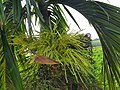 New buds of Areca catechu
 -
 Areca sapling, Coorg, India
 -
 An Areca catechu plantation in Taiwan
 -
 Areca palm fruit at Kerala, India
 -
 Young "betel" nuts in Malaysia
 -
 Areca catechu of Bangladesh
 -
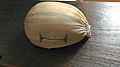 Hat palathoppi (Outer view) made of the leaf of Areca catechu in Kerala
 -
 Hat_ palathoppi (inner view) made of the leaf of Areca catechu in Kerala
 -
 Areca nut in Paan preparation, Myanmar


References[edit]
- ^ a b c "Areca catechu". Germplasm Resources Information Network. Agricultural Research Service, United States Department of Agriculture. Retrieved 2008-03-02.
- ^ a b c "Areca catechu L." Plants of the World Online. Royal Botanic Gardens Kew. Retrieved 2 May 2023.
- ^ a b Zumbroich TJ (2007–2008). "The origin and diffusion of betel chewing: a synthesis of evidence from South Asia, Southeast Asia and beyond". eJournal of Indian Medicine. 1: 87–140.
- ^ Jones, D. (2001), Palms Throughout The World, Reed New Holland, Australia.
- ^
- Baker W, Dransfield J (2016). "Beyond Genera Palmarum: progress and prospects in palm systematics". Botanical Journal of the Linnean Society. 182 (2). Oxford University Press: 207–233. doi:10.1111/boj.12401. ISSN 0024-4074. S2CID 88254797.
- This review cites this research.
- Heatubun C, Dransfield J, Flynn T, Tjitrosoedirdjo S, Mogea J, Baker W (2011). "A monograph of the betel nut palms (Areca: Arecaceae) of East Malesia". Botanical Journal of the Linnean Society. 168 (2). Oxford University Press: 147–173. doi:10.1111/j.1095-8339.2011.01199.x. ISSN 0024-4074. S2CID 82477722.
- ^ Kusumoto IT, Nakabayashi T, Kida H, Miyashiro H, Hattori M, Namba T, Shimotohno K (1995). "Screening of various plant extracts used in ayurvedic medicine for inhibitory effects on human immunodeficiency virus type 1 (HIV-1) protease". Phytotherapy Research. 9 (3): 180–184. doi:10.1002/ptr.2650090305. S2CID 84577539.
- ^ Rama Bhat P, Savitri V, Laxmi P, Jenitta E (2016). "A Study on the phytochemical analysis, silver nanoparticle synthesis and antibacterial activity from seed extract of Areca catechu L.". International Journal of Biochemistry Research & Review. 9 (1): 1–9.
- ^ Thomas and MacLennan (1992). "Slaked lime and betel nut cancer in Papua New Guinea". The Lancet. 340 (8819): 577–578. doi:10.1016/0140-6736(92)92109-S. PMID 1355157. S2CID 34296427.
- ^ Hemantha Amarasinghe (2010). "Betel-quid chewing with or without tobacco is a major risk factor for oral potentially malignant disorders in Sri Lanka: A case-control study". Oral Oncology. 46 (4): 297–301. doi:10.1016/j.oraloncology.2010.01.017. PMID 20189448.
- ^ Ray JG, Chatterjee R, Chaudhuri K (2019). "Oral submucous fibrosis: A global challenge. Rising incidence, risk factors, management, and research priorities". Periodontology 2000. 80 (1): 200–212. doi:10.1111/prd.12277. PMID 31090137. S2CID 155089425.
- ^ Marcello Spinella (2001). The psychopharmacology of herbal medicine: plant drugs that alter mind, brain, and behavior. MIT Press. pp. 233–. ISBN 978-0-262-69265-6. Retrieved 14 October 2011.
- ^ Palm Leaf Plates Archived 2016-09-16 at the Wayback Machine on the website TheWholeLeafCo.dom; viewed in September 2016
External links[edit]
