


B-flat major
| Relative key | G minor |
|---|---|
| Parallel key | B-flat minor |
| Dominant key | F major |
| Subdominant | E-flat major |
| Component pitches | |
| B♭, C, D, E♭, F, G, A | |
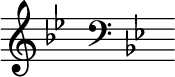
B-flat major is a major scale based on B♭, with pitches B♭, C, D, E♭, F, G, and A. Its key signature has two flats. Its relative minor is G minor and its parallel minor is B-flat minor.
The B-flat major scale is:

Many transposing instruments are pitched in B-flat major, including the clarinet, trumpet, tenor saxophone, and soprano saxophone. As a result, B-flat major is one of the most popular keys for concert band compositions.
Scale degree chords[edit]
- Tonic - B-flat major
- Supertonic - C minor
- Mediant - D minor
- Subdominant - E-flat major
- Dominant - F major
- Submediant - G minor
- Leading-tone - A diminished
History[edit]
Joseph Haydn's Symphony No. 98 is often credited as the first symphony written in that key, including trumpet and timpani parts. However, his brother Michael Haydn wrote one such symphony earlier, No. 36. Nonetheless, Joseph Haydn still gets credit for writing the timpani part at actual pitch with an F major key signature (instead of transposing with a C major key signature), a procedure that made sense since he limited that instrument to the tonic and dominant pitches.[1] Many editions of the work use no key signature and specify the instrument as "Timpani in B♭–F".
Notable classical compositions[edit]
- François Couperin
- Johann Sebastian Bach
- Luigi Boccherini
- Cello Concerto No. 9, G. 482
- Joseph Haydn
- Wolfgang Amadeus Mozart
- Ludwig van Beethoven
- Franz Schubert
- Impromptu No. 3, Op. 142
- Mass No. 3
- Der Hirt auf dem Felsen, D. 965
- Piano Sonata No. 21, D. 960
- Piano Trio No. 1, D. 898
- Symphony No. 2
- Symphony No. 5
- Felix Mendelssohn
- Symphony No. 2 (Lobgesang)
- String Quintet No. 2
- Cello Sonata No. 1
- Frédéric Chopin
- Robert Schumann
- Symphony No. 1, Op. 38, (Frühling)
- The second, fourth and sixth movement of Kreisleriana, Op. 16
- Humoreske for piano, Op. 20
- Faschingsschwank aus Wien for piano, Op. 26
- Franz Liszt
- Transcendental Étude No. 5 (Feux follets) from Transcendental Études
- Anton Bruckner
- Johannes Brahms
- Bohuslav Martinů
- Sergei Prokofiev
- Dmitri Shostakovich
- Ottorino Respighi
References[edit]
- ^ H. C. Robbins Landon, Haydn Symphonies, London: British Broadcasting Corporation (1966): 57
External links[edit]
 Media related to B-flat major at Wikimedia Commons

