


C minor
| Relative key | E-flat major |
|---|---|
| Parallel key | C major |
| Dominant key | G minor |
| Subdominant | F minor |
| Component pitches | |
| C, D, E♭, F, G, A♭, B♭ | |
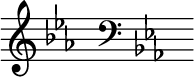
C minor is a minor scale based on C, consisting of the pitches C, D, E♭, F, G, A♭, and B♭. Its key signature consists of three flats. Its relative major is E♭ major and its parallel major is C major.
The C natural minor scale is:

Changes needed for the melodic and harmonic versions of the scale are written in with accidentals as necessary. The C harmonic minor and melodic minor scales are:


Scale degree chords[edit]
- Tonic - C minor
- Supertonic - D diminished
- Mediant - E-flat major
- Subdominant - F minor
- Dominant - G minor
- Submediant - A-flat major
- Subtonic - B-flat major
Notable compositions[edit]
- Charles-Valentin Alkan
- Johannes Sebastian Bach
- Ludwig van Beethoven (See Beethoven and C minor)
- Johannes Brahms
- Anton Bruckner
- Frédéric Chopin
- Gabriel Fauré
- Élégie, Op. 24
- Joseph Haydn
- Franz Liszt
- Gustav Mahler
- Felix Mendelssohn
- Wolfgang Amadeus Mozart
- Great Mass in C minor, K. 427 (417a)
- Piano Concerto No. 24, K. 491)
- Maurerische Trauermusik K. 477 (479a)
- Als Luise die Briefe ihres ungetreuen Liebhabers verbrannte, K. 517
- Adagio and Fugue in C minor. K. 546
- Wind Serenade in C minor. K. 388 (384a)
- Fantasy in C minor for violin and piano, K. 396 (385f)
- Piano Sonata in C minor, K. 457
- Fantasy in C minor, K. 475
- Kleiner Trauermarsch, K. 453a
- Sergei Prokofiev
- Sergei Rachmaninoff
- Camille Saint-Saëns
- Dmitri Shostakovich
- Franz Schubert
- Symphony No. 4, D. 417
- Piano Sonata No. 19, D. 958
- Impromptu No. 1, D. 899
See also[edit]
External links[edit]
 Media related to C minor at Wikimedia Commons


| Authority control databases: National |
|---|
