


Checkpoint Charlie
 | This article needs additional citations for verification. (March 2022) |


Checkpoint Charlie (or "Checkpoint C") was the best-known Berlin Wall crossing point between East Berlin and West Berlin during the Cold War (1947–1991), as named by the Western Allies.[1]
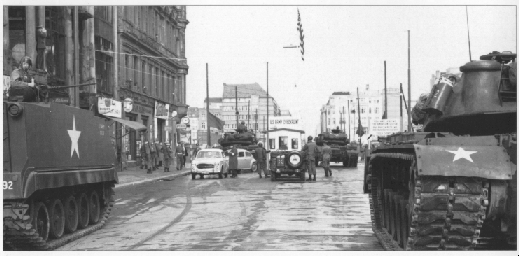
East German leader Walter Ulbricht agitated and maneuvered to get the Soviet Union's permission to construct the Berlin Wall in 1961 to stop emigration and defection westward through the Border system, preventing escape across the city sector border from East Berlin into West Berlin. Checkpoint Charlie became a symbol of the Cold War, representing the separation of East and West. Soviet and American tanks briefly faced each other at the location during the Berlin Crisis of 1961. On 26 June 1963, U.S. President John F. Kennedy visited Checkpoint Charlie and looked from a platform onto the Berlin Wall and into East Berlin.[2]
After the dissolution of the Eastern Bloc and the reunification of Germany, the American guard house at Checkpoint Charlie became a tourist attraction. It is now located in the Allied Museum in the Dahlem neighborhood of Berlin.52°30′27″N 13°23′25″E / 52.50750°N 13.39028°E
Background
[edit]
Emigration restrictions, the Inner German border and Berlin
[edit]By the early 1950s, the Soviet method of restricting emigration was emulated by most of the rest of the Eastern Bloc, including East Germany.[3] However, in occupied Germany, until 1952, the lines between East Germany and the western occupied zones remained easily crossed in most places.[4] Subsequently, the inner German border between the two German states was closed and a barbed-wire fence erected.
Even after closing of the inner German border officially in 1952,[5] the city sector border in between East Berlin and West Berlin remained considerably more accessible than the rest of the border because it was administered by all four occupying powers.[4] Accordingly, Berlin became the main route by which East Germans left for the West.[6] Hence the Berlin sector border was essentially a "loophole" through which Eastern Bloc citizens could still escape.[5]
The 3.5 million East Germans who had left by 1961 totaled approximately 20% of the entire East German population.[7] The emigrants tended to be young and well educated.[8] The loss was disproportionately great among professionals — engineers, technicians, physicians, teachers, lawyers and skilled workers.[7]
Berlin Wall constructed
[edit]The brain drain of professionals had become so damaging to the political credibility and economic viability of East Germany that the resecuring of the Soviet imperial frontier was imperative.[9] Between 1949 and 1961, over 2½ million East Germans fled to the West.[10] The numbers increased during the three years before the Berlin Wall was erected,[10] with 144,000 in 1959, 199,000 in 1960 and 207,000 in the first seven months of 1961 alone.[10][11] The East German economy suffered accordingly.[11]
On 13 August 1961, a barbed-wire barrier that would become the Berlin Wall separating East and West Berlin was erected by the East Germans.[9] Two days later, police and army engineers began to construct a more permanent concrete wall.[12] Along with the wall, the 830-mile (1336 km) zonal border became 3.5 miles (5.6 km) wide on its East German side in some parts of Germany with a tall steel-mesh fence running along a "death strip" bordered by mines, as well as channels of ploughed earth, to slow escapees and more easily reveal their footprints.[13]
Checkpoint
[edit]
Checkpoint Charlie was a crossing point in the Berlin Wall located at the junction of Friedrichstraße with Zimmerstraße and Mauerstraße (which for older historical reasons coincidentally means "Wall Street"). It is in the Friedrichstadt neighborhood. Checkpoint Charlie was designated as the single crossing point (on foot or by car) for foreigners and members of the Allied forces. (Members of the Allied forces were not allowed to use the other sector crossing point designated for use by foreigners, the Friedrichstraße railway station).[citation needed]
The name "Charlie" came from the letter C in the NATO phonetic alphabet; similarly for other Allied checkpoints on the Autobahn from the West: Checkpoint Alpha at Helmstedt and its counterpart Checkpoint Bravo at Dreilinden, Wannsee in the south-west corner of Berlin. The Soviets simply called it the Friedrichstraße Crossing Point (КПП Фридрихштрассе, KPP Fridrikhshtrasse). The East Germans referred officially to Checkpoint Charlie as the Grenzübergangsstelle ("Border Crossing Point") Friedrich-/Zimmerstraße.[citation needed]
As the most visible Berlin Wall checkpoint, Checkpoint Charlie was featured in movies[14] and books. A famous cafe and viewing place for Allied officials, armed forces and visitors alike, Cafe Adler ("Eagle Café"), was situated right on the checkpoint.
The development of the infrastructure around the checkpoint was largely asymmetrical, reflecting the contrary priorities of East German and Western border authorities. During its 28-year active life, the infrastructure on the Eastern side was expanded to include not only the wall, watchtower and zig-zag barriers, but a multi-lane shed where cars and their occupants were checked. However, the Allied authority never erected any permanent buildings. A wooden shed used as the guard house was replaced during the 1980s by a larger metal structure, now displayed at the Allied Museum in western Berlin. Their reasoning was that they did not consider the inner Berlin sector boundary an international border and did not treat it as such.[citation needed]
Related incidents
[edit]Stand-off between Soviet and U.S. tanks in October 1961
[edit]
Soon after the construction of the Berlin Wall in August 1961, a stand-off occurred between US and Soviet tanks on either side of Checkpoint Charlie. It began on 22 October as a dispute over whether East German border guards were authorized to examine the travel documents of a US diplomat based in West Berlin named Allan Lightner heading to East Berlin to watch an opera show there, since according to the agreement between all four Allied powers occupying Germany, there was to be free movement for Allied forces in Berlin and that no German military forces from either West Germany or East Germany were to be based in the city, and moreover the Western Allies did not (initially) recognise the East German state and its right to remain in its self-declared capital of East Berlin. Instead, Allied forces only recognised the authority of the Soviets over East Berlin rather than their East German allies. By 27 October, ten Soviet and an equal number of American tanks stood 100 yards apart on either side of the checkpoint. This stand-off ended peacefully on 28 October following a US-Soviet understanding to withdraw tanks and reduce tensions. Discussions between US Attorney General Robert F. Kennedy and Soviet intelligence officer Georgi Bolshakov played a vital role in realizing this tacit agreement.[15]
Early escapes
[edit]The Berlin Wall was erected with great speed by the East German government in 1961, but there were initially many means of escape that had not been anticipated. For example, Checkpoint Charlie was initially blocked only by a gate, and a citizen of the GDR (East Germany) smashed a car through it to escape, so a strong pole was erected. Another escapee approached the barrier in a convertible, the windscreen removed prior to the event, and slipped under the barrier. This was repeated two weeks later, so the East Germans duly lowered the barrier and added uprights.[16]
Death of Peter Fechter
[edit]
On 17 August 1962, a teenaged East German, Peter Fechter, was shot in the pelvis by East German guards while trying to escape from East Berlin. His body lay tangled in a barbed wire fence as he bled to death in full view of the world's media. He could not be rescued from West Berlin because he was a few metres inside the Soviet sector. East German border guards were reluctant to approach him for fear of provoking Western soldiers, one of whom had shot an East German border guard just days earlier. More than an hour later, Fechter's body was removed by the East German guards. A spontaneous demonstration formed on the American side of the checkpoint, protesting against the action of the East and the inaction of the West.[17]
A few days later, a crowd threw stones at Soviet buses driving towards the Soviet War Memorial, located in the Tiergarten in the British sector; the Soviets tried to escort the buses with armoured personnel carriers (APCs). Thereafter, the Soviets were only allowed to cross via the Sandkrug Bridge crossing (which was the nearest to Tiergarten) and were prohibited from bringing APCs. Western units were deployed in the middle of the night in early September with live armaments and vehicles, in order to enforce the ban.[citation needed]
Today: Tourist and memorial site
[edit]
Although the wall was opened in November 1989 and the checkpoint booth removed on 22 June 1990,[18] the checkpoint remained an official crossing for foreigners and diplomats until German reunification in October 1990.
Checkpoint Charlie has since become one of Berlin's primary tourist attractions, where some original remnants of the border crossing blend with reconstructed parts, memorial and tourist facilities.
The guard house on the American side was removed in 1990; it is now on display in the open-air museum of the Allied Museum in Berlin-Zehlendorf.[19] A copy of the guard house and the sign that once marked the border crossing was reconstructed later on roughly the same site. It resembles the first guard house erected during 1961, behind a sandbag barrier toward the border. Over the years this was replaced several times by guard houses of different sizes and layouts. The one removed in 1990 was considerably larger than the first one and did not have sandbags. Tourists used to be able to have their photographs taken for a fee with actors dressed somewhat as Allied military police standing in front of the guard house but Berlin authorities banned the practice in November 2019 stating the actors had been exploiting tourists by demanding money for photos at the attraction.[citation needed]
The course of the former wall and border is now marked in the street with a line of cobblestones.[citation needed]

An open-air exhibition was opened during the summer of 2006. Gallery walls along Friedrichstraße and Zimmerstraße give information about escape attempts, how the checkpoint was expanded, and its significance during the Cold War, in particular the confrontation of Soviet and American tanks in 1961. Also, an overview of other important memorial sites and museums about the division of Germany and the wall is presented.[citation needed]
Developers demolished the East German checkpoint watchtower in 2000, to make way for offices and shops. The watchtower was the last surviving major original Checkpoint Charlie structure. The city tried to save the tower but failed, as it was not classified as a historic landmark.[citation needed] Yet, that development project was never realised. To this day,[when?] the area between Zimmerstraße and Mauerstraße/Schützenstraße (the East German side of the border crossing) remains vacant, providing space for a number of temporary tourist and memorial uses. New plans since 2017 for a hotel on the site stirred a professional and political debate about appropriate development of the area. After the final listing of the site as a protected heritage area in 2018, plans were changed towards a more heritage-friendly approach.[20]
BlackBox Cold War Exhibition
[edit]The "BlackBox Cold War" exhibition has illuminated the division of Germany and Berlin since 2012. The free open-air exhibition offers original Berlin Wall segments and information about the historic site. However, the indoor exhibition (entrance fee required) illustrates Berlin's contemporary history with 16 media stations, a movie theatre and original objects and documents. It is run by the NGO Berliner Forum fuer Geschichte und Gegenwart e.V..[21]
Checkpoint Charlie Museum
[edit]
Near the location of the guard house is the Haus am Checkpoint Charlie. The "Mauermuseum - Museum Haus am Checkpoint Charlie" was opened on 14 June 1963[citation needed] in the immediate vicinity of the Berlin Wall. It shows photographs and fragments related to the separation of Germany. The border fortifications and the "assistance of the protecting powers" are illustrated. In addition to photos and documentation of successful escape attempts, the exhibition also showcases escape devices including a hot-air balloon, escape cars, chair lifts, and a mini-submarine.
From October 2004 until July 2005, the Freedom Memorial, consisting of original wall segments and 1,067 commemorative crosses, stood on a leased site.[22][23]
The museum is operated by the Arbeitsgemeinschaft 13. August e. V., a registered association founded by Dr. Rainer Hildebrandt. The director is Alexandra Hildebrandt, the founder's widow. The museum is housed in part in the "House at Checkpoint Charlie" building by architect Peter Eisenman.[citation needed]
With 850,000 visitors in 2007, the Checkpoint Charlie Museum is one of the most visited museums in Berlin and in Germany.[24]
In popular culture
[edit]Checkpoint Charlie figures in numerous Cold War-era espionage and political novels and films. Some examples:
James Bond (played by Roger Moore) passed through Checkpoint Charlie in the film Octopussy (1983) from West to East.[25]
Checkpoint Charlie is featured in the opening scene of the 1965 film The Spy Who Came in from the Cold (starring Richard Burton and Claire Bloom), based on the John le Carré novel of the same name.
In the feature film Bridge of Spies, imprisoned American student Frederic Pryor is released at Checkpoint Charlie as part of a deal to trade Pryor and U-2 pilot Francis Gary Powers for convicted Soviet spy Rudolf Abel. Pryor's release happens offscreen while the trade of Powers for Abel takes place at the Glienicke Bridge.
It was depicted in the opening scene of the film The Man from U.N.C.L.E (2015).
The 1985 film Gotcha! includes a scene where the protagonist (Anthony Edwards) transits through Checkpoint Charlie into West Berlin.
Elvis Costello mentions Checkpoint Charlie in his hit song "Oliver's Army".[26]
The 69 Eyes mentions Checkpoint Charlie in their song Feel Berlin, from the album Devils.
Trivia
[edit]At the border crossing from Hyder in Alaska, USA to Stewart in British Columbia, Canada, there is a humorous imitation of the Checkpoint Charlie sign with the inscription "You are leaving the American Sector" in English, French, and German, as well as a sign reading "Eastern Sektor"[27] (Stewart is indeed located east of Hyder). Hyder is the only place in the USA that can be legally entered without any border control. However, border control is required for entry into Canada; the sign was erected in 2015 as a protest after the Canadian administration announced plans to close the border control at night.[28]
See also
[edit]References
[edit]- ^ "A brief history of Checkpoint Charlie". Archived from the original on 19 March 2022. Retrieved 19 March 2022.
- ^ Andreas Daum, Kennedy in Berlin. New York: Cambridge University Press, 2008, pp. 134‒35.
- ^ Dowty 1989, p. 114
- ^ a b Dowty 1989, p. 121
- ^ a b Harrison 2003, p. 99
- ^ Maddrell, Paul (2006). Spying on Science: Western Intelligence in Divided Germany 1945–1961. Oxford University Press. pp. 56. ISBN 978-0-19-926750-7.
- ^ a b Dowty 1989, p. 122
- ^ Thackeray 2004, p. 188
- ^ a b Pearson 1998, p. 75
- ^ a b c Gedmin, Jeffrey (1992). "The Dilemma of Legitimacy". The hidden hand: Gorbachev and the collapse of East Germany. AEI studies. Vol. 554. American Enterprise Institute. p. 35. ISBN 978-0-8447-3794-2.
- ^ a b Dowty 1989, p. 123
- ^ Dowty 1989, p. 124
- ^ Black et al. 2000, p. 141
- ^ Blau, Christine (6 November 2014). "Insider's Guide to Cold War Berlin". National Geographic. Archived from the original on 20 October 2022. Retrieved 2 November 2018.
- ^ Kempe, Frederick (2011). Berlin 1961. Penguin Group (USA). pp. 478–479. ISBN 978-0-399-15729-5.
- ^ Dearden, Lizzie (7 November 2014). "Berlin Wall: What You Need To Know About the Barrier That Divided East and West". The Independent. Archived from the original on 4 April 2018. Retrieved 16 September 2017.
- ^ "Media battle ensues following the death of Peter Fechter". www.axelspringer.com. Retrieved 6 September 2023.
- ^ "June 22, 1990: Checkpoint Charlie Closes". ABC News. Archived from the original on 2 February 2012. Retrieved 21 June 2011.
- ^ "Allied Museum Berlin". Archived from the original on 21 June 2008.
- ^ Eddy, Melissa (5 February 2019). "At Checkpoint Charlie, Cold War History Confronts Crass Commercialism". The New York Times. Archived from the original on 11 February 2019. Retrieved 11 February 2019.
- ^ "Black Box Cold War". www.berlin.de. 25 May 2016. Archived from the original on 15 October 2019. Retrieved 15 October 2019.
- ^ "Berlin Council Targets 'Checkpoint Charlie' Memorial". NPR. Archived from the original on 26 January 2018. Retrieved 5 April 2018.
- ^ Checkpoint Charlie: Between Memorials and Snack Bars. In: Sites of Unity (Haus der Geschichte), 2022.
- ^ "Museen in Berlin: Die Top Ten – 4. Platz 4: Mauermuseum - Haus am Checkpoint Charly". www.berlin.de. 4 July 2014. Archived from the original on 7 November 2017. Retrieved 6 November 2017.
- ^ "Bond's Border Crossing (Checkpoint Charlie) – James Bond Locations". www.jamesbondmm.co.uk. Archived from the original on 16 May 2012. Retrieved 18 November 2011.
- ^ Elvis Costello – Oliver's Army, retrieved 7 January 2023
- ^ McGuire, Richard (2 June 2016), Checkpoint Charlie, retrieved 27 December 2023
- ^ Levin, Dan (4 July 2016). "In Hyder, roaming grizzlies, no police and large doses of Canada". Retrieved 27 December 2023.
Sources
[edit]- Black, Cyril E.; English, Robert D.; Helmreich, Jonathan E.; McAdams, James A. (2000), Rebirth: A Political History of Europe since World War II, Westview Press, ISBN 0-8133-3664-3
- Daum, Andreas, Kennedy in Berlin. New York: Cambridge University Press, 2008, ISBN 978-0-521-85824-3.
- Dowty, Alan (1989), Closed Borders: The Contemporary Assault on Freedom of Movement, Yale University Press, ISBN 0-300-04498-4
- Dowty, Alan (1988), "The Assault on Freedom of Emigration", World Affairs, 151 (2)
- Harrison, Hope Millard (2003), Driving the Soviets Up the Wall: Soviet-East German Relations, 1953–1961, Princeton University Press, ISBN 0-691-09678-3
- Pearson, Raymond (1998), The Rise and Fall of the Soviet Empire, Macmillan, ISBN 0-312-17407-1
- Thackeray, Frank W. (2004), Events that changed Germany, Greenwood Publishing Group, ISBN 0-313-32814-5
External links
[edit]| External media | |
|---|---|
| Images | |
 Tanks at 1961 checkpoint Tanks at 1961 checkpoint | |
| Western Allies Berlin website images | |
| Video | |
 Virtual e-Tour (Shockwave Player required) Virtual e-Tour (Shockwave Player required) | |
| The short film "Berlin Documentary (1961)" is available for free viewing and download at the Internet Archive. | |
| The short film "U.S. Army In Berlin: Checkpoint Charlie (1962)" is available for free viewing and download at the Internet Archive. |
 Media related to Checkpoint Charlie at Wikimedia Commons
- Museum Haus am Checkpoint Charlie


Visitor attractions in Berlin | ||
|---|---|---|
| Mitte |
|  |
| Western Berlin |
| |
| Eastern Berlin | ||
| Metropolitan region | ||
| International | |
|---|---|
| National | |

- Berlin Wall
- 1990 disestablishments in West Germany
- Berlin border crossings
- Allied occupation of Germany
- Checkpoints
- Cold War sites in Germany
- Buildings and structures in Mitte
- Buildings and structures in Friedrichshain-Kreuzberg
- 1961 establishments in East Germany
- Rebuilt buildings and structures in Berlin
- Tourist attractions in Berlin
- 1990 disestablishments in East Germany
- 1961 establishments in West Germany