


Extremely Large Telescope
 Artist's impression of the ELT | |
| Alternative names | ELT |
|---|---|
| Part of | European Southern Observatory  |
| Location(s) | Cerro Armazones, Antofagasta Province, Antofagasta Region, Chile |
| Coordinates | 24°35′21″S 70°11′30″W / 24.5893°S 70.1916°W |
| Organization | European Southern Observatory |
| Altitude | 3,046 m (9,993 ft) |
| Observing time | 320 nights per year |
| Built | 26 May 2017– |
| Telescope style | extremely large telescope infrared telescope Nasmyth telescope |
| Diameter | 39.3 m (128 ft 11 in) |
| Secondary diameter | 4.09 m (13 ft 5 in) |
| Tertiary diameter | 3.75 m (12 ft 4 in) |
| Angular resolution | 0.005 arcsecond |
| Collecting area | 978 m2 (10,530 sq ft) |
| Focal length | 743.4 m (2,439 ft 0 in) |
| Enclosure | dome |
| Website | elt |
  Location of Extremely Large Telescope | |
 Related media on Commons Related media on Commons | |
The Extremely Large Telescope (ELT) is an astronomical observatory under construction.[1] When completed, it will be the world's largest optical/near-infrared extremely large telescope. Part of the European Southern Observatory (ESO) agency, it is located on top of Cerro Armazones in the Atacama Desert of northern Chile.
The design consists of a reflecting telescope with a 39.3-metre-diameter (130-foot) segmented primary mirror and a 4.2 m (14 ft) diameter secondary mirror. The telescope will be supported by adaptive optics, six laser guide star units, and multiple large science instruments.[2][3] The observatory's design will gather 100 million times more light than the human eye, equivalent to about 10 times more light than the largest optical telescopes existing as of 2023, and will correct for atmospheric distortion. It has around 250 times the light gathering area of the Hubble Space Telescope and, according to the ELT's specifications, would provide images 16 times sharper than those from Hubble.[4]
The project was originally called the European Extremely Large Telescope (E-ELT), but the name was shortened in 2017.[5] The ELT is intended to advance astrophysical knowledge by enabling detailed studies of planets around other stars, the first galaxies in the Universe, supermassive black holes, and the nature of the Universe's dark sector, and to detect water and organic molecules in protoplanetary disks around other stars.[6] As planned in 2011, the facility was expected to take 11 years to construct, from 2014 to 2025.[7]
On 11 June 2012, the ESO Council approved the ELT programme's plans to begin civil works at the telescope site, with the construction of the telescope itself pending final agreement with governments of some member states.[8] Construction work on the ELT site started in June 2014.[9] By December 2014, ESO had secured over 90% of the total funding and authorized construction of the telescope to start, which will cost around one billion euros for the first construction phase.[10] The first stone of the telescope was ceremonially laid on 26 May 2017, initiating the construction of the dome's main structure and telescope.[11][12] The telescope passed the halfway point in its development and construction in July 2023, with completion and first light planned at that time for 2028.[13][3]
History[edit]

On 26 April 2010, the European Southern Observatory (ESO) Council selected Cerro Armazones, Chile, as the baseline site for the planned ELT.[15] Other sites that were under discussion included Cerro Macon, Salta, in Argentina; Roque de los Muchachos Observatory, on the Canary Islands; and sites in North Africa, Morocco, and Antarctica.[16][17]
Early designs included a segmented primary mirror with a diameter of 42 metres (140 feet) and an area of about 1,300 m2 (14,000 sq ft), with a secondary mirror with a diameter of 5.9 m (19 ft). However, in 2011 a proposal was put forward to reduce overall size by 13% to 978 m2, with a 39.3 m (130 ft) diameter primary mirror and a 4.2 m (14 ft) diameter secondary mirror.[2] This reduced projected costs from 1.275 billion to 1.055 billion euros and should allow the telescope to be finished sooner. The smaller secondary is a particularly important change; 4.2 m (14 ft) places it within the capabilities of multiple manufacturers, and the lighter mirror unit avoids the need for high-strength materials in the secondary mirror support spider.[18]: 15
.jpg)
ESO's Director General commented in a 2011 press release that "With the new E-ELT design we can still satisfy the bold science goals and also ensure that the construction can be completed in only 10–11 years."[19] The ESO Council endorsed the revised baseline design in June 2011 and expected a construction proposal for approval in December 2011.[19] Funding was subsequently included in the 2012 budget for initial work to begin in early 2012.[20] The project received preliminary approval in June 2012.[8] ESO approved the start of construction in December 2014, with over 90% funding of the nominal budget secured.[10]
The design phase of the 5-mirror anastigmat was fully funded within the ESO budget. With the 2011 changes in the baseline design (such as a reduction in the size of the primary mirror from 42 m to 39.3 m), in 2017 the construction cost was estimated to be €1.15 billion (including first generation instruments).[21][22] In 2014, the start of operations was planned for 2024.[12] Actual construction officially began in early 2017,[23] and as of 2023[update], first light is planned for 2028.[13]
Planning[edit]

ESO focused on the current design after a feasibility study concluded the proposed 100 m (328 ft) diameter, Overwhelmingly Large Telescope, would cost €1.5 billion (£1 billion), and be too complex. Both current fabrication technology and road transportation constraints limit single mirrors to being roughly 8 m (26 ft) per piece. The next-largest telescopes currently in use are the Keck Telescopes, the Gran Telescopio Canarias and the Southern African Large Telescope, which each use small hexagonal mirrors fitted together to make a composite mirror slightly over 10 m (33 ft) across. The ELT uses a similar design, as well as techniques to work around atmospheric distortion of incoming light, known as adaptive optics.[24]
A 40-metre-class mirror will allow the study of the atmospheres of extrasolar planets.[25] The ELT is the highest priority in the European planning activities for research infrastructures, such as the Astronet Science Vision and Infrastructure Roadmap and the ESFRI Roadmap.[26] The telescope underwent a Phase B study in 2014 that included "contracts with industry to design and manufacture prototypes of key elements like the primary mirror segments, the adaptive fourth mirror or the mechanical structure (...) [and] concept studies for eight instruments".[27]
Design[edit]

The ELT will use a novel design with a total of five mirrors.[28] The first three mirrors are curved (non-spherical) and form a three-mirror anastigmat design for excellent image quality over the 10-arcminute field of view (one-third of the width of the full Moon). The fourth and fifth mirrors are (almost) flat, and respectively provide adaptive optics correction for atmospheric distortions (mirror 4) and tip-tilt correction for image stabilization (mirror 5). The fourth and fifth mirrors also send the light sideways to one of two Nasmyth focal stations at either side of the telescope structure, allowing multiple large instruments to be mounted simultaneously.
ELT mirror and sensors contracts[edit]
Primary mirror[edit]

The 39-metre primary mirror will be composed of 798 hexagonal segments, each approximately 1.4 metres across and with 50 mm thickness.[30] Two segments will be re-coated and replaced each working day, to keep the mirror always clean and highly reflective.
Edge sensors constantly measure the positions of the primary mirror segments relative to their immediate neighbours. 2394 position actuators (3 for each segment) use this information to adjust the system, keeping the overall surface shape unchanged against deformations caused by external factors such as wind, gravity, temperature changes and vibrations.[31]
In January 2017,[32] ESO awarded the contract for the fabrication of the 4608 edge sensors to the FAMES consortium, which is composed of Fogale[33] and Micro-Epsilon.[34] These sensors can measure relative positions to an accuracy of a few nanometres, the most accurate ever used in a telescope.

In May 2017, ESO awarded two additional contracts. One was awarded to Schott AG who will manufacture the blanks of the 798 segments, as well as a maintenance set of 133 additional segments. This maintenance set allows segments to be removed, replaced, and recoated on a rotating basis once the ELT is in operation. The mirror is being cast from the same low-expansion ceramic Zerodur as the existing Very Large Telescope mirrors in Chile.

The other contract was awarded to the French company, Safran Reosc,[36] a subsidiary of Safran Electronics & Defense. They will receive the mirror blanks from Schott, and polish one mirror segment per day to meet the 7-year deadline. During this process, each segment will be polished until it has no surface irregularity greater than 7.5 nm root mean square. Afterward, Safran Reosc will then mount, test, and complete all optical testing before delivery. This is the second-largest contract for ELT construction and the third-largest contract ESO has ever signed.
The segment support system units for the primary mirror are designed and produced by CESA (Spain)[37] and VDL (the Netherlands). The contracts signed with ESO also include the delivery of detailed and complete instructions and engineering drawings for their production. Additionally, they include the development of the procedures required to integrate the supports with the ELT glass segments; to handle and transport the segment assemblies; and to operate and maintain them.[38]
As of July 2023, over 70% of the mirror segment blanks and their supporting structures have been manufactured,[3] and by early 2024 tens of segments had been polished.[39]
Secondary mirror[edit]

Making the secondary mirror is a major challenge as it is highly convex, and aspheric. It is also very large; at 4.2 metres in diameter and weighing 3.5 tonnes, it will be the largest secondary mirror ever employed on an optical telescope and the largest convex mirror ever produced.
In January 2017,[32] ESO awarded a contract for the mirror blank to Schott AG, who cast it later the same year from Zerodur.
Complex support cells are also necessary to ensure the flexible secondary and tertiary mirrors retain their correct shape and position; these support cells will be provided by SENER.[41] Like the tertiary mirror, the secondary mirror will be mounted on 32 points, with 14 along its edges and 18 on the back. The entire assembly will be mounted on a hexapod, allowing its position to be aligned every few minutes to sub-micrometer precision. Deformations on the secondary mirror have a much smaller effect on the final image compared to errors on the tertiary, quaternary, or quinary mirrors.[42]
The pre-formed glass-ceramic blank of the secondary mirror is being polished and tested by Safran Reosc.[43][44][3] The mirror will be shaped and polished to a precision of 15 nanometres (15 millionths of a millimetre) over the optical surface.
By early 2024 this mirror was reported to be close to final accuracy.[39]
Tertiary mirror[edit]
The 3.8-metre concave tertiary mirror, also cast from Zerodur, will be an unusual feature of the telescope. Most current large telescopes, including the VLT and the NASA/ESA Hubble Space Telescope, use two curved mirrors to form an image. In these cases, a small, flat tertiary mirror is sometimes introduced to divert the light to a convenient focus. However, in the ELT the tertiary mirror also has a curved surface, as the use of three mirrors delivers a better final image quality over a larger field of view than would be possible with a two-mirror design.[32]
Much like the secondary mirror (with which it shares many design characteristics), the tertiary mirror will be slightly deformable to regularly allow deviations to be corrected. Both mirrors will be mounted on 32 points, with 18 on their backside and 14 along their edges.[42]
As of July 2023, the tertiary mirror has been cast and is in polishing.[3]
Quaternary mirror[edit]
The 2.4-metre quaternary mirror is a 2-millimeter-thick flat adaptive mirror. With up to 8000 actuators, the surface can be readjusted one thousand times per second.[45] The deformable mirror will be the largest adaptive mirror ever made,[46] and consists of six component petals, control systems, and voice-coil actuators. The image distortion caused by the turbulence of the Earth's atmosphere can be corrected in real-time, as well as deformations caused by the wind upon the main telescope. The ELT's adaptive optics system will provide an improvement of about a factor of 500 in the resolution compared to the best seeing conditions achieved so far without adaptive optics.[46]
The AdOptica consortium,[47] partnered with INAF (Istituto Nazionale di Astrofisica) as subcontractors, are responsible for the design and manufacture of the quaternary mirror.[48] The 6 petals were cast by Schott in Germany and polished by Safran Reosc.[49][50]
As of July 2023, all 6 petals are completed and in the process of being integrated into their support structure.[3] The six laser sources for the adaptive optics system, which will work hand-in-hand with the quaternary mirror, have also been completed and are in testing.
Quinary mirror[edit]
The 2.7-metre by 2.2-metre quinary mirror is a tip-tilt mirror used to refine the image using adaptive optics. The mirror will include a fast tip-tilt system for image stabilization that will compensate perturbations caused by wind, atmospheric turbulence, and the telescope itself before reaching the ELT instruments.[51]
As of early 2024 the six component petals had been fabricated and are being brazed into a single unit.[39]
ELT dome and structure[edit]
Dome construction[edit]

The ELT dome will have a height of nearly 74 metres from the ground and a diameter of 86 metres,[52] making it the largest dome ever built for a telescope. The dome will have a total mass of around 6100 tonnes, and the telescope mounting and tube structure will have a total moving mass of around 2800 tonnes.
For the observing slit, two main designs were under study: one with two sets of nested doors, and the current baseline design, i.e. a single pair of large sliding doors. This pair of doors has a total width of 45.3 m.
ESO signed a contract for its construction,[53] together with the main structure of the telescopes, with the Italian ACe Consortium, consisting of Astaldi and Cimolai[54] and the nominated subcontractor, Italy's EIE Group.[55] The signature ceremony took place on 25 May 2016[56] at ESO's Headquarters in Garching bei München, Germany.
The dome is to provide needed protection to the telescope in inclement weather and during the day. A number of concepts for the dome were evaluated. The baseline concept for the 40m-class ELT dome is a nearly hemispherical dome, rotating atop a concrete pier, with curved laterally-opening doors. This is a re-optimisation from the previous design, aimed at reducing the costs, and it is being revalidated to be ready for construction.[57]
One year after signing the contract, and after the laying of the first stone ceremony in May 2017, the site was handed over to ACe, signifying the beginning of the construction of the dome's main structure.
Astronomical performance[edit]
In terms of astronomical performance the dome is required to be able to track about the 1-degree zenithal avoidance locus as well as preset to a new target within 5 minutes. This requires the dome to be able to accelerate and move at angular speeds of 2 degrees/s (the linear speed is approximately 5 km/h).[58]

The dome is designed to allow complete freedom to the telescope so that it can position itself whether it is opened or closed. It will also permit observations from the zenith down to 20 degrees from the horizon.
Windscreen[edit]
With such a large opening, the ELT dome requires the presence of a windscreen to protect the telescope's mirrors (apart from the secondary), from direct exposure to the wind. The baseline design of the windscreen minimises the volume required to house it. Two spherical blades, either side of the observing slit doors, slide in front of the telescope aperture to restrict the wind.
Ventilation and air-conditioning[edit]
The dome design ensures that the dome provides sufficient ventilation for the telescope not to be limited by dome seeing. For this the dome is also equipped with louvers, whereby the windscreen is designed to allow them to fulfill their function.
Computational fluid dynamic simulations and wind tunnel work are being carried out to study the airflow in and around the dome, as well as the effectiveness of the dome and windscreen in protecting the telescope.
Besides being designed for water-tightness, air-tightness is also one of the requirements as it is critical to minimise the air-conditioning load. The air-conditioning of the dome is necessary not only to thermally prepare the telescope for the forthcoming night but also in order to keep the telescope optics clean.
The air-conditioning of the telescope during the day is critical and the current specifications permit the dome to cool the telescope and internal volume by 10 °C over 12 hours.
Science goals[edit]
The ELT will search for extrasolar planets—planets orbiting other stars. This will include not only the discovery of planets down to Earth-like masses through indirect measurements of the wobbling motion of stars perturbed by the planets that orbit them, but also the direct imaging of larger planets and possibly even the characterisation of their atmospheres.[59] The telescope will attempt to image Earthlike exoplanets.[2]
Furthermore, the ELT's suite of instruments will allow astronomers to probe the earliest stages of the formation of planetary systems and to detect water and organic molecules in protoplanetary discs around stars in the making. Thus, the ELT will answer fundamental questions regarding planet formation and evolution.[6]
By probing the most distant objects the ELT will provide clues to understanding the formation of the first objects that formed: primordial stars, primordial galaxies and black holes and their relationships. Studies of extreme objects like black holes will benefit from the power of the ELT to gain more insight into time-dependent phenomena linked with the various processes at play around compact objects.[59]
The ELT is designed to make detailed studies of the first galaxies. Observations of these early galaxies with the ELT will give clues that will help understand how these objects form and evolve. In addition, the ELT will be a unique tool for making an inventory of the changing content of the various elements in the Universe with time, and to understand star formation history in galaxies.[60]
One of the goals of the ELT is the possibility of making a direct measurement of the acceleration of the Universe's expansion. Such a measurement would have a major impact on our understanding of the Universe. The ELT will also search for possible variations in the fundamental physical constants with time. An unambiguous detection of such variations would have far-reaching consequences for our comprehension of the general laws of physics.[60]
Instrumentation[edit]

The telescope will have several science instruments and will be able to switch from one instrument to another within minutes. The telescope and dome will also be able to change positions on the sky and start a new observation in a short time.
Four of its instruments, the first generation, will be available at or shortly after first light, while two others will begin operations later. Throughout its operation other instruments can be installed.[62]
The first generation includes four instruments: MICADO, HARMONI and METIS, along with the adaptive optics system MORFEO.
- HARMONI: The High Angular Resolution Monolithic Optical and Near-infrared Integral field spectrograph (HARMONI) will function as the telescope's workhorse instrument for spectroscopy.[63]
- METIS: The Mid-infrared ELT Imager and Spectrograph (METIS) will be a mid-infrared imager and spectrograph.[64]
- MICADO: The Multi-AO (adaptive optics) Imaging Camera for Deep Observations (MICADO) will be the first dedicated imaging camera for the ELT and will work with the Multiconjugate adaptive Optics Relay For ELT Observations, (MORFEO, formerly MAORY).[65][66]
The second generation of instruments consists of MOSAIC and ANDES.
- MOSAIC: A proposed multi-object spectrograph which will allow astronomers to trace the growth of galaxies and the distribution of matter from shortly after the Big Bang to the present day.[67]
- ANDES (formerly HIRES): The ArmazoNes high Dispersion Echelle Spectrograph will be used to search for indications of life on Earth-like exoplanets, find the first-born stars of the universe, test for possible variations of the fundamental constants of physics, and measure the acceleration of the Universe's expansion.[68]
Comparison[edit]


One of the largest optical telescopes operating today is the Gran Telescopio Canarias, with a 10.4 m aperture and a light-collecting area of 74 m2. Other planned extremely large telescopes include the 25 m/368 m2 Giant Magellan Telescope and 30 m/655 m2 Thirty Meter Telescope, which are also targeting the second half of the 2020 decade for completion. These two other telescopes roughly belong to the same next generation of optical ground-based telescopes.[69][70] Each design is much larger than previous telescopes.[2]
The size of the ELT has been reduced from its original design (Overwhelmingly Large Telescope). Even with that reduction, the ELT is significantly larger than both other planned extremely large telescopes.[2] It has the aim of observing the universe in greater detail than the Hubble Space Telescope by taking images 15 times sharper, although it is designed to be complementary to space telescopes, which typically have very limited observing time available.[25] The ELT's 4.2-metre secondary mirror is the same size as the primary mirror on the William Herschel Telescope, the second largest optical telescope in Europe.
| Name | Aperture diameter (m) |
Collecting area (m²) |
First light | Ref |
|---|---|---|---|---|
| Extremely Large Telescope (ELT) | 39.3 | 978 | 2028 | [71] |
| Thirty Meter Telescope (TMT) | 30.0 | 655 | ? | |
| Giant Magellan Telescope (GMT) | 25.4 | 368 | 2029 | [72] |
| Southern African Large Telescope (SALT) | 11.1 × 9.8 | 79 | 2005 | |
| Gran Telescopio Canarias (GTC) | 10.4 | 74 | 2007 | |
| Keck Telescopes | 10.0 | 76 | 1990, 1996 | |
| Very Large Telescope (VLT) | 8.2 | 50 (×4) | 1998–2000 | |
| Notes: Future first-light dates are provisional and likely to change. | ||||
The ELT under ideal conditions has an angular resolution of 0.005 arcsecond which corresponds to separating two light sources 1 AU apart from 200 pc (650 ly) distance, or two light sources 30 cm apart from roughly 12,000 km distance. At 0.03 arcseconds, the contrast is expected to be 108, sufficient to search for exoplanets.[73] The unaided human eye has an angular resolution of 1 arcminute which corresponds to separating two light sources 30 cm apart from 1 km distance.
Gallery[edit]
 | This section contains an unencyclopedic or excessive gallery of images. |
-
Artist's impression of the Extremely Large Telescope (ELT) in its enclosure on Cerro Armazones during night-time observations. The four beams shooting skywards are lasers that create artificial stars high in the Earth's atmosphere.
-
This video shows an artist's impression of the Extremely Large Telescope, the ELT. The protective dome is seen opening for a night observing the optical and infrared skies.
-
-
A 3D view of the new road to Cerro Armazones area in the Chilean desert. The road extends from the public Route B-710 to the top of the mountain where the European Extremely Large Telescope (E-ELT) will sit.
-
On 19 June 2014, a major milestone towards construction of the ELT was reached. Part of Cerro Armazones was blasted. This video provides a closer look at the event. Note that only natural sound is provided.
-
Construction workers using heavy machinery work in the Atacama Desert to flatten the top of the mountain for a platform large enough to host the ELT
-
This drone camera view gives an early indication of the scale of the project.
-
A video describing what the ELT will be
-
These drone visuals from Gerhard Hüdepohl show the future location of the ELT against the tranquil backdrop of the barren Chilean desert, as of September 2016.
-
 Rendering of the MICADO instrument[74]
 -
![The night sky over the construction site for the Extremely Large Telescope[75]](//upload.wikimedia.org/wikipedia/commons/thumb/7/7a/Potw2011a_-_The_Milky_Way.jpg/476px-Potw2011a_-_The_Milky_Way.jpg) The night sky over the construction site for the Extremely Large Telescope[75]
The night sky over the construction site for the Extremely Large Telescope[75]

![The night sky over the construction site for the Extremely Large Telescope[75]](/wiki/File:Potw2011a_-_The_Milky_Way.jpg)
-
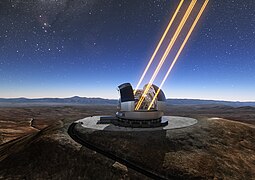 Artist's rendering of the ELT in operation[76]
 -
 Diagram of the 40m-class ELT primary mirror
 -
 ELT compared with one of the four existing VLT Unit Telescopes at Cerro Paranal, Chile
 -
 Rendering of ELT during the day
 -
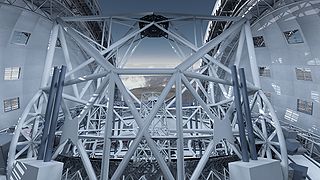 Model of the gigantic and intricate structure inside the enclosure of the ELT
 -
 Close-up of ELT primary mirror (artist's impression)[77]


See also[edit]
- Lists of telescopes
- List of largest optical reflecting telescopes
- List of optical telescopes
- Large Binocular Telescope
- European Solar Telescope (planned completion in 2025)
- Gran Telescopio Canarias
- Overwhelmingly Large Telescope
- List of astronomical observatories
- List of highest astronomical observatories
- Other observatories in Chile:
References[edit]
- ^ Overbye, Dennis (8 March 2024). "Good News and Bad News for Astronomers' Biggest Dream - The National Science Foundation takes a step (just one) toward an "extremely large telescope."". The New York Times. Archived from the original on 8 March 2024. Retrieved 8 March 2024.
- ^ a b c d e Schilling, Govert (14 June 2011). "Europe Downscales Monster Telescope to Save Money". Science Insider. Retrieved 29 June 2020.
- ^ a b c d e f "ESO's Extremely Large Telescope is now half completed". European Southern Observatory.
- ^ "The European Extremely Large Telescope ('ELT') Project". European Southern Observatory.
- ^ information@eso.org. "Renaming the E-ELT - Statement from ESO's Director General". www.eso.org. Retrieved 9 October 2023.
- ^ a b "ESO – Are We Alone?". Archived from the original on 17 January 2013. Retrieved 15 June 2011.
- ^ "The E-ELT construction proposal" (PDF). European Southern Observatory. Retrieved 16 January 2011.
- ^ a b Amos, Jonathan (11 June 2012). "European Extremely Large Telescope given go-ahead". BBC News. Retrieved 11 June 2012.
- ^ James Vincent (19 June 2014). "European Extremely Large Telescope to break ground (using dynamite) live later today". The Independent.
- ^ a b "Construction of Extremely Large Telescope Approved". Spaceref. 4 December 2014. Archived from the original on 23 August 2020. Retrieved 7 December 2014.
- ^ "Construction begins on world's largest telescope in Chilean desert". Reuters. 26 May 2017.
- ^ a b "Groundbreaking for the E-ELT". ESO. 19 June 2014.
- ^ a b "ELT Timeline".
- ^ "ESO To Build World's Biggest Eye on the Sky". European Southern Observatory. Retrieved 13 June 2012.
- ^ "E-ELT Site Chosen". ESO. 26 April 2010. Retrieved 17 August 2011.
- ^ "E-ELT: Finding a home". Archived from the original on 10 April 2019. Retrieved 24 January 2018.
- ^ Vernin, Jean; Muñoz-Tuñón, Casiana; Sarazin, Marc; Vazquez Ramió, Héctor; Varela, Antonia M.; Trinquet, Hervé; Miguel Delgado, José; Jiménez Fuensalida, Jesús; Reyes, Marcos; Benhida, Abdelmajid; Benkhaldoun, Zouhair; García Lambas, Diego; Hach, Youssef; Lazrek, M.; Lombardi, Gianluca; Navarrete, Julio; Recabarren, Pablo; Renzi, Victor; Sabil, Mohammed; Vrech, Rubén (1 November 2011). "European Extremely Large Telescope Site Characterization I: Overview" (PDF). Publications of the Astronomical Society of the Pacific. 123 (909): 1334–1346. Bibcode:2011PASP..123.1334V. doi:10.1086/662995. S2CID 120016246. Archived from the original (PDF) on 4 March 2016. Retrieved 22 June 2014.
- ^ "The E-ELT Construction Proposal" (PDF), ESO, 2 December 2011, retrieved 22 June 2014
- ^ a b "ESO Moves One Step Closer to the First Extremely Large Telescope". ESO. 15 June 2011. Retrieved 17 August 2011.
- ^ "The E-ELT Moves Closer to Reality". ESO. 9 December 2011.
- ^ "ESO's collaboration with industry". Xavier Bacons. ESO. 22 December 2017. Retrieved 14 January 2018.
- ^ "ESO – Preparing a Revolution". Archived from the original on 10 April 2019. Retrieved 24 January 2018.
- ^ "Construction begins on the world's first super telescope". phys.org.
- ^ Gilmozzi, Roberto; Spyromilio, Jason (March 2007). "The European Extremely Large Telescope (E-ELT)" (PDF). The Messenger. 127 (127): 11–19. Bibcode:2007Msngr.127...11G.
- ^ a b An Expanded View of the Universe – Science with the European Extremely Large Telescope (PDF). ESO Science Office.
- ^ "ESO – Europe's Window on the Universe". Retrieved 15 June 2011.
- ^ Astronet (2008), Bode, Michael F.; Cruz, Maria J.; Molster, Frank J. (eds.), The ASTRONET Infrastructure Roadmap: A Strategic Plan for European Astronomy (PDF), p. 43, ISBN 978-3-923524-63-1, archived from the original (PDF) on 23 September 2015, retrieved 21 June 2014
- ^ Hippler, Stefan (2019). "Adaptive Optics for Extremely Large Telescopes". Journal of Astronomical Instrumentation. 8 (2): 1950001–322. arXiv:1808.02693. Bibcode:2019JAI.....850001H. doi:10.1142/S2251171719500016. S2CID 119505402.
- ^ "Contracts Signed for ELT Mirrors and Sensors". www.eso.org. Retrieved 23 January 2017.
- ^ "ESO – E-ELT Optics". www.eso.org (in German). Retrieved 24 January 2017.
- ^ "Multiple E-ELT Mirror Segments Tested Together for the First Time". www.eso.org. Retrieved 24 January 2017.
- ^ a b c "Contracts Signed for ELT Mirrors and Sensors". www.eso.org. Retrieved 24 January 2017.
- ^ "FOGALE nanotech". www.fogale.fr. Retrieved 24 January 2017.
- ^ "High precision sensors, measurement devices and systems". www.micro-epsilon.com. Retrieved 24 January 2017.
- ^ "First ELT Main Mirror Segments Successfully Cast". www.eso.org. Retrieved 9 January 2018.
- ^ "Safran Reosc". Safran Reosc. Retrieved 29 May 2017.
- ^ "Compañía Española de Sistemas Aeronáuticos". Retrieved 29 May 2017.
- ^ "ESO Awards Contracts for E-ELT Primary Mirror Segment Support System Units". www.eso.org. Retrieved 29 May 2017.
- ^ a b c Roberto Tamai (19 June 2024). "ESO's ELT halfway through construction". SPIE.
- ^ "World's largest convex mirror blank ready for final touches – The ELT's M2 blank is being shipped to France for fine polishing". www.eso.org. Retrieved 16 January 2019.
- ^ "SENER group". SENER (in Spanish). Retrieved 24 January 2017.
- ^ a b "M2 and M3 Mirrors". ESO. Retrieved 12 July 2023.
- ^ "ESO Signs Contract to Polish the E-ELT Secondary Mirror – French company Reosc will polish the largest secondary mirror ever built". www.eso.org. Retrieved 24 January 2017.
- ^ "Safran". Safran. Retrieved 24 January 2017.
- ^ "ESO – E-ELT Optics". www.eso.org (in German). Retrieved 29 May 2017.
- ^ a b "ESO Awards Contract for E-ELT Adaptive Mirror Design Study". www.eso.org. Retrieved 29 May 2017.
- ^ "www.adoptica.it". www.adoptica.it. Retrieved 29 May 2017.
- ^ "Contract Signed for Final Design and Construction of Largest Adaptive Mirror Unit in the World". www.eso.org. Retrieved 29 May 2017.
- ^ "ESO Signs Contract for Deformable Shell Mirrors for E-ELT". www.eso.org. Retrieved 29 May 2017.
- ^ "M4 Mirror". www.eso.org. Retrieved 12 July 2023.
- ^ "M5 Mirror". European Southern Observatory. Retrieved 7 July 2021.
- ^ "Construction of the ELT Dome Foundations Begins". 27 September 2019. Retrieved 21 November 2020.
- ^ "ESO Signs Largest Ever Ground-based Astronomy Contract for ELT Dome and Telescope Structure". www.eso.org. Retrieved 29 May 2017.
- ^ "Cimolai – Home Page". www.cimolai.com. Retrieved 29 May 2017.
- ^ "EIE GROUP Home". www.eie.it. Retrieved 29 May 2017.
- ^ "ESO Signs Largest Ever Ground-based Astronomy Contract for E-ELT Dome and Telescope Structure". www.eso.org. Retrieved 24 January 2017.
- ^ "E-ELT Phase B Final Design Review" (PDF). www.eso.org. Retrieved 24 January 2017.
- ^ "ESO – E-ELT Enclosure". www.eso.org (in German). Retrieved 24 January 2017.
- ^ a b E-ELT The European Extremely Large Telescope – The World's Biggest Eye on the Sky (brochure). ESO.
- ^ a b "ESO – The First Objects in the Universe". Archived from the original on 10 April 2019. Retrieved 17 August 2011.
- ^ "First Instruments for E-ELT Approved". Retrieved 13 July 2015.
- ^ "Instruments | ELT | ESO". elt.eso.org. Retrieved 7 May 2022.
- ^ "ESO HARMONI Webpage". Retrieved 16 April 2019.
- ^ "ESO METIS Webpage". Retrieved 16 April 2019.
- ^ "ESO MICADO Webpage". Retrieved 16 April 2019.
- ^ "ESO MORFEO Webpage". Retrieved 23 April 2023.
- ^ "ESO MOSAIC Webpage". Retrieved 16 April 2019.
- ^ "ESO HIRES Webpage". Retrieved 16 April 2019.
- ^ "GMT Overview – Giant Magellan Telescope". Archived from the original on 9 June 2011. Retrieved 15 June 2011.
- ^ "About TMT – Thirty Meter Telescope". Archived from the original on 8 August 2011. Retrieved 15 June 2011.
- ^ "Extremely Large Telescope – Timeline". Retrieved 11 July 2023.
- ^ "Giant Magellan Telescope – 6th mirror cast". 12 March 2021. Retrieved 11 July 2023.
- ^ EPICS: direct imagine of exoplanets with the E-ELT
- ^ "ELT MICADO Instrument Passes Preliminary Design Review". www.eso.org. Retrieved 23 January 2020.
- ^ "The Milky Way above the ELT site". Retrieved 16 March 2020.
- ^ "Artist's rendering of the ELT in operation". www.eso.org. Retrieved 29 May 2017.
- ^ "Milestones Reached in Incredible Journey of ELT Main Mirror Segments". Retrieved 11 February 2020.
External links[edit]

- ESO Extremely Large Telescope
- ESO The Extremely Large Telescope ("E-ELT") Project
- Final stage for telescope design
- Green light for ELT
- Ground Telescope to Super Size
- MICADO
- METIS
- HARMONI
- Record mirror for Euro telescope BBC Online August 7 2006
- ESO Council Gives Green Light to Detailed Study of the European Extremely Large Telescope Spaceref.com[permanent dead link]
| Facilities |  | |
|---|---|---|
| Telescopes | ||
| Telescope instruments | ||
| Miscellany | ||


Astronomical observatories in Chile | |
|---|---|
| Antofagasta Region | |
| Coquimbo Region | |
| Santiago Metropolitan Region | |
| Ground-based |
|    | |||||||||
|---|---|---|---|---|---|---|---|---|---|---|---|
| Space missions |
| ||||||||||
| Related | |||||||||||


