


Portal:Outer space

Introduction


Outer space (or simply space) is the expanse beyond celestial bodies and their atmospheres. It contains ultra-low levels of particle densities, constituting a near-perfect vacuum of predominantly hydrogen and helium plasma, permeated by electromagnetic radiation, cosmic rays, neutrinos, magnetic fields and dust. The baseline temperature of outer space, as set by the background radiation from the Big Bang, is 2.7 kelvins (−270 °C; −455 °F).
The plasma between galaxies is thought to account for about half of the baryonic (ordinary) matter in the universe, having a number density of less than one hydrogen atom per cubic metre and a kinetic temperature of millions of kelvins. Local concentrations of matter have condensed into stars and galaxies. Intergalactic space takes up most of the volume of the universe, but even galaxies and star systems consist almost entirely of empty space. Most of the remaining mass-energy in the observable universe is made up of an unknown form, dubbed dark matter and dark energy.
Outer space does not begin at a definite altitude above Earth's surface. The Kármán line, an altitude of 100 km (62 mi) above sea level, is conventionally used as the start of outer space in space treaties and for aerospace records keeping. Certain portions of the upper stratosphere and the mesosphere are sometimes referred to as "near space". The framework for international space law was established by the Outer Space Treaty, which entered into force on 10 October 1967. This treaty precludes any claims of national sovereignty and permits all states to freely explore outer space. Despite the drafting of UN resolutions for the peaceful uses of outer space, anti-satellite weapons have been tested in Earth orbit.
The concept that the space between the Earth and the Moon must be a vacuum was first proposed in the 17th century after scientists discovered that air pressure decreased with altitude. The immense scale of outer space was grasped in the 20th century when the distance to the Andromeda galaxy was first measured. Humans began the physical exploration of space later in the same century with the advent of high-altitude balloon flights. This was followed by crewed rocket flights and, then, crewed Earth orbit, first achieved by Yuri Gagarin of the Soviet Union in 1961. The economic cost of putting objects, including humans, into space is very high, limiting human spaceflight to low Earth orbit and the Moon. On the other hand, uncrewed spacecraft have reached all of the known planets in the Solar System. Outer space represents a challenging environment for human exploration because of the hazards of vacuum and radiation. Microgravity has a negative effect on human physiology that causes both muscle atrophy and bone loss. (Full article...)
Selected article

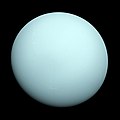
Uranus is the seventh planet from the Sun; it is the third largest and fourth most massive planet in the Solar System. Uranus was the first planet discovered in modern times. Though it is visible to the naked eye like the five classical planets, it was never recognised as a planet by ancient observers due to its dimness. Sir William Herschel announced its discovery on March 13, 1781, expanding the known boundaries of the solar system. Uranus' atmosphere, although similar to Jupiter and Saturn in being composed primarily of hydrogen and helium, contains a higher proportion of "ices" such as water, ammonia and methane, along with the usual traces of hydrocarbons. It has the coldest planetary atmosphere in the solar system, with a minimum temperature of 49 K, and has a complex layered cloud structure in which water is thought to make up the lowest clouds, while methane makes up the uppermost layer of clouds. In 1986, images from the Voyager 2 space probe showed Uranus as a virtually featureless planet in visible light without the cloud bands or storms associated with the other giants. The wind speeds on Uranus can reach 250 m/s (560 mph).
Selected picture
-


Pioneer plaque The Pioneer plaque, which was included on both Pioneer 10 and Pioneer 11 unmanned spacecraft, the first man-made objects to leave the Solar System. Made from gold-anodised aluminium, the plaque shows the figures of a man and a woman along with several symbols that are designed to provide information about the origin of the spacecraft. However, the mean time for the spacecraft to come within 30 astronomical units of a star is longer than the current age of our galaxy. -
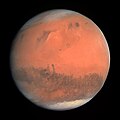 Photograph credit: European Space AgencyMars is the fourth planet from the Sun and is known as the "Red Planet" due to its reddish appearance as seen from Earth. The planet is named after Mars, the Roman god of war. A terrestrial planet, Mars has a thin atmosphere and surface features reminiscent both of the impact craters of the Moon and the volcanoes, valleys, deserts and polar ice caps of the Earth. The planet has the highest mountain in the Solar System, Olympus Mons, as well as the largest canyon, Valles Marineris. Mars's rotation period and seasonal cycles are also similar to those of the Earth. Of all the planets in the Solar System other than Earth, Mars is the most likely to harbour liquid water and perhaps life. There are ongoing investigations assessing Mars's past potential for habitability, as well as the possibility of extant life. Future astrobiology missions are planned, including NASA's Mars 2020 rover and the European Space Agency (ESA)'s Rosalind Franklin rover. In November 2016, NASA reported finding a large amount of underground ice in the Utopia Planitia region of the planet. The volume of water detected has been estimated to be equivalent to the volume of water in Lake Superior. Mars has two moons, Phobos and Deimos, which are small and irregularly shaped.
This picture is a true-colour image of Mars, taken from a distance of about 240,000 kilometres (150,000 mi) by the OSIRIS instrument on ESA's Rosetta spacecraft, during its February 2007 flyby of the planet. The image was generated using OSIRIS's orange (red), green and blue filters. -
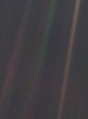 Pale Blue Dot is the name given to this 1990 photo of Earth taken from Voyager 1 when its vantage point reached the edge of the Solar System, a distance of roughly 3.7 billion miles (6 billion kilometres). Earth can be seen as a blueish-white speck approximately halfway down the brown band to the right. The light band over Earth is an artifact of sunlight scattering in the camera's lens, resulting from the small angle between Earth and the Sun. Carl Sagan came up with the idea of turning the spacecraft around to take a composite image of the Solar System. Six years later, he reflected, "All of human history has happened on that tiny pixel, which is our only home."
 -
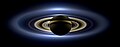 The Day the Earth Smiled refers to the date July 19, 2013, on which the Cassini spacecraft turned to image Saturn, its entire ring system, and the Earth from a position where Saturn eclipsed the Sun. Cassini imaging team leader and planetary scientist Carolyn Porco called for all the world's people to reflect on humanity's place in the cosmos, to marvel at life on Earth, and to look up and smile in celebration. The final mosaic, shown here, was released four months later and includes planets Earth, Mars, and Venus, and a host of Saturnian moons.
 -

Astronaut Bruce McCandless using a Manned Maneuvering Unit Credit: NASAA Manned Maneuvering Unit (MMU) is a jet pack (propulsion backpack that snaps onto the back of the space suit) which has been used on untethered spacewalks from NASA's Space Shuttle, allowing an astronaut to move independently from the shuttle. The MMU was used on three Shuttle missions in 1984. It was first tested on February 7 during mission STS-41-B by astronauts Bruce McCandless II (seen here) and Robert L. Stewart. -
 Photo: Adam EvansThe Andromeda Galaxy is a spiral galaxy approximately 2.5 million light-years away. The image, created using a hydrogen-alpha filter, also shows Messier objects 32 and 110, as well as NGC 206 and the star Nu Andromedae. On December 15, 1612, German astronomer Simon Marius became the first person to describe the galaxy using a telescope.
 -
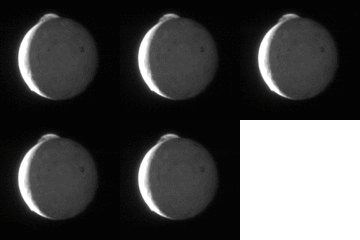 Photo credit: New Horizons probeAn animation of an eruption by the Tvashtar Paterae volcanic region on the innermost of Jupiter's Galilean moons, Io. The ejecta plume is 330 km (205 mi) high, though only its uppermost half is visible in this image, as its source lies over the moon's limb on its far side. This animation consists of a sequence of five images taken by NASA's New Horizons probe on March 1, 2007, over the course of eight minutes from 23:50 UTC.
 -
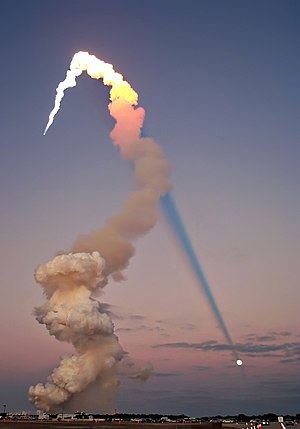
Space Shuttle Atlantis launch plume The launch of Space Shuttle Atlantis on STS-98, February 7 2001, at sunset. The sun is behind the camera, and the shape of the plume is cast across the vault of the sky, intersecting the rising full moon. The top portion of the plume is bright because it is illuminated directly by the sun; the lower portions are in the Earth's shadow. After launch, the shuttle must engage in a pitch and roll program so that the vehicle is below the external tank and SRBs, as evidenced in the plume trail. The vehicle climbs in a progressively flattening arc, because achieving low orbit requires much more horizontal than vertical acceleration. -
 Map credit: Ignace-Gaston PardiesIgnace-Gaston Pardies (1636–1673) was a French Catholic priest and scientist. His celestial atlas, entitled Globi coelestis in tabulas planas redacti descriptio, comprised six charts of the night sky and was first published in 1674. The atlas uses a gnomonic projection so that the plates make up a cube of the celestial sphere. The constellation figures are drawn from Uranometria, but were carefully reworked and adapted to a broader view of the sky. This is the second plate from a 1693 edition of Pardies's atlas, featuring constellations including Pegasus and Andromeda, visible in the northern sky.
 -
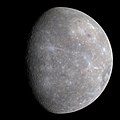 Mercury is the smallest and closest to the Sun of the eight planets in the Solar System. It has no known natural satellites. The planet is named after the Roman deity Mercury, the messenger to the gods.
 -
 Image credit: Dave JarvisAn illustration of relative astronomical orders of magnitude, starting with the terrestrial planets of the Solar System in image 1 (top left) and ending with the largest known star, VY Canis Majoris, at the bottom right. The biggest celestial body in each image is shown on the left of the next frame.
 -
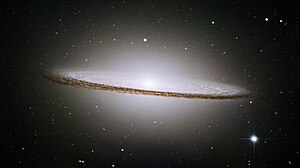
Sombrero Galaxy The Sombrero Galaxy is a spiral galaxy in the Virgo constellation. It was discovered in the late 1700s. It is about 28 million light years away and is just faint enough to be invisible to the naked eye but easily visible with small telescopes. In our sky, it is about one-fifth the diameter of the full moon. M104 is moving away from Earth at about 1,000 kilometers per second. -
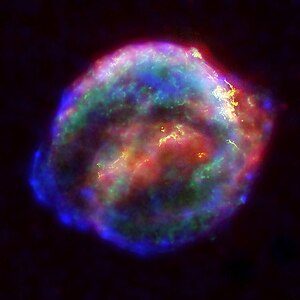
Kepler's Supernova Credit: NASAThis Supernova remnant of Kepler's Supernova (SN 1604) is made up of the materials left behind by the gigantic explosion of a star. There are two possible routes to this end: either a massive star may cease to generate fusion energy in its core, and collapse inward under the force of its own gravity, or a white dwarf star may accumulate material from a companion star until it reaches a critical mass and undergoes a similar collapse. In either case, the resulting supernova explosion expels much or all of the stellar material with great force. -
 NGC 4414 is an unbarred spiral galaxy about 62 million light-years away in the constellation Coma Berenices. It is a flocculent spiral galaxy, with short segments of spiral structure but without the dramatic well-defined spiral arms of a grand design spiral. NGC 4414 is a very isolated galaxy, with no signs of past interactions with other galaxies.
 -
 Photograph credit: NASA / JPL / Space Science InstituteThe Cassini–Huygens space-research project involved a collaboration between NASA, the European Space Agency, and the Italian Space Agency to send a probe to study the planet Saturn and its system, including its rings and its natural satellites.
This natural-color mosaic image, combining thirty photographs, was taken by the Cassini orbiter over the course of approximately two hours on 23 July 2008 as it panned its wide-angle camera across Saturn and its ring system as the planet approached equinox. Six moons are pictured in the panorama, with the largest, Titan, visible at the bottom left. -
 Photo credit: Spitzer Space TelescopeThis infrared image shows hundreds of thousands of stars crowded into the swirling core of our spiral Milky Way galaxy. In visible-light pictures, this region cannot be seen at all because cosmic dust lying between Earth and the galactic center blocks our view.
 -
-
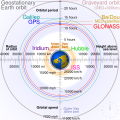 Animation credit: CmgleeThis is an animation showing geocentric satellite orbits, to scale with the Earth, at 3,600 times actual speed. The second-outermost (shown in grey) is a geostationary orbit, 35,786 kilometres (22,236 miles) above Earth's equator and following the direction of Earth's rotation, with an orbital period matching the planet's rotation period (a geosynchronous orbit). An object in such an orbit will appear to occupy a fixed position in the sky. Some 300 kilometres (190 miles) farther away is the graveyard orbit (brown), used for satellites at the end of their operational lives. Nearer to the Earth are the orbits of navigational satellites, such as Galileo (turquoise), BeiDou (beige), GPS (blue) and GLONASS (red), in medium Earth orbits. Much closer to the planet, and within the inner Van Allen belt, are satellites in low Earth orbit, such as the Iridium satellite constellation (purple), the Hubble Space Telescope (green) and the International Space Station (magenta).
 -
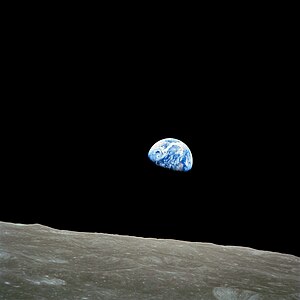
Earthrise, as seen by Apollo 8 Credit: William Anders"Earthrise," the first occasion in which humans saw the Earth seemingly rising above the surface of the Moon, taken during the Apollo 8 mission on December 24, 1968. This view was seen by the crew at the beginning of its fourth orbit around the Moon, although the very first photograph taken was in black-and-white. Note that the Earth is in shadow here. A photo of a fully lit Earth would not be taken until the Apollo 17 mission. -
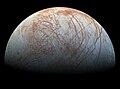 Realistic-color mosaic of images of Jupiter's moon Europa taken by NASA's Jupiter orbiter Galileo in 1995 and 1998. This view of the moon's anti-Jovian hemisphere shows numerous lineae, linear features created via a tectonic process in which crustal plates of water ice floating on a subsurface ocean (kept warm by tidal flexing) shift in relative position. Reddish regions are areas where the ice has a higher mineral content. The north polar region is at right. (Geologic features are annotated in Commons.)
 -
 Photograph: NASA/JPL-Caltech/University of ArizonaThe Helix Nebula is a large planetary nebula located in the constellation Aquarius. Discovered by Karl Ludwig Harding, probably before 1824, it is one of the closest to Earth of all the bright planetary nebulae, about 215 parsecs (700 light-years) away. It is similar in appearance to the Cat's Eye Nebula and the Ring Nebula.
 -

Color-composite image of the Pleiades from the Digitized Sky Survey Credit: NASA, ESA, AURA/Caltech, Palomar ObservatoryThe Pleiades (also known as M45 or the Seven Sisters) is an open cluster in the constellation of Taurus. It is among the nearest to the Earth of all open clusters, probably the best known and certainly the most striking to the naked eye.


.jpg)


.jpg)


.jpg)
.jpg)


General images
-
 A dusty trail from the early Solar System to carbonaceous dust today. (from Cosmic dust)
 -
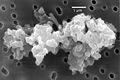 Porous chondrite dust particle (from Cosmic dust)
 -
 Astronomers used the James Webb Space Telescope to image the warm dust around a nearby young star, Fomalhaut, in order to study the first asteroid belt ever seen outside of the Solar System in infrared light. (from Cosmic dust)
 -
 Surface of Mars by the Spirit rover (2004) (from Space exploration)
 -
 The boundary between space and Earth, at an altitude of 100 km, roughly where the yellow line of airglow is visible. (from Outer space)
 -
 Tupan Patera on Io (from Space exploration)
 -
 Because of the hazards of a vacuum, astronauts must wear a pressurized space suit while outside their spacecraft.
 -
 Interstellar medium and astrosphere meeting (from Interstellar medium)
 -
 This light-year-long knot of interstellar gas and dust resembles a caterpillar. (from Interstellar medium)
 -

-
 Voyager 1 is the first artificial object to reach the interstellar medium. (from Interstellar medium)
 -
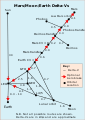 Delta-v's in km/s for various orbital maneuvers (from Space exploration)
 -
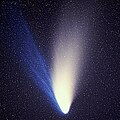 The sparse plasma (blue) and dust (white) in the tail of comet Hale–Bopp are being shaped by pressure from solar radiation and the solar wind, respectively.
 -
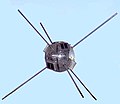 Vanguard 1 is expected to remain in orbit for 240 years. (from Space debris)
 -
 Atmospheric attenuation in dB/km as a function of frequency over the EHF band. Peaks in absorption at specific frequencies are a problem, due to atmosphere constituents such as water vapor (H2O) and carbon dioxide (CO2). (from Interstellar medium)
 -
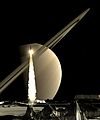 Artistic image of a rocket lifting from a Saturn moon (from Space exploration)
 -
 A micrometeoroid left this crater on the surface of Space Shuttle Challenger's front window on STS-7. (from Space debris)
 -
 Concept art for a NASA Vision mission (from Space exploration)
 -
 Growth of tracked objects in orbit and related events; efforts to manage outer space global commons have so far not reduced the debris or the growth of objects in orbit (from Space debris)
 -
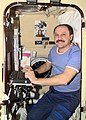 Crew quarters on Zvezda, the base ISS crew module (from Space exploration)
 -
 The black background is outer space as seen from Earth's surface at night. The interplanetary dust cloud is illuminated and visible as zodiacal light, with its parts the false dawn, gegenschein and the rest of its band, which is visually crossed by the Milky Way (from Outer space)
 -
 Debris impacts on Mir's solar panels degraded their performance. The damage is most noticeable on the panel on the right, which is facing the camera with a high degree of contrast. Extensive damage to the smaller panel below is due to impact with a Progress spacecraft. (from Space debris)
 -
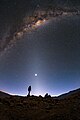 Zodiacal light caused by cosmic dust. (from Cosmic dust)
 -
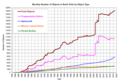 Objects in Earth orbit including fragmentation debris, November 2020, NASA: ODPO (from Space debris)
 -
-
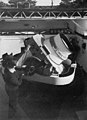 Baker-Nunn cameras were widely used to study space debris. (from Space debris)
 -
-
 Illustration of Earth's atmosphere gradual transition into outer space (from Outer space)
 -
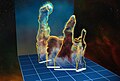 Three-dimensional structure in Pillars of Creation. (from Interstellar medium)
 -
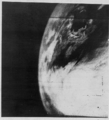 First television image of Earth from space, taken by TIROS-1 (1960) (from Space exploration)
 -
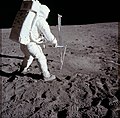
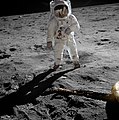 Astronaut Buzz Aldrin had a personal Communion service when he first arrived on the surface of the Moon. (from Space exploration)
 -
 Apollo 16 LEM Orion, the Lunar Roving Vehicle and astronaut John Young (1972) (from Space exploration)
 -
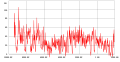 Reconstruction of solar activity over 11,400 years. Period of equally high activity over 8,000 years ago marked. (from Space climate)
 -
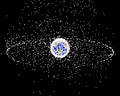 A computer-generated map of objects orbiting Earth, as of 2005. About 95% are debris, not working artificial satellites (from Outer space)
 -
 The diversity found in the different types and scales of astronomical objects make the field of study increasingly specialized. (from Outline of space science)
 -
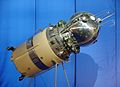 Model of Vostok spacecraft (from Space exploration)
 -
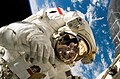 Astronaut Piers Sellers during the third spacewalk of STS-121, a demonstration of orbiter heat shield repair techniques (from Outline of space science)
 -

-
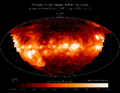 The distribution of ionized hydrogen (known by astronomers as H II from old spectroscopic terminology) in the parts of the Galactic interstellar medium visible from the Earth's northern hemisphere as observed with the Wisconsin Hα Mapper (Haffner et al. 2003). (from Interstellar medium)
 -
 Outer space from the International Space Station at 400 km (250 mi) altitude in low Earth orbit. In the background the Milky Way's interstellar space is visible, as well as in the foreground, above Earth, the airglow of the ionosphere just below and beyond the so-defined edge of space the Kármán line in the thermosphere (from Outer space)
 -
 Near-Earth space showing the low-Earth (blue), medium Earth (green), and high Earth (red) orbits. The last extends beyond the radius of geosynchronous orbits (from Outer space)
 -
 A MESSENGER image from 18,000 km showing a region about 500 km across (2008) (from Space exploration)
 -
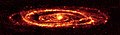 Cosmic dust of the Andromeda Galaxy as revealed in infrared light by the Spitzer Space Telescope. (from Cosmic dust)
 -
 V-2 Rocket in the Peenemünde Museum (from Space exploration)
 -
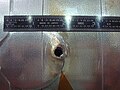 Space Shuttle Endeavour had a major impact on its radiator during STS-118. The entry hole is about 5.5 mm (0.22 in), and the exit hole is twice as large. (from Space debris)
 -
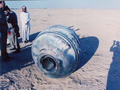 Saudi officials inspect a crashed PAM-D module in January 2001. (from Space debris)
 -
 For the first time, the NASA / ESA / Canadian Space Agency / James Webb Space Telescope has observed the chemical signature of carbon-rich dust grains at redshift, which is roughly equivalent to one billion years after the birth of the Universe, this observation suggests exciting avenues of investigation into both the production of cosmic dust and the earliest stellar populations in our Universe. (from Cosmic dust)
 -
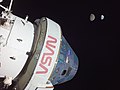 Earth and the Moon as seen from cislunar space on the 2022 Artemis 1 mission (from Outer space)
 -
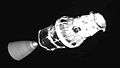
 Apollo CSM in lunar orbit (from Space exploration)
 -
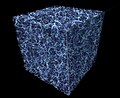 Large-scale matter distribution in a cubic section of the universe. The blue fiber-like structures represent the matter, and the empty regions in between represent the cosmic voids of the intergalactic medium (from Outer space)
 -
 Major elements of 200 stratospheric interplanetary dust particles. (from Cosmic dust)
 -
 Debris density in low Earth orbit (from Space debris)
 -
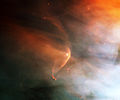 Bow shock formed by the magnetosphere of the young star LL Orionis (center) as it collides with the Orion Nebula flow
 -

-
 Spatial density of LEO space debris by altitude, according to 2011 a NASA report to the United Nations Office for Outer Space Affairs (from Space debris)
 -
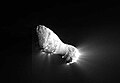 Comet 103P/Hartley (2010) (from Space exploration)
 -
 A proposed timeline of the origin of space, from physical cosmology (from Outline of space science)
 -
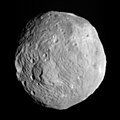
-
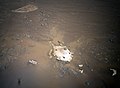 Perseverance's backshell sitting upright on the surface of Jezero Crater (from Space debris)
 -
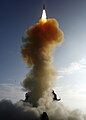 Conventional anti-satellite weapons such as the SM-3 missile remain legal under space law, even though they create hazardous space debris (from Outer space)
 -
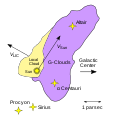 Map showing the Sun located near the edge of the Local Interstellar Cloud and Alpha Centauri about 4 light-years away in the neighboring G-Cloud complex (from Interstellar medium)
 -
 Infographic showing the space debris situation in different kinds of orbits around Earth (from Space debris)
 -
 Gabbard diagram of almost 300 pieces of debris from the disintegration of the five-month-old third stage of the Chinese Long March 4 booster on 11 March 2000 (from Space debris)
 -
 Smooth chondrite interplanetary dust particle. (from Cosmic dust)
 -
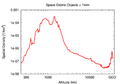 Spatial density of space debris by altitude according to ESA MASTER-2001, without debris from the Chinese ASAT and 2009 collision events (from Space debris)
 -
 Artist's impression of dust formation around a supernova explosion. (from Cosmic dust)
 -
 The first image of Earth taken by a person. South is up. (from Outer space)
 -
 A laser-guided observation of the Milky Way Galaxy at the Paranal Observatory in Chile in 2010 (from Outline of space science)
 -

-
 The original Magdeburg hemispheres (left) used to demonstrate Otto von Guericke's vacuum pump (right)
 -
Timeline of the expansion of the universe, where space, including hypothetical non-observable portions of the universe, is represented at each time by the circular sections. On the left, the dramatic expansion occurs in the inflationary epoch; and at the center, the expansion accelerates (artist's concept; neither time nor size are to scale). (from Outer space)
-
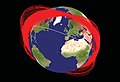 Known orbit planes of Fengyun-1C debris one month after the weather satellite's disintegration by the Chinese ASAT (from Space debris)
 -
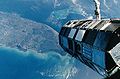 The Long Duration Exposure Facility (LDEF) is an important source of information on small-particle space debris. (from Space debris)


.jpg)


.jpg)


.png)

.jpg)


.jpg)


_(53057957393).jpg)


Did you know (auto-generated)

- ... that, for the Space 220 Restaurant, Disney reached out to NASA engineers to understand what a space elevator might look like?
- ... that some severe environmental impacts of the invasion of Ukraine can be seen from space?
- ... that the space industry of India has supported the launch of more than 100 domestic satellites and more than 300 foreign satellites?
- ... that Nature's Fynd, producer of microbe-based meat substitutes, is working with NASA to develop a bioreactor for use in space travel?
- ... that Louis W. Roberts was among the highest ranking African-American space program staff at NASA while the Apollo program was underway?
Space news
2024 in space | ||
|---|---|---|
Space probe launches  |
|  |
| Impact events | ||
| Selected NEOs | ||
| Discoveries | ||
| Comets | ||


Upcoming spaceflight launches
Astronomical events

Topics
| Biology |
|  | ||||
|---|---|---|---|---|---|---|
| Environment | ||||||
| Society | ||||||
| Technology |
| |||||


2020 in space | ||
|---|---|---|
| Space probe launches |
|   _on_Jul_14_2020_aligned_to_stars.jpg) |
| Impact events | ||
| Selected NEOs |
| |
| Exoplanets |
| |
| Discoveries |
| |
| Comets | ||
| Space exploration |
| |
2019 in space | ||
|---|---|---|
| Space probe launches |
|    |
| Impact events |
| |
| Selected NEOs | ||
| Exoplanets |
| |
| Discoveries |
| |
| Comets | ||
| Space exploration |
| |
2018 in space | ||
|---|---|---|
| Space probe launches |
|   .png) |
| Impact events | ||
| Selected NEOs | ||
| Exoplanets | ||
| Discoveries |
| |
| Novae |
| |
| Comets | ||
| Space exploration |
| |
2017 in space | ||
|---|---|---|
| Space probe launches |
|    |
| Impact events | ||
| Selected NEOs | ||
| Exoplanets | ||
| Discoveries | ||
| Comets | ||
| Space exploration |
| |
2016 in space | ||
|---|---|---|
| Space probe launches |
|    |
| Impact events | ||
| Selected NEOs | ||
| Exoplanets |
| |
| Discoveries |
| |
| Novae | ||
| Comets | ||
| Space exploration | ||
2015 in space | ||||||
|---|---|---|---|---|---|---|
| Space probe launches |
|    | ||||
| Impact events | ||||||
| Selected NEOs | ||||||
| Exoplanets |
| |||||
| Discoveries |
| |||||
| Comets | ||||||
| Space exploration | ||||||
Categories

Wikimedia
The following Wikimedia Foundation sister projects provide more on this subject:
-
 Commons
Free media repository -
 Wikibooks
Free textbooks and manuals -
 Wikidata
Free knowledge base -
 Wikinews
Free-content news -
 Wikiquote
Collection of quotations -
 Wikisource
Free-content library -
 Wikiversity
Free learning tools -
 Wiktionary
Dictionary and thesaurus


