In probability theory and statistics, the generalized extreme value (GEV) distribution[2] is a family of continuous probability distributions developed within extreme value theory to combine the Gumbel, Fréchet and Weibull families also known as type I, II and III extreme value distributions. By the extreme value theorem the GEV distribution is the only possible limit distribution of properly normalized maxima of a sequence of independent and identically distributed random variables.[3] Note that a limit distribution needs to exist, which requires regularity conditions on the tail of the distribution. Despite this, the GEV distribution is often used as an approximation to model the maxima of long (finite) sequences of random variables.
In some fields of application the generalized extreme value distribution is known as the Fisher–Tippett distribution, named after Ronald Fisher and L. H. C. Tippett who recognised three different forms outlined below. However usage of this name is sometimes restricted to mean the special case of the Gumbel distribution. The origin of the common functional form for all 3 distributions dates back to at least Jenkinson, A. F. (1955),[4] though allegedly[5] it could also have been given by von Mises, R. (1936).[6]
Using the standardized variable , where , the location parameter, can be any real number, and is the scale parameter; the cumulative distribution function of the GEV distribution is then
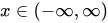
where , the shape parameter, can be any real number. Thus, for , the expression is valid for , while for it is valid for . In the first case, is the negative, lower end-point, where is 0; in the second case, is the positive, upper end-point, where is 1. For , the second expression is formally undefined and is replaced with the first expression, which is the result of taking the limit of the second, as in which case can be any real number.
In the special case of , we have , so regardless of the values of and .
The probability density function of the standardized distribution is
again valid for in the case , and for in the case . The density is zero outside of the relevant range. In the case , the density is positive on the whole real line.
Since the cumulative distribution function is invertible, the quantile function for the GEV distribution has an explicit expression, namely
The shape parameter governs the tail behavior of the distribution. The sub-families defined by three cases: and these correspond, respectively, to the Gumbel, Fréchet, and Weibullfamilies, whose cumulative distribution functions are displayed below.
Type I or Gumbel extreme value distribution, case for all
Type II or Fréchet extreme value distribution, case for all
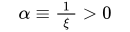
Let and
Type III or reversed Weibull extreme value distribution, case for all
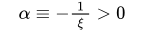
Let and
The subsections below remark on properties of these distributions.
The theory here relates to data maxima and the distribution being discussed is an extreme value distribution for maxima. A generalised extreme value distribution for data minima can be obtained, for example by substituting for in the distribution function, and subtracting the cumulative distribution from one: That is, replace with . Doing so yields yet another family of distributions.
Alternative convention for the Weibull distribution
The ordinary Weibull distribution arises in reliability applications and is obtained from the distribution here by using the variable which gives a strictly positive support, in contrast to the use in the formulation of extreme value theory here. This arises because the ordinary Weibull distribution is used for cases that deal with data minima rather than data maxima. The distribution here has an addition parameter compared to the usual form of the Weibull distribution and, in addition, is reversed so that the distribution has an upper bound rather than a lower bound. Importantly, in applications of the GEV, the upper bound is unknown and so must be estimated, whereas when applying the ordinary Weibull distribution in reliability applications the lower bound is usually known to be zero.
Note the differences in the ranges of interest for the three extreme value distributions: Gumbel is unlimited, Fréchet has a lower limit, while the reversed Weibull has an upper limit.
More precisely, Extreme Value Theory (Univariate Theory) describes which of the three is the limiting law according to the initial law X and in particular depending on its tail.
One can link the type I to types II and III in the following way: If the cumulative distribution function of some random variable is of type II, and with the positive numbers as support, i.e. then the cumulative distribution function of is of type I, namely Similarly, if the cumulative distribution function of is of type III, and with the negative numbers as support, i.e. then the cumulative distribution function of is of type I, namely
The cumulative distribution function of the generalized extreme value distribution solves the stability postulate equation.[citation needed] The generalized extreme value distribution is a special case of a max-stable distribution, and is a transformation of a min-stable distribution.
The GEV distribution is widely used in the treatment of "tail risks" in fields ranging from insurance to finance. In the latter case, it has been considered as a means of assessing various financial risks via metrics such as value at risk.[8][9]
Fitted GEV probability distribution to monthly maximum one-day rainfalls in October, Surinam[10]
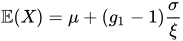
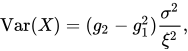
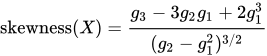
However, the resulting shape parameters have been found to lie in the range leading to undefined means and variances, which underlines the fact that reliable data analysis is often impossible.[11]
In hydrology the GEV distribution is applied to extreme events such as annual maximum one-day rainfalls and river discharges.[12] The blue picture, made with CumFreq, illustrates an example of fitting the GEV distribution to ranked annually maximum one-day rainfalls showing also the 90% confidence belt based on the binomial distribution. The rainfall data are represented by plotting positions as part of the cumulative frequency analysis.
^ ab
Muraleedharan, G; Guedes Soares, C.; Lucas, Cláudia (2011). "Characteristic and moment generating functions of generalised extreme value distribution (GEV)". In Wright, Linda L. (ed.). Sea Level Rise, Coastal Engineering, Shorelines and Tides. Nova Science Publishers. Chapter-14, pp. 269–276. ISBN978-1-61728-655-1.
^Haan, Laurens; Ferreira, Ana (2007). Extreme value theory: an introduction. Springer.
^Jenkinson, Arthur F (1955). "The frequency distribution of the annual maximum (or minimum) values of meteorological elements". Quarterly Journal of the Royal Meteorological Society. 81 (348): 158–171. Bibcode:1955QJRMS..81..158J. doi:10.1002/qj.49708134804.
^Haan, Laurens; Ferreira, Ana (2007). Extreme value theory: an introduction. Springer.
^von Mises, R. (1936). "La distribution de la plus grande de n valeurs". Rev. Math. Union Interbalcanique 1: 141–160.
^Guégan, D.; Hassani, B.K. (2014), "A mathematical resurgence of risk management: an extreme modeling of expert opinions", Frontiers in Finance and Economics, 11 (1): 25–45, SSRN2558747
Leadbetter, M.R., Lindgren, G. and Rootzén, H. (1983). Extremes and related properties of random sequences and processes. Springer-Verlag. ISBN0-387-90731-9.{{cite book}}: CS1 maint: multiple names: authors list (link)
Resnick, S.I. (1987). Extreme values, regular variation and point processes. Springer-Verlag. ISBN0-387-96481-9.






![{\displaystyle x\in {\big (}-\infty ,\mu -{\tfrac {\sigma }{\xi }}{\big ]}}](https://wikimedia.org/api/rest_v1/media/math/render/svg/01e82a58b83a648cd799d3a4789f3acca929f52c)


![{\displaystyle t(x)={\begin{cases}\left[1+\xi \left({\tfrac {x-\mu }{\sigma }}\right)\right]^{-1/\xi }&{\text{if }}\xi \neq 0\\\exp \left(-{\tfrac {x-\mu }{\sigma }}\right)&{\text{if }}\xi =0\end{cases}}}](https://wikimedia.org/api/rest_v1/media/math/render/svg/a4c22348000bf315025f9901b990e1ad77038c52)





![{\displaystyle Q(p;\mu ,\sigma ,\xi )={\begin{cases}\mu -\sigma \ln(-\ln p)&{\text{for }}\xi =0{\text{ and }}p\in (0,1),\\\mu +{\dfrac {\sigma }{\xi }}{\big (}(-\ln p)^{-\xi }-1{\big )}&{\text{for }}\xi >0{\text{ and }}p\in [0,1),{\text{ or }}\xi <0{\text{ and }}p\in (0,1];\end{cases}}}](https://wikimedia.org/api/rest_v1/media/math/render/svg/d42fc55541879b03fde51df7dff99d0a0fcffd84)



![{\displaystyle \operatorname {Mode} (X)=\mu +{\frac {\sigma }{\xi }}[(1+\xi )^{-\xi }-1].}](https://wikimedia.org/api/rest_v1/media/math/render/svg/3e521bc92df80d7eb58353837509a1a6930338b6)


























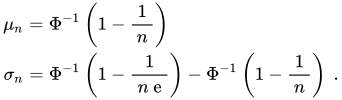

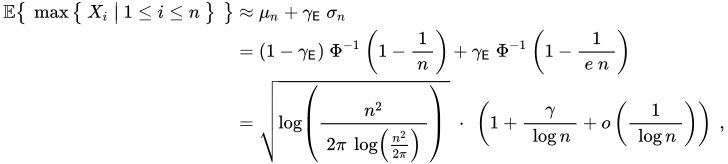

















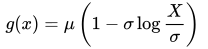
![{\displaystyle {\begin{aligned}\operatorname {\mathbb {P} } \left\{\ \mu \left(1-\sigma \log {\frac {\ X\ }{\sigma }}\right)<x\ \right\}&=\operatorname {\mathbb {P} } \left\{\ \log {\frac {X}{\sigma }}>{\frac {1-x/\mu }{\sigma }}\ \right\}\\{}\\&{\mathsf {\ Since\ the\ logarithm\ is\ always\ increasing:\ }}\\{}\\&=\operatorname {\mathbb {P} } \left\{\ X>\sigma \exp \left[{\frac {1-x/\mu }{\sigma }}\right]\ \right\}\\&=\exp \left(-\left({\cancel {\sigma }}\exp \left[{\frac {1-x/\mu }{\sigma }}\right]\cdot {\cancel {\frac {1}{\sigma }}}\right)^{\mu }\right)\\&=\exp \left(-\left(\exp \left[{\frac {{\cancelto {\mu }{1}}-x/{\cancel {\mu }}}{\sigma }}\right]\right)^{\cancel {\mu }}\right)\\&=\exp \left(-\exp \left[{\frac {\mu -x}{\sigma }}\right]\right)\\&=\exp \left(-\exp \left[-s\right]\right),\quad s={\frac {x-\mu }{\sigma }}\ ,\end{aligned}}}](https://wikimedia.org/api/rest_v1/media/math/render/svg/68fdc2171dae2d4b0846822e9b2efc3f03fcf4fa)



![{\displaystyle {\begin{aligned}\operatorname {\mathbb {P} } \left\{\ \mu -\sigma \log X<x\ \right\}&=\operatorname {\mathbb {P} } \left\{\ \log X>{\frac {\mu -x}{\sigma }}\ \right\}\\{}\\&{\mathsf {\ Since\ the\ logarithm\ is\ always\ increasing:\ }}\\{}\\&=\operatorname {\mathbb {P} } \left\{\ X>\exp \left({\frac {\ \mu -x\ }{\sigma }}\right)\ \right\}\\&=\exp \left[-\exp \left({\frac {\ \mu -x\ }{\sigma }}\right)\right]\\&=\exp \left[-\exp(-s)\right]\ ,\quad ~{\mathsf {where}}~\quad s\equiv {\frac {x-\mu }{\sigma }}\ ;\end{aligned}}}](https://wikimedia.org/api/rest_v1/media/math/render/svg/f7df66a6042ee71d5cb7dbca80ce3b3eb9d58d63)


