


Normal-inverse Gaussian distribution
| Parameters |
location (real) tail heaviness (real) asymmetry parameter (real) scale parameter (real) | ||
|---|---|---|---|
| Support | |||
|
denotes a modified Bessel function of the second kind[1] | |||
| Mean | |||
| Variance | |||
| Skewness | |||
| Excess kurtosis | |||
| MGF | |||
| CF | |||


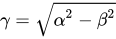

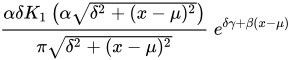



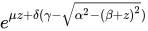

The normal-inverse Gaussian distribution (NIG, also known as the normal-Wald distribution) is a continuous probability distribution that is defined as the normal variance-mean mixture where the mixing density is the inverse Gaussian distribution. The NIG distribution was noted by Blaesild in 1977 as a subclass of the generalised hyperbolic distribution discovered by Ole Barndorff-Nielsen.[2] In the next year Barndorff-Nielsen published the NIG in another paper.[3] It was introduced in the mathematical finance literature in 1997.[4]
The parameters of the normal-inverse Gaussian distribution are often used to construct a heaviness and skewness plot called the NIG-triangle.[5]
Properties[edit]
Moments[edit]
The fact that there is a simple expression for the moment generating function implies that simple expressions for all moments are available.[6][7]
Linear transformation[edit]
This class is closed under affine transformations, since it is a particular case of the Generalized hyperbolic distribution, which has the same property. If

then[8]

Summation[edit]
This class is infinitely divisible, since it is a particular case of the Generalized hyperbolic distribution, which has the same property.
Convolution[edit]
The class of normal-inverse Gaussian distributions is closed under convolution in the following sense:[9] if and are independent random variables that are NIG-distributed with the same values of the parameters and , but possibly different values of the location and scale parameters, , and , respectively, then is NIG-distributed with parameters and


Related distributions[edit]
The class of NIG distributions is a flexible system of distributions that includes fat-tailed and skewed distributions, and the normal distribution, arises as a special case by setting and letting .



Stochastic process[edit]
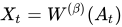
The normal-inverse Gaussian distribution can also be seen as the marginal distribution of the normal-inverse Gaussian process which provides an alternative way of explicitly constructing it. Starting with a drifting Brownian motion (Wiener process), , we can define the inverse Gaussian process Then given a second independent drifting Brownian motion, , the normal-inverse Gaussian process is the time-changed process . The process at time has the normal-inverse Gaussian distribution described above. The NIG process is a particular instance of the more general class of Lévy processes.





As a variance-mean mixture[edit]
Let denote the inverse Gaussian distribution and denote the normal distribution. Let , where ; and let , then follows the NIG distribution, with parameters, . This can be used to generate NIG variates by ancestral sampling. It can also be used to derive an EM algorithm for maximum-likelihood estimation of the NIG parameters.[10]





References[edit]
- ^ Ole E Barndorff-Nielsen, Thomas Mikosch and Sidney I. Resnick, Lévy Processes: Theory and Applications, Birkhäuser 2013 Note: in the literature this function is also referred to as Modified Bessel function of the third kind
- ^ Barndorff-Nielsen, Ole (1977). "Exponentially decreasing distributions for the logarithm of particle size". Proceedings of the Royal Society of London. Series A, Mathematical and Physical Sciences. 353 (1674). The Royal Society: 401–409. doi:10.1098/rspa.1977.0041. JSTOR 79167.
- ^ O. Barndorff-Nielsen, Hyperbolic Distributions and Distributions on Hyperbolae, Scandinavian Journal of Statistics 1978
- ^ O. Barndorff-Nielsen, Normal Inverse Gaussian Distributions and Stochastic Volatility Modelling, Scandinavian Journal of Statistics 1997
- ^ S.T Rachev, Handbook of Heavy Tailed Distributions in Finance, Volume 1: Handbooks in Finance, Book 1, North Holland 2003
- ^ Erik Bolviken, Fred Espen Beth, Quantification of Risk in Norwegian Stocks via the Normal Inverse Gaussian Distribution, Proceedings of the AFIR 2000 Colloquium
- ^ Anna Kalemanova, Bernd Schmid, Ralf Werner, The Normal inverse Gaussian distribution for synthetic CDO pricing, Journal of Derivatives 2007
- ^ Paolella, Marc S (2007). Intermediate Probability: A computational Approach. John Wiley & Sons.
- ^ Ole E Barndorff-Nielsen, Thomas Mikosch and Sidney I. Resnick, Lévy Processes: Theory and Applications, Birkhäuser 2013
- ^ Karlis, Dimitris (2002). "An EM Type Algorithm for ML estimation for the Normal–Inverse Gaussian Distribution". Statistics and Probability Letters. 57: 43–52.

