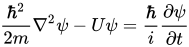
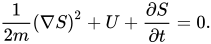
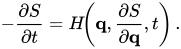
The Hamilton–Jacobi equation is a formulation of mechanics in which the motion of a particle can be represented as a wave. In this sense, it fulfilled a long-held goal of theoretical physics (dating at least to Johann Bernoulli in the eighteenth century) of finding an analogy between the propagation of light and the motion of a particle. The wave equation followed by mechanical systems is similar to, but not identical with, Schrödinger's equation, as described below; for this reason, the Hamilton–Jacobi equation is considered the "closest approach" of classical mechanics to quantum mechanics.[1][2] The qualitative form of this connection is called Hamilton's optico-mechanical analogy.
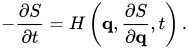
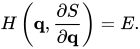
for a system of particles at coordinates . The function is the system's Hamiltonian giving the system's energy. The solution of the equation is the action functional, ,[4] called Hamilton's principal function in older textbooks.
The solution can be related to the system Lagrangian by an indefinite integral of the form used in the principle of least action:[5]: 431
Geometrical surfaces of constant action are perpendicular to system trajectories, creating a wavefront-like view of the system dynamics. This property of the Hamilton-Jacobi equation connects classical mechanics to quantum mechanics.[6]: 175
A dot over a variable or list signifies the time derivative (see Newton's notation). For example,
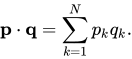
The dot product notation between two lists of the same number of coordinates is a shorthand for the sum of the products of corresponding components, such as
The action functional (a.k.a. Hamilton's principal function)[edit]
shows that the Euler–Lagrange equations form a system of second-order ordinary differential equations. Inverting the matrix transforms this system into
Let a time instant and a point in the configuration space be fixed. The existence and uniqueness theorems guarantee that, for every the initial value problem with the conditions and has a locally unique solution Additionally, let there be a sufficiently small time interval such that extremals with different initial velocities would not intersect in The latter means that, for any and any there can be at most one extremal for which and Substituting into the action functional results in the Hamilton's principal function (HPF)
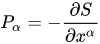
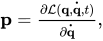
The momenta are defined as the quantities This section shows that the dependency of on disappears, once the HPF is known.
Indeed, let a time instant and a point in the configuration space be fixed. For every time instant and a point let be the (unique) extremal from the definition of the Hamilton's principal function . Call the velocity at . Then
Proof
While the proof below assumes the configuration space to be an open subset of the underlying technique applies equally to arbitrary spaces. In the context of this proof, the calligraphic letter denotes the action functional, and the italic the Hamilton's principal function.
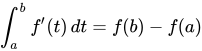
Step 1. Let be a path in the configuration space, and a vector field along . (For each the vector is called perturbation, infinitesimal variation or virtual displacement of the mechanical system at the point ). Recall that the variation of the action at the point in the direction is given by the formula
where one should substitute and after calculating the partial derivatives on the right-hand side. (This formula follows from the definition of Gateaux derivative via integration by parts).
Assume that is an extremal. Since now satisfies the Euler–Lagrange equations, the integral term vanishes. If 's starting point is fixed, then, by the same logic that was used to derive the Euler–Lagrange equations, Thus,
Step 2. Let be the (unique) extremal from the definition of HPF, a vector field along and a variation of "compatible" with In precise terms,
By definition of HPF and Gateaux derivative,
Here, we took into account that and dropped for compactness.
Step 3. We now substitute and into the expression for from Step 1 and compare the result with the formula derived in Step 2. The fact that, for the vector field was chosen arbitrarily completes the proof.
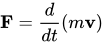
The conjugate momenta correspond to the first derivatives of with respect to the generalized coordinates
As a solution to the Hamilton–Jacobi equation, the principal function contains undetermined constants, the first of them denoted as , and the last one coming from the integration of .
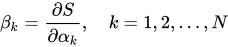
The relationship between and then describes the orbit in phase space in terms of these constants of motion. Furthermore, the quantities
are also constants of motion, and these equations can be inverted to find as a function of all the and constants and time.[8]
Comparison with other formulations of mechanics[edit]
The Hamilton–Jacobi equation is a single, first-order partial differential equation for the function of the generalized coordinates and the time . The generalized momenta do not appear, except as derivatives of , the classical action.
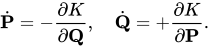
For comparison, in the equivalent Euler–Lagrange equations of motion of Lagrangian mechanics, the conjugate momenta also do not appear; however, those equations are a system of , generally second-order equations for the time evolution of the generalized coordinates. Similarly, Hamilton's equations of motion are another system of 2N first-order equations for the time evolution of the generalized coordinates and their conjugate momenta .
and Hamilton's equations in terms of the new variables and new Hamiltonian have the same form:
To derive the HJE, a generating function is chosen in such a way that, it will make the new Hamiltonian . Hence, all its derivatives are also zero, and the transformed Hamilton's equations become trivial
so the new generalized coordinates and momenta are constants of motion. As they are constants, in this context the new generalized momenta are usually denoted , i.e. and the new generalized coordinates are typically denoted as , so .
Setting the generating function equal to Hamilton's principal function, plus an arbitrary constant :
the HJE automatically arises
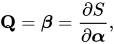
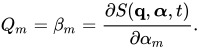
When solved for , these also give us the useful equations
or written in components for clarity
Ideally, these N equations can be inverted to find the original generalized coordinates as a function of the constants and , thus solving the original problem.
When the problem allows additive separation of variables, the HJE leads directly to constants of motion. For example, the time t can be separated if the Hamiltonian does not depend on time explicitly. In that case, the time derivative in the HJE must be a constant, usually denoted (), giving the separated solution
where the time-independent function is sometimes called the abbreviated action or Hamilton's characteristic function[5]: 434 and sometimes[9]: 607 written (see action principle names). The reduced Hamilton–Jacobi equation can then be written
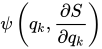
To illustrate separability for other variables, a certain generalized coordinate and its derivative are assumed to appear together as a single function
in the Hamiltonian
In that case, the function S can be partitioned into two functions, one that depends only on qk and another that depends only on the remaining generalized coordinates
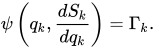
Substitution of these formulae into the Hamilton–Jacobi equation shows that the function ψ must be a constant (denoted here as ), yielding a first-order ordinary differential equation for
In fortunate cases, the function can be separated completely into functions
The separability of S depends both on the Hamiltonian and on the choice of generalized coordinates. For orthogonal coordinates and Hamiltonians that have no time dependence and are quadratic in the generalized momenta, will be completely separable if the potential energy is additively separable in each coordinate, where the potential energy term for each coordinate is multiplied by the coordinate-dependent factor in the corresponding momentum term of the Hamiltonian (the Staeckel conditions). For illustration, several examples in orthogonal coordinates are worked in the next sections.
In spherical coordinates the Hamiltonian of a free particle moving in a conservative potential U can be written
The Hamilton–Jacobi equation is completely separable in these coordinates provided that there exist functions such that can be written in the analogous form
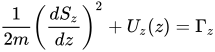
where the foci of the ellipses are located at on the -axis. The Hamilton–Jacobi equation is completely separable in these coordinates provided that has an analogous form
where , and are arbitrary functions. Substitution of the completely separated solution
The HJE establishes a duality between trajectories and wavefronts.[10] For example, in geometrical optics, light can be considered either as “rays” or waves. The wave front can be defined as the surface that the light emitted at time has reached at time . Light rays and wave fronts are dual: if one is known, the other can be deduced.
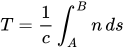
More precisely, geometrical optics is a variational problem where the “action” is the travel time along a path,
where is the medium's index of refraction and is an infinitesimal arc length. From the above formulation, one can compute the ray paths using the Euler–Lagrange formulation; alternatively, one can compute the wave fronts by solving the Hamilton–Jacobi equation. Knowing one leads to knowing the other.
The above duality is very general and applies to all systems that derive from a variational principle: either compute the trajectories using Euler–Lagrange equations or the wave fronts by using Hamilton–Jacobi equation.
The wave front at time , for a system initially at at time , is defined as the collection of points such that . If is known, the momentum is immediately deduced.
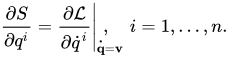
Once is known, tangents to the trajectories are computed by solving the equation
for , where is the Lagrangian. The trajectories are then recovered from the knowledge of .
The isosurfaces of the function can be determined at any time t. The motion of an -isosurface as a function of time is defined by the motions of the particles beginning at the points on the isosurface. The motion of such an isosurface can be thought of as a wave moving through -space, although it does not obey the wave equation exactly. To show this, let S represent the phase of a wave
where is a constant (the Planck constant) introduced to make the exponential argument dimensionless; changes in the amplitude of the wave can be represented by having be a complex number. The Hamilton–Jacobi equation is then rewritten as
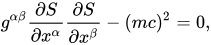
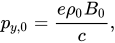
For a particle of rest mass and electric charge moving in electromagnetic field with four-potential in vacuum, the Hamilton–Jacobi equation in geometry determined by the metric tensor has a form
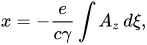
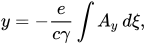
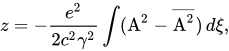
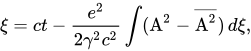
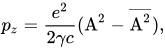
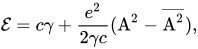
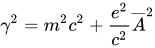
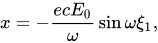
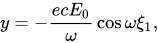
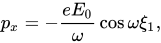
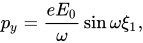
and can be solved for the Hamilton principal action function to obtain further solution for the particle trajectory and momentum:[13]
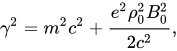
where and with the cycle average of the vector potential.
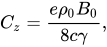
where , implying the particle moving along a circular trajectory with a permanent radius and an invariable value of momentum directed along a magnetic field vector.
A monochromatic linearly polarized plane wave[edit]
For the flat, monochromatic, linearly polarized wave with a field directed along the axis
hence
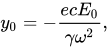
implying the particle figure-8 trajectory with a long its axis oriented along the electric field vector.
An electromagnetic wave with a solenoidal magnetic field[edit]
For the electromagnetic wave with axial (solenoidal) magnetic field:[14]
hence
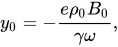
where is the magnetic field magnitude in a solenoid with the effective radius , inductivity , number of windings , and an electric current magnitude through the solenoid windings. The particle motion occurs along the figure-8 trajectory in plane set perpendicular to the solenoid axis with arbitrary azimuth angle due to axial symmetry of the solenoidal magnetic field.
^Kálmán, Rudolf E. (1963). "The Theory of Optimal Control and the Calculus of Variations". In Bellman, Richard (ed.). Mathematical Optimization Techniques. Berkeley: University of California Press. pp. 309–331. OCLC1033974.
^ abcGoldstein, Herbert; Poole, Charles P.; Safko, John L. (2008). Classical mechanics (3, [Nachdr.] ed.). San Francisco Munich: Addison Wesley. ISBN978-0-201-65702-9.
^E. V. Shun'ko; D. E. Stevenson; V. S. Belkin (2014). "Inductively Coupling Plasma Reactor With Plasma Electron Energy Controllable in the Range from ~6 to ~100 eV". IEEE Transactions on Plasma Science. 42, part II (3): 774–785. Bibcode:2014ITPS...42..774S. doi:10.1109/TPS.2014.2299954. S2CID34765246.

































![{\displaystyle \delta {\cal {S}}_{\delta \xi }[\gamma ,t_{1},t_{0}]}](https://wikimedia.org/api/rest_v1/media/math/render/svg/5925bb75ac2527ebec817fa292ef461324b12d2b)

![{\displaystyle \delta {\cal {S}}_{\delta \xi }[\xi ,t_{1},t_{0}]=\int _{t_{0}}^{t_{1}}\left({\frac {\partial {\cal {L}}}{\partial \mathbf {q} }}-{\frac {d}{dt}}{\frac {\partial {\cal {L}}}{\partial \mathbf {\dot {q}} }}\right)\delta \xi \,dt+{\frac {\partial {\cal {L}}}{\partial \mathbf {\dot {q}} }}\,\delta \xi {\Biggl |}_{t_{0}}^{t_{1}},}](https://wikimedia.org/api/rest_v1/media/math/render/svg/3c7d21084e5f41892a45563e97683f4f205ded9e)


![{\displaystyle \delta {\cal {S}}_{\delta \xi }[\xi ,t;t_{0}]=\left.{\frac {\partial {\cal {L}}}{\partial \mathbf {\dot {q}} }}\right|_{\mathbf {\dot {q}} ={\dot {\xi }}(t)}^{\mathbf {q} =\xi (t)}\,\delta \xi (t).}](https://wikimedia.org/api/rest_v1/media/math/render/svg/aa70b09d9f637c3eb8da5dbb7f7f0570e295e85c)







![{\displaystyle \delta {\cal {S}}_{\delta \gamma }[\gamma ,t]{\overset {\text{def}}{{}={}}}\left.{\frac {d{\cal {S}}[\gamma _{\varepsilon },t]}{d\varepsilon }}\right|_{\varepsilon =0}=\left.{\frac {dS(\gamma _{\varepsilon }(t),t)}{d\varepsilon }}\right|_{\varepsilon =0}={\frac {\partial S}{\mathbf {\partial q} }}\,\delta \gamma (t).}](https://wikimedia.org/api/rest_v1/media/math/render/svg/5ac37e83ad61a3ed68e813e829cfc91acc0584d2)



![{\displaystyle \delta {\cal {S}}_{\delta \xi }[\xi ,t;t_{0}]}](https://wikimedia.org/api/rest_v1/media/math/render/svg/bf64c7c89fb15ff0e0510833c3230577076a58ca)




![{\displaystyle {\cal {L}}(\xi (t),{\dot {\xi }}(t),t)={\frac {dS(\xi (t),t)}{dt}}=\left[{\frac {\partial S}{\partial \mathbf {q} }}\mathbf {\dot {q}} +{\frac {\partial S}{\partial t}}\right]_{\mathbf {\dot {q}} ={\dot {\xi }}(t)}^{\mathbf {q} =\xi (t)}.}](https://wikimedia.org/api/rest_v1/media/math/render/svg/c00f09f39fab9e4db886ebaa5b04dc0671b39bb8)










































![{\displaystyle H={\frac {1}{2m}}\left[p_{r}^{2}+{\frac {p_{\theta }^{2}}{r^{2}}}+{\frac {p_{\phi }^{2}}{r^{2}\sin ^{2}\theta }}\right]+U(r,\theta ,\phi ).}](https://wikimedia.org/api/rest_v1/media/math/render/svg/1d84f2cba2231029bc99e6c3bcaeb5de497e9874)




![{\displaystyle {\frac {1}{2m}}\left({\frac {dS_{r}}{dr}}\right)^{2}+U_{r}(r)+{\frac {1}{2mr^{2}}}\left[\left({\frac {dS_{\theta }}{d\theta }}\right)^{2}+2mU_{\theta }(\theta )\right]+{\frac {1}{2mr^{2}\sin ^{2}\theta }}\left[\left({\frac {dS_{\phi }}{d\phi }}\right)^{2}+2mU_{\phi }(\phi )\right]=E.}](https://wikimedia.org/api/rest_v1/media/math/render/svg/ca9dad5ab4db3a31800c366190e9494f070890d7)

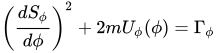

![{\displaystyle {\frac {1}{2m}}\left({\frac {dS_{r}}{dr}}\right)^{2}+U_{r}(r)+{\frac {1}{2mr^{2}}}\left[\left({\frac {dS_{\theta }}{d\theta }}\right)^{2}+2mU_{\theta }(\theta )+{\frac {\Gamma _{\phi }}{\sin ^{2}\theta }}\right]=E.}](https://wikimedia.org/api/rest_v1/media/math/render/svg/20ea3b4c9e47946cd9627dc6a28bd629f07e1509)











![{\displaystyle {\frac {1}{2m}}\left({\frac {dS_{z}}{dz}}\right)^{2}+U_{z}(z)+{\frac {1}{2ma^{2}\left(\sinh ^{2}\mu +\sin ^{2}\nu \right)}}\left[\left({\frac {dS_{\mu }}{d\mu }}\right)^{2}+\left({\frac {dS_{\nu }}{d\nu }}\right)^{2}+2ma^{2}U_{\mu }(\mu )+2ma^{2}U_{\nu }(\nu )\right]=E.}](https://wikimedia.org/api/rest_v1/media/math/render/svg/ac87cd9d6f1069ef4944847c2adfe17d7ff9ef30)








![{\displaystyle {\frac {1}{2m}}\left({\frac {dS_{z}}{dz}}\right)^{2}+U_{z}(z)+{\frac {1}{2m\left(\sigma ^{2}+\tau ^{2}\right)}}\left[\left({\frac {dS_{\sigma }}{d\sigma }}\right)^{2}+\left({\frac {dS_{\tau }}{d\tau }}\right)^{2}+2mU_{\sigma }(\sigma )+2mU_{\tau }(\tau )\right]=E.}](https://wikimedia.org/api/rest_v1/media/math/render/svg/2c8bffbfef87ccf88604581a38e5143e245074c2)