Indium phosphide

| |

| |
| Names | |
|---|---|
| Other names
Indium(III) phosphide
| |
| Identifiers | |
3D model (JSmol)
|
|
| ChemSpider | |
| ECHA InfoCard | 100.040.856 |
PubChem CID
|
|
| UNII | |
CompTox Dashboard (EPA)
|
|
| |
| |
| Properties | |
| InP | |
| Molar mass | 145.792 g/mol |
| Appearance | black cubic crystals[1] |
| Density | 4.81 g/cm3, solid[1] |
| Melting point | 1,062 °C (1,944 °F; 1,335 K)[1] |
| Solubility | slightly soluble in acids |
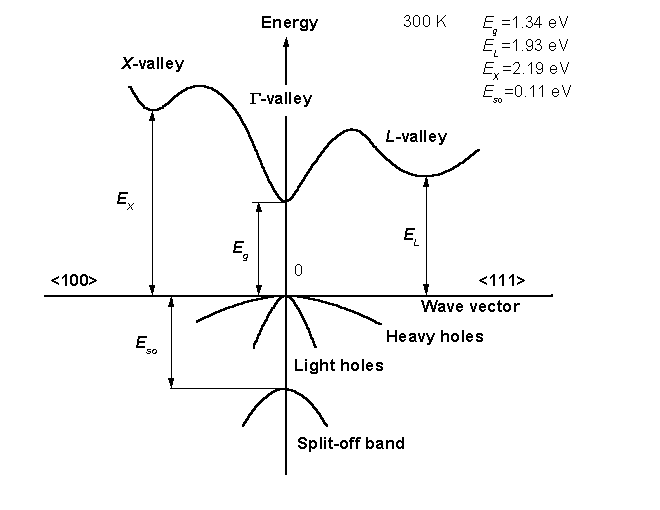
| Band gap | 1.344 eV (300 K; direct) |
| Electron mobility | 5400 cm2/(V·s) (300 K) |
| Thermal conductivity | 0.68 W/(cm·K) (300 K) |
Refractive index (nD)
|
3.1 (infrared); 3.55 (632.8 nm)[2] |
| Structure | |
| Zinc blende | |
a = 5.8687 Å [3]
| |
| Tetrahedral | |
| Thermochemistry[4] | |
Heat capacity (C)
|
45.4 J/(mol·K) |
Std molar
entropy (S⦵298) |
59.8 J/(mol·K) |
Std enthalpy of
formation (ΔfH⦵298) |
-88.7 kJ/mol |
Gibbs free energy (ΔfG⦵)
|
-77.0 kJ/mol |
| Hazards | |
| Occupational safety and health (OHS/OSH): | |
Main hazards
|
Toxic, hydrolysis to phosphine |
| Safety data sheet (SDS) | External MSDS |
| Related compounds | |
Other anions
|
Indium nitride Indium arsenide Indium antimonide |
Other cations
|
Aluminium phosphide Gallium phosphide |
Related compounds
|
Indium gallium phosphide Aluminium gallium indium phosphide Gallium indium arsenide antimonide phosphide |
Except where otherwise noted, data are given for materials in their standard state (at 25 °C [77 °F], 100 kPa).
| |


Indium phosphide (InP) is a binary semiconductor composed of indium and phosphorus. It has a face-centered cubic ("zincblende") crystal structure, identical to that of GaAs and most of the III-V semiconductors.
Manufacturing
[edit].jpg)
Indium phosphide can be prepared from the reaction of white phosphorus and indium iodide at 400 °C.,[5] also by direct combination of the purified elements at high temperature and pressure, or by thermal decomposition of a mixture of a trialkyl indium compound and phosphine.[6]
Applications
[edit]The application fields of InP splits up into three main areas. It is used as the basis for optoelectronic components,[7] high-speed electronics,[8] and photovoltaics[9]
High-speed optoelectronics
[edit]InP is used as a substrate for epitaxial optoelectronic devices based other semiconductors, such as indium gallium arsenide. The devices include pseudomorphic heterojunction bipolar transistors that could operate at 604 GHz.[10]
InP itself has a direct bandgap, making it useful for optoelectronics devices like laser diodes and photonic integrated circuits for the optical telecommunications industry, to enable wavelength-division multiplexing applications.[11] It is used in high-power and high-frequency electronics because of its superior electron velocity with respect to the more common semiconductors silicon and gallium arsenide.
Optical Communications
[edit]InP is used in lasers, sensitive photodetectors and modulators in the wavelength window typically used for telecommunications, i.e., 1550 nm wavelengths, as it is a direct bandgap III-V compound semiconductor material. The wavelength between about 1510 nm and 1600 nm has the lowest attenuation available on optical fibre (about 0.2 dB/km).[12] Further, O-band and C-band wavelengths supported by InP facilitate single-mode operation, reducing effects of intermodal dispersion.
Photovoltaics and optical sensing
[edit]InP can be used in photonic integrated circuits that can generate, amplify, control and detect laser light.[13]
Optical sensing applications of InP include
- Air pollution control by real-time detection of gases (CO, CO2, NOX [or NO + NO2], etc.).
- Quick verification of traces of toxic substances in gases and liquids, including tap water, or surface contaminations.
- Spectroscopy for non-destructive control of product, such as food. Researchers of Eindhoven University of Technology and MantiSpectra have already demonstrated the application of an integrated near-infrared spectral sensor for milk.[14] In addition, it has been proven that this technology can also be applied to plastics and illicit drugs.[15]
References
[edit]- ^ a b c Haynes, p. 4.66
- ^ Sheng Chao, Tien; Lee, Chung Len; Lei, Tan Fu (1993), "The refractive index of InP and its oxide measured by multiple-angle incident ellipsometry", Journal of Materials Science Letters, 12 (10): 721, doi:10.1007/BF00626698, S2CID 137171633.
- ^ "Basic Parameters of InP". Ioffe Institute, Russia.
- ^ Haynes, p. 5.23
- ^ Indium Phosphide at HSDB. U.S. National Institute of Health
- ^ InP manufacture. U.S. National Institute of Health
- ^ "Optoelectronic devices and components – Latest research and news | Nature". www.nature.com. Retrieved 2022-02-22.
- ^ "High Speed Electronics". www.semiconductoronline.com. Retrieved 2022-02-22.
- ^ "Photovoltaics". SEIA. Retrieved 2022-02-22.
- ^ Indium Phosphide and Indium Gallium Arsenide Help Break 600 Gigahertz Speed Barrier. Azom. April 2005
- ^ The Light Brigade appeared in Red Herring in 2002. Archived June 7, 2011, at the Wayback Machine
- ^ D’Agostino, Domenico; Carnicella, Giuseppe; Ciminelli, Caterina; Thijs, Peter; Veldhoven, Petrus J.; Ambrosius, Huub; Smit, Meint (2015-09-21). "Low-loss passive waveguides in a generic InP foundry process via local diffusion of zinc". Optics Express. 23 (19): 25143–25157. Bibcode:2015OExpr..2325143D. doi:10.1364/OE.23.025143. PMID 26406713.
- ^ Osgood, Richard Jr. (2021). Principles of photonic integrated circuits : materials, device physics, guided wave design. Xiang Meng. Springer. ISBN 978-3-030-65193-0. OCLC 1252762727.
- ^ Hakkel, Kaylee D.; Petruzzella, Maurangelo; Ou, Fang; van Klinken, Anne; Pagliano, Francesco; Liu, Tianran; van Veldhoven, Rene P. J.; Fiore, Andrea (2022-01-10). "Integrated near-infrared spectral sensing". Nature Communications. 13 (1): 103. Bibcode:2022NatCo..13..103H. doi:10.1038/s41467-021-27662-1. PMC 8748443. PMID 35013200.
- ^ Kranenburg, Ruben F.; Ou, Fang; Sevo, Petar; Petruzzella, Maurangelo; de Ridder, Renee; van Klinken, Anne; Hakkel, Kaylee D.; van Elst, Don M. J.; van Veldhoven, René; Pagliano, Francesco; van Asten, Arian C.; Fiore, Andrea (2022-08-01). "On-site illicit-drug detection with an integrated near-infrared spectral sensor: A proof of concept". Talanta. 245: 123441. doi:10.1016/j.talanta.2022.123441. PMID 35405444. S2CID 247986674.
Cited sources
[edit]- Haynes, William M., ed. (2016). CRC Handbook of Chemistry and Physics (97th ed.). CRC Press. ISBN 9781498754293.