


Mint (candy)
 Scotch mints | |
| Alternative names | Peppermints, spearmints |
|---|---|
| Type | Confectionery |
| Main ingredients | Mint flavoring or mint oil or other oil (such as wintergreen) |
| Variations | Hard mint, soft mints, Scotch mints, Mint Imperials |
A mint or breath mint is a food item often consumed as an after-meal refreshment or before business and social engagements to improve breath odor.[1] Mints are commonly believed to soothe the stomach given their association with natural byproducts of the plant genus Mentha.[2] Mints sometimes contain derivatives from plants such as peppermint oil or spearmint oil, or wintergreen from the plant genus Gaultheria. However, many of the most popular mints citing these natural sources contain none in their ingredient list or contain only trace amounts.[3][4][5]
History[edit]
The production of mints as a discrete food item can be traced back to the 18th century with the invention of Altoids.[6][7][8] The popularity of mints took off in the early 20th century, with the advent of mass urbanization and mass marketing. Advertising for mints focused on their convenience, and on the socially isolating effects of bad breath. These advertisements targeted young people generally, and young women particularly.[9][10]
Mints have been offered in a variety of packaging, usually in an effort to promote portability. Early producers used cardboard boxes and tins, which have remained popular.[11] More recent packaging solutions have included "rolls" containing many mints stacked in one package composed of paper or foil, plastic boxes, and individually wrapped mints. Mint sales have remained robust in the 21st century.[1]
Types[edit]
Hard[edit]

Hard mints are hard candies or boiled sweets flavored with mint. Examples of hard mints include starlight mints, also known as pinwheel mints, white, circular, with red or green rays emitting from the middle; candy canes; humbugs; and brand name mints such as Altoids and Ice Breakers.[citation needed] Branded breath mints are produced in flavors other than mint.[12][13]
Soft[edit]

Soft mints, such as "dinner mints" and "butter mints", are soft candies, often with a higher butter content, that dissolve more readily inside one's mouth.[14]
Scotch[edit]
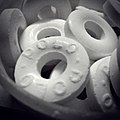
A "scotch mint", "pan drop",[15] granny sooker[15][16] or "mint imperial" is a white round candy with a hard shell but fairly soft middle, popular in Great Britain and other Commonwealth nations and in Europe. Scotch mints were traditionally spheroids, more recently moving toward a larger, discoid shape. Various forms of mint may be used but those termed "scotch mints" are named for the specific mint plant Mentha × gracilis.
Use[edit]
In addition to breath freshening, mints that actually contain peppermint oil or extract have been popular in helping with digestion after a meal.[17] Peppermint has muscle relaxant properties and therefore may relax the smooth muscles of the GI tract, allowing for easier passage of food contents. However, since the lower esophageal sphincter may be relaxed, peppermint may aggravate "heartburn" or GERD.
Peppermint also seems to be effective in relieving intestinal gas and indigestion.[2] According to the German Commission E Monograph, real peppermint oil or extract has been used for cramp-like complaints in the gastrointestinal tract. This can help to explain why mints with real peppermint oil, in addition to peppermint tea, have been popular for and are frequently used after meals to help with digestion as well as to help freshen the breath.
Gallery[edit]
-

-
-
 Opened package of Howard's Mint candies
 -
 Tic Tac package of orange-flavored breath mints
 -
 Mints provided to guests at a funeral home in the United States.


.jpg)

See also[edit]
References[edit]
- ^ a b Berman, Jillian (2017-09-11). "There's Something About Breath Mints and Sharing". Wall Street Journal. ISSN 0099-9660. Retrieved 2019-02-15.
- ^ a b "Peppermint". Archived from the original on 2007-08-30. Retrieved 2007-09-11.
- ^ "Tic Tac Ingredients". www.fooducate.com. Retrieved 2019-02-15.
- ^ "Mentos Mint". us.mentos.com. Archived from the original on 2018-10-02. Retrieved 2019-02-15.
- ^ "Altoids Ingredients". www.fooducate.com. Retrieved 2019-02-15.
- ^ "Callard & Bowser is making a mint on Altoids - Oct. 14, 1998". money.cnn.com. Retrieved 2019-02-15.
- ^ "Altoids | Curiously Strong". 2011-07-26. Archived from the original on 2011-07-26. Retrieved 2019-02-15.
- ^ "A Breath of Fresh Air in an Old Tin". Los Angeles Times. 1996-12-02. Retrieved 2019-12-20.
- ^ D., Levitt, Steven (2009-08-25). Freakonomics : a rogue economist explores the hidden side of everything. Dubner, Stephen J. New York. ISBN 9780060731335. OCLC 166872408.
{{cite book}}: CS1 maint: location missing publisher (link) CS1 maint: multiple names: authors list (link) - ^ "LISTERINE® Antiseptic: A Very Useful Product". Kilmer House. Retrieved 2019-02-15.
- ^ Terdiman, Daniel (2005-02-05). "In mint condition: Altoids tins reborn". The New York Times. ISSN 0362-4331. Retrieved 2019-02-15.
- ^ "The Best Breath Mints for 2023 | TheStreet Reviews". TheStreet. Retrieved 2023-05-31.
- ^ "Eating Certain Mints Can Actually Make Your Breath Worse". Good Housekeeping. 2018-12-07. Retrieved 2023-05-31.
- ^ "What are the soft peppermints called? - Oven Via". 2022-02-18. Retrieved 2022-06-16.
- ^ a b "Dictionaries of the Scots Language:: SND :: pan n1 v".
- ^ "Dictionaries of the Scots Language:: SND :: sndns1827".
- ^ Wolf, Maura. "What Are the Benefits of Peppermint Candy?". livestrong.com. Retrieved 2018-11-14.
Further reading[edit]

- Blumenthal, et al. The Complete German Commission E Monographs First Edition 1998 American Botanical Council, USA.
- Grigoleit HG, Grigoleit P (August 2005). "Pharmacology and preclinical pharmacokinetics of peppermint oil". Phytomedicine. 12 (8): 612–6. doi:10.1016/j.phymed.2004.10.007. PMID 16121523.
- Baker JR, Bezance JB, Zellaby E, Aggleton JP (October 2004). "Chewing gum can produce context-dependent effects upon memory". Appetite. 43 (2): 207–10. doi:10.1016/j.appet.2004.06.004. PMID 15458807. S2CID 14305864.
| By category | |
|---|---|
| Lists | |
| Chocolate | |
| Chewing gum | |
| Sugar candy | |
| Medicinal candy | |
| Sweets | |
