


Mudbrick


Mudbrick or mud-brick, also known as unfired brick, is an air-dried brick, made of a mixture of mud (containing loam, clay, sand and water) mixed with a binding material such as rice husks or straw. Mudbricks are known from 9000 BCE.
From around 5000–4000 BCE, mudbricks evolved into fired bricks to increase strength and durability. Nevertheless, in some warm regions with very little timber available to fuel a kiln, mudbricks continued to be in use. Until today, mudbricks are the standard of vernacular architecture in some warmer regions mainly in parts of Africa and western Asia. In the 20th century, the compressed earth block was developed using high pressure as a cheap and eco-friendly alternative to obtain non-fired bricks with more strength than the simpler air-dried mudbricks.
Ancient world[edit]

The history of mudbrick production and construction in the southern Levant may be dated as far back to the Pre-Pottery Neolithic A (e.g., PPNA Jericho).[2] These sun dried mudbricks, also known as adobe or just mudbrick, were made from a mixture of sand, clay, water and frequently tempered (e.g. chopped straw and chaff branches), and were the most common method/material for constructing earthen buildings throughout the ancient Near East for millennia.[2][3][4] Unfired mud-brick is still made throughout the world today, using both modern and traditional methods.[5][6]
The 9000 BCE dwellings of Jericho were constructed from mudbricks,[7] affixed with mud, as were those at numerous sites across the Levant over the following millennia. Well-preserved mudbricks from a site at Tel Tsaf, in the Jordan Valley, have been dated to 5200 BCE,[8] though there is no evidence that either site was the first to use the technology. Evidence suggests that the mudbrick composition at Tel Tsaf was stable for at least 500 years, throughout the middle Chalcolithic period.[2]
The South Asian inhabitants of Mehrgarh constructed and lived in mud-brick houses between 7000–3300 BCE.[9] Mud bricks were used at more than 15 reported sites attributed to the 3rd millennium BCE in the ancient Indus Valley civilization. In the Mature Harappan phase fired bricks were used.[10]
The Mesopotamians used sun-dried bricks in their city construction;[11] typically these bricks were flat on the bottom and curved on the top, called plano-convex mud bricks. Some were formed in a square mould and rounded so that the middle was thicker than the ends. Some walls had a few courses of fired bricks from their bases up to the splash line to extend the life of the building.

In Minoan Crete, at the Knossos site, there is archaeological evidence that sun-dried bricks were used in the Neolithic period (prior to 3400 BCE).[12]
Sun dried mudbrick was the most common construction material employed in ancient Egypt during pharaonic times and were made in pretty much the same way for millennia. Mud from some locations required sand, chopped straw or other binders such as animal dung to be mixed in with the mud to increase durability and plasticity.[4] Workers gathered mud from the Nile river and poured it into a pit. Workers then tramped on the mud while straw was added to solidify the mold.[citation needed] The mudbricks were chemically suitable as fertilizer, leading to the destruction of many ancient Egyptian ruins, such as at Edfu. A well-preserved site is Amarna.[13] Mudbrick use increased at the time of Roman influence.[14]
In the Ancient Greek world, mudbrick was commonly used for the building of walls, fortifications and citadels, such as the walls of the Citadel of Troy (Troy II).[15] These mudbricks were often made with straw or dried vegetable matter.[16]
Adobe[edit]
In areas of Spanish influence, mud-brick construction is called adobe, and developed over time into a complete system of wall protection, flat roofing and finishes which in modern English usage is often referred to as adobe style, regardless of the construction method.
Banco[edit]

The Great Mosque of Djenné, in central Mali, is the world's largest mudbrick structure. It, like much of Sahelian architecture, is built with a mudbrick called Banco,[17] a recipe of mud and grain husks, fermented, and either formed into bricks or applied on surfaces as a plaster like paste in broad strokes. This plaster must be reapplied annually.[18]
Durability[edit]
In some cases, brickmakers extended the life of mud bricks by putting fired bricks on top or covering them with stucco.
Mudbrick architecture worldwide[edit]
-
 Production of mudbricks for construction in Niger, 2007.
 -
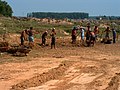 Mudbrick is still used today, as seen here in the Romania Danube River Delta.
 -

-
-

-
 Making mudbricks near Cooktown, Australia


See also[edit]
- Cob – Building material made of soil and fiber
- Earth structure – Building or other structure made largely from soil
- Loam – Soil composed of similar proportions of sand and silt, and somewhat less clay
- Rammed earth – Construction material of damp subsoil
- Sod house – Turf house used in early colonial North America
Notes[edit]
- ^ Roman Ghirshman, La ziggourat de Tchoga-Zanbil (Susiane), Comptes rendus des séances de l'Académie des Inscriptions et Belles-Lettres, vol. 98 lien Issue 2, pp. 233–238, 1954
- ^ a b c Rosenberg, Danny; Love, Serena; Hubbard, Emily; Klimscha, Florian (22 January 2020). "7,200 years old constructions and mudbrick technology: The evidence from Tel Tsaf, Jordan Valley, Israel". PLOS ONE. 15 (1): e0227288. Bibcode:2020PLoSO..1527288R. doi:10.1371/journal.pone.0227288. ISSN 1932-6203. PMC 6975557. PMID 31968007.
- ^ Hasel, Michael G. (2019). "Architecture". In Freedman, David Noel (ed.). Eerdmans dictionary of the Bible. William B. Eerdmans Publishing Company. pp. 246–247?. ISBN 978-1-4674-6046-0. Archived from the original on 2023-09-24. Retrieved 2023-03-23.
- ^ a b Morgenstein, Maury E.; Redmount, Carol A. (1998). "Mudbrick Typology, Sources, and Sedimentological Composition: A Case Study from Tell el-Muqdam, Egyptian Delta". Journal of the American Research Center in Egypt. 35: 129–146. doi:10.2307/40000466. ISSN 0065-9991. JSTOR 40000466. Archived from the original on 2023-09-23. Retrieved 2021-04-23.
- ^ Littman, Robert; Lorenzon, Marta; Silverstein, Jay (2014). "With & without straw: How Israelite slaves made bricks". Biblical Archaeology Review. 40 (2).
- ^ Emery, Virginia L. (2009). "Mud-Brick" (PDF). UCLA Encyclopedia of Egyptology. 1 (1). Archived (PDF) from the original on 2023-09-24. Retrieved 2021-04-23.
- ^ Tellier, Luc-Normand (2009). Urban World History: An Economic and Geographical Perspective. PUQ. ISBN 978-2-7605-2209-1.
- ^ Rosenberg, Danny; Love, Serena; Hubbard, Emily; Klimscha, Florian (2020-01-22). "7,200 years old constructions and mudbrick technology: The evidence from Tel Tsaf, Jordan Valley, Israel". PLOS ONE. 15 (1): e0227288. Bibcode:2020PLoSO..1527288R. doi:10.1371/journal.pone.0227288. ISSN 1932-6203. PMC 6975557. PMID 31968007.
- ^ Possehl, Gregory L. (1996)
- ^ Bricks and urbanism in the Indus Valley rise and decline Archived 2019-05-17 at the Wayback Machine, bricks in antiquity
- ^ Mogens Herman Hansen, A Comparative Study of Six City-state Cultures, Københavns universitet Polis centret (2002) Videnskabernes Selskab, 144 pages ISBN 87-7876-316-9
- ^ C. Michael Hogan, Knossos fieldnotes, Modern Antiquarian (2007) Archived 2017-11-08 at the Wayback Machine
- ^ Hawkes, Jacquetta (1974). Atlas of Ancient Archaeology. McGraw-Hill Book Company. p. 146. ISBN 0-07-027293-X.
- ^ Kathryn A. Bard and Steven Blake Shubert, Encyclopedia of the Archaeology of Ancient Egypt, 1999, Routledge, 938 pages ISBN 0-415-18589-0
- ^ Neer, Richard. T., Art & archaeology of the Greek world: a new history, c. 2500-c.150 BCE, Second edition, Thames and Hudson, London, 2019, pp.23
- ^ Birge, Darice Elizabeth; Miller, Stephen Gaylord; Kraynak, Lynn Harriett; Miller, S. G. (1992–2018). Excavations at Nemea. University of California Press. p. 113n345. ISBN 978-0-520-07027-1. Archived from the original on 2023-06-30. Retrieved 2023-03-23.
Adding straw or dried vegetable matter to the clay of mudbricks was a common practice
- ^ SACKO, Oussouby (15 November 2015). "Issues of Cultural Conservation and Tourism Development in the Process of World Heritage Preservation" (PDF). Area Studies. Archived from the original (PDF) on 27 September 2015. Retrieved 7 October 2016.
- ^ Bradbury, Dominic (30 October 2008). "Timbuktu: Mud, mud, glorious mud". The Telegraph. Archived from the original on 2022-01-12. Retrieved 25 February 2012.
References[edit]
- Possehl, Gregory L. (1996). Mehrgarh in Oxford Companion to Archaeology, edited by Brian Fagan. Oxford University Press.
External links[edit]
- Earth Architecture, website whose focus is contemporary issues in earth architecture.
- EARTHA: Earth Architecture and Conservation in East Anglia, British organisation that focuses on the proper maintenance and conservation of earth buildings in a region of the UK that has a long history of building with mud. Very experienced experts are contactable and there are regular demonstrations in the area.
- Video showing mud brick making, mud brick building and biolytic sewerage in South Africa.
- CRAterre: Centre de recherche architectural en terre, French university research organisation dedicated to unfired earth construction