


Peanut butter

 "Smooth" peanut butter in a jar | |||||||
| Type | Spread | ||||||
|---|---|---|---|---|---|---|---|
| Main ingredients | Peanuts | ||||||
| Ingredients generally used | Salt, sweeteners, and/or emulsifiers | ||||||
| Variations | Crunchy, smooth | ||||||
| 597 kcal (2500 kJ)[1] | |||||||
| |||||||
| Similar dishes | Nut butter | ||||||


Peanut butter is a food paste or spread made from ground, dry-roasted peanuts. It commonly contains additional ingredients that modify the taste or texture, such as salt, sweeteners, or emulsifiers. Consumed in many countries, it is the most commonly used of the nut butters, a group that also includes cashew butter and almond butter (though peanuts are not botanically nuts, peanut butter is culinarily considered a nut butter).
Peanut butter is a nutrient-rich food containing high levels of protein, several vitamins, and dietary minerals. It is typically served as a spread on bread, toast, or crackers, and used to make sandwiches (notably the peanut butter and jelly sandwich). It is also used in a number of breakfast dishes and desserts, such as granola, smoothies, crepes, cookies, brownies, or croissants.
History

The earliest references to peanut butter can be traced to Aztec and Inca civilizations, who ground roasted peanuts into a paste.[2] However, several people can be credited with the invention of modern peanut butter and the processes involved in making it. The US National Peanut Board credits three modern inventors with the earliest patents related to the production of modern peanut butter.[3] Marcellus Gilmore Edson of Montreal, Quebec, Canada, obtained the first patent for a method of producing peanut butter from roasted peanuts using heated surfaces in 1884.[4] Edson's cooled product had "a consistency like that of butter, lard, or ointment" according to his patent application which described a process of milling roasted peanuts until the peanuts reached "a fluid or semi-fluid state". He mixed sugar into the paste to harden its consistency.[citation needed]
A businessman from St. Louis named George Bayle produced and sold peanut butter in the form of a snack food in 1894.[5] By 1917, American consumers used peanut products during periods of meat rationing, with government promotions of "meatless Mondays" when peanut butter was a favored choice.[6]
John Harvey Kellogg, known for his line of prepared breakfast cereals, was an advocate of using plant foods as a healthier dietary choice than meat.[6] He was issued a patent for a "Process of Producing Alimentary Products" on May 24, 1898, and used peanuts, although he boiled the peanuts rather than roasting them.[6][7][8] Kellogg's Western Health Reform Institute served peanut butter to patients because they needed a food that contained a lot of protein that could be eaten without chewing.[5][6] At first, peanut butter was a food for wealthy people, as it became popular initially as a product served at expensive health care institutes.[5][6]
Although often credited with its invention, George Washington Carver did not invent peanut butter.[9] By the time Carver published his document about peanuts, entitled "How to Grow the Peanut and 105 Ways of Preparing it For Human Consumption" in 1916,[10] many methods of preparation of peanut butter had already been developed or patented by various pharmacists, doctors, and food scientists working in the US and Canada.[11][12][13]
Early peanut-butter-making machines were developed by Joseph Lambert, who had worked at John Harvey Kellogg's Battle Creek Sanatorium, and Dr. Ambrose Straub who obtained a patent for a peanut-butter-making machine in 1903.[14][13]
"In 1922, chemist Joseph Rosefield invented a process for making smooth peanut butter that kept the oil from separating by using partially hydrogenated oil; Rosefield "...licensed his invention to the company that created Peter Pan peanut butter" in 1928; further, in "...1932 he began producing his own peanut butter under the name Skippy".[14] Under the Skippy brand, Rosefield developed a new method of churning creamy peanut butter, giving it a smoother consistency. He also mixed fragments of peanut into peanut butter, creating the first "chunky"-style peanut butter.[5] In 1955, Procter & Gamble launched a peanut butter named Jif, which was sweeter than other brands, due to the use of "sugar and molasses" in its recipe.[5] A slang term for peanut butter in World War II was "monkey butter".[15]
In South Africa, the first peanut butter was produced in 1926 by Alderton Limited in Potgietersrus (now Mokopane),[16] The product proved so popular that Tiger Brands (then Tiger Oats Company) took over the manufacture under the brand name Black Cat, which it still produces.[17]
A related dish named pinda-dokkunnu ("peanut cheese" in Sranan Tongo) existed in Suriname by 1783. This was more solid than modern peanut butter, and could be cut and served in slices like cheese. Pinda bravoe, a soup-like peanut based dish, also existed in Suriname around that time.[18] Peanut butter is referred to as "pindakaas" (peanut cheese) in Dutch for this reason, as Suriname was a Dutch colony at that time.[19] When peanut butter was brought onto the market in the Netherlands in 1948, it was not allowed to do so under the name "peanut butter". The word "butter" was specifically reserved for real butter, to avoid confusion with margarine.
Name
Similar to nut milks, nut butters and peanut butter are related to an equivalent dairy product that people are familiar with. Butter is a dairy product usually made from cow's milk and processed into a solid that can be spread on food things. Although, peanut butter is not solid at normal room temperatures, it is thick and spreadable.
Types
Among the types of peanut butter are
- conventional peanut butter, which consists of up to 10% salt, sugars, and hydrogenated vegetable oil[20]
- crunchy or chunky peanut butter, which includes coarsely-ground peanut fragments to give extra texture[21]
- smooth peanut butter, in which the peanuts are ground uniformly, possibly with the addition of corn syrup and vegetable oil, to create a thick, creamy texture like butter[22]
- natural peanut butter, which normally contains only peanuts and salt and is sold without emulsifiers that bind the peanut oils with the peanut paste, and so requires stirring to recombine the ingredients before consumption[20]
- organic and artisanal peanut butters, whose markets are small;[5][23] artisanal peanut butter is usually preservative-free, additive-free, and handmade in a cottage industry-style setup used first around 1970.[24]
Production process
Planting and harvesting
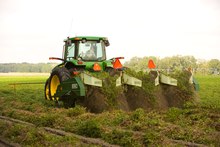
Due to weather conditions, peanuts are usually planted in spring. The peanut comes from a yellow flower that bends over and penetrates the soil after blooming and wilting, and the peanut starts to grow in the soil. Peanuts are harvested from late August to October, while the weather is clear.[25] This weather allows for dry soil so that when picked, the soil does not stick to the stems and pods. The peanuts are then removed from vines and transported to a peanut shelling machine for mechanical drying. After cropping, the peanuts are delivered to warehouses for cleaning, where they are stored unshelled in silos.[25]
Shelling
Shelling must be conducted carefully lest the seeds be damaged during the removal of the shell. The moisture of the unshelled peanuts is controlled to avoid excessive frangibility of the shells and kernels, which in turn, reduces the amount of dust present in the plant.[25] After, the peanuts are sent to a series of rollers set specifically for the batch of peanuts, where they are cracked. After cracking, the peanuts go through a screening process where they are inspected for contaminants.[25]
Roasting
The dry roasting process employs either the batch or continuous method. In the batch method, peanuts are heated in large quantities in a revolving oven at about 800 °F (430 °C).[26] Next, the peanuts in each batch are uniformly held and roasted in the oven at 320 °F (160 °C) for about 40 to 60 minutes.[25] This method is good to use when the peanuts differ in moisture content. In the continuous method, a hot air roaster is employed. The peanuts pass through the roaster whilst being rocked to permit even roasting. A photometer indicates the completion of dry roasting.[27] This method is favored by large manufacturers since it can lower the rate of spoilage and requires less labor.[25]
Cooling
After dry roasting, peanuts are removed from the oven as quickly as possible and directly placed in a blower-cooler cylinder.[25] There are suction fans in the metal cylinder that can pull a large volume of air through,[27] so the peanuts can be cooled more efficiently. The peanuts will not be dried out because cooling can help retain some oil and moisture.[27] The cooling process is completed when the temperature in the cylinder reaches 86 °F (30 °C).[25]
Blanching
After the kernels have been cooled down, the peanuts will undergo either heat blanching or water blanching to remove the remaining seed coats. Compared to heat blanching, water blanching is a new process. Water blanching first appeared in 1949.[25]
Heat blanching
Peanuts are heated by hot air at 280 °F (138 °C) for not more than 20 minutes in order to soften and split the skins. After that, the peanuts are exposed to continuous steam in a blanching machine. The skins are then removed using either bristles or soft rubber belts. After that, these skins are separated and blown into waste bags. Meanwhile, the hearts of peanuts are segregated through inspection.[25]
Water blanching
After the kernels are arranged in troughs, the skin of the kernel is cracked on opposite sides by rolling it through sharp stationary blades. While the skins are removed, the kernels are brought through a one-minute hot water bath and placed on a swinging pad with canvas on top. The swinging action of the pad rubs off the skins. Afterward, the blanched kernels are dried for at least six hours by hot air at 120 °F (49 °C).[25]
After blanching, the peanuts are screened and inspected to eliminate the burnt and rotten peanuts. A blower is also used to remove light peanuts and discolored peanuts are removed using a color sorting machine.[25]
Grinding
After blanching the peanuts are sent to grinding to be manufactured into peanut butter. The peanuts are then sent through two sizes of grinders. The first grinder produces a medium grind, and the second produces a fine grind.[25] At this point, salt, sugar and a vegetable oil stabilizer may be added to the fine grind; this adds flavor and allows the peanut butter to stay as a homogeneous mixture.[28] Chopped peanuts may also be added at this stage to produce "chunky" peanut butter.[25]
Packaging
Before packaging, the peanut butter must first be cooled in order to be sealed in jars.[25] The mixture is pumped into a heat exchanger in order to cool it to about 120 °F (49 °C).[28] Once cool, the peanut butter is pumped into jars and vacuum-sealed, a process which removes air and deoxygenates the peanut butter to inhibit its oxidation.[citation needed] The jars are then labeled and set aside until crystallization occurs. The peanut butter jars are then packaged into cartons distributed to retailers, where they are stored at room temperature and sold to consumers.[25]
A 2012 article stated that "China and India are the first and second-largest producers, respectively", of peanuts.[14] The United States of America "...is the third-largest producer of peanuts (Georgia and Texas are the two major peanut-producing states)"[14] and "more than half of the American peanut crop goes into making peanut butter."[14]
Consumption
The United States is a leading exporter of peanut butter, and one of the largest consumers of peanut butter annually per capita.[29] January 24 is National Peanut Butter Day in the United States.[30] In March 2020 during the COVID-19 pandemic, retail sales of peanut butter in the United States increased by 75% over the level in March 2019.[31]
According to Jon Krampner's 2013 book on peanut butter, per capita consumption of peanut butter in Canada and the Netherlands – the largest consumer per capita in Europe – exceeds that of the United States.[32]
In Israel, the peanut-butter-flavored puffcorn snack Bamba accounts for 25% of the snack market;[33] its consumption by infants has been linked to a low incidence of peanut allergies among Israelis.[34]
Health
Nutritional profile
| Nutritional value per 100 g (3.5 oz) | |
|---|---|
| Energy | 597 kcal (2,500 kJ) |
22.3 g | |
| Starch | 4.8 g |
| Sugars | 10.5 g |
| Dietary fiber | 4.8 g |
51.1 g | |
| Saturated | 10.1 |
| Monounsaturated | 25.4 |
| Polyunsaturated | 12.3 |
22.5 g | |
| Vitamins | Quantity %DV† |
| Vitamin A equiv. | 0% 0 μg |
| Thiamine (B1) | 12% 0.138 mg |
| Riboflavin (B2) | 15% 0.191 mg |
| Niacin (B3) | 83% 13.3 mg |
| Pantothenic acid (B5) | 22% 1.1 mg |
| Vitamin B6 | 26% 0.44 mg |
| Folate (B9) | 22% 86 μg |
| Vitamin C | 0% 0 mg |
| Vitamin E | 61% 9.1 mg |
| Vitamin K | 0% 0.3 μg |
| Minerals | Quantity %DV† |
| Calcium | 4% 49 mg |
| Copper | 47% 0.42 mg |
| Iron | 9% 1.7 mg |
| Magnesium | 40% 169 mg |
| Manganese | 65% 1.5 mg |
| Phosphorus | 27% 339 mg |
| Potassium | 19% 564 mg |
| Selenium | 7% 4.1 μg |
| Sodium | 19% 429 mg |
| Zinc | 23% 2.54 mg |
| Other constituents | Quantity |
| Water | 1.1 g |
| †Percentages estimated using US recommendations for adults,[35] except for potassium, which is estimated based on expert recommendation from the National Academies.[36] | |
In a 100 gram amount, smooth peanut butter supplies 597 calories and is composed of 51% fat, 22% protein, 22% carbohydrates (including 5% dietary fiber), and 1% water (table). Both crunchy and smooth peanut butter are sources of saturated and monounsaturated fats (mainly oleic acid) as 25% of total serving amount, and polyunsaturated fat (12% of total), primarily as linoleic acid).[1]
Peanut butter is a rich source (20% or more of the Daily Value, DV) of dietary fiber, vitamin E, pantothenic acid, folate, niacin, and vitamin B6 (table, USDA FoodData Central). Also high in content are the dietary minerals manganese, magnesium, phosphorus, zinc, copper, and sodium (added as salt during manufacturing). Peanut butter is a moderate source (10–19% DV) of thiamin, riboflavin, iron, and potassium (table).
Peanut allergy
For people with a peanut allergy, peanut butter can cause a variety of possible allergic reactions, including life-threatening anaphylaxis.[37] This potential effect has led to banning peanut butter, among other common foods, in some schools.[38][39]
Symptoms[40]
- Shortness of breath
- Wheezing
- Tightening of the throat
- Itching
- Skin reactions such as hives and swelling
- Digestive problems
Uses
As an ingredient
Peanut butter is included as an ingredient in many recipes: peanut butter and jelly sandwiches, peanut butter cookies, and candies where peanut is the main flavor, such as Reese's Pieces, or various peanut butter and chocolate treats, such as Reese's Peanut Butter Cups and the Crispy Crunch candy bar.[citation needed]
Peanut butter's flavor combines well with other flavors, such as oatmeal, cheese, cured meats, savory sauces, and various types of breads and crackers. The creamy or crunchy, fatty, salty taste pairs very well with complementary soft and sweet ingredients like fruit preserves, bananas, apples, and honey. The taste can also be enhanced by similarly salty things like bacon (see Peanut butter, banana and bacon sandwich), especially if the peanut butter has added sweetness.[citation needed]
One snack for children is called "ants on a log", with a celery stick acting as the "log". The groove in the celery stick is filled with peanut butter and raisins arranged in a row along the top are "ants".[41]
Plumpy'nut is a peanut butter-based food used to fight malnutrition in famine-stricken countries. A single pack contains 500 calories, can be stored unrefrigerated for two years, and requires no cooking or preparation.[42]
-
 Peanut butter cookies, a popular type of cookie made from peanut butter and other ingredients
 -
 Buckeyes, a type of peanut-butter-based confectionery product

.jpg)
As animal food
Peanut butter inside a hollow chew toy is a method to occupy a dog with a favored treat.[43] A common outdoor bird feeder is a coating of peanut butter on a pine cone with an overlying layer of birdseed.[44]
Physical properties
Peanut butter is a viscoelastic food that exhibits both solid and fluid behaviors. It consists of ground up peanuts and may contain additional additives, such as stabilizers, sugars, or salt. Its characteristic soft, spreadable texture can be further defined through rheology – the study of flow and deformation of matter, affecting texture, consistency, and mouthfeel. Specifically for peanut butter, rheology can be used to more accurately define characteristics, such as spreadability and grittiness.
See also

- List of peanut dishes – includes dishes that use peanut butter as a main ingredient
- List of spreads
- Peanut paste
- Peanut pie
- Peanut sauce
- Ruth Desmond, "Peanut Butter Grandmother"[45]
References
- ^ a b "Peanut butter (survey); nutrient contents per 100 grams; FDC ID: 1100559". FoodData Central, USDA National Nutrient Database. October 30, 2020. Retrieved January 19, 2021.
- ^ "Who Invented Peanut Butter?". National Peanut Board. [better source needed]. Retrieved June 15, 2021.
- ^ "Who Invented Peanut Butter?". National Peanut Board. Retrieved June 15, 2021.
- ^ "Manufacture of peanut candy, US Patent #306727". US Patent Office. October 21, 1884. Archived from the original on April 5, 2017. Retrieved May 8, 2017.
- ^ a b c d e f Michaud, Jon (November 28, 2012). "A chunky history of peanut butter". www.newyorker.com. New Yorker. Archived from the original on March 31, 2017. Retrieved May 9, 2017.
- ^ a b c d e Kate Wheeling (January 1, 2021). "A brief history of peanut butter". Smithsonian Magazine. Retrieved January 16, 2021.
- ^ "Process of preparing nutmeal". United States Patent Office. May 24, 1898. Archived from the original on January 6, 2024. Retrieved January 6, 2024 – via Google Patents.
- ^ "Process of producing alimentary products, US Patent #604493". US Patent Office. May 24, 1898. Archived from the original on April 5, 2017. Retrieved May 8, 2017.
- ^ National Peanut Board, Who Invented Peanut Butter?, archived from the original on November 25, 2016, retrieved November 24, 2016.
- ^ "George Washington Carver" Archived November 1, 2015, at the Wayback Machine, National Peanut Board.
- ^ "US Patent #306727". Archived from the original on February 18, 2017.
- ^ "US Patent #604493". Archived from the original on April 5, 2017.
- ^ a b Innovate St. Louis (August 25, 2011). "Innovation in St. Louis History – Innovate St. Louis". Innovatestl.org. Archived from the original on December 27, 2011. Retrieved December 18, 2011.
- ^ a b c d e "The History of Peanut Butter". Huffington Post. August 31, 2012. Archived from the original on September 26, 2016. Retrieved October 3, 2016.
- ^ Jacobs, Jay (1995). The Eaten Word: The Language of Food, the Food in Our Language. Carol Publishing Corporation. ISBN 1-55972-285-1.
- ^ "Our Story Black Cat Peanut Butter". Black Cat. Retrieved August 15, 2021.
- ^ "Tiger Brands Food and Beverage Company". Tiger Brands. Retrieved August 15, 2021.
- ^ van Donselaar, Door J. "Pindakaas, een oud woord uit Suriname" (PDF) (in Dutch). www.fryske-akademy.nl. Archived from the original (PDF) on March 3, 2014. Retrieved January 11, 2022.
- ^ Zwan, Kees; Eerten, Laura van; Noë, Raymond (March 4, 2016). Waar komt pindakaas vandaan?: en 99 andere vragen over woorden (in Dutch). Amsterdam University Press. ISBN 978-90-485-2707-6.
- ^ a b "The Difference Between Natural and Conventional Peanut Butter".
- ^ "Journey of a Peanut Butter Jar: From Manufacturers to Your Home | National Peanut Board".
- ^ "How peanut butter is made" (PDF). Pennsylvania State University. December 2015. Retrieved March 23, 2022.
- ^ Wright, Simon (2012). Handbook of Organic Food Processing and Production. Springer Science & Business Media. p. 129.
- ^ Michaud, Jon (November 28, 2012). "A Chunky History of Peanut Butter". The New Yorker. Retrieved April 22, 2020.
- ^ a b c d e f g h i j k l m n o p Sideman, Eva. "Peanut Butter | Encyclopedia.com". www.encyclopedia.com.
- ^ "AP 42 Compilation of Air Pollutant Emission Factors § 9.10.2.2 Peanut Processing" (PDF). United States Environmental Protection Agency. January 1995. Retrieved August 8, 2018.
- ^ a b c George, Anthonia (Fall 2015). "How Peanut Butter Is Made" (PDF). Archived (PDF) from the original on August 11, 2017. Retrieved February 23, 2022.
- ^ a b "Subject Matter: Making Peanut Butter - IFT.org". www.ift.org. Archived from the original on August 11, 2017. Retrieved August 11, 2017.
- ^ Chakravorty, Rup. "Breeding a better peanut butter". American Society of Agronomy. Archived from the original on November 10, 2015. Retrieved October 15, 2015.
- ^ "American Holidays – United States National Holidays". Statesymbolsusa.org. Archived from the original on December 17, 2011. Retrieved December 18, 2011.
- ^ Elaine Watson (September 24, 2020). "Pandemic fuels peanut butter, snacking peanuts, as US per capita consumption rises to all-time high". Food-Navigator-USA.com, William Reed Business Media, Ltd. Retrieved January 27, 2021.
- ^ Jon Krampner (2013). Creamy & Crunchy: An Informal History of Peanut Butter, the All-American Food. Columbia University Press. pp. 127–9. ISBN 978-0231162326. Retrieved January 27, 2021.
- ^ Leah Granof (January 11, 2007). "The Bisli Snack attack". The Jerusalem Post.
- ^ Hindley, James P.; Filep, Stephanie; Block, Denise S.; King, Eva M.; Chapman, Martin D. (February 1, 2018). "Dose of allergens in a peanut snack (Bamba) associated with prevention of peanut allergy". Journal of Allergy and Clinical Immunology. 141 (2): 780–782. doi:10.1016/j.jaci.2017.05.050. ISSN 0091-6749. PMID 28709966.
- ^ United States Food and Drug Administration (2024). "Daily Value on the Nutrition and Supplement Facts Labels". Retrieved March 28, 2024.
- ^ National Academies of Sciences, Engineering, and Medicine; Health and Medicine Division; Food and Nutrition Board; Committee to Review the Dietary Reference Intakes for Sodium and Potassium (2019). Oria, Maria; Harrison, Meghan; Stallings, Virginia A. (eds.). Dietary Reference Intakes for Sodium and Potassium. The National Academies Collection: Reports funded by National Institutes of Health. Washington, DC: National Academies Press (US). ISBN 978-0-309-48834-1. PMID 30844154.
- ^ "Food allergies in schools". Centers for Disease Control, US Department of Health and Human Services. 2015. Archived from the original on April 29, 2015. Retrieved May 3, 2015.
- ^ James Barron (September 27, 1998). "Dear Mr. Carver. This Is a Cease and Desist Order". The New York Times. Archived from the original on September 10, 2010.
- ^ Labi S (January 31, 2010). "Schools' banned food list has gone nuts". The Daily Telegraph, Sydney, Australia. Retrieved May 3, 2015.
- ^ Mayo Clinic. "Peanut Allergy". Mayo Clinic. Retrieved October 24, 2019.
- ^ "Kids' Recipe: Ants on a Log". Fit.webmd.com. April 24, 2012. Archived from the original on October 13, 2013. Retrieved October 19, 2013.
- ^ Michael Wines (August 8, 2005). "Hope for Hungry Children, Arriving in a Foil Packet". The New York Times. Archived from the original on December 19, 2013.
- ^ "KONG and Other Food Puzzle Toys for Dogs: Usage and Recipes". Pets.webmd.com. Archived from the original on October 12, 2013. Retrieved October 19, 2013.
- ^ "Pine Cone Bird Feeder". Wisconsin State Environmental Education for Kids!. Archived from the original on February 11, 2009.
- ^ Sugarman, Carole (October 5, 1988). "THE 'PEANUT BUTTER GRANDMOTHER'". Washington Post. ISSN 0190-8286. Retrieved September 13, 2022.
Further reading
- Cumo, Christopher, ed. Foods That Changed History: How Foods Shaped Civilization from the Ancient World to the Present (Facts on File, 2015)
- Johnson, Sylvia A. Tomatoes, Potatoes, Corn, and Beans: How the Foods of the Americas Changed Eating around the World (Atheneum Books, 1997).
- Krampner, Jon. Creamy and Crunchy: An Informal History of Peanut Butter, the All-American Food (Columbia University Press, 2013).ISBN 9780231162333
External links
 Definitions from Wiktionary
 Media from Commons
 News from Wikinews
 Quotations from Wikiquote
 Texts from Wikisource
 Recipes from Wikibooks
 Resources from Wikiversity


- US Code of Federal Regulations, Peanut butter; part 164.150; last amended 24 March 1998 Archived April 27, 2021, at the Wayback Machine
| Authority control databases: National |
|---|
