


Phaeton (carriage)

,_19th_century.jpg)
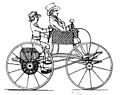
A phaeton (also phaéton) was a form of sporty open carriage popular in the late eighteenth and early nineteenth century. Drawn by one or two horses, a phaeton typically featured a minimal very lightly sprung body atop four extravagantly large wheels. With open seating, it was both fast and dangerous, giving rise to its name, drawn from the mythical Phaëthon, son of Helios, who nearly set the Earth on fire while attempting to drive the chariot of the Sun.
With the advent of the automobile, the term was adopted to refer to open touring cars,[1] which were in consequence referred to as phaeton-bodied.
Types[edit]

The most impressive but dangerous phaeton was the four-wheeled 'high-flyer', the body of which consisted of a light seat perched above two sets of springs.[2] It was from one of these that the rising poet Thomas Warwick was thrown to his death near the fashionable town of Bath during the 1780s.[3] There was also the heavier mail phaeton used chiefly to carry passengers with luggage and named for its construction, using "mail" springs originally designed for use on mail coaches.[4] The spider phaeton, of American origin and made for gentlemen drivers,[4] was a high and lightly constructed carriage with a covered seat in front and a footman's seat behind.[5] Fashionable phaetons used at horse shows included the Stanhope, typically having a high seat and closed back,[6] and the Tilbury, a two-wheeled carriage with an elaborate spring suspension system, with or without a top.[7] A variation of this type of a carriage is called a Victoria, with a retractable cover over the rear passenger compartment.
Use[edit]

Queen Victoria was particularly associated with the phaeton and there are prints and photos of her driving in them both before[8] and throughout her reign. Its openness put her in danger and there were assassination attempts made on her life while in one by Edward Oxford in 1840 and by Henry Holford in 1846.[9] In her later years she enjoyed travelling in a phaeton drawn by a single donkey or mule, and there are examples of this type in the Royal Collection.[10]
Another was put to use by Queen Elizabeth II each June from 1978 to 2011 during the official Queen's Birthday celebrations, when she traveled to and from Trooping the Colour on Horse Guards Parade in an ivory-mounted phaeton carriage made in 1842 for her great-great-grandmother, Queen Victoria.[11]
A social statement of a different kind was made during the 1880s by Valerie, Lady Meux, who defied London Society by driving herself in a high phaeton drawn by zebras.[12] Yet another was the use of such carriages by revolutionaries to carry out the 1907 Tiflis bank robbery.
Gallery[edit]
-
 Phaeton 1816 with a pair of outsized, swan-neck rear leaf springs and high-mounted body
 -
 A jump seat phaeton
 -
 Another view of the same jump seat phaeton
 -
 Phaeton carriage in Geraz do Lima Carriage museum
 -
 Argentine Presidential Phaeton in the Museo del Bicentenario, Buenos Aires
 -
 A phaeton
 -
 Basket phaeton engraved by John Henry Walker
 -
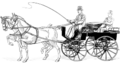 A typical phaeton
 -


.png)

See also[edit]
References[edit]
- ^ "Definition of Phaeton". The Free Dictionary. Retrieved 17 December 2017.
- ^ "Phaeton | Victorian Era, Horse-Drawn, Luxury | Britannica". www.britannica.com.
- ^ Richard Polwhele, Biographical Sketches in Cornwall, Truro 1831, vol.1, p. p.44
- ^ a b Gregersen, Erik; Levy, Michael I., eds. (2012). The Complete History of Wheeled Transportation: From Cars and Trucks to Buses and Bikes. Britannica Educational Publishing. ISBN 978-1-61530-728-9. Retrieved 2014-05-20.
- ^ Gove, Philip Babcock, ed. (1966). "S". Webster's Third New International Dictionary of the English Language, Unabridged. Vol. L–Z. Springfield, Mass.: G & C Merriam. p. 2194. ISBN 0-7135-1037-4.
- ^ "Design for a Stanhope Phaeton carriage". Google Arts & Culture.
- ^ Smith, D. J. (2004) [1994]. "Owner-driven passenger vehicles". Discovering Horse-drawn Vehicles. Princes Risborough, Bucks. UK: Shire Publications. p. 68. ISBN 0-7478-0208-4. Retrieved 2014-05-20.
- ^ "Princess (Soon to be Queen) Victoria in Her Pony Phaeton Carriage in About 1835 -".
- ^ "[Henry Holford attempts to assassinate Queen Victoria] — illustration for G. W. M. Reynolds's "The Mysteries of London" by G. Stiff". victorianweb.org.
- ^ "Pony Phaeton". Carriages of Britain.
- ^ "Trooping the Colour (The Queen's Birthday Parade)" Archived 2006-10-03 at the Wayback Machine, The British Army official website
- ^ "The Third Family of Captain John Francis Hyde". Retrieved 20 April 2018.
External links[edit]

- MNC - Spider Phaeton. Museu Nacional dos Coches (National Coach Museum), Lisbon, Portugal