


Pleistocene Park
 | This article has multiple issues. Please help improve it or discuss these issues on the talk page. (Learn how and when to remove these template messages)
|


| Pleistocene Park | |
|---|---|
| Плейстоценовый парк | |
 Depiction of some mammals common in northern Eurasia during the late Pleistocene, by Mauricio Antón. From left to right: wild horse, woolly mammoth, reindeer, cave lion and woolly rhinoceros. | |
  | |
| Location | Russian Arctic, Sakha Republic |
| Nearest city | Chersky |
| Coordinates | 68°30′48″N 161°31′32″E / 68.51333°N 161.52556°E |
| Area | 20 km2 (8 sq mi) |
| Established | 1988 / 1996 |
| Founder | Sergey Zimov |
| Director | Nikita Zimov |
| Website | pleistocenepark |

Pleistocene Park (Russian: Плейстоценовый парк, romanized: Pleystotsenovyy park) is a nature reserve on the Kolyma River south of Chersky in the Sakha Republic, Russia, in northeastern Siberia, where an attempt is being made to re-create the northern subarctic steppe grassland ecosystem that flourished in the area during the last glacial period.[1][a]
The project is being led by Russian scientists Sergey Zimov and Nikita Zimov,[3][4][5][6][7] testing the hypothesis that repopulating with large herbivores (and predators) can restore rich grasslands ecosystems, as expected if overhunting, and not climate change, was primarily responsible for the extinction of wildlife and the disappearance of the grasslands at the end of the Pleistocene epoch.[8][9]
The aim of the project is to research the climatic effects of the expected changes in the ecosystem. Here the hypothesis is that the change from tundra to grassland will result in a raised ratio of energy emission to energy absorption of the area, leading to less thawing of permafrost and thereby less emission of greenhouse gases.[8][9] It is also thought that removal of snow by large herbivores will further reduce the permafrost's insulation.
To study this, large herbivores have been released, and their effect on the local flora is being monitored. Preliminary results point at the ecologically low-grade tundra biome being converted into a productive grassland biome and at the energy emission of the area being raised.[10]
Research goals[edit]
Effects of large herbivores on the arctic tundra/grasslands ecosystem[edit]
The primary aim of Pleistocene Park is to recreate the mammoth steppe (ancient taiga/tundra grasslands that were widespread in the region during the last ice age). The key concept is that animals, rather than climate, maintained that ecosystem. Reintroducing large herbivores to Siberia would then initiate a positive feedback loop promoting the reestablishment of grassland ecosystems. This argument is the basis for rewilding Pleistocene Park's landscape with megafauna that were previously abundant in the area, as evidenced by the fossil record.[8][9][11]
The grassland-steppe ecosystem that dominated Siberia during the Pleistocene disappeared 10,000 years ago and was replaced by a mossy and forested tundra and taiga ecosystem.[8] Concurrently, most of the large herbivores that roamed Siberia during the Pleistocene have vanished from the region.[9] The mainstream explanation for this used to be that at the beginning of the Holocene the arid steppe climate changed into a humid one, and when the steppe vanished so did the steppe's animals.[8] Sergei Zimov points out that in contradiction to this scenario:
- Similar climatic shifts occurred in previous interglacial periods without causing such massive environmental changes.[8][9][11]
- Those large herbivores of the former steppe that survived until today (e.g. musk oxen, bison, horses) thrive in humid environments just as well as in arid ones.[8][9][11]
- The climate (both temperatures and humidity) in today's northern Siberia is in fact similar to that of the mammoth steppe. The radiation aridity index for northern Siberia on Mikhail Budyko's scale is 2 (= steppe bordering on semi-desert).[8][9][11] Budyko's scale compares the ratio of the energy received by the earth's surface to the energy required for the evaporation of the total annual precipitation.
Zimov and colleagues argue for a reversed order of environmental change in the mammoth steppe. Humans, with their constantly improving technology, overhunted the large herbivores and led to their extinction and extirpation.[8][9][11][12] Without herbivores grazing and trampling over the land, mosses, shrubs and trees were able to take over and replace the grassland ecosystem.[8][9][11][12] If the grasslands were destroyed because herbivore populations were decimated by human hunting, then "it stands to reason that those landscapes can be reconstituted by the judicious return of appropriate herbivore communities."[8]
Effects of large herbivores on permafrost and global warming[edit]
A secondary aim is to research the climatic effects of the expected changes in the ecosystem. Here the key concept is that some of the effects of the large herbivores, such as eradicating trees and shrubs or trampling snow, will result in a stronger cooling of the ground in the winter, leading to less thawing of permafrost during summer and thereby less emission of greenhouse gases.[8][9][11]

Permafrost is a large global carbon reservoir that has remained frozen throughout much of the Holocene.[13] Due to recent climate change, the permafrost is beginning to thaw, releasing stored carbon and forming thermokarst lakes.[13][14] When the thawed permafrost enters the thermokarst lakes, its carbon is converted into carbon dioxide and methane and released into the atmosphere.[15][16][17] Methane is a potent greenhouse gas and the methane emissions from thermokarst lakes have the potential to initiate a positive feedback cycle in which increased atmospheric methane concentrations lead to amplified global climate change, which in turn leads to more permafrost thaw and more methane and carbon dioxide emissions.[16][17]
As the combined carbon stored in the world's permafrost (1670 Gt)[18] equals about twice the amount of the carbon currently released in the atmosphere (720 Gt),[19] the setting in motion of such a positive feedback cycle could potentially lead to a runaway climate change scenario. Even if the ecological situation of the arctic were as it was 400,000 years ago (i.e., grasslands instead of tundra), a global temperature rise of 1.5 °C (2.7 °F) relative to the pre-industrial level would be enough to start the thawing of permafrost in Siberia.[20] An increased cooling of the ground during winter would raise the current tipping point, potentially delaying such a scenario.
Implementation[edit]
Background: regional Pleistocene ecoregions[edit]

It has been proposed that the introduction of a variety of large herbivores will recreate their ancient ecological niches in Siberia and regenerate the Pleistocene terrain with its different ecological habitats such as taiga, tundra, steppe and alpine terrain.
The main objective, however, is to recreate the extensive grasslands that covered the Beringia region in the late Pleistocene.
Proposed procedure[edit]
In present-day Siberia only a few of the former species of megafauna are left; and their population density is extremely low, too low to affect the environment. To reach the desired effects, the density has to be raised artificially by fencing in and concentrating the existing large herbivores. A large variety of species is important as each species affects the environment differently and as the overall stability of the ecosystem increases with the variety of species[8] (compare Biodiversity and ecological services). Their numbers will be raised by reintroducing species that became locally extinct (e.g., muskoxen). For species that became completely extinct, suitable replacements will be introduced if possible (e.g., wild Bactrian camels for the extinct Pleistocene camels of the genus Paracamelus). As the number of herbivores increases, the enclosure will be expanded.[8][9][21][22]
While this is taking place, the effects will be monitored. This concerns for example the effects on the flora (are the mosses being replaced by grasses, etc.), the effects on the atmosphere (changes in levels of methane, carbon dioxide, water vapor) and the effects on the permafrost.[10][23][24]
Finally, once a high density of herbivores over a vast area has been reached, predators larger than the wolves will have to be introduced to keep the megafauna in check.[8][9]
Progress and plans[edit]
- 1988–1996
The first grazing experiments began in 1988 at the Northeast Science Station in Chersky with Yakutian horses.[10]
- 1996–2004
In 1996 a 50 ha (125 acre) enclosure was built in Pleistocene Park.[9] As a first step in recreating the ancient landscape, the Yakutian horses were introduced, as horses had been the most abundant ungulates on the northeastern Siberian mammoth steppe.[25] Of the first 40 horses, 15 were killed by predators and 12 died of eating poisonous plants. More horses were imported, and they learned to cope with the environment.[23] In 2006 approximately 20 horses lived in the park,[26] and by 2007 more horses were being born annually than died.[23] By 2013, the number had risen to about 30.[27] Moose, already present in the region, were also introduced.[28] The effects of large animals (mammoths and wisents) on nature were artificially created by using an engineering tank and an 8 wheel drive Argo all-terrain vehicle to crush pathways through the willow shrub.[12][29][30][31]

The vegetation in the park started to change. In the areas where the horses grazed, the soil has been compacted[24] and mosses, weeds and willow shrub were replaced by grasses.[3][10][22][32] Flat grassland is now the dominating landscape inside the park.[31] The permafrost was also influenced by the grazers. When air temperature sank to −40 °C (−40 °F) in winter, the temperature of the ground was found to be only –5 °C (+23 °F) under an intact cover of snow, but −30 °C (−22 °F) where the animals had trampled down the snow. The grazers thus help keep permafrost intact, thereby lessening the amount of methane released by the tundra.[10][11]
- 2004–2011
In the years 2004–2005 a new fence was erected, creating an enclosure of 16 km2 (6 sq mi).[22][33]
The new enclosure finally allowed a more rapid development of the project.[22] After the fence was completed, reindeer were brought into the park from herds in the region and are now the most numerous ungulates in the park.[28][34] To increase moose density in the park, special constructions were added to the fence in several places that allow animals outside the fenced area to enter the park, while not allowing them to leave. Besides that, wild moose calves were caught in other regions and transported to the park.[35]
In 2007 a 32 meter (105 foot) high tower was erected in the park that constantly monitors the levels of methane, carbon dioxide and water vapor in the park's atmosphere.[23][36]
In September 2010, 6 male muskox from Wrangel Island were reintroduced,[6] but 2 muskoxen died in the first months: one from unknown causes, and the other from infighting among the muskoxen.[37][23][38] Seven months later, in April 2011, 6 Altai wapiti and 5 wisents arrived at the park, the wapiti were from the Altai mountains and the wisents from Prioksko-Terrasny Nature Reserve, near Moscow.[39][40] The enclosing fence proved too low for the wapiti, and by the end of 2012 all 6 had jumped the fence and run off.[41]
- 2011–2016
In the years 2011–2016 progress slowed down as most energy was put into the construction of a 150 ha (370 ac) branch of Pleistocene Park near the city of Tula in Tula Oblast in Europe,[27][42] see below (Wild Field section). A few more reindeer and moose were introduced into Pleistocene Park during this time,[42][43] and a monitoring system for measuring the energy balance (ratio of energy emission and energy absorption)[b] of the pasture was installed.[44][45]
- 2017–2022
Attention has now been shifted back to the further development of Pleistocene Park. A successful crowdfunding effort in early 2017 provided funding for further animal acquisitions.[46][47][48] Later that year 12 domestic yak[49][50] and 30 domestic sheep[51][52] were brought to the park.[53][54] and the introduction of more muskoxen was planned for 2020.[55][better source needed]
For the near future the focus in animal introductions will generally be placed on browsers, not grazers, i.e., bison, muskoxen, horses, and domestic yaks. Their role in this phase will be to diminish the amount of shrubs and trees and enlarge the grassy areas. Only when these areas have sufficiently increased will grazers like saiga and wild Bactrian camels be introduced.[56][57]
2023
In 2023, 24 plains bison were brought to Pleistocene Park. The animals were sourced from Ditlevsdal Bison Farm, Denmark. Later that year, fourteen musk oxen were brought to the park.[citation needed]
Reception[edit]
Controversial aspects[edit]
Critics[who?] admonish that introducing alien species could damage the fragile ecosystem of the existing tundra. To this criticism Sergey Zimov replied: "The tundra is not an ecosystem. Such systems had not existed on the planet [before the disappearance of the megafauna], and there is nothing to cherish in the tundra. Of course, it would be silly to create a desert instead of the tundra, but if the same site would evolve into a steppe, then it certainly would improve the environment. If deer, foxes, bovines were more abundant, nature would only benefit from this. And people too. However, the danger still exists, of course, you have to be very careful. If it is a revival of the steppes, then, for example, small animals are really dangerous to release without control. As for large herbivores – no danger, as they are very easy to remove again."[58]
Another point of concern is doubt that the majority of species can be introduced in such harsh conditions. For example, according to some critics, the Yakutian horses, although they have been living in the park for several generations, would not have survived without human intervention. They normally tolerate –60 °C, but are said to cope poorly with an abundance of snow and possibly would have died of starvation in the first snowy winter. However, horses of much less primitive stock abandoned by the Japanese Army have been living feral on some uninhabited Kuril Islands since 1945. Despite the deep snows (two to three times deeper than in Yakutia), they have successfully survived all the winters without feeding. And in Pleistocene Park, while some of the Yakutian horses accept supplementary feeding, others keep away and survive on their own.[23]
Positive reception[edit]
The Zimovs' concept of Pleistocene Park and repopulating the mammoth steppe is listed as one of the "100 most substantive solutions to global warming" by Project Drawdown.[59] The list, encompassing only technologically viable, existing solutions, was compiled by a team of over 200 scholars, scientists, policymakers, business leaders and activists;[60][61] for each solution the carbon impact through the year 2050, the total and net cost to society, and the total lifetime savings were measured and modeled.[62][63]
In January 2020, a study co-authored by Nikita Zimov and three University of Oxford researchers assessed the viability of the park's goals when implemented on a larger scale. It was estimated that if three large-scale experimental areas were set up, each containing 1000 animals and costing 114 million US dollars over a ten year period, that 72,000 metric tons of carbon could be held and generate 360,000 US dollars in carbon revenues.[64]
Visitors[edit]
The park is a hub for international scientists and students, who come from around the world to conduct their own ecological research and experiments.[10] The Polaris Project was a yearly visitor from 2009 to 2015, sending American students on excursions to the park each summer.[65]
Another group of visitors are journalists. The park is steadily gaining more media attention and while most journalists do not come to the park itself the number of visitors is increasing. In 2016 for example, the park was visited by a filmmaker, two print media (Swiss 24 Heures and American The Atlantic), and two TV broadcasting companies (German ARD and American HBO).[66]
The total of visitors for 2016 (summer months only) was 45.[67]
Size and administration[edit]
Pleistocene Park is a 160 km2 scientific nature reserve (zakaznik) consisting of willow brush, grasslands, swamps, forests and a multitude of lakes.[8][68][c] The average temperature in January is about –33 °C and in July +12 °C; annual precipitation is 200–250 mm.[9]
Pleistocene Park is owned and administered by a non-profit corporation, the Pleistocene Park Association, consisting of the ecologists from the Northeast Science Station in Chersky and the Grassland Institute in Yakutsk.[68] The present park area was signed over to the association by the state and is exempt from land tax.[5] The reserve is surrounded by a 600 km2 buffer zone that will be added to the park by the regional government once the animals have successfully established themselves.[68]
In July 2015 the "Pleistocene Park Foundation". was founded, a non-profit organization (registered in Pennsylvania, US, with 501(c)(3) status)[69] dedicated to acquiring private donations for funding Pleistocene Park.[70] Hitherto Pleistocene Park had been financed solely through the funds of the founders, a practice that grew increasingly insufficient.[70]
In 2019 the "Pleistocene & Permafrost Foundation". 26 April 2023. was founded in Germany by Michael Kurzeja and Bernd Zehentbauer and serves as a bridge between science, politics, companies, and society. It takes care of the project's financing, seeks donations in kind such as tractors, utility vehicles, and pick-ups to build the park, and funds further research projects with the Max Planck Institute. "Dirk Steffens". and "Anabel Ternès". are involved as ambassadors.
Animals[edit]
Present in the park[edit]
Herbivores[edit]

- Reindeer (Rangifer tarandus):[34] Present before the project started (although more are being brought to help simulate Pleistocene conditions). They mainly graze in the southern highlands of the park. This territory is not affected by spring flooding and dominated by larch forests and shrubland. Reindeer rarely visit the flood plain. Besides actively grazing (especially in winter) they browse on willow shrubs, tree moss, and lichens. (Numbers in park in November 2021: 20–30)[71]
- Elk[BE]/moose[AE] (Alces alces):[35] Present before the project started, although in low numbers. Immigration from neighboring areas is stimulated. Due to poaching the density of moose in the region has substantially decreased in the last 20 years. To increase moose density in the park, special constructions were added to the fence in several places that allow animals outside the fenced area to enter the park, while not allowing them to leave. Besides that, wild moose calves are being caught in other regions and transported to the park.[35] It is the largest extant species of the deer family and one of the largest herbivores in the park today. (Numbers in park in November 2021: 5–15)[72]
- Yakutian horse (a domestic breed of horse):[73] The first species to be introduced for the project, they were imported from the surrounding Srednekolymsk region beginning in 1988.[73] Yakutian horses have developed a range of remarkable morphologic, metabolic and physiologic adaptions to the harsh environment of Siberia, including an extremely dense and long winter coat, a compact build, a metabolism adjusted to seasonal needs, and an increased production of antifreezing compounds.[74][75] In summer they grow very large hooves, which they wear down in winter scraping away snow to get at food. Despite their size, they proved to be dominant over the wisents, who often fled from them. Yakutian horses are purely grazing animals – they eat only grass species and visit the park's forests only during the spring flood. In the spring of 2015, ten more Yakutian horses were acquired to increase genetic diversity.[76] (Numbers in park in November 2021: approximately 40)[77]

- Muskox (Ovibos moschatus):[78] Muskoxen arrived at the park in September 2010. They were brought from Wrangel Island[78] (itself repopulated with animals from Canada). They are doing well and are now fully grown. Unfortunately only males could be acquired, after an attempt to get both males and females was thwarted during the expedition when a polar bear broke the fence to eat one of them,[37] and the Zimovs are now urgently looking for females.[38] The introduction of more muskoxen was planned for 2019.[55][79] A new expedition to go to Wrangel Island was planned to take place in late 2020, but ultimately cancelled due to various delays by the time they had the boats ready, including by the COVID-19 pandemic.[80] The original muskoxen managed to escape the park several times, eventually escaping it for good, but in July 2023, they would retrieve 14 young muskoxen from the Yamal Peninsula in exchange for several plains bison. (Numbers in park in September 2023: approximately 14)[81]

- Domestic yak (Bos mutus grunniens): Ten domestic yaks acquired in Irkutsk Oblast were introduced in Pleistocene Park in June 2017; two calves were born a few days after the arrival.[49] Another calf was born after that.[82] Yaks are adapted to extreme cold, short growing seasons for grazing herbage, and rough grazing conditions with sedges and shrubby plants. Wild yaks lived in Beringia until the early Holocene.[83][84] (Numbers in park in November 2021: approximately 8)[49][50][82]
- Edilbaevskaya sheep (a domestic breed of sheep):[85] 30 domestic sheep acquired in Irkutsk Oblast were introduced in Pleistocene Park in October 2017.[51][52] The sheep are from a breed that is adapted to the Siberian cold.[51] They belong to the breed group of fat-tailed sheep; their fatty rump evolved to store fat as a reserve for lean seasons,[86] analogous to a camel's humps.[87] (Numbers in park in November 2021: 18)[88]
- Kalmykian cattle (a domestic breed of cattle adapted for the Mongolian steppe):[89] A population was introduced to the park in October 2018.[90] (Numbers in park in November 2021: 15)[91]
- Plains bison (Bison bison bison): Twelve yearling plains bison, nine males and three females,[92] were acquired and would have been introduced in the park once the United States' FAA gave clearance for the flight.[4][93] The plains bison were bought from the Stevens Village Bison Reserve[d] near Delta Junction in Alaska; as the climate there is comparable to that of Siberia, the young bison were expected to thrive.[97] Plains bison are grazers of grasses and sedges. Unlike wisents, plains bison are almost pure grazers, which will consume other plant material mainly in time of need.[98][99][100] While wood bison were the preferred choice of subspecies, they are not easy to acquire;[101][102] plains bison simply are the subspecies that could be brought to the Park most easily.[47][103] They got bison from Denmark, from the Ditlevsdal bison farm. The bison began traveling on 7 May, and officially arrived safely in the park on 9 June. A second expedition to the Ditlevsdal bison farm allowed for another herd to be brought to the park. (Numbers in park in September 2023: 35)[92]
- Orenburg fur goat (Capra aegagrus hircus): Its presence is necessary due to their ability to eat anything, including plant poisonous to other herbivores.[37] Only difficulty with acquiring them is due to them being only found in Orenburg, due to veterinary services not allowing shipping out of that region. Current plans involve bringing the goats from a farm belonging to a park ranger that formerly worked for Pleistocene Park into the park around May 2021.[104] The trip to acquire them began on May 5, with the goats being loaded on May 8, then the long trek to bring them to Pleistocene Park finished with their arrival at the park on June 18. (Numbers in park in November 2021: 35)[105]

- Bactrian camel (Camelus bactrianus): Either of the two-humped camel species could act as a proxy for extinct Pleistocene camel species, whose fossils have been found in areas that once formed part of Beringia.[106] [107] The camel evolved in the high arctic as a large boreal browser; its hump presumably evolved to store fat as a resource for the long winter.[87] Bactrian camels will eat almost anything, preferably any plant material such as grass, shrubs, bark, etc., but in times of need also carrion.[108][109] In the winter they will dig under snow to get at forage.[108] Camels are not suitable for wet environments, preferring uplands, and are mainly sought out in order to browse away at plants like willow shrubs, though they do sometimes eat the wet grasses.[104] The trip to acquire them began on May 5, 2021 with the camels being loaded on May 8, and then the expedition would wrap up with the transport truck carrying the camels arriving at Pleistocene Park on June 18. (Numbers in park in November 2021: 10)[105]
- Several non-ungulate herbivores were already present before establishment of the park and remain resident; these include the mountain hare (Lepus timidus), the black-capped marmot (Marmota camtschatica), the Arctic ground squirrel (Spermophilus parryii),[8][9] the muskrat (Ondatra zibethicus), and diverse species of voles.[110]
Carnivores[edit]
- Eurasian lynx (Lynx lynx): Resident before the project started.[8] It is an important predator of medium-sized herbivores like hares and roe deer.
- Tundra wolf (Canis lupus albus): Before the project started the area was already home to a family of wolves,[111] despite the originally low concentration of prey ungulates.[8]
- Arctic fox (Vulpes lagopus): Resident before the project started.[8]

- East Siberian brown bear (Ursus arctos collaris): Resident before the project started.[8][9]
- Wolverine (Gulo gulo): Present before the project started.[8][9]
- Yakutsk red fox (Vulpes vulpes jakutensis): Resident before the project started.[8]
- Sable (Martes zibellina): Resident before the project started.[110][better source needed]
- Stoat (Mustela erminea): Resident before the project started.[110][better source needed]
Formerly present and considered for introduction[edit]
Herbivores[edit]
- Wisent (AKA European bison, Bison bonasus):[112] During the last ice age, wisents were the most cold-adapted of the Bison species and thrived in the glacial grassland-steppe biome.[113][e] Their dietary needs are very different from the American bison. Year-round 10% of their diet necessarily consists of trees and shrubs, and they will ignore their main forage (grasses, sedges and forbs) in favour of woody forage to reach this quota.[114] Without supplementary feeding in winter, the yearly average may rise to 20% even in countries with mild winters.[115] Five wisents, one adult male and four juvenile females, were introduced in the park in April 2011. The wisents were brought to the park from the Prioksko-Terrasny Nature Reserve near Moscow.[40][112] The transportation was more complicated and took a longer time than originally thought, but all the animals recovered rapidly after the trip. Unfortunately, the wisents did not sufficiently acclimatize in the first months. They started to moult in November, when temperatures already were down to –30 °C (–35 °F) in Cherskii. The four juveniles died; only the adult bull survived. He is now fully acclimatized.[27][101] (Numbers in park in November 2021: 1 male)[79] The park announced via an Instagram comment that after 12 years of residence, the remaining wisent died sometime during the winter of 2022.[116]
- Wood bison (Bison bison athabascae): Better adapted to life in the Far North than the plains bison.[47] Mainly a grazer of grasses and sedges,[98][117] seasonally supplements this diet with other plant material like forbs, lichen, and silverberry and willow leaves.[117][118] Wet meadows in bottomlands (like the Kolyma river plain) are an important habitat for wood bison.[117] The original plans for the rewilding of Bison had called for the introduction of wood bison as an ecological proxy for the extinct steppe wisent, Bison priscus.[111][119] These plans did not work out[120] and wisents were acquired instead.

- Altai wapiti or Altai maral (Cervus canadensis sibiricus): Had been introduced in April 2011.[121] The wapiti made their way to the park all the way from the mountainous regions of Altai in central southern Siberia.[121] Wapiti are very good jumpers and all six escaped within the first two years. The fence has been strengthened to cope with future introductions.[43]
Carnivores[edit]
- Siberian tiger (Panthera tigris tigris): Introduction planned for a later stage, when herbivores have multiplied.[8][9][23]
Introductions in the event of de-extinction[edit]
Despite referencing the Jurassic Park franchise in its name, the park's staff is not involved in species de-extinction research, be it through cloning, genome editing, or other methods.[122] Nonetheless, Zimov has manifested his willingness to volunteer the park as a location for reintroduction in the event of such animals ever being produced, particularly in regard to the woolly mammoth (Mammuthus primigenius), an extinct ecosystem engineer with no living proxies. Currently the staff uses a vehicle to bulldoze trees too large to be broken by the park's residents but that would be vulnerable to mammoths, opening forest terrain that the animals can turn into grassland through grazing. This vehicle is nicknamed the "baby mammoth".[123]
Southern branch of Pleistocene Park: The Wild Field wilderness reserve[edit]
In 2012 to 2014 a branch of Pleistocene Park named "Wild Field" (Russian: Дикое поле, Dikoe pole) was constructed near the city of Tula in Tula Oblast in the European part of Russia, approximately 250 km (150 mi) south of Moscow.[27][124]
Unlike Pleistocene Park, Wild Field's primary purpose is not scientific research but public outreach, i.e., it will provide a model of what an unregulated steppe ecosystem looked like before the advent of humans. It is situated near a federal road and a railway station and will be accessible to the general public.[124]
Wild Field comprises 300 ha (740 ac)[124] of which 280 ha have been fenced off and stocked with animals.[125] Already present in the park are nine species of large herbivores and one omnivore species: Bashkir horses (a strain of Equus ferus caballus) from the southern part of the Ural Mountains,[126][127] Altai maral/Altai wapiti (Cervus canadensis sibiricus),[127] Edilbaevskaya sheep (a strain of Ovis orientalis aries),[citation needed] roe deer (Capreolus spec.),[f][124][129] Kalmykian cattle (a strain of Bos primigenius taurus),[7][130] domestic yaks (Bos mutus grunniens),[7][130][131] wild boar (Sus scrofa),[131] one female elk[BE]/moose[AE] (Alces alces),[131] four reindeer (Rangifer tarandus)[132] and 73 domestic Pridonskaya goats (a strain of Capra aegagrus hircus).[125]
See also[edit]


- Wild Field (wilderness reserve)
- Permafrost carbon cycle
- Quaternary extinction event
- Rewilding (conservation biology)
External links[edit]
- Successful Kickstarter campaign
- Fundraiser at Indiegogo
- Ben Fogle: New Lives In The Wild, S11 E2: Siberia available online until 20 October 2022
Footnotes[edit]
- ^ During the last ice age northeastern Siberia remained a grassy refuge for scores of animals, including bison and woolly mammoths. Then, about 10,000 years ago, this vast ecosystem disappeared as the Ice Age ended. Now, though, the Ice Age landscape is on its way back, with a little help from the Russian scientists who have established "Pleistocene Park".[2]
- ^ Wikipedia has no good basic article, or at least article section on the energy balance (ratio of energy emission and energy absorption) of land surfaces: What it is, what affects it, etc. Some information may be gleaned from the articles
- Earth's energy budget, though this article deals with the geological energy balance of the whole earth and not of individual areas,
- Albedo, which is the scientific term for the fraction of the Sun's radiation reflected from a surface, though this article deals with geological albedo only in passing and more from a physical than from a geological or ecological point of view, and it is one of those articles written in such a way that, if you do not already know the topic beforehand, the introductory paragraph may stymie you.
- ^ A newer source talks of "around 14 thousand hectares" (140 km2),[5] but as the two older references[8][68] were written by Sergey Zimov himself, while the newer source was written by a journalist, 160 km2 is more likely to be the correct number.
- ^ For information on the Stevens Village Bison Reserve see for example the website of the Stevens Village Community Improvement Corporation, subpage "Stevens Village Bison Reserve";[94] the 2006 article "Stevens Village council launches bison project" in the Juneau Empire;[95] and the 2010 article "Other tribes restore buffalo ties" in the Casper Star-Tribune.[96]
- ^ Two bison species are known to have co-existed during that period in Eurasia, the steppe bison (Bison priscus, the ancestor of today's American bison) and the ancestral form of today's wisent. A study on the distribution of these two species in the Urals, the Caucasus and Western Europe found that population replacements between steppe bison and wisent occurred regularly in correlation "with major palaeoenvironmental shifts", with the wisent being "associated with colder, more tundra-like landscapes and absence of a warm summer" while the steppe bison dominated during the warmer interstadials. During the Last Glacial Maximum the steppe bison disappeared from all of the area covered by the study, leaving only the wisent.[113]
- ^ These are the roe deer of the Tula region, which were already present on the site of Wild Field reserve. The species is not certain, as roe deer were absent in much of European Russia throughout the 20th century and only reoccupied the area in the last decades. Judging by the IUCN distribution maps,[128] the roe deer of the Tula region should be European roe deer (Capreolus capreolus), with the westernmost extension of the range of the Siberian roe deer (Capreolus pygargus) ending approximately 500 km (300 mi) to the east.
References[edit]
- ^ Kintisch, Eli (4 December 2015). "Born to rewild. A father and son's quixotic quest to bring back a lost ecosystem – and save the world". Science. Vol. 350, no. 6265. pp. 1148–1151.
- ^ "Pleistocene Park underway: Home for reborn mammoths?". National Geographic. 17 May 2005. Archived from the original on 21 May 2005. Retrieved 20 April 2009.
- ^ a b Meyer, Anna (2005). Hunting the double helix: How DNA is solving puzzles of the past. Allen & Unwin. ISBN 978-1-74114-107-8. Retrieved 20 April 2009.
... lies in the work of a Russian ecologist, Sergei Zimov, who hopes to recreate a 'mammoth steppe' in north-east Siberia, part of a 'Pleistocene Park'. Work on the project has begun, and so far there are horses, moose, reindeer and bison in the park. These animals are removing mosses and shrubs, ...
- ^ a b Nikita Zimov: "Bison to save the world." Indiegogo crowdfunding campaign, update #7 of 30 May 2018. Retrieved 2 June 2018.
- ^ a b c Строганова (Stroganova), Анна (Anna) (8 May 2018). "Бизоны для Сибири: как двое ученых борются с глобальным потеплением". Interview with Nikita Zimov (in French). Radio France Internationale russe. Retrieved 2 June 2018.
- ^ a b www.pleistocenepark.ru/en/ – Diary of Nikita Zimov during the trip to Wrangel Island in August-September 2010. (In Russian.) Archived 3 November 2016 at the Wayback Machine Retrieved 2 May 2013.
- ^ a b c zoologist.ru – Зоологический форум (Zoological forum) (1 November 2014). "Плейстоценовые парки - Pleistocene Parks". Private communication by Nikita Zimov, director of Pleistocene Park, quoted in an online discussion forum. Retrieved 2 April 2015.
- ^ a b c d e f g h i j k l m n o p q r s t u v w x y Sergey A. Zimov (6 May 2005): "Pleistocene Park: Return of the mammoths' ecosystem" In: Science, pages 796–798. Article also to be found in www.pleistocenepark.ru/en/ – Materials. Archived 3 November 2016 at the Wayback Machine Retrieved 5 May 2013.
- ^ a b c d e f g h i j k l m n o p q r Sergei Zimov (2007): "Mammoth Steppes and Future Climate." Archived 29 October 2013 at the Wayback Machine In: Science in Russia, pages 105–112. Article found in: www.pleistocenepark.ru/en/ – Materials. Archived 3 November 2016 at the Wayback Machine Retrieved 5 May 2013.
- ^ a b c d e f Damira Davletyarova (11 February 2013). "The Zimovs: Restoration of the mammoth-era ecosystem, and reversing global warming". Ottawa life Magazine. Retrieved 6 June 2013.
- ^ a b c d e f g h S.A. Zimov; N.S. Zimov; A.N. Tikhonov; F.S. Chapin III (4 December 2012). "Mammoth steppe: A high-productivity phenomenon" (PDF). Quaternary Science Reviews. 57: 42 fig. 17. Bibcode:2012QSRv...57...26Z. doi:10.1016/j.quascirev.2012.10.005. S2CID 14078430. Archived from the original (PDF) on 4 March 2016. Retrieved 17 October 2014.
- ^ a b c Adam Wolf (Sep–Oct 2008): "The Big Thaw." In: Stanford Magazine, pages 63–69. Article found in: www.pleistocenepark.ru/en/ – Materials. Retrieved 7 May 2013.
- ^ a b Sergey A. Zimov; Edward A. G. Schuur; F.S. Chapin III (2006). "Permafrost and the global carbon budget". Science. 312 (5780): 1612–1613. doi:10.1126/science.1128908. PMID 16778046. S2CID 129667039.
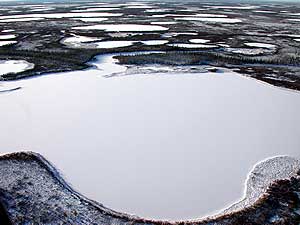
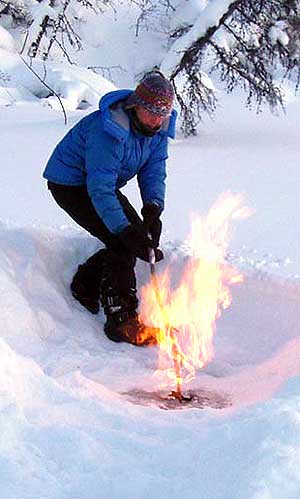
- ^ Grimes, Marmian (24 October 2007). "Study reveals lakes a major source of prehistoric methane". University of Alaska Fairbanks. Archived from the original on 4 March 2016. Retrieved 4 February 2015. Broken picture links: An aerial photo ..., UAF researcher Katey Walter lights a pocket of methane ... Methane bubbles ... Archived 4 February 2021 at the Wayback Machine, Graduate students ... pose near a large pocket of methane ... Archived 5 March 2016 at the Wayback Machine
- ^ K. M. Walter; M. E. Edwards; G. Grosse; S. A. Zimov; F.S. Chapin III (26 October 2007). "Thermokarst lakes as a source of atmospheric CH4 during the last deglaciation". Science. 318 (5850): 633–636. Bibcode:2007Sci...318..633W. doi:10.1126/science.1142924. PMID 17962561. S2CID 31630756.
- ^ a b K. M. Walter; S. A. Zimov; J. P. Chanton; D. Verbyla; F.S. Chapin III (7 September 2006). "Methane bubbling from Siberian thaw lakes as a positive feedback to climate warming". Nature. 443 (7107): 71–75. Bibcode:2006Natur.443...71W. doi:10.1038/nature05040. PMID 16957728. S2CID 4415304.
- ^ a b S. A. Zimov; Y. V. Voropaev; I. P. Semiletov; S. P. Davidov; S. F. Prosiannikov; F. S. Chapin III; M. C. Chapin; S. Trumbore; S. Tyler (8 August 1997): "North Siberian Lakes: A Methane Source Fueled by Pleistocene Carbon." In: Science, vol. 277, no. 5327, pp. 800–802. Full text as pdf. Retrieved 4 February 2015.
- ^ Tarnocai, C.; Canadell, J.G.; Schuur, E.A.G.; Kuhry, P.; Mazhitova, G.; Zimov, S. (27 June 2009). "Soil organic carbon pools in the northern circumpolar permafrost region". Global Biogeochemical Cycles. 23 (2): n/a. Bibcode:2009GBioC..23.2023T. doi:10.1029/2008GB003327. GB2023.
- ^ Falkowski, P.; et al. (13 October 2000). "The global carbon cycle: A test of our knowledge of Earth as a system". Science. 290 (5490): 291–6. Bibcode:2000Sci...290..291F. doi:10.1126/science.290.5490.291. PMID 11030643.
- ^ A. Vaks; et al. (12 April 2013) [21 February 2013]. "Speleothems Reveal 500,000-Year History of Siberian Permafrost". Science. 340 (6129): 183–186. Bibcode:2013Sci...340..183V. doi:10.1126/science.1228729. hdl:20.500.11820/ad9e4b95-dd79-44b4-be37-bf04e0958094. PMID 23429705. S2CID 206544502. Quoted after: Fiona Harvey (21 February 2013). "1.5C rise in temperature enough to start permafrost melt, scientists warn". The Guardian. Retrieved 4 February 2015.
- ^ www.pleistocenepark.ru/en/ – Scientific background. Retrieved 2 May 2013.
- ^ a b c d Александр Марков (Aleksandr Markov) (6 December 2006): "Хороший забор — главное условие восстановления мамонтовых степей." In: Элементы. Article found in: www.pleistocenepark.ru/en/ – Media about us. Retrieved 7 May 2013.
- ^ a b c d e f g Arthur Max (27 November 2010): "Russian Scientist Working To Recreate Ice Age Ecosystem." In: The Huffington Post. Article found in: www.pleistocenepark.ru/en/ – Media about us. Retrieved 7 May 2013.
- ^ a b Алексей Курило (Aleksey Kurilo) (2 August 2008). ""Плейстоценовый парк" Якутии открывает тайны прошлого". Sakha News. Retrieved 27 June 2013.
- ^ Boeskorov, Gennady G. (2004). "The north of eastern Siberia: Refuge of mammoth fauna in the Holocene" (PDF). Gondwana Research. 7 (2): 451–455. Bibcode:2004GondR...7..451B. doi:10.1016/S1342-937X(05)70796-6. Retrieved 14 June 2013.
- ^ Александр Костинский (Aleksandr Kostinskiy); Александр Марков (Aleksandr Markov) (21 December 2006) [15 December 2006]. В Сибирской тундре воссоздается экосистема, погибшая 12 тысяч лет назад. Радио Свобода. Retrieved 14 June 2013. – transcript of an interview with Sergey Zimov aired by Radio Svoboda on 15 December 2006 –
- ^ a b c d zoologist.ru – Зоологический форум (Zoological forum) (8 December 2013). "Плейстоценовые парки - Pleistocene Parks". Private communication by Nikita Zimov, director of Pleistocene Park, quoted in an online discussion forum. Retrieved 18 January 2014.
- ^ a b www.pleistocenepark.ru/en/ – The Park. Retrieved 14 June 2013.
- ^ Paricio, Mark (20 July 2012). "Pleistocene Park". The Polaris Project. Retrieved 7 May 2013.
- ^ www.pleistocenepark.ru/en/photo/62/ www.pleistocenepark.ru/en/ – Machinery; slide 62. Retrieved 2 May 2013.
- ^ a b Fanny Kittler (17 July 2013): "Summer Blog: Chersky 2013 – Pleistocene Park." In: PAGE21: Summer Blog: Chersky 2013. Retrieved 10 February 2014.
- ^ Terry Chapin: The Pleistocene Park Concept. An Illustration. Retrieved 29 August 2014.
- ^ www.pleistocenepark.ru/en/ – Homepage. Retrieved 2 May 2013.
- ^ a b www.pleistocenepark.ru/en/ – Reindeer. Retrieved 14 June 2013.
- ^ a b c www.pleistocenepark.ru/en/ – Moose. Retrieved 19 September 2012.
- ^ www.pleistocenepark.ru/en/ – The Park; slide 10: the monitoring tower. Retrieved 2 May 2013.
- ^ a b c "The Pleistocene Park Foundation is creating northern Serengeti and mitigating climate change". patreon.com. 6 September 2020.
- ^ a b www.pleistocenepark.ru/en/ – News Oct. 14, 2014: Musk ox situation. Retrieved 15 October 2014.
- ^ www.pleistocenepark.ru/en/ – News April 24, 2011: Wapiti and Bisons have arrived to the Park. Retrieved 2 May 2012.
- ^ a b "Пятеро смелых ... зубров" [Five Bold ... Wisents]. БезФормата.Ru (in Russian). 12 April 2011. Archived from the original on 2 December 2013. Retrieved 11 October 2017.
- ^ Griswold-Tergis, Luke (11 November 2013). "A Pleistocene Park – pt.2". Earth Challenge Blog. Retrieved 10 February 2014.
- ^ a b www.pleistocenepark.ru/en/ – News September 17, 2016: Updates from the Pleistocene Park. Retrieved 26 September 2016.
- ^ a b www.pleistocenepark.ru/en/ – News Oct. 14, 2014: Update on the Pleistocene Park activity in 2012–2014. Retrieved 15 October 2014.
- ^ www.pleistocenepark.ru/en/ – News Oct. 14, 2014: Infrastructure advancements in the Pleistocene Park. Retrieved 16 October 2014.
- ^ www.pleistocenepark.ru/en/ – Musk ox; slide 235. Retrieved 16 October 2014.
- ^ The Pleistocene Park Foundation, Inc. (2017): "Pleistocene Park: an ice-age ecosystem to save the world." Kickstarter crowdfunding campaign. Retrieved 4 March 2017.
- ^ a b c Peters, Adele (21 March 2017). "Home, home on the ферма. Meet the father-son duo importing American bison to Siberia to save the planet". Fast Company. Retrieved 29 March 2017.
- ^ David Addison (2017): "A steppe towards a new age of restoration. If you learned that, today, you had the opportunity to back a mammoth effort to restore one of the world's biggest ecosystems, would you take it?" Virgin, 15 March 2017. Retrieved 17 March 2017.
- ^ a b c Pleistocene Park: "On June 9th, we have finally arrived to the Pleistocene Park, with all yaks on board." Facebook post of 13 June 2017. Retrieved 13 June 2017.
- ^ a b Pleistocene Park: "Apparently we had more than one pregnant yak during the trip." Facebook post of 24 June 2017. Retrieved 2 July 2017.
- ^ a b c Pleistocene Park: "As I mentioned yesterday, we are making another expedition to bring animals." Facebook post of 8 September 2017. Retrieved 11 October 2017.
- ^ a b Pleistocene Park: "Road to the Park earlier today." Facebook post of 7 October 2017. Retrieved 11 October 2017.
- ^ "Pleistocene Park". facebook.com. Retrieved 10 March 2018.
- ^ Pleistocene Park. facebook.com (video). Retrieved 7 April 2018.
- ^ a b "Pleistocene Park". facebook.com. Retrieved 10 March 2018.
- ^ Наталья Парамонова (Natalia Paramonov) (27 June 2011). "Через сто лет в Якутии может сформироваться популяция зубров". RIA Novosti. Retrieved 27 June 2013.
- ^ zoologist.ru – Зоологический форум (Zoological forum) (2011). "Плейстоценовые парки - Pleistocene Parks". Comments by Nikita Zimov, director of Pleistocene Park, in an online discussion forum. Retrieved 27 June 2013.
- ^ Александр Марков (Aleksandr Markov), Ольга Орлова (Olga Orlova) (26 December 2006). "Сибирский парк "мамонтового периода"". Полiт.ру. Interview with Sergey Zimov. Retrieved 10 February 2014.
- ^ Project Drawdown (w/o date): "Repopulating the Mammoth Steppe." Retrieved 16 March 2017.
- ^ "Paul Hawken - Drawdown (San Rafael)". Book Passage. 3 January 2017. Retrieved 16 March 2017.
- ^ Project Drawdown homepage. Retrieved 16 March 2017.
- ^ Project Drawdown (w/o date): "Solutions." Retrieved 16 March 2017.
- ^ Joel Makower (2014): "Inside Paul Hawken's audacious plan to 'drawdown' climate change." GreenBiz, 22 October 2014. Retrieved 16 March 2017.
- ^ Macias-Fauria, Marc; Jepson, Paul; Zimov, Nikita; Malhi, Yadvinder (16 March 2020). "Pleistocene Arctic megafaunal ecological engineering as a natural climate solution?". Philosophical Transactions of the Royal Society B: Biological Sciences. 375 (1794): 20190122. doi:10.1098/rstb.2019.0122. PMC 7017769. PMID 31983339.
- ^ Polaris Project: "Blog." Retrieved 26 September 2016.
- ^ www.pleistocenepark.ru/en/ – News September 19, 2016: Visiting Media. Retrieved 26 September 2016.
- ^ www.pleistocenepark.ru/en/ – News September 19, 2016: End of field season. Retrieved 26 September 2016.
- ^ a b c d Sergei A. Zimov, F. Stuart Chapin, III, Melissa Chapin (w/o date): "Pleistocene Park: Re-Establishment of a Functional Steppe Ecosystem in Northeast Siberia." Retrieved 4 March 2017.
- ^ The Pleistocene Park Foundation: Official Website of the Pleistocene Park Foundation, continuously updated. Retrieved 2 June 2018.
- ^ a b www.pleistocenepark.ru/en/ – News July 9, 2015: Opening of The Pleistocene Park Foundation. Retrieved 24 September 2015.
- ^ "Reindeer | Pleistocene Park". pleistocenepark.ru. Retrieved 25 September 2020.
- ^ "Moose | Pleistocene Park". pleistocenepark.ru. Retrieved 25 September 2020.
- ^ a b www.pleistocenepark.ru/en/ – Horses. Archived 2 November 2013 at the Wayback Machine Retrieved 19 September 2012.
- ^ Pablo Librado et al. (23 November 2015): "Tracking the origins of Yakutian horses and the genetic basis for their fast adaptation to subarctic environments." Proceedings of the National Academy of Sciences of the United States of America, vol. 112 no. 50, E6889–E6897, 23 November 2015. https://doi.org/10.1073/pnas.1513696112. Retrieved 11 November 2017.
- ^ Uffe Wilken (23 November 2015): "Adapting to –70 degrees in Siberia: A tale of Yakutian horses." University of Copenhagen, Faculty of Science, 23 November 2015. Retrieved 11 November 2017.
- ^ Jake Kong: Private communication from Zimov. Published on the True Nature Foundation Facebook site, 11 April 2015.
- ^ "Yakutian Horse | Pleistocene Park". pleistocenepark.ru. Retrieved 25 September 2020.
- ^ a b www.pleistocenepark.ru/en/ – Musk ox. Retrieved 19 September 2012.
- ^ a b Laurén, Anna-Lena (31 July 2017). "Sibirien sjunker sakta ned i dyn när permafrosten tinar". Dagens Nyheter (in Swedish). Retrieved 18 October 2017. "Russian version" (in Russian). 24 September 2017. Retrieved 18 October 2017.
- ^ "Facebook". facebook.com. 17 October 2020.
- ^ "Musk Ox | Pleistocene Park". pleistocenepark.ru. Retrieved 7 October 2023.
- ^ a b "Pleistocene Park". www.facebook.com. Retrieved 3 August 2018.
- ^ Fox-Dobbs, K., Leonard, J. A., & Koch, P. L. (2008). "Pleistocene megafauna from eastern Beringia: Paleoecological and paleoenvironmental interpretations of stable carbon and nitrogen isotope and radiocarbon records". Palaeogeography, Palaeoclimatology, Palaeoecology, 261 (1-2), 30-46.
- ^ Murchie, T.J., et al. (2021) "Collapse of the mammoth-steppe in central Yukon as revealed by ancient environmental DNA". Nature Communications, 12 (1): 1-18.
- ^ Pleistocene Park: "Unfortunately we did not get to the park with ships." Facebook post of 12 October 2017. Retrieved 13 October 2017.
- ^ Jill Tilsley-Benham (1987): "Sheep with Two Tails: Sheep's Tail-Fat as Cooking Medium in the Middle East." In: Tom Jaine (ed.), The Cooking Medium, proceedings of the Oxford Symposium on Food and Cookery 1986, London, Prospect Books 1987. ISBN 0-907325-36-X (google books). Retrieved 13 October 2017.
- ^ a b Kate Allen (2013): "Camel fossils discovered in Canada's Arctic shed light on animal's evolution." The Toronto Star: thestar.com, 5 March 2013. Retrieved 13 October 2017.
- ^ "Sheep | Pleistocene Park".
- ^ "Pleistocene Park". www.facebook.com. Retrieved 11 August 2018.
- ^ "Pleistocene Park". www.facebook.com. Retrieved 7 October 2018.
- ^ "Kalmykian Cows | Pleistocene Park".
- ^ a b de Marban, Alex (24 May 2018). "Alaska bison await shipment to Siberia in project to fight climate change". Anchorage Daily News. Retrieved 30 May 2018.
- ^ Pleistocene Park: "At the end of May 2018 ..." Facebook post of 8 June 2018, comments section. Retrieved 19 June 2018.
- ^ Stevens Village Community Improvement Corporation: "Stevens Village Bison Reserve." Without date. Retrieved 23 January 2018.
- ^ Associated Press (2006): "Stevens Village council launches bison project." Juneau Empire, 4 September 2006. Retrieved 23 January 2018.
- ^ Tom Mast (2010): "Other tribes restore buffalo ties." Casper Star-Tribune, 28 November 2010. Retrieved 23 January 2018.
- ^ Peters, Adele (23 April 2018). "Baby bison are being flown to Siberia to try to save the permafrost". Fast Company. Retrieved 29 May 2018.
- ^ a b "Frequently Asked Questions – What do bison eat? How often do they eat?". Alaska Department of Fish and Game. Wood Bison Restoration in Alaska. State of Alaska. Retrieved 14 November 2017.
- ^ Newell, Toni Lynn; Sorin, Anna Bess (2003). "Bison bison. American bison". Animal Diversity Web. University of Michigan. Retrieved 14 November 2017.
- ^ Illinois State Museum (w/o date): "Bison, Bison bison." In: Explore the Ice Age Midwest ... plants and animals of the Pleistocene, web resource of the Illinois State Museum. Retrieved 14 November 2017.
- ^ a b www.pleistocenepark.ru/en/ – Bison; slide 241. Retrieved 16 October 2014.
- ^ Pleistocene Park: "Very exciting project. Wild bison once again roam Alaska. Siberia is next. Making plans for spring." Facebook post of 1 November 2017. Retrieved 5 November 2017.
- ^ Nikita Zimov (2017): "Dear Brian." Reply to comment in Comments section of Kickstarter crowdfunding page, 28 March 2017. Retrieved 5 November 2017.
- ^ a b "The Pleistocene Park Foundation Inc. is creating Northern Serengeti and Mitigating Climate Change". patreon.com. 2 April 2021.
- ^ a b "Pleistocene Park". www.facebook.com. Retrieved 20 June 2021.
- ^ "Yukon's Camels | Yukon Beringia Interpretive Centre". www.beringia.com. Retrieved 13 December 2023.
- ^ "Bactrian Camels | Pleistocene Park". pleistocenepark.ru. Retrieved 13 December 2023.
- ^ a b Cutshall, Emily (2017). Powers, Karen; Dewey, Tanya (eds.). "Camelus bactrianus. Bactrian camel". Animal Diversity Web. University of Michigan. Retrieved 11 November 2017.
- ^ Jay Sharp: "The Wild Bactrian Camel. (Camelus ferus.)" DesertUSA, w/o date. Retrieved 11 November 2017.
- ^ a b c Pleistocene Park: "Photo of the Arctic ground squirrel, made somewhere in the neighborhood of Pleistocene Park." Facebook post of 10 May 2017. Retrieved 11 May 2017.
- ^ a b Richard Stone (7 November 1998). "Pleistocene Park". The Moscow Times. Archived from the original on 2 February 2014. Retrieved 22 January 2014.
- ^ a b www.pleistocenepark.ru/en/ – Bison. Retrieved 19 September 2012.
- ^ a b Julien Soubrier, Alan Cooper, et al. (2016): "Early cave art and ancient DNA record the origin of European bison." Nature Communications 7, Article 13158. Retrieved 28 October 2016.
- ^ Hendricks, Kassondra (2013). Bruggink, John; Dewey, Tanya (eds.). "Bison bonasus. European bison (also: wisent)". Animal Diversity Web. University of Michigan. Retrieved 14 November 2017.
- ^ Joris P. G. M. Cromsigt, Yvonne J. M. Kemp, Esther Rodriguez, Hubert Kivit: "Rewilding Europe's large grazer community: how functionally diverse are the diets of European bison, cattle, and horses?" Restoration Ecology, 17 December 2017. https://doi.org/10.1111/rec.12661. Retrieved 30 January 2018.
- ^ "Pleistocene Park". www.instagram.com. Retrieved 10 August 2023.
- ^ a b c Jonathan A. Mitchell, C. Cormack Gates (2002): "Status of the Wood Bison (Bison bison athabascae) in Alberta." Wildlife Status Report No. 38. Edmonton, AB: Alberta Sustainable Resource Development, Fish and Wildlife Division, and Alberta Conservation Association, January 2002. Retrieved 14 November 2017.
- ^ "Wood Bison (Bison bison athabascae)". Alaska Department of Fish and Game. Species Profile. State of Alaska. Retrieved 14 November 2017.
- ^ Terry Chapin: "Pleistocene Park" and "Bison and Pleistocene Park." Retrieved 29 August 2014.
- ^ Pleistocene Park: "This picture was taken in the Wild Field in the first year animals were introduced." Facebook post of 1 February 2017. Retrieved 5 November 2017.
- ^ a b www.pleistocenepark.ru/en/ – Wapiti. Retrieved 19 September 2012.
- ^ Pleistocene Park FAQ
- ^ Pleistocene Park by The Atlantic.
- ^ a b c d www.pleistocenepark.ru/en/ – News Oct. 15, 2014: Opening of the new reserve ″Wild Field″. Retrieved 15 October 2014.
- ^ a b Pleistocene Park: "Wild Field 31.05.2017." Facebook post of 4 June 2017. Retrieved 2 July 2017.
- ^ True Nature Foundation (4 March 2014): ″Professor Zimov and his team, known from Pleistocene Park, ...″ TNF Facebook site. Retrieved 5 March 2014.
- ^ a b www.pleistocenepark.ru/en/ – Wild Field. Archived 19 October 2014 at the Wayback Machine Retrieved 15 October 2014.
- ^ The IUCN Red List of Threatened Species: Distribution map of Capreolus capreolus, Distribution map of Capreolus pygargus. Retrieved 24 October 2014.
- ^ "Wild Field; slide 245". Pleistocene Park. Archived from the original on 13 September 2015. Retrieved 24 October 2014.
- ^ a b На территории Воловского района создаётся экспериментальный заповедник [On the territory of Volovsky district an experimental reserve is created] (TV feature). Wild Field reserve. First Tula Telechannel. 31 March 2015. Archived from the original on 15 December 2021. Retrieved 2 April 2015 – via YouTube.
- ^ a b c "Reports from Wild Field". Pleistocene Park. 19 June 2016. Archived from the original on 20 August 2016.
- ^ Pleistocene Park: "To the wild field were introduced 75 goats and 4 reindeers." Facebook post of 24 May 2017. Retrieved 2 July 2017.


Media[edit]

- Official park website
- PleistocenePark (Patreon)
- Official facebook site
- Official website of the Pleistocene Park Foundation (Last update April 2018)
- ″Wild Field″ Manifesto Archived 10 May 2018 at the Wayback Machine. Sergey A. Zimov, 2014.
Literature[edit]
- Sergey A. Zimov (2005): ″Pleistocene Park: Return of the Mammoth's Ecosystem.″ In: Science, 6 May 2005, vol. 308, no. 5723, pp. 796–798. Accessed 5 May 2013..
- Aleksandr Markov (2006): ″Good Fence for Future Mammoth Steppes.″ Translated by Anna Kizilova. Russia-InfoCentre website, 21 January 2007. Accessed 5 May 2013..
- Sergei Zimov (2007): ″Mammoth Steppes and Future Climate.″ In: Science in Russia, 2007, pp. 105–112. Article found in: www.pleistocenepark.ru/en/ – Materials. Accessed 5 May 2013..
- Adam Wolf (2008): ″The Big Thaw.″ In: Stanford Magazine, Sept.–Oct. 2008, pp. 63–69. Accessed 7 May 2013.. – PDF of print version, found in: www.pleistocenepark.ru/en/ – Materials. Accessed 7 May 2013..
- Arthur Max (2010): ″Russian Scientist Working To Recreate Ice Age Ecosystem.″ In: The Huffington Post, 27 November 2010. Accessed 7 May 2013..
- Martin W. Lewis (2012): ″Pleistocene Park: The Regeneration of the Mammoth Steppe?″ and ″Pleistocene Re-Wilding: Environmental Restoration or Ecological Heresy?″ In: GeoCurrents, 12 respectively 14 April 2012. Accessed 2 May 2013..
- Sergey A. Zimov, Nikita S. Zimov, F. Stuart Chapin III (2012): "The Past and Future of the Mammoth Steppe Ecosystem." (doi). In: Julien Louys (ed.), Paleontology in Ecology and Conservation, Berlin Heidelberg, Springer-Verlag 2012. Accessed 4 November 2017..
- S.A. Zimov, N.S. Zimov, A.N. Tikhonov, F.S. Chapin III (2012): ″Mammoth steppe: a high-productivity phenomenon.″ In: Quaternary Science Reviews, vol. 57, 4 December 2012, pp. 26–45. Accessed 10 February 2014..
- Damira Davletyarova (2013): ″The Zimovs: Restoration of the Mammoth-Era Ecosystem, and Reversing Global Warming.″ In: Ottawa Life Magazine, 11 February 2013. Accessed 6 June 2013..
- Eli Kintisch (2015): "Born to rewild. A father and son's quixotic quest to bring back a lost ecosystem – and save the world." In: Science, 4 December 2015, vol. 350, no. 6265, pp. 1148–1151. (Alternative version on the Pulitzer Center on Crisis Reporting website.) Accessed 26 September 2016..
- Ross Andersen (2017): "Welcome to Pleistocene Park. In Arctic Siberia, Russian scientists are trying to stave off catastrophic climate change—by resurrecting an Ice Age biome complete with lab-grown woolly mammoths." In: The Atlantic, April 2017. Accessed 10 March 2017..
- Adele Peters (2017): "Home, home on the ферма. Meet The Father-Son Duo Importing American Bison To Siberia To Save The Planet." In: Fast Company, 21 March 2017. Accessed 29 March 2017..
- Animal People, Inc. (2017): "An Interview with Nikita Zimov, Director of Pleistocene Park." In: Animal People Forum, 2 April 2017.
- Noah Deich (2017): "Mammoths, Permafrost & Soil Carbon Storage: A Q&A about Pleistocene Park." Interview with Dr. Guy Lomax of the Natural Climate Initiative at The Nature Conservancy. Center for Carbon Removal, 3 April 2017.
Video[edit]
- Pleistocene Park (w/o date): 360° panorama view from top of the monitoring tower. Photo in Pleistocene Park Picture Gallery. Accessed 20 October 2014..
- R. Max Holmes (2011): An Arctic Solution to Climate Warming. Talk at the TEDxWoodsHole, 2 March 2011, in Woods Hole, Mass. Video, 9:17 min., uploaded 18 November 2011. Accessed 10 March 2017..
- Eugene Potapov (2012): Pleistocene Park. Video, 7:11 min., uploaded 21 October 2012. Accessed 23 April 2013..
- Panoramio (2012): A view of the Kolyma River floodplains taken from the surrounding hills above Pleistocene Park. Photo, uploaded 23 October 2012. Accessed 27 June 2013..
- Luke Griswold-Tergis (2014): Can Woolly Mammoths Save the World? Talk at the TEDxConstitutionDrive 2014 (Menlo Park, CA).] Video, 15:25 min., uploaded 29 May 2014. Accessed 20 October 2014..
- Grant Slater, Ross Andersen (2016): Creating Pleistocene Park. Video, 26:01 min., uploaded 13 March 2017. Accessed 6 April 2017..
- The Pleistocene Park Foundation, Inc. (2017): Pleistocene Park: an ice-age ecosystem to save the world. Video, 3:09 min. Kickstarter crowdfunding campaign. Accessed 4 March 2017..
- ZoominTV (2017) Jurassic Park IRL: How the mammoth can help our future. Video, 3:25 min., uploaded 10 July 2017. Note: This video shows Wild Field footage cut against an interview about Pleistocene Park.Accessed 6 April 2017..
- Barbara Lohr (2017): Siberia: Raiders of the Lost Age. Video, 36 min. ARTE Reportage.
- Atlas Pro (2021): The Plan to Revive the Mammoth Steppe to Fight Climate Change. Video, 20 min.

External links[edit]
 Media related to Pleistocene Park at Wikimedia Commons
- 1988 establishments in Russia
- 1996 establishments in Russia
- Protected areas established in 1988
- Protected areas established in 1996
- Nature reserves in Russia
- Geography of the Sakha Republic
- Protected areas of the Russian Far East
- Wildlife sanctuaries of Asia
- Paleoecology
- Pleistocene Asia
- Pleistocene extinctions
- Ecological experiments
- Animal reintroduction
- Climate change mitigation
- Permafrost
- Rewilding
- Siberian Tiger Re-population Project