


Tipping points in the climate system


In climate science, a tipping point is a critical threshold that, when crossed, leads to large, accelerating and often irreversible changes in the climate system.[3] If tipping points are crossed, they are likely to have severe impacts on human society and may accelerate global warming.[4][5] Tipping behavior is found across the climate system, for example in ice sheets, mountain glaciers, circulation patterns in the ocean, in ecosystems, and the atmosphere.[5] Examples of tipping points include thawing permafrost, which will release methane, a powerful greenhouse gas, or melting ice sheets and glaciers reducing Earth's albedo, which would warm the planet faster. Thawing permafrost is a threat multiplier because it holds roughly twice as much carbon as the amount currently circulating in the atmosphere.[6]
Tipping points are often, but not necessarily, abrupt. For example, with average global warming somewhere between 0.8 °C (1.4 °F) and 3 °C (5.4 °F), the Greenland ice sheet passes a tipping point and is doomed, but its melt would take place over millennia.[2][7] Tipping points are possible at today's global warming of just over 1 °C (1.8 °F) above preindustrial times, and highly probable above 2 °C (3.6 °F) of global warming.[5] It is possible that some tipping points are close to being crossed or have already been crossed, like those of the West Antarctic and Greenland ice sheets, the Amazon rainforest and warm-water coral reefs.[8]
A danger is that if the tipping point in one system is crossed, this could cause a cascade of other tipping points, leading to severe, potentially catastrophic,[9] impacts.[10] Crossing a threshold in one part of the climate system may trigger another tipping element to tip into a new state.[11] For example, ice loss in West Antarctica and Greenland will significantly alter ocean circulation. Sustained warming of the northern high latitudes as a result of this process could activate tipping elements in that region, such as permafrost degradation, and boreal forest dieback.[3]
Scientists have identified many elements in the climate system which may have tipping points.[12][13] As of September 2022, nine global core tipping elements and seven regional impact tipping elements are known.[2] Out of those, one regional and three global climate elements will likely pass a tipping point if global warming reaches 1.5 °C (2.7 °F). They are the Greenland ice sheet collapse, West Antarctic ice sheet collapse, tropical coral reef die off, and boreal permafrost abrupt thaw.
Tipping points exists in a range of systems, for example in the cryosphere, within ocean currents, and in terrestrial systems. The tipping points in the cryosphere include: Greenland ice sheet disintegration, West Antarctic ice sheet disintegration, East Antarctic ice sheet disintegration, arctic sea ice decline, retreat of mountain glaciers, permafrost thaw. The tipping points for ocean current changes include the Atlantic Meridional Overturning Circulation (AMOC), the North Subpolar Gyre and the Southern Ocean overturning circulation. Lastly, the tipping points in terrestrial systems include Amazon rainforest dieback, boreal forest biome shift, Sahel greening, and vulnerable stores of tropical peat carbon.
Definition[edit]

The IPCC Sixth Assessment Report defines a tipping point as a "critical threshold beyond which a system reorganizes, often abruptly and/or irreversibly".[14] It can be brought about by a small disturbance causing a disproportionately large change in the system. It can also be associated with self-reinforcing feedbacks, which could lead to changes in the climate system irreversible on a human timescale.[13] For any particular climate component, the shift from one state to a new stable state may take many decades or centuries.[13]
The 2019 IPCC Special Report on the Ocean and Cryosphere in a Changing Climate defines a tipping point as: "A level of change in system properties beyond which a system reorganises, often in a non-linear manner, and does not return to the initial state even if the drivers of the change are abated. For the climate system, the term refers to a critical threshold at which global or regional climate changes from one stable state to another stable state.".[15]
In ecosystems and in social systems, a tipping point can trigger a regime shift, a major systems reorganisation into a new stable state.[16] Such regime shifts need not be harmful. In the context of the climate crisis, the tipping point metaphor is sometimes used in a positive sense, such as to refer to shifts in public opinion in favor of action to mitigate climate change, or the potential for minor policy changes to rapidly accelerate the transition to a green economy.[17][18][19]
Comparison of tipping points[edit]
Scientists have identified many elements in the climate system which may have tipping points.[12][13] In the early 2000s the IPCC began considering the possibility of tipping points, originally referred to as large-scale discontinuities. At that time the IPCC concluded they would only be likely in the event of global warming of 4 °C (7.2 °F) or more above preindustrial times, and another early assessment placed most tipping point thresholds at 3–5 °C (5.4–9.0 °F) above 1980–1999 average warming.[20] Since then estimates for global warming thresholds have generally fallen, with some thought to be possible in the Paris Agreement range (1.5–2 °C (2.7–3.6 °F)) by 2016.[21] As of 2021 tipping points are considered to have significant probability at today's warming level of just over 1 °C (1.8 °F), with high probability above 2 °C (3.6 °F) of global warming.[5] Some tipping points may be close to being crossed or have already been crossed, like those of the ice sheets in West Antarctic and Greenland, warm-water coral reefs, and the Amazon rainforest.[22][23]
As of September 2022, nine global core tipping elements and seven regional impact tipping elements have been identified.[2] Out of those, one regional and three global climate elements are estimated to likely pass a tipping point if global warming reaches 1.5 °C (2.7 °F), namely Greenland ice sheet collapse, West Antarctic ice sheet collapse, tropical coral reef die off, and boreal permafrost abrupt thaw. Two further tipping points are forecast as likely if warming continues to approach 2 °C (3.6 °F): Barents sea ice abrupt loss, and the Labrador sea subpolar gyre collapse.[2][24][7]
| Proposed climate tipping element (and tipping point) | Threshold ( °C) | Timescale (years) | Maximum Impact ( °C) | ||||||
|---|---|---|---|---|---|---|---|---|---|
| Estimated | Minimum | Maximum | Estimated | Minimum | Maximum | Global | Regional | ||
| Greenland Ice Sheet (collapse) | 1.5 | 0.8 | 3.0 | 10,000 | 1,000 | 15,000 | 0.13 | 0.5 to 3.0 | |
| West Antarctic Ice Sheet (collapse) | 1.5 | 1.0 | 3.0 | 2,000 | 500 | 13,000 | 0.05 | 1.0 | |
| Labrador-Irminger Seas/SPG Convection (collapse) | 1.8 | 1.1 | 3.8 | 10 | 5 | 50 | -0.5 | -3.0 | |
| East Antarctic Subglacial Basins (collapse) | 3.0 | 2.0 | 6.0 | 2,000 | 500 | 10,000 | 0.05 | ? | |
| Arctic Winter Sea Ice (collapse) | 6.3 | 4.5 | 8.7 | 20 | 10 | 100 | 0.6 | 0.6 to 1.2 | |
| East Antarctic Ice Sheet (collapse) | 7.5 | 5.0 | 10.0 | ? | 10,000 | ? | 0.6 | 2.0 | |
| Amazon Rainforest (dieback) | 3.5 | 2.0 | 6.0 | 100 | 50 | 200 | 0.1 (partial) 0.2 (total)[T1 1] | 0.4 to 2.0 | |
| Boreal Permafrost (collapse) | 4.0 | 3.0 | 6.0 | 50 | 10 | 300 | 0.2 - 0.4[T1 2] | ~ | |
| Atlantic Meridional Overturning Circulation (collapse) | 4.0 | 1.4 | 8.0 | 50 | 15 | 300 | -0.5 | -4 to -10 | |
- ^ The paper also provides the same estimate in terms of equivalent emissions: partial dieback would be equivalent to the emissions of 30 billion tonnes of carbon, while total dieback would be equivalent to 75 billion tonnes of carbon.
- ^ The paper also provides the same estimate in terms of emissions: between 125 and 250 billion tonnes of carbon and between 175 and 350 billion tonnes of carbon equivalent.
| Proposed climate tipping element (and tipping point) | Threshold ( °C) | Timescale (years) | Maximum Impact ( °C) | ||||||
|---|---|---|---|---|---|---|---|---|---|
| Estimated | Minimum | Maximum | Estimated | Minimum | Maximum | Global | Regional | ||
| Low-latitude Coral Reefs (dieoff) | 1.5 | 1.0 | 2.0 | 10 | ~ | ~ | ~ | ~ | |
| Boreal Permafrost (abrupt thaw) | 1.5 | 1.0 | 2.3 | 200 | 100 | 300 | 0.04 per °C by 2100;0.11 per °C by 2300[T2 1] | ~ | |
| Barents Sea Ice (abrupt loss) | 1.6 | 1.5 | 1.7 | 25 | ? | ? | ~ | + | |
| Mountain Glaciers (loss) | 2.0 | 1.5 | 3.0 | 200 | 50 | 1,000 | 0.08 | + | |
| Sahel and W.African Monsoon (greening) | 2.8 | 2.0 | 3.5 | 50 | 10 | 500 | ~ | + | |
| Boreal Forest (southern dieoff) | 4.0 | 1.4 | 5.0 | 100 | 50 | ? | net -0.18[T2 2] | -0.5 to -2 | |
| Boreal Forest (northern expansion) | 4.0 | 1.5 | 7.2 | 100 | 40 | ? | net +0.14[T2 3] | 0.5-1.0 | |
- ^ The paper clarifies that this represents a 50% increase of gradual permafrost thaw: it also provides the same estimate in terms of emissions per each degree of warming: 10 billion tonnes of carbon and 14 billion tonnes of carbon equivalent by 2100, and 25/35 billion tonnes of carbon/carbon equivalent by 2300.
- ^ The loss of these forests would be equivalent to the emissions of 52 billion tons of carbon, but this would be more than offset by the area's albedo effect increasing and reflecting more sunlight.
- ^ Extra forest growth here would absorb around 6 billion tons of carbon, but because this area receives a lot of sunlight, this is very minor when compared to reduced albedo, as this vegetation absorbs more heat than the snow-covered ground it moves into.
Tipping points in the cryosphere[edit]
Greenland ice sheet disintegration[edit]

The Greenland ice sheet is the second largest ice sheet in the world, and is three times the size of the American state of Texas.[25] The water which it holds would, if completely melted, raise sea levels globally by 7.2 metres (24 ft).[26] Due to global warming, the ice sheet is melting at an accelerating rate, adding almost 1 mm to global sea levels every year.[27] Around half of the ice loss occurs via surface melting, and the remainder occurs at the base of the ice sheet where it touches the sea, by calving (breaking off) icebergs from its margins.[28]
The Greenland ice sheet has a tipping point because of the melt-elevation feedback. Surface melting reduces the height of the ice sheet, and air at a lower altitude is warmer. The ice sheet is then exposed to warmer temperatures, accelerating its melt.[29] A 2021 analysis of sub-glacial sediment at the bottom of a 1.4 kilometres (0.87 mi) Greenland ice core finds that the Greenland ice sheet melted away at least once during the last million years, and therefore strongly suggests that its tipping point is below the 2.5 °C (4.5 °F) maximum temperature increase over the preindustrial conditions observed over that period.[30][31] There is some evidence that the Greenland ice sheet is losing stability, and getting close to a tipping point.[29]
West Antarctic ice sheet disintegration[edit]

The West Antarctic Ice Sheet (WAIS) is a large ice sheet in Antarctica; in places more than 4 kilometres (2.5 mi) thick. It sits on bedrock mostly below sea level, having formed a deep subglacial basin due to the weight of the ice sheet over millions of years.[32] As such, it is in contact with the heat from the ocean which makes it vulnerable to fast and irreversible ice loss. A tipping point could be reached once the WAIS's grounding lines (the point at which ice no longer sits on rock and becomes floating ice shelves) retreat behind the edge of the subglacial basin, resulting in self-sustaining retreat in to the deeper basin - a process known as the Marine Ice Sheet Instability (MISI).[33][34] Thinning and collapse of the WAIS's ice shelves is helping to accelerate this grounding line retreat. If completely melted, the WAIS would contribute around 3.3 metres (11 ft) of sea level rise over thousands of years.[13]
Ice loss from the WAIS is accelerating, and some outlet glaciers are estimated to be close to or possibly already beyond the point of self-sustaining retreat.[35][36][37] The paleo record suggests that during the past few hundred thousand years, the WAIS largely disappeared in response to similar levels of warming and CO2 emission scenarios projected for the next few centuries.[38]
Like with the other ice sheets, there is a counteracting negative feedback - greater warming also intensifies the effects of climate change on the water cycle, which result in an increased precipitation over the ice sheet in the form of snow during the winter, which would freeze on the surface, and this increase in the surface mass balance (SMB) counteracts some fraction of the ice loss. In the IPCC Fifth Assessment Report, it was suggested that this effect could potentially overpower increased ice loss under the higher levels of warming and result in small net ice gain, but by the time of the IPCC Sixth Assessment Report, improved modelling had proven that the glacier breakup would consistently accelerate at a faster rate.[39][40]
East Antarctic ice sheet disintegration[edit]
East Antarctic ice sheet is the largest and thickest ice sheet on Earth, with the maximum thickness of 4,800 metres (3.0 mi). A complete disintegration would raise the global sea levels by 53.3 metres (175 ft), but this may not occur until global warming of 10 °C (18 °F), while the loss of two-thirds of its volume may require at least 6 °C (11 °F) of warming to trigger.[41] Its melt would also occur over a longer timescale than the loss of any other ice on the planet, taking no less than 10,000 years to finish. However, the subglacial basin portions of the East Antarctic ice sheet may be vulnerable to tipping at lower levels of warming.[7] The Wilkes Basin is of particular concern, as it holds enough ice to raise sea levels by about 3–4 metres (10–13 ft).[3]
Arctic sea ice decline[edit]


Arctic sea ice was once identified as a potential tipping element. The loss of sunlight-reflecting sea ice during summer exposes the (dark) ocean, which would warm. Arctic sea ice cover is likely to melt entirely under even relatively low levels of warming, and it was hypothesised that this could eventually transfer enough heat to the ocean to prevent sea ice recovery even if the global warming is reversed. Modelling now shows that this heat transfer during the Arctic summer does not overcome the cooling and the formation of new ice during the Arctic winter. As such, the loss of Arctic ice during the summer is not a tipping point for as long as the Arctic winter remains cool enough to enable the formation of new Arctic sea ice.[42][43] However, if the higher levels of warming prevent the formation of new Arctic ice even during winter, then this change may become irreversible. Consequently, Arctic Winter Sea Ice is included as a potential tipping point in a 2022 assessment.[7]
Additionally, the same assessment argued that while the rest of the ice in the Arctic Ocean may recover from a total summertime loss during the winter, ice cover in the Barents Sea may not reform during the winter even below 2 °C (3.6 °F) of warming.[7] This is because the Barents Sea is already the fastest-warming part of the Arctic: in 2021-2022 it was found that while the warming within the Arctic Circle has already been nearly four times faster than the global average since 1979,[44][45] Barents Sea warmed up to seven times faster than the global average.[46][47] This tipping point matters because of the decade-long history of research into the connections between the state of Barents-Kara Sea ice and the weather patterns elsewhere in Eurasia.[48][49][50][51][52]
Retreat of mountain glaciers[edit]

Mountain glaciers are the largest repository of land-bound ice after the Greenland and the Antarctica ice sheets, and they are also undergoing melting as the result of climate change. A glacier tipping point is when it enters a disequilibrium state with the climate and will melt away unless the temperatures go down.[54][55] Examples include glaciers of the North Cascade Range, where even in 2005 67% of the glaciers observed were in disequilibrium and will not survive the continuation of the present climate,[56] or the French Alps, where The Argentière and Mer de Glace glaciers are expected to disappear completely by end of the 21st century if current climate trends persist.[57] Altogether, it was estimated in 2023 that 49% of the world's glaciers would be lost by 2100 at 1.5 °C (2.7 °F) of global warming, and 83% of glaciers would be lost at 4 °C (7.2 °F). This would amount to one quarter and nearly half of mountain glacier *mass* loss, respectively, as only the largest, most resilient glaciers would survive the century. This ice loss would also contribute ~9 cm (3+1⁄2 in) and ~15 cm (6 in) to sea level rise, while the current likely trajectory of 2.7 °C (4.9 °F) would result in the SLR contribution of ~11 cm (4+1⁄2 in) by 2100.[53]
The absolute largest amount of glacier ice is located in the Hindu Kush Himalaya region, which is colloquially known as the Earth's Third Pole as the result. It is believed that one third of that ice will be lost by 2100 even if the warming is limited to 1.5 °C (2.7 °F), while the intermediate and severe climate change scenarios (RCP 4.5 and 8.5) are likely to lead to the losses of 50% and >67% of the region's glaciers over the same timeframe. Glacier melt is projected to accelerate regional river flows until the amount of meltwater peaks around 2060, going into an irreversible decline afterwards. Since regional precipitation will continue to increase even as the glacier meltwater contribution declines, annual river flows are only expected to diminish in the western basins where contribution from the monsoon is low: however, irrigation and hydropower generation would still have to adjust to greater interannual variability and lower pre-monsoon flows in all of the region's rivers.[58][59][60]
Permafrost thaw[edit]

Perennially frozen ground, or permafrost, covers large fractions of land – mainly in Siberia, Alaska, northern Canada and the Tibetan plateau – and can be up to a kilometre thick.[61][13] Subsea permafrost up to 100 metres thick also occurs on the sea floor under part of the Arctic Ocean.[62] This frozen ground holds vast amounts of carbon from plants and animals that have died and decomposed over thousands of years. Scientists believe there is nearly twice as much carbon in permafrost than is present in Earth's atmosphere.[62] As the climate warms and the permafrost begins to thaw, carbon dioxide and methane are released into the atmosphere. With higher temperatures, microbes become active and decompose the biological material in the permafrost. This could happen rapidly, or over longer timespans, and the loss would be irreversible. Because CO2 and methane are both greenhouse gases, they act as a self-reinforcing feedback on permafrost melt.[63][64]
[edit]
Atlantic Meridional Overturning Circulation (AMOC)[edit]

The Atlantic Meridional Overturning Circulation (AMOC), also known as the Gulf Stream System, is a large system of ocean currents.[65][66] It is driven by differences in the density of water; colder and more salty water is heavier than warmer fresh water.[66] The AMOC acts as a conveyor belt, sending warm surface water from the tropics north, and carrying cold fresh water back south.[65] As warm water flows northwards, some evaporates which increases salinity. It also cools when it is exposed to cooler air. Cold, salty water is more dense and slowly begins to sink. Several kilometres below the surface, cold, dense water begins to move south.[66] Increased rainfall and the melting of ice due to global warming dilutes the salty surface water, and warming further decreases its density. The lighter water is less able to sink, slowing down the circulation.[13]
Theory, simplified models, and reconstructions of abrupt changes in the past suggest the AMOC has a tipping point. If freshwater input from melting glaciers reaches a certain threshold, it could collapse into a state of reduced flow. Even after melting stops, the AMOC may not return to its current state. It is unlikely that the AMOC will tip in the 21st century,[67] but it may do so before 2300 if greenhouse gas emissions are very high. A weakening of 24% to 39% is expected depending on greenhouse emissions, even without tipping behaviour.[68] If the AMOC does shut down, a new stable state could emerge that lasts for thousands of years, possibly triggering other tipping points.[13]
In 2021, a study which used a primitive finite-difference ocean model estimated that AMOC collapse could be invoked by a sufficiently fast increase in ice melt even if it never reached the common thresholds for tipping obtained from slower change. Thus, it implied that the AMOC collapse is more likely than what is usually estimated by the complex and large-scale climate models.[69] Another 2021 study found early-warning signals in a set of AMOC indices, suggesting that the AMOC may be close to tipping.[70] However, it was contradicted by another study published in the same journal the following year, which found a largely stable AMOC which had so far not been affected by climate change beyond its own natural variability.[71] Two more studies published in 2022 have also suggested that the modelling approaches commonly used to evaluate AMOC appear to overestimate the risk of its collapse.[72][73]
North Subpolar Gyre[edit]

Some climate models indicate that the deep convection in Labrador-Irminger Seas could collapse under certain global warming scenarios, which would then collapse the entire circulation in the North subpolar gyre. It is considered unlikely to recover even if the temperature is returned to a lower level, making it an example of a climate tipping point. This would result in rapid cooling, with implications for economic sectors, agriculture industry, water resources and energy management in Western Europe and the East Coast of the United States.[74] Frajka-Williams et al. 2017 pointed out that recent changes in cooling of the subpolar gyre, warm temperatures in the subtropics and cool anomalies over the tropics, increased the spatial distribution of meridional gradient in sea surface temperatures, which is not captured by the AMO Index.[75]
A 2021 study found that this collapse occurs in only four CMIP6 models out of 35 analyzed. However, only 11 models out of 35 can simulate North Atlantic Current with a high degree of accuracy, and this includes all four models which simulate collapse of the subpolar gyre. As the result, the study estimated the risk of an abrupt cooling event over Europe caused by the collapse of the current at 36.4%, which is lower than the 45.5% chance estimated by the previous generation of models [76] In 2022, a paper suggested that previous disruption of subpolar gyre was connected to the Little Ice Age.[77]Southern Ocean overturning circulation[edit]

Southern ocean overturning circulation itself consists of two parts, the upper and the lower cell. The smaller upper cell is most strongly affected by winds due to its proximity to the surface, while the behaviour of the larger lower cell is defined by the temperature and salinity of Antarctic bottom water.[79] The strength of both halves had undergone substantial changes in the recent decades: the flow of the upper cell has increased by 50-60% since 1970s, while the lower cell has weakened by 10-20%.[80][81] Some of this has been due to the natural cycle of Interdecadal Pacific Oscillation,[82][83] but climate change has also played a substantial role in both trends, as it had altered the Southern Annular Mode weather pattern,[84][82] while the massive growth of ocean heat content in the Southern Ocean[85] has increased the melting of the Antarctic ice sheets, and this fresh meltwater dilutes salty Antarctic bottom water.[86][87]
Paleoclimate evidence shows that the entire circulation had strongly weakened or outright collapsed before: some preliminary research suggests that such a collapse may become likely once global warming reaches levels between 1.7 °C (3.1 °F) and 3 °C (5.4 °F). However, there is far less certainty than with the estimates for most other tipping points in the climate system.[88] Even if initiated in the near future, the circulation's collapse is unlikely to be complete until close to 2300,[89] Similarly, impacts such as the reduction in precipitation in the Southern Hemisphere, with a corresponding increase in the North, or a decline of fisheries in the Southern Ocean with a potential collapse of certain marine ecosystems, are also expected to unfold over multiple centuries.[90]Tipping points in terrestrial systems[edit]

Amazon rainforest dieback[edit]
The Amazon rainforest is the largest tropical rainforest in the world. It is twice as big as India and spans nine countries in South America. It produces around half of its own rainfall by recycling moisture through evaporation and transpiration as air moves across the forest.[13] When forest is lost via climate change (droughts and fires) or deforestation, there will be less rain and more trees will die. Eventually, large parts of the rainforest may die off and transform into a dry savanna landscape.[92] In 2022, a study reported that the rainforest has been losing resilience since the early 2000s. Resiliency is measured by recovery-time from short-term perturbations. This delayed return to equilibrium of the rainforest is termed critical slowing down. The observed loss of resilience reinforces the theory that the rainforest is approaching a critical transition.[93][94]
Boreal forest biome shift[edit]
During the last quarter of the twentieth century, the zone of latitude occupied by taiga experienced some of the greatest temperature increases on Earth. Winter temperatures have increased more than summer temperatures. In summer, the daily low temperature has increased more than the daily high temperature.[95] It has been hypothesised that the boreal environments have only a few states which are stable in the long term - a treeless tundra/steppe, a forest with >75% tree cover and an open woodland with ~20% and ~45% tree cover. Thus, continued climate change would be able to force at least some of the presently existing taiga forests into one of the two woodland states or even into a treeless steppe - but it could also shift tundra areas into woodland or forest states as they warm and become more suitable for tree growth.[96]

These trends were first detected in the Canadian boreal forests in the early 2010s,[97][98][99][100] and summer warming had also been shown to increase water stress and reduce tree growth in dry areas of the southern boreal forest in central Alaska and portions of far eastern Russia.[101] In Siberia, the taiga is converting from predominantly needle-shedding larch trees to evergreen conifers in response to a warming climate. Subsequent research in Canada found that even in the forests where biomass trends did not change, there was a substantial shift towards the deciduous broad-leaved trees with higher drought tolerance over the past 65 years,[102] and a Landsat analysis of 100,000 undisturbed sites found that the areas with low tree cover became greener in response to warming, but tree mortality (browning) became the dominant response as the proportion of existing tree cover increased.[103] A 2018 study of the seven tree species dominant in the Eastern Canadian forests found that while 2 °C (3.6 °F) warming alone increases their growth by around 13% on average, water availability is much more important than temperature and further warming of up to 4 °C (7.2 °F) would result in substantial declines unless matched by increases in precipitation.[104]
A 2021 paper had confirmed that the boreal forests are much more strongly affected by climate change than the other forest types in Canada and projected that most of the eastern Canadian boreal forests would reach a tipping point around 2080 under the RCP 8.5 scenario, which represents the largest potential increase in anthropogenic emissions.[105] Another 2021 study projected that under the moderate SSP2-4.5 scenario, boreal forests would experience a 15% worldwide increase in biomass by the end of the century, but this would be more than offset by the 41% biomass decline in the tropics.[106] In 2022, the results of a 5-year warming experiment in North America had shown that the juveniles of tree species which currently dominate the southern margins of the boreal forests fare the worst in response to even 1.5 °C (2.7 °F) or 3.1 °C (5.6 °F) of warming and the associated reductions in precipitation. While the temperate species which would benefit from such conditions are also present in the southern boreal forests, they are both rare and have slower growth rates.[107]
Sahel greening[edit]

The Special Report on Global Warming of 1.5 °C and the IPCC Fifth Assessment Report indicate that global warming will likely result in increased precipitation across most of East Africa, parts of Central Africa and the principal wet season of West Africa.[108]: 16–17 However, there is significant uncertainty related to these projections especially for West Africa.[108]: 16–17 Currently, the Sahel is becoming greener but precipitation has not fully recovered to levels reached in the mid-20th century.[109]: 267
A study from 2022 concluded: "Clearly the existence of a future tipping threshold for the WAM (West African Monsoon) and Sahel remains uncertain as does its sign but given multiple past abrupt shifts, known weaknesses in current models, and huge regional impacts but modest global climate feedback, we retain the Sahel/WAM as a potential regional impact tipping element (low confidence)."[2]
Some simulations of global warming and increased carbon dioxide concentrations have shown a substantial increase in precipitation in the Sahel/Sahara.[110]: 4 This and the increased plant growth directly induced by carbon dioxide[111]: 236 could lead to an expansion of vegetation into present-day desert, although it might be accompanied by a northward shift of the desert, i.e. a drying of northernmost Africa.[109]: 267
Vulnerable stores of tropical peat carbon: Cuvette Centrale peatland[edit]

In 2017, it was discovered that 40% of the Cuvette Centrale wetlands are underlain with a dense layer of peat, which contains around 30 petagrams (billions of tons) of carbon. This amounts to 28% of all tropical peat carbon, equivalent to the carbon contained in all the forests of the Congo Basin. In other words, while this peatland only covers 4% of the Congo Basin area, its carbon content is equal to that of all trees in the other 96%.[112][113][114] It was then estimated that if all of that peat burned, the atmosphere would absorb the equivalent of 20 years of current United States carbon dioxide emissions, or three years of all anthropogenic CO2 emissions.[113][115]
This threat prompted the signing of Brazzaville Declaration in March 2018: an agreement between Democratic Republic of Congo, the Republic of Congo and Indonesia (a country with longer experience of managing its own tropical peatlands) aiming to promote better management and conservation of this region.[116] However, 2022 research by the same team which had originally discovered this peatland not only revised its area (from the original estimate of 145,500 square kilometres (56,200 sq mi) to 167,600 square kilometres (64,700 sq mi)) and depth (from 2 m (6.6 ft) to (1.7 m (5.6 ft)) but also noted that only 8% of this peat carbon is currently covered by the existing protected areas. For comparison, 26% of its peat is located in areas open to logging, mining or palm oil plantations, and nearly all of this area is open for fossil fuel exploration.[117]
Even in the absence of local disturbance from these activities, this area is the most vulnerable store of tropical peat carbon in the world, as its climate is already much drier than that of the other tropical peatlands in the Southeast Asia and the Amazon Rainforest. A 2022 study suggests that the geologically recent conditions between 7,500 years ago and 2,000 years ago were already dry enough to cause substantial peat release from this area, and that these conditions are likely to recur in the near future under continued climate change. In this case, Cuvette Centrale would act as one of the tipping points in the climate system at some yet unknown time.[114][118]Other tipping points[edit]
Coral reef die-off[edit]

Around 500 million people around the world depend on coral reefs for food, income, tourism and coastal protection.[119] Since the 1980s, this is being threatened by the increase in sea surface temperatures which is triggering mass bleaching of coral, especially in sub-tropical regions.[120] A sustained ocean temperature spike of 1 °C (1.8 °F) above average is enough to cause bleaching.[121] Under heat stress, corals expel the small colourful algae which live in their tissues, which causes them to turn white. The algae, known as zooxanthellae, have a symbiotic relationship with coral such that without them, the corals slowly die.[122] After these zooxanthellae have disappeared, the corals are vulnerable to a transition towards a seaweed-dominated ecosystem, making it very difficult to shift back to a coral-dominated ecosystem.[123] The IPCC estimates that by the time temperatures have risen to 1.5 °C (2.7 °F) above pre-industrial times, Coral reefs... are projected to decline by a further 70–90% at 1.5 °C; and that if the world warms by 2 °C (3.6 °F), they will become extremely rare.[124]
Break-up of equatorial stratocumulus clouds[edit]
In 2019, a study employed a large eddy simulation model to estimate that equatorial stratocumulus clouds could break up and scatter when CO2 levels rise above 1,200 ppm (almost three times higher than the current levels, and over 4 times greater than the preindustrial levels). The study estimated that this would cause a surface warming of about 8 °C (14 °F) globally and 10 °C (18 °F) in the subtropics, which would be in addition to at least 4 °C (7.2 °F) already caused by such CO2 concentrations. In addition, stratocumulus clouds would not reform until the CO2 concentrations drop to a much lower level.[125] It was suggested that this finding could help explain past episodes of unusually rapid warming such as Paleocene-Eocene Thermal Maximum[126] In 2020, further work from the same authors revealed that in their large eddy simulation, this tipping point cannot be stopped with solar geoengineering: in a hypothetical scenario where very high CO2 emissions continue for a long time but are offset with extensive solar geoengineering, the break-up of stratocumulus clouds is simply delayed until CO2 concentrations hit 1,700 ppm, at which point it would still cause around 5 °C (9.0 °F) of unavoidable warming.[127]
However, because large eddy simulation models are simpler and smaller-scale than the general circulation models used for climate projections, with limited representation of atmospheric processes like subsidence, this finding is currently considered speculative.[128] Other scientists say that the model used in that study unrealistically extrapolates the behavior of small cloud areas onto all cloud decks, and that it is incapable of simulating anything other than a rapid transition, with some comparing it to "a knob with two settings".[129] Additionally, CO2 concentrations would only reach 1,200 ppm if the world follows Representative Concentration Pathway 8.5, which represents the highest possible greenhouse gas emission scenario and involves a massive expansion of coal infrastructure. In that case, 1,200 ppm would be passed shortly after 2100.[128]Cascading tipping points[edit]

Crossing a threshold in one part of the climate system may trigger another tipping element to tip into a new state. Such sequences of thresholds are called cascading tipping points, an example of a domino effect.[11] Ice loss in West Antarctica and Greenland will significantly alter ocean circulation. Sustained warming of the northern high latitudes as a result of this process could activate tipping elements in that region, such as permafrost degradation, and boreal forest dieback.[3] Thawing permafrost is a threat multiplier because it holds roughly twice as much carbon as the amount currently circulating in the atmosphere.[6] Loss of ice in Greenland likely destabilises the West Antarctic ice sheet via sea level rise, and vice-versa, especially if Greenland were to melt first as West Antarctica is particularly vulnerable to contact with warm sea water.[130]
A 2021 study with three million computer simulations of a climate model showed that nearly one-third of those simulations resulted in domino effects, even when temperature increases were limited to 2 °C (3.6 °F) – the upper limit set by the Paris Agreement in 2015.[130][131] The authors of the study said that the science of tipping points is so complex that there is great uncertainty as to how they might unfold, but nevertheless, argued that the possibility of cascading tipping points represents "an existential threat to civilisation".[132] A network model analysis suggested that temporary overshoots of climate change – increasing global temperature beyond Paris Agreement goals temporarily as often projected – can substantially increase risks of climate tipping cascades ("by up to 72% compared with non-overshoot scenarios").[133][134]
Formerly considered tipping elements[edit]

The possibility that the El Niño–Southern Oscillation (ENSO) is a tipping element had attracted attention in the past.[135] Normally strong winds blow west across the South Pacific Ocean from South America to Australia. Every two to seven years, the winds weaken due to pressure changes and the air and water in the middle of the Pacific warms up, causing changes in wind movement patterns around the globe. This is known as El Niño and typically leads to droughts in India, Indonesia and Brazil, and increased flooding in Peru. In 2015/2016, this caused food shortages affecting over 60 million people.[136] El Niño-induced droughts may increase the likelihood of forest fires in the Amazon.[137] The threshold for tipping was estimated to be between 3.5 °C (6.3 °F) and 7 °C (13 °F) of global warming in 2016.[21] After tipping, the system would be in a more permanent El Niño state, rather than oscillating between different states. This has happened in Earth's past, in the Pliocene, but the layout of the ocean was significantly different from now.[135] So far, there is no definitive evidence indicating changes in ENSO behaviour,[137] and the IPCC Sixth Assessment Report concluded that it is "virtually certain that the ENSO will remain the dominant mode of interannual variability in a warmer world."[138] Consequently, the 2022 assessment no longer includes it in the list of likely tipping elements.[7]
The Indian summer monsoon is another part of the climate system which was considered suspectible to irreversible collapse in the earlier research.[139] However, more recent research has demonstrated that warming tends to strengthen the Indian monsoon,[140] and it is projected to strengthen in the future.[141]
Methane hydrate deposits in the Arctic were once thought to be vulnerable to a rapid dissociation which would have a large impact on global temperatures, in a dramatic scenario known as a clathrate gun hypothesis. Later research found that it takes millennia for methane hydrates to respond to warming,[142] while methane emissions from the seafloor rarely transfer from the water column into the atmosphere.[143][144][145] IPCC Sixth Assessment Report states "It is very unlikely that gas clathrates (mostly methane) in deeper terrestrial permafrost and subsea clathrates will lead to a detectable departure from the emissions trajectory during this century".[146]
Mathematical theory[edit]
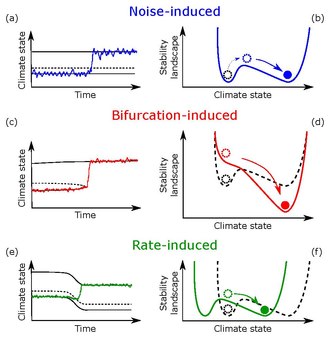
Tipping point behaviour in the climate can be described in mathematical terms. Three types of tipping points have been identified—bifurcation, noise-induced and rate-dependent.[147][148]
Bifurcation-induced tipping[edit]
Bifurcation-induced tipping happens when a particular parameter in the climate (for instance a change in environmental conditions or forcing), passes a critical level – at which point a bifurcation takes place – and what was a stable state loses its stability or simply disappears.[148][149] The Atlantic Meridional Overturning Circulation (AMOC) is an example of a tipping element that can show bifurcation-induced tipping. Slow changes to the bifurcation parameters in this system – the salinity and temperature of the water – may push the circulation towards collapse.[150][151]
Many types of bifurcations show hysteresis,[152] which is the dependence of the state of a system on its history. For instance, depending on how warm it was in the past, there can be differing amounts of ice on the poles at the same concentration of greenhouse gases or temperature.[153]
Early warning signals[edit]
For tipping points that occur because of a bifurcation, it may be possible to detect whether a system is getting closer to a tipping point, as it becomes less resilient to perturbations on approach of the tipping threshold. These systems display critical slowing down, with an increased memory (rising autocorrelation) and variance. Depending on the nature of the tipping system, there may be other types of early warning signals.[154][155] Abrupt change is not an early warning signal (EWS) for tipping points, as abrupt change can also occur if the changes are reversible to the control parameter.[156][157]
These EWSs are often developed and tested using time series from the paleo record, like sediments, ice caps, and tree rings, where past examples of tipping can be observed.[154][158] It is not always possible to say whether increased variance and autocorrelation is a precursor to tipping, or caused by internal variability, for instance in the case of the collapse of the AMOC.[158] Quality limitations of paleodata further complicate the development of EWSs.[158] They have been developed for detecting tipping due to drought in forests in California,[159] and melting of the Pine Island Glacier in West Antarctica,[157] among other systems. Using early warning signals (increased autocorrelation and variance of the melt rate time series), it has been suggested that the Greenland ice sheet is currently losing resilience, consistent with modelled early warning signals of the ice sheet.[160]
Human-induced changes in the climate system may be too fast for early warning signals to become evident, especially in systems with inertia.[161]
Noise-induced tipping[edit]
Noise-induced tipping is the transition from one state to another due to random fluctuations or internal variability of the system. Noise-induced transitions do not show any of the early warning signals which occur with bifurcations. This means they are unpredictable because the underlying potential does not change. Because they are unpredictable, such occurrences are often described as a "one-in-x-year" event.[162] An example is the Dansgaard–Oeschger events during the last ice age, with 25 occurrences of sudden climate fluctuations over a 500 year period.[163]
Rate-induced tipping[edit]
Rate-induced tipping occurs when a change in the environment is faster than the force that restores the system to its stable state.[148] In peatlands, for instance, after years of relative stability, rate-induced tipping can lead to an "explosive release of soil carbon from peatlands into the atmosphere" – sometimes known as "compost bomb instability".[164][165] The AMOC may also show rate-induced tipping: if the rate of ice melt increases too fast, it may collapse, even before the ice melt reaches the critical value where the system would undergo a bifurcation.[166]
Potential impacts[edit]

Tipping points can have very severe impacts.[3] They can exacerbate current dangerous impacts of climate change, or give rise to new impacts. Some potential tipping points would take place abruptly, such as disruptions to the Indian monsoon, with severe impacts on food security for hundreds of millions. Other impacts would likely take place over longer timescales, such as the melting of the ice caps. The 10 metres (33 ft) of sea level rise from the combined melt of Greenland and West Antarctica would require moving many cities inland. A collapse of the Atlantic Overturning Circulation would alter Europe radically, and lead to about 1 metre (3+1⁄2 ft) of sea level rise in the North Atlantic.[5] These impacts could happen simultaneously in the case of cascading tipping points.[142] A review of abrupt changes over the last 30,000 years showed that tipping points can lead to a large set of cascading impacts in climate, ecological and social systems. For instance, the abrupt termination of the African humid period cascaded, and desertification and regime shifts led to the retreat of pastoral societies in North Africa and a change of dynasty in Egypt.[158]
Scholars have described a threshold which, if crossed, could trigger multiple tipping points and self-reinforcing feedback loops that would prevent stabilization of the climate, causing much greater warming and sea-level rises and leading to severe disruption to ecosystems, society, and economies.[167] This scenario is sometimes called the Hothouse Earth (or greenhouse and icehouse Earth) scenario. Research has indicated that a threshold of around 2°C above pre-industrial levels might be critical. Decisions taken over the next decade could influence the climate of the planet for tens to hundreds of thousands of years and potentially even lead to conditions which are inhospitable to current human societies. The report also states that there is a possibility of a cascade of tipping points being triggered even if the goal outlined in the Paris Agreement to limit warming to 1.5-2.0°C (2.7-3.6°F) is achieved.[167]
Geological timescales[edit]

The geological record shows many abrupt changes that suggest tipping points may have been crossed in pre-historic times.[168] For instance, the Dansgaard–Oeschger events during the last ice age were periods of abrupt warming (within decades) in Greenland and Europe, that may have involved the abrupt changes in major ocean currents. During the deglaciation in the early Holocene, sea level rise was not smooth, but rose abruptly during meltwater pulses. The monsoon in North Africa saw abrupt changes on decadal timescales during the African humid period. This period, spanning from 15,000 to 5,000 years ago, also ended suddenly in a drier state.
Runaway greenhouse effect[edit]
A runaway greenhouse effect is a tipping point so extreme that oceans evaporate[169] and the water vapour escapes to space, an irreversible climate state that happened on Venus.[170] A runaway greenhouse effect has virtually no chance of being caused by people.[171][further explanation needed] Venus-like conditions on the Earth require a large long-term forcing that is unlikely to occur until the sun brightens by a few tens of percents, which will take a few billion years.[172]
See also[edit]
- African humid period#Implications for future global warming
- Greenhouse and icehouse Earth
- Climate sensitivity
- Planetary boundaries
- World Scientists' Warning to Humanity
References[edit]
- ^ "Tipping Elements – big risks in the Earth System". Potsdam Institute for Climate Impact Research. Retrieved 31 January 2024.
- ^ a b c d e f g h Armstrong McKay, David; Abrams, Jesse; Winkelmann, Ricarda; Sakschewski, Boris; Loriani, Sina; Fetzer, Ingo; Cornell, Sarah; Rockström, Johan; Staal, Arie; Lenton, Timothy (9 September 2022). "Exceeding 1.5°C global warming could trigger multiple climate tipping points". Science. 377 (6611): eabn7950. doi:10.1126/science.abn7950. hdl:10871/131584. ISSN 0036-8075. PMID 36074831. S2CID 252161375.
- ^ a b c d e Lenton, Tim; Rockström, Johan; Gaffney, Owen; Rahmstorf, Stefan; Richardson, Katherine; Steffen, Will; Schellnhuber, Hans Joachim (2019). "Climate tipping points – too risky to bet against". Nature. 575 (7784): 592–595. Bibcode:2019Natur.575..592L. doi:10.1038/d41586-019-03595-0. PMID 31776487.
- ^ "Climate change driving entire planet to dangerous "global tipping point"". National Geographic. 27 November 2019. Archived from the original on 19 February 2021. Retrieved 17 July 2022.
- ^ a b c d e Lenton, Tim (2021). "Tipping points in the climate system". Weather. 76 (10): 325–326. Bibcode:2021Wthr...76..325L. doi:10.1002/wea.4058. ISSN 0043-1656. S2CID 238651749.
- ^ a b "The irreversible emissions of a permafrost "tipping point"". World Economic Forum. 18 February 2020. Retrieved 17 July 2022.
- ^ a b c d e f g h Armstrong McKay, David (9 September 2022). "Exceeding 1.5°C global warming could trigger multiple climate tipping points – paper explainer". climatetippingpoints.info. Retrieved 2 October 2022.
- ^ Ripple, William J; Wolf, Christopher; Newsome, Thomas M.; Gregg, Jillian W.; Lenton, Tim; Palomo, Ignacio; Eikelboom, Jasper A. J.; Law, Beverly E.; Huq, Saleemul; Duffy, Philip B.; Rockström, Johan (28 July 2021). "World Scientists' Warning of a Climate Emergency 2021". BioScience. 71 (biab079): 894–898. doi:10.1093/biosci/biab079. hdl:1808/30278. ISSN 0006-3568.
- ^ Steffen, Will; Rockström, Johan; Richardson, Katherine; Lenton, Timothy M.; Folke, Carl; Liverman, Diana; Summerhayes, Colin P.; Barnosky, Anthony D.; Cornell, Sarah E.; Crucifix, Michel; Donges, Jonathan F.; Fetzer, Ingo; Lade, Steven J.; Scheffer, Marten; Winkelmann, Ricarda; Schellnhuber, Hans Joachim (14 August 2018). "Trajectories of the Earth System in the Anthropocene". Proceedings of the National Academy of Sciences. 115 (33): 8252–8259. Bibcode:2018PNAS..115.8252S. doi:10.1073/pnas.1810141115. ISSN 0027-8424. PMC 6099852. PMID 30082409.
- ^ Wunderling, Nico; Donges, Jonathan F.; Kurths, Jürgen; Winkelmann, Ricarda (3 June 2021). "Interacting tipping elements increase risk of climate domino effects under global warming". Earth System Dynamics. 12 (2): 601–619. Bibcode:2021ESD....12..601W. doi:10.5194/esd-12-601-2021. ISSN 2190-4979. S2CID 236247596. Archived from the original on 4 June 2021. Retrieved 4 June 2021.
- ^ a b Rocha, Juan C.; Peterson, Garry; Bodin, Örjan; Levin, Simon (2018). "Cascading regime shifts within and across scales". Science. 362 (6421): 1379–1383. Bibcode:2018Sci...362.1379R. doi:10.1126/science.aat7850. ISSN 0036-8075. PMID 30573623. S2CID 56582186.
- ^ a b Defined in IPCC_AR6_WGI_Chapter_04 Archived 5 September 2021 at the Wayback Machine, p.95, line 34.
- ^ a b c d e f g h i "Explainer: Nine "tipping points" that could be triggered by climate change". Carbon Brief. 10 February 2020. Retrieved 16 July 2022.
- ^ "IPCC AR6 WG1 Ch4" (PDF). p. 95. Archived (PDF) from the original on 5 September 2021. Retrieved 14 November 2021.
- ^ "Glossary — Special Report on the Ocean and Cryosphere in a Changing Climate". Archived from the original on 16 August 2021. Retrieved 10 July 2021.
- ^ Heinze, Christoph; Blenckner, Thorsten; Martins, Helena; Rusiecka, Dagmara; Döscher, Ralf; Gehlen, Marion; Gruber, Nicolas; Holland, Elisabeth; Hov, Øystein; Joos, Fortunat; Matthews, John Brian Robin (2021). "The quiet crossing of ocean tipping points". Proceedings of the National Academy of Sciences. 118 (9): e2008478118. Bibcode:2021PNAS..11808478H. doi:10.1073/pnas.2008478118. ISSN 0027-8424. PMC 7936299. PMID 33619085.
- ^ Michael E. Mann (2021). The New Climate War: The Fight to Take Back Our Planet. PublicAffairs. pp. 231–238. ISBN 978-1-541-75822-3.
- ^ Damian Carrington (20 January 2023). "'Super-tipping points' could trigger cascade of climate action". the Guardian.
- ^ Lenton, Timothy M.; Benson, Scarlett; Smith, Talia; Ewer, Theodora; Lanel, Victor; Petykowski, Elizabeth; Powell, Thomas W. R.; Abrams, Jesse F.; Blomsma, Fenna; Sharpe, Simon (2022). "Operationalising positive tipping points towards global sustainability". Global Sustainability. 5. Bibcode:2022GlSus...5E...1L. doi:10.1017/sus.2021.30. hdl:10871/126085. ISSN 2059-4798. S2CID 235719545.
- ^ a b Lenton, Timothy M.; Held, Hermann; Kriegler, Elmar; Hall, Jim W; Lucht, Wolfgang; Rahmstorf, Stefan; Schellnhuber, Hans Joachim (12 February 2008). "Tipping elements in the Earth's climate system". PNAS. 105 (6): 1786–1793. Bibcode:2008PNAS..105.1786L. doi:10.1073/pnas.0705414105. PMC 2538841. PMID 18258748.
- ^ a b Schellnhuber, Hans Joachim; Rahmstorf, Stefan; Winkelmann, Ricarda (2016). "Why the right climate target was agreed in Paris". Nature Climate Change. 6 (7): 649–653. Bibcode:2016NatCC...6..649S. doi:10.1038/nclimate3013. ISSN 1758-6798.
- ^ "Critical measures of global heating reaching tipping point, study finds". the Guardian. 28 July 2021.
- ^ Ripple, William J; Wolf, Christopher; Newsome, Thomas M.; Gregg, Jillian W.; Lenton, Tim; Palomo, Ignacio; Eikelboom, Jasper A. J.; Law, Beverly E.; Huq, Saleemul; Duffy, Philip B.; Rockström, Johan (28 July 2021). "World Scientists' Warning of a Climate Emergency 2021". BioScience. 71 (biab079): 894–898. doi:10.1093/biosci/biab079. hdl:1808/30278. ISSN 0006-3568.
- ^ Baker, Harry (15 September 2022). "Climate "points of no return" may be much closer than we thought". livescience.com. Retrieved 18 September 2022.
- ^ "Quick Facts on Ice Sheets". National Snow and Ice Data Center. Retrieved 17 July 2022.
- ^ "New climate models suggest faster melting of the Greenland Ice Sheet". World Economic Forum. 21 December 2020. Retrieved 17 July 2022.
- ^ Scambos, Ted; Straneo, Fiamma; Tedesco, Marco (2021). "How fast is the Greenland ice sheet melting?". Arctic, Antarctic, and Alpine Research. 53 (1): 221–222. Bibcode:2021AAAR...53..221S. doi:10.1080/15230430.2021.1946241. ISSN 1523-0430. S2CID 242536272.
- ^ Todd, Joe; Christoffersen, Poul; Zwinger, Thomas; Råback, Peter; Chauché, Nolwenn; Benn, Doug; Luckman, Adrian; Ryan, Johnny; Toberg, Nick; Slater, Donald; Hubbard, Alun (2018). "A Full-Stokes 3-D Calving Model Applied to a Large Greenlandic Glacier". Journal of Geophysical Research: Earth Surface. 123 (3): 410–432. Bibcode:2018JGRF..123..410T. doi:10.1002/2017JF004349. S2CID 54546830.
- ^ a b Boers, Niklas; Rypdal, Martin (2021). "Critical slowing down suggests that the western Greenland Ice Sheet is close to a tipping point". Proceedings of the National Academy of Sciences. 118 (21): e2024192118. Bibcode:2021PNAS..11824192B. doi:10.1073/pnas.2024192118. ISSN 0027-8424. PMC 8166178. PMID 34001613.
- ^ Garric, Audrey (15 March 2021). "La calotte glaciaire du Groenland a déjà fondu au moins une fois au cours du dernier million d'années". Le Monde.
- ^ Christ, Andrew J.; Bierman, Paul R.; Schaefer, Joerg M.; Dahl-Jensen, Dorthe; Steffensen, Jørgen P.; Corbett, Lee B.; Peteet, Dorothy M.; Thomas, Elizabeth K.; Steig, Eric J.; Rittenour, Tammy M.; Tison, Jean-Louis; Blard, Pierre-Henri; Perdrial, Nicolas; Dethier, David P.; Lini, Andrea; Hidy, Alan J.; Caffee, Marc W.; Southon, John (30 March 2021). "A multimillion-year-old record of Greenland vegetation and glacial history preserved in sediment beneath 1.4 km of ice at Camp Century". Proceedings of the National Academy of Sciences of the United States. 118 (13): e2021442118. Bibcode:2021PNAS..11821442C. doi:10.1073/pnas.2021442118. PMC 8020747. PMID 33723012.
- ^ Fretwell, P.; Pritchard, H. D.; Vaughan, D. G.; Bamber, J. L.; Barrand, N. E.; Bell, R.; Bianchi, C.; Bingham, R. G.; Blankenship, D. D.; Casassa, G.; Catania, G. (28 February 2013). "Bedmap2: improved ice bed, surface and thickness datasets for Antarctica". The Cryosphere. 7 (1): 375–393. Bibcode:2013TCry....7..375F. doi:10.5194/tc-7-375-2013. ISSN 1994-0416. S2CID 13129041.
- ^ Hulbe, Christina (2017). "Is ice sheet collapse in West Antarctica unstoppable?". Science. 356 (6341): 910–911. Bibcode:2017Sci...356..910H. doi:10.1126/science.aam9728. PMID 28572353. S2CID 206658277.
- ^ Alley, Richard B.; Anandakrishnan, Sridhar; Christianson, Knut; Horgan, Huw J.; Muto, Atsu; Parizek, Byron R.; Pollard, David; Walker, Ryan T. (2015). "Oceanic Forcing of Ice-Sheet Retreat: West Antarctica and More". Annual Review of Earth and Planetary Sciences. 43 (1): 207–231. Bibcode:2015AREPS..43..207A. doi:10.1146/annurev-earth-060614-105344. S2CID 131486847.
- ^ Shepherd, Andrew; Ivins, Erik; Rignot, Eric; Smith, Ben; van den Broeke, Michiel; Velicogna, Isabella; Whitehouse, Pippa; Briggs, Kate; Joughin, Ian; Krinner, Gerhard; Nowicki, Sophie (2018). "Mass balance of the Antarctic Ice Sheet from 1992 to 2017". Nature. 558 (7709): 219–222. Bibcode:2018Natur.558..219I. doi:10.1038/s41586-018-0179-y. hdl:2268/225208. ISSN 1476-4687. PMID 29899482. S2CID 186244208.
- ^ Feldmann, Johannes; Levermann, Anders (17 November 2015). "Collapse of the West Antarctic Ice Sheet after local destabilization of the Amundsen Basin". Proceedings of the National Academy of Sciences. 112 (46): 14191–14196. Bibcode:2015PNAS..11214191F. doi:10.1073/pnas.1512482112. PMC 4655561. PMID 26578762.
- ^ Joughin, Ian; Smith, Benjamin E.; Medley, Brooke; Seroussi, H.; Scheuchl, B. (16 May 2014). "Marine Ice Sheet Collapse Potentially Under Way for the Thwaites Glacier Basin, West Antarctica". Science. 344 (6185): 735–738. Bibcode:2014Sci...344..735J. doi:10.1126/science.1249055. PMID 24821948. S2CID 206554077.
- ^ Joughin, Ian; Alley, Richard B. (2011). "Stability of the West Antarctic ice sheet in a warming world". Nature Geoscience. 4 (8): 506–513. Bibcode:2011NatGe...4..506J. doi:10.1038/ngeo1194. ISSN 1752-0908.
- ^ Justin Gillis (March 22, 2016) "Scientists Warn of Perilous Climate Shift Within Decades, Not Centuries" New York Times
- ^ Fox-Kemper, B.; Hewitt, H.T.; Xiao, C.; Aðalgeirsdóttir, G.; Drijfhout, S.S.; Edwards, T.L.; Golledge, N.R.; Hemer, M.; Kopp, R.E.; Krinner, G.; Mix, A. (2021). Masson-Delmotte, V.; Zhai, P.; Pirani, A.; Connors, S.L.; Péan, C.; Berger, S.; Caud, N.; Chen, Y.; Goldfarb, L. (eds.). "Chapter 9: Ocean, Cryosphere and Sea Level Change" (PDF). Climate Change 2021: The Physical Science Basis. Contribution of Working Group I to the Sixth Assessment Report of the Intergovernmental Panel on Climate Change. Cambridge University Press, Cambridge, UK and New York, NY, USA: 1270–1272.
- ^ Garbe, Julius; Albrecht, Torsten; Levermann, Anders; Donges, Jonathan F.; Winkelmann, Ricarda (2020). "The hysteresis of the Antarctic Ice Sheet". Nature. 585 (7826): 538–544. Bibcode:2020Natur.585..538G. doi:10.1038/s41586-020-2727-5. PMID 32968257. S2CID 221885420.
- ^ "Does Arctic sea ice have a tipping point?". National Snow and Ice Data Center. 17 December 2021. Retrieved 19 July 2022.
- ^ Arias, Paola A.; Bellouin, Nicolas; Coppola, Erika; Jones, Richard G.; et al. (2021). "Technical Summary" (PDF). IPCC AR6 WG1. p. 76.
- ^ Rantanen, Mika; Karpechko, Alexey Yu; Lipponen, Antti; Nordling, Kalle; Hyvärinen, Otto; Ruosteenoja, Kimmo; Vihma, Timo; Laaksonen, Ari (11 August 2022). "The Arctic has warmed nearly four times faster than the globe since 1979". Communications Earth & Environment. 3 (1): 168. Bibcode:2022ComEE...3..168R. doi:10.1038/s43247-022-00498-3. ISSN 2662-4435. S2CID 251498876.
- ^ "The Arctic is warming four times faster than the rest of the world". Science Magazine. 14 December 2021. Retrieved 6 October 2022.
- ^ Isaksen, Ketil; Nordli, Øyvind; et al. (15 June 2022). "Exceptional warming over the Barents area". Scientific Reports. 12 (1): 9371. Bibcode:2022NatSR..12.9371I. doi:10.1038/s41598-022-13568-5. PMC 9200822. PMID 35705593.
- ^ Damian Carrington (15 June 2022). "New data reveals extraordinary global heating in the Arctic". The Guardian. Retrieved 7 October 2022.
- ^ Petoukhov, Vladimir; Semenov, Vladimir A. (2010). "A link between reduced Barents-Kara sea ice and cold winter extremes over northern continents" (PDF). Journal of Geophysical Research. 115 (D21): D21111. Bibcode:2010JGRD..11521111P. doi:10.1029/2009JD013568.
- ^ He, Shengping; Gao, Yongqi; Furevik, Tore; Wang, Huijun; Li, Fei (16 December 2017). "Teleconnection between sea ice in the Barents Sea in June and the Silk Road, Pacific–Japan and East Asian rainfall patterns in August". Advances in Atmospheric Sciences. 35: 52–64. doi:10.1007/s00376-017-7029-y. S2CID 125312203.
- ^ Zhang, Ruonan; Screen, James A. (16 June 2021). "Diverse Eurasian Winter Temperature Responses to Barents-Kara Sea Ice Anomalies of Different Magnitudes and Seasonality". Geophysical Research Letters. 48 (13). Bibcode:2021GeoRL..4892726Z. doi:10.1029/2021GL092726. S2CID 236235248.
- ^ Song, Mirong; Wang, Zhao-Yin; Zhu, Zhu; Liu, Ji-Ping (August 2021). "Nonlinear changes in cold spell and heat wave arising from Arctic sea-ice loss". Advances in Climate Change Research. 12 (4): 553–562. Bibcode:2021ACCR...12..553S. doi:10.1016/j.accre.2021.08.003. S2CID 238716298.
- ^ Sun, Jianqi; Liu, Sichang; Cohen, Judah; Yu, Shui (2 August 2022). "Influence and prediction value of Arctic sea ice for spring Eurasian extreme heat events". Communications Earth & Environment. 3 (1): 172. Bibcode:2022ComEE...3..172S. doi:10.1038/s43247-022-00503-9. S2CID 251230011.
- ^ a b Rounce, David R.; Hock, Regine; Maussion, Fabien; Hugonnet, Romain; et al. (5 January 2023). "Global glacier change in the 21st century: Every increase in temperature matters". Science. 379 (6627): 78–83. Bibcode:2023Sci...379...78R. doi:10.1126/science.abo1324. PMID 36603094. S2CID 255441012.
- ^ Hubbard, Bryn; Neil F. Glasser (20 May 2005). Field Techniques in Glaciology and Glacial Geomorphology. Wiley. pp. 179–198. ISBN 978-0470844274. Retrieved 23 November 2020.
- ^ Pelto, M.S. (2010). "Forecasting temperate alpine glacier survival from accumulation zone observations". The Cryosphere. 4 (1): 67–75. Bibcode:2010TCry....4...67P. doi:10.5194/tc-4-67-2010. Retrieved 23 November 2020.
- ^ Mauri S. Pelto. "North Cascade Glacier Terminus Behavior". Nichols College. Retrieved 7 August 2016.
- ^ Vaughn, Adam (18 September 2019). "Special report: How climate change is melting France's largest glacier". New Scientist. Retrieved 3 February 2021.
- ^ Damian Carrington (4 February 2019). "A third of Himalayan ice cap doomed, finds report". TheGuardian.com. Retrieved 20 October 2022.
- ^ Bolch, Tobias; Shea, Joseph M.; Liu, Shiyin; Azam, Farooq M.; Gao, Yang; Gruber, Stephan; Immerzeel, Walter W.; Kulkarni, Anil; Li, Huilin; Tahir, Adnan A.; Zhang, Guoqing; Zhang, Yinsheng (5 January 2019). "Status and Change of the Cryosphere in the Extended Hindu Kush Himalaya Region". The Hindu Kush Himalaya Assessment: Mountains, Climate Change, Sustainability and People. Springer. pp. 209–255. doi:10.1007/978-3-319-92288-1_3. ISBN 9783319922881. S2CID 134572569.
- ^ Scott, Christopher A.; Zhang, Fan; Mukherji, Aditi; Immerzeel, Walter; Mustafa, Daanish; Bharati, Luna (5 January 2019). "Water in the Hindu Kush Himalaya". The Hindu Kush Himalaya Assessment: Mountains, Climate Change, Sustainability and People. pp. 257–299. doi:10.1007/978-3-319-92288-1_8. ISBN 978-3-319-92287-4. S2CID 133800578.
- ^ Zhang, T.; Barry, R. G.; Knowles, K.; Heginbottom, J. A.; Brown, J. (2008). "Statistics and characteristics of permafrost and ground-ice distribution in the Northern Hemisphere". Polar Geography. 31 (1–2): 47–68. Bibcode:2008PolGe..31...47Z. doi:10.1080/10889370802175895. ISSN 1088-937X. S2CID 129146972.
- ^ a b "Where is Frozen Ground?". National Snow and Ice Data Center. Retrieved 17 July 2022.
- ^ Viglione, Giuliana (14 March 2022). "'Imminent' tipping point threatening Europe's permafrost peatlands". Carbon Brief. Retrieved 16 July 2022.
- ^ Fewster, Richard E.; Morris, Paul J.; Ivanovic, Ruza F.; Swindles, Graeme T.; Peregon, Anna M.; Smith, Christopher J. (2022). "Imminent loss of climate space for permafrost peatlands in Europe and Western Siberia". Nature Climate Change. 12 (4): 373–379. Bibcode:2022NatCC..12..373F. doi:10.1038/s41558-022-01296-7. ISSN 1758-6798. S2CID 247440316. Archived from the original on 9 September 2022. Retrieved 16 July 2022.
{{cite journal}}: CS1 maint: bot: original URL status unknown (link) - ^ a b Potsdam Institute for Climate Impact Research. "Gulf Stream System at its weakest in over a millennium". ScienceDaily. Retrieved 17 July 2022.
- ^ a b c "What is the Atlantic Meridional Overturning Circulation?". Met Office. Retrieved 26 November 2021.
- ^ "Risk management of climate thresholds and feedbacks: Atlantic Meridional Overturning Circulation (AMOC)" (PDF). Met Office. December 2019. Retrieved 25 November 2020.
- ^ Fox-Kemper, Baylor; Hewitt, Helene T.; Xiao, Cunde; Aðalgeirsdóttir, Guðfinna; et al. (2021). "Chapter 9: Ocean, cryosphere, and sea level change" (PDF). IPCC AR6 WG1. Section 9.2.3.1.
- ^ Lohmann, Johannes; Ditlevsen, Peter D. (2 March 2021). "Risk of tipping the overturning circulation due to increasing rates of ice melt". Proceedings of the National Academy of Sciences. 118 (9): e2017989118. Bibcode:2021PNAS..11817989L. doi:10.1073/pnas.2017989118. ISSN 0027-8424. PMC 7936283. PMID 33619095.
- ^ Boers, Niklas (2021). "Observation-based early-warning signals for a collapse of the Atlantic Meridional Overturning Circulation". Nature Climate Change. 11 (8): 680–688. Bibcode:2021NatCC..11..680B. doi:10.1038/s41558-021-01097-4. ISSN 1758-6798. S2CID 236930519.
- ^ Latif, Mojib; Sun, Jing; Visbeck, Martin; Bordbar, M. Hadi (25 April 2022). "Natural variability has dominated Atlantic Meridional Overturning Circulation since 1900". Nature Climate Change. 12 (5): 455–460. Bibcode:2022NatCC..12..455L. doi:10.1038/s41558-022-01342-4. S2CID 248385988.
- ^ He, Feng; Clark, Peter U. (7 April 2022). "Freshwater forcing of the Atlantic Meridional Overturning Circulation revisited". Nature Climate Change. 12 (5): 449–454. Bibcode:2022NatCC..12..449H. doi:10.1038/s41558-022-01328-2. S2CID 248004571.
- ^ Kim, Soong-Ki; Kim, Hyo-Jeong; Dijkstra, Henk A.; An, Soon-Il (11 February 2022). "Slow and soft passage through tipping point of the Atlantic Meridional Overturning Circulation in a changing climate". npj Climate and Atmospheric Science. 5 (13). Bibcode:2022npjCA...5...13K. doi:10.1038/s41612-022-00236-8. S2CID 246705201.
- ^ Sgubin; et al. (2017). "Abrupt cooling over the North Atlantic in modern climate models". Nature Communications. 8. doi:10.1038/ncomms14375. PMC 5330854. PMID 28198383.
- ^ Eleanor Frajka-Williams; Claudie Beaulieu; Aurelie Duchez (2017). "Emerging negative Atlantic Multidecadal Oscillation index in spite of warm subtropics". Scientific Reports. 7 (1): 11224. Bibcode:2017NatSR...711224F. doi:10.1038/s41598-017-11046-x. PMC 5593924. PMID 28894211.
- ^ Swingedouw, Didier; Bily, Adrien; Esquerdo, Claire; Borchert, Leonard F.; Sgubin, Giovanni; Mignot, Juliette; Menary, Matthew (2021). "On the risk of abrupt changes in the North Atlantic subpolar gyre in CMIP6 models". Annals of the New York Academy of Sciences. 1504 (1): 187–201. Bibcode:2021NYASA1504..187S. doi:10.1111/nyas.14659. PMID 34212391. S2CID 235712017.
- ^ Arellano-Nava, Beatriz; Halloran, Paul R.; Boulton, Chris A.; Scourse, James; Butler, Paul G.; Reynolds, David J.; Lenton, Timothy (25 August 2022). "Destabilisation of the Subpolar North Atlantic prior to the Little Ice Age". Nature Communications. 13 (1): 5008. Bibcode:2022NatCo..13.5008A. doi:10.1038/s41467-022-32653-x. PMC 9411610. PMID 36008418.
- ^ "NOAA Scientists Detect a Reshaping of the Meridional Overturning Circulation in the Southern Ocean". NOAA. 29 March 2023.
- ^ Pellichero, Violaine; Sallée, Jean-Baptiste; Chapman, Christopher C.; Downes, Stephanie M. (3 May 2018). "The southern ocean meridional overturning in the sea-ice sector is driven by freshwater fluxes". Nature Communications. 9 (1): 1789. Bibcode:2018NatCo...9.1789P. doi:10.1038/s41467-018-04101-2. PMC 5934442. PMID 29724994.
- ^ Lee, Sang-Ki; Lumpkin, Rick; Gomez, Fabian; Yeager, Stephen; Lopez, Hosmay; Takglis, Filippos; Dong, Shenfu; Aguiar, Wilton; Kim, Dongmin; Baringer, Molly (13 March 2023). "Human-induced changes in the global meridional overturning circulation are emerging from the Southern Ocean". Communications Earth & Environment. 4 (1): 69. Bibcode:2023ComEE...4...69L. doi:10.1038/s43247-023-00727-3.
- ^ "NOAA Scientists Detect a Reshaping of the Meridional Overturning Circulation in the Southern Ocean". NOAA. 29 March 2023.
- ^ a b Zhou, Shenjie; Meijers, Andrew J. S.; Meredith, Michael P.; Abrahamsen, E. Povl; Holland, Paul R.; Silvano, Alessandro; Sallée, Jean-Baptiste; Østerhus, Svein (12 June 2023). "Slowdown of Antarctic Bottom Water export driven by climatic wind and sea-ice changes". Nature Climate Change. 13: 701–709. doi:10.1038/s41558-023-01667-8.
- ^ Silvano, Alessandro; Meijers, Andrew J. S.; Zhou, Shenjie (17 June 2023). "Slowing deep Southern Ocean current may be linked to natural climate cycle—but melting Antarctic ice is still a concern". The Conversation.
- ^ Stewart, K. D.; Hogg, A. McC.; England, M. H.; Waugh, D. W. (2 November 2020). "Response of the Southern Ocean Overturning Circulation to Extreme Southern Annular Mode Conditions". Geophysical Research Letters. 47 (22): e2020GL091103. Bibcode:2020GeoRL..4791103S. doi:10.1029/2020GL091103. hdl:1885/274441. S2CID 229063736.
- ^ Bourgeois, Timothée; Goris, Nadine; Schwinger, Jörg; Tjiputra, Jerry F. (17 January 2022). "Stratification constrains future heat and carbon uptake in the Southern Ocean between 30°S and 55°S". Nature Communications. 13 (1): 340. Bibcode:2022NatCo..13..340B. doi:10.1038/s41467-022-27979-5. PMC 8764023. PMID 35039511.
- ^ Silvano, Alessandro; Rintoul, Stephen Rich; Peña-Molino, Beatriz; Hobbs, William Richard; van Wijk, Esmee; Aoki, Shigeru; Tamura, Takeshi; Williams, Guy Darvall (18 April 2018). "Freshening by glacial meltwater enhances the melting of ice shelves and reduces the formation of Antarctic Bottom Water". Science Advances. 4 (4): eaap9467. doi:10.1126/sciadv.aap9467. PMC 5906079. PMID 29675467.
- ^ Ribeiro, N.; Herraiz‐Borreguero, L.; Rintoul, S. R.; McMahon, C. R.; Hindell, M.; Harcourt, R.; Williams, G. (15 July 2021). "Warm Modified Circumpolar Deep Water Intrusions Drive Ice Shelf Melt and Inhibit Dense Shelf Water Formation in Vincennes Bay, East Antarctica". Journal of Geophysical Research: Oceans. 126 (8). doi:10.1029/2020JC016998. ISSN 2169-9275.
- ^ Lenton, T. M.; Armstrong McKay, D.I.; Loriani, S.; Abrams, J.F.; Lade, S.J.; Donges, J.F.; Milkoreit, M.; Powell, T.; Smith, S.R.; Zimm, C.; Buxton, J.E.; Daube, Bruce C.; Krummel, Paul B.; Loh, Zoë; Luijkx, Ingrid T. (2023). The Global Tipping Points Report 2023 (Report). University of Exeter.
- ^ Liu, Y.; Moore, J. K.; Primeau, F.; Wang, W. L. (22 December 2022). "Reduced CO2 uptake and growing nutrient sequestration from slowing overturning circulation". Nature Climate Change. 13: 83–90. doi:10.1038/s41558-022-01555-7. OSTI 2242376. S2CID 255028552.
- ^ Logan, Tyne (29 March 2023). "Landmark study projects 'dramatic' changes to Southern Ocean by 2050". ABC News.
- ^ "Amazon Against the Clock: A Regional Assessment on Where and How to Protect 80% by 2025" (PDF). Amazon Watch. September 2022. p. 8. Archived (PDF) from the original on 10 September 2022.
Graphic 2: Current State of the Amazon by country, by percentage / Source: RAISG (Red Amazónica de Información Socioambiental Georreferenciada) Elaborated by authors.
- ^ Amigo, Ignacio (2020). "When will the Amazon hit a tipping point?". Nature. 578 (7796): 505–507. Bibcode:2020Natur.578..505A. doi:10.1038/d41586-020-00508-4. PMID 32099130. S2CID 211265824.
- ^ "Climate crisis: Amazon rainforest tipping point is looming, data shows". The Guardian. 7 March 2022. Retrieved 18 April 2022.
- ^ Boulton, Chris A.; Lenton, Tim; Boers, Niklas (March 2022). "Pronounced loss of Amazon rainforest resilience since the early 2000s". Nature Climate Change. 12 (3): 271–278. Bibcode:2022NatCC..12..271B. doi:10.1038/s41558-022-01287-8. ISSN 1758-6798. S2CID 247255222.
- ^ Wilmking, M. (9 October 2009). "Coincidence and Contradiction in the Warming Boreal Forest". Geophysical Research Letters. 32 (15): L15715. Bibcode:2005GeoRL..3215715W. doi:10.1029/2005GL023331. Retrieved 14 January 2012.
- ^ Scheffer, Marten; Hirota, Marina; Holmgren, Milena; Van Nes, Egbert H.; Chapin, F. Stuart (26 December 2012). "Thresholds for boreal biome transitions". Proceedings of the National Academy of Sciences. 109 (52): 21384–21389. Bibcode:2012PNAS..10921384S. doi:10.1073/pnas.1219844110. ISSN 0027-8424. PMC 3535627. PMID 23236159.
- ^ Peng, Changhui; Ma, Zhihai; Lei, Xiangdong; Zhu, Qiuan; Chen, Huai; Wang, Weifeng; Liu, Shirong; Li, Weizhong; Fang, Xiuqin; Zhou, Xiaolu (20 November 2011). "A drought-induced pervasive increase in tree mortality across Canada's boreal forests". Nature Climate Change. 1 (9): 467–471. Bibcode:2011NatCC...1..467P. doi:10.1038/nclimate1293.
- ^ Ma, Zhihai; Peng, Changhui; Zhu, Qiuan; Chen, Huai; Yu, Guirui; Li, Weizhong; Zhou, Xiaolu; Wang, Weifeng; Zhang, Wenhua (30 January 2012). "Regional drought-induced reduction in the biomass carbon sink of Canada's boreal forests". Biological Sciences. 109 (7): 2423–2427. Bibcode:2012PNAS..109.2423M. doi:10.1073/pnas.1111576109. PMC 3289349. PMID 22308340.
- ^ Chen, Han Y. H.; Luo, Yong (2 July 2015). "Net aboveground biomass declines of four major forest types with forest ageing and climate change in western Canada's boreal forests". Global Change Biology. 21 (10): 3675–3684. Bibcode:2015GCBio..21.3675C. doi:10.1111/gcb.12994. PMID 26136379. S2CID 25403205.
- ^ Sulla-Menashe, Damien; Woodcock, Curtis E; Friedl, Mark A (4 January 2018). "Canadian boreal forest greening and browning trends: an analysis of biogeographic patterns and the relative roles of disturbance versus climate drivers". Environmental Research Letters. 13 (1): 014007. Bibcode:2018ERL....13a4007S. doi:10.1088/1748-9326/aa9b88. S2CID 158470300.
- ^ "Boreal Forests and Climate Change - Changes in Climate Parameters and Some Responses, Effects of Warming on Tree Growth on Productive Sites". Archived from the original on 27 July 2011. Retrieved 25 March 2011.
- ^ Hisano, Masumi; Ryo, Masahiro; Chen, Xinli; Chen, Han Y. H. (16 May 2021). "Rapid functional shifts across high latitude forests over the last 65 years". Global Change Biology. 27 (16): 3846–3858. doi:10.1111/gcb.15710. PMID 33993581. S2CID 234744857.
- ^ Berner, Logan T.; Goetz, Scott J. (24 February 2022). "Satellite observations document trends consistent with a boreal forest biome shift". Global Change Biology. 28 (10): 3846–3858. doi:10.1111/gcb.16121. PMC 9303657. PMID 35199413.
- ^ D'Orangeville, Loïc; Houle, Daniel; Duchesne, Louis; Phillips, Richard P.; Bergeron, Yves; Kneeshaw, Daniel (10 August 2018). "Beneficial effects of climate warming on boreal tree growth may be transitory". Nature Communications. 9 (1): 3213. Bibcode:2018NatCo...9.3213D. doi:10.1038/s41467-018-05705-4. PMC 6086880. PMID 30097584.
- ^ Boulanger, Yan; Puigdevall, Jesus Pascual (3 April 2021). "Boreal forests will be more severely affected by projected anthropogenic climate forcing than mixedwood and northern hardwood forests in eastern Canada". Landscape Ecology. 36 (6): 1725–1740. Bibcode:2021LaEco..36.1725B. doi:10.1007/s10980-021-01241-7. S2CID 226959320.
- ^ Larjavaara, Markku; Lu, Xiancheng; Chen, Xia; Vastaranta, Mikko (12 October 2021). "Impact of rising temperatures on the biomass of humid old-growth forests of the world". Carbon Balance and Management. 16 (1): 31. Bibcode:2021CarBM..16...31L. doi:10.1186/s13021-021-00194-3. PMC 8513374. PMID 34642849.
- ^ Reich, Peter B.; Bermudez, Raimundo; Montgomery, Rebecca A.; Rich, Roy L.; Rice, Karen E.; Hobbie, Sarah E.; Stefanski, Artur (10 August 2022). "Even modest climate change may lead to major transitions in boreal forests". Nature. 608 (7923): 540–545. Bibcode:2022Natur.608..540R. doi:10.1038/s41586-022-05076-3. PMID 35948640. S2CID 251494296.
- ^ a b ODI and CDKN (2014) The IPCC’s Fifth Assessment Report - What’s in it for Africa? Overseas Development Institute and Climate and Development Knowledge Network
- ^ a b Brooks, Nick; Chiapello, Isabelle; Lernia, Savino Di; Drake, Nick; Legrand, Michel; Moulin, Cyril; Prospero, Joseph (2005). "The climate-environment-society nexus in the Sahara from prehistoric times to the present day". The Journal of North African Studies. 10 (3–4): 253–292. doi:10.1080/13629380500336680. ISSN 1362-9387.
- ^ Renssen, H.; Brovkin, V.; Fichefet, T.; Goosse, H. (2003). "Holocene climate instability during the termination of the African Humid Period". Geophysical Research Letters. 30 (4). doi:10.1029/2002GL016636. ISSN 0094-8276.
- ^ Pausata, Francesco S.R.; Gaetani, Marco; Messori, Gabriele; Berg, Alexis; Maia de Souza, Danielle; Sage, Rowan F.; deMenocal, Peter B. (2020). "The Greening of the Sahara: Past Changes and Future Implications". One Earth. 2 (3): 235–250. doi:10.1016/j.oneear.2020.03.002.
- ^ Dargie, Greta C.; Lewis, Simon L.; Lawson, Ian T.; Mitchard, Edward T.A.; Page, Susan E.; Bocko, Yannick E.; Ifo, Suspense A. (11 January 2017). "Age, extent and carbon storage of the central Congo Basin peatland complex" (PDF). Nature. 542 (Month 2017): 86–90. Bibcode:2017Natur.542...86D. doi:10.1038/nature21048. PMID 28077869. S2CID 205253362.
- ^ a b Lewis, Simon (13 January 2017). "Guest post: Vast carbon store found under Congo swamp forest". Carbon Brief. Retrieved 15 January 2023.
- ^ a b Lewis, Simon (2 November 2022). "Guest post: Discovering a potential 'tipping point' for Congo's tropical peatland". Carbon Brief. Retrieved 15 January 2023.
- ^ Grossman, Daniel (1 October 2019). "Inside the search for Africa's carbon time bomb". National Geographic. Archived from the original on 2 October 2019. Retrieved 11 October 2019.
- ^ "Historic agreement signed to protect the world's largest tropical peatland". UNEP - UN Environment Programme. 23 March 2018.
- ^ Crezee, Bart; Dargie, Greta C.; Corneille, E. N. Ewango; Mitchard, Edward T.A.; Ovide, Emba B.; Kanyama T., Joseph; Bola, Pierre; Ndjango, Jean-Bosco N.; Girkin, Nicholas T.; Bocko, Yannick E.; Ifo, Suspense A.; Hubau, Wannes; Seidensticker, Dirk; Batumike, Rodrigue; Imani, Gérard; Cuní-Sanchez, Aida; Kiahtipes, Christopher A.; Lebamba, Judicaël; Wotzka, Hans-Peter; Bean, Hollie T.; Baker, Timothy R.; Baird, Andy J.; Boom, Arnoud; Morris, Paul J.; Lawson, Ian T.; Page, Susan E.; Lewis, Simon L. (21 July 2022). "Mapping peat thickness and carbon stocks of the central Congo Basin using field data". Nature Geoscience. 15 (August 2022): 639–644. doi:10.1038/s41561-022-00966-7. hdl:10023/26809. S2CID 250928067.
- ^ Garcin, Yannick; Schefuß, Enno; Dargie, Greta C.; Hawthorne, Donna; Lawson, Ian T.; Sebag, David; Biddulph, George E.; Crezee, Bart; Bocko, Yannick E.; Ifo, Suspense A.; Wenina, Emmanuel Mampouya; Mbemba, Mackline; Corneille, E. N. Ewango; Ovide, Emba B.; Bola, Pierre; Kanyama T., Joseph; Tyrrell, Genevieve; Young, Dylan M.; Gassier, Ghislain; Girkin, Nicholas T.; Vane, Christopher H.; Adatte, Thierry; Baird, Andy J.; Boom, Arnoud; Gulliver, Pauline; Morris, Paul J.; Page, Susan E.; Sjögersten, Sofie; Lewis, Simon L. (2 November 2022). "Hydroclimatic vulnerability of peat carbon in the central Congo Basin". Nature. 612 (November 2022): 277–282. doi:10.1038/s41586-022-05389-3. PMC 9729114. PMID 36323786.
- ^ Gibbens, Sarah (4 June 2020). "The world's coral reefs are dying—here's how scientists plan to save them". National Geographic. Archived from the original on 19 February 2021. Retrieved 17 July 2022.
- ^ Hughes, Terry P.; Kerry, James T.; Álvarez-Noriega, Mariana; Álvarez-Romero, Jorge G.; Anderson, Kristen D.; Baird, Andrew H.; Babcock, Russell C.; Beger, Maria; Bellwood, David R.; Berkelmans, Ray; Bridge, Tom C. (2017). "Global warming and recurrent mass bleaching of corals". Nature. 543 (7645): 373–377. Bibcode:2017Natur.543..373H. doi:10.1038/nature21707. hdl:20.500.11937/52828. ISSN 1476-4687. PMID 28300113. S2CID 205254779.
- ^ Worland, Justin. "Explore This Coral Reef Before it Disappears". Time. Retrieved 17 July 2022.
- ^ Gilmour, James Paton; Green, Rebecca (21 May 2019). "'Bright white skeletons': some Western Australian reefs have the lowest coral cover on record". The Conversation. Retrieved 17 July 2022.
- ^ Holbrook, Sally J.; Schmitt, Russell J.; Adam, Thomas C.; Brooks, Andrew J. (2016). "Coral Reef Resilience, Tipping Points and the Strength of Herbivory". Scientific Reports. 6 (1): 35817. Bibcode:2016NatSR...635817H. doi:10.1038/srep35817. ISSN 2045-2322. PMC 5090207. PMID 27804977.
- ^ IPCC (2018). "Summary for Policymakers" (PDF). Global warming of 1.5°C: An IPCC Special Report on the impacts of global warming of 1.5°C. p. 8.
- ^ Schneider, Tapio; Kaul, Colleen M.; Pressel, Kyle G. (2019). "Possible climate transitions from breakup of stratocumulus decks under greenhouse warming". Nature Geoscience. 12 (3): 163–167. Bibcode:2019NatGe..12..163S. doi:10.1038/s41561-019-0310-1. S2CID 134307699.
- ^ Wolchover, Natalie (25 February 2019). "A World Without Clouds". Quanta Magazine. Retrieved 2 October 2022.
- ^ Schneider, Tapio; Kaul, Colleen M.; Pressel, Kyle G. (2020). "Solar geoengineering may not prevent strong warming from direct effects of CO2 on stratocumulus cloud cover". PNAS. 117 (48): 30179–30185. Bibcode:2020PNAS..11730179S. doi:10.1073/pnas.2003730117. PMC 7720182. PMID 33199624.
- ^ a b "Extreme CO2 levels could trigger clouds 'tipping point' and 8C of global warming". Carbon Brief. 25 February 2019. Retrieved 2 October 2022.
- ^ Voosen, Paul (26 February 2019). "A world without clouds? Hardly clear, climate scientists say". Science Magazine.
- ^ a b Wunderling, Nico; Donges, Jonathan F.; Kurths, Jürgen; Winkelmann, Ricarda (3 June 2021). "Interacting tipping elements increase risk of climate domino effects under global warming". Earth System Dynamics. 12 (2): 601–619. Bibcode:2021ESD....12..601W. doi:10.5194/esd-12-601-2021. ISSN 2190-4979.
- ^ Turner, Ben (12 June 2021). "Dramatic climate domino effects could be unleashed after less than 2 degrees of warming, a new study reveals". livescience.com. Retrieved 23 July 2022.
- ^ Carrington, Damian (27 November 2019). "Climate emergency: world "may have crossed tipping points"". the Guardian.
- ^ "Overshooting climate targets could significantly increase risk for tipping cascades". Potsdam Institute for Climate Impact Research via phys.org. Retrieved 17 January 2023.
- ^ Wunderling, Nico; Winkelmann, Ricarda; Rockström, Johan; Loriani, Sina; Armstrong McKay, David I.; Ritchie, Paul D. L.; Sakschewski, Boris; Donges, Jonathan F. (January 2023). "Global warming overshoots increase risks of climate tipping cascades in a network model". Nature Climate Change. 13 (1): 75–82. Bibcode:2023NatCC..13...75W. doi:10.1038/s41558-022-01545-9. ISSN 1758-6798. S2CID 255045153.
- ^ a b Wunderling, Nico; Donges, Jonathan F.; Kurths, Jürgen; Winkelmann, Ricarda (3 June 2021). "Interacting tipping elements increase risk of climate domino effects under global warming". Earth System Dynamics. 12 (2): 601–619. Bibcode:2021ESD....12..601W. doi:10.5194/esd-12-601-2021. ISSN 2190-4979. S2CID 236247596.
- ^ "Tipping Points: Why we might not be able to reverse climate change". ClimateScience. Retrieved 17 July 2022.
- ^ a b Duque-Villegas, Mateo; Salazar, Juan Fernando; Rendón, Angela Maria (2019). "Tipping the ENSO into a permanent El Niño can trigger state transitions in global terrestrial ecosystems". Earth System Dynamics. 10 (4): 631–650. Bibcode:2019ESD....10..631D. doi:10.5194/esd-10-631-2019. ISSN 2190-4979. S2CID 210348791.
- ^ Arias, Paola A.; Bellouin, Nicolas; Coppola, Erika; Jones, Richard G.; et al. (2021). "Technical Summary" (PDF). IPCC AR6 WG1. p. 88.
- ^ Stolbova, Veronika; Surovyatkina, Elena; Bookhagen, Bodo; Kurths, Jürgen (2016). "Tipping elements of the Indian monsoon: Prediction of onset and withdrawal". Geophysical Research Letters. 43 (8): 3982–3990. Bibcode:2016GeoRL..43.3982S. doi:10.1002/2016GL068392. hdl:2164/9132. S2CID 51811076.
- ^ Katzenberger, Anja; Schewe, Jacob; Pongratz, Julia; Levermann, Anders (2021). "Robust increase of Indian monsoon rainfall and its variability under future warming in CMIP-6 models". Earth System Dynamics. 12 (2): 367–386. Bibcode:2021ESD....12..367K. doi:10.5194/esd-12-367-2021. S2CID 235080216.
- ^ Arias, Paola A.; Bellouin, Nicolas; Coppola, Erika; Jones, Richard G.; et al. (2021). "Technical Summary" (PDF). IPCC AR6 WG1. p. 100.
- ^ a b Schellnhuber, Hans Joachim; Winkelmann, Ricarda; Scheffer, Marten; Lade, Steven J.; Fetzer, Ingo; Donges, Jonathan F.; Crucifix, Michel; Cornell, Sarah E.; Barnosky, Anthony D. (2018). "Trajectories of the Earth System in the Anthropocene". Proceedings of the National Academy of Sciences. 115 (33): 8252–8259. Bibcode:2018PNAS..115.8252S. doi:10.1073/pnas.1810141115. ISSN 0027-8424. PMC 6099852. PMID 30082409.
- ^ Sparrow, Katy J.; Kessler, John D.; Southon, John R.; Garcia-Tigreros, Fenix; Schreiner, Kathryn M.; Ruppel, Carolyn D.; Miller, John B.; Lehman, Scott J.; Xu, Xiaomei (17 January 2018). "Limited contribution of ancient methane to surface waters of the U.S. Beaufort Sea shelf". Science Advances. 4 (1): eaao4842. Bibcode:2018SciA....4.4842S. doi:10.1126/sciadv.aao4842. PMC 5771695. PMID 29349299.
- ^ Mau, S.; Römer, M.; Torres, M. E.; Bussmann, I.; Pape, T.; Damm, E.; Geprägs, P.; Wintersteller, P.; Hsu, C.-W.; Loher, M.; Bohrmann, G. (23 February 2017). "Widespread methane seepage along the continental margin off Svalbard - from Bjørnøya to Kongsfjorden". Scientific Reports. 7: 42997. Bibcode:2017NatSR...742997M. doi:10.1038/srep42997. PMC 5322355. PMID 28230189.
- ^ Silyakova, Anna; Jansson, Pär; Serov, Pavel; Ferré, Benedicte; Pavlov, Alexey K.; Hattermann, Tore; Graves, Carolyn A.; Platt, Stephen M.; Lund Myhre, Cathrine; Gründger, Friederike; Niemann, Helge (1 February 2020). "Physical controls of dynamics of methane venting from a shallow seep area west of Svalbard". Continental Shelf Research. 194: 104030. Bibcode:2020CSR...19404030S. doi:10.1016/j.csr.2019.104030. hdl:10037/16975. S2CID 214097236.
- ^ Fox-Kemper, B.; Hewitt, H.T.; Xiao, C.; Aðalgeirsdóttir, G.; Drijfhout, S.S.; Edwards, T.L.; Golledge, N.R.; Hemer, M.; Kopp, R.E.; Krinner, G.; Mix, A. (2021). Masson-Delmotte, V.; Zhai, P.; Pirani, A.; Connors, S.L.; Péan, C.; Berger, S.; Caud, N.; Chen, Y.; Goldfarb, L. (eds.). "Chapter 5: Global Carbon and other Biogeochemical Cycles and Feedbacks" (PDF). Climate Change 2021: The Physical Science Basis. Contribution of Working Group I to the Sixth Assessment Report of the Intergovernmental Panel on Climate Change. Cambridge University Press, Cambridge, UK and New York, NY, USA: 5. doi:10.1017/9781009157896.011.
- ^ Ashwin, Peter; Wieczorek, Sebastian; Vitolo, Renato; Cox, Peter (13 March 2012). "Tipping points in open systems: bifurcation, noise-induced and rate-dependent examples in the climate system". Philosophical Transactions of the Royal Society A: Mathematical, Physical and Engineering Sciences. 370 (1962): 1166–1184. arXiv:1103.0169. Bibcode:2012RSPTA.370.1166A. doi:10.1098/rsta.2011.0306. ISSN 1364-503X. PMID 22291228. S2CID 2324694.
- ^ a b c Rietkerk, Max; Bastiaansen, Robbin; Banerjee, Swarnendu; van de Koppel, Johan; Baudena, Mara; Doelman, Arjen (8 October 2021). "Evasion of tipping in complex systems through spatial pattern formation". Science. 374 (6564): eabj0359. doi:10.1126/science.abj0359. hdl:1874/413153. ISSN 0036-8075. PMID 34618584. S2CID 238476226.
- ^ O'Keeffe, Paul E.; Wieczorek, Sebastian (1 January 2020). "Tipping Phenomena and Points of No Return in Ecosystems: Beyond Classical Bifurcations". SIAM Journal on Applied Dynamical Systems. 19 (4): 2371–2402. arXiv:1902.01796v7. doi:10.1137/19M1242884. hdl:10468/10788. S2CID 119316104.
- ^ Boulton, Chris A.; Allison, Lesley C.; Lenton, Tim (December 2014). "Early warning signals of Atlantic Meridional Overturning Circulation collapse in a fully coupled climate model". Nature Communications. 5 (1): 5752. Bibcode:2014NatCo...5.5752B. doi:10.1038/ncomms6752. ISSN 2041-1723. PMC 4268699. PMID 25482065.
- ^ Bathiany, Sebastian; Dijkstra, Henk; Crucifix, Michel; Dakos, Vasilis; Brovkin, Victor; Williamson, Mark S.; Lenton, Tim; Scheffer, Marten (2016). "Beyond bifurcation: using complex models to understand and predict abrupt climate change". Dynamics and Statistics of the Climate System. 1 (1): dzw004. doi:10.1093/climsys/dzw004. ISSN 2059-6987.
- ^ Smith, Adam B.; Revilla, Eloy; Mindell, David P.; Matzke, Nicholas; Marshall, Charles; Kitzes, Justin; Gillespie, Rosemary; Williams, John W.; Vermeij, Geerat (2012). "Approaching a state shift in Earth's biosphere". Nature. 486 (7401): 52–58. Bibcode:2012Natur.486...52B. doi:10.1038/nature11018. hdl:10261/55208. ISSN 1476-4687. PMID 22678279. S2CID 4788164.
- ^ Pollard, David; DeConto, Robert M. (2005). "Hysteresis in Cenozoic Antarctic ice-sheet variations". Global and Planetary Change. 45 (1–3): 9–12. Bibcode:2005GPC....45....9P. doi:10.1016/j.gloplacha.2004.09.011.
- ^ a b Thomas, Zoë A. (15 November 2016). "Using natural archives to detect climate and environmental tipping points in the Earth System". Quaternary Science Reviews. 152: 60–71. Bibcode:2016QSRv..152...60T. doi:10.1016/j.quascirev.2016.09.026. ISSN 0277-3791. Archived from the original on 21 November 2021. Retrieved 20 April 2020.
- ^ Lenton, Tim; Livina, V.N.; Dakos, V.; Van Nes, E.H.; Scheffer, M. (2012). "Early warning of climate tipping points from critical slowing down: comparing methods to improve robustness". Philosophical Transactions of the Royal Society A: Mathematical, Physical and Engineering Sciences. 370 (1962): 1185–1204. Bibcode:2012RSPTA.370.1185L. doi:10.1098/rsta.2011.0304. ISSN 1364-503X. PMC 3261433. PMID 22291229.
- ^ Rosier, Sebastian (6 April 2021). "Guest post: Identifying three "tipping points" in Antarctica's Pine Island glacier". Carbon Brief. Archived from the original on 31 July 2021. Retrieved 1 August 2021.
- ^ a b Rosier, Sebastian H. R.; Reese, Ronja; Donges, Jonathan F.; De Rydt, Jan; Gudmundsson, G. Hilmar; Winkelmann, Ricarda (25 March 2021). "The tipping points and early warning indicators for Pine Island Glacier, West Antarctica". The Cryosphere. 15 (3): 1501–1516. Bibcode:2021TCry...15.1501R. doi:10.5194/tc-15-1501-2021. ISSN 1994-0416. S2CID 233738686. Archived from the original on 1 August 2021. Retrieved 1 August 2021.
- ^ a b c d Brovkin, Victor; Brook, Edward; Williams, John W.; Bathiany, Sebastian; et al. (29 July 2021). "Past abrupt changes, tipping points and cascading impacts in the Earth system". Nature Geoscience. 14 (8): 550–558. Bibcode:2021NatGe..14..550B. doi:10.1038/s41561-021-00790-5. S2CID 236504982. Archived from the original on 30 July 2021. Retrieved 1 August 2021.
- ^ Liu, Yanlan; Kumar, Mukesh; Katul, Gabriel G.; Porporato, Amilcare (November 2019). "Reduced resilience as an early warning signal of forest mortality". Nature Climate Change. 9 (11): 880–885. Bibcode:2019NatCC...9..880L. doi:10.1038/s41558-019-0583-9. ISSN 1758-6798. S2CID 203848411. Archived from the original on 1 August 2021. Retrieved 1 August 2021.
- ^ Boers, Niklas; Rypdal, Martin (25 May 2021). "Critical slowing down suggests that the western Greenland Ice Sheet is close to a tipping point". Proceedings of the National Academy of Sciences. 118 (21): e2024192118. Bibcode:2021PNAS..11824192B. doi:10.1073/pnas.2024192118. ISSN 0027-8424. PMC 8166178. PMID 34001613.
- ^ Chen, D.; Rojas, M.; Samset, B.H.; Cobb, K.; et al. (2021). "Chapter 1: Framing, context, and methods" (PDF). In Masson-Delmotte, V. (ed.). Climate Change 2021: The Physical Science Basis. Contribution of Working Group I to the Sixth Assessment Report of the Intergovernmental Panel on Climate Change. Section 1.4.4.3.
- ^ Lenton, Tim (2011). "Early warning of climate tipping points". Nature Climate Change. 1 (4): 201–209. Bibcode:2011NatCC...1..201L. CiteSeerX 10.1.1.666.244. doi:10.1038/nclimate1143. ISSN 1758-6798.
- ^ Ditlevsen, Peter D.; Johnsen, Sigfus J. (2010). "Tipping points: Early warning and wishful thinking". Geophysical Research Letters. 37 (19): n/a. Bibcode:2010GeoRL..3719703D. doi:10.1029/2010GL044486. ISSN 1944-8007.
- ^ Wieczorek, S.; Ashwin, P.; Luke, C. M.; Cox, P. M. (8 May 2011). "Excitability in ramped systems: the compost-bomb instability". Proceedings of the Royal Society A: Mathematical, Physical and Engineering Sciences. 467 (2129): 1243–1269. Bibcode:2011RSPSA.467.1243W. doi:10.1098/rspa.2010.0485. ISSN 1364-5021.
- ^ Luke, C. M.; Cox, P. M. (2011). "Soil carbon and climate change: from the Jenkinson effect to the compost-bomb instability". European Journal of Soil Science. 62 (1): 5–12. Bibcode:2011EuJSS..62....5L. doi:10.1111/j.1365-2389.2010.01312.x. ISSN 1365-2389. S2CID 55462001.
- ^ Lohmann, Johannes; Ditlevsen, Peter D. (2021). "Risk of tipping the overturning circulation due to increasing rates of ice melt". Proceedings of the National Academy of Sciences. 118 (9): e2017989118. Bibcode:2021PNAS..11817989L. doi:10.1073/pnas.2017989118. ISSN 0027-8424. PMC 7936283. PMID 33619095.
- ^ a b Steffen, Will; Rockström, Johan; Richardson, Katherine; Lenton, Timothy M.; Folke, Carl; Liverman, Diana; Summerhayes, Colin P.; Barnosky, Anthony D.; Cornell, Sarah E.; Crucifix, Michel; Donges, Jonathan F. (14 August 2018). "Trajectories of the Earth System in the Anthropocene". Proceedings of the National Academy of Sciences. 115 (33): 8252–8259. Bibcode:2018PNAS..115.8252S. doi:10.1073/pnas.1810141115. PMC 6099852. PMID 30082409.
- ^ a b Brovkin, Victor; Brook, Edward; Williams, John W.; Bathiany, Sebastian; Lenton, Tim; Barton, Michael; DeConto, Robert M.; Donges, Jonathan F.; Ganopolski, Andrey; McManus, Jerry; Praetorius, Summer (2021). "Past abrupt changes, tipping points and cascading impacts in the Earth system". Nature Geoscience. 14 (8): 550–558. Bibcode:2021NatGe..14..550B. doi:10.1038/s41561-021-00790-5. ISSN 1752-0908. S2CID 236504982.
- ^ "What can Venus tell us about climate change on Earth?". BBC Sky at Night Magazine. Retrieved 18 July 2022.
- ^ Dunbar, Brian (6 May 2015). "Venus". NASA. Retrieved 18 July 2022.
- ^ Scoping of the IPCC 5th Assessment Report Cross Cutting Issues (PDF). Thirty-first Session of the IPCC Bali, 26–29 October 2009 (Report). Archived (PDF) from the original on 9 November 2009. Retrieved 24 March 2019.
- ^ Hansen, James; Sato, Makiko; Russell, Gary; Kharecha, Pushker (2013). "Climate sensitivity, sea level and atmospheric carbon dioxide". Philosophical Transactions of the Royal Society A: Mathematical, Physical and Engineering Sciences. 371 (2001). 20120294. arXiv:1211.4846. Bibcode:2013RSPTA.37120294H. doi:10.1098/rsta.2012.0294. PMC 3785813. PMID 24043864.
External links[edit]

- Global tipping points and research on tipping points at the University of Exeter
- The climate tipping points - 2022 BBC radio documentary
| |||||||||||||
| |||||||||||||
| |||||||||||||
| |||||||||||||
| |||||||||||||
| |||||||||||||


| Technological | |||||
|---|---|---|---|---|---|
| Sociological | |||||
| Ecological |
| ||||
| Biological |
| ||||
| Astronomical | |||||
| Eschatological | |||||
| Others |
| ||||
| Fictional | |||||
| Organizations | |||||
| General | |||||
