


Pomelo
| Pomelo | |
|---|---|

| |
Scientific classification 
| |
| Kingdom: | Plantae |
| Clade: | Tracheophytes |
| Clade: | Angiosperms |
| Clade: | Eudicots |
| Clade: | Rosids |
| Order: | Sapindales |
| Family: | Rutaceae |
| Genus: | Citrus |
| Species: | C. maxima
|
| Binomial name | |
| Citrus maxima | |

The pomelo (/ˈpɒmɪloʊ, ˈpʌm-/ POM-il-oh, PUM-;[2][3] Citrus maxima), also known as a shaddock, is the largest citrus fruit. It is an ancestor of several cultivated citrus species, including the bitter orange and the grapefruit. It is a natural, non-hybrid, citrus fruit, native to Southeast Asia. Similar in taste to a sweet grapefruit, the pomelo is commonly eaten and used for festive occasions throughout Southeast and East Asia. As with the grapefruit, phytochemicals in the pomelo have the potential for drug interactions.
Description
[edit]The pomelo tree may be 5–15 meters (16–50 feet) tall, possibly with a crooked trunk 10–30 centimeters (4–12 inches) thick, and low-hanging, irregular branches. Their leaf petioles are distinctly winged, with alternate, ovate or elliptic shapes 5–20 cm (2–8 in) long, with a leathery, dull green upper layer, and hairy under-leaf. The flowers — single or in clusters — are fragrant and yellow-white in color.[4]
The fruit is large, 15–25 cm (6–10 in) in diameter,[5] usually weighing 1–2 kilograms (2–4 pounds). It has a thicker rind than a grapefruit, and is divided into 11 to 18 segments. The flesh tastes like mild grapefruit, with a little of its common bitterness (the grapefruit is a hybrid of the pomelo and the orange).[4][6] The enveloping membranes around the segments are chewy and bitter, considered inedible, and usually discarded.[4] There are at least sixty varieties.[7] The fruit generally contains a few, relatively large seeds, but some varieties have numerous seeds.[4] The physical and chemical characteristics of pomelo vary widely across South Asia.[4]
-
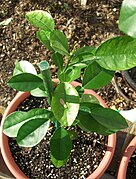 Seedling
 -
 Flowers
 -
 Tree
Tree -
 Fruit
Fruit -
 Fruit and blossoms at the same time


History
[edit]Ancestral Citrus species
[edit]_Merr.);_flowe_Wellcome_V0042686.jpg)
The pomelo is significant botanically as one of the three major wild ancestors of several cultivated hybrid Citrus species, including the bitter orange and the grapefruit; and less directly also of the lemon, the sweet orange, and some types of mandarin.[8][9] The sweet orange is a naturally occurring hybrid between the pomelo and the mandarin, with the pomelo the larger and firmer of the two. The grapefruit was originally presumed to be a naturally occurring hybrid of the pomelo and the mandarin; however, genome analysis shows that it is actually a backcrossed hybrid between a pomelo and a sweet orange, which is why 63% of the grapefruit's genome comes from the pomelo.[10] The bitter orange is a hybrid of wild type mandarin and pomelo; in turn, the lemon is a hybrid of bitter orange and citron, i.e. cultivated lemons have some pomelo ancestry.[9] In addition, there has been repeated introgression of pomelo genes into both early cultivated hybrid mandarins and later mandarin varieties, these last also involving hybridization with the sweet orange. Pomelo genes are thus included in many types of cultivated Citrus.[9]

Etymology
[edit]According to the Oxford English Dictionary, the etymology of the word 'pomelo' is uncertain.[11] It may be derived from Dutch pompelmoes.[4] The Dutch name in turn has uncertain etymology, but is possibly derived from Dutch pompel 'swollen' or pompoen 'pumpkin', combined with limoes 'lemon, citrus fruit', influenced by Portuguese limões with the same meaning. An alternative possibility is that the Dutch name derives from Portuguese pomos limões 'citrus fruit'.[12] The specific name maxima is the female form of the Latin for 'biggest'.[13]
One theory for the alternative English name 'shaddock' is that it was adopted after the plant's introduction into Barbados by a 'Captain Shaddock' of the East India Company (apparently Philip Chaddock, who visited the island in the late 1640s).[14][15][16] From there the name spread to Jamaica in 1696.[17] The fruit is called jambola in varieties of English spoken in South Asia,[4] and jabong in Hawai'i.[18]
As food
[edit]Nutrition
[edit] Flesh of a pomelo | |||||||||||||||||||||||||||||||||||||
| Nutritional value per 100 g (3.5 oz) | |||||||||||||||||||||||||||||||||||||
|---|---|---|---|---|---|---|---|---|---|---|---|---|---|---|---|---|---|---|---|---|---|---|---|---|---|---|---|---|---|---|---|---|---|---|---|---|---|
| Energy | 159 kJ (38 kcal) | ||||||||||||||||||||||||||||||||||||
9.62 g | |||||||||||||||||||||||||||||||||||||
| Dietary fiber | 1 g | ||||||||||||||||||||||||||||||||||||
0.04 g | |||||||||||||||||||||||||||||||||||||
0.76 g | |||||||||||||||||||||||||||||||||||||
| |||||||||||||||||||||||||||||||||||||
| Other constituents | Quantity | ||||||||||||||||||||||||||||||||||||
| Water | 89 g | ||||||||||||||||||||||||||||||||||||
| †Percentages estimated using US recommendations for adults,[19] except for potassium, which is estimated based on expert recommendation from the National Academies.[20] | |||||||||||||||||||||||||||||||||||||
Raw pomelo flesh is 89% water, 10% carbohydrates, 1% protein, and contains negligible fat. A 100-gram reference amount provides 159 kilojoules (38 kilocalories) of food energy, and is rich in vitamin C (68% of the Daily Value), with no other micronutrients in significant content (table).
Culinary
[edit]The flesh and juice are edible, and the rind is used to make preserves, or may be candied.[4] In Brazil, the outer part of the rind is used for making a sweet conserve, while the spongy pith of the rind is discarded. In Sri Lanka, it is often eaten as a dessert, sometimes sprinkled with sugar. In large parts of Southeast Asia where pomelo is native it is commonly eaten as a dessert, sprinkled with salt or dipped in a salt mixture, or made into salads.[4] In the Philippines, a pink beverage is made from pomelo and pineapple juice.[21]
The fruit may have been introduced to China around 100 BCE.[4] In East Asia, especially in Cantonese cuisine, braised pomelo pith is used to make dishes that are high in fibre and low in fat.[22]
-

-
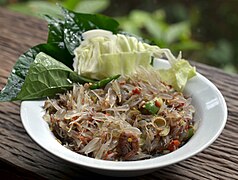 Tam som-o nam pu: spicy Thai pomelo salad with crab extract


Drug interactions
[edit]The pomelo, while not itself toxic, can cause adverse interactions similar to those caused by the grapefruit with a wide range of prescription drugs. These occur by the inhibition of cytochrome P450-mediated metabolism of prescription drugs including for example some anti-hypertensives, some anticoagulants, some anticancer agents, some anti-infective agents, some statins, and some immunosuppressants.[23]
Cultivation
[edit]The seeds of the pomelo are monoembryonic, producing seedlings with genes from both parents, but they are usually similar to the tree they grow from and therefore in Asia, pomelos are typically grown from seed.[4] Seeds can be stored for 80 days at a temperature of 5 °C (41 °F) with moderate relative humidity.[4] Outside Asia, the pomelo is usually grafted onto other citrus rootstocks to produce trees that are identical to the parent; high-quality varieties are propagated by air-layering or by budding onto favored rootstocks.[4]
-
 Fujian's Pinghe County is famous in China for its pomelos
 -
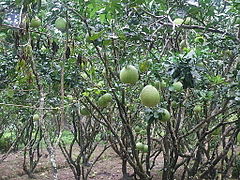 Orchard


References
[edit]- ^ Botanic Gardens Conservation International (BGCI).; IUCN SSC Global Tree Specialist Group (2019). "Citrus maxima". IUCN Red List of Threatened Species. 2019: e.T62042732A147027490. doi:10.2305/IUCN.UK.2019-2.RLTS.T62042732A147027490.en. Retrieved 19 November 2021.
- ^ "pomelo". The Chambers Dictionary (9th ed.). Chambers. 2003. ISBN 0-550-10105-5.
- ^ "pomelo". Merriam-Webster.com Dictionary. Merriam-Webster. Retrieved 2021-01-25.
- ^ a b c d e f g h i j k l m Morton, Julia F. (1987). "Pummelo: Citrus maxima". Fruits of warm climates. NewCROP, New Crop Resource Online Program, Center for New Crops and Plant Products, Purdue University. pp. 147–151. Retrieved 31 January 2020.
- ^ "Pomelo: Growing the granddaddy of grapefruit", SFGate.com, December 25, 2004
- ^ Morton, Julia F. (1987). "Grapefruit: Citrus paradisi". Fruits of warm climates. NewCROP, New Crop Resource Online Program, Center for New Crops and Plant Products, Purdue University. pp. 152–158. Retrieved 31 January 2020.
- ^ Pomelos, grapefruit's sweeter and mellower relative, have a wealth of flavor, by Jeanne Kelley, in the Los Angeles Times; published February 12, 2016; retrieved November 19, 2021 (via archive.org)
- ^ Klein, Joshua D. (2014). "Citron Cultivation, Production and Uses in the Mediterranean Region". Medicinal and Aromatic Plants of the Middle-East. Medicinal and Aromatic Plants of the World. Vol. 2. pp. 199–214. doi:10.1007/978-94-017-9276-9_10. ISBN 978-94-017-9275-2.
- ^ a b c d Wu, Guohong Albert; Terol, Javier; Ibanez, Victoria; López-García, Antonio; Pérez-Román, Estela; et al. (2018). "Genomics of the origin and evolution of Citrus". Nature. 554 (7692): 311–316. Bibcode:2018Natur.554..311W. doi:10.1038/nature25447. hdl:20.500.11939/5741. PMID 29414943. and Supplement
- ^ Louzada, Eliezer S.; Ramadugu, Chandrika (June 2021). "Grapefruit: History, Use, and Breeding in: HortTechnology Volume 31 Issue 3 (2021)". Horttechnology. 31 (3). Journals.ashs.org: 243–258. doi:10.21273/HORTTECH04679-20. Retrieved 2022-05-01.
- ^ "pomelo". Oxford English Dictionary (Online ed.). Oxford University Press. (Subscription or participating institution membership required.)
- ^ "pompelmoes - (grote citrusvrucht (Citrus maxima))". Etymologiebank.nl. Retrieved 1 November 2024.
- ^ "maximus". Cambridge Dictionary. Retrieved 28 October 2024.
- ^ Kumamoto, J.; Scora, R.W.; Lawton, H.W.; Clerx, W.A. (1987). "Mystery of the Forbidden Fruit: Historical Epilogue on the Origin of the Grapefruit, Citrus paradisi (Rutaceae)". Economic Botany. 41 (1): 97–107. Bibcode:1987EcBot..41...97K. doi:10.1007/BF02859356. S2CID 42178548.
- ^ "Pomelo (Pummelo) Citrus maxima". Citruspages.free.fr. 2009-11-14. Retrieved 2020-07-06.
- ^ "fruitInfo-trdLevel2021.html". Itfnet.org. 2008-06-12. Retrieved 2020-07-06.
- ^ American Heritage Dictionary, 1973.
- ^ Colón-Singh, Rose Y. "What Is Jabong Fruit?". Fine Dining Lovers.
- ^ United States Food and Drug Administration (2024). "Daily Value on the Nutrition and Supplement Facts Labels". FDA. Archived from the original on 2024-03-27. Retrieved 2024-03-28.
- ^ National Academies of Sciences, Engineering, and Medicine; Health and Medicine Division; Food and Nutrition Board; Committee to Review the Dietary Reference Intakes for Sodium and Potassium (2019). "Chapter 4: Potassium: Dietary Reference Intakes for Adequacy". In Oria, Maria; Harrison, Meghan; Stallings, Virginia A. (eds.). Dietary Reference Intakes for Sodium and Potassium. The National Academies Collection: Reports funded by National Institutes of Health. Washington, DC: National Academies Press (US). pp. 120–121. doi:10.17226/25353. ISBN 978-0-309-48834-1. PMID 30844154. Retrieved 2024-12-05.
- ^ Hargreaves, Dorothy; Hargreaves, Bob (1970). Tropical Trees of the Pacific. Kailua, Hawaii: Hargreaves. p. 51.
- ^ "Braised pomelo pith". Week in China. 8 December 2017. Archived from the original on 2021-01-25. Retrieved 22 August 2020.
- ^ Bailey, D. G.; Dresser, G.; Arnold, J. M. O. (26 November 2012). "Grapefruit-medication interactions: Forbidden fruit or avoidable consequences?". Canadian Medical Association Journal. 185 (4): 309–316. doi:10.1503/cmaj.120951. PMC 3589309. PMID 23184849.


