


Yuzu
 | This article needs additional citations for verification. (July 2020) |
| Yuzu | |
|---|---|
.jpg)
| |
Scientific classification 
| |
| Kingdom: | Plantae |
| Clade: | Tracheophytes |
| Clade: | Angiosperms |
| Clade: | Eudicots |
| Clade: | Rosids |
| Order: | Sapindales |
| Family: | Rutaceae |
| Genus: | Citrus |
| Species: | C. × junos
|
| Binomial name | |
| Citrus × junos | |
Yuzu (Citrus × junos, from Japanese 柚子 or ユズ; /ˈjuːzuː/ ⓘ) is a citrus fruit and plant in the family Rutaceae of East Asian origin. Yuzu has been cultivated mainly in East Asia, though it has also recently been grown in New Zealand, Australia, Spain, Italy, and France.[1]
It is believed to have originated in central China as an F1 hybrid of the mangshanyeju subspecies of mandarin orange and the ichang papeda.[2][3]
Description[edit]
This fruit resembles a yellow clementine with uneven skin and can be either yellow or green depending on the degree of ripeness. Yuzu fruits, which are very aromatic, typically range between 5.5 and 7.5 cm (2+1⁄8 and 3 in) in diameter but can be as large as a regular grapefruit (up to 10 cm or 4 in, or larger).
Yuzu forms an upright shrub or small tree, which commonly has many large thorns. Leaves are notable for a large, leaf-like petiole, resembling those of the related makrut lime and ichang papeda, and are heavily scented.
Yuzu closely resembles sudachi (Citrus sudachi, a Japanese citrus from Tokushima Prefecture, a yuzu–mandarin orange cross) in many regards, though, unlike the sudachi, yuzu eventually ripen to an orange colour and there are subtle differences between the flavors of the fruit.
-
 Citrus × junos fruits and cross sections
 -
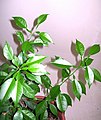 The leaves have large leaf-like petioles.
 -
 Yuzu (left) compared to mandarin orange (right)


Cultivation[edit]
The yuzu originated and grew wild in central China and Tibet region. It was introduced to Japan and Korea during the Tang dynasty and is still cultivated there.[4] It grows slowly, generally requiring ten years to fruit.[citation needed] To shorten the duration to fruiting, it may be grafted onto karatachi (P. trifoliata).[citation needed] It is unusual among citrus plants in being relatively frost-hardy, due to its cold-hardy Ichang papeda ancestry, and can be grown in regions with winters as low as −7 °C (19 °F) where more sensitive citrus would not thrive.[5]
Varieties and similar fruits[edit]
In Japan, an ornamental version of yuzu called hana yuzu (花柚子, 花ゆず) "flower yuzu" is also grown for its flowers rather than its fruit. A sweet variety of yuzu known as the yuko, only present in Japan, became severely endangered during the 1970s and 1980s; a major attempt has been made to revive this varietal in southern Japan.[6] Another variety of yuzu in Japan, with knobby skin, is called shishi yuzu (獅子柚子, literally "lion yuzu").[7]
Dangyuja, a Korean citrus fruit from Jeju Island, is often considered a type of yuzu due to its similar shape and flavor, but it is genetically a variety of pomelo.
Use[edit]
East Asia[edit]
Culinary use[edit]
Japan[edit]

Yuzu's domestic production is about 27,000 tons (2016).[8] Though rarely eaten as a fruit, yuzu is a common ingredient in Japanese cuisine, where the aromatic zest (outer rind) and the juice are used much in the same way that lemons are used in other cuisines.[9] The yuzu's flavor is tart and fragrant, closely resembling that of the grapefruit, with overtones of mandarin orange.[10]
It is an integral ingredient (along with sudachi, daidai, and other similar citrus fruits) in the citrus-based sauce ponzu, and yuzu vinegar is also produced.[9] Yuzu is often combined with honey to make yuzu hachimitsu (柚子蜂蜜), a kind of syrup that is used to make yuzu tea (柚子茶), or as an ingredient in alcoholic drinks such as the yuzu sour (柚子サワー).[11] Yuzu kosho (also yuzukosho, literally "yuzu and pepper") is a spicy Japanese sauce made from green or yellow yuzu zest, green or red chili peppers, and salt.[3]
It is used to make liquor (such as yuzukomachi, 柚子小町) and wine.[12][13] Slivered yuzu rind is used to garnish a savory, salty egg-pudding dish called chawanmushi, as well as miso soup.[14] It is often used along with sudachi and kabosu. Yuzu is used to make various sweets, including marmalade and cake. It is used extensively in the flavoring of many snack products, such as Doritos.[15][16][17]
Korea[edit]
In Korean cuisine, yuja is most commonly used to make yuja-cheong (유자청, yuja marmalade) and yuja tea. Yuja-cheong can be made by sugaring peeled, depulped, and thinly sliced yuja, and yuja-cha, yuja tea, can be made by mixing hot water with yuja-cheong.[3] Yuja-hwachae (유자화채, yuja punch), a variety of hwachae (fruit punch), is another common dessert made with yuja. Yuja is also a common ingredient in Korean-style western food, such as salads.[18]
-
 Yuja tea and yuja-cheong
 -
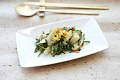 Deodeok yuja salad
 -
 Yuja bread sold in Yeosu


Other uses[edit]
Yuzu baths[edit]
Yuzu is also known for its characteristically strong aroma, and the oil from its skin is marketed as a fragrance. In Japan, bathing with yuzu on Tōji, the winter solstice, is a custom that dates to at least the early 18th century.[19][20] Whole yuzu fruits are floated in the hot water of the bath, sometimes enclosed in a cloth bag, releasing their aroma.[21] The fruit may also be cut in half, allowing the citrus juice to mingle with the bathwater. The yuzu bath, known commonly as yuzu yu (柚子湯), but also as yuzu buro (柚子風呂), is said to guard against colds, treat the roughness of skin, warm the body, and relax the mind.[20]
Use as wood[edit]
The body of the taepyeongso, a Korean traditional oboe, close to the Chinese suona or the zurna, is often made from jujube, mulberry, or yuzu wood.[22]
Elsewhere[edit]
Beginning in the early 21st century, yuzu has been increasingly used by chefs in the United States and other Western nations, achieving notice in a 2003 article in The New York Times.[23]
In the United States, the Department of Agriculture has a ban on the import of fresh yuzu (alongside most citrus plants) from abroad, including both the fruit and the trees.[24] This is intended to prevent the spread of contagious diseases amongst domestic crops.[23][25] However, following its introduction to California in 1888, yuzu is cultivated and available for sale in the United States.[23]
See also[edit]

References[edit]
- ^ Japan External Trade Organization (日本貿易振興機構 JETRO ジェトロ) Archived 2021-01-08 at the Wayback Machine.
- ^ Wu, Guohong Albert; Sugimoto, Chikatoshi; Kinjo, Hideyasu; Asama, Chika; Mitsube, Fumimasa; Talon, Manuel; Gmitter, Grederick G Jr; Rokhsar, Daniel S (2021). "Diversification of mandarin citrus by hybrid speciation and apomixis". Nature Communications. 12 (1): 4377. Bibcode:2021NatCo..12.4377W. doi:10.1038/s41467-021-24653-0. PMC 8313541. PMID 34312382. and Supplement
- ^ a b c Sawamura, Masayoshi (September 14, 2011). Citrus Essential Oils: Flavor and Fragrance. John Wiley & Sons. pp. 367–358. ISBN 978-1-118-07438-1.
- ^ "Yuzu ichandrin (papeda hybrid). Citrus junos Sieb. ex Tanaka. Citrus ichangensis X C. reticulata var. austere". Citrus Variety Collection. University of California Riverside. Archived from the original on June 23, 2010. Retrieved November 17, 2012.
- ^ Nishihara, Yukinaga; Kubozoe, Masatika; Tsuji, Kohei; Osaki, Suguru. "産地と企業との持続可能なパートナーシップ形成過程の解明". J-STAGE. Japan Science and Technology Agency. p. 2. Retrieved August 18, 2023.
- ^ Kurokawa, Yoko (January 7, 2009). "Vol. 11: The Yuko, a Native Japanese Citrus". Japanese Traditional Foods. Tokyo Foundation. Archived from the original on May 23, 2009.
- ^ "photo". Archived from the original on February 24, 2007. Retrieved February 4, 2007.
- ^ Japan External Trade Organization (日本貿易振興機構 JETRO ジェトロ) Archived 2021-01-08 at the Wayback Machine Ministry of Agriculture, Forestry and Fisheries (農林水産省) 2016 Survey
- ^ a b Khan, Muhammad Sarwar; Khan, Iqrar Ahmad (November 3, 2021). "12". Citrus: Research, Development and Biotechnology. BoD – Books on Demand. pp. 229–232. ISBN 978-1-83968-723-5.
- ^ Matsumoto, Tamaki; Kimura, Tetsuya; Hayashi, Tatsuya (April 21, 2016). "Aromatic effects of a Japanese citrus fruit-yuzu (Citrus junos Sieb. ex Tanaka)-on psychoemotional states and autonomic nervous system activity during the menstrual cycle: A single-blind randomized controlled crossover study". BioPsychoSocial Medicine. 10: 2. doi:10.1186/s13030-016-0063-7. PMC 4839105. PMID 27103942.
- ^ 5分. "柚子サワー | ホームクッキング【キッコーマン】". Kikkoman.co.jp. Archived from the original on March 5, 2012. Retrieved March 4, 2012.
{{cite web}}: CS1 maint: numeric names: authors list (link) - ^ "Yuzu wine". Archived from the original on November 15, 2006.
- ^ "Bottle of Yuzu wine". Archived from the original on September 28, 2007.
- ^ Fletcher, Janet (May 31, 2006). "Yuzu and Huckleberry, Flavors of the Moment: How these and other obscure ingredients end up on so many Bay Area menus". San Francisco Chronicle. Archived from the original on May 26, 2013.
- ^ Phro, Preston (September 22, 2015). "New citrus-yuzu-salt-flavored Jagariko potato sticks are delicious, cheap, and ultra-limited". Sora News 24. Archived from the original on February 20, 2019. Retrieved February 19, 2019.
- ^ Loss, Laura (January 11, 2017). "13 Ways You Can Enjoy Yuzu, Japan's Favourite Citrus Fruit". DigJapan!. Archived from the original on February 20, 2019. Retrieved February 19, 2019.
- ^ Morelli, Vivian (December 18, 2017). "The Zesty World of Yuzu". NHK World. Archived from the original on February 20, 2019. Retrieved February 19, 2019.
Yuzu is also even used in the flavoring of many snack products, such as chips and chocolate bars.
- ^ "Bureau of Taste: Korean All-Purpose Yuzu Salad Dressing". Sous Chef. September 12, 2014. Archived from the original on January 5, 2017. Retrieved January 5, 2017.
- ^ Emi, Doi (December 21, 2017). "Soaking and Seasoning: The Aromatic Pleasures of "Yuzu"". Archived from the original on February 19, 2019. Retrieved December 22, 2017.
Yuzuyu dates from the Edo period (1603–1868) and may have been partially inspired by a form of Japanese wordplay called goroawase — the characters for "winter solstice" (冬至) and "hot-spring cure" (湯治) can both be read as tōji.
- ^ a b "Yuzuyu". Nihon Kokugo Daijiten (in Japanese). Tokyo: Shogakukan. 2012. Archived from the original on August 25, 2007. Retrieved February 28, 2012.
- ^ "Yuzuyu". Dijitaru daijisen (in Japanese). Tokyo: Shogakukan. 2012. Archived from the original on August 25, 2007. Retrieved May 22, 2012.
- ^ Low, Kathleen (October 15, 2019). Asian Fruits and Berries: Growing Them, Eating Them, Appreciating Their Lore. McFarland. p. 220. ISBN 978-1-4766-7595-4.
- ^ a b c Karp, David (December 3, 2003). "The Secrets Behind Many Chefs' Not-So-Secret Ingredient". The New York Times. p. 12. Archived from the original on January 12, 2011.
- ^ Rosner, Helen (February 27, 2020). "Nothing Compares to Yuzu". The New Yorker. Archived from the original on June 4, 2020. Retrieved February 27, 2020.
- ^ "Importation advisory: Citrus fruit cannot be brought into United States from Canada". U.S. Customs and Border Protection. December 12, 2017.
External links[edit]
 Media related to yuzu at Wikimedia Commons
 Data related to yuzu at Wikispecies
 The dictionary definition of yuzu at Wiktionary


| Main dishes |
|
|---|---|
| Side dishes | |
| Beverages | |
| Snacks / desserts | |
| Ingredients / condiments | |
| Utensils | |
| Lists | |
| Fruits | |
| Related | |
| Authority control databases: National |
|---|


