


Porsche Cayenne
| Porsche Cayenne | |
|---|---|
 | |
| Overview | |
| Manufacturer | Porsche AG |
| Also called | Ruf Dakara |
| Production | August 2002–present |
| Model years | 2003–present |
| Body and chassis | |
| Class | Luxury crossover SUV |
| Layout | Front-engine, four-wheel-drive |
The Porsche Cayenne is a series of automobiles manufactured by the German company Porsche since 2002. It is a luxury crossover SUV, and has been described as both a full-sized and a mid-sized vehicle.[1][2][3][4][5][6] The first generation was known within Porsche as the Type 9PA (955/957) or E1. It was the first V8-engined vehicle built by Porsche since 1995, when the Porsche 928 was discontinued. It is also Porsche's first off-road variant vehicle since its Super and Junior tractors of the 1950s, as well as the first production Porsche with four doors. Since 2014, the Cayenne has been sold alongside a smaller Porsche SUV, the Macan.
The second-generation Cayenne (Type 92A or E2) was unveiled at the 2010 Geneva Motor Show in March. The Cayenne shares its platform, body frame, doors, and electronics with the Volkswagen Touareg and Audi Q7. It received a facelift in 2014 with minor external changes, and introduced a new plug-in E-Hybrid version with its public launch at the Paris Motor Show.[7] Since 2008, all engines have featured direct injection technology. The third generation (Type 9YA or E3) was unveiled in 2017 in the German city of Stuttgart.
First generation (E1 9PA; 2002)
[edit]| First generation (9PA) | |
|---|---|
 | |
| Overview | |
| Also called | Ruf Dakara |
| Production | August 2002 – May 2010 |
| Model years | 2003–2010 |
| Assembly | Slovakia: Bratislava (Volkswagen Bratislava Plant: body assembly, paint, engine, gearbox, drivetrain, under chassis, wheels) Germany: Leipzig (Porsche Leipzig GmbH: interior, finishing, inspection) |
| Designer |
|
| Body and chassis | |
| Body style | 5-door SUV |
| Platform | Volkswagen Group PL71 platform |
| Related | Volkswagen Touareg Audi Q7 |
| Powertrain | |
| Engine | |
| Transmission | 6-speed Aisin Warner TR60SN 09D automatic (Tiptronic S) 6-speed manual (V6 Base model and GTS only) |
| Dimensions | |
| Wheelbase | 2,855 mm (112.4 in) |
| Length | 9PA Cayenne: 4,782 mm (188.3 in) 955 Turbo: 4,786 mm (188.4 in) 957 Cayenne: 4,798 mm (188.9 in) 957 GTS and Turbo: 4,795 mm (188.8 in) |
| Width | 1,928 mm (75.9 in) 957 GTS: 1,957 mm (77.0 in) |
| Height | 1,699 mm (66.9 in) 957 GTS: 1,675 mm (65.9 in) 957 Turbo: 1,696 mm (66.8 in) |
The original Porsche Cayenne entered into the global market to a mixed reception, but it proved itself to have excellent performance for an SUV and had comparably good handling as well as powerful engines.[10][additional citation(s) needed] The lineup initially consisted of the V8-powered Cayenne S and Cayenne Turbo. Later in the model cycle, VR6 and diesel-powered versions joined the lineup. In the eight model years of the E1 generation, a total of 276,652 units were produced.[11] The name Cayenne was coined by Manfred Gotta.
The base model Cayenne is powered by a 3.2-L VR6 engine producing 250 PS (184 kW; 247 hp). The intake manifold is unique to Porsche, but otherwise the engine is largely the same as the VW engine. Acceleration from 0–100 km/h (0–62 mph) is 9.1 seconds with the manual transmission and 9.7 seconds with the Tiptronic S.
-
 Rear view (Face-lifted 9PA Cayenne Turbo)
 -
 E1 Cayenne Interior

.jpg)


Cayenne S
[edit]The S in the 955 pre-facelift 9PA is powered by a 4.5L V8 engine with a wet-sump lubrication system and variable valve timing. It produces 335 hp (250 kW; 340 PS) and 310 lb⋅ft (420 N⋅m) of torque. Acceleration from 0–60 mph (0–97 km/h) takes 6.9 seconds and the top speed is 150 mph (241 km/h).[12]
Introduced only for 2006 (as a pre-GTS concept), the Cayenne S Titanium Edition was a one-year exclusive, limited production SUV featuring a lightweight steel body, featuring an aluminium hood (lighter than the one equipped on the Cayenne S), titanium-painted accented body parts, side lower rocker body panels, Sport-Quad Tip Exhaust chrome tailpipes, 19" titanium painted alloy wheels, bi-xenon headlights, two-tone interior upholstery, Porsche PCM 2.0 w/ trip computer navigation, MP3 audio and Bose cabin surround sound. Under the hood, improvements included sport-tuned suspension, an aerodynamic body package, low-range transfer case, locking differential and a 6-speed automatic Tiptronic S transmission. The Cayenne S Titanium Edition is powered by the same 4.5L V8 engine that powered the Cayenne S - still producing 335 hp (250 kW; 340 PS) and 310 lb⋅ft (420 N⋅m) of torque. Acceleration is even quicker than the regular Cayenne S from 0–60 mph (0–97 km/h) at 6.2 seconds and the top speed is 150 mph (241 km/h).
In the updated 9PA chassis 957 Cayenne S introduced between 2008 and 2010, it featured a direct fuel injection (DFI) 4.8L V8 engine which produces 390 PS (287 kW; 385 hp) and 500 N⋅m (370 lb⋅ft) of torque. It had a 0–100 km/h (62 mph) time of 6.6 seconds with a top speed of 250 km/h. The updated V8 engine featured VarioCam Plus which combine variable valve timing with two-stage valve lift on the inlet side.
Cayenne GTS
[edit]The E1 Gran-Turismo Sport (GTS) was only offered in the updated 9PA chassis between the year 2008 and 2010. It was the first Porsche of the modern era to feature the GTS abbreviation nameplate in its model designation. Its sporty chassis had been specially developed only for this model variant and it was powered with a performance tuned 411 PS (302 kW; 405 hp) 4.8 L V8. It also featured a lowered sport suspension, sports exhaust system and 21-inch (533 mm) high performance wheels as standard. It was much lighter than a normal Cayenne and had an aerodynamic wide body kit standard from factory. The Porsche Cayenne GTS had a 0–100 km/h (62 mph) time of 6.1 seconds with a top speed of 253 km/h. A six-speed manual transmission was also offered in the GTS.[13]
Cayenne Turbo and Turbo S
[edit]
The first-generation 9PA Cayenne Turbo had 450 PS (331 kW), and can accelerate from 0–100 km/h (62 mph) in 5.6 seconds.[12] A Turbo S version was built in 2006 to compete with the Mercedes-Benz ML 63 AMG. The Cayenne Turbo and Turbo S include a low-range case, a locking differential, and height-adjustable, off-road suspension. The Turbo S is powered by a twin-turbocharged 4.5 L V8 that produces 521 PS (383 kW; 514 hp) and 720 N⋅m (530 lb⋅ft) of torque; Acceleration from 0–60 mph (97 km/h) takes 5.0 seconds and the top speed is 167 mph (269 km/h); It features a six-speed automatic Tiptronic S transmission.
.jpg)
In 2008 an updated 9PA Turbo model, featuring a larger direct fuel injection 4.8-L V8 engine, was revealed at the Beijing Auto Show. It produces 500 PS (368 kW; 493 hp) more power, and can accelerate from 0–60 mph (97 km/h) in 4.9 seconds.[14] Also revealed with the new Turbo, was a new 550 hp (410 kW) Turbo S model. Acceleration from 0–60 mph (97 km/h) for that car takes 4.7 seconds and it can be had with optional ceramic composite brakes.
Cayenne Diesel
[edit]The original Cayenne Diesel was only available in the facelift 9PA chassis, powered by a 3.0-L V6 VW TDI engine, since February 2009.[15] The engine is rated at 240 PS (177 kW; 237 hp) and 550 N⋅m (410 lb⋅ft) of torque. The car was unveiled at the 2009 Geneva Motor Show.[16] The diesel can accelerate from 0–60 mph (97 km/h) in 8.2 seconds.
Cayenne S Transsyberia
[edit]The Cayenne S Transsyberia was originally a racing vehicle designed for the Transsyberia rally, in which only 285 were built.[17]
The street version was later built to commemorate Porsche's victory in the Transsyberia rally. It is only available in the 9PA chassis with the 405 hp (302 kW) direct-inject 4.8-L V8 from the Cayenne GTS. Sales began in January 2009, with a targeted production run of 600 road vehicles worldwide (285 for North America), but far fewer were actually built (102 for USA, 17 for Canada including 3 which were 6 speed manual).[18]
Cayenne GTS Porsche Design Edition 3 (2010)
[edit]In May 2009,[19] a limited edition version based on the Cayenne GTS was introduced, designed by Porsche Design Studio and included a Porsche Design chronograph Type P'6612. Production was limited to 1000 units worldwide.[20]
Cayenne Concepts
[edit]In April 2022,[21] Porsche unveiled a concept open-top Cayenne for the first time to the public as a part of the 20th anniversary of the Porsche Cayenne. The Cayenne was proving successful, so in December 2002 Porsche designers wanted to assess the viability of more Cayenne body styles. They came up 3 alternate body shapes: a coupe style SUV, a convertible SUV and a longer wheelbase 3 row SUV. Porsche designers decided to continue with the idea of a convertible SUV, creating a two-door, non-drivable (due to a lack of strengthening added to the chassis to prevent the car from buckling without a fixed roof) convertible Cayenne that had two alternate designs on the rear. Additionally, its doors were 20 cm longer than the standard Cayenne and it had a shorter A-Pillar than the standard model. Due to the concerns surrounding head room, boot space and rear design the idea was scrapped. However, the coupe style SUV lead to the modern Cayenne Coupe. Moreover, the idea of a longer wheelbase 3 row SUV likely led to the large Porsche SUV which is currently in the prototype stages.[22]
Engines
[edit] |
| Model | Production period | Engine | Power (PS, torque) at rpm |
|---|---|---|---|
| Cayenne | 2004–2007 | 3,189 cc (3.2 L; 194.6 cu in) VR6 | 250 PS (184 kW; 247 hp) at 6,000, 310 N⋅m (229 lb⋅ft) at 2,500 |
| Cayenne | 2007–2010 | 3,598 cc (3.6 L; 219.6 cu in) VR6 | 290 PS (213 kW; 286 hp) at 6,200, 385 N⋅m (284 lb⋅ft) at 3,000 |
| Cayenne S | 2002–2007 | 4,511 cc (4.5 L; 275.3 cu in) V8 | 340 PS (250 kW; 335 hp) at 6,000, 420 N⋅m (310 lb⋅ft) at 2,500 |
| Cayenne S Titanium Edition | 2006–2007 | 4,511 cc (4.5 L; 275.3 cu in) V8 | 344.7 PS (254 kW; 340 hp) at 6,000, 420 N⋅m (310 lb⋅ft) at 2,500 |
| Cayenne S | 2007–2010 | 4,806 cc (4.8 L; 293.3 cu in) V8 | 385 PS (283 kW; 380 hp) at 6,200, 500 N⋅m (369 lb⋅ft) at 3,500 |
| Cayenne S Transsyberia | 2009–2010 | 4,806 cc (4.8 L; 293.3 cu in) V8 | 405 PS (298 kW; 399 hp) at 6,500, 500 N⋅m (369 lb⋅ft) at 3,500 |
| Cayenne GTS | 2008–2010 | 4,806 cc (4.8 L; 293.3 cu in) V8 | 411 PS (302 kW; 405 hp) at 6,500, 500 N⋅m (369 lb⋅ft) at 3,500 |
| Cayenne GTS Porsche Design Edition 3 | 2009–2010 | 4,806 cc (4.8 L; 293.3 cu in) V8 | 411 PS (302 kW; 405 hp) at 6,500, 500 N⋅m (369 lb⋅ft) at 3,500 |
| Cayenne Turbo | 2002–2007 | 4,511 cc (4.5 L; 275.3 cu in) twin turbo V8 | 450 PS (331 kW; 444 hp) at 6,000, 620 N⋅m (457 lb⋅ft) at 2,250 |
| Cayenne Turbo | 2008–2010 | 4,806 cc (4.8 L; 293.3 cu in) twin turbo V8 | 500 PS (368 kW; 493 hp) at 6,000, 700 N⋅m (516 lb⋅ft) at 4,500 |
| Cayenne Turbo S | 2006–2007 | 4,511 cc (4.5 L; 275.3 cu in) twin turbo V8 | 521 PS (383 kW; 514 hp) at 5,500, 720 N⋅m (531 lb⋅ft) at 2,750 |
| Cayenne Turbo S | 2008–2010 | 4,806 cc (4.8 L; 293.3 cu in) twin turbo V8 | 550 PS (405 kW; 542 hp) at 6,000, 750 N⋅m (553 lb⋅ft) at 2,250 |
| Cayenne Diesel | 2009–2010 | 2,967 cc (3.0 L; 181.1 cu in) turbo V6 | 240 PS (176 KW; 237 hp) at 4,000, 550 N⋅m (406 lb⋅ft) at 2,000 |
Second generation (E2 92A; 2010)
[edit]| Second generation (92A) | |
|---|---|
_%E2%80%93_Frontansicht,_10._Oktober_2011,_W%C3%BClfrath.jpg) | |
| Overview | |
| Production | April 2010–August 2017[23] |
| Model years | 2011–2018 |
| Assembly | Slovakia: Bratislava (Volkswagen Bratislava Plant: body assembly, paint, engine, gearbox, drivetrain, under chassis, wheels) Germany: Leipzig (Porsche Leipzig GmbH: interior, finishing, inspection) Germany: Osnabrück (Volkswagen Osnabrück Plant: interior, finishing, inspection; 2015–2017) |
| Designer | Mitja Borkert |
| Body and chassis | |
| Body style | 5-door SUV |
| Platform | Volkswagen Group PL72 platform |
| Related | |
| Powertrain | |
| Engine |
|
| Electric motor | 35 kW (47 hp; 48 PS) 1NM AC synchronous (Cayenne S hybrid) 61 kW (82 hp; 83 PS) 1NM AC synchronous (Cayenne S E-Hybrid) |
| Transmission | 8-speed Aisin Warner TR-80SD automatic (Tiptronic S) 6-speed manual (2011-2014 V6 Base model only) |
| Hybrid drivetrain |
|
| Battery |
|
| Dimensions | |
| Wheelbase | 2,895 mm (114.0 in) |
| Length | 4,846 mm (190.8 in) (2010-14) 4,855 mm (191.1 in)(2014-) |
| Width | 1,938 mm (76.3 in) (2010-14) 1,939 mm (76.3 in)(2014-) |
| Height | 1,705 mm (67.1 in) |
| Curb weight | 2,085–2,215 kg (4,597–4,883 lb) |
The second-generation Porsche Cayenne 92A went on sale in April–May 2010 as a 2011 model, with an official debut at the 2010 Geneva Motor Show. In preparation for the unveiling, the Cayenne production facility in Leipzig, Germany, closed in December 2009 to commence factory retooling for the new model, a process that took two to three months.[citation needed]
_%E2%80%93_Heckansicht,_10._Oktober_2011,_W%C3%BClfrath.jpg)
The 92A Porsche Cayenne was slightly larger than its predecessors, but featured a more slanted rear window, less upright windshield, a more sloping roofline, door-mounted mirrors, smaller windows at the rear of the vehicle, headlights inspired by the Carrera GT, taillights that extend onto the car's tailgate, LED daytime running lights and a vastly redesigned interior much like the Panamera.[24] The 2011 Cayenne is almost 250 kg (551 lb) lighter than the previous models due to removing the low-range transfer case making it slightly more fuel efficient than the previous lineup. More use of aluminium and magnesium also helped shave weight.[25] Despite its lower stance, the new vehicle's off-road capabilities have been retained without compromising the street performance-oriented layout and design.[citation needed] In addition to a diesel offering, a hybrid version is available.[26] Model year 2013–2016 diesel Porsche Cayennes are included in the Volkswagen emissions scandal.
Standard features of the 92A Porsche Cayenne included automatic air conditioning with dual-zone climate controls, interior air filter, tilt/telescopic leather-wrapped steering wheel with radio controls, cruise control, leather upholstery, eight-way power front seats, outside-temperature indicator, and universal garage door opener in the base model. The Cayenne S adds a power sunroof and memory for the driver's seat.[25] The Cayenne GTS added an optional rearview camera, keyless access and start, and memory system. Finally, the most upscale Cayenne Turbo and Turbo S added a navigation system with voice recognition, optional four-zone climate controls, heated rear seats, premium sound system with six-disc CD changer.[27]
The E2 Cayenne was powered by a 3.6-L VR6 engine producing 300 PS (221 kW; 296 hp), the Cayenne S features the same 4.8-L V8 in the Panamera S models producing 400 PS (294 kW; 395 hp) and the Cayenne Turbo comes with Panamera Turbo's 4.8 L twin turbo V8 producing 500 PS (368 kW; 493 hp).[25] The Cayenne S Hybrid uses an Audi-sourced 3.0-L V6 engine producing 333 PS (245 kW; 328 hp), paired with a nickel metal hydride battery capable of 47 PS (35 kW; 46 hp), for a total of 380 PS (279 kW; 375 hp).[28] A six-speed manual gearbox serves as the standard transmission system on the base Cayenne to 2014, with all other models featuring an eight-speed automatic (Tiptronic S) as standard equipment. The low-range transfer case found in the previous generation has been removed. All vehicles will feature about 10% less weight than their predecessors, 70 kg worth of standard equipment in excess of that found on the current model and a more heavily contoured rear bench.[citation needed]
Available Porsche Dynamic Chassis Control (PDCC) active anti-roll bars,[29] Adaptive air suspension and Porsche Active Suspension Management (PASM).
In September 2012 Porsche announced the Cayenne S Diesel.[30] This model is fitted with the Audi 4.2 V8 TDI engine. In October 2012, Porsche confirmed the addition of a new Cayenne Turbo S.[31]
In July 2014, Porsche launched a facelifted Cayenne range, with minor exterior alterations and new power-train options, including a plug-in E-Hybrid and downsizing of the S model's 4.8-L V8 to a turbocharged 3.6-L V6.[citation needed]
-
 Porsche Cayenne V6 Diesel (UK; facelift)
 -
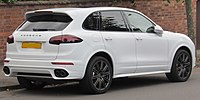 Porsche Cayenne V6 Diesel (UK; facelift)


Hybrid
[edit]
At the IAA 2005, Porsche announced it would produce a hybrid version of the Cayenne before 2010 (Porsche Cayenne Hybrid).[32] Two years later, at the IAA 2007, Porsche presented a functioning Cayenne Hybrid and demonstration model of the drivetrain.[33]
Notable modifications to this car include an electric vacuum pump and hydraulic steering pump, allowing the car to function even when the engine is deactivated. A 288-volt nickel metal hydride battery is placed under the boot floor, occupying the space normally used for a spare tire.[34]
The production version, called the 'S' Hybrid, was launched in 2010, with a 3.0-L petrol V6 linked with an electric motor to achieve CO2 emissions of 193 g/km.[35] The S Hybrid was launched in the U.S. market in November 2010.[36]
Plug-in hybrid
[edit]
In July 2014, Porsche announced the launch of the Porsche Cayenne S E-Hybrid, a plug-in hybrid with an all-electric range between 18 and 36 km (11 and 22 mi) under the New European Driving Cycle (NEDC) standard. The plug-in model displaced the Cayenne S Hybrid from the line up, and it is part of the revised range. The Cayenne S E-Hybrid is the first plug-in hybrid in the premium SUV segment, allowing Porsche to become the first automaker with three production plug-in hybrid models.[37] Deliveries in Germany were scheduled to begin in October 2014.[38] Sales in the U.S. began in November 2014.[39]
- EPA fuel economy ratings
The following are the official EPA ratings of the Cayenne S E-Hybrid compared with the others models of the 2015 line up available in the U.S.:
| Vehicle | Model year |
Operating mode (AER) |
EPA fuel economy ratings[40] | ||
|---|---|---|---|---|---|
| Combined | City | Highway | |||
| Porsche Cayenne S E-Hybrid | 2015 | Electricity and gasoline (14 mi) |
47 mpg-e (69 kWh/100 mi) |
- | - |
| Gasoline only | 22 mpg | - | - | ||
| Porsche Cayenne Diesel | 2015 | Diesel only | 23 mpg | 20 mpg | 29 mpg |
| Porsche Cayenne S | 2015 | Gasoline only | 20 mpg | 17 mpg | 24 mpg |
| Porsche Cayenne Turbo | 2015 | Gasoline only | 17 mpg | 14 mpg | 21 mpg |
Engines
[edit] |
| Model | Production period | Engine | Power (PS, torque) at rpm | Emissions CO2 |
|---|---|---|---|---|
| Cayenne | 2010–2014 | 3,598 cc (3.6 L; 219.6 cu in) VR6 | 300 PS (221 kW; 296 hp) at 6,300, 400 N⋅m (295 lb⋅ft) at 3,000 | 236 g/km |
| Cayenne | 2014–2018 | 3,598 cc (3.6 L; 219.6 cu in) VR6 | 300 PS (221 kW; 296 hp) at 6,300, 400 N⋅m (295 lb⋅ft) at 3,000 | 215 g/km |
| Cayenne S | 2010–2014 | 4,806 cc (4.8 L; 293.3 cu in) V8 | 400 PS (294 kW; 395 hp) at 6,000, 500 N⋅m (369 lb⋅ft) at 3,500 | 245 g/km |
| Cayenne S | 2015–2018 | 3,604 cc (3.6 L; 219.9 cu in) twin turbo V6 | 420 PS (309 kW; 414 hp) at 6,000, 500 N⋅m (369 lb⋅ft) at 1,350 | 223 g/km |
| Cayenne S Hybrid | 2010–2014 | 2,995 cc (3.0 L; 182.8 cu in) supercharged V6 + electric motor | 380 PS (280 kW; 370 hp) at 5,600, 580 N⋅m (428 lb⋅ft) at 1,000 | 193 g/km |
| Cayenne S E-Hybrid | 2014–2018 | 2,995 cc (3.0 L; 182.8 cu in) supercharged V6 PHEV | 416 PS (306 kW; 410 hp) at 5,500, 590 N⋅m (435 lb⋅ft) at 3,000 | 79 g/km |
| Cayenne GTS | 2010–2014 | 4,806 cc (4.8 L; 293.3 cu in) V8 | 420 PS (309 kW; 414 hp) at 6,500, 515 N⋅m (380 lb⋅ft) at 3,500 | 251 g/km |
| Cayenne GTS | 2015–2018 | 3,604 cc (3.6 L; 219.9 cu in) twin turbo V6 | 440 PS (324 kW; 434 hp) at 6,000, 600 N⋅m (443 lb⋅ft) at 1,600 | 228 g/km |
| Cayenne Turbo | 2010–2014 | 4,806 cc (4.8 L; 293.3 cu in) twin turbo V8 | 500 PS (368 kW; 493 hp) at 6,000, 700 N⋅m (516 lb⋅ft) at 2,250 | 270 g/km |
| Cayenne Turbo | 2014–2018 | 4,806 cc (4.8 L; 293.3 cu in) twin turbo V8 | 520 PS (382 kW; 513 hp) at 6,000, 750 N⋅m (553 lb⋅ft) at 2,250 | 261 g/km |
| Cayenne Turbo S | 2010–2014 | 4,806 cc (4.8 L; 293.3 cu in) twin turbo V8 | 550 PS (405 kW; 542 hp) at 6,000, 750 N⋅m (553 lb⋅ft) at 2,250 | 270 g/km |
| Cayenne Turbo S | 2015–2018 | 4,806 cc (4.8 L; 293.3 cu in) twin turbo V8 | 570 PS (419 kW; 562 hp) at 6,000, 800 N⋅m (590 lb⋅ft) at 2,500 | 267 g/km |
| Cayenne Diesel | 2010–2011 | 2,967 cc (3.0 L; 181.1 cu in) turbo V6 | 240 PS (177 kW; 237 hp) at 4,000, 550 N⋅m (406 lb⋅ft) at 2,000 | 195 g/km |
| Cayenne Diesel | 2011–2014 | 2,967 cc (3.0 L; 181.1 cu in) turbo V6 | 245 PS (180 kW; 242 hp) at 4,000, 550 N⋅m (406 lb⋅ft) at 1,750 | 189 g/km |
| Cayenne Diesel | 2014–2018 | 2,967 cc (3.0 L; 181.1 cu in) turbo V6 | 262 PS (193 kW; 258 hp) at 4,000, 580 N⋅m (428 lb⋅ft) at 1,750 | 173 g/km |
| Cayenne S Diesel | 2014–2018 | 4,134 cc (4.1 L; 252.3 cu in) twin turbo v8 | 385 PS (283 kW; 380 hp) at 3,750, 850 N⋅m (627 lb⋅ft) at 2,000 | 209 g/km |
Guinness World Record
[edit]On 1 May 2017, a 2017 Porsche Cayenne S Diesel set the Guinness World Record for heaviest aircraft pulled by a production car. The Cayenne towed a 265-ton Air France Airbus A380 to a distance of 42 meters, breaking the previous 2013 record of a Nissan Patrol towing a 170-ton Ilyushin Il-76 to a distance of 50 meters.[41] After the attempt Porsche repeated the test using a petrol-powered Cayenne Turbo S with 800 Nm of torque, 50 Nm less than the S Diesel, in an effort to prove the Cayenne's remarkable ability.[42]
Third generation (E3 9YA/9YB; 2017)
[edit]| Third generation (9YA/9YB) | |
|---|---|
 2018 Cayenne Turbo | |
| Overview | |
| Production | August 2017–present[43] |
| Model years | 2019–present[43] |
| Assembly |
|
| Designer | Ingo Scheinhutte[45] under Michael Mauer |
| Body and chassis | |
| Body style | |
| Platform | Volkswagen Group MLB Evo |
| Related | |
| Powertrain | |
| Engine | |
| Electric motor | 100 kW (136 PS; 134 hp) integrated electric motor (E-Hybrid) |
| Transmission | 8-speed ZF 8HP automatic (Tiptronic S) |
| Battery |
|
| Dimensions | |
| Wheelbase | 2,895 mm (114.0 in) |
| Length |
|
| Width | 1,983–1,995 mm (78.1–78.5 in) |
| Height |
|
| Curb weight | 2,083–2,643 kg (4,592–5,827 lb) |
The third-generation Porsche Cayenne was revealed on August 29, 2017, set to be put on sale in 2019. It is built on the Volkswagen Group MLB platform shared with several other luxury crossover SUVs produced by Volkswagen Group, including the Volkswagen Touareg, Audi Q7, Audi Q8, Bentley Bentayga, and Lamborghini Urus.[46]
For this generation, the Cayenne no longer shares the door panel design with the Volkswagen Touareg. According to Stephan Lenschow, the Cayenne body product manager, this allows Porsche to give the Cayenne a more 'coke bottle' design. The Cayenne also received a redesigned front end with larger air intakes, more prominent creases along the bonnet, and a lower roofline to align its styling with the Porsche 911.[47]
The wheelbase remains unchanged from the previous generation, but Porsche increased the Cayenne's overall length slightly by about 63 mm (2.5 in). The height is slightly lowered by 9 mm (0.4 in) and the coefficient of drag is rated at 0.35.[48]
Despite a small increase in length, the third-generation Cayenne is lighter by around 65 kg (143 lb), depending on the configuration, due to the use of a lighter chassis. Aluminium is used extensively throughout the vehicle, including in the doors, roof, hood, rear hatch, as well as its body in white. The ratio of aluminium to high-strength steel is roughly 50-50, according to Lenschow. A lighter lithium-ion polymer starter battery that saves 10 kg (22 lb) also contributes to its weight distribution, which in base configuration is nearly balanced with approximately 55 percent front and 45 percent rear.
All engine options of the third-generation Cayenne are turbocharged, while diesel engines are no longer offered.[46] All Cayenne models in this generation are equipped with an updated eight-speed "Tiptronic S" transmission that is claimed to provide quicker shifts than before.
Porsche offers optional Porsche Surface Coated Brakes (PSCB), which consist of a cast-iron disc with 70 micrometers of tungsten-carbide coating. According to Karl Heess, Porsche director for product line SUV, PSCB reduce brake dust by as much as 50 percent over conventional iron brake discs), and extend the life of the disc by up to 35 percent. It is more expensive than iron discs while still being 50 percent less expensive than the ceramic brake option. Other innovations in this generation include staggered (different width) front and rear tires, and optional rear-axle steering to reduce the turning radius.[47]
In the first quarter of 2022, Porsche sales declined by 5%, but the Cayenne remained the manufacturer's best-selling car.[49]
-
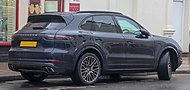 Rear (Cayenne Turbo)
 -
 Interior (Cayenne S)


Cayenne Coupé
[edit]A model with a more rakish roofline dubbed the Cayenne Coupé became available in 2019. It was revealed during the Shanghai Auto Show in April 2019. At launch, there were two sub-models, the Cayenne Coupé and Cayenne Turbo Coupé.
The Cayenne Coupé is extensively reworked from the standard model, featuring a shallower front windshield and narrower A-pillar. The roof is lowered by 20 mm (0.8 in), while new rear door panels and updated fenders extended the vehicle width by 18 mm (0.7 in). The drag coefficient is rated at 0.34, which is 0.1 lower than the regular model.[50] Every Cayenne Coupé is equipped with standard 2.16 m2 (23.3 sq ft) fixed-glass panoramic roof, while an optional contoured carbon roof is also available as an option.[51]
-
 Cayenne Turbo Coupé
 -
 Rear view


Variants
[edit]At its introduction in August 2017, Porsche released two versions of the third-generation Cayenne, which are base and Cayenne S.[52] The Cayenne Turbo was released a month later. The Cayenne S used the EA839 2.9 liter twin turbo V6 engine, with larger brake rotors and calipers compared with the base model.
Cayenne Turbo
[edit]In September 2017, Porsche added the Cayenne Turbo to the line-up. Introduced at the Frankfurt Motor Show, the Cayenne Turbo is powered with a twin-turbocharged 4.0-litre V8 rated at 549 PS (404 kW; 541 hp) and 770 N⋅m (78.5 kg⋅m; 568 lb⋅ft) of torque. Porsche claimed a 0–100 km/h (0–62 mph) acceleration figure of 4.1 seconds, or 3.9 seconds with the Sport Chrono package, and a top speed of 285 km/h (177 mph) The Porsche Surface Coated Brakes (PSCB) is a standard equipment.[53]
Cayenne E-Hybrid
[edit]In May 2018, Porsche introduced the Cayenne E-Hybrid. Sharing the same plug-in hybrid system with the Panamera 4 E-Hybrid, the variant uses a 3.0-litre V6 petrol engine with an eight-speed Tiptronic S automatic gearbox rated at 462 PS (340 kW; 456 hp) and 700 N⋅m (71.4 kg⋅m; 516 lb⋅ft) of torque. Porsche claims a 0–100 km/h (0–62 mph) time of 5.0 seconds and top speed of 252 km/h (157 mph). The all-electric range is rated by Porsche at 43 km (27 mi). It takes 7.8 hours to fully charge the 14.1 kWh battery with a 230-volt connection, or 2.3 hours if an optional 7.2 kW on-board charger is fitted.[54]
Cayenne Turbo S E-Hybrid
[edit]In August 2019, the Cayenne Turbo S E-Hybrid was released for both regular and Coupé body styles. A plug-in hybrid model, it uses a twin-turbocharged 4.0-litre V8 petrol engine rated at 550 PS (405 kW; 542 hp) and a 136 PS (100 kW; 134 hp) electric motor for a combined total of 680 PS (500 kW; 671 hp) and 900 N⋅m (664 lb⋅ft) of torque. A 14.1-kWh lithium-ion battery is used, and was said to offer 30 percent more capacity than the battery used in previous generation plug-in hybrid Cayenne models. Charging time is quoted at 2.4 hours when connected to a 240-volt, 50-amp source. Porsche claimed a 0–100 km/h (0–62 mph) acceleration figure of 3.6 seconds with a top speed of 295 km/h (183 mph). Porsche Ceramic Composite Brakes (PCCB), Porsche Dynamic Chassis Control (PDCC), Porsche Torque Vectoring Plus (PTV+), and Sport Chrono Package are standard equipment for the model.[55]
Cayenne GTS
[edit]In June 2020, Porsche introduced the Cayenne GTS and Cayenne GTS Coupé for the 2021 model year, after a two-year hiatus. It is powered by a twin-turbocharged 4.0-litre V8 shared with the Panamera GTS, which is rated at 460 PS (338 kW; 454 hp) and 620 N⋅m (63.2 kg⋅m; 457 lb⋅ft) of torque. The new models are capable of reaching 100 km/h (62 mph) in 4.8 seconds or 4.5 seconds using Performance Start, which is included in the optional Sport Chrono Package (standard on Coupé). Sport Design package, 21-inch RS Spyder Design wheels, and Sport Exhaust are included as standard equipment.[56]
-
 Cayenne GTS
 -
 Rear view
_GTS_IMG_3952.jpg)
_GTS_IMG_3953.jpg)
Cayenne Turbo GT
[edit]
In June 2021, Porsche introduced the Cayenne Turbo GT version. Based on the Cayenne Coupé, it uses a 4.0-litre twin-turbo V8 engine which Porsche claims to produce 640 PS (471 kW; 631 hp) and claimed 0–100 km/h (0–62 mph) acceleration time in 3.3 seconds. It is equipped with 22-inch wheels with Pirelli P Zero Corsa tyres. Ride height is lowered by 18 mm (0.7 in), while overall vehicle height is 30 mm (1.2 in) lower.[57]
2023 facelift
[edit]In April 2023, the Cayenne was given a mid-cycle refresh for the 2024 model year. Notable changes include a new dashboard layout, similar to that of the Taycan, a fully digital 12.6-inch gauge cluster, and minor exterior restyling modifications for the hood, headlights, bumpers, fenders, and trunk.
Matrix LED headlamps are now equipped as standard equipment across the range, while HD Matrix LED units are optional. The HD Matrix LED features two high-definition modules and more than 32 000 pixels per headlamp, and the pixel accuracy of the headlamp units enables the selective blocking out of parts of the high beam.
The powertrains were also upgraded, with the base 3.0-litre V6 engine power output increasing by 10 kW (13 hp) and 50 N⋅m (37 lbf⋅ft) of torque to produce 260 kW (349 hp) and 500 N⋅m (369 lbf⋅ft). The Cayenne S gained a V8 engine which it lost since the release of the third-generation Cayenne. It is a 4.0-litre turbocharged petrol engine that produces 350 kW (469 hp) and 600 N⋅m (443 lbf⋅ft) of torque, representing an increase of output of 25 kW (34 hp) and 50 N⋅m (37 lbf⋅ft) over the previous Cayenne S that is powered by a 2.9 dm3 twin-turbocharged petrol V6.[58]
The electric motor from the E-Hybrid plug-in hybrid variant was increased from 100 to 130 kW (134 to 174 hp), and the battery increased to 93 MJ (26 kWh), up from 64.5 MJ (17.9 kWh) previously, offering a pure electric driving range of up to 90 km on the WLTP test cycle.[59]
Revisions to the chassis for this refreshed model included revised dampers with two-valve technology for separate compression and rebound sections, which Porsche claimed will help offer a wider range of performance between ride comfort and handling.[58]
-
 2024 Porsche Cayenne Coupé
 -
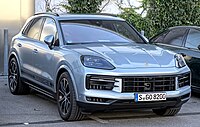 2024 Porsche Cayenne S
 -
 2024 Porsche Cayenne Coupé S
 -
 2024 Porsche Cayenne E-Hybrid
 -
 2024 Porsche Cayenne Turbo E-Hybrid
 -
 2024 Porsche Cayenne Turbo GT


Powertrain
[edit]SC = With Sport Chrono Package
| Model | Production | Engine | Power at rpm | CO2 emissions | Acceleration 0–100 km/h (0–62 mph) |
|---|---|---|---|---|---|
| Cayenne | 2018–2023 | 2,995 cc (3.0 L; 182.8 cu in) turbo V6 | 340 PS (250 kW; 335 hp) at 5,300-6,400, 450 N⋅m (332 lb⋅ft) at 1,340 - 5,300 | 265 g/km | 6.2 seconds
(SC: 5.9 seconds) |
| Cayenne (facelift) | 2023–present | 2,995 cc (3.0 L; 182.8 cu in) turbo V6 | 353 PS (260 kW; 348 hp) at 5,400-6,400, 500 N⋅m (369 lb⋅ft) at 1,450 - 4,500 | 6.0 seconds
(SC: 5.7 seconds) | |
| Cayenne E-Hybrid | 2018–2023 | 2,995 cc (3.0 L; 182.8 cu in) turbo V6 PHEV | 462 PS (340 kW; 456 hp) at 5,300-6,400, 700 N⋅m (516 lb⋅ft) at 1,340 - 5,300 | 88 g/km | 5.0 seconds |
| Cayenne E-Hybrid
(facelift) |
2023–present | 2,995 cc (3.0 L; 182.8 cu in) turbo V6 PHEV | 470 PS (346 kW; 464 hp) at 5,400-6,400, 650 N⋅m (479 lb⋅ft) at 1,400 - 4,800 | 4.9 seconds | |
| Cayenne S | 2018–2023 | 2,894 cc (2.9 L; 176.6 cu in) twin turbo V6 | 440 PS (324 kW; 434 hp) at 5,700-6,600, 549 N⋅m (405 lb⋅ft) at 1,800 - 5,500 | 267 g/km | 4.9 seconds
(SC: 4.6 seconds)[60] |
| Cayenne S (facelift) | 2023–present | 3,996 cc (4.0 L; 243.9 cu in) twin turbo V8 | 475 PS (349 kW; 469 hp) at 6000, 600 N⋅m (443 lb⋅ft) at 2,000 - 5,000 | 5.0 seconds
(SC: 4.7 seconds) | |
| Cayenne S E-Hybrid (facelift) | 2023–present | 2,995 cc (3.0 L; 182.8 cu in) turbo V6 PHEV | 519 PS (382 kW; 512 hp) at 5,000 - 6,500, 750 N⋅m (553 lb⋅ft) at 1,450 - 4,500 | 4.7 seconds | |
| Cayenne GTS | 2020–2023 | 3,996 cc (4.0 L; 243.9 cu in) twin turbo V8 | 460 PS (338 kW; 454 hp) at 6,000 - 6,500, 620 N⋅m (457 lb⋅ft) at 1,800 - 4,500 | 301 g/km | 4.8 seconds
(SC: 4.5 seconds) |
| Cayenne GTS (facelift) | 2024–present | 3,996 cc (4.0 L; 243.9 cu in) twin turbo V8 | 500 PS (368 kW; 493 hp), 660 N⋅m (487 lb⋅ft) | 303 g/km | 4.7 seconds
(SC: 4.4 seconds) |
| Cayenne Turbo | 2018–2023 | 3,996 cc (4.0 L; 243.9 cu in) twin turbo V8 | 549 PS (404 kW; 541 hp) at 5,750 - 6,000, 770 N⋅m (568 lb⋅ft) at 2,000 - 4,500 | 309 g/km | 4.1 seconds
(SC: 3.9 seconds) |
| Cayenne Turbo S E-Hybrid | 2019–2023 | 3,996 cc (4.0 L; 243.9 cu in) twin turbo V8 PHEV | 680 PS (500 kW; 671 hp) at 5,750 - 6,000, 900 N⋅m (664 lb⋅ft) at 2,100 - 4,500 | 110 g/km | 3.6 seconds |
| Cayenne Turbo E-Hybrid (facelift) | 2023–present | 3,996 cc (4.0 L; 243.9 cu in) twin turbo V8 PHEV | 739 PS (544 kW; 729 bhp) at 5,750 - 6,000, 950 N⋅m (701 lb⋅ft) at 1,400 - 5,500 | 111 g/km | SC: 3.5 seconds |
| Cayenne Turbo GT | 2021–2023 | 3,996 cc (4.0 L; 243.9 cu in) twin turbo V8 | 640 PS (471 kW; 631 bhp), 850 N⋅m (627 lb⋅ft) | 271 g/km | 3.3 seconds |
| Cayenne Turbo GT (facelift) | 2023–present | 3,996 cc (4.0 L; 243.9 cu in) twin turbo V8 | 659 PS (485 kW; 650 bhp), 849 N⋅m (626 lb⋅ft) | 3.1 seconds |
Safety
[edit]| Test | Points | % |
|---|---|---|
| Overall: | 
| |
| Adult occupant: | 36.2 | 95% |
| Child occupant: | 39.6 | 80% |
| Pedestrian: | 30.8 | 73% |
| Safety assist: | 7.5 | 62% |
Records
[edit]In June 2021, a Porsche Cayenne Turbo GT lapped 7:38:925 at Nürburgring Nordschleife. The car was driven by test driver Lars Kern.[62]
Mechanical issues
[edit]The Porsche Cayenne is known for some mechanical issues. This includes the failure of the center drive shaft carrier bearing. Cayenne engines using Lokasil or Alusil engine blocks, with exception of the VW-based VR6 six-cylinder engine which has a cast iron block, can suffer from cylinder bore scoring as well.[63] Early V8 Cayenne models came equipped with plastic coolant pipes that would crack and fail, possibly causing the engine to overheat. Subsequent Cayenne S and Turbo engines were fitted with upgraded aluminum coolant pipes to rectify this issue. 958 Cayenne models except Hybrid and V6 Diesel suffer with transfer case problems, and Porsche issued a 10-year warranty on 958.1 (2011–2014) and a 7-year warranty on 958.2 (2015–2018), both with unlimited mileage.[64]
In popular culture
[edit]In 2021, a Chinese manufacturer introduced the Changan Uni-K, which bears a striking resemblance to the Porsche Cayenne, especially from the rear and side profiles. The car was sold for approximately 21,000 euros.[65]
References
[edit]- ^ Canada (27 February 2014). "Porsche Macan: An SUV in name only". The Globe and Mail. Archived from the original on 19 May 2014. Retrieved 17 November 2016.
- ^ Custard, Ben (30 January 2023). "Porsche Cayenne review". Auto Express. Archived from the original on 7 April 2023. Retrieved 7 April 2023.
- ^ Adams, Eric (30 October 2017). "2019 Porsche Cayenne Review: Porsche Adds a Little Pepper to its SUV". The Drive. Archived from the original on 3 December 2022. Retrieved 7 April 2023.
- ^ Silvestro, Brian (15 May 2019). "2020 Porsche Cayenne Coupe Looks Like a Big Macan". Road and Track. Archived from the original on 23 May 2022. Retrieved 7 April 2023.
- ^ "Porsche Cayenne". 25 June 2024.
- ^ "2023 Porsche Cayenne".
- ^ "Facelifted Porsche Cayenne revealed ahead of Paris motor show launch". Autocar. 23 July 2014. Archived from the original on 31 July 2018. Retrieved 28 July 2014.
- ^ "Porsche Cayenne 955 - The Story". stuttcars.com. 15 September 2021. Archived from the original on 25 November 2022. Retrieved 24 November 2022.
- ^ "How the first Porsche Cayenne was designed". MotorAuthority.com. 24 July 2022. Archived from the original on 25 November 2022. Retrieved 24 November 2022.
- ^ "2004 Porsche Cayenne Review". JB car pages. Archived from the original on 4 May 2019. Retrieved 3 April 2011.
- ^ "Porsche Cayenne turns 20 - and it's ageing like fine wine". news24. 30 May 2022. Retrieved 15 June 2023.
- ^ a b "2004 Porsche Cayenne Specs". JB car pages. Archived from the original on 20 July 2012. Retrieved 3 April 2011.
- ^ "Porsche Cayenne GTS at the Chicago Auto Show". Automoblog.net. 15 February 2008. Archived from the original on 28 August 2008. Retrieved 3 October 2010.
- ^ "2008 Porsche Cayenne Specs". JB car pages. Archived from the original on 20 July 2012. Retrieved 3 April 2011.
- ^ Tan, Paul. "Porsche Cayenne TDI diesel in February 2009". Paultan.org. Archived from the original on 9 June 2009. Retrieved 3 October 2010.
- ^ Abuelsamid, Sam (19 February 2009). "Geneva Preview: Porsche to publicly debut Cayenne diesel". Autobloggreen.com. Archived from the original on 23 February 2009. Retrieved 3 October 2010.
- ^ Nunez, Alex (15 April 2007). "Porsche Cayenne S Transsyberia: factory-built rally machine". Autoblog.com. Archived from the original on 5 September 2008. Retrieved 3 October 2010.
- ^ Neff, John (8 September 2008). "Paris Preview: Porsche Cayenne S Transsyberia special edition". Autoblog.com. Archived from the original on 12 September 2008. Retrieved 3 October 2010.
- ^ "New Porsche Cayenne GTS Porsche Design Edition 3". Porsche.com. 25 March 2009. Archived from the original on 3 October 2011. Retrieved 3 October 2010.
- ^ Neff, John (25 March 2009). "Limited-edition Cayenne GTS Porsche Design Edition 3 to hit the streets". Autoblog.com. Archived from the original on 29 March 2009. Retrieved 3 October 2010.
- ^ "Open-top one-off: why there has only been one Cayenne convertible". Porsche Newsroom. 8 April 2022. Retrieved 10 April 2024.
- ^ "2027 Porsche K1 spy shots: Electric SUV with third-row seats coming". Motor Authority. 2 April 2024. Retrieved 10 April 2024.
- ^ "2017 Porsche Cayenne 2nd-gen. phase-II SUV (model 92A) all versions specifications and performance data". Automobile Catalog. Retrieved 17 January 2024.
- ^ "2008 Porsche Cayenne Review". JB car pages. Archived from the original on 19 July 2012. Retrieved 3 April 2011.
- ^ a b c "2011 Porsche Cayenne Specs & Features". JB car pages. Archived from the original on 20 July 2012. Retrieved 3 April 2011.
- ^ "2011 Porsche Cayenne Review". JB car pages. Archived from the original on 20 July 2012. Retrieved 3 April 2011.
- ^ Cayenne S or Turbo? - Page 2 - MBWorld.org Forums says (16 March 2009). "2010 Porsche Cayenne SUV - SPY SHOTS". StreetCars. Retrieved 9 July 2009.
{{cite web}}: CS1 maint: numeric names: authors list (link)[permanent dead link] - ^ "2011 Porsche Cayenne Hybrid Specs & Features". JB car pages. Archived from the original on 11 October 2012. Retrieved 3 April 2011.
- ^ "Porsche Dynamic Chassis Control (PDCC) - Chassis - Cayenne Turbo - Dr. Ing. h.c. F. Porsche AG". Porsche AG - Dr. Ing. h.c. F. Porsche AG. Archived from the original on 31 December 2014. Retrieved 31 December 2014.
- ^ "Cayenne S Diesel: a measure of efficiency". Archived from the original on 2 February 2014. Retrieved 12 September 2012.
- ^ "2013 Porsche Cayenne Turbo S model confirmed". autoweek.com. 10 October 2012. Archived from the original on 13 October 2012. Retrieved 12 October 2012.
- ^ "PORSCHE CAYENNE HYBRID OFFICIEEL AANGEKONDIGD". Autowereld. 19 September 2005. Archived from the original on 18 January 2021. Retrieved 9 January 2020.
- ^ "PORSCHE CAYENNE HYBRID IN PROTOTYPE-FASE". Autowereld. 31 July 2007. Archived from the original on 18 January 2021. Retrieved 9 January 2020.
- ^ "Look: Porsche Cayenne Hybrid". Edmunds. 6 August 2007. Archived from the original on 22 September 2008. Retrieved 3 October 2010.
- ^ "Porsche Cayenne S Hybrid". Auto Express. 3 April 2010. Archived from the original on 11 November 2014. Retrieved 28 July 2014.
- ^ "2011 Porsche Cayenne S Hybrid on Sale in November". Insideline.com. 28 October 2010. Archived from the original on 31 December 2010. Retrieved 24 April 2011.
- ^ Porsche Press Release (24 July 2014). "Porsche introducing new plug-in Cayenne S E-Hybrid SUV; third plug-in from Porsche". Green Car Congress. Archived from the original on 27 July 2014. Retrieved 27 July 2014.
- ^ Martin Achter (24 July 2014). "Neuer Porsche Cayenne kommt im Oktober" [New Porsche Cayenne comes in October]. KFZ-Betrieb (in German). Archived from the original on 11 November 2014. Retrieved 27 July 2014.
- ^ Jay Cole (3 December 2014). "November 2014 Plug-In Electric Vehicle Sales Report Card". InsideEVs.com. Archived from the original on 9 December 2014. Retrieved 4 December 2014.
- ^ U. S. Environmental Protection Agency and U.S. Department of Energy (5 December 2014). "Compare Side-by-Side - 2015 Porsche Cayenne S E-Hybrid, 2015 Porsche Cayenne Diesel, 2015 Porsche Cayenne S and 2015 Porsche Cayenne Turbo". Fueleconomy.gov. Archived from the original on 10 December 2014. Retrieved 5 December 2014.
- ^ Tadeo, Patrick Everett (2 May 2017). "Porsche Cayenne tows Airbus A380 to set Guinness World Record". Carmudi/Yahoo! News. Archived from the original on 3 May 2017. Retrieved 3 May 2017.
- ^ "Watch a Porsche Cayenne tow an Airbus A380, earn a world record - Roadshow". Roadshow. Archived from the original on 6 May 2017. Retrieved 8 May 2017.
- ^ a b https://sk.volkswagen.sk/content/dam/companies/sk_vw_slovakia/podnik/vyrocne_spravy/annual_report_2017.pdf [bare URL PDF]
- ^ "Porsche presents the new "Made in Slovakia" Cayenne". spectator.sme.sk. 31 August 2017. Archived from the original on 15 January 2018. Retrieved 14 January 2018.
- ^ "The new Cayenne: firmer design and larger wheels". newsroom.porsche.com. Porsche. 29 August 2017. Archived from the original on 15 December 2019. Retrieved 2 March 2023.
- ^ a b Porsche (29 August 2017). "World premiere of the new Cayenne in Zuffenhausen". Porsche. Archived from the original on 30 August 2017. Retrieved 30 August 2017.
- ^ a b "2019 Porsche Cayenne First Look Review". MotorTrend. 29 August 2017. Retrieved 23 April 2023.
- ^ "This Really Is The New Porsche Cayenne, Honest". Car Throttle. 30 August 2017. Retrieved 23 April 2023.
- ^ "LES VENTES DE PORSCHE EN BAISSE CE TRIMESTRE". autoplus. 15 April 2022.
- ^ "Cayenne S Coupé Technical Data" (PDF). Porsche AG. Retrieved 23 April 2023.
- ^ "Porsche Cayenne Coupe Debuts As Prettiest Crossover Coupe Yet". Motor1.com. Retrieved 23 April 2023.
- ^ "The new Porsche Cayenne should be even better to drive". Top Gear. 29 August 2017. Retrieved 23 April 2023.
- ^ "2019 Porsche Cayenne Turbo debuts in Frankfurt with 550 hp". Autoblog. 12 September 2017. Retrieved 23 April 2023.
- ^ Sheehan, Sam (1 May 2018). "Porsche Cayenne E-Hybrid launched with 456bhp electrified powertrian". Autocar. Retrieved 26 April 2023.
- ^ "Crazy-Quick Porsche Cayenne Turbo S E-Hybrid Packs 670 Horsepower". Car and Driver. 12 August 2019. Retrieved 23 April 2023.
- ^ "The New 2021 Porsche Cayenne GTS and Cayenne GTS Coupe". AP NEWS. 20 December 2021. Retrieved 23 April 2023.
- ^ Droppa, Denis (30 June 2021). "Cayenne Turbo GT is Porsche's new top gun". businesslive. Archived from the original on 9 July 2021. Retrieved 1 July 2021.
- ^ a b "2024 Porsche Cayenne facelift debuts - 3.0L V6 base and hybrid, 4.0L V8 Cayenne S; EU drops Turbo GT - paultan.org". Paul Tan's Automotive News. 19 April 2023. Retrieved 23 April 2023.
- ^ "2024 Porsche Cayenne Revealed: More, More, More!". Car and Driver. 18 April 2023. Retrieved 19 April 2023.
- ^ "Press kit: Cayenne S and Cayenne Turbo". porsche.com. Porsche. Retrieved 6 October 2024.
- ^ "Euro NCAP – Porsche Cayenne 3.0 diesel, LHD (2017)". euroncap.com. Retrieved 12 August 2018. Report
- ^ "Porsche Cayenne performance variant breaks record for fastest SUV around Nürburgring". Financialexpress. Retrieved 23 April 2023.
- ^ "Cayenne Bore Scoring".
- ^ Swann, Richard (17 September 2020). "Porsche Extends Transfer Case Warranty for Cayenne & Macan". PcarWise. Retrieved 7 June 2024.
- ^ "Changan Uni-K, le faux Porsche Cayenne chinois à 20 500 euros". motor1.
Bibliography
[edit]- Becker, Clauspeter; Warter, Stefan (2002). Porsche Cayenne. Bielefeld: Delius Klasing Verlag. ISBN 3-7688-1403-3. (in English)
- Chapman, Giles (2005). SUV: The World's Greatest Sport Utility Vehicles. London: Merrell Publishers. ISBN 1858942748.
- Gabriel, Andreas (2014). Porsche Cayenne: Bestseller Story (in German). Berlin: BMB Berlin Motor Books. ISBN 9783981459296.
- Henshaw, Peter (2005). The Ultimate Guide to SUVs and Off-Road Vehicles. Edison, NJ, USA: Chartwell Books. ISBN 0785818200.
- Kittler, Eberhard (2005). Deutsche Autos [German Cars] (in German). Vol. Offroader und SUV - seit [since] 1945. Stuttgart: Motorbuch Verlag. ISBN 361302490X.
- Ludvigsen, Karl (2019). Porsche: Excellence Was Expected – Book 3: Comeback (1982-2008) (All new ed.). Cambridge, MA, USA: Bentley Publishers. ISBN 9780837617725.
- ——————— (2019). Porsche: Excellence Was Expected – Book 4: 21st Century (2002-2020) (All new ed.). Cambridge, MA, USA: Bentley Publishers. ISBN 9780837617732.
- Lowney, Damon (22 March 2017). "Model Guide: First-generation Cayenne — 2003-2010". www.pca.org. Porsche Club of America. Archived from the original on 27 September 2021. Retrieved 27 September 2021.
- Morris, Raymond. "2014 Porsche Cayenne Platinum Edition Review". izmoStudio. Archived from the original on 9 November 2014. Retrieved 24 August 2014.
External links
[edit]
| Volkswagen Group marques & companies | |||||||
|---|---|---|---|---|---|---|---|
| Cars |
| ||||||
| Tractors | |||||||
| Motorsport |
| ||||||
| Engines and technologies | |||||||
| People |
| ||||||
| See also | |||||||


- Porsche vehicles
- Cars introduced in 2002
- 2010s cars
- 2020s cars
- Sport utility vehicles
- Luxury sport utility vehicles
- All-wheel-drive vehicles
- Cars powered by VR engines
- Hybrid sport utility vehicles
- Euro NCAP large off-road
- Plug-in hybrid vehicles
- Partial zero-emissions vehicles
- Vehicles with four-wheel steering