


Saffron (color)
| Saffron | |
|---|---|
 Color coordinates Color coordinates | |
| Hex triplet | #F4C430 |
| sRGBB (r, g, b) | (244, 196, 48) |
| HSV (h, s, v) | (45°, 80%, 96%) |
| CIELChuv (L, C, h) | (81, 90, 63°) |
| Source | Maerz and Paul[1] |
| ISCC–NBS descriptor | Vivid yellow |
| B: Normalized to [0–255] (byte) | |
| Rajah | |
|---|---|
| Color coordinates | |
| Hex triplet | #FBAB60 |
| sRGBB (r, g, b) | (251, 171, 96) |
| HSV (h, s, v) | (29°, 62%, 98%) |
| CIELChuv (L, C, h) | (76, 83, 42°) |
| Source | [Unsourced] |
| ISCC–NBS descriptor | Moderate orange |
| B: Normalized to [0–255] (byte) | |
| Deep saffron (Bhagwa) | |
|---|---|
| Colour coordinates | |
| Hex triplet | #FF9933 |
| sRGBB (r, g, b) | (255, 153, 51) |
| HSV (h, s, v) | (30°, 80%, 100%) |
| CIELChuv (L, C, h) | (72, 105, 37°) |
| Source | [Unsourced] |
| ISCC–NBS descriptor | Strong orange |
| B: Normalized to [0–255] (byte) | |
| India saffron (Kesara/Kesariya) | |
|---|---|
| Colour coordinates | |
| Hex triplet | #FF7722 |
| sRGBB (r, g, b) | (255, 119, 34) |
| HSV (h, s, v) | (23°, 87%, 100%) |
| CIELChuv (L, C, h) | (65, 125, 26°) |
| Source | Vexillological: |
| ISCC–NBS descriptor | Strong orange |
| B: Normalized to [0–255] (byte) | |
Saffron is a shade of yellow or orange, the colour of the tip of the saffron crocus thread, from which the spice saffron is derived.[2] The hue of the spice saffron is primarily due to the carotenoid chemical crocin.
Etymology[edit]
The word saffron ultimately derives (via Arabic) from the Middle Iranian ja'far-. The name was used for the saffron spice in Middle English from c. 1200. As a colour name, it dates to the late 14th century.[3]
Deep saffron approximates the colour of India saffron (also known as bhagwa or kesari).[4][5]
In Rajasthani, this colour is called kesariya. The word derives its name from kesar, the Hindustani name for saffron, an important crop in Kashmir.
Religion[edit]
The color Saffron (Hindi: भगवा, romanized: Bhagawā) is considered as a sacred color in Hinduism. According to Hindu mythology, Saffron (or Kesariya) is the color of Sunset (Sandhya) and Fire (Agni) which symbolises sacrifice, light, and quest of salvation.[6] The color is worn by Hindu saints and ascetics as their devotion toward the religion.[7] Many Hindu kingdoms and dynasties had Saffron color in their flag denoting the Sanātana Dharma, including Maratha Empire.
Hinduism, Jainism and Buddhism associate saffron with the pious renunciation of material life.[8][9][10]
Buddhist monks in the Theravada tradition typically wear saffron robes (although occasionally maroon — the color normally worn by Vajrayana Buddhist monks — is worn). The tone of saffron typically worn by Theravada Buddhist monks is the lighter tone of saffron shown above.
Saffron holds symbolic meaning in Sikhism, representing spirit and sacrifice.[11] Originally a shade of yellow called basanti, the field of the modern Nishan Sahib is saffron.[11][12] Turbans worn by Sikhs most often are blue or white,[13] but basanti colour is common.[11][14]
-
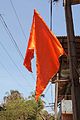 Bhagwa colour flag, used by Hindus
 -
 Flag of the Sikh religion, the Nishan Sahib.
 -

-
 Hindu ascetic


.JPG)
Political & religious uses[edit]


In politics, it was used by the Indian independence movement, and it was chosen as one of the three colours of the Indian national flag after independence in 1947, and is used by Hindus.[15] India saffron, representing courage and sacrifice, was chosen for one of the three bands of the National Flag of India, along with white (peace and truth) and what is now called India green (faith and chivalry).[16][17] The Flag of India is officially described in the Flag Code of India as follows:
The colour of the top panel shall be India saffron (Kesari) and that of the bottom panel shall be India green. The middle panel shall be white, bearing at its centre the design of Ashoka Chakra in navy blue colour with 24 equally spaced spokes.[18]
Sarvepalli Radhakrishnan, who later became India's first Vice President and second President, described the significance of the Indian National Flag as follows:
Bhagwa or the saffron colour denotes renunciation or disinterestedness. Our leaders must be indifferent to material gains and dedicate themselves to their work. The white in the centre is light, the path of truth to guide our conduct. The green shows our relation to (the) soil, our relation to the plant life here, on which all other life depends. The "Ashoka Chakra" in the centre of the white is the wheel of the law of dharma. Truth or satya, dharma or virtue ought to be the controlling principle of those who work under this flag. Again, the wheel denotes motion. There is death in stagnation. There is life in movement. India should no more resist change, it must move and go forward. The wheel represents the dynamism of a peaceful change.[19]
The use of saffron in the national flag and as political symbolism has been opposed.[8] One line of opposition asserts that the color is sacred and should not be politicized.[8] Another source of opposition comes from Islamists who claim the color is forbidden in Islam and strongly prohibited to be worn by the males.[8][20]
Basanti turbans are associated with the Khalistan movement in the Punjab region of Pakistan and India.[11] Even otherwise Basanti turbans are commonly used by Sikhs and not all wearing Basanti turban should be associated with separatist movement.
Because Therevada Buddhist monks were at the forefront of the 2007 Burmese anti-government protests, the uprising has been referred to as the Saffron Revolution by some in the international media.[21][22]
Hindu nationalism[edit]


The saffron flag (bhagwa dhwaj) of the medieval Hindu warrior Shivaji was held in high esteem by the Hindu Mahasabha and Rashtriya Swayamsevak Sangh (RSS) in the 1920s as a representative of Hindu resurgence and militaristic tradition. The saffron flag was the "true guru" to which Hedgewar demanded obeisance from the RSS members. "The Gerva [saffron] Flag shall be the flag of the Hindu nation. With its Om, the Swastik and the Sword, it appeals to the sentiments cherished by our race since the Vaidik [Vedic] days," he said.[23]
The Bharatiya Jana Sangh and its successor Bharatiya Janata Party (BJP) both used saffron as their colour. The BJP used a saffron lotus on its flag, along with a green side band that possibly reflected accommodation with Islam.[24] The Vishva Hindu Parishad (VHP), a Hindu religious body affiliated to the RSS, also used saffron as its predominant colour, with its ascetic leaders clad in saffron robes and the lay leaders wearing saffron scarves.[25] During the Ram Janmabhoomi movement in the 1990s, the VHP and its affiliate Bajrang Dal distributed saffron flags and saffron headbands to their followers by the millions.[26][27][28]
The predominance of the saffron symbolism in the BJP and its allies led to the BJP being referred to as the 'saffron party' in the 1990s, and the term 'saffronisation' came to be used describe the increasing influence of Hindu nationalism in party politics. This period saw phrases such as the "saffronisation of the coastal belt",[29] "saffronisation of Karnataka"[30] and "saffronisation of the Congress(I)".[31] Academic and non-academic scholars wrote books with titles involving 'saffron' to refer to Hindu nationalism: Brotherhood in Saffron,[32] Khaki Shorts and Saffron Flags,[33] The Saffron Wave,[34] and The Saffron Swastika.[35]
Clothing[edit]
Saffron-coloured cloth had a history of use among the Gaelic-Irish. A saffron kilt is worn by the pipers of certain Irish regiments in the British Army, and the saffron léine in the defence forces of the Republic of Ireland. The latter garment is also worn by some Irish and Irish-American men as an item of national costume (though most wear kilts, believing them to be Irish). Its colour varies from a true saffron orange to a range of dull mustard and yellowish-brown hues.
The Antrim GAA teams are nicknamed "The Saffrons" because of the saffron-coloured kit which they play in. The Old Irish word for saffron, cróc,[36] derives directly from the Latin Crocus sativus. In Ireland between the 14th and 17th centuries, men wore léinte (singular léine),[37] loose saffron-coloured shirts that reached down to mid-thigh or the knee.[38] (see Irish clothing).
Literature[edit]
The colour saffron is associated with the goddess of dawn (Eos in Greek mythology and Aurora in Roman mythology) in classical literature:

Now when Dawn in robe of saffron was hastening from the streams of Okeanos, to bring light to mortals and immortals, Thetis reached the ships with the armor that the god had given her. (19.1)
Aurora now had left her saffron bed,
And beams of early light the heav'ns o'erspread,
When, from a tow'r, the queen, with wakeful eyes,
Saw day point upward from the rosy skies.
Other media[edit]
- The lyrics of Donovan's 1966 song, "Mellow Yellow" repeat the line, "I'm just mad about Saffron".[41]
- In the Pokémon franchise, in the region of Kanto there is a city named Saffron City.
- The Gates is a site-specific art installation by Christo and Jeanne-Claude. The artists installed 7,503 metal "gates" along 23 miles (37 km) of pathways in Central Park in New York City. From each gate hung a flag-shaped piece of deep saffron-coloured nylon fabric. The exhibit ran from February 12, 2005, through February 27, 2005.
- Saffron Monsoon is a character in Absolutely Fabulous.
In nature[edit]


Plants
- Byzantine meadow saffron (Colchicum × byzantinum) is a hybrid flowering plant.
- Cape saffron (Cassine peragua) is a flowering tree with saffron-coloured bark.
- Cobra saffron (Mesua ferrea) is a tree found in southern Asia.
- Meadow saffron (Colchicum autumnale) is a flowering plant found in Europe.
- Mediterranean meadow saffron (Colchicum cupanii) is a flowering plant found in central Mediterranean basin.
- Saffron buckwheat (Eriogonum crocatum) is a species of wild buckwheat endemic to the Conejo Valley.
- Saffron spice is derived from the flowers of the plant named saffron crocus (Crocus sativus).
- Saffron plum (Sideroxylon celastrinum) is a flowering plant found in North, Central, and South America.
- Saffron thistle (Carthamus lanatus) is a thistle native to the Mediterranean basin.
- Spring meadow saffron (Colchicum bulbocodium) is a flowering alpine plant found in Europe.
- Steven's meadow saffron (Colchicum stevenii) is a flowering plant found in the eastern Mediterranean.
Birds
_male.JPG)
- The saffron-billed sparrow (Arremon flavirostris) is a bird found in South America.
- The saffron-breasted prinia (Prinia hypoxantha) is a passerine bird found in eastern South Africa and Swaziland.
- The saffron-crested tyrant-manakin (Neopelma chrysocephalum) is a bird found in the Guianas, southern Venezuela, and the northwestern Amazon basin.
- The saffron-crowned tanager (Tangara xanthocephala) is a bird found in the montane forests of South America.
- The saffron-headed parrot (Pyrilia pyrilia) is a parrot found in the montane forests of South America.
- The saffron finch (Sicalis flaveola) is a tanager from South America, and is common in both open and semi-open areas in lowlands outside the Amazon basin.
- The saffron siskin (Spinus siemiradzkii) is a finch found in Ecuador and Peru.
- The saffron toucanet (Pteroglossus bailloni) is a toucan from South American's Atlantic Forest.
Aquatic animals

- The saffron cod (Eleginus gracilis) is a commercially harvested fish in the North Pacific.
- The saffron-coloured clam (Tridacna crocea) is a bivalve found in the Indo-Pacific region.
- The saffron shiner (Notropis rubricroceus) is a fish found in Tennessee River drainage.
Amphibians
- The saffron-bellied frog (Chaperina fusca) is a frog found in the Malay Peninsula, Borneo, and the Philippines.
Insects
.jpg)
- The saffron-winged meadowhawk (Sympetrum costiferum) is a dragonfly found in North America.
- The saffron beetle (Calosoma schayeri) is a beetle found in Australia.
- The saffron sapphire (Iolaus pallene) is a butterfly found in Africa.
- The saffron skipper (Poanes aaroni) is a skipper found in North America.
Fungi
- False saffron milkcap (Lactarius deterrimus) is a fungus found in Europe and Asia.
- Saffron milk cap (Lactarius deliciosus) is an edible fungus found in Europe.
- Saffron ringless amanita (Amanita crocea) is a Amantia found in Europe.
Viruses
- The Saffron Scourge is another name for yellow fever.[42]
See also[edit]
- Saffron, spice of the saffron crocus
- History of saffron
- RAL 1017 Saffron yellow
- List of colours
- Saffron Type System, an anti-aliased text-rendering engine
References[edit]
- ^ The colour displayed in the colour box above matches the colour called saffron in the 1930 book by Maerz and Paul A Dictionary of Colour New York:1930 McGraw-Hill; the colour saffron is displayed on page 43 Plate 10, Colour Sample K8.
- ^ Oxford Living Dictionaries On-Line. Webster's New World Dictionary of the American Language (1962)
- ^ Maerz and Paul A Dictionary of Colour New York:1930 McGraw-Hill Page 203; Colour Sample of Saffron: Page 43 Plate 10 Colour Sample K8
- ^ "History of Indian Flag". Archived from the original on December 11, 2011. Retrieved December 17, 2011.
- ^ "Indian Standards" (PDF). Bureau of Indian Standards. Archived from the original (PDF) on 11 September 2008. Retrieved 2 November 2011.
- ^ "Why do Indian saints wear saffron colour? Science tells us!". The Times of India. 2018-03-22. Retrieved 2022-08-24.
- ^ "Significance of Saffron color in Hinduism". Beauty of India. 9 June 2018.
- ^ a b c d Ragini Sen; Wolfgang Wagner; Caroline Howarth (30 September 2013). Secularism and Religion in Multi-faith Societies: The Case of India. Springer Science & Business Media. pp. 37–38. ISBN 978-3-319-01922-2.
- ^ Peggy Froerer (23 July 2019). Religious Division and Social Conflict: The Emergence of Hindu Nationalism in Rural India. Taylor & Francis. ISBN 978-1-351-37812-3.
- ^ "Colour Symbolism in Hinduism". 18 July 2021. Archived from the original on 11 August 2021. Retrieved 18 July 2021.
- ^ a b c d Opinderjit Kaur Takhar (5 December 2016). Sikh Identity: An Exploration of Groups Among Sikhs. Taylor & Francis. p. 88. ISBN 978-1-351-90010-2.
- ^ Kartar Singh Bhalla (2002). Let's Know Sikhism: A Religion of Harmony, Brotherhood and Tolerance. Star Publications. p. 40. ISBN 978-81-7650-055-5.
- ^ "Learn How to Tie Different Sikh Turbans". 21 May 2008.
- ^ Pashaura Singh (18 April 2019). A Dictionary of Sikh Studies. OUP Oxford. p. 78. ISBN 978-0-19-250843-0.
- ^ Krishna, Subhash (2020-07-19). Salvation by Lord Shri Krishna. Notion Press. ISBN 978-1-64587-108-8.
- ^ "Flag of India". Encyclopædia Britannica. Encyclopædia Britannica Online. 2009. Retrieved 2 July 2009.
- ^ "My India My Pride - Indian Tricolor - Know India: National Portal of India". Archived from the original on August 13, 2017.
- ^ "Flag Code of India" (PDF). Mha.gov.in. Archived from the original (PDF) on 2013-01-23. Retrieved 2016-02-27.
- ^ "Flag Code of India" (PDF). Ministry of Home Affairs (India). Archived from the original (PDF) on 21 January 2013. Retrieved 2 November 2011.
- ^ Imaam Ahmad and Ibn Maajah, 3591
- ^ "Burmese Days". Timesonline.co.uk. Retrieved 2016-02-27. (subscription required)
- ^ Lloyd Parry, Richard (24 September 2007). "Nuns join monks in Burma's Saffron Revolution". The Times. London. Retrieved 10 April 2009.
Which meant that to the public the Monks and their religion played an important role throughout the protests. Along with the monks were nuns, students and activists who were protesting during the revolution.
- ^ Bapu, Prabhu (2013), Hindu Mahasabha in Colonial North India, 1915-1930: Constructing Nation and History, Routledge, p. 99, ISBN 978-0415671651
- ^ Marty, Martin E.; Appleby, R. Scott; Sciences, American Academy of Arts and (1 July 1994), Fundamentalisms Observed, University of Chicago Press, pp. 573–, ISBN 978-0-226-50878-8
- ^ Katju, Manjari (2003), Vishva Hindu Parishad and Indian Politics, Orient Blackswan, pp. 40–, ISBN 978-81-250-2476-7
- ^ Basu, Amrita (30 June 2015), Violent Conjunctures in Democratic India, Cambridge University Press, pp. 93–, ISBN 978-1-107-08963-1
- ^ Varadarajan, Siddharth (2002), Gujarat, the Making of a Tragedy, Penguin Books India, pp. 85–, ISBN 978-0-14-302901-4
- ^ Dossani, Rafiq; Rowen, Henry S. (2005), Prospects for Peace in South Asia, Stanford University Press, pp. 190–, ISBN 978-0-8047-5085-1
- ^ Assadi 1996.
- ^ Assadi 1998.
- ^ Venkitesh Ramakrishnan (1 November 1997). "A Pyrrhic victory?". Frontline. Vol. 14, no. 22. Retrieved 2014-11-08.
- ^ Andersen, Walter K.; Damle, Shridhar D. (1987) [Originally published by Westview Press], The Brotherhood in Saffron: The Rashtriya Swayamsevak Sangh and Hindu Revivalism, Delhi: Vistaar Publications
- ^ Basu, Tapan; Sarkar, Tanika (1993), Khaki Shorts and Saffron Flags: A Critique of the Hindu Right, Orient Longman, ISBN 0863113834
- ^ Hansen, Thomas Blom (1999), The Saffron Wave: Democracy and Hindu Nationalism in Modern India, Princeton University Press, ISBN 9781400823055
- ^ Elst, Koenraad (2001), The Saffron Swastika: The Notion of "Hindu Fascism", Voice of India, ISBN 978-81-85990-69-9
- ^ "saffron - Translation to Irish Gaelic with audio pronunciation of translations for saffron by New English-Irish Dictionary". www.focloir.ie. Retrieved Jan 5, 2021.
- ^ "shirt - Translation to Irish Gaelic with audio pronunciation of translations for shirt by New English-Irish Dictionary". www.focloir.ie. Retrieved Jan 5, 2021.
- ^ "An Leine Crioch — The Irish Leine in the 16th century – Reconstructing History". Mar 12, 2016. Archived from the original on 2016-03-12. Retrieved Jan 5, 2021.
- ^ Next Page. "The Iliad - Free Online Book". Publicliterature.org. Archived from the original on 2010-03-16. Retrieved 2016-02-27.
- ^ The Aeneid by Virgil - Free Ebook. 1995-03-01. Retrieved 2016-02-27 – via Gutenberg.org.
- ^ Donavan. "Mellow Yellow". Archived from the original on April 23, 2008. Retrieved May 20, 2008.
- ^ Jo Ann Carrigan (15 December 2015). The Saffron Scourge: A History of Yellow Fever in Louisiana, 1796-1905. University of Louisiana at Lafayette Press. ISBN 978-1-935754-48-0.