


Softmax function
| Part of a series on |
| Machine learning and data mining |
|---|
The softmax function, also known as softargmax[1]: 184 or normalized exponential function,[2]: 198 converts a vector of K real numbers into a probability distribution of K possible outcomes. It is a generalization of the logistic function to multiple dimensions, and used in multinomial logistic regression. The softmax function is often used as the last activation function of a neural network to normalize the output of a network to a probability distribution over predicted output classes.
Definition
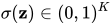
[edit]The softmax function takes as input a vector z of K real numbers, and normalizes it into a probability distribution consisting of K probabilities proportional to the exponentials of the input numbers. That is, prior to applying softmax, some vector components could be negative, or greater than one; and might not sum to 1; but after applying softmax, each component will be in the interval , and the components will add up to 1, so that they can be interpreted as probabilities. Furthermore, the larger input components will correspond to larger probabilities.

Formally, the standard (unit) softmax function , where , takes a vector and computes each component of vector with



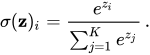
In words, the softmax applies the standard exponential function to each element of the input vector (consisting of real numbers), and normalizes these values by dividing by the sum of all these exponentials. The normalization ensures that the sum of the components of the output vector is 1. The term "softmax" derives from the amplifying effects of the exponential on any maxima in the input vector. For example, the standard softmax of is approximately , which amounts to assigning almost all of the total unit weight in the result to the position of the vector's maximal element (of 8).



In general, instead of e a different base b > 0 can be used. As above, if b > 1 then larger input components will result in larger output probabilities, and increasing the value of b will create probability distributions that are more concentrated around the positions of the largest input values. Conversely, if 0 < b < 1 then smaller input components will result in larger output probabilities, and decreasing the value of b will create probability distributions that are more concentrated around the positions of the smallest input values. Writing or [a] (for real β)[b] yields the expressions:[c]



A value proportional to the reciprocal of β is sometimes referred to as the temperature: , where k is typically 1 or the Boltzmann constant and T is the temperature. A higher temperature results in a more uniform output distribution (i.e. with higher entropy; it is "more random"), while a lower temperature results in a sharper output distribution, with one value dominating.

In some fields, the base is fixed, corresponding to a fixed scale,[d] while in others the parameter β (or T) is varied.
Interpretations
[edit]Smooth arg max
[edit]The Softmax function is a smooth approximation to the arg max function: the function whose value is the index of a vector's largest element. The name "softmax" may be misleading. Softmax is not a smooth maximum (that is, a smooth approximation to the maximum function). The term "softmax" is also used for the closely related LogSumExp function, which is a smooth maximum. For this reason, some prefer the more accurate term "softargmax", though the term "softmax" is conventional in machine learning.[3][4] This section uses the term "softargmax" for clarity.
Formally, instead of considering the arg max as a function with categorical output (corresponding to the index), consider the arg max function with one-hot representation of the output (assuming there is a unique maximum arg): where the output coordinate if and only if is the arg max of , meaning is the unique maximum value of . For example, in this encoding since the third argument is the maximum.





This can be generalized to multiple arg max values (multiple equal being the maximum) by dividing the 1 between all max args; formally 1/k where k is the number of arguments assuming the maximum. For example, since the second and third argument are both the maximum. In case all arguments are equal, this is simply Points z with multiple arg max values are singular points (or singularities, and form the singular set) – these are the points where arg max is discontinuous (with a jump discontinuity) – while points with a single arg max are known as non-singular or regular points.


With the last expression given in the introduction, softargmax is now a smooth approximation of arg max: as , softargmax converges to arg max. There are various notions of convergence of a function; softargmax converges to arg max pointwise, meaning for each fixed input z as , However, softargmax does not converge uniformly to arg max, meaning intuitively that different points converge at different rates, and may converge arbitrarily slowly. In fact, softargmax is continuous, but arg max is not continuous at the singular set where two coordinates are equal, while the uniform limit of continuous functions is continuous. The reason it fails to converge uniformly is that for inputs where two coordinates are almost equal (and one is the maximum), the arg max is the index of one or the other, so a small change in input yields a large change in output. For example, but and for all inputs: the closer the points are to the singular set , the slower they converge. However, softargmax does converge compactly on the non-singular set.




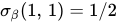

Conversely, as , softargmax converges to arg min in the same way, where here the singular set is points with two arg min values. In the language of tropical analysis, the softmax is a deformation or "quantization" of arg max and arg min, corresponding to using the log semiring instead of the max-plus semiring (respectively min-plus semiring), and recovering the arg max or arg min by taking the limit is called "tropicalization" or "dequantization".

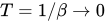
It is also the case that, for any fixed β, if one input is much larger than the others relative to the temperature, , the output is approximately the arg max. For example, a difference of 10 is large relative to a temperature of 1: However, if the difference is small relative to the temperature, the value is not close to the arg max. For example, a difference of 10 is small relative to a temperature of 100: As , temperature goes to zero, , so eventually all differences become large (relative to a shrinking temperature), which gives another interpretation for the limit behavior.



Probability theory
[edit]In probability theory, the output of the softargmax function can be used to represent a categorical distribution – that is, a probability distribution over K different possible outcomes.
Statistical mechanics
[edit]In statistical mechanics, the softargmax function is known as the Boltzmann distribution (or Gibbs distribution):[5]: 7 the index set are the microstates of the system; the inputs are the energies of that state; the denominator is known as the partition function, often denoted by Z; and the factor β is called the coldness (or thermodynamic beta, or inverse temperature).

Applications
[edit]The softmax function is used in various multiclass classification methods, such as multinomial logistic regression (also known as softmax regression),[2]: 206–209 [6] multiclass linear discriminant analysis, naive Bayes classifiers, and artificial neural networks.[7] Specifically, in multinomial logistic regression and linear discriminant analysis, the input to the function is the result of K distinct linear functions, and the predicted probability for the jth class given a sample vector x and a weighting vector w is:
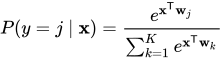
This can be seen as the composition of K linear functions and the softmax function (where denotes the inner product of and ). The operation is equivalent to applying a linear operator defined by to vectors , thus transforming the original, probably highly-dimensional, input to vectors in a K-dimensional space .



Neural networks
[edit]The standard softmax function is often used in the final layer of a neural network-based classifier. Such networks are commonly trained under a log loss (or cross-entropy) regime, giving a non-linear variant of multinomial logistic regression.
Since the function maps a vector and a specific index to a real value, the derivative needs to take the index into account:

This expression is symmetrical in the indexes and thus may also be expressed as


Here, the Kronecker delta is used for simplicity (cf. the derivative of a sigmoid function, being expressed via the function itself).
To ensure stable numerical computations subtracting the maximum value from the input vector is common. This approach, while not altering the output or the derivative theoretically, enhances stability by directly controlling the maximum exponent value computed.
If the function is scaled with the parameter , then these expressions must be multiplied by .

See multinomial logit for a probability model which uses the softmax activation function.
Reinforcement learning
[edit]In the field of reinforcement learning, a softmax function can be used to convert values into action probabilities. The function commonly used is:[8]
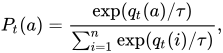
where the action value corresponds to the expected reward of following action a and is called a temperature parameter (in allusion to statistical mechanics). For high temperatures (), all actions have nearly the same probability and the lower the temperature, the more expected rewards affect the probability. For a low temperature (), the probability of the action with the highest expected reward tends to 1.


Computational complexity and remedies
[edit]In neural network applications, the number K of possible outcomes is often large, e.g. in case of neural language models that predict the most likely outcome out of a vocabulary which might contain millions of possible words.[9] This can make the calculations for the softmax layer (i.e. the matrix multiplications to determine the , followed by the application of the softmax function itself) computationally expensive.[9][10] What's more, the gradient descent backpropagation method for training such a neural network involves calculating the softmax for every training example, and the number of training examples can also become large. The computational effort for the softmax became a major limiting factor in the development of larger neural language models, motivating various remedies to reduce training times.[9][10]
Approaches that reorganize the softmax layer for more efficient calculation include the hierarchical softmax and the differentiated softmax.[9] The hierarchical softmax (introduced by Morin and Bengio in 2005) uses a binary tree structure where the outcomes (vocabulary words) are the leaves and the intermediate nodes are suitably selected "classes" of outcomes, forming latent variables.[10][11] The desired probability (softmax value) of a leaf (outcome) can then be calculated as the product of the probabilities of all nodes on the path from the root to that leaf.[10] Ideally, when the tree is balanced, this would reduce the computational complexity from to .[11] In practice, results depend on choosing a good strategy for clustering the outcomes into classes.[10][11] A Huffman tree was used for this in Google's word2vec models (introduced in 2013) to achieve scalability.[9]


A second kind of remedies is based on approximating the softmax (during training) with modified loss functions that avoid the calculation of the full normalization factor.[9] These include methods that restrict the normalization sum to a sample of outcomes (e.g. Importance Sampling, Target Sampling).[9][10]
Mathematical properties
[edit]Geometrically the softmax function maps the vector space to the boundary of the standard -simplex, cutting the dimension by one (the range is a -dimensional simplex in -dimensional space), due to the linear constraint that all output sum to 1 meaning it lies on a hyperplane.

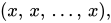
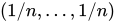
Along the main diagonal softmax is just the uniform distribution on outputs, : equal scores yield equal probabilities.
More generally, softmax is invariant under translation by the same value in each coordinate: adding to the inputs yields , because it multiplies each exponent by the same factor, (because ), so the ratios do not change:
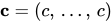




Geometrically, softmax is constant along diagonals: this is the dimension that is eliminated, and corresponds to the softmax output being independent of a translation in the input scores (a choice of 0 score). One can normalize input scores by assuming that the sum is zero (subtract the average: where ), and then the softmax takes the hyperplane of points that sum to zero, , to the open simplex of positive values that sum to 1, analogously to how the exponent takes 0 to 1, and is positive.


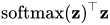
By contrast, softmax is not invariant under scaling. For instance, but


The standard logistic function is the special case for a 1-dimensional axis in 2-dimensional space, say the x-axis in the (x, y) plane. One variable is fixed at 0 (say ), so , and the other variable can vary, denote it , so the standard logistic function, and its complement (meaning they add up to 1). The 1-dimensional input could alternatively be expressed as the line , with outputs and







The softmax function is also the gradient of the LogSumExp function, a smooth maximum:

where the LogSumExp function is defined as .

History
[edit]The softmax function was used in statistical mechanics as the Boltzmann distribution in the foundational paper Boltzmann (1868),[12] formalized and popularized in the influential textbook Gibbs (1902).[13]
The use of the softmax in decision theory is credited to R. Duncan Luce,[14]: 1 who used the axiom of independence of irrelevant alternatives in rational choice theory to deduce the softmax in Luce's choice axiom for relative preferences.[citation needed]
In machine learning, the term "softmax" is credited to John S. Bridle in two 1989 conference papers, Bridle (1990a):[14]: 1 and Bridle (1990b):[3]
We are concerned with feed-forward non-linear networks (multi-layer perceptrons, or MLPs) with multiple outputs. We wish to treat the outputs of the network as probabilities of alternatives (e.g. pattern classes), conditioned on the inputs. We look for appropriate output non-linearities and for appropriate criteria for adaptation of the parameters of the network (e.g. weights). We explain two modifications: probability scoring, which is an alternative to squared error minimisation, and a normalised exponential (softmax) multi-input generalisation of the logistic non-linearity.[15]: 227
For any input, the outputs must all be positive and they must sum to unity. ...
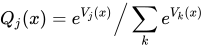
Given a set of unconstrained values, , we can ensure both conditions by using a Normalised Exponential transformation: This transformation can be considered a multi-input generalisation of the logistic, operating on the whole output layer. It preserves the rank order of its input values, and is a differentiable generalisation of the 'winner-take-all' operation of picking the maximum value. For this reason we like to refer to it as softmax.[16]: 213

Example
[edit]With an input of (1, 2, 3, 4, 1, 2, 3), the softmax is approximately (0.024, 0.064, 0.175, 0.475, 0.024, 0.064, 0.175). The output has most of its weight where the "4" was in the original input. This is what the function is normally used for: to highlight the largest values and suppress values which are significantly below the maximum value. But note: a change of temperature changes the output. When the temperature is multiplied by 10, the inputs are effectively (0.1, 0.2, 0.3, 0.4, 0.1, 0.2, 0.3) and the softmax is approximately (0.125, 0.138, 0.153, 0.169, 0.125, 0.138, 0.153). This shows that high temperatures de-emphasize the maximum value.
Computation of this example using Python code:
>>> import numpy as np
>>> z = np.array([1.0, 2.0, 3.0, 4.0, 1.0, 2.0, 3.0])
>>> beta = 1.0
>>> np.exp(beta * z) / np.sum(np.exp(beta * z))
array([0.02364054, 0.06426166, 0.1746813, 0.474833, 0.02364054,
       0.06426166, 0.1746813])
Alternatives
[edit]The softmax function generates probability predictions densely distributed over its support. Other functions like sparsemax or α-entmax can be used when sparse probability predictions are desired.[17]
See also
[edit]- Softplus
- Multinomial logistic regression
- Dirichlet distribution – an alternative way to sample categorical distributions
- Partition function
- Exponential tilting – a generalization of Softmax to more general probability distributions
Notes
[edit]- ^ Positive β corresponds to the maximum convention, and is usual in machine learning, corresponding to the highest score having highest probability. The negative −β corresponds to the minimum convention, and is conventional in thermodynamics, corresponding to the lowest energy state having the highest probability; this matches the convention in the Gibbs distribution, interpreting β as coldness.
- ^ The notation β is for the thermodynamic beta, which is inverse temperature: ,
- ^ For (coldness zero, infinite temperature), , and this becomes the constant function , corresponding to the discrete uniform distribution.
- ^ In statistical mechanics, fixing β is interpreted as having coldness and temperature of 1.



References
[edit]- ^ Goodfellow, Ian; Bengio, Yoshua; Courville, Aaron (2016). "6.2.2.3 Softmax Units for Multinoulli Output Distributions". Deep Learning. MIT Press. pp. 180–184. ISBN 978-0-26203561-3.
- ^ a b Bishop, Christopher M. (2006). Pattern Recognition and Machine Learning. Springer. ISBN 0-387-31073-8.
- ^ a b Sako, Yusaku (2018-06-02). "Is the term "softmax" driving you nuts?". Medium.
- ^ Goodfellow, Bengio & Courville 2016, pp. 183–184: The name "softmax" can be somewhat confusing. The function is more closely related to the arg max function than the max function. The term "soft" derives from the fact that the softmax function is continuous and differentiable. The arg max function, with its result represented as a one-hot vector, is not continuous nor differentiable. The softmax function thus provides a "softened" version of the arg max. The corresponding soft version of the maximum function is . It would perhaps be better to call the softmax function "softargmax," but the current name is an entrenched convention.
- ^ LeCun, Yann; Chopra, Sumit; Hadsell, Raia; Ranzato, Marc’Aurelio; Huang, Fu Jie (2006). "A Tutorial on Energy-Based Learning" (PDF). In Gökhan Bakır; Thomas Hofmann; Bernhard Schölkopf; Alexander J. Smola; Ben Taskar; S.V.N Vishwanathan (eds.). Predicting Structured Data. Neural Information Processing series. MIT Press. ISBN 978-0-26202617-8.
- ^ "Unsupervised Feature Learning and Deep Learning Tutorial". ufldl.stanford.edu. Retrieved 2024-03-25.
- ^ ai-faq What is a softmax activation function?
- ^ Sutton, R. S. and Barto A. G. Reinforcement Learning: An Introduction. The MIT Press, Cambridge, MA, 1998. Softmax Action Selection
- ^ a b c d e f g Onal, Kezban Dilek; Zhang, Ye; Altingovde, Ismail Sengor; Rahman, Md Mustafizur; Karagoz, Pinar; Braylan, Alex; Dang, Brandon; Chang, Heng-Lu; Kim, Henna; McNamara, Quinten; Angert, Aaron (2018-06-01). "Neural information retrieval: at the end of the early years". Information Retrieval Journal. 21 (2): 111–182. doi:10.1007/s10791-017-9321-y. hdl:11245.1/008d6e8f-df13-4abf-8ae9-6ff2e17377f3. ISSN 1573-7659. S2CID 21684923.
- ^ a b c d e f Chen, Wenlin; Grangier, David; Auli, Michael (August 2016). "Strategies for Training Large Vocabulary Neural Language Models". Proceedings of the 54th Annual Meeting of the Association for Computational Linguistics (Volume 1: Long Papers). Berlin, Germany: Association for Computational Linguistics: 1975–1985. arXiv:1512.04906. doi:10.18653/v1/P16-1186. S2CID 6035643.
- ^ a b c Morin, Frederic; Bengio, Yoshua (2005-01-06). "Hierarchical Probabilistic Neural Network Language Model" (PDF). International Workshop on Artificial Intelligence and Statistics. PMLR: 246–252.
- ^ Boltzmann, Ludwig (1868). "Studien über das Gleichgewicht der lebendigen Kraft zwischen bewegten materiellen Punkten" [Studies on the balance of living force between moving material points]. Wiener Berichte. 58: 517–560.
- ^ Gibbs, Josiah Willard (1902). Elementary Principles in Statistical Mechanics.
- ^ a b Gao, Bolin; Pavel, Lacra (2017). "On the Properties of the Softmax Function with Application in Game Theory and Reinforcement Learning". arXiv:1704.00805 [math.OC].
- ^ Bridle, John S. (1990a). Soulié F.F.; Hérault J. (eds.). Probabilistic Interpretation of Feedforward Classification Network Outputs, with Relationships to Statistical Pattern Recognition. Neurocomputing: Algorithms, Architectures and Applications (1989). NATO ASI Series (Series F: Computer and Systems Sciences). Vol. 68. Berlin, Heidelberg: Springer. pp. 227–236. doi:10.1007/978-3-642-76153-9_28.
- ^ Bridle, John S. (1990b). D. S. Touretzky (ed.). Training Stochastic Model Recognition Algorithms as Networks can Lead to Maximum Mutual Information Estimation of Parameters. Advances in Neural Information Processing Systems 2 (1989). Morgan-Kaufmann.
- ^ "Speeding Up Entmax" by Maxat Tezekbayev, Vassilina Nikoulina, Matthias Gallé, Zhenisbek Assylbekov, https://arxiv.org/abs/2111.06832v3
Differentiable computing | |||||||
|---|---|---|---|---|---|---|---|
| General | |||||||
| Concepts | |||||||
| Applications | |||||||
| Hardware | |||||||
| Software libraries | |||||||
| Implementations |
| ||||||
| People | |||||||
| Organizations | |||||||
| Architectures |
| ||||||
| |||||||

