


Stolperstein


A Stolperstein (pronounced [ˈʃtɔlpɐˌʃtaɪn] ⓘ; plural Stolpersteine) is a ten-centimetre (3.9 in) concrete cube bearing a brass plate inscribed with the name and life dates of victims of Nazi extermination or persecution. Literally, it means 'stumbling stone' and metaphorically 'stumbling block'.
The Stolpersteine project, initiated by the German artist Gunter Demnig in 1992, aims to commemorate persons at the last place that they chose freely to reside, work or study (with exceptions possible on a case-by-case basis) before they fell victim to Nazi terror, forced euthanasia, eugenics, deportation to a concentration or extermination camp, or escaped persecution by emigration or suicide.[1] As of June 2023[update], 100,000[2] Stolpersteine have been laid, making the Stolpersteine project the world's largest decentralized memorial.[3][4]
The majority of Stolpersteine commemorate Jewish victims of the Holocaust.[5] Others have been placed for Sinti and Romani people (then also called "gypsies"), Poles, homosexuals, the physically or mentally disabled, Jehovah's Witnesses, black people, members of the Communist Party, the Social Democratic Party, and the anti-Nazi Resistance, the Christian opposition (both Protestants and Catholics), and Freemasons, along with International Brigade soldiers in the Spanish Civil War, military deserters, conscientious objectors, escape helpers, capitulators, "habitual criminals", looters, and others charged with treason, military disobedience, or undermining the Nazi military, as well as Allied soldiers.
Origin of the name
The name of the Stolpersteine project invokes multiple allusions. In Nazi Germany, an antisemitic saying, when accidentally stumbling over a protruding stone, was: "A Jew must be buried here".[6][7] In a metaphorical sense, the German term Stolperstein can mean "potential problem".[8] The term "to stumble across something", in German and English, can also mean "to find out (by chance)".[9] Thus, the term provocatively invokes an antisemitic remark of the past, but at the same time intends to provoke thoughts about a serious issue. Stolpersteine are not placed prominently, but are rather discovered by chance, only recognizable when passing by at close distance. In contrast to central memorial places, which according to Demnig can be easily avoided or bypassed, Stolpersteine represent a much deeper intrusion of memory into everyday life.
Stolpersteine are placed right into the pavement. When Jewish cemeteries were destroyed throughout Nazi Germany, the gravestones were often repurposed as sidewalk paving stones. The desecration of the memory of the dead was implicitly intended, as people had to walk on the gravestones and tread on the inscriptions. The Stolpersteine provocatively hint at this act of desecration, as they lack any kind of defense against new acts of shame. While the art project thus intends to keep alive the memory, implying that improper acts could easily happen again, the intentional lack of defense against potential desecration also created criticism and concern. Some German cities like Munich still do not accept the setting of Stolpersteine, and look for alternative ways of commemoration instead.[10]
"Here lived ..."

Research about future Stolperstein locations is usually done by local school children and their teachers, victims' relatives, or local history organizations. The database of Yad Vashem in Jerusalem[11] and the online database of the Mapping the Lives publication of the 1939 Germany Minority Census are used to search for names and residential addresses of Nazi victims.[12]
When research on a particular person is completed, Demnig sets out to manufacture an individual Stolperstein. The person's name and dates of birth, deportation and death, if known, are engraved into the brass plate. The words Hier wohnte ... ('Here lived ...') are written on most of the plates, emphasizing that the victims of persecution did not live and work at any anonymous place, but "right here". The Stolperstein is then inserted at flush level into the roadway or sidewalk, at the individual's last known place of freely chosen residence or work, with the intention to "trip up the passer-by" and draw attention to the memorial.[13]
The costs of Stolpersteine are covered by individual donations, local public fund raising, contemporary witnesses, school classes, or community funds. From the beginning of the project until 2012, one Stolperstein cost €95.[14][15] In 2012, the price increased to €120.[16] Each individual Stolperstein is still manufactured by hand, so that only about 440 of them can be produced per month. Today, it may take up to several months from the application for a new Stolperstein until it is finally installed.[17]
Starting in 2005, Michael Friedrichs-Friedländer has partnered with Gunter Demnig to install about 63,000 Stolpersteine in 20 different languages.[18] Friedrichs-Friedländer explained to a reporter that he has not changed the engraving process and all engraving continues to be completed by hand; this is purposeful, to prevent the process from becoming anonymous.[18]
First Stolperstein
.jpg)

On 16 December 1992, 50 years had passed since Heinrich Himmler had signed the so-called Auschwitz-Erlass ('Auschwitz decree'), ordering the deportation of Sinti and Roma to extermination camps. This order marks the beginning of the mass deportation of Jews from Germany. To commemorate this date, Gunter Demnig traced the "road to deportation" by pulling a self-built, rolling pavement-printing machine through the inner city to the train station, where the deportees had boarded the trains to the extermination camps. Afterward, he installed the first Stolperstein in front of Cologne's historic City Hall. On its brass plate were engraved the first lines of the Auschwitz decree.[19] Demnig also intended to contribute to the debate, ongoing at that time, about granting the right of residence in Germany to Roma people who had fled from former Yugoslavia.
Gradually, the idea arose of expanding the commemoration project to include all victims of Nazi persecution, as well as always doing so at the last places of residence which they were free to choose. A Stolperstein would symbolically bring back the victims to their neighbourhoods, to the places where they rightfully belonged, even many years after they had been deported. Gunter Demnig published further details of his project in 1993, and outlined his artistic concept in a contribution to the project Größenwahn – Kunstprojekte für Europa ('Megalomania: Art Projects for Europe'). In 1994, he exhibited 250 Stolpersteine for murdered Sinti and Roma at St Anthony's Church in Cologne, encouraged by Kurt Pick, the parish priest. This church, located prominently in Cologne city centre, was already serving as an important commemorative institution, and is part of the Cross of Nails community since 2016.[20] In January 1995, these Stolpersteine were brought to different locations in the city of Cologne, and laid into the pavements.[21]
Another 55 Stolpersteine were set up in the Kreuzberg neighborhood of Berlin in 1996, during the "Artists Research Auschwitz" project.[13] In 1997, the first two Stolpersteine were laid in St. Georgen, Austria, commemorating Jehovah's Witnesses Matthias and Johann Nobis. This had been suggested by Andreas Maislinger, founder of Arts Initiative KNIE and the Austrian Holocaust Memorial Service. Friedrich Amerhauser was the first mayor who granted permission to install Stolpersteine within his city.[22] Four years later, Demnig received permission to install 600 more Stolpersteine in Cologne.
Growth

By October 2007, Gunter Demnig had laid more than 13,000 Stolpersteine in more than 280 cities. He expanded his project beyond the borders of Germany to Austria, Italy, the Netherlands and Hungary. Some Stolpersteine were scheduled to be laid in Poland on 1 September 2006, but permission was withdrawn, and the project was cancelled.
On 24 July 2009, the 20,000th Stolperstein was unveiled in the Rotherbaum district of Hamburg, Germany.[23] Gunter Demnig, representatives of the Hamburg government and its Jewish community, and descendants of the victims attended. By May 2010, more than 22,000 Stolpersteine had been set in 530 European cities and towns, in eight countries which had formerly been under Nazi control or occupied by Nazi Germany.[24][25]
By July 2010 the number of Stolpersteine had risen to more than 25,000, in 569 cities and smaller towns.[15] By June 2011 Demnig had installed 30,000 Stolpersteine.[26]
In 2013 Gunter Demnig stated on his website:[27]
There are already over 32,000 Stolpersteine in over 700 locations. Many cities and villages across Europe, not only in Germany, have expressed an interest in the project. Stones have already been laid in many places in Austria, Hungary, the Netherlands, Belgium, in the Czech Republic, in Poland (seven in Wrocław, one in Słubice), in Ukraine (Pereiaslav), in Italy (Rome) and Norway (Oslo).
— stolpersteine.com
During a talk at TEDxKoeln on 14 May 2013, Gunter Demnig announced the installation of the 40,000th Stolperstein, which had taken place in Oldambt (Drieborg), Netherlands, on 3 July 2013. It was one of the first 10 Stolpersteine in memory of Dutch communists who were executed by the German occupation forces after their betrayal by countrymen for hiding Jews and Roma.[28][29][30]
On 11 January 2015, the 50,000th Stolperstein was installed in Torino, Italy, for Eleonora Levi.[31]
On 23 October 2018, the 70,000th Stolperstein was installed in Frankfurt, Germany, for Willy Zimmerer, a victim of Nazi euthanasia who was murdered at Hadamar on 18 December 1944, when he was 43 years old.[32]
On 29 December 2019, the 75,000th Stolperstein was installed in Memmingen for Martha and Benno Rosenbaum.[33]
On 26 May 2023, the 100,000th Stolperstein was installed in Nuremberg for Johann Wild, a firefighter.[34]
Locations

Stolpersteine are always installed at the last place that the person chose freely to reside, work or study, with exceptions possible on a case-by-case basis.[1] The most important source for potential locations is the so-called Judenkartei ('Jews register'), which was set up at the 1939 census of Germany as of 17 May 1939.[35] In cases where the actual houses were destroyed during World War II or during later restructuring of the cities, some Stolpersteine have been installed at the former site of the house.
By the end of 2016, Gunter Demnig and his co-workers had installed about 60,000 stones in more than 1,200 towns and cities throughout Europe:[36][37]
- Germany (since 1992)
- Austria (since 1997)
- The Netherlands and Hungary (since 2007)
- Poland and Czech Republic (since 2008)
- Belgium and Ukraine (since 2009)
- Italy (since 2010)
- Norway (since 2011)
- Slovakia and Slovenia (since 2012)
- France, Croatia, Luxemburg, Russia and Switzerland (since 2013)
- Romania (since 2014)
- Greece and Spain[38] (since 2015)
- Belarus (since 2014)
- Lithuania (since 2016).
- Finland (since 2018)[39]
- Moldova (since 2018)[40]
- Denmark and Sweden (since 2019)
- Serbia (since 2021)
Netherlands
Since 2007, Demnig has frequently been invited to place Stolpersteine in the Netherlands. The first city to do so was Borne. As of 2016, 82 Stolpersteine have been installed there. By January 2016, in total, more than 2,750 Stolpersteine have been laid in 110 Dutch cities and townships, including Amsterdam, The Hague and Rotterdam, but particularly in smaller cities like Hilversum (92 Stolpersteine), Gouda (183), Eindhoven (244), Oss and Oudewater (263 each).[citation needed] In March 2016 Demnig was in the Netherlands again, placing stones in Hilversum, Monnickendam, and Gouda, and Amsterdam. In the latter city he placed 74 stones; 250 had already been placed, and there were requests for 150 more.[41]
Czech Republic
In the Czech Republic, the work on Stolpersteine started on 8 October 2008 in Prague[5] and was initiated by the Czech Union of Jewish Students.[42] Today, Stolpersteine are found across almost the entire area of the country. As of January 2016 the exact number of Stolpersteine has not yet been established, but the main work was done in the larger cities, including Prague, Brno, Olomouc and Ostrava. In the small cities of Tišnov there are 15, and in Lomnice u Tišnova nine Stolpersteine. One of them commemorates Hana Brady, who was murdered at the age of 13. Since 2010, a Stolperstein in Třeboň also commemorates her father.
Italy


Work in Italy began in Rome on 28 January 2010; there are now 207 Stolpersteine (in Italian called "pietre d'inciampo") there. In 2012, work continued in the regions of Liguria, Trentino-Alto Adige/Südtirol and Lombardia. Veneto and Tuscany joined in 2014, Emilia-Romagna in 2015, Apulia, Abruzzo and Friuli-Venezia Giulia in 2016, Marche in 2017. In Italy, marked differences are observed, as compared to other countries: many Stolpersteine are dedicated not only to Jewish people and members of the political resistance, but also to soldiers of the Italian army who were disarmed, deported to Germany, and had to work as forced laborers there. They were given special status, so that they were not protected as prisoners of war under the Geneva Conventions after Italy left the coalition of the Axis powers after 8 September 1943.
France
In France where 75,000 Jews were deported to the concentration camps, initial efforts to install Stolpersteine were rejected. Notably, after a year-long campaign in 2011 led by a schoolgirl, Sarah Kate Francis, in the coastal town of La Baule-Escoublac (where 32 Jewish residents, including eight children, were deported), the councillor in charge of relations with patriotic organisations, Xavier de Zuchowicz, refused to allow a request for Stolpersteine to be installed, claiming that to do so might infringe the French constitutional principles of secularism ("laïcité") and freedom of opinion ("liberté d'opinion") and that they would therefore need to consult the Conseil d'État, France's constitutional court.[44] In fact, Stolpersteine contain no reference to the religion of the victim who is commemorated, and 'freedom of opinion/expression' has never been invoked in either French or European jurisprudence to justify the refusal to commemorate individual victims of war crimes. The Mayor of La Baule has consistently refused to elaborate on his reasoning, and there is no record of the Municipal Council of La Baule having sought a declaration from the Conseil d'Etat in respect of these objections.
The first Stolpersteine were installed in France in 2015 in L'Aiguillon-sur-Mer in the Vendée.
Other countries
.jpg)
Stolpersteine have also been installed in Spain, Sweden, Switzerland and the United Kingdom, though these countries were never occupied. Stolpersteine in Switzerland mostly remember people who were caught smuggling illegal written material at the German border. In Spain, a large number of Republicans who fled to France after Francisco Franco's victory were caught by the Nazis after they had invaded France, and were either handed over to the Vichy regime, or deported to Mauthausen-Gusen concentration camp. About 7,000 Spanish people were held prisoner there, and were subjected to forced labour; more than half of them were murdered. The survivors were denationalized by the Franco regime, and became stateless persons, who were denied any form of recognition as victims, and deprived of any reparation. In Sweden, since 2019, the few Stolpersteine remember Jewish refugees who escaped there only to be captured by German spies and taken to the camps.
In Helsinki, Finland, there are seven Stolpersteine to honor Austrian Jewish refugees who had arrived to the country but who were given over to the Gestapo in November 1942. They were taken to Auschwitz and only one of the eight people survived.[45]
In Dublin, Ireland, six Stolpersteine (unveiled in 2022) commemorate six Irish Jews who were murdered in the Holocaust: Ettie Steinberg, her Belgian-born husband Wojtech Gluck and their son Leon Gluck, who were all murdered at Auschwitz in 1942; Isaac Shishi, killed at Viekšniai, Lithuania in 1941; and siblings Ephraim and Jeanne (Lena) Saks, murdered at Auschwitz in 1944.[46] Shishi and the Sakses were all born in Dublin but moved to continental Europe before war broke out.[47]
.jpg)
In November 2022 the first Stolperstein in the UK was installed in Golden Square, Soho, London, commemorating Ada von Dantzig, who was murdered at Auschwitz in 1943 after she returned to the Netherlands, to rescue her family, who also became victims.[48]
Even in countries where no Stolpersteine are installed, such as the United States, the decentralized monument of the Stolpersteine has attracted media attention.[49]
Stolperschwellen: "From here..."

In special cases, Demnig also installs his so-called "Stolperschwellen" ('stumbling thresholds'), measuring 100 by 10 centimetres (39 by 4 in), which serve to commemorate entire groups of victims, where there are too many individuals to remember at one single place. The text usually starts with the words: "Von hier aus..." ('From here...'). Stolperschwellen are installed at Stralsund main station. From there, 1,160 mentally ill persons were deported in December 1939, victims of the forced euthanasia program Action T4, and murdered in Wielka Piaśnica.
Other Stolperschwellen commemorate female forced labourers from Geißlingen, who were imprisoned in the Natzweiler-Struthof concentration camp, the victims of the Holocaust in Luxemburg in Ettelbrück, forced laborers in Glinde and Völklingen, victims of forced euthanasia in Merseburg, and the first deportees, Roma and Sinti from Cologne. Further Stolperschwellen exist in Bad Buchau, Berlin-Friedenau, Nassau, another in Stralsund, and one in Weingarten. A Stolperschwelle was set up in Thessaloniki in front of the house in which Alois Brunner and Adolf Eichmann had planned the deportation and annihilation of 96.5% of the Jewish population of the town.
Public discussion
Opposition
The city of Villingen-Schwenningen heatedly debated the idea of allowing Stolpersteine in 2004, but voted against them.[50] There is a memorial at the railway station and there are plans for a second memorial.[51]
Unlike many other German cities, the city council of Munich in 2004 rejected the installation of Stolpersteine on public property, following objections raised by Munich's Jewish community (and particularly its chairwoman, Charlotte Knobloch, then also President of the Central Council of Jews in Germany, and herself a former victim of Nazi persecution). She objected to the idea that the names of murdered Jews be inserted in the pavement, where people might accidentally step on them. The vice president of the Central Council, Salomon Korn, however, warmly welcomed the idea at the same time. Christian Ude, then mayor of Munich, warned against an "inflation of monuments". Demnig also took part in the discussion, stating that "he intends to create a memorial at the very place where the deportation started: at the homes where people had lived last".[52] The rejection was reconsidered and upheld in 2015; other ways of commemoration, like plaques on the walls of individual houses, and a central memorial displaying the names of the people deported from Munich, will be set up.[53][54] The city's rejection of participation in the project only affects public property, however. As of 2020 around a hundred Stolpersteine have been installed on private property.[52]
In other cities, permission for the project was preceded by long and sometimes emotional discussions. In Krefeld, the vice-chairman of the Jewish community, Michael Gilad, said that Demnig's memorials reminded him of how the Nazis had used Jewish gravestones as slabs for sidewalks.[10] A compromise was reached that a Stolperstein could be installed if a prospective site was approved by both the house's owner and (if applicable) the victim's relatives.[55] The city of Pulheim denied permission to install a Stolperstein for 12-year-old Ilse Moses, who was deported from Pulheim and murdered by the Nazi regime. The majority in the city council, CDU and FDP, opposed the project and prevented it.[56] Starting in 2009, 23 Stolpersteine for the Belgian city of Antwerp have been produced; however, owing to local resistance to the project, they have been unable to be installed. They have been stored in Brussels, where they are regularly exhibited.[57]
The Polish Institute of National Remembrance (IPN) has expressed reservations towards the project, noting that the form of the memorial, particularly its location on regular sidewalks, which are regularly stomped over by passersby, is not respectful. Another criticism from IPN has concerned inadequate level of detail provided on Stolpersteine, such as lack of context clarifying that most of the perpetrators of the Holocaust were Germans and not Poles. IPN officials have repeatedly suggested that instead of Stolpersteine, the more respectful, informative and traditional form of remembrance that the IPN is willing to support instead takes the form of larger memorial plaques on the walls of nearby buildings.[58][59][60][61]
Support
The majority of German cities welcome the installation of Stolpersteine. In Frankfurt am Main, which had a long tradition of Jewish life before the Holocaust, the 1000th Stolperstein was set in May 2015,[62] and newspapers publish progress reports and invitations for citizens to sponsor further memorial stones. In Frankfurt, the victim's descendants are not allowed to sponsor Stolpersteine; these have to be paid for by the current inhabitants of the house, ensuring that they will respect the monument.[63]
Reactions of passers-by
People's attention is drawn towards the Stolpersteine by reports in newspapers and their personal experience. Their thoughts are directed towards the victims.[24][64][65][66] Cambridge historian Joseph Pearson argues that "It is not what is written [on the stolpersteine] which intrigues, because the inscription is insufficient to conjure a person. It is the emptiness, void, lack of information, the maw of the forgotten, which gives the monuments their power and lifts them from the banality of a statistic."[67]
Development of a commemorative tradition

Often the installation of a new Stolperstein is announced in local newspapers or on the cities' official websites and is accompanied by a remembrance gathering. Citizens, school children and relatives of the persons who are commemorated on the plates are invited to take part.[68] Often the citizens state that they are motivated by the idea that "they were our neighbours", and that they wish to remember the victims' names, or, symbolically, allow the deported to return to the place where they rightfully belong.[69] If the person remembered on the plate was Jewish, their descendants are invited to attend the installation of the stone, and pray Kaddish, if they wish to do so.[70]
Stolpersteine are installed in places where they are exposed to all kinds of climatic conditions, dust and dirt. As the brass material of the plates is subject to superficial corrosion, it will become dull over time if it is not cleaned from time to time. Demnig recommends regular cleaning of the plates.[71] Many regional initiatives have set up schedules for cleaning and acts of remembrance, when Stolpersteine are adorned with flowers or candles. Often remembrance days are chosen for these activities:
- 27 January, International Holocaust Remembrance Day.[72][73]
- Yom HaShoah, 27 Nisan (April-May)
- 12 June, birthday of Anne Frank[74][75]
- 9 November, the German Kristallnacht Remembrance Day[76]
Documentary film
A documentary, Stolperstein, was made by Dörte Franke in 2008.[77]
Gallery
-

-
 Stolperstein for Max and Olga Mayer in Heidelberg
 -

-
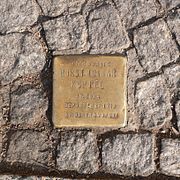 Stolperstein for Horst Lothar Koppel in Berlin
 -
 Stolpersteine for Hertha and Alexander Adam, Berlin-Friedrichshain
 -
 Stolpersteine for Růžena Lindtová and Rudolf Pick in Prague
 -
 Stolpersteine for the Weissfisch family in Bratislava
 -
 Stolpersteine for people with disabilities in Vorarlberg
 -
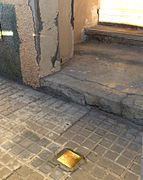 Stolperstein for Josep Soler Torrens in Spain
 -

-
 Stolperstein for Kaszás Andor in Budapest
 -
 Stolpersteine for murdered schoolboys in Thessaloniki
 -
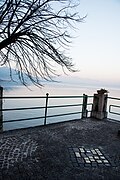 Stolpersteine for the victims of the massacre of Meina
 -
 Stolpersteine for the Pollack family in Amsterdam
 -
 Stolpersteine for the Heidenheim family in Cologne


.jpg)


Stolpersteine in different countries
- Austria: Stolpersteine in the district of Braunau am Inn
- Belgium: Stolpersteine in Charleroi
- Czech Republic: Prague: Josefov, Malá Strana, Vršovice and Modřany – Královéhradecký kraj
- Germany: Lake Constance district, Weingarten
- Lithuania: Stumbling Stones in Lithuania
- Norway: Snublesteiner i Norge
See also
- List of places with stolpersteine
- Shoes on the Danube Bank
- Culture of Remembrance
- Vergangenheitsbewältigung ('Coming to terms with the past')
- Last Address
References
- ^ a b "Schritte zum Verlegen von Stolpersteinen" [Steps for laying a Stolperstein]. Stolpersteine (in German). Archived from the original on 23 January 2024. Retrieved 22 April 2024.
Die Stolpersteine sollen möglichst vor der letzten selbst gewählten Wohnadresse liegen – nicht an der Stelle, wo die Opfer zwangsweise einziehen mussten [...]. Falls das ursprüngliche Gebäude nicht mehr steht, werden die Steine an einem gut einsehbaren naheliegenden Punkt verlegt. [...] Ausnahmen sind im Einzelfall möglich, müssten jedoch mit uns besprochen und abgewogen werden. [...] Weitere Möglichkeiten sind: hier lernte, hier lehrte; hier arbeitete; hier praktizierte [...], und hier lebte [...].
- ^ "In Nürnberg liegt jetzt Europas 100.000 Stolperstein" (in German). Nürnberger Nachrichten. Retrieved 2 October 2023.
- ^ "Theatrical release of award-winning doc Stumbling Stone". Documentary Campus. 5 November 2008. Archived from the original on 11 March 2016. Retrieved 26 February 2016.
- ^ Swann Nowak. "Stolpersteine vs Memorial". FH Potsdam. Archived from the original on 21 October 2015. Retrieved 26 February 2016.
- ^ a b Gross, Tom (25 April 2019). "Honouring the dead, one stone at a time". Standpoint. Archived from the original on 1 May 2019. Retrieved 27 January 2023.
- ^ "Stolpersteine für München – Presse-Archiv" (in German). Alt.stolpersteine-muenchen.de. 16 June 2004. Archived from the original on 3 March 2016. Retrieved 10 December 2012.
- ^ ""Jude" als Schimpfwort" (in German). Archiv.raid-rush.ws. 28 March 2007. Retrieved 10 December 2012.
- ^ "Stolperstein, der". Duden. Retrieved 11 May 2016.
- ^ "Stumble across/on/onto/upon". Merriam-Webster online dictionary of English. Retrieved 2 June 2016.
- ^ a b "Der Ton wird schärfer". Westdeutsche Zeitung (in German). 24 December 2005. Archived from the original on 19 July 2011. Retrieved 12 June 2010.
- ^ "Stolpersteine" (in German). Archived from the original on 18 July 2011. Retrieved 18 June 2010.
- ^ "A non-profit organization dedicated to the research and memorialization of the persecuted in Europe 1933-1945". Tracing the Past e.V. Retrieved 11 November 2014.
- ^ a b Ingrid Scheffer (2008). "Do Tread on Me!". Goethe-Institute. Archived from the original on 30 October 2008. Retrieved 24 December 2015.
- ^ Grieshaber, Kirsten (29 November 2003). "Plaques for Nazi Victims Offer a Personal Impact". The New York Times. Retrieved 14 June 2010.
- ^ a b Grieshaber, Kirsten. "German Artist Gunter Demnig Revives Names of Holocaust Victims". Associated Press. Retrieved 15 July 2010.
- ^ "FAQ". Stolpersteine Salzburg. Archived from the original on 9 July 2015. Retrieved 11 October 2011.
- ^ "News". stolpersteine.eu. November 2015. Retrieved 11 May 2016.
New Stolpersteine can only be laid from August 2016 on.
- ^ a b Apperly, Eliza (29 March 2019). "The Holocaust memorial of 70,000 stones". BBC. Retrieved 30 September 2019.
- ^ The text reproduces the original Nazi wording: "Auf Befehl des Reichsführers SS vom 16.12.42 – Tgb. Nr. I 2652/42 Ad./RF/V. – sind Zigeunermischlinge, Rom-Zigeuner und nicht deutschblütige Angehörige zigeunerischer Sippen balkanischer Herkunft nach bestimmten Richtlinien auszuwählen und in einer Aktion von wenigen Wochen in ein Konzentrationslager einzuweisen. Dieser Personenkreis wird im nachstehenden kurz als 'zigeunerische Personen' bezeichnet. Die Einweisung erfolgt ohne Rücksicht auf den Mischlingsgrad familienweise in das Konzentrationslager (Zigeunerlager) Auschwitz. – By decree of the Reichsführer SS as of 16.12.42 – Tgb. Nr. I 2652/42 Ad./RF/V. – Gypsie bastards, Rom-Gypsies and people belonging to clans of Balkan origin with non-German blood are to be selected according to certain guidelines and to be admitted to a concentration camp by an action of a few weeks' duration. This group of persons will henceforth be called 'gypsie persons'. The admission will occur by family, regardless of their degree of bastardism, to the concentration camp (gypsie camp) of Auschwitz."
- ^ "Antoniterkirche erhält Nagelkreuz von Coventry" [St. Anthony's church receives the Coventry Cross of Nails]. domradio.de (in German). 21 February 2016. Retrieved 11 May 2016.
- ^ "Koordinierungsstelle Stolpersteine Berlin". Retrieved 23 July 2013.
- ^ "Pressemitteilung der Zeugen Jehovas – 17. Juli 1997 / "Stolpersteine" zur mahnenden Erinnerung". Austrian Service Abroad (Press release). Archived from the original on 18 May 2015. Retrieved 22 April 2015.
- ^ "Europaweit 20.000ster Stolperstein wird verlegt". haGalil (in German). 23 July 2009. Retrieved 11 June 2010.
- ^ a b Rüger, Livia (15 May 2010). "Stolpern über Stolpersteine". Main Post (in German). Archived from the original on 3 March 2016. Retrieved 15 June 2010.
- ^ Mrziglod, Wolfgang (29 May 2010). "Stadt Pulheim will keine Stolpersteine". Kölnische Rundschau (in German). Retrieved 21 June 2010.
- ^ Imdahl, Georg (24 June 2011). "Zu erfolgreich" (in German). Retrieved 11 October 2011.
- ^ "Technical Aspects". Retrieved 27 May 2013.
- ^ "'Stolpersteine' (stumble blocks): Tracks and paths: Gunter Demnig at TEDxKoeln ". Retrieved 13 June 2013. (in German)
- ^ "'40.000 Stolpersteine, 40.000 Schicksale'" (in German). Archived from the original on 3 December 2013. Retrieved 7 July 2013.
- ^ "Stolpersteine: Der 40.000ste ist ein Kommunist" [Stolpersteine: The 40,000th is a Communist]. Stern.de (in German). 3 July 2013. Retrieved 13 June 2013.
- ^ Stolpersteine. "In #Turin (Italien) wurde heute der europaweit 50.000ste #Stolperstein verlegt! Er erinnert an Eleonora Levi. #Demnigpic.twitter.com/896ukXnaNL".
- ^ "Der 70.000. Stolperstein wird in Frankfurt verlegt" (in German). Retrieved 23 October 2018.[permanent dead link]
- ^ 75-tausendster Stolperstein in Memmingen verlegt. Retrieved 29 December 2019. (in German)
- ^ "In Nürnberg liegt jetzt Europas 100.000 Stolperstein". www.nn.de (in German). Retrieved 28 May 2023.
- ^ 1939 census in Germany on Tracing the Past, retrieved 11 November 2014.
- ^ Holocaust-Gedenken / Münchner kämpfen für Stolpersteine. In: Die Welt, 29 April 2015, retrieved 4 May 2015.
- ^ Monika Klein: 60.000 Stolpersteine sind das Mahnmal. In: Rheinische Post (online-version), 31 January 2017, retrieved 20 February 2017.
- ^ "Navàs, first municipality in the Spanish state to commemorate Nazi victims with Stolperstein plaques". Archived from the original on 4 March 2016.
- ^ Niemi, Liisa (5 June 2018). "Vasta 1,5-vuotias Franz Olof vietiin perheineen Helsingistä keskitysleirille – Munkkiniemeen ilmestyivät Suomen ensimmäiset "kompastuskivet", joiden ohi harva pystyy kävelemään liikuttumatta" [Franz Olof, only 1.5 years old, was taken with his family from Helsinki to a concentration camp – Finland's first "stumbling blocks" appeared in Munkkiniemi, past which few can walk without being moved]. Helsingin Sanomat (in Finnish).
- ^ "German Artist Brings 'Stumbling Blocks' Holocaust Project To Moldova". Radio Free Europe/Radio Liberty. 24 July 2018.
- ^ Obdeijn, Laura (1 March 2016). "Vraag naar struikelstenen niet bij te benen in Amsterdam". Het Parool (in Dutch). Retrieved 23 July 2017.
- ^ https://stolpersteinecz.cz/" Archived 2021-02-03 at the Wayback Machine
- ^ Swedish Institutes of Athens and Rome, Annals of (September 2016). "Le temps de Rhodes. Une chronologie des inscrip-tions de la cité fondée sur l'étude de ses institutions". Opuscula. Retrieved 27 August 2017.
- ^ Kaiser, Claire (2018). "Les premiers Stolpersteine en France : état des lieux d'une difficile implantation". Allemagne d'aujourd'hui. 3 (225): 104. doi:10.3917/all.225.0104. Retrieved 21 January 2023.
- ^ Klingberg, Laura (19 November 2020). "Nya snubbelstenar i Helsingfors påminner om deporterade judar". Hufvudstadsbladet (in Swedish). Helsingfors. p. 10.
- ^ "Irish-born Holocaust victims discovered in new research". IrishCentral.com. 5 February 2019. Retrieved 11 November 2022.
- ^ "'Stumbling stones' in memory of Irish Holocaust victims unveiled". RTÉ. 1 June 2022. Retrieved 1 June 2022.
- ^ "London Stolperstein stone: First UK plaque for Holocaust victim unveiled". BBC News. 30 May 2022. Retrieved 12 November 2022.
- ^ Kalbert, Elizabeth (18 February 2015). "The last trial – A great-grandmother, Auschwitz, and the arc of justice". The New Yorker. New York. Retrieved 11 May 2016.
- ^ "Trouble about wrong lexicon entry" Südkurier (11 October 2011). Retrieved 11 October 2011. (in German)
- ^ "The artist wants to earn his living, too..." (Comments section) Südkurier (11 October 2011). Retrieved 11 October 2011. (in German)
- ^ a b "Neue Diskussion über die "Stolpersteine" – Renewed discussion about stolpersteine". Süddeutsche Zeitung (in German). Munich. 17 May 2010. Retrieved 11 May 2016.
- ^ Frankfurter Allgemeine Zeitung, 29 July 2015: "Keine Stolpersteine zum Gedenken an NS-Opfer" ("No stolpersteine [in Munich] to remember Nazi victims"). online, in German, retrieved 11 May 2016
- ^ "Munich to Continue Ban of Stumbling Stone Holocaust Memorials". Newsweek. 29 July 2015. Retrieved 16 December 2016.
- ^ Lutz Mäurer, "Stolpersteine: A compromise was found." Archived 8 March 2012 at the Wayback Machine Westdeutsche Zeitung (24 March 2006). Retrieved 12 June 2010. (in German)
- ^ Wolf, Dieter (24 June 2010). "Straßen-Mahnmale Aus für die Stolpersteine". Kölnische Rundschau.
- ^ "Des pavés de la mémoire d'Anvers seront présentés vendredi au soldat inconnu à Bruxelles". L'Avenir (in French). 10 November 2016. Retrieved 20 February 2017.
- ^ Ptaszyński, Radosław (8 February 2020). "Negatywne wzmianki o Szczecinie w izraelskiej prasie. Jest jeszcze czas, by naprawić błąd". szczecin.wyborcza.pl (in Polish). Archived from the original on 27 January 2023. Retrieved 7 June 2021.
- ^ Zadworny, Adam (30 January 2020). "Szczecin potyka się o kamienie pamięci. 80 lat po pierwszej w Niemczech wywózce Żydów IPN sięgnął bruku" [Szczecin stumbles over the stones of memory. 80 years after the first deportation of Jews in Germany, IPN has reached the cobblestones.]. szczecin.wyborcza.pl (in Polish). Archived from the original on 27 January 2023. Retrieved 7 June 2021.
- ^ "Kolejne Stolpersteine w Polsce". Jewish.pl (in Polish). 28 July 2019. Retrieved 7 June 2021.
- ^ Narodowej, Instytut Pamięci. "W odpowiedzi na informacje zawarte w artykule dotyczącym 'kamieni pamięci o ofiarach Holocaustu'" [In response to the information contained in the article on 'Holocaust memorial stones']. Instytut Pamięci Narodowej (in Polish). Retrieved 7 June 2021.
- ^ Frankfurter Allgemeine Zeitung, 17 May 2015: "In Frankfurt glänzen jetzt 1000 Stolpersteine" ("In Frankfurt, 1000 stolpersteine are sparkling now"). online, retrieved 11 May 2016, (in German)
- ^ Frankfurter Neue Presse, 15 October 2015: "Stolpersteine erinnern an Gelehrte" ("Stolpersteine commemorate scholars"). [1] Archived 4 June 2016 at the Wayback Machine, retrieved 11 May 2016. (in German)
- ^ "Sealed in Stone". Retrieved 20 June 2010.
- ^ Renate Stendhal, "Stumbling Stones in German Streets" scene4 magazine (November 2009). Retrieved 20 June 2010.
- ^ Stacy Perman, "The Right Questions" Tablet (25 July 2007). Retrieved 20 June 2010.
- ^ "The Needle: Berlin". Retrieved 28 June 2011.
- ^ "Stolpersteine in Kiel – Verlegung am 14. April 2016" [Stolpersteine in Kiel – Installation on 14 April 2016] (in German). City of Kiel official internet page. Archived from the original on 10 July 2017. Retrieved 11 May 2016.
- ^ Marlis Meckel: Den Opfern ihre Namen zurückgeben. Stolpersteine in Freiburg – To give back their names to the victims. Rombach Verlag, Freiburg (2006) ISBN 3793050181 (in German)
- ^ "Stolpersteine in Einbeck – Sie waren unsere Nachbarn (Stolpersteine in Einbeck – They were our neighbors" (in German). worldpress.com. Retrieved 11 May 2016.
- ^ "FAQ". Stolpersteine.eu. Retrieved 7 December 2021.
As the brass-plate oxidises, a protective layer forms on the surface of the STOLPERSTEIN, which are made of concrete and topped with engraved brass plates. These plates can become dull, darken and even change colour, with the inscriptions perhaps becoming less legible. We recommend various methods for cleaning the STOLPERSTEINE: You can use regular metal polish or brass polish with just a bit of water and a sponge. Do not pour the polish directly onto the stone to avoid damaging the surface around the stone. Let the product dry for about a minute before polishing the stone. You should not use wire brushes or hard items to clean the brass-plate as this could cause permanent damage.
- ^ "Let's clean the stolpersteine on Holocaust Remembrance Day". 27 January 2015. Archived from the original on 19 January 2016. Retrieved 11 May 2016.
- ^ Lukesch, Angelika (11 May 2016). "178 Stolpersteine in der Stadt gereinigt" [178 stolpersteine cleaned in our town] (in German).
- ^ Pauli, Ralf (9 June 2022). "Anne-Frank-Tag an deutschen Schulen: 'Eine coole Idee'". Die Tageszeitung. Retrieved 27 January 2023.
- ^ "Paul-Löbe-Schule Berlin". annefranktag.de. Anne Frank Zentrum.
- ^ "Gedenkaktion 'Mahnwache und STOLPERSTEINE putzen'" [Solemn vigil and cleanup of Stolpersteine] (in German). Archived from the original on 23 November 2015. Retrieved 19 January 2015.
- ^ Stolperstein Movie Maze, official website. Retrieved 12 June 2010. (in German)
Sources
- Kurt Walter & AG Spurensuche, Stolpersteine in Duisburg, Evangelischer Kirchenkreis Duisburg/ Evangelisches Familienbildungswerk, Duisburg (2005) ISBN 3000177302 (in German)
- Beate Meyer (editor), Die Verfolgung und Ermordung der Hamburger Juden 1933–1945. Geschichte, Zeugnis, Erinnerung, Landeszentrale für Politische Bildung, Hamburg (2006) (in German)
- Kirsten Serup-Bilfeldt, Stolpersteine. Vergessene Namen, verwehte Spuren. Wegweiser zu Kölner Schicksalen in der NS-Zeit, Kiepenheuer & Witsch (2003) ISBN 3462035355 (in German)
- Oswald Burger and Hansjörg Straub, Die Levingers. Eine Familie in Überlingen, Eggingen (2002) ISBN 3861421178 (in German)
- Stumbling Upon Memories (Photos)
External links

- Gunter Demnig and the Stumbling Blocks
- (in German) Gunter Demnig's homepage
- (in English) Gunter Demnig's homepage
- antidef.org.au
| Prague |  | |
|---|---|---|
| Central Bohemian Region | ||
| Olomouc Region | ||
| South Moravian Region | ||
| Further regions | ||
| International | |
|---|---|
| National | |


